INTRODUCTION
A large part of the benthic fauna associated with estuarine waters is formed by brachyuran crustaceans, particularly Portunidae Rafinesque, 1815 (Severino-Rodrigues et al., Reference Severino-Rodrigues, Pita and Graça-Lopes2001). This dominance may have contributed to the popularization of swimming-crab fisheries (Callinectes Stimpson, 1860), making this one of the oldest fishing activities along the Brazilian coast. Presently several communities survive from the commercialization of these crabs (Barreto et al., Reference Barreto, Leite and Aguiar2006). Besides contributing to the diet and economy of human river communities, these crabs are important biological indicators of distinct water masses and are used to delimit marine biogeographical regions (Taissoun, Reference Taissoun1973).
The portunid fauna of the Americas consists of about 45 species, 13 of which belong to the genus Callinectes (Robles et al., Reference Robles, Schubart, Conde, Carmona-Suarez, Alvarez, Villalobos and Felder2007). Another 3 species occur in the eastern Atlantic (Williams, Reference Williams1974). Southern Brazil is characterized by the presence of three abundant species, C. danae Smith, 1869, Callinectes sapidus Rathbun, 1986, and C. ornatus Ordway, 1863 (Melo, Reference Melo1996), and two less abundant species, C. bocourti A. Milne-Edwards, 1879, and C. exasperatus Gerstaecker, 1856.
The biology and fisheries of C. sapidus is well documented in North America, mainly in the pioneer papers of Churchill Jr. (Reference Churchill1919) and Van Engel (Reference Van Engel1958, Reference Van Engel, Majumdar, Hall and Austin1987, Reference Van Engel1990), in Chesapeake Bay, USA, having been recently reviewed by Kennedy & Cronin (Reference Kennedy and Cronin2007). In Brazil, most information is from Patos lagoon (Rio Grande do Sul), available in the form of dissertations and theses. The biology of C. danae was investigated in the country by Pereira-Barros (Reference Pereira-Barros1980), Pita et al. (Reference Pita, Rodrigues, Lopes and Coelho1985), Branco & Thives (Reference Branco and Thives1991), Branco & Avila (Reference Branco and Avila1992), Branco & Masunari (Reference Branco and Masunari2000), Branco & Verani (Reference Branco and Verani1997), Baptista-Metri et al. (Reference Baptista-Metri, Pinheiro, Blankensteyn and Borzone2005) and Barreto et al. (Reference Barreto, Leite and Aguiar2006), while Severino-Rodrigues et al. (Reference Severino-Rodrigues, Pita and Graça-Lopes2001) studied its commercial importance and Weber et al. (Reference Weber, Puchnick, Lamego and Levy2003) researched the genetic relations among four species of Portunidae. Fecundity and the reproductive cycle of C. danae was studied in Ubatuba Bay, São Paulo, by Costa & Negreiros-Fransozo (Reference Costa and Negreiros-Fransozo1996, Reference Costa and Negreiros-Fransozo1998).
The estuarine complex of Babitonga Bay shelters the largest concentration of mangroves of the coast of Santa Catarina State, and represents the second largest formation of mixohaline waters in the south region of Brazil (IBAMA, 1998). In this region, the crabs Callinectes danae and C. sapidus are the most abundant species and represent an important food item and a significant income product for the local craft fishermen and their families.
The present paper provides information on the population biology of these species, contributing new information for the management of this resource in the south-western Atlantic.
MATERIALS AND METHODS
Babitonga Bay is located on the north coast of the State of Santa Catarina, among the municipalities of Joinville, Araquari, São Francisco do Sul, Barra do Sul, Itapoá and Garuva, with coordinates 26°02′–26°28′S and 48°28′–48°50′W, embracing many mangroves, beaches, rocky shores, and small islands (IBAMA, 1998). Sediments are of the types sandy, silty sand, and sandy silt, with low salinity stratification. Tides are the main water regulators, having a mixed regime and being predominantly semi-diurnal (IBAMA, 1998).
Swimming crabs were collected monthly in four traditional fishing areas located within the bay (Figure 1), during the morning, afternoon and night, in the period from December, 2003 to November, 2004. Ten traps (known locally as jererés) were used for the capture of specimens. These nets consisted of a metal arch (0.7 m × 0.45 m), attached to a nylon chord of 15 m. Pieces of fish were used as bait (Gamba, Reference Gamba1994). The traps were inspected every fifteen minutes, and remained immersed for three hours in each colleting area (Branco, Reference Branco1996).
Map of Babitonga Bay, indicating collecting areas.

Samples of bottom water were obtained in parallel with a Nansen bottle, temperature (°C) and salinity being registered with an optic refractometer.
The identification and recognition of the sexes followed the protocol in Williams (Reference Williams1974). Maturation stages were established by the shape and degree of adherence of the abdomen to the thoracic sternites (Taissoun, Reference Taissoun1969). Total carapace width (Wid) in centimetres was obtained with an ichthyometer, representing the distance between the lateral spines in complete specimens. Total weight (Wt) was obtained in grams with a digital scale (precision of 0.01 g).
To verify possible differences between the sexes, both monthly and by width class, the Chi-square test (χ2) was used, with a significance level of 0.05 and (n-1) degrees of liberty. The relation of the carapace weight/width (Santos, Reference Santos1978), and the size of the first morphological maturation stage (Taissoun, Reference Taissoun1969), were calculated for each sex. Fecundity was estimated from the egg masses of 20 females that were initially weighed in a semi-analytic scale. Three subsamples of eggs of 0.01 g, from females with orange or yellow eggs, characterizing initial developmental stages (Costa & Negreiros-Fransozo, Reference Costa and Negreiros-Fransozo1996), were removed from each female, placed in quadriculated Petri dishes with water, and the eggs were then counted under a stereomicroscope (Ogawa & Rocha, Reference Ogawa and Rocha1976).
Capture per unit of effort (CPUE) was calculated for each sampled area, representing the biomass of crabs sampled by the 10 traps during a period of three hours. The analysis of parametric variance (ANOVA) (Zar, Reference Zar1999) was used to verify the existence of significant differences in the CPUE among areas and among stations of the year, being tested for homogeneity of variance (Bartlett test) and for normality of distribution (Kolmogorov–Smirnov proof). With significant differences, the contrast of media (Tukey–Kramer test) was applied to indicate which media were significantly different.
RESULTS
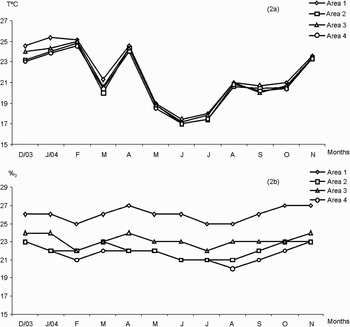
Water temperatures oscillated during the study period, with the highest values occurring in summer months (24.0±1.7) and the lowest values occurring at the end of autumn and at the beginning of winter (22.5±1.9) (Figure 2a). Significant differences were not observed among the temperatures of the sampled areas (F3–44 = 0.152; P > 0.05).
Fluctuation in surface water temperature (a) and surface water salinity (b) of Areas 1, 2, 3 and 4.

Salinity presented the same tendency to fluctuate in the study area, with larger variations in spring (24.0±1.7), followed by autumn (23.2±2.5), summer (23.1±1.7) and winter (22.5±1.9) (Figure 2b). Significant differences in salinity were observed among collecting areas (F3–44 = 73.860; P < 0.05), being attributed by the Tukey–Kramer test to the highest values registered in Area I (Figure 2b).
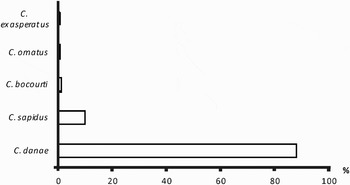
The relative participation of the biomass of captured crabs in Babitonga Bay was as follows: C. danae represented 85.4% of the total, followed by C. sapidus (12.6%), C. bocourti (1.5%), C. exasperatus (0.3%) and C. ornatus (0.2%) (Figure 3). We provide data for the two most abundant species.
Relative contribution of biomass in Callinectes captured in Babitonga Bay.

Callinectes danae
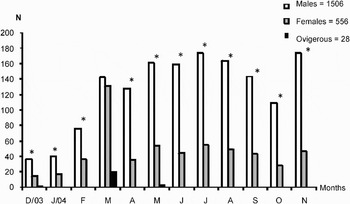
The relative frequencies between sexes within populations differed from 1:1 (except in March 2004). This tendency became evident with the application of the χ2 test by collecting month, indicating significant differences in favour of males, except in March, and of egg-bearing females in January, March and May (Figure 4).
Monthly distribution of frequencies of males, females and egg-bearing females of Callinectes danae in Babitonga Bay (*, significant difference in favour of one sex, χ2, P = 0.05).

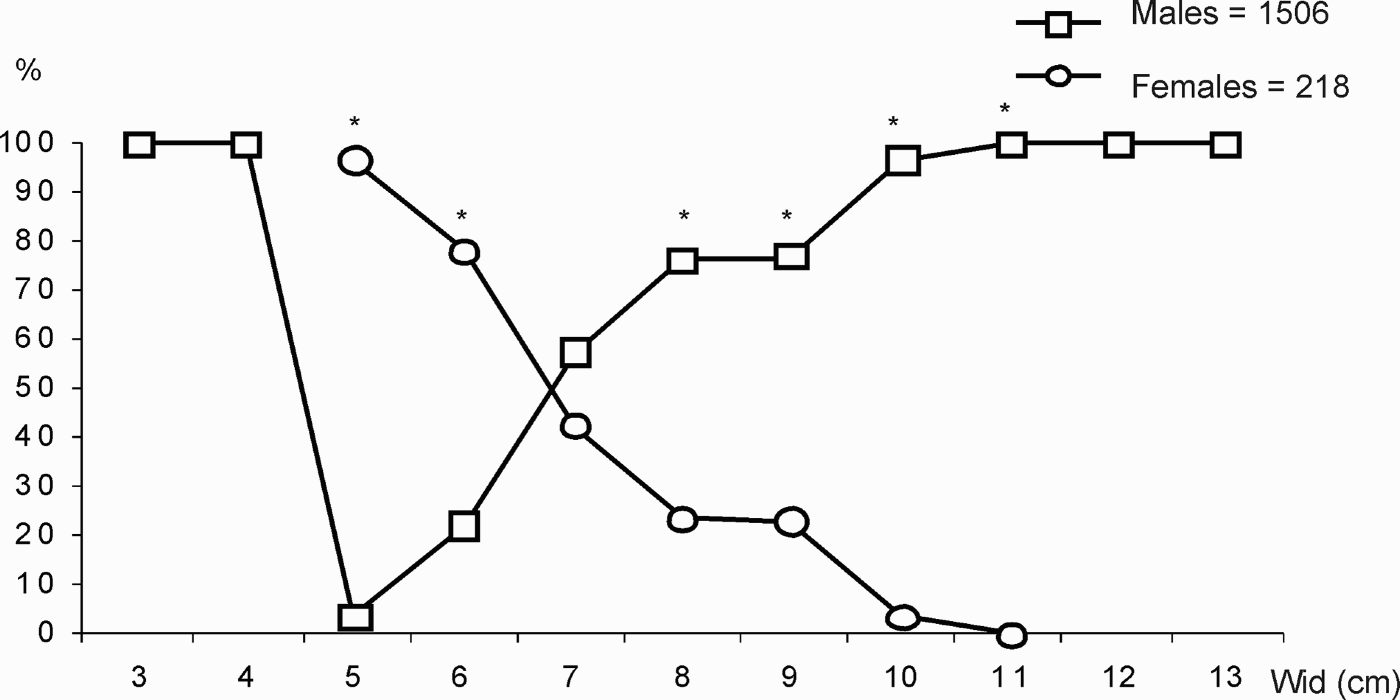
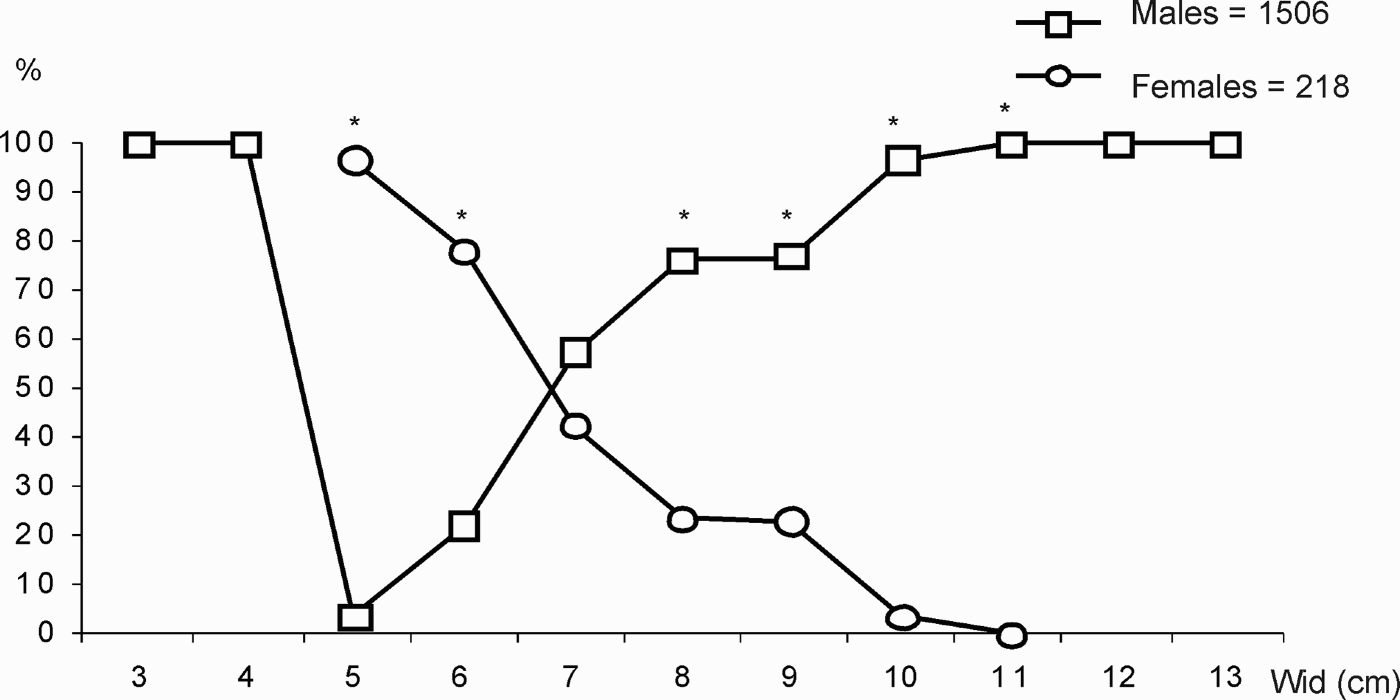
The distributions of frequencies of males and females by classes of carapace width presented an amplitude of 3.0 to 13.0 cm (males) and between 5.0 and 11.0 cm (females), with a significant domain (χ2, P < 0.05) of males in classes from 8.0 to 12.0 cm and an inversion in favour of females from 5.0 to 6.0 cm. In the class of 7.0 cm no significant differences occurred between the sexes (Figure 5).
Monthly distribution of percentage per length-class (%) of males and females of Callinectes danae (*, significant difference, χ2, P = 0.05).
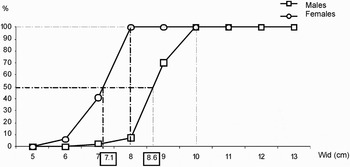
The carapace width of the first maturation of C. danae was estimated as 7.1 cm (females) and 8.6 cm (males) and, beginning at 8.0 and 10.0 cm, respectively, all specimens captured were mature (Figure 6). The fishing effort in Babitonga Bay influenced the adult stock (males = 86.39% and females = 56.42%) and, to a smaller degree, the juvenile stock (males = 13.61% and females = 43.58%) (Figure 7).
Distribution of accumulated frequencies of males and females of Callinectes danae by classes of total length. Males WidPM = 8.6 cm; females WidPM = 7.1 cm.

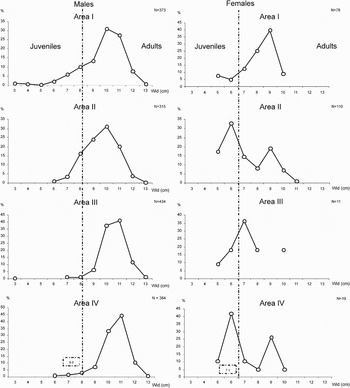
Distribution of frequencies of total length in males and females of Callinectes danae by collecting area.

The distributions of carapace widths indicate that stratifications did not occur in the sizes of males. Peak captures for male carapace widths reached between 9.0 and 11.0 cm (Figure 7). In Area I, females were represented mainly by adults, with the highest frequencies in the classes of 9.0 cm. In the remaining areas juveniles alternated with adults, with most captures ranging in the classes of 6.0 and 9.0 cm (Figure 7).
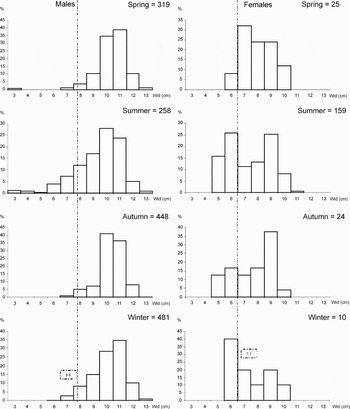
The seasonal distribution of carapace widths presented a tendency of unimodality in males, with amplitudes oscillating between 3.0 and 13.0 cm (Figure 8). In spring the highest frequencies occurred between 10.0 and 11.0 cm, while in summer the recruitment of juveniles incremented the classes of smaller sizes. The peak of 10.0 cm was maintained until autumn, returning to 11.0 cm in the winter months (Figure 8). Females presented a multimodal tendency, with an amplitude between 5.0 and 11.0 cm. The largest captures occurred between classes of 6.0 and 9.0 cm, independently of the station of the year (Figure 8).
Seasonal distribution of frequencies of total length of males and females of Callinectes danae in Babitonga Bay.

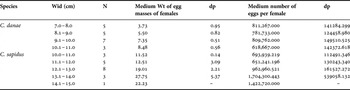
The amplitude of carapace widths in egg-bearing females in C. danae was between 7.0 and 11.0 cm, with the largest frequencies in classes from 9.1 to 10.0 cm (Table 1). Fecundity oscillated from 618,667 to 811,267 eggs, with a medium of 755,357.250 eggs per female, and a tendency to increment the mass of eggs with the size of the female (Table 1).
Medium fecundity and carapace weight of Callinectes danae and Callinectes sapidus, by class of carapace width (Wid = carapace width, Wt = body weight, dp = standard deviation).

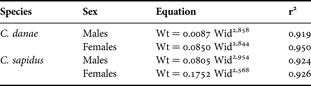
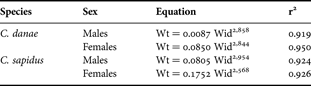
The values of the relation weight/width of the carapace were corroborated by the adherence of empirical points to the coefficient of determination curve (Table 2). The species presented a negative allometric growth. In males, the width varied between 3.0 and 13.6 cm, and the weight between 0.32 and 202.9 g. In females, width varied from 5.1 to 11.6 cm and weight varied from 8.12 to 122.5 g (Table 2).
Weight/width relationship of carapace of males and females of Callinectes danae and Callinectes sapidus, during the study period.
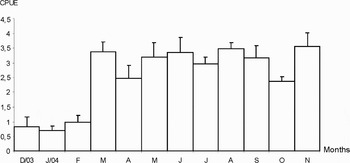
Significant differences were not observed (F3–44 = 1.273; P > 0.05) between the CPUE and collecting areas. However, when the data were analysed by month, independently of area, moderate differences occurred (F11–36 = 3.057; P < 0.05). The Tukey–Kramer test attributed these differences to the smallest rates of capture in the months of December 2003, January and February 2004, and to the highest rates registered in March, August and November (Figure 9).
Medium monthly variation of CPUE (capture per unit of effort) (kg) of Callinectes danae (vertical bar indicates standard error).

Callinectes sapidus
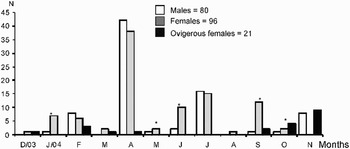
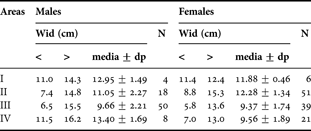
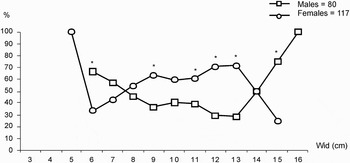
A total of 80 males and 117 females were captured, with larger abundances in Area III (45.18%), followed by II, IV and I (Table 3). Females dominated significantly (χ2, P = 0.05) in January, May, June, September and October 2004, while in December 2003, March and August 2004, males were not captured (Figure 10).
Monthly distribution of frequency of males, females and egg-bearing females of Callinectes sapidus in Babitonga Bay (*, significant difference, P < 0.05).

Variation in carapace width (Wid cm) of males and females of Callinectes sapidu s in collecting areas in Babitonga Bay (<, smallest value; >, largest value; media±dp, medium±standard deviation).
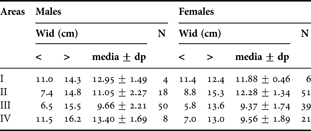
The distribution of frequencies of carapace widths presented an amplitude oscillating between 5.0 and 16.0 cm, with a significant dominance of males (χ2, P = 0.05) in the classes from 6.0 to 15.0 cm, and of females from 9.0 and 11.0 to 13.0 cm (Figure 11). In the 20 egg-bearing females captured, the width varied from 10.0 to 15.0 cm, with the highest frequencies in the class of 12.0 cm (Table 1).
Distribution of frequencies of total length of males and females of Callinectes sapidus in Babitonga Bay.

The size of the first maturation of C. sapidus was estimated as 10.2 cm of carapace width for females and 8.9 cm for males. Above 12.0 cm all captured specimens were adults (Figure 12). As a function of these sizes and of the frequencies of carapace widths, it may be verified that the fishing effort in Babitonga Bay is acting in relative equilibrium between the adult stock (males = 58.75% and females = 52.99%) and the juvenile stock (males = 41.25% and females = 47.01%) (Figure 13).
Distribution of accumulated frequencies of males and females of Callinectes sapidus, by class of total length. Males WidPM = 8.9 cm; females WidPM = 10.2 cm.

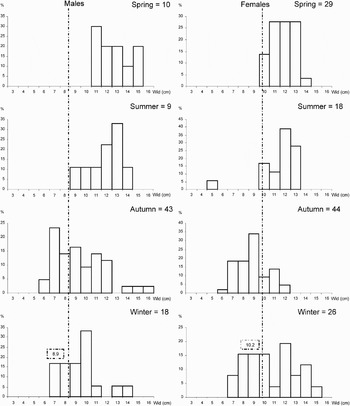
Seasonal distribution of frequencies of total lengths in males and females of Callinectes sapidus in Babitonga Bay.

The seasonal distributions of carapace widths alternate between unimodal, in the majority of stations, and polymodal, in autumn (males) and winter (females). In summer the smallest specimens were collected (N = 6), indicating that recruitment possibly occurs between the months of summer and autumn (Figure 14).
Monthly variation in capture rates of Callinectes sapidus in Babitonga Bay.

The values of the relation weight/width of the carapace were corroborated by the adherence of empirical points to the curve and by the determination coefficients (Table 2). Callinectes sapidus presented negative allometric growth. In males, width varied between 6.5 and 16.2 cm, and weight varied from 18.97 to 343.18 g. In females, width varied between 5.5 and 15.3 cm, and weight varied from 10.92 to 192.81 g (Table 2).
The amplitude of the carapace width in egg-bearing females of C. sapidus was between 10.0 and 15.0 cm, with highest frequencies in the classes of 12.0 to 13.0 cm (Table 1). Fecundity oscillated between 651,241.196 and 1,704,300.443 eggs, with average of 978,109.000 eggs per female and a tendency to increase the median number and the weight of the egg mass with the size of the female (Table 1).
The reduced occurrence of C. sapidus, mainly in Areas I and IV (Table 3), made comparisons among capture rates unfeasible. However, when data were analysed by month, independently of area, moderate differences occurred (F11–24 = 3.120; <0.05). These differences are attributable to the larger rates of capture in the months of April and November 2004, and to smaller rates of capture in December 2003, March 2004, May and August (Figure 14).
DISCUSSION
Temperature of the surface water in Babitonga Bay maintained the expected seasonal pattern for the region (Matsuura, Reference Matsuura1986). Salinity fluctuated during the year, as a function of river discharges and tidal regimes. The hydrographic complex of this bay receives the input of several rivers and streams, the most important regarding water volume are rivers Cubatão do Norte, Palmital, Cachoeira and Parati. These salinity oscillations probably contributed to the stratification of sizes in captured Callinectes, with a predominance of adult females mainly in areas of higher salinity. Besides this movement, characteristic of swimming crabs in the different age strata, salinity, water temperature, food, depth, wind, time of year and place of capture influence in fishing regarding relative participation of species, and in number and size of specimens (Taissoun, Reference Taissoun1969; Severino-Rodrigues et al., Reference Severino-Rodrigues, Pita and Graça-Lopes2001).
The distribution and availability of species during fisheries in the interior of the bay may also be affected by the capacity of adult swimming crabs of chasing away smaller or less abundant species in the collecting areas (Williams, Reference Williams1974).
The sexual proportion of species of Callinectes is related to the reproductive behaviour, seasonal variations and the salinity gradient (Van Engel, Reference Van Engel1958; Tagatz, Reference Tagatz1965). Males of C. danae dominated the collecting areas, probably due to the migration of adult females to waters of higher salinity, where they release their larvae (Branco & Masunari, Reference Branco and Masunari2000). This tendency of males to predominate over females was maintained in the littoral of Santa Catarina State (Branco & Masunari, Reference Branco and Masunari2000), in Ubatuba, São Paulo State (Mantelatto & Fransozo, Reference Mantelatto and Fransozo1999), in Pontal do Paraná, Paraná State (Baptista-Metri et al., Reference Baptista-Metri, Pinheiro, Blankensteyn and Borzone2005), and in Matinhos, Paraná State (Branco & Lunardon-Branco, Reference Branco and Lunardon-Branco1993).
Usually, the highest abundances of C. sapidus were obtained in estuarine waters, mainly in the proximity of river mouths and mangrove areas (Melo, Reference Melo1996). A similar pattern was obtained for Babitonga Bay, with females dominating in most samples, while in the bay of Santos, São Paulo State, males dominated in samples (Severino-Rodrigues et al., Reference Severino-Rodrigues, Pita and Graça-Lopes2001).
In swimming crabs, males always attain a larger final size than females (Williams, Reference Williams1974), by investing metabolic energy in somatic growth, while females give precedence for the production of eggs (Hartnoll, Reference Hartnoll and Bliss1982). Captured specimens of both species presented negative allometric growth and ‘b’ values similar for both sexes, following the expected pattern for brachyuran crustaceans (Hartnoll, Reference Hartnoll and Bliss1982). The relation weight/width of the carapace has been largely used to facilitate the prediction of the weight of a specimen from its width and to determine the type of growth of the species.
In the present study, males of C. danae presented a tendency for the width of the carapace to be unimodal. Juveniles of this species tended to dominate in the summer months, without stratification of size by area. Females were mostly represented by juveniles, with a tendency to be multimodal by areas of sampling, except in Area I, located near the entrance to the bay, where adults predominated. Probably this is the site of highest concentration of egg-bearing females in the bay, which migrate through the connecting channel to the adjacent sea, where the eclosion of larvae occurs (Branco & Masunari, Reference Branco and Masunari2000).
The size of the first sexual maturation stage is an important parameter to be estimated, when the population is subject to commercialization. This parameter furnishes background on how the exploratory activity is affecting reproductive individuals (Campbell & Fielder, Reference Campbell and Fielder1986; Vazzoler, Reference Vazzoler1996). This size varies considerably among populations of C. danae from the Brazilian littoral, oscillating between 6.1 and 6.3 cm in the region of Itamaracá, Pernambuco State (Barreto et al., Reference Barreto, Leite and Aguiar2006), measuring 6.4 cm in Sepetiba Bay, Rio de Janeiro State (Medeiros & Oshiro, Reference Medeiros and Oshiro1992), 5.5 cm in the Santos Bay-Estuary complex, São Paulo State (Pita et al., Reference Pita, Rodrigues, Lopes and Coelho1985), varying between 5.2 and 6.0 cm in the Shangri-lá bathing resourt, Paraná State (Baptista-Metri et al., Reference Baptista-Metri, Pinheiro, Blankensteyn and Borzone2005), and, in Florianópolis, Santa Catarina State, attaining 8.8 cm in the Itacorubi mangrove (Branco & Thives, Reference Branco and Thives1991) and 8.4 cm in Conceição Lake (Branco & Masunari, Reference Branco and Masunari2000). In the present study, females of C. danae attained sexual maturity at 7.1 cm and males at 8.6 cm. Maturity is related to the morphological or physiological stage of crabs rather than to latitude. These comparisons illustrate that life cycle variations in C. danae are a function of available food and fishing pressure.
The international literature referring to C. sapidus is very abundant (see Kennedy & Cronin, Reference Kennedy and Cronin2007), dealing with different aspects of the biology, ecology and fishing of this group. Nevertheless, studies along the Brazilian littoral are rare. The size of the first maturation estimated for Babitonga Bay was below that registered in Chesapeake Bay (EUA), where a mean of 11.2 cm for males and females was obtained (Van Engel, Reference Van Engel1958).
The knowledge on fecundity, associated to egg diameter, provide important subsidies for the estimation of the reproductive potential of species, which serves as a parameter for the protection of the site of eclosion of larvae (Branco & Avila, Reference Branco and Avila1992).
The estimated fecundity of C. danae in Babitonga Bay was lower than that obtained by Branco & Avila (Reference Branco and Avila1992) in Conceição Lake, where the number of eggs carried by females varied between 111,549 and 1,292,190, and by Santos (Reference Santos1990) in Vitória Bay, Espírito Santo State, which varied from 229,200 to 1,064,000 eggs per female. However, it was higher than that registered by Baptista-Metri et al. (Reference Baptista-Metri, Pinheiro, Blankensteyn and Borzone2005), which oscillated between 25,127 and 246,676 eggs per female. The obtained differences may be attributed to the methods of quantification of eggs, to differences between numbers of eggs during first and second postures, to time and stages of development of embryos during estimations (Branco & Avila, Reference Branco and Avila1992) and to genetic characteristics of populations in the studied habitats (Weber et al., Reference Weber, Puchnick, Lamego and Levy2003).
The estimated fecundity for C. sapidus was relatively smaller, when compared with studies conducted in Chesapeake Bay, where from 700,000 to 4,500,000 eggs per female were obtained (Truitt, Reference Truitt1939; Tressler & Lemon, Reference Tressler and Lemon1951; Prager et al., Reference Prager, McConaugha, Jones and Geer1990). In general, the fecundity of genus Callinectes also tends to increase with the size of females (Branco & Avila, Reference Branco and Avila1992; Santos, Reference Santos1990; Baptista-Metri et al., Reference Baptista-Metri, Pinheiro, Blankensteyn and Borzone2005). This is corroborated by results from Babitonga Bay.
The CPUE, in biomass or number of specimens, may be considered the most adequate index of abundance for the monitoring of the fishing potential of a species of crustacean. In the present study, differences in capture rates among areas were not observed, but moderate differences may be attributed to monthly fluctuations in abundance along the year. For C. sapidus, the largest biomasses occurred between April and November 2004, with similar contributions of males and females and of adults and juveniles. This confirms previous knowledge for many north-western localities, but represents relevant new information for community structure in the south-western Atlantic. Fluctuations in the salinity and temperature gradients are determinant factors in the life cycle of Callinectes (Van Engel, Reference Van Engel1958; Williams, Reference Williams1974). Pronounced oscillations in the abiotic parameters in Babitonga Bay may have favoured the establishment of dominant species, such as C. danae and C. sapidus. However, to understand the population dynamics, it becomes necessary to monitor reproductive events, establishing migration routes and recruitment periods in the bay and mouths of the tributary rivers, as well as to conduct temporal studies of capture rates. This monitoring may, in the future, contribute to the increment of the fisheries of swimming crabs, to the maintenance of local fishermen, and to the conservation of Babitonga Bay.
ACKNOWLEDGEMENTS
J.O.B. and M.L.C. appreciate the productivity scholarship provided by the National Science Foundation (CNPq). We thank Dimitri de Araújo Costa for help with the figures.