Introduction
Recent scholarship on modern Chinese history has sharply re-evaluated the state-building of the Guomindang (GMD, the Nationalist Party). Previously, most scholars had discussed the GMD government as a corrupt military dictatorship doomed to lose its power in 1949 to the Chinese Communist Party (CCP). However, with many facets of the GMD being re-examined, the GMD government's commitment to modern technocracy and administration has become well recognized. In a similar vein, the active role of modern intellectuals in the regime also draws close attention from scholars.Footnote 1 Whilst focusing on the activities of these elite bureaucrats in the central government, scholars have paid less attention to political workers in the GMD party per se.Footnote 2 Compared with their colleagues in the government or their counterparts in the CCP, the GMD cadres were widely known for their failures in executing, developing and consolidating the party's power. Thus it is tempting to consider GMD party personnel to have been a dysfunctional element that not only interfered with the regime's more constructive ones in elite governmental units but also prevented fresh intellectual blood from revitalizing the party's political energy. The party-state thus appears as an unpromising political combination that inevitably alienated China's ‘reformist elite’.Footnote 3
This paper intends to provide a different observation on the relationship between the GMD cadres and educated intellectuals. By studying the Central Politics School, a major GMD political training institute for professional party cadres,Footnote 4 the nature of the GMD party-state will be reassessed and will hopefully remind researchers that the regime's governmental rationalization occurred in a particular context: one in which the party faced difficult choices between nurturing party-liners needed for political struggle and accommodating depoliticized intellectuals needed for public administration.
The paper is divided into four sections. The first section describes the predecessor of the Central Politics School, which had a strong politically-oriented curriculum. The second section describes how the Central Politics School deviated from its original political purpose and developed into an independent university with a liberal curriculum and atmosphere. The third section evaluates the political performance of the School's graduates and teachers. In conclusion, in order to redefine the role of intellectuals within the GMD, three main arguments will be put forward. First, the GMD's political impotence in competition with the CCP was due not so much to its failure to recruit enough capable experts as to the concentration of its well-trained cadres on relatively narrow non-political administrative tasks. Second, GMD cadres and generally recognized intellectuals were not far apart in either educational level or ideology. This makes it essential to include party workers in a ‘Chinese intelligentsia’ whose general interaction with politics is worth discussing.Footnote 5 An adjusted conception of intellectuals will be used to define that group and its relationship with one-party states in modern Chinese politics. Finally, intellectuals within the GMD one-party dictatorship could still maintain their autonomy and promote a quite liberal political agenda.
Education and ethos in the Guomindang Central Party Affairs School
In August 1927, 314 people passed the entrance examination to the Guomindang Central Party Affairs School (國民黨中央黨務學校, hereafter ‘the Affairs School’). Among them, Zhang Jinjian (張金鑑) is worth a mention here, not only because he would later gain his master's degree in public administration from Stanford University and become dean of the Administration Department at the Central Politics School (中央政治學校,) a decade later, but also because his political experience and ethos were characteristic of the students of the Affairs School.
Zhang Jinjian was a perfect candidate for the party's cadre recruitment. By the time Zhang attended the school, he had been a student at Beijing University. In addition, he had had a period of internship in a county government where he worked as an apprentice to a magistrate's private consultant (shiye師爺)Footnote 6, so was an intellectual with some political experience. According to his reminiscences, Zhang left Beijing University for fear of being arrested and persecuted by the warlord authorities because he was a member of the Guomindang. He had never actually thought to become a student of the newly established the Affairs School until after he had fled to Nanjing. In fact, many future the Affairs School students were just like Zhang: they had no clear plan, happened to know of the existence of the school, and took the opportunity to attend whilst having only vague ideas about their career goals.
As a school founded only 18 days after the formal schism of the GMD between Nanjing and Wuhan, the Affairs School had to meet Chiang Kai-shek's (蔣介石Jiang Jieshi) urgent need for loyal and competent party cadres to fight a political battle against enemies who controlled the GMD machine.Footnote 7 In the circumstances, what was new to Zhang in the school's courses was probably the practical techniques for mobilizing masses, and manipulating or breaking up meetings. These partisan skills, which could never be found in Beijing University, were taught by experienced professional revolutionaries. They included Duan Xipeng (段錫朋),Footnote 8 a major student leader in the May 4th Movement, and several graduates of the Moscow Sun Yat-sen University (莫斯科中山大學), who where the Affairs School instructors trained for revolution by the Soviet Communist Party. Many of them, such as Kang Ze (康澤), would become high-ranking officials of the GMD.Footnote 9
From the very first day, all students were organized into study teams. Each team had an appointed instructor who was responsible for teaching political skills and supervising the behavior of the team members. To coordinate instruction in the party's theories, instructors would meet every week, before they led their team discussions, so as to unite their political perspectives. At these meetings, the best GMD theorists, including Zhou Fohai (周佛海), gathered together and pushed the team leaders towards a single perspective.Footnote 10 At the same time, the students in the teams were also required to make out reports regarding the instructor's teaching and political reliability.Footnote 11 It was a kind of political apprenticeship in which instructors and students were also party comrades. Zhang's memoir illustrates how excited he felt when he learned the techniques of political mobilization and participated in criticizing and self-criticism.Footnote 12
Attending a political cram school, meant that students were required to take courses about GMD political doctrines, history, and the works of the party founder, Sun Yat-sen. Some social science courses were also included. All these subjects were taught by nationally famous scholars such as Wang Shijie (王世杰), Luo Jialun (羅家倫), Yang Xingfo (楊杏佛), Zhou Gengsheng (周鯁生) and Fang Dongmei (方東美).Footnote 13 From the beginning, the Affairs School had shown a tendency to develop new party cadres who had not only political loyalty but also adequate knowledge of modern social sciences related to statecraft.
Military training and militarized administration was also an indispensable part of the Affairs School education. In fact, only a few days after the students began their studies, 70,000 warlord troops suddenly waged an all-out counterstrike in an attempt to recapture Nanjing. At the most dangerous moment, the Affairs School students had been given rifles and were prepared to support the frontline, which was not too far from the school.Footnote 14 Perhaps for this reason, after the attack was defeated, the school was still staffed with many army officers to carry out rigorous military training. Sun Liren (孫立人) happened to be one of them. In 1927, he had just finished his military education at Virginia Military Institute and returned to China.Footnote 15
Naturally, as a military training officer, he had to train all his students, men and women alike. Unexpectedly, when he announced separate training for female students, all the female students protested fiercely, since they believed that they were equal to men and should be trained in the same way as their male classmates. This incident vividly demonstrates these students’ revolutionary enthusiasm. Sun's record also indicates that students had to attend field manoeuvres. The intensity of the military training in the Affairs School far eclipsed any similar programme in other non-military schools.Footnote 16
Unfortunately for the Affairs School development, between April 1927 and early 1928, China was in tremendous political turmoil. In August 1927, a public statement from the school's principal, Chiang Kai-shek, was posted on the school's bulletin board. Although Chiang had to temporarily step down after he lost a round of political combat, he asked the students to follow the orders of the authorities and await his return and the final success of the revolution.Footnote 17 Chiang's statement received little, if any, student reaction at the school. After a few months of continuous unrest, eventually in November, the students clashed with the military and the police, and some were shot in the streets.Footnote 18 There were also political assemblies inside the school where students accused each other of being traitors to the revolution.
Meanwhile, the Affairs School faculty was also divided on the political position. During the period in which Chiang sat quietly behind the backdrop of the political stage in order to recover his power, he and other GMD cliques constantly mobilized people in the school for their own political purposes.Footnote 19 The extent to which students were involved in direct political mobilizations and struggles was such that Sun Liren lamented: ‘People [here] tended to pursue factions, ingroups and cabals. . .It really had been over-politicized’.Footnote 20 For this reason, Sun Liren left the school in 1928—he was neither the first nor the last teacher to leave the school for political reasons. Kang Ze, who organized the school's Russian-style political training, also left at about the same time.Footnote 21 Other capable political workers from cliques who were opposed to Chiang Kai-shek such as Zhou Fohai had also been forced to leave by the end of 1930.Footnote 22
After Chiang returned to power and continued his efforts to unite China, for the first time, students of the Affairs School performed political missions under the command of a united GMD. In March 1928, 79 members left the school to be propagandists in the GMD army. Others, who graduated in May, were dispatched to different positions in the army according to the school's evaluation of their loyalty to the party and to Chiang. Forty of the most loyal students were appointed to jobs in GMD central headquarters. The rest of the students were sent back to their native provinces to take part in party affairs there.Footnote 23 In short, the majority of the Affairs School graduates became GMD cadres.
Zhang was one of the 79 who joined the propaganda detachment in the army. He and his classmates experienced a strenuous military life. Zhang's working report earned him first place amongst the students who took part in the detachment, after which he was employed in the GMD Central Organization Department.
In sum, the Affairs School was basically a party cadre school which was initially established for and actually involved in very practical political activities. The school was staffed with the most experienced political workers in the GMD. Its students were trained and mobilized as staunch partisans. Neither the party nor the students themselves doubted their role as party cadres. However, that situation would not last long. The students of the second class of the Affairs School began their education in September 1928. A few months later, in 1929, the school was renamed and reorganized into the Central Politics School. Therefore, Zhang Jinjian and his classmates became the only 252 graduates of the Guomindang Central Party Affairs School. Although the Central Politics School was directly derived from the Affairs School, it was quite different to its predecessor. With the nominal unification of China, students of the Central Politics School would not have the adventurous political experience and ethos that Zhang Jinjian and the other students had. The new Central Politics School education was redesigned towards a stable political environment. The members of the new faculty, which included the future dean, Zhang Jinjian himself, would mostly devote their teaching efforts to training qualified civil servants rather than political activists.
From party affairs to national affairs
As a founding member of the school's board in 1927, Luo Jialun (羅家倫) effected profound changes to the running of the school, including persuading the GMD to extend its programme from two to three years, even though he did not become dean until January 1931. Yet another year was added to the school's programme (making four in all) the moment he was installed as dean, which enabled the school to become a formal university. In addition, Luo tried to add a further six departments to the existing four, in which he did not quite succeed due to limited funding.Footnote 24 Nevertheless, he persevered with the idea to establish a first-class university. He believed that the best way to undergird the GMD regime was not by political mobilization but with proficient governmental organizations,Footnote 25 which belief proved to be very important in the future direction of the school.
As if in protest against Luo's minimization of their significance, unprecedented demands for political mobilization soon threatened to overrule his vision. Eight months after his inauguration, the Japanese army invaded and occupied China's provinces in Manchuria. Chinese youths on campuses were completely infuriated by the action of the Japanese army and the weak reaction of the GMD government. The students of the Central Politics School were no exception, and one night after the roll call a student named Fan Changjiang (范長江) spoke out and urged his classmates to act. Before long, many students began to question the school administration about its passive attitude towards anti-Japanese activities, which ultimately led to a student strike and organizing of anti-Japanese demonstrations.Footnote 26 In the face of the indignation of Fan and the other students, Luo did not concede and still insisted on carrying out his own agenda. ‘What we should do today,’ Luo told his anxious students, ‘is to let the Central Politics School take the responsibility L'Ecole des Sciences Politiques took after [the] Franco-Prussian War in 1870.’Footnote 27 Luo hoped that his students could temporarily bear the nation's defeat and that they would continue to enrich their knowledge in readiness for the real revival of China. From then on, Luo's words became the watchword of the school. He did not allow any further political mobilization to detract from his quest to make the Central Politics School a first-class university, which ultimately ensured its future direction of development.
In order to establish a formal university, the Central Politics School had to staff its faculty. As a recruitment incentive, the school authorities spared no expense by offering candidates high salaries, transportation fees, and cars, which they hoped would attract the best professors and foremost scholars from Beijing or Shanghai into its faculty.Footnote 28 Gradually, people with high academic reputations took up major positions at the school. By 1937, well-educated scholars had taken charge of all seven departments, three major professional colleges, and the institute of advanced study.Footnote 29
Well-educated members of a faculty, of course, do not guarantee an ideal academic environment. The best way to judge whether or not the Central Politics School was an excellent university is to look at how the students lived and learned, and at the school curriculum. Students in the Central Politics School never enjoyed the freedom of daily life afforded to college students at other institutions. All Central Politics School students lived according to a strict, regular schedule.Footnote 30 In addition, there were two formal military trainings or manoeuvres every week. Some students trained together with the German-trained model troops in a nearby barracks.Footnote 31 Except for holidays, they were not allowed to leave the school without permission.Footnote 32
Though daily life at the school was hard and regimented, the atmosphere in classes and in learning was neither rigid nor repressive. After 1931, more and more talented youths from around the nation wanted to attend the Central Politics School because of its free education, guaranteed job assignment, and abundant academic resources.Footnote 33 Consequently, these outstanding young students had very high expectations of the school's faculty. Many written sources indicate that Central Politics School students expected their tutors to be of the highest standard. They did not tolerate unqualified teachers. Only professors with real scholarship and good teaching skills were able to respond to the students’ challenge and to win their respect. For this reason, every time a new tutor arrived, the dean of studies had to ensure that they met the requirements of the students.Footnote 34 By the same token, it was not rare for erudite teachers who had dissenting political views to be hired by the school. To cite just one of many examples, the leader of the Youth Party, Zuo Shunsheng (左舜生) taught modern Chinese history for six semesters at the school.Footnote 35
The high quality of the members of the faculty brought strict academic requirements. From the beginning, students who gained entry to the school had to succeed in the very competitive entrance examinations. However, these successful candidates soon realized that even tougher academic requirements lay ahead. In general, having excellent linguistic abilities and logic were essential to their learning because they were required to read and comprehend a lot of supplementary social science materials which were supplied in foreign languages.
As in other good universities, the Central Politics School students had adequate opportunities to be in contact with top experts in their areas. Every department had a research workshop in which professors and students discussed specific topics. They often published their findings in major newspapers or journals. Also, many visiting professors or experts with different perspectives were invited by members to these workshops. Students at the school found these free conferences were even more inspiring than their normal classes. Thus, they often crowded into the hall and listened to famous scholars and took part in serious discussions.Footnote 36
It is certain that pure academic research was not the major purpose of the school. To provide high quality human resources to consolidate the regime's power was always the central aim of the school leaders and tutors. Therefore it is necessary to know what they deemed to be important in order for the students to achieve this aim. It is not necessary here to discuss the teaching content of all the departments, and this paper will focus on the administration and law departments only.
The authorities of the Central Politics School attempted to supervise tutors, and the majority of appointed professors were supporters of the GMD. However, abundant evidence also shows that the efforts of the authorities to ensure a curriculum useful to the party simply stopped there. They seemed never to consider the possibility that the teaching of these pro-GMD scholars was necessarily helpful to the regime. By and large, Luo and his successors let the faculty members decide the content of their courses.
This is why public administration, a fledgling discipline in both America and China at that time, was introduced by teachers in the Central Politics School Administration department so quickly. The founding father of the department, Sa Menwu (薩孟武), emphasizes the role of institutions and administrative measures in politics. That may explain why the name of the department was ‘Administration’ (Xingzheng行政) rather than ‘Political Science’ (Zhengzhi政治) and why so many scholars of public administration were hired by the department.Footnote 37
As researchers have pointed out, public administration scholars of the time commonly held the belief that administration, as a science, could and should be independent of political intervention.Footnote 38 By reflecting on the teachings of the Central Politics School professors, it can be seen that their focus was on how to improve the administrative efficiency of the government through scientific management. For example, Professor Xue Bokang (薛伯康) was an expert in personnel administration. He pointed out that Sun Yat-sen's Five-Power Constitution was neither practically nor theoretically feasible as a way of promoting administrative efficiency. One of its biggest problems, which defied all experience and principles of modern politics, was that administrative institutions were deprived of the right to manage their own personnel appointments.Footnote 39 However, ‘considering that the official administration is corrupt in today's China’, he added, ‘it seems to be proper to temporarily deny administrative institutes the right of personnel appointment’.Footnote 40 Nevertheless, Xue emphasized that to establish a truely scientific administration would still require that all government functionaries be selected by fair civil service examinations and that these remain politically neutral. He told his readers that even fascist Italy allowed its functionaries to maintain a neutral administration.Footnote 41 By so doing, Xue objected, though indirectly, to the party's political monopoly (Dangzhi 黨治).
In a similar vein, another professor in the Administration department, Jiang Kangli (江康黎) also lacked enthusiasm for the party's political domination. He supported the opinion of many non-GMD intellectuals: politics should be run by experts.Footnote 42 Of course, such an experts’ political view could also be used to legitimate one-party dictatorship. However, in Jiang's view, what counted as expertise was scientific knowledge and administrative rationalization, not GMD doctrine. For instance, he claimed that since the spoils system in the United States was anachronistic, there was no reason for China to imitate this old-fashioned practice.Footnote 43 Xue and Jiang both taught classes at the Central Politics School, including municipal administration and personnel administration, for many years.
As for the Law department, for most of the prewar period, its dean was Ruan Yicheng (阮毅成), a master in law from Université de Paris. His specialty was comparative civil law.Footnote 44 In a journal article, he argued:
Who says the current government is not strong or powerful? Only, it sometimes uses its power to extremes but sometimes does not use [it] at all. . .It would be very dangerous if we stress the intensification of the governmental power over civilians again.Footnote 45
The above quotation also shows that Ruan was not an advocate of party rule. Since he had criticized modern Chinese legal education for only pursuing pragmatism and quick training, Ruan devoted himself during his four-year term at the school to cultivating truly qualified judges with sufficient theoretical training.Footnote 46 He overhauled the curriculum of the department and encouraged his students to forego the guaranteed job distribution and take the national judiciary examination instead, which was in his view the legitimate channel (zheng tu正途) to becoming a judge.Footnote 47 Moreover, he insisted on a jurisdiction independent from the oversight of the GMD government because of his objection to GMD attempts to control justice.Footnote 48 Ruan's colleague and succeeding dean, Mei Zhongxie (梅仲協), also a law master of Université de Paris and civil law expert, basically followed Ruan's policy. The main difference was that Mei placed more emphasis on jurisprudence and languages. He believed that the only way to comprehend the spirit of Western laws was to study them in their original languages. Therefore, the students in the Law department had to take mandatory German and Japanese classes for four years.Footnote 49 In short, there was no sign that the department in the school was different from its counterparts at other universities.
To further understand Central Politics School education, it is worth mentioning the teachers and graduate students in the Central Politics School Land Economics College (地政學院). People in this college were trained to work in rural society. This mission allowed the student land reformers to have a stronger political awareness than other bureaucratically-oriented students. To compete with the Chinese Communist Party by land reform policies, students not only had to develop a political agenda that admitted the necessity of redistributing land whilst denying the legitimacy of violent revolution, but they also had to learn pragmatic techniques so as to measure and investigate land in areas just recovered by the government armies from CCP control.Footnote 50 In addition, due to the ambiguity of Sun Yat-sen's slogan ‘equalize land rights’ (Ping jun di quan), they were forced to be very careful about how they expressed party policies.Footnote 51
Nevertheless, the method they adopted to avoid those political taboos was to study purely academic subjects such as agricultural economics, rural finance, demography, and even pedology from their Western-educated professors.Footnote 52 These facts illustrate that, despite the possibility that these land reformers developed some sense of reality and practical knowledge for political work in rural areas, they would not be expected to be political activists because they were trained as scientific administrators for a rural society.
In sum, the major curriculum of the Central Politics School seems to have reflected less concern with politics than with academics. Under Luo's command, on the one hand, the Central Politics School successfully earned a strong academic reputation in a short time. Through the entire 1930s and 1940s, every year tens of thousands of students competed for 500 places at the school. Only the top three students of a province could attend the school without an entrance examination.Footnote 53 On the other hand, we should not forget that this academic quality, to a large extent, was achieved at the cost of the GMD's political monopoly.
However, there were still political instructors at the Central Politics School whose main jobs appeared to be the monitoring of student behaviour in daily life or the enforcement of military training. Practical political skills might still be taught by individual instructors if they had the knowledge and experience. Yet, since most of the Russian-trained or experienced instructors had already left the school, more often than not, new instructors were political ‘greenhorns’ who had just graduated from the Whampoa Military Academy or Central Politics School itself and knew little about realpolitik.Footnote 54 Some instructors thus simply adopted a laissez-faire attitude.Footnote 55
This may explain why the teaching of political skills was no longer mandatory. In fact, they were no longer taught at all. The only mandatory political course was party principles (Dang Yi黨義). According to the curriculum, all Central Politics School freshmen had a two-hour-long Dang Yi class every week.Footnote 56 However, as many students and professors recalled, nobody cared about this course. Students did not study the textbook until the last minutes before final examinations.Footnote 57 Although there were still two or three night-time discussion sections every week, neither the form nor the content of these discussions was serious. Everyone knew it was simply routine.Footnote 58
Under the circumstances, the Central Politics School witnessed its first crisis in early 1938, several months after the War of Resistance against Japan broke out. In Zhijiang, Hunan province, where the school was relocated after the fall of Nanjing, some Central Politics School students waged a strong protest and strike over the school's stern military administration and cuts to student monthly stipends. This protest was rapidly quelled by expelling its student leaders and by moving the school to the wartime capital Chongqing. However, the school's poor control over its students had been exposed.Footnote 59
Some signs indicate that after this student protest the authorities of the Central Politics School tried to enhance political control. For example, a ‘very partisan man’ Wang Muzun (王慕尊) became the new chief instructor.Footnote 60 He felt very uncomfortable knowing there was a Youth Party member teaching at the school and at his insistence, Zuo Shunsheng was forced to end his teaching career there. Meanwhile, the school authorities extended the length of orientation. Before beginning to learn formal courses, new students had to receive a two-month-long intensive military training during which party principles were instilled.Footnote 61 Tao Baichuan (陶百川), author of the best selling Dang Yi textbook, was invited to teach the subject.Footnote 62 In order to purge the school of potential CCP supporters, more students were expelled because of their political beliefs. One of the suspects, Zha Liangyong (查良鏞), was to become the greatest Chinese martial arts novelist. According to his story, he, a student in the Diplomacy department, was expelled just because he mocked the behaviour of standing to attention upon hearing Chiang Kai-shek's name.Footnote 63 Other sources also indicate that the school authorities paid more attention to students’ political thoughts and behaviour after 1938 by deploying more party personnel and by censoring the letters and writings of students.Footnote 64
On the surface, the school authorities rapidly retrieved their political control. However, closer examination reveals that this control was weak. The GMD cadres could neither direct school affairs nor instill party ideology and political skills upon the students. Many sources indicate that the political instructors at the school were commonly despised as redundant members of the Central Politics School faculty. Some students, therefore, gave them derogatory nicknames such as ‘prepuces’ or ‘blind guts’.Footnote 65 Although all students were obliged to join the GMD when they entered the school, the party's activities were anything but energetic. One graduate wrote:
Over the last four years, there were obvious changes in the party's activities:
1. Regarding the party's principles, we gradually tended to have our own perspectives rather than accept other people's explanations.
2. The ways of activity turned from public propaganda to individual studies.
3. Our focus changed from theoretical discussions to real concerns about how to promote the revolution.
4. We held fewer discussions ourselves and more often heard the past experience of senior party comrades.Footnote 66
Perhaps the best way to understand the political consequences implicit in the quotation above is to see how political education and rectification was conducted in the CCP-run cadre schools in Yan'an (延安) during the same period.Footnote 67 Almost all cadre schools in Yan'an bore titles that implied they were higher education institutes, such as Shaanbei Public School (陜北公學),Chinese People's Resist-Japan Military and Political University (中國人民抗日軍政大學 hereafter Resist-Japan University), Chinese Women's University (中國女子大學,) and Lu Xun Art College (魯迅藝術學院). However, the curricula they offered in fact had little in common with ordinary universities. These so-called schools were usually a set of caves dug on slopes of loess plateaus around Yan'an. Due to extreme material shortages, the students had no textbooks, desks, or even paper. However, this harsh situation did not prevent the CCP from recruiting young students because this form of party education required few concrete materials but plenty of political lecturers. In general, these programmes rarely continued for more than a few months. In addition to a few required political lectures, such as Marxism-Leninism, it was compulsory to attend political presentations by high-ranking party officials, sometimes no less a person than Chairman Mao Zedong (毛澤東) himself. The main goal of this education was to ensure that future cadres had the correct political beliefs. For the same reason, impractical academic knowledge was replaced by frequent participation in agricultural production, political mobilization, policy propaganda and enforcement.Footnote 68 As a foreign visitor observed:
It must be noted that political subjects made up the larger part of [the] curriculum. . . . .One of the key subjects was practical work in the tasks and methods of political organization, a prime element for all. It was especially so for the students undergoing specific training for such work.Footnote 69
After these political courses and presentations, intensive and disciplined team discussions and reading sessions were organized under the close supervision of the party activists These forums could last hours, or even days, until all team members’ perspectives and understanding were clearly expressed, investigated, and united. As a result, even those students who were supposed to acquire some nonpolitical professions, such as radio communication and foreign languages, spent little time on their own learning. For example, a student recalled that of his four years in the Russian Study Team in the Resist-Japan University from 1941 to 1944, only a year was really used to learn the language—political activities consumed all the rest of the time.Footnote 70 Looking at some entries in another Russian major student's diary, one can easily understand how this kind of education influenced this youth girl:
April 29, 1943
Meeting all the day. . .the entire team was exhausted. . .The content of the meeting was to investigate Tang Guohua. . .
May 7, 1943
Continue investigating Tang. It has taken us two weeks, but he remains uncooperative. Is it because we did not treat him harshly? I guess so. Coercion seems inevitable. Many suspicious points indicate that he is a GMD agent. . .
May 14, 1943
These two day's discussion was exciting. . .I thought I was concentrated, able to think and raise questions. . . .How audacious is the GMD agent we investigate (I am sure he is an agent) He has been completely exposed. Confess quickly!Footnote 71
Trained as this CCP student was in this highly politicized environment, it is small wonder that CCP cadres were skilled political workers.
Unlike their GMD counterparts, the CCP students would never just sit and listen to lectures and then form their own ‘perspectives’. Nor would they be allowed to miss party activities. It is true that Central Politics School graduates also expressed their interest in practical issues of the revolution. However, according to the yearbook, the only real political praxis done by Central Politics School students during their study was a short-term visit to nearby villages where these outsiders taught villagers modern norms, such as hygienic knowledge.Footnote 72
The inept political pedagogy inevitably led to slack political control. The CCP-run New China Daily was in fact circulated throughout the school. Some students’ communist identities were almost an open secret. For example, one student in the Journalism Department debated with her communist room-mate for four years until they graduated.Footnote 73 In the circumstances, Central Politics School students had adequate freedom to pursue all kinds of extracurricular activities and to gain knowledge.Footnote 74 To the contrary, it was thus difficult for political instructors to maintain ideological control, let alone teach students practical skills. Some instructors were so desperate that they also tried to teach classes such as Chinese, English or Japanese in order to prove that they were not only party cadres but also knowledgeable professors.Footnote 75
Small wonder when the school held a simulated National Consultative Assembly (國民參政會), the scene was a mess. The students who played the representatives of GMD soon lost control of the meeting and were forced to leave in protest at the ‘communist’ representatives’ subversive proposals. Decades later, Yang Zhongkui (楊仲揆) still took delight in talking about how he impersonated the CCP leader and defeated his classmates. The event may have been a victory and a sweet memory for Yang, who never trained for the meeting. However, it is definitely an indication of failed political training for the GMD. According to Yang's reminiscences, their chief instructor was astonished by the result. He scolded the GMD representatives for their completely immature reaction to the ‘CCP’. ‘How could you leave the meeting?. . .What if the CCP passed a resolution to overthrow the government?’Footnote 76
The marginalization of party cadres was also reflected in their inability to interfere with teaching and personnel affairs. Although the party cadres had attempted to kick out political dissenters, there were still a lot of non-party teachers teaching general education at the Central Politics School.Footnote 77 For example, Yu Songhua (余頌華), an open CCP sympathizer and chief editor of the Shenbao Weekly (申報週刊) who continued to publish left wing writers’ articles, taught journalistic writing at the Central Politics School every week for two years. During this period, the party cadres had no way to deal with him because he had been directly invited by the dean of the Journalism Department, Ma Xinye (馬星野).Footnote 78
Another case was when a chief political instructor tried to change some teaching positions. His proposal was fiercely resisted by the dean of studies. They argued and even fought each other at a meeting about school affairs. In the end, the chief instructor was forced to leave the school because the dean of studies not only had the support of the other professors but also obtained the endorsement of a senior GMD leader who had participated in the founding of the school.Footnote 79 Similarly, Zhang Jinjian, as dean of the Legal-Administration department successfully aligned with other faculty professors to expel a vice dean of studies whom they did not like.Footnote 80
It should not be assumed however that the party cadres were all narrow-minded people and only concerned with political reliability. In general, they were likely to be more politically experienced than the professors at the Central Politics School and knew how to adjust its education to meet real situations. Unfortunately for the GMD though, academically-oriented teaching at the school had become so ingrained that no party cadre had the ability to make the school revert back to its original state in the days of the Guomindang Central Party Affairs School.
Wang Depu (王德溥)'s case explicitly indicates how difficult it could be when a party member tried to divert the trend of ‘intellectualization’ at the Central Politics School. When Wang was appointed as director of the Graduate Guidance department (畢業生指導部) in 1940, he had already worked in various administrative and political positions for 20 years. His practical experience led him to believe that what he should do was to enhance the connection between Central Politics School students and the party cadres who had political experience. For this reason, he organized a series of conferences, inviting senior party workers to share their experiences and explain party policies. Wang also suggested to the school authorities that the school should report to GMD central party headquarters and receive directives regarding what kind and number of cadres the school should train for the party's needs. To ensure that graduates could understand and meet the requirements of real work, Wang recommended that every department should establish a committee which included an equal number of professors and experienced political workers. Wang hoped that by so doing, the school could become more helpful to GMD regime-building. All things considered, Wang's proposals were politically reasonable for the GMD. But, to his surprise and disappointment, all his suggestions were rejected by the other professors at a meeting of school affairs, and ultimately, Wang left the school in less than a year.Footnote 81
As these examples show, the Central Politics School professors were no doubt the main policy-makers in the school. In contrast, the GMD cadres had to cooperate with their scholarly colleagues if they wanted to promote the work of the party.
The political influence of the Central Politics School graduates and professors
On 20 May 1940, the thirteenth anniversary of the founding of the Central Politics School, Chiang Kai-shek addressed its students. Whilst he praised highly the achievements of the Whampoa Military Academy, Chiang sorrowfully pointed out that:
In my view, the accomplishments of our school in the past years were far from meeting our expectations. The state's expectation for our school is not like the one for ordinary universities. . .The students of our school serve as cadres of Chinese political revolution in order to wipe out any corrupt and dark power in Chinese politics and remove all politico-economic bondage that imperialism has imposed on China . . . However, we are far from reaching these ideals.Footnote 82
In the same speech, Chiang also criticized the students for having professional, but not practical, knowledge which was indispensable in order to work with common people at grassroots level. Did Chiang's complaint really make sense?
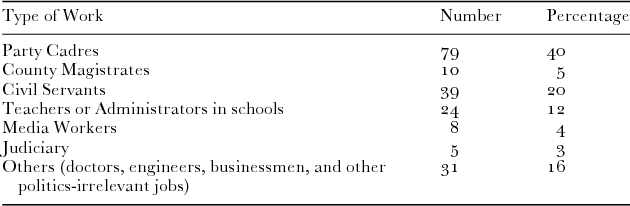
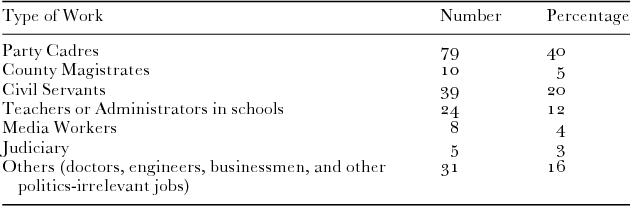
There is nothing more revealing than knowing what the Central Politics School graduates did after graduating if we wish to understand whether they actually helped the GMD improve its political status. Fortunately there is a complete survey which records all the occupations and positions of the graduates who attended both the original Guomindang Central Party Affairs School and its successive Central Politics School. As discussed in the first section, the Affairs School was a party cadre training centre where students learned practical skills from professional political activists. Its graduates were supposed to be employed as local party workers. Although the records do not give a detailed description of the work done by these graduates, from their titles, institutes and mail address, an educated guess can be made about the nature of their jobs. Among the 252 graduates, 53 had died or lost contact with the Central Politics School by the time of the survey.Footnote 83 As for the jobs of the remaining 199 graduates, these can be roughly classified into seven areas of employment, as Table 1 indicates.
Central Party Affairs School graduates’ occupations in 1939
Source: statistics by author
The number of the Affairs School graduates working as party cadres, after 11 years’ occupational career, was still apparently more than that of governmental functionaries. It seems to be a favourable outcome for the GMD that Party Cadres was undeniably the largest occupational group. On the other hand, the figure also indicates that although each Affairs School student was employed in a party job in a central or local party department when he or she graduated, by 1939 a large number had become pure civil servants in a central or local administrative hierarchy where they had more opportunities to handle routine official documents than to organize party work.
Nonetheless, at least during their early working years, the Affairs School students had been more or less suitable personnel on the political front. For example, Zhang Jinjian had been sent to reorganize and centralize the disobedient party branch in Shandong province from 1929 to 1930. Facing unfriendly local party members, Zhang successfully soothed them and earned their support by holding a party personnel training class. According to his description, he cooperated with an Affairs School classmate and successfully overcame the hindrances set up by other party members and controlled the class. In addition, he also established a Boy Scout camp where he instilled the party ideology into Shandong's teenagers, inspected party affairs in Hunan and Hubei, and pursued secret missions in Tianjin. Anyway, whether or not Zhang had the success that he describes, there is no doubt that he, as an Affairs School graduate, did pursue a real political struggle.Footnote 84 In other words, the Affairs School did perform certain political functions for GMD regime-building, especially compared with the later performance of the Central Politics School, to which we now turn.
According to the occupational distribution of the first class of the Central Politics School, out of 174 people with known occupational titles, only 13 were still working for the party. At the same time, there were 45 county magistrates and 66 local functionaries. In percentage terms, 7 years after their graduation, only 7 per cent of Central Politics School graduates from the first class worked as party cadres whilst 63 per cent had already served as administrators. It is interesting to note that the Central Politics School students of the first class actually matriculated as the second class of the Affairs School. They had the same one-year-long education as the first class at the Affairs School until the school became Central Politics School in the last months of their programme. Therefore, their political training and experience should not have been far different from the earlier Affairs School graduates.Footnote 85 However, their occupational distribution tells us that the more university-like curriculum in their three-year Central Politics School life seemed to be more decisive to their identities, even though they were recruited as future party cadres when they first entered the Affairs School.
The situation regarding later classes of the Central Politics School further proved just how drastic was the political transition between the inauguration of the Affairs School and the succeeding Central Politics School. Among 92 Central Politics School graduates of the second class, only one was still pursuing party work by the time of survey, and the number of party cadres among 44 graduates of the second class was only 3. Other class numbers are given in Table 2.
The number of Central Politics School graduates working as party cadres in 1939

Source: statistics by author
Since the Central Politics School was established, party cadres had always been a small minority of its graduates. In addition, most graduates never did even a day's work for the party after they left school.Footnote 86 Take the 123 students of the eighth class as an example. They had just begun their internships and had not acquired their diplomas by the time of the survey. Only 5 students were willing to launch their career with a party position.Footnote 87
It cannot simply be assumed that the only way to enhance party rule is to directly engage in party affairs. As local administrators, it was still possible that their work had a positive effect on the GMD regime. For this reason, we should also examine what the Central Politics School graduates did in the Administrative department.
The golden age when Central Politics School-trained administrators made the greatest contribution to the GMD regime should have been the period between 1933 and 1937 when the school's most important founder and director Chen Guofu (陳果夫) served as the governor of Jiangsu province.Footnote 88 As the province encompassing the national capital, Nanjing, and the only metropolis, Shanghai, Jiangsu had an unmatched political and strategic importance to Chiang and the entire GMD regime. Chen Guofu knew this well and did not hesitate to mobilize the Central Politics School resources to consolidate this power base.
To begin with, he staffed Jiangning Experimental County (江寧實驗縣), which was on the outskirts of Nanjing with Central Politics School teachers and students. Jiangning Experimental County was designated as the location for the Central Politics School teachers and students to promote or experience modern administration. The dean of the School's administration department was the magistrate whilst other chiefs of the bureaux in the county government were graduates of the School.Footnote 89
Students were responsible for enforcing their teachers’ policies. In fact, working at the County was part of Central Politics School education and internship. As a result, Jiangning Experimental County had far more high quality administrators than other local governments dared to even think about. These administrators helped the county investigate land ownership and to gather the land tax, distribute micro-credit to peasants, and organize household registration and the militia.Footnote 90 With the support of School members, one of the most evident achievements was that Jiangning Experimental County's land tax collection doubled.Footnote 91 Meanwhile, the county government, for the first time in Chinese history, established modern archival management, a value added tax on land, and conscription.Footnote 92 In fact, during Chen's term, almost all the counties in Jiangsu province had Central Politics School graduates working there. They served as magistrates, chiefs of bureaux in county governments and as local administrators and functionaries. Chen's partial reliance on these graduates enabled him effectively to mobilize hundreds of thousands of people to work on the extensive project of regulating the Huai River.Footnote 93 From this angle, Central Politics School students and graduates were committed to developing a firm GMD rule.
However, we should keep three things in mind. Firstly, all Central Politics School students were implementers rather than local party leaders. They were under the direct supervision of local government. It is true that they had to face many problems in reality where they could not rely on the government for help. But by and large, they relied on the existing resources of the government. This situation was particularly evident before the experimental counties were established. At the time, all Central Politics School students did their internship in ordinary counties, where often they could do nothing because local officials thought the School's training was not useful so dare not let Central Politics School students take over tax collection or judicial affairs, which were the two major tasks of a traditional Chinese county government.Footnote 94 Secondly, these interns only stayed in assignment areas for a short period of time. Therefore, they had no chance or time to face and address difficult practical problems, to say nothing of developing grassroots party organizations. Finally, the Jiangning model, as the dean of Land Economics College Xiao Zheng (蕭錚) admitted, could not be emulated by other provinces and counties because they did not have enough money and human resources to establish a so-called scientific administration.
In the circumstances, once Central Politics School students graduated and went to their new jobs outside the experimental counties, they would find that they had to work alone in much more unfriendly situations without the assistance of their classmates. The irony is that these students received a good administrative education, only to find they could do nothing but sit in offices where they and their colleagues followed procedures that bore no relation to those found in the administration textbooks.
This predicament might have been greatly eased if Central Politics School students had been taught directly by excellent incumbent local officials and party cadres rather than by the professors. Or if they had been organized into teams after graduation and had been able to take over the leadership unit by unit, county by county, in reality they could have had greater power and confidence to impose the party's will. Unfortunately, because learning how to consolidate political control was not top priority in the school's education, the measures mentioned above were never institutionalized and enforced.
Therefore, accomplishments such as wholesale land registration in the experimental county actually could not be duplicated, even in other counties in Jiangsu province.Footnote 95 Meanwhile, Central Politics School graduate students found that modern administration was not always workable in reality. For example, Dong Zhongsheng (董中生), who graduated from the Land Economics College and held office in the bureau of land in Wu County, Jiangsu, could not understand why his magistrate always gave him a sullen face until another Central Politics School student who had worked there for a while told him the reason: Dong's work in fact had cut off one of the county's significant income streams. Due to his promotion of land registration, landlords no longer needed to pay the tax on land title deeds every year since the official registration had confirmed their permanent ownership. This case shows that the so-called rational scientific administration and the actual administrative needs were often incompatible. However, Central Politics School education seemed to neglect teaching students how to overcome such difficulties, much less how to pursue realpolitik outside the bureaucracy. Before long, this shortcoming was exposed. In 1935, Chen Liefu (陳烈甫), a School graduate of the first class, in his term as the magistrate of Gaochun County, Jiangsu, became involved in a scandal in the election of a national representative. Chen was accused of supporting his classmate in the election by cheating, and arresting those who came to the county government to protest. Allegedly, Chen was a good administrator who succeeded in promoting education and forbidding opium and gambling. Unfortunately, he proved himself to be a clumsy political manipulator by using such a crude measure.Footnote 96
After the Sino-Japanese War broke out in 1937, Central Politics School graduates further felt a lack of ability to cope with increasingly tough and complicated wartime situations. Dong Zhongshen's experience is again exemplary. When he was appointed as magistrate of Zhejiang's Changhua County, which was very close to the Japanese occupation area, he knew almost nothing about how to organize a county government, especially in wartime. He invited ten other Central Politics School graduates to work with him. Although Dong praised these ten graduates as being good at oral presentation and document-writing, it still took them almost six months to find their way out of a political predicament in which they could neither mobilize people nor implement governmental policy, much less overcome the opposition from the local gentry. All these difficulties led him to realize:
Laws and regulations account for less than fifty per cent of the success in leading subordinate staff. The rest comes from the leader's spiritual powers such as passion and personality.Footnote 97
To put it simply, he realized that what he had learnt in Central Politics School was not so helpful to get his job done.
Dong's experience actually represents one of the most positive encounters for a wartime Central Politics School administrator. Not every School graduate could establish political control within six months. Chen Kaisi (陳開泗)'s experience in Xindu Experimental county, Sichuan, indicates how difficult this could be. Chen was a Central Politics School graduate of the first class. Before he became the county's magistrate in 1937, he had worked hard for four years to gain a good reputation in different counties as an administrator or magistrate. With the help of 15 other classmates, Chen spent a year abolishing various unreasonable institutions and gradually establishing effective administrative systems.Footnote 98 On the surface, his effort rapidly ensured the government's control over local society.Footnote 99 However, he also offended the vested interests of the local bigwigs. In November 1938, they used the excuse of protesting against conscription and mobilized gangsters to surround the county seat. In the end, Chen was forced to transfer to another area.Footnote 100 This is only one of many cases that expose the limitation of Central Politics School-led administrative penetration of local society.
A few Central Politics School students received exceptional opportunities to engage in high level politics by directly working with Chiang Kai-shek. Once they were appreciated by the highest leader, their personal careers could go very smoothly. The people who worked for Chiang as confidential secretaries all had bright career prospects. However, these secretaries rarely participated in concrete political tasks that could improve GMD rule. As one of them, Zhou Cezong (周策縱), recollected:
For two years. . .I saw all the important figures. . .and attended every important meeting. Gradually, I realized how dark politics was. . .even though I continued my work, which would not help improve national affairs. . .so I decided to study abroad.Footnote 101
In a sense, Zhou's feelings represent those of many School graduates working in the bureaucracy. However excellent their personal abilities were, they were still only passive cogs in a big state machine.
Of all the people mentioned in the sources I had access to, Ma Heling (馬鶴凌) was the only one who clearly expressed his willingness to be a party cadre from the very beginning. In his autobiography written in 1955 when he received the party's retraining, Ma wrote that his father had died in the chaos of the CCP uprising in 1927. Therefore, he was determined to work for the GMD in order to gain revenge. He graduated from the Central Politics School Law and Administration Department in 1944 and responded to the government's call for intellectual youths to join the army. Thereafter, he became a political officer in the army. He claimed that he successfully used student organizations to mobilize youths and defeat the CCP's political sabotage in the army. Soon the War of Resistance ended but the civil war began, Ma claimed that his campaign in Guangxi in 1947 to recruit intellectual youth soldiers achieved great victories. More than 10,000 youths joined the army because of his work.Footnote 102 However, the comments in Ma's record file indicate that his superintendents did not believe his claim. As the evaluator put it:
Good educational background, having thorough understanding of our party's principles, good ability. . . . However, he craves unpractical greatness and success and only believes in himself, thus incurring mistakes that ruin his achievement in his career. In addition, his attitude also leads to bad interpersonal relationships and extra obstacles in his work. . . . So, if he could remove his self-pride, he would be a perfect person with ability.Footnote 103
From these comments, Ma seemed to fit perfectly the image Chiang criticized in his speech: a proud Central Politics School graduate who had knowledge learned from the school but had no common sense with regard to practical politics.
To sum up, most Central Politics School graduates were administrators rather than political cadres.Footnote 104 They worked in what political scientist James Q. Wilson calls procedural and coping organizationsFootnote 105 where their administrative inputs and outcomes often had unclear connections to the actual enhancement of the regime's control over society.
In the circumstances, it is not hard to understand why the GMD needed to establish the Central Cadre School (中央幹部學校, hereafter Cadre School), another institute for training political cadres in 1944. Some may argue that Chiang Ching-kuo (蔣經國 Jiang Jingguo), Chiang Kai-shek's first son, established the Cadre School simply because he wanted his own cadre training centre but could not take over the Central Politics School from Chen Guofu. This is probably true.Footnote 106 However, it needs to be stressed here that education at the Cadre School was quite different to that of the Central Politics School, but very similar to that of the Affairs School. To begin with, the Cadre School was a short term political-cram school. Its curriculum ran for only one or two years. Secondly, some very practical political skills, which had been indispensable parts of Affairs School education, such as how to manipulate meetings, communicate in secret codes, and propagandize, were back.Footnote 107 Last but not least, the Cadre School was controlled by Chiang Ching-kuo and his classmates from Moscow Sun Yat-sen University.Footnote 108 This school could be seen as the last effort of the GMD to revitalize its party cadre education.
Finally, this paper discusses the political influence of the Central Politics School faculty on the GMD. Compared with their students, the political careers of the School's faculty members were even simpler. Some of them may have been various kinds of civil servants, advisors and national consultants for a time. However, in general, they were not political workers who directly controlled, organized, or mobilized Chinese society.
Where the Central Politics School faculty had direct influence was in the Movement for Administrative Efficiency, which lasted through the 1930s and 1940s. The movement could be seen as an attempt to establish and institutionalize a modern bureaucracy which followed the principles of scientific public administration. Behind their efforts to improve administrative efficiency was the concept that public administration was a science that could be largely separated from politics.Footnote 109 This concept was not only prevalent in the West at that time but was also widely accepted by Chinese intellectuals who were out of patience with unending political struggles and internal strife. On this point, School professors were not much different from other non-GMD intellectuals. Their efforts finally crystallized in the Three-in-One Administrative System (行政三聯制), which was promulgated in March, 1940, with the establishment of the Central Planning Board (中央設計局) which was supposed to design all major national policies.Footnote 110 Theoretically, by integrating policy-making, implementation, and assessment, the administration and the enactment of policies would be more rational, and administrative efficiency would be improved too.Footnote 111
However, the Three-in-One Administrative System was based on the impractical assumption that administrative affairs could all be placed into one of three clearly divided stages: planning, implementation, and assessment. In fact, administration is much more complicated, and at every stage is intertwined. It is impossible for administration to be enforced like an experiment according to pre-set procedures.Footnote 112 The establishment of an entirely new institution, the Central Planning Board, also helped little in GMD regime-building.Footnote 113 Even so, the Central Politics School scholars still trained their students to loyally implement the Three-in-One Administrative System. From this perspective, the reason why students could not meet Chiang's expectations was not so much their reluctance to devote themselves to the party's regime-building as their willingness to learn what their Central Politics School teachers taught them. In a larger sense, the more the students served in the bureaucracy their teachers tried so hard to build, the less they could act as political cadres who had to deal with realpolitik rather than purely with administration.
In 1947, when Central Politics School students heard that their school would become a formal national university, most of them were very happy. However, once they knew that the first chancellor of the new university would be Chiang Ching-Kuo, these proud young people were outraged and showed their displeasure of this appointment by launching a strike. For many students, the really unbearable thing was not that Chiang Ching-kuo was the son of Chiang Kai-shek, rather, it was because Chiang Ching-kuo had no formal academic degree other than from a Soviet political training school. In their opinion, having a recognized academic degree was a basic requirement for qualification as leader of any university. Although the GMD resorted to various measures to stop the strike and persuade students to accept Chiang Ching-kuo, within weeks it bowed to the pressure and gave in to the demands of the students.Footnote 114 The famous scientist Gu Yuxiu (顧毓琇), who held a doctorate from the Massachusetts Institute of Technology in electrical engineering, then became chancellor of National Chengchi University (國立政治大學Chengchi is the phonetic Wade-Giles Romanization of the Chinese word for ‘politics’).
If GMD leaders had studied the history of the Central Politics School, they would have thought twice before appointing Chiang Ching-kuo. After all, the school had been going in the direction of developing as an academic university rather than a political one for almost 20 years. The political culture formed there just could not allow a paramount party allegiance, still less a leadership cult. What the striking students were expressing was an unmistakable identification with the political preference and attitude shared by the major educated strata of the population: they might still hesitate to support the CCP in principle, but they did not feel strongly obliged to help the GMD to stay in power.
Conclusion
There is no denying that the GMD never attained a sustainable ‘institutional breakthrough’ in turning its party into a highly efficient, disciplined, and organized ‘Weberian technocracy’ throughout its time in office in Mainland China.Footnote 115 More often than not, well-intended policies enacted by experts at the top could not be properly fulfilled due to poor implementation by the party cadres. However, as this paper has shown, the party's chronic ineptitude in fulfilling its will cannot simply be attributed to a lack of committed party members recruited from amongst Chinese intellectuals. Supervised by the party's most important leaders, the Central Politics School was unambiguously given the mission of providing the GMD with high quality personnel. From the perspective of academics, it succeeded: the higher education that the students received rivalled that from other eminent Chinese universities at the time. Dogmatic and intolerant as the ‘partification’ of the education might have been in theory, the Central Politics School teaching and campus ambiance featured an actual open-mindedness which was just as cherished by its faculty members and students as by other liberals outside the GMD.Footnote 116 This ‘liberalism’ was such that graduates were more likely to identify themselves with professional civil servants rather than with party agents
Moreover, the content of the Central Politics School curriculum also made it hard for graduates to be competent partisans in realpolitik. Practical political skills had long been ignored by the school. Therefore, although they were awarded party membership once they entered the school, graduates had little in common with the CCP cadres in terms of their self-image and training. It would be impractical to expect these political greenhorns to compete with the CCP specialists in political mobilization and control. In this sense, the reason the GMD lost its battle against the CCP was not because it recruited inadequate support from intellectual reformists, but because what its most-trained cadres were capable of was a peacetime administration, rather than a life-and-death political struggle.
This paper has also shown that historians need a more flexible definition of intellectuals in order to analyze their roles in modern Chinese politics. For example, although in the long run the formation of the populist one-party state in twentieth-century China did lead the marginalization of liberal intellectuals in the political process, as historian Yu Ying-shih observes, the case of the Central Politics School challenges any general claim that absolutizes the authoritarian nature of the one-party state.Footnote 117 At least, during the GMD era (1928–1949), the one-party dictatorship in China did not necessarily create a definite schism between dominant partisans and oppressed intellectuals. To a great degree, party members still shared similar educational backgrounds, cultural tastes, and even political ideology with the rest of the major educated population. This phenomenon exposes problems with defining intellectuals in politics by a few customary measures such as educational level, political stance, and their public reputation. For instance, was a Central Politics School professor, who also kept a party position, an intellectual? If School professors were intellectuals, is it proper to deny their well-educated students this title once they began working for the party? Therefore, perhaps an amicable solution to these problems might be to consider the status of being an ‘intellectual’ not as an objective category but as an intention to distinguish specific people from other identities by following some habitus in certain fields, as Pierre Bourdieu suggests.Footnote 118 Bourdieu's definition seems more instructive to comprehend those people who came from disparate socioeconomic and political backgrounds but who nevertheless still all identified themselves with a Chinese intelligentsia.
Considering the words and deeds of a large number of Central Politics School members, it seems a reasonable generalization that a Weberian technocracy which was run by professionalized bureaucrats with reformist and liberal minds was truly the habitus these GMD cadres shared with other intellectuals. Including party cadres amongst the ‘Chinese intelligentsia’, a different picture emerges in which intellectuals were not hostile to the GMD per se but their habitus made them aloof and worthless to the one-party state, even when they served it.Footnote 119 Of course this discovery does not mean that the pervasive dissatisfaction among Chinese intellectuals with the GMD regime did not exist, or had no severe political consequence. The disaffection of the majority of intellectuals, both inside and outside the party, is definitely a critical reason for the regime's collapse. However, a more complicated and flexible definition of the intellectual does shed some new light in understanding the mechanism that influenced the interaction between the one-party state and the reformist elite.
On the one hand, as Julia Strauss points out, this enduring political preference represented a profound historical continuity, which could be traced back to the final years of the Qing dynasty and continued well into the era of the People's Republic of China.Footnote 120 On the other hand, it also presented a real political dilemma for revolutionary parties in modern China. In order to establish a crucial alliance with a variety of intellectuals without undermining the ideological consolidation of the party cadres was a much more difficult project than mere institutional rationalization. The GMD and CCP differed greatly in their approaches to this political dilemma, even though both were one-party dictatorships. The GMD's acceptance of significant intellectual autonomy represented a mild but ineffective path to a more open society. By contrast, a series of rectification campaigns launched by the CCP to keep down its intellectual members before its victory in 1949 reflected not only a callously rational political manipulation but also a tendency that later found expression in the much more radical anti-intellectualism of the Cultural Revolution.Footnote 121