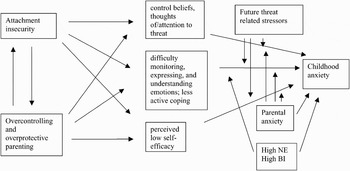
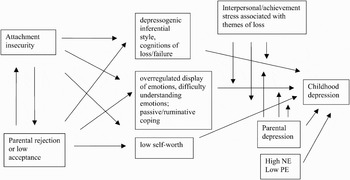
Anxiety and depression, typically labeled as internalizing symptoms/disorders, are among the most common forms of psychopathology affecting children and adolescents (Costello et al., Reference Costello, Angold, Burns, Stangl, Tweed and Erkanli1996; Last, Perrin, Hersen, & Kazdin, Reference Last, Perrin, Hersen and Kazdin1996), and therefore, it is important to understand factors that may give rise to these conditions. With origins in the study of clinical issues, attachment theory provides one framework for understanding the development of anxiety and depression (Bowlby, Reference Bowlby1969, Reference Bowlby1973). Although studies assessing these associations have begun to emerge in the last decade, a comprehensive review of empirical findings is missing from the literature. One review focused exclusively on family factors in anxiety, but not depression (Bögels & Brechman-Toussaint, Reference Bögels and Brechman-Toussaint2006), and other reviews (e.g., DeKlyen & Greenberg, Reference DeKlyen, Greenberg, Cassidy and Shaver2008; Ranson & Urichuk, Reference Ranson and Urichuk2008) have assessed the relations of attachment with a broad range of symptomatology, all with a limited focus on empirical evidence regarding the associations of parent–child attachment with internalizing problems or, more specifically, anxiety and depression. The purpose of this paper is to review theoretical approaches and to evaluate the empirical evidence for the links between attachment and the development of internalizing problems in childhood and adolescence. In addition, we propose two models that might explain how attachment, in combination with other factors, may relate to anxiety or depression.
Anxiety and Depression: Conceptual Definitions
Internalizing problems are characterized by covert, inner-directed symptoms (e.g., distress) and overcontrolled behaviors (Achenbach & McConaughy, Reference Achenbach, McConaughy and Reynolds1992), and are operationalized in the child and adult literatures as symptoms, syndromes, or diagnoses (Compas, Ey, & Grant, Reference Compas, Ey and Grant1993; Fonseca & Perrin, Reference Fonseca, Perrin, Silverman and Treffers2001). Anxiety disorders include: generalized anxiety disorder, social phobia, specific phobia, obsessive–compulsive disorder (OCD), panic disorder, posttraumatic stress disorder, and separation anxiety disorder, with the latter the only anxiety disorder specific to childhood (American Psychiatric Association [APA], 2000). The common denominator of anxiety disorders is an intense fear or worry associated with avoidant behavior (Kendall, Hedtke, & Aschenbrand, Reference Kendall, Hedtke, Aschenbrand, Wolfe and Mash2006). The most common depressive disorders in children are major depressive disorder and dysthymic disorder, marked by feelings of sadness, diminished energy, and sleep and appetite disturbances (APA, 2000). Diagnostic criteria for depression are similar for children and adults, with two exceptions: irritability may substitute for depressed mood, and the required duration of dysthymic disorder is shorter in childhood. Bipolar disorders are also included among the depressive disorders (APA, 2000), but given the rarity and difficulty of these diagnoses in childhood (Hammen & Rudolph, Reference Hammen, Rudolph, Mash and Barkley2003), bipolar disorders are not discussed in the current review. For simplicity, we will use the terms anxiety and depression as reflecting symptoms and syndromes. However, when we address studies based on diagnoses, we use the term disorder.
Internalizing problems are linked to children's healthy adaptation. High levels of anxiety are associated with maladaptive outcomes such as avoidance of developmentally appropriate activities, higher risk for comorbid conditions such as another type of anxiety disorder, depression, or disruptive behaviors, and difficulties in social adjustment (Albano, Chorpita, & Barlow, Reference Albano, Chorpita, Barlow, Mash and Barkley2003; Fonseca & Perrin Reference Fonseca, Perrin, Silverman and Treffers2001; Ollendick, Shortt, & Sander, Reference Ollendick, Shortt, Sander, Maddux and Winstead2005). High levels of depression are associated with psychosocial disturbances such as academic difficulties and impaired interpersonal relationships, subsequent episodes of depression, increased risk for thoughts of death or suicidal behaviors, and substance abuse during later adolescence (Birmaher et al., Reference Birmaher, Ryan, Williamson, Brent, Kaufman and Dahl1996; Hammen & Rudolph, Reference Hammen, Rudolph, Mash and Barkley2003).
Attachment Theory: Theoretical Links With Anxiety and Depression
Given the cognitive, emotional, and behavioral impairments associated with anxiety and depression, as well as the high costs associated with their treatment (Greenberg et al., Reference Greenberg, Sisitsky, Kessler, Finkelstein, Berndt and Davidson1999), it is important to develop and test theories addressing their etiology. Bowlby (Reference Bowlby1969) suggested that the quality of attachment between parents and children sets the stage for later personality development. Attachment (in children) is typically defined as an emotional long-lasting bond that a child forms with an attachment figure (Ainsworth, Reference Ainsworth1989). Children feel secure in their relationships with attachment figures to the extent that they perceive those figures as consistently available, sensitive, and responsive to their needs. Securely attached children use their caregivers as a secure base from which to explore and as a haven of safety in times of need. The attachment figures' sensitive responses soothe their distress, allowing them to return to their routine. When there is a lack of responsiveness and sensitive care, children form insecure relationships with their attachment figures and, consequently, are less able to use them as a secure base and safe haven.
Ainsworth further expanded Bowlby's tenets and identified two types of insecure relationships: ambivalent (C type) and avoidant (A type; Ainsworth, Blehar, Waters, & Wall, Reference Ainsworth, Blehar, Waters and Wall1978). Ambivalently attached children exhibit fearful and excessive attachment behavior (i.e., heightening of negative emotions) and increased dependence on the attachment figure reflecting attempts to gain the attention of their inconsistently available caregiver (Cassidy & Berlin, Reference Cassidy and Berlin1994; Main & Solomon, Reference Main, Solomon, Brazelton and Yogman1986). Their attachment figure is thought to have difficulty setting limits on children's behavior, to undermine children's autonomy and exploration, and to be inconsistent in responding to the child's distress (Cassidy, Reference Cassidy1994; Cassidy & Berlin, Reference Cassidy and Berlin1994). Avoidantly attached children tend to mask negative affect, to engage in affectively neutral interactions with their attachment figure, and to minimize his or her importance as a source of comfort (Cassidy, Reference Cassidy1994; Main & Solomon, Reference Main, Solomon, Brazelton and Yogman1986). This self-reliance strategy, developed as a consequence of consistent rejection by their attachment figure, particularly in times of distress, serves children by allowing them to avoid further rejection that might be triggered by their attempts for contact. For example, the attachment figures of avoidantly attached children are thought to use a controlling interactional style and to withdraw from interactions when children display negative affect (Belsky & Fearon, Reference Belsky, Fearon, Cassidy and Shaver2008; Cassidy, Reference Cassidy1994). The child then learns that expressing negative affect is inappropriate.
Main and Solomon (Reference Main, Solomon, Brazelton and Yogman1986) documented a third type of insecure relationship, disorganized attachment. Infants with disorganized attachments do not have a coherent and organized strategy to cope with distress in the presence of their caregiver. These children show contradictory, bizarre, and incoherent behaviors as an expression of experiencing a paradoxical situation: the caregiver is at the same time a source of apprehension and the secure base (Lyons-Ruth & Spielman, Reference Lyons-Ruth and Spielman2004; Main & Solomon, Reference Main, Solomon, Brazelton and Yogman1986; van IJzendoorn, Schuengel, & Bakermans-Kraneburg, Reference Van IJzendoorn, Schuengel and Bakermans-Kranenburg1999). Three subgroups of disorganized attachment have been identified, two of which manifest role reversal with the caregiver: controlling–caregiving, including children who focus on guiding and entertaining the parent; controlling–punitive, including children who manifest hostile behaviors toward the parent; and insecure–other or atypical, encompassing children who do not show a clear A or C pattern (Main & Cassidy, Reference Main and Cassidy1986, cited in Moss, Cyr, & Dubois-Comtois, Reference Moss, Cyr and Dubois-Comtois2004). Disorganized attachment is thought to arise if children experience a psychologically unavailable attachment figure, extremely hostile or abusive caregiving, or actual or symbolic loss of the attachment figure (Lyons-Ruth & Jacobvitz, Reference Lyons-Ruth, Jacobvitz, Cassidy and Shaver2008; Moss, Cyr, et al., Reference Moss, Cyr and Dubois-Comtois2004).
Although acknowledging the role played by temperament and genetic factors, Bowlby (Reference Bowlby1973) emphasized that children's concerns about attachment figures' availability constitute the basis of anxiety. Based on their experiential history with caregivers, children learn to predict the attachment figures' availability. If children's attempts to forecast the caregivers' availability fail, particularly when separated from the attachment figures or when experiencing disturbing situations, they respond with fear and anxiety. Further, Bowlby (Reference Bowlby1980) asserted that uncontrollable and prolonged loss, perceived or actual, increases vulnerability to depression. Broadly defined, loss encompasses a wide range of situations such as physical separation, death, and divorce, or conditions other than physical separation that lead to systematic unavailability of the caregiver (e.g., parent suffers a traumatic event). The lack of caregivers' availability that contributes to attachment insecurity promotes perceptions of the self as a failure, perceptions that will be carried out and further reinforced throughout subsequent losses that fuel depressive symptomatology. In sum, Bowlby provided a theoretical basis for speculating that insecure attachment relates to both anxiety and depression in children and adolescents.
With the advent of developmental psychopathology, the investigation of behavioral maladaptation in the context of the study of normal development (Cicchetti, Reference Cicchetti1984; Sroufe & Rutter, Reference Sroufe and Rutter1984), theorists further refined Bowlby's ideas while underscoring the complexities of the association between attachment and internalizing symptoms in general and anxiety or depression in particular. Perry and colleagues (Finnegan, Hodges, & Perry, 1996; Hodges, Finnegan, & Perry, Reference Hodges, Finnegan and Perry1999) proposed that ambivalent attachment, rather then avoidant attachment, is relevant for the development of internalizing symptoms. Their reasoning stems from the fact that ambivalent attachment is characterized by inhibition of autonomy and exploration and difficulty in regulating emotions during minor stressors, which in turn, promote fear responses and self-perceptions of weakness and helplessness; these characteristics are often associated with internalizing symptoms. Perry and colleagues did not discuss disorganized attachment. Some researchers argue that, because disorganized children perceive themselves as helpless and vulnerable in the face of frightening situations and attachment figures as unable to protect them, disorganization may be the attachment pattern most likely to be associated with the development of internalizing symptoms (e.g., Moss, Rousseau, Parent, St-Laurent, & Saintonge, Reference Moss, Rousseau, Parent, St-Laurent and Saintonge1998).
Other researchers made more specific predictions regarding the associations between different insecure attachment patterns and anxiety or depression. Carlson and Sroufe (Reference Carlson, Sroufe, Cicchetti and Cohen1995) suggested that both avoidantly and ambivalently attached children may be vulnerable to develop internalizing symptoms, but only the latter are at greater risk for anxiety. Their prediction is based on Bowlby's (1973) observations that anxiety symptoms (i.e., phobias) are often associated with family patterns in which children worry about the availability or well-being of attachment figures. By the nature of their relationship, ambivalently attached children have concerns about the availability of attachment figures; thus, they are likely to experience fears about leaving home and other related fears. By contrast, Manassis (Reference Manassis, Silverman and Treffers2001) suggested that ambivalent, avoidant, and disorganized attachments may all predispose a child to develop anxiety, but that specific insecure attachment patterns may be associated with specific anxiety disorders/symptoms. Because ambivalently attached children become preoccupied with bidding for the caregivers' attention and are less involved in exploratory behaviors, they may develop separation anxiety. The caregivers of these children may express frustration at children's contact attempts or when the children try to reduce anxiety by being near caregivers, further increasing rather than alleviating separation anxiety. Manassis also speculated that the self-reliance strategy used by avoidantly attached children, along with their perceptions of being rejected by their caregivers, may result in decreased desire for social contact. In temperamentally vulnerable individuals, this desire may lead to social phobia. Alternatively, the restriction and avoidance of the expression of negative emotions may lead to defenses characteristic of obsessive–compulsive symptomatology or to physical expression of distress as somatic complaints. In disorganized attachment, the child sometimes has to look after a psychologically unavailable parent and may become excessively concerned with the caregiver's well-being, which may result in school phobia associated with separation anxiety.
Children with different forms of insecure attachments may all be susceptible to develop depression. For both avoidantly and ambivalently attached children, symbolic or actual loss of attachment figures (i.e., lack of a supportive relationship) may confirm their expectations about the psychological unavailability of attachment figures and may lead to depression (Carlson & Sroufe, Reference Carlson, Sroufe, Cicchetti and Cohen1995). In a more recent paper, Egeland and Carlson (Reference Egeland, Carlson, Atkinson and Goldberg2004) further refined the theoretical link between insecure attachment and depression and postulated, based on Bowlby's (1969) observations, that each insecure attachment pattern is related to depression for different reasons. Ambivalently attached children, who cannot fulfill the caregiver's demands despite repeated attempts, may perceive later difficulties or loss as another failure and develop depression, experienced mainly as helplessness. Avoidantly attached children, who learn through their interactions with attachment figures that they are unlovable or inadequate, may perceive others as hostile rather than supportive, and develop depression experienced as alienation and hopelessness. Children with disorganized attachments, some of whom experience intense traumas, may interpret later difficulties as overwhelming and the self as incapable in the face of challenges, schemas that ultimately would lead to depression.
Literature Review
With the revived interest in the clinical implications of attachment theory, a focal question arises: is attachment indeed related to internalizing symptoms? One major purpose of this paper is to evaluate the empirical evidence for the links between attachment and internalizing symptoms in childhood and adolescence. Specifically, we address several key issues: (a) how consistent is the evidence that attachment security or insecurity is linked to internalizing symptoms, anxiety, and depression? (b) How consistent is the evidence that specific forms of insecurity are more strongly related to internalizing symptoms, anxiety, and depression than are other forms of insecurity? (c) Are associations with internalizing symptoms, anxiety, and depression consistent for mother–child and father–child attachment?
Study selection
Studies included in this review have met the following criteria: (a) included a measure of attachment to mother, father, or both parents in childhood and/or adolescence; (b) included a measure of internalizing symptoms,Footnote 1 anxiety, or depression; and (c) reported a mean age of 18 years or younger for participants. Studies examining solely the associations of parenting, attachment to peers or romantic partner, and other family aspects (e.g., family environment, other dimensions of the child–parent relationship) or grouping attachment to parents and peers in the same category were excluded. Because temperament is one of the most widely accepted precursors of internalizing problems, but not a symptom of internalizing problems (Kagan, Snidman, Arcus, & Reznick, Reference Kagan, Snidman, Arcus and Reznick1994), measures of the anxious style of temperament (also referred to as inhibition, withdrawal, shyness, and approach/avoidance) were not treated as measures of anxiety or depression. Studies that referred to affective disorders were also excluded if they did not differentiate between depression and schizoaffective disorder.
We conducted a literature search for studies presenting quantitative data by (a) crossing different key words from the attachment domain (attachment, secure-, insecure-, ambivalence, disorg-, avoid-) and internalizing symptoms domain (e.g., anxi-, OCD, obsessive, depress-, internalize-) using the 1967 to present PsychInfo database; and (b) tracing some studies based on the references provided by relevant theoretical papers (e.g., Cummings & Cicchetti, Reference Cummings, Cicchetti, Greenberg, Cicchetti and Cummings1990; DeKlyen & Greenberg, Reference DeKlyen, Greenberg, Cassidy and Shaver2008). We perused the titles, abstracts, and method and result sections, and retained the studies corresponding to the aims of this review. Thus, the literature search resulted in a final pool of 55 studies covering the published research between 1984 and 2008.
Attachment measures
There are different assessment approaches and measures of attachment from infancy to adulthood. The most common procedure for identifying attachment patterns (secure, ambivalent, avoidant, and disorganized) in infancy is the Strange Situation procedure (Ainsworth et al., Reference Ainsworth, Blehar, Waters and Wall1978), which consists of a series of separation and reunion episodes with a caregiver in the laboratory. Adaptations of the Strange Situation procedure are widely used at preschool and early school age (Solomon & George, Reference Solomon, George, Cassidy and Shaver2008). The Attachment Q-Set assesses the quality of a young child's secure base behavior in the home (Waters, Reference Waters1995). Semiprojective techniques such as story-stem narratives and picture response procedures assess children's internal representations of attachment, and have been developed for preschoolers and older school age children (e.g., Attachment Story Completion Task; Bretherton, Ridgeway, & Cassidy, Reference Bretherton, Ridgeway, Cassidy, Greenberg, Cicchetti and Cummings1990; Separation Anxiety Test [SAT]; Slough & Greenberg, Reference Slough and Greenberg1990; for reviews, see Kerns, Schlegelmilch, Morgan, & Abraham, Reference Kerns, Schlegelmilch, Morgan, Abraham, Kerns and Richardson2005; Solomon & George, Reference Solomon, George, Cassidy and Shaver2008). The Adult Attachment Interview (AAI; George, Kaplan, & Main, Reference George, Kaplan and Main1996) is a narrative discourse measure often used in adolescence and adulthood to assess a person's “state of mind” toward attachment. Based on experiences with attachment figures and the meaning currently assigned to past attachment-related experiences, the adolescent is classified into categories that parallel the infant classifications: autonomous (secure), dismissing (avoidant), preoccupied (ambivalent), or unresolved (disorganized). In addition, a variety of questionnaires, assessing children's and adolescents' perceptions of attachment, have been proposed (e.g., the Security Scale; Kerns, Aspelmeier, Gentzler, & Grabill, Reference Kerns, Aspelmeier, Gentzler and Grabill2001; the Inventory of Parent and Peer Attachment [IPPA]; Armsden & Greenberg, Reference Armsden and Greenberg1987).
Although most attachment measures are intended to capture the secure base and safe haven constructs, a variety of terms are used to conceptualize security (i.e., greater attachment, attachment beliefs) or insecurity in childhood and adolescence (i.e., angry distress and unavailability, anxiety and avoidance, etc.), as well as to refer to the attachment patterns (e.g., secure, ambivalent, avoidant, and disorganized; Main & Solomon, Reference Main, Solomon, Brazelton and Yogman1986; secure, preoccupied, dismissive, and fearful; Bartholomew & Harowitz, Reference Bartholomew and Horowitz1991). To avoid confusion, throughout this paper we will use the terms secure, ambivalent, avoidant, and disorganized to refer to the attachment categories or dimensions assessed. However, when the terms are not conceptually equivalent with the infant classification, we will use the terms proposed by the authors.
In addition, it is important to note that different measures vary in how they conceptualize attachment. Some measures assess attachment behaviors, some assess representations, and others assess perceptions of attachment. Some measures have been designed for use only in infancy and early childhood (e.g., behavioral observation measures), some have been used both in preschool years and early adolescence (e.g., the SAT), and others have been designed specifically for older adolescents or adults (e.g., the AAI). Early childhood assessments, such as those based on coding of child's attachment behaviors, are considered relationship-specific assessments, whereas measures for older adolescents (e.g., the AAI) are considered measures of an individual's general style across attachment relationships (Crowell, Fraley, & Shaver, Reference Crowell, Fraley, Shaver, Cassidy and Shaver2008; Kerns et al., Reference Kerns, Schlegelmilch, Morgan, Abraham, Kerns and Richardson2005; Solomon & George, Reference Solomon, George, Cassidy and Shaver2008). Finally, there are variations within and across measures of attachment in terms of psychometric properties. Ainsworth's classification measure has been extensively validated on US and Western European populations. The observational measures for preschoolers also have relative good reliability and validity (Moss, Bureau, Cyr, Mongeau, & St-Laurent, Reference Moss, Bureau, Cyr, Mongeau and St-Laurent2004; Solomon & George, Reference Solomon, George, Cassidy and Shaver2008). Similarly, the relative stability, reliability, and predictive validity of the AAI are well established (Hesse, Reference Hesse, Cassidy and Shaver2008). Representational measures (e.g., the story-stem technique) seem a promising approach, but have not been validated as extensively (Kerns et al., Reference Kerns, Schlegelmilch, Morgan, Abraham, Kerns and Richardson2005). Although attachment questionnaires have adequate internal consistency, validity data are sparse for some measures (Kerns, Reference Kerns, Cassidy and Shaver2008).
Based on theory and previous reviews (Crowell et al., Reference Crowell, Fraley, Shaver, Cassidy and Shaver2008; Kerns et al., Reference Kerns, Schlegelmilch, Morgan, Abraham, Kerns and Richardson2005; Solomon & George, Reference Solomon, George, Cassidy and Shaver2008), we grouped the attachment measures used in the reviewed studies into three categories: (a) behavioral observation measures including the Strange Situation procedure (Ainsworth et al., Reference Ainsworth, Blehar, Waters and Wall1978), the Main and Cassidy extension of the Strange Situation to preschool and early school age (Cassidy & Marvin, Reference Cassidy and Marvin1992; Main & Cassidy, Reference Main and Cassidy1986), and the Attachment Q-set (Waters, Reference Waters1995); (b) measures of attachment representations involving storytelling, semistructured autobiographical interviews or family drawings (the Attachment Story Completion Task, Bretherton et al., Reference Bretherton, Ridgeway, Cassidy, Greenberg, Cicchetti and Cummings1990; the SAT, Slough & Greenberg, Reference Slough and Greenberg1990; the Manchester Child Attachment Story Task, Goldwyn, Stanley, Smith, & Green, Reference Goldwyn, Stanley, Smith and Green2000; the AAI and Q-Set; George et al., Reference George, Kaplan and Main1996; Kobak, Cole, Ferenz-Gillies, Fleming, & Gamble, Reference Kobak, Cole, Ferenz-Gillies, Fleming and Gamble1993; analysis of drawings, Fury, Carlson, & Sroufe, 1987); and (c) questionnaires (the Security Scale, Kerns et al., Reference Kerns, Aspelmeier, Gentzler and Grabill2001; Coping Strategies Questionnaire, Finnegan et al., Reference Finnegan, Hodges and Perry1996; the IPPA, Armsden & Greenberg, Reference Armsden and Greenberg1987; the Adolescent Attachment Questionnaire, West, Rose, Spreng, Sheldon-Keller, & Adam, Reference West, Rose, Spreng, Sheldon-Keller and Adam1998; the Relationship Questionnaire, Bartholomew & Horowitz, Reference Bartholomew and Horowitz1991; Parental Attachment Questionnaire, Kenny, Reference Kenny1987). When possible, we grouped studies within a measurement category based on the instrument used (e.g., studies based on the IPPA).
Review format
To facilitate evaluating hypotheses regarding specificity of relations between attachment patterns and particular internalizing problems, we separately summarized the literature for internalizing symptoms (in general), anxiety, and depression. There are some variations in the manifestation of internalizing symptoms between childhood and adolescence, and in the correlates of anxiety and depression (APA, 2000). Our initial intention was to group studies based on the outcome and the age of development (childhood, middle childhood, preadolescence, adolescence). There are, however, very few studies assessing internalizing symptoms in early childhood (age 6 or younger). In addition, many symptoms do not become prevalent until later middle childhood (10–12 years of age). Therefore, for each type of symptom (internalizing symptoms, anxiety, and depression) we summarized separately the data for studies in childhood (up to age 10 years) and preadolescence/adolescence (age 10 years or older). For studies with a large age range, a decision was made based on the mean and/or median age of assessment. When enough information was provided (i.e., means and standard deviations, correlations, etc.), we used standard formulas to compute Cohen's (Reference Cohen1988) effect size.Footnote 2 We used Cohen's (Reference Cohen1988) conventions for effect sizes; thus, d = 0.2 was considered a small effect, d = 0.5 was a medium effect, and d = 0.8 was a large effect. A correction factor was applied, when computing effect sizes based on means, to account for the differences in sample sizes and small samples, according to the suggestions of Hedges (Reference Hedges1981). Details about the studies are presented in Tables 1–6. It should be noted that the majority of the samples were predominantly Caucasian (for exceptions, see Anan & Barnett, Reference Anan and Barnett1999; Constantine, Reference Constantine2006) and were drawn from the Untied States, Canada, or Europe. Although a significant number of studies employed a longitudinal design (23 studies), cross-sectional designs were commonly used (32 studies).
Studies of attachment and childhood internalizing symptoms

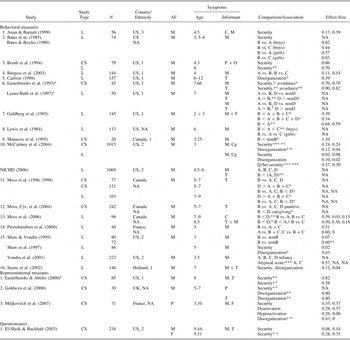
Note: For study type: L, longitudinal; CS, cross-sectional. For ethnicity: 1, predominantly Caucasian; 2, majority Caucasian, but some other ethnicities are relatively well represented; 3, predominantly African American. AF, attachment figure. For attachment figure: M, mother, P, parent. For internalizing symptoms, age is reported in years (range or mean). For symptoms informant: C, child; Cg, caregiver; F, father; M, mother; O, observation; P, parent; T, teacher. For comparison: A, avoidant; B, secure; C, ambivalent; D, disorganized.
aOverlapping samples.
bPositive association.
†p < .10. *p < .05. **p < .01. ***p < .001.
Studies of attachment and preadolescent or adolescent internalizing symptoms

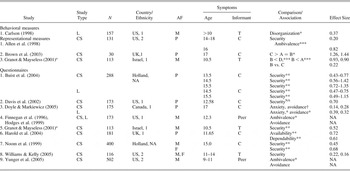
Note: For study type: L, longitudinal; CS, cross-sectional. For ethnicity: 1, predominantly Caucasian, 2, majority Caucasian, but some other ethnicities are relatively well represented. AF, attachment figure. For attachment figure: M, mother; F, father; P, parent. For internalizing symptoms, age is reported in years (range or mean). For symptoms informant: C, child; T, teacher. For comparison: A, avoidant; B, secure; C, ambivalent; D, disorganized.
aStudies included in more than one category.
†p < .10. *p < .05 **p < .01. ***p < .001.
Studies of attachment and childhood anxiety
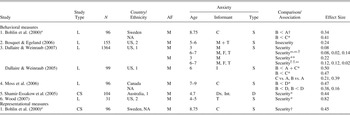
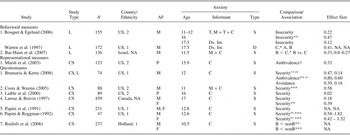
Note: For study type: L, longitudinal; CS, cross-sectional. For ethnicity: 1, predominantly Caucasian; 2, majority Caucasian, but some other ethnicities are relatively well represented. AF, attachment figure. For attachment figure: M, mother. For anxiety, age is reported in years (range or mean). For anxiety informant: M, mother; F, father; C, child; T, teacher; I, interview; Dx. Int., diagnostic interview. For anxiety type: S, symptoms/syndrome; D, disorder. For comparison: A, avoidant; B, secure; C, ambivalent.
aStudies included in more than one category.
†p < .10. *p < .05.
Studies of attachment and preadolescent or adolescent anxiety

Note: For study type: L, longitudinal; CS, cross-sectional. For ethnicity: 1, predominantly Caucasian; 2, majority Caucasian, but some other ethnicities are relatively well represented. AF, attachment figure. For attachment figure: M, mother; F, father; P, parent. For anxiety, age is reported in years (range or mean). For anxiety informant: M, mother; C, child; T, teacher; Dx. Int., diagnostic interview. For anxiety type: S, symptom/syndromes; D, disorder. For comparison: A, avoidant; B, secure; C, ambivalent.
†p < .10. *p < .05.**p < .01. ***p < .001.
Studies of attachment and childhood depression

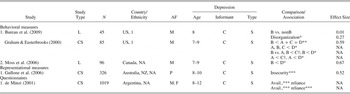
Note: For study type: L, longitudinal; CS, cross-sectional. For ethnicity: 1, predominantly Caucasian. AF, attachment figure. For attachment figure: M, mother, F, father; P, parent. For depression, age is reported in years (range or mean). For depression informant: C, child. For depression type: S, symptoms/syndromes. For comparison: A, avoidant; B, secure; C, ambivalent; D, disorganized.
†p < .10. *p < .05.**p < .01. ***p < .001.
Studies of attachment and preadolescent or adolescent depression

Note: For study type: L, longitudinal; CS, cross-sectional. For ethnicity: 1, predominantly Caucasian; 2, majority Caucasian, but some other ethnicities are relatively well represented; 3, predominantly African American. AF, attachment figure. For attachment figure: M, mother; F, father; P, parent. For depression, age is reported in years (range or mean). For depression informant: C, child, Dx. Int., diagnostic interview. For depression type: S, symptoms/syndrome; D, disorder. For comparison: B, secure.
*p < .05. **p < .01. ***p < .001.
Attachment and Internalizing Symptoms
Childhood internalizing symptoms
The 19 studies reporting associations between attachment and internalizing symptoms in childhood, and the corresponding effect sizes, are presented in Table 1.
Behavioral observation studies
All 16 studies assessed attachment to mother. Ten of these studies used the Strange Situation procedure, four of which assessed only secure, ambivalent, and avoidant attachments, but did not assess the disorganized attachment. Specifically, Lewis, Feiring, McGuffog, and Jaskir (Reference Lewis, Feiring, McGuffog and Jaskir1984) found that, at age 6 years, securely attached boys were rated the lowest by mothers and ambivalently attached boys the highest on an internalizing scale. No significant results were reported for girls. Although Pierrehumbert, Miljkovitch, Plancherel, Halfon, and Ansermet (Reference Pierrehumbert, Miljkovitch, Plancherel, Halfon and Ansermet2000) did not perform statistical analyses to assess differences among attachment patterns, effect sizes indicated that insecure infants showed more internalizing symptoms at age 5 years than did secure infants, and that avoidant infants showed more internalizing symptoms than nonavoidant infants. No differences were found between ambivalent and nonambivalent children. Two other studies reported no associations between ABC attachment classifications in infancy and internalizing symptoms in the preschool years (Bates & Bayles, Reference Bates, Bayles, Belsky and Nezworski1988; Bates, Maslin, & Frankel, Reference Bates, Maslin and Frankel1985; Burgess, Marshall, Rubin, & Fox, Reference Burgess, Marshall, Rubin and Fox2003). It is interesting that the effect sizes based on the results of Bates and colleagues' study suggest that, at the age of 5 and 6 years, securely attached boys showed more internalizing problems than ambivalently attached boys, and securely attached girls showed more internalizing problems that avoidantly attached girls.
Six studies based on the Strange Situation assessed disorganization, although not all studies included all four attachment patterns. In a mixed sample of healthy and chronically ill children (Goldberg, Gotowiec, & Simmons, Reference Goldberg, Gotowiec and Simmons1995), securely attached children in infancy received lower ratings of internalizing symptoms at ages 2–3 years than did insecurely attached children. The secure–avoidant contrast was also significant. In the Lyons-Ruth, Easterbrooks, and Cibelli (Reference Lyons-Ruth, Easterbrooks and Cibelli1997) study of a low-income sample, infants classified avoidant as opposed to secure displayed more internalizing symptoms at the age of 7 as rated by teachers, but not by mothers, when continuous but not clinical scores of the internalizing scale were used. Disorganized status, as opposed to organized status, was not consistently related to internalizing symptoms as rated by mothers or teachers. This sample did not contain infants in the ambivalent category. In the National Institute of Child Health and Human Development (NICHD) Study of Early Child Care, secure and disorganized attachments in infancy did not relate to mothers' or caregivers' reported internalizing symptoms at the age of 3 years (McCartney, Owen, Booth, Clarke-Stewart, & Vandell, Reference McCartney, Owen, Booth, Clarke-Stewart and Vandell2004). McCartney et al. (Reference McCartney, Owen, Booth, Clarke-Stewart and Vandell2004) did not include ambivalent and avoidant attachments in the analyses. ABCD attachment classifications were not significantly related to mother ratings of internalizing problems when children were between 4.5 years and first grade (NICHD Early Child Care Research Network, 2006), although teachers rated first graders with secure attachments in infancy lower on internalizing symptoms than avoidant or disorganized children. Two studies based on samples at economic risk reported a positive association between disorganization in infancy and childhood internalizing symptoms (Carlson, Reference Carlson1998; Shaw, Keenan, Vondra, Delliquadri, & Giovannelli, Reference Shaw, Keenan, Vondra, Delliquadri and Giovannelli1997). Carlson (Reference Carlson1998) focused exclusively on disorganization and Shaw et al. (Reference Shaw, Keenan, Vondra, Delliquadri and Giovannelli1997) included also secure attachment, which was not related to internalizing scores at the age of 5. Based on the same sample, Shaw and Vondra (Reference Shaw and Vondra1995) reported that insecurity at 18 months, but not at 12 months, was associated with higher rates of internalizing symptoms at the age of 3. Based on an overlapping sample but including all four attachment patterns, Vondra, Shaw, Swearingen, Cohen, and Owens (Reference Vondra, Shaw, Swearingen, Cohen and Owens2001) reported that attachment patterns in infancy were not associated with later internalizing symptoms. Similar results were reported in the Stams, Juffer, and van IJzendoorn (Reference Stams, Juffer and van IJzendoorn2002) longitudinal study.
Some studies based on the Main and Cassidy system or an equivalent system for preschool and school age children yielded significant results for attachment. The Booth, Rose-Krasnor, McKinnon, and Rubin (Reference Booth, Rose-Krasnor, McKinnon and Rubin1994) study showed that attachment security at age 4 years was not related concurrently with internalizing symptoms, but was negatively associated with internalizing symptoms at 8 years. The McCartney et al. (Reference McCartney, Owen, Booth, Clarke-Stewart and Vandell2004) study discussed above showed that concurrent secure attachment was negatively associated with maternal and caregiver ratings of internalizing symptoms. Disorganized status was positively related to maternal report but not caregiver report of internalizing symptoms. Anan and Barnett (Reference Anan and Barnett1999) reported that attachment security at the age 4 was not significantly associated with self-reported or mother-reported internalizing symptoms approximately 2 years later. In the Easterbrooks, Davidson, and Chazan (Reference Easterbrooks, Davidson and Chazan1993) article, based on overlapping sample with Lyons-Ruth et al. (Reference Lyons-Ruth, Easterbrooks and Cibelli1997), attachment security and avoidance correlated in the expected directions with concurrent ratings of internalizing symptoms provided by mothers and teachers. Unfortunately, the authors did not report any results based on the four attachment classifications, although they were used in other analyses. In Vondra et al. (Reference Vondra, Shaw, Swearingen, Cohen and Owens2001), insecure–other classification at 24 months, but not ambivalent or avoidant classifications, measured with the Crittenden (Reference Crittenden1994) scoring system, predicted internalizing symptoms at the age of 4.
A series of three studies conducted by Moss' research group included all four attachment classifications. Attachment patterns, measured between 5 and 7 years, did not relate to children's levels of internalizing symptoms assessed concurrently (Moss, Parent, Gosselin, Rousseau, & St-Laurent, Reference Moss, Parent, Gosselin, Rousseau and St-Laurent1996). Based on approximately the same sample, Moss et al. (Reference Moss, Rousseau, Parent, St-Laurent and Saintonge1998) reported that disorganized children showed more internalizing symptoms concurrently and 2 years later than the combined A, B, and C groups and B group alone. Also, avoidant boys had significantly higher internalizing scores than avoidant girls at the age of 5–7. In a different study, children with (disorganized) controlling attachments at ages 5–7 years had significantly higher scores on internalizing symptoms at the age of 7–9 years than the secure group (Moss et al., Reference Moss, Smolla, Cyr, Dubois-Comtois, Mazzarello and Berthiaume2006). Differences among other attachment groups were not found consistently. In another study that included all three subcategories reflecting disorganization, controlling–caregiving children showed more internalizing symptoms than did the secure children (Moss et al., Reference Moss, Cyr and Dubois-Comtois2004). No other contrasts were significant.
In a sample of children aged 18 to 59 months whose mother received an anxiety disorder diagnosis, the Strange Situation was coded either with the infant scoring system or with the preschool scoring system, depending on the age of the child (Manassis, Bradley, Goldberg, Hood, & Swinson, Reference Manassis, Bradley, Goldberg, Hood and Swinson1995). Mothers of insecurely attached children reported more internalizing symptoms shown by their children than did mothers of securely attached children. Finally, the McCartney et al. (Reference McCartney, Owen, Booth, Clarke-Stewart and Vandell2004) study was the only one to assess security with the Attachment Q-Set. Attachment security at age 2 years was negatively associated with mothers' and caregivers' reports of internalizing symptoms 1 year later.
Attachment representation studies
We identified three studies using representational measures. One study showed that security with mother measured with the SAT was negatively related to mother's report of children's internalizing symptoms, and marginally, positively related to teacher's reports (Easterbrooks & Abeles, Reference Easterbrooks and Abeles2000). It should be noted that the sample of this study overlaps with the sample of the Lyons-Ruth et al. (Reference Lyons-Ruth, Easterbrooks and Cibelli1997) and Easterbrooks et al. (Reference Easterbrooks, Davidson and Chazan1993) articles. Another study (Miljkovitch, Pierrehumbert, & Halfon, Reference Miljkovitch, Pierrehumbert and Halfon2007) showed that none of the four attachment patterns, measured with the attachment story completion task, was concurrently associated with mother's or father's reports of child's internalizing symptoms. Surprisingly, another study, based on the Manchester Attachment Story Task, showed that more secure children were rated higher on an internalizing scale by their mothers (Goldwyn et al., Reference Goldwyn, Stanley, Smith and Green2000). Disorganization was also associated positively with internalizing symptoms.
Questionnaire studies
El-Sheikh and Buckhalt (Reference El-Sheikh and Buckhalt2003) reported that attachment to father, but not to mother, measured with the IPPA, was related to elementary school-age children's internalizing symptoms.
Preadolescent/adolescent internalizing symptoms
The 12 studies of attachment and internalizing symptoms in preadolescence or adolescence, and the corresponding effects sizes, are shown in Table 2.
Behavioral observation studies
Carlson (Reference Carlson1998) reported that infants receiving higher disorganization ratings were rated higher by their teachers on an internalizing scale when they were in high school.
Attachment representation studies
We identified three studies in this category. Allen, Moore, Kuperminc, and Bell (Reference Allen, Moore, Kuperminc and Bell1998) measured attachment using the AAI, and found that ambivalence, but not security, was related to internalizing symptoms. Dismissing and hyperactivating scales were not used in the analyses. This study also included the IPPA. Although the authors did not conceptualize the IPPA as measuring attachment, the total score of the IPPA predicted the internalizing scores in the regression analysis at a trend level. Granot and Mayseless (Reference Granot and Mayseless2001) measured attachment to mother with the Doll Story Interview, a version of the Attachment Story Completion Task (Bretherton et al., Reference Bretherton, Ridgeway, Cassidy, Greenberg, Cicchetti and Cummings1990) for preadolescents. The secure group had fewer teacher-reported internalizing symptoms compared with the disorganized and avoidant groups. Brown and Wright (Reference Brown and Wright2003), using a version of the SAT in a mixed clinical and nonclinical sample, found that adolescents ambivalently attached with parents reported higher levels of internalizing symptoms than did avoidantly or securely attached adolescents.
Questionnaire studies
We identified nine questionnaire-based studies, three of which were based on the Security Scale. Security with mother (Granot & Mayseless, Reference Granot and Mayseless2001) or with parent (Harold, Shelton, Goeke-Morey, & Cummings, Reference Harold, Shelton, Goeke-Morey and Cummings2004) was correlated negatively with adolescents' internalizing symptoms. One study found that attachment security with each parent was not related to sixth to eighth graders' internalizing symptoms (Williams & Kelly, Reference Williams and Kelly2005). Two studied were based on the IPPA questionnaire. Buist, Deković, Meeus, and van Aken (Reference Buist, Deković, Meeus and van Aken2004) reported significant correlations between attachment security and internalizing symptoms at three time points. Noom, Deković, and Meeus (Reference Noom, Deković and Meeus1999) reported that attachment security with both mother and father was negatively associated with adolescents' internalizing symptoms. Using a questionnaire developed for their study, Davies, Harold, Goeke-Morey, and Cummings (Reference Davies, Harold, Goeke-Morey and Cummings2002) found that attachment security was negatively related to internalizing symptoms.
In the Doyle and Markiewicz (Reference Doyle and Markiewicz2005) study, two dimensions of attachment to parents, anxiety and avoidance, were assessed with the Relationship Questionnaire when the participants were 13 years old and 3 years later. The attachment dimensions were longitudinally but not concurrently related to adolescents' internalizing symptoms. Two studies employed the Coping Strategies Questionnaire to assess the differential outcomes of ambivalence and avoidance. Controlling for age and other variables, higher ambivalence but not higher avoidance with mother was related to more peer-reported internalizing symptoms both concurrently (for boys only, Finnegan et al., Reference Finnegan, Hodges and Perry1996) and longitudinally (Hodges et al., Reference Hodges, Finnegan and Perry1999). Yunger, Corby, and Perry (Reference Yunger, Corby, Perry, Kerns and Richardson2005) replicated the former results in a larger sample of fifth and sixth graders.
Summary of studies assessing attachment and internalizing symptoms
Evidence for a relation between attachment and internalizing symptoms in childhood was mixed. Two of 13 longitudinal studies (15.38%) indicated significant results, five studies (38.47%) reported nonsignificant results, and six studies (46.15%) yielded mixed results (e.g., security was related to internalizing symptoms when contrasted with only one insecure pattern; security was related to internalizing symptoms as reported by one informant, but not another, or to internalizing symptoms assessed at one age but not another). Three of nine concurrent studies (33.33%) reported significant results, two studies reported mixed results (22.22%), three studies reported nonsignificant results (33.33%), and one study (11.11%) reported a positive association between security and internalizing problems. Effect sizes ranged between low and high regardless of the type of study. The results regarding the associations of security with internalizing symptoms in preadolescence/adolescence were more consistent, with the one longitudinal study (100%) and six of eight concurrent studies (75%) yielding significant results, and most effect sizes ranging from moderate to very high. Because questionnaires are the most common form of attachment assessment in preadolescence/adolescence, shared method variance may partially account for these results.
Studies that assessed avoidance or ambivalence showed that neither was consistently associated with internalizing symptoms in childhood. Of 11 studies that included A and C classifications, one longitudinal study (9.09%) showed a significant A versus B contrast, one longitudinal study (9.09%) yielded mixed results regarding A versus B contrast, and one longitudinal study (9.09%) showed that ambivalently attached adolescent boys but not girls have higher levels of internalizing symptoms than avoidantly attached boys. One other study yielded mixed results for avoidance and did not include the C classification. Although clear patterns did not emerge in childhood, in preadolescence/adolescence one of five studies (20%) reported a significant concurrent A versus B contrast, and one study (20%) indicated that avoidance is longitudinally but not concurrently related to depression. Four of five studies (80%) found that ambivalence bears a significant relation to internalizing symptoms. Note that most of the results regarding ambivalence are based on concurrent studies and none of the preadolescent/adolescent studies supporting an association between ambivalence and internalizing symptoms assessed disorganization. In those studies where it was assessed, there was some evidence that disorganization entails a greater risk for developing internalizing symptoms than other attachment patterns (6 of 11 studies [54.55%] of childhood yielded significant results and two studies reported mixed results [18.18%]; two of two studies [100%] of preadolescence/adolescence found significant results for disorganization).
The role of fathers in the development of internalizing symptoms has been neglected as most studies focused on attachment to mothers only (for exceptions, see El-Sheik & Buckhalt, Reference El-Sheikh and Buckhalt2003; Noom et al., Reference Noom, Deković and Meeus1999; Williams & Kelly, Reference Williams and Kelly2005). Few studies of internalizing problems included a representational measure to assess attachment. Future studies should incorporate multiple measures, assessing different aspects of attachment (attachment behavior, representations, and perceptions of attachment) to evaluate the consistency of the results. Null effects of internalizing symptoms in childhood are difficult to explain as they were reported in both concurrent and longitudinal studies, small and large samples, and preschool or elementary school age. The inconsistent findings may be partially due to the diversity of symptoms assessed with global measures of internalizing symptoms. In the following sections, we evaluate whether attachment relates specifically to anxiety or depression.
Studies of the Associations Between Attachment and Anxiety
Childhood anxiety
The six studies investigating attachment to mother and anxiety in children under age 10, and the corresponding study effect sizes, are included in Table 3.
Behavioral observation studies
As shown in Table 3, six studies in childhood included observational assessments of attachment, five of which are longitudinal. Two studies used the Strange Situation procedure for infants, two employed its preschool version, one used both measures, and one used the Attachment Q-Set. Bohlin, Hagekull, and Rydell (Reference Bohlin, Hagekull and Rydell2000) found that children who were secure as infants, compared to those who had been insecure (ambivalent or avoidant), reported lower levels of social anxiety symptoms at the age of 9 years old. Dallaire and Weinraub (Reference Dallaire and Weinraub2005), based on a subsample from the NICHD Study of Early Child Care, reported that insecurely attached children showed more separation anxiety at the age of 6 than did securely attached children. In a larger sample of participants from the same study, attachment security in infancy or at the age 3 was not related to a general measure of child anxiety symptoms at first grade (Dallaire & Weinraub, Reference Dallaire and Weinraub2007). Based on an economically high-risk sample, Bosquet and Egeland (Reference Bosquet and Egeland2006) also found no direct association between an insecure attachment history in infancy and an aggregate score of anxiety measured in kindergarten and first grade. Moss et al. (Reference Moss, Smolla, Cyr, Dubois-Comtois, Mazzarello and Berthiaume2006) reported that children with (disorganized) controlling attachments rated themselves higher on separation anxiety, but not on overanxiety or simple phobia, than did securely attached children. The Shamir-Essakov, Ungerer, and Rapee (2005) study of preschoolers drawn from a behavioral inhibition prevention program is the only study that assessed the presence of an anxiety disorder. Insecure attachment was associated with the sum of the number of anxiety disorders for which a child met criteria. Wood (2007) reported that security assessed with the Attachment Q-Set at age 3 was associated with preschool anxiety.
Attachment representation studies
The Bohlin et al. (Reference Bohlin, Hagekull and Rydell2000) study also measured concurrent attachment security with the SAT when children reached the age of 9 years old and reported that overall security was marginally associated with social anxiety.
Preadolescent/adolescent anxiety
The 10 studies investigating the relation between attachment and anxiety in children 10–18 years, as well as the corresponding effect sizes, are included in Table 4.
Behavioral observation studies
The two longitudinal studies in this category assessed attachment to mother with the Strange Situation. Two articles are based on the same Minnesota Longitudinal Study of Parents and Children. Attachment insecurity in infancy was not directly related to anxiety symptoms at sixth grade or at age 17.5 years, but was associated with anxiety at age 16 (Bosquet & Egeland, Reference Bosquet and Egeland2006). Ambivalence, but not security or avoidance, was positively and longitudinally related to the number of anxiety disorder diagnoses (Warren, Huston, Egeland, & Sroufe, Reference Warren, Huston, Egeland and Sroufe1997). The Bar-Haim, Dan, Eshel, and Sagi-Schwartz (Reference Bar-Haim, Dan, Eshel and Sagi-Schwartz2007) study included only participants who were securely or ambivalently attached in infancy. At 11 years, children who were ambivalently attached in infancy had higher scores on school phobia, but not on the total anxiety score or other types of anxiety symptoms, compared with children who were securely attached.
Attachment representation studies
Marsh, McFarland, Allen, McElhaney, and Land (Reference Marsh, McFarland, Allen, McElhaney and Land2003) used only scores of ambivalence with parents derived from the AAI in a sample of adolescents experiencing academic difficulties. There was a statistical trend for the relation between ambivalence and anxiety symptoms, which became nonsignificant after accounting for the effect of demographic factors.
Questionnaire studies
Seven studies that used questionnaires to assess attachment were identified, five of which relied on the IPPA and assessed the relations concurrently. Costa and Weem (2003) reported that attachment security with mother was negatively associated with anxiety. Three studies assessed security with mother and father separately using the IPPA (Larose & Boivin, Reference Larose and Boivin1997; Papini & Rogman, Reference Papini and Roggman1992; Papini, Roggman, & Anderson; Reference Papini, Roggman and Anderson1991). The results for attachment to mother and father were similar, with effect sizes ranging from small to very high. One other study based on the IPPA assessed attachment security with the parent who has the most influence on the child and found no significant relation with self-reported anxiety (Laible, Carlo, & Raffaelli, Reference Laible, Carlo and Raffaelli2000). In one study, the Relationship Questionnaire for Children was used to assess attachment security (Roelofs, Meester, ter Huurne, Bamelis, & Muris, Reference Roelofs, Meesters, Ter Huurne, Bamelis and Muris2006). Preadolescents insecurely attached to mother or father reported higher anxiety than did securely attached preadolescents. In one study, using the Security Scale and the Coping Strategies Questionnaire to assess the relations of past and concurrent security, ambivalence, and avoidance with social anxiety, ambivalence was the attachment pattern most consistently associated with social anxiety (Brumariu & Kerns, Reference Brumariu and Kerns2008).
Summary of studies assessing attachment and anxiety
Overall, these results provided some support for the hypothesis that attachment security is associated with lower levels of anxiety in childhood and preadolescence/adolescence. As shown in Table 3, two of five longitudinal studies (40%) of childhood anxiety indicated marginally significant or significant findings, two longitudinal studies (40%) provided mixed results, and one study (20%) reported nonsignificant results. Two concurrent studies (100%) reported marginally significant or significant findings. Regarding preadolescent/adolescent anxiety, two of three longitudinal studies (66.66%) yielded mixed results and one (33.33%) yielded nonsignificant results. Four of seven concurrent studies (57.15%) yielded consistently significant results, one study (14.28%) reported mixed results, and two studies (28.57%) reported nonsignificant results. The majority of significant effect sizes fell between the lower range of a medium effect size and a high effect size.
For the specific insecure patterns, two longitudinal studies (100%) of childhood anxiety found a significant B versus C contrast. For ambivalence, two of three longitudinal studies (66.66%) of preadolescent/adolescent anxiety reported significant results and one study (33.33%) provided mixed results. Two concurrent studies (100%) of preadolescent/adolescent anxiety reported significant or marginally significant results. For avoidance, one of two longitudinal studies of childhood anxiety (50%) yielded marginally significant results, and one study (50%) reported nonsignificant results, whereas two longitudinal studies of preadolescent/adolescent anxiety (100%) reported nonsignificant results. For disorganization, the one study of childhood anxiety provided mixed results. Because none of the studies of preadolescence/adolescence included a measure of disorganization, studies assessing this attachment pattern are desirable. Studies assessing attachment to father are also needed.
Notably, research assessing the links between attachment and childhood anxiety relies on behavioral observation measures of attachment. Given that observational measures of attachment have not been validated for children over the age of 7, studies including other attachment measurement approaches are needed to provide a comprehensive picture of the relation between attachment and childhood anxiety. A limitation of findings regarding preadolescent/adolescent anxiety is that most studies utilized adolescent self-reports for both attachment and anxiety, which increases the risk of inflated correlations. There is a critical need for studies assessing anxiety and children's attachment representations in adolescence.
Studies of the Associations Between Attachment and Depression
Childhood depression
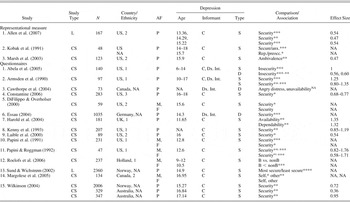
The four studies of attachment and depression in childhood, and the corresponding effect sizes, are described in Table 5.
Behavioral observation studies
Two papers are based on the same sample at economic risk, which also overlaps with the sample of the Lyons-Ruth et al. (Reference Lyons-Ruth, Easterbrooks and Cibelli1997), Easterbrooks et al. (Reference Easterbrooks, Davidson and Chazan1993), and Easterbrooks and Abeles (Reference Easterbrooks and Abeles2000) articles. Disorganization, but not secure/insecure classification in infancy, was related to depression at early school age (Bureau, Easterbrooks, & Lyons-Ruth, 2009). At ages 7–9 years, securely attached children reported concurrently fewer symptoms of depression than did insecurely attached children, when the three insecure classifications were combined (Graham & Easterbrooks, Reference Graham and Easterbrooks2000). When analyzed separately, differences were found between children with secure and children with ambivalent or disorganized attachment, but not between children with secure or avoidant attachments. In addition, controlling (disorganized) preschoolers reported the highest levels of depression. Similarly, Moss et al. (Reference Moss, Smolla, Cyr, Dubois-Comtois, Mazzarello and Berthiaume2006) reported that controlling children reported higher levels of depression than did secure children. No other attachment groups were included in the analyses.
Attachment representation studies
The only study in the literature, based on family drawings, indicated that attachment insecurity with parent was positively correlated with self-reported depression (Gullone, Ollendick, & King, Reference Gullone, Ollendick and King2006).
Questionnaire studies
De Minzi (Reference De Minzi2006) found that father's availability and reliance, and mother's availability, measured with the Security Scale, were associated with children's depression.
Preadolescent/adolescent depression
The 18 studies of attachment and depression in adolescence and the corresponding effect sizes are included in Table 6.
Attachment representation studies
The three studies in this category used the AAI to assess attachment. In a study of adolescents assessed at three time points at the ages of 13, 14, and 15, attachment security, measured between Waves 2 and 3, correlated negatively with self-reported depression at all three time periods (Allen, Porter, McFarland, McElhaney, & Marsh, Reference Allen, Porter, McFarland, McElhaney and Marsh2007). Marsh and colleagues (2003) reported that adolescent ambivalence was related to self-reported symptoms of depression. In a sample selected for elevated depressive symptoms, the secure/anxiety attachment dimension was associated with depression concurrently and 10 months prior to the AAI Q-Set assessment (i.e., higher security related to lower depression), whereas the repression/preoccupation dimension was associated positively with concurrent depression only (Kobak, Sudler, & Gamble, Reference Kobak, Sudler and Gamble1991).
Questionnaire studies
We found 15 studies using questionnaires, nine of which relied on the IPPA to assess attachment. Three studies separately assessed attachment to mothers or fathers using the IPPA. Whereas two studies indicated that security with mother and father was negatively related to depression (Papini et al., Reference Papini, Roggman and Anderson1991, Reference Papini and Roggman1992), one study found that security with mother, but not with father, was related to self-reported depression in a sample of adolescent psychiatric inpatients (DiFilippo & Overholser, 2000).
Six of the IPPA-based studies did not differentiate between attachment to mother and attachment to father, but assessed attachment to parents in general or to the parent who most influenced the child, or reported the composite sum of attachment to mother and father. Two of these studies reported a significant negative relation between attachment security and depression (Constantine, Reference Constantine2006; Laible et al., Reference Laible, Carlo and Raffaelli2000). In another study, when attachment scores were divided in four quartiles varying from most secure to least secure, each quartile increment in insecure attachment increased the odds of reporting more severe depression by 36% (Sund & Wichstrøm, Reference Sund and Wichstrøm2002). Notably, three studies based on the IPPA examined the presence of a diagnosis. Abela et al. (Reference Abela, Hankin, Haigh, Adams, Vinokuroff and Trayhern2005) reported significant associations between attachment insecurity with parents and current self-reported levels of depression, a current diagnosis of depression, and current severity of depression, in a sample of offspring of parents with a history of depression. No relations were found between attachment insecurity and past diagnosis of depression or past severity of depression. In the Armsden, McCauley, Greenberg, Burke, and Mitchell (Reference Armsden, McCauley, Greenberg, Burke and Mitchell1990) study, depressed adolescents reported less secure attachment than did children with other psychiatric conditions and children without a psychiatric condition. The level of attachment security of adolescents with resolved depression was similar to that of the nonpsychiatric control group. Among all psychiatric patients, security scores correlated negatively with ratings of the severity of children's depression based on parent and child interview as well as with children's self-reported depression, with higher associations for the week of evaluation than for the depressive episode as a whole. Similarly, Essau (Reference Essau2004) reported that attachment security was lower among depressed (pure or comorbid) adolescents than among adolescents without a psychiatric disorder.
One study employed the Adolescent Attachment Questionnaire to assess security with parents in a sample of inpatient females (Cawthorpe, West, & Wilkes, Reference Cawthorpe, West and Wilkes2004). The attachment insecurity variables (angry distress and unavailability) had higher scores for the group with a depressive disorder than for the group with other disorders. Two studies used the Relationship Questionnaire. Whereas one study reported that higher levels of insecure attachment (i.e., more negative models of self and others) in relation with mother, but not with father, was related to greater depression (Margolese, Markiewicz, & Doyle, Reference Margolese, Markiewicz and Doyle2005), the other study found that children insecurely attached to father, but not to mother, displayed higher levels of depression than securely attached children (Roelofs et al., Reference Roelofs, Meesters, Ter Huurne, Bamelis and Muris2006). One study employed the Security Scale and reported a negative relation between attachment security and self-reported depression (Harold et al., Reference Harold, Shelton, Goeke-Morey and Cummings2004). Kenny, Moilanen, Lomax, and Brabeck (Reference Kenny, Moilanen, Lomax and Brabeck1993) reported a negative relation between the three subscales of the Parental Attachment Questionnaire and depression. Finally, Wilkinson (Reference Wilkinson2004) found that attachment security, measured with a scale designed for this study, was negatively associated with depressive symptoms in adolescence.
Summary of studies assessing attachment and depression
Collectively, the results provide evidence that attachment security relates to childhood depression, with three of four available effect sizes in the medium range. Nonetheless, this evidence is based on a total of only four studies, with one of two longitudinal studies (50%) and two concurrent studies (100%) yielding significant results. The lack of studies assessing the links between attachment and childhood depression may be due to the rarity of depression (as a diagnosis) in young children (Hammen & Rudolph, Reference Hammen, Rudolph, Mash and Barkley2003). However, some children do receive a diagnosis of depression in childhood or experience symptoms of depression, which increase the risk for future diagnosis of depression (Hammen & Rudolph, Reference Hammen, Rudolph, Mash and Barkley2003). Further, studies assessing a relation between other risk or protective factors and childhood depression exist in the literature (e.g., parenting, negative cognitions, stress; see Garber & Hilsman, Reference Garber and Hilsman1992; Rapee, Reference Rapee1997), suggesting that the low prevalence rate of depression at this age is not a viable explanation for the scarcity of studies focusing on the links with attachment. All studies of preadolescence/adolescence, 2 longitudinal and 16 concurrent, found a consistent relation between attachment security and depression, at both symptom and diagnosis levels, with all available effect sizes in the high and very high range. However, because both attachment and depression were assessed concurrently with questionnaires in several studies, some findings regarding symptoms of depression may be inflated because of shared method variance and the possible impact of depressed mood on reports of parent–child attachment.
Further, two studies found that disorganization relates concurrently and longitudinally to childhood depression, and one study reported that ambivalence is concurrently associated with preadolescent/adolescent depression. Overall, these findings point to the need for more studies based on approaches that include assessments of all insecure attachment patterns. Attachments to both parents have been assessed only in preadolescence/adolescence, although it should be noted that there are very few studies and they included questionnaires evaluating these associations. Studies are needed to further explore the consistency of the relation between attachment to both parents and depression. There are few longitudinal studies that raise concerns about the causal link between attachment and depression. Is depression a product of attachment, or does depression color one's perceptions of attachment relationships (e.g., Roisman, Fortuna, & Holland, Reference Roisman, Fortuna and Holland2006)? Future studies should clarify this issue.
General Discussion of Findings
How consistent is the evidence that attachment security or insecurity is linked to internalizing symptoms, anxiety, and depression?
The reviewed studies revealed that attachment security is more consistently, although modestly, related to anxiety and depression than to global internalizing symptoms. The associations are stronger in preadolescence/adolescence than in childhood. Although the current findings are to some extent consistent with Bowlby's (1973, 1980) hypothesis that insecurity is positively associated with internalizing problems, particularly anxiety and depression, to conclude that attachment is a causal factor for internalizing problems, strong longitudinal support is needed, and the available data provide mixed support for this hypothesis. Most effect sizes were in the medium to large range, which is not surprising, given that this review is based on the published literature. As expected, the effect sizes are generally higher for the studies based on questionnaires than for the studies based on behavioral or representational measures of attachment.
There is variability in the use of attachment measurement approaches across studies. For example, whereas behavioral observation measures are relatively well represented among studies of childhood anxiety and internalizing symptoms, with few exceptions (e.g., Bosquet & Egeland, Reference Bosquet and Egeland2006), they are almost nonexistent among studies of adolescent internalizing symptoms, adolescent anxiety, and childhood and adolescent depression. Future literature could benefit from longitudinal studies of the association between secure attachment behavior in childhood and adolescent internalizing symptoms. Studies of children's attachment representations are rare, regardless of the type of internalizing symptoms assessed. Attachment questionnaires are the most employed assessment procedure in studies evaluating adolescents' internalizing symptoms. There is a need for additional studies using other methods of assessing attachment to avoid capitalizing on shared method variance and response biases that inflate associations when questionnaires are used to measure both attachment and internalizing symptoms. Finally, because mood can influence the recollection of attachment related events (Roisman et al., Reference Roisman, Fortuna and Holland2006), longitudinal studies that control for initial levels of internalizing symptoms may disentangle the possible bidirectional effects between attachment and internalizing symptoms.
How consistent is the evidence that some specific forms of insecurity are more strongly related than others to internalizing symptoms, anxiety, and depression?
Although a definitive conclusion cannot be reached, two consistent patterns have emerged, depending on how many attachment patterns/dimensions were assessed in a particular study (three vs. four). Studies that included A and C classifications or their corresponding dimensions, but not D classification, found that ambivalence poses a higher risk for preadolescence/adolescence internalizing symptoms and anxiety than do other patterns of attachment. There are too few studies to evaluate these associations with depression. Avoidance was not consistently associated with internalizing symptoms, although it was related to internalizing symptoms in at risk samples (e.g., Goldberg et al., Reference Goldberg, Gotowiec and Simmons1995; Lyons-Ruth et al., Reference Lyons-Ruth, Easterbrooks and Cibelli1997). When disorganization was assessed, ambivalence was less consistently associated with internalizing problems. Several studies showed that disorganization was related to internalizing symptoms (e.g., Carlson, Reference Carlson1998, Granot & Mayseless, Reference Granot and Mayseless2001; Moss, Cyr, et al., 2004; Moss et al., Reference Moss, Rousseau, Parent, St-Laurent and Saintonge1998, Reference Moss, Smolla, Cyr, Dubois-Comtois, Mazzarello and Berthiaume2006; Shaw et al., Reference Shaw, Keenan, Vondra, Delliquadri and Giovannelli1997) or depression (Bureau et al., 2009; Graham & Easterbrooks, Reference Graham and Easterbrooks2000), although there were some exceptions (Lyons-Ruth et al., Reference Lyons-Ruth, Easterbrooks and Cibelli1997; Stams et al., Reference Stams, Juffer and van IJzendoorn2002). Comparing different subtypes of disorganized attachment, it has been found that controlling–caregiving children show more anxiety than controlling–punitive or insecure–other children (Moss, Cyr, et al., 2004). Overall, the results for disorganization indicate moderate effect sizes.
However, caution is recommended when interpreting these findings. As already noted, few studies assessed the insecure patterns, and most of these studies examined internalizing symptoms rather than specifically anxiety or depression. For example, only one study evaluated the relation of disorganization with anxiety (Moss et al., Reference Moss, Smolla, Cyr, Dubois-Comtois, Mazzarello and Berthiaume2006), and only two studies examined the relation of disorganization with depression in childhood (Graham & Easterbrooks, Reference Graham and Easterbrooks2000; Moss et al., Reference Moss, Smolla, Cyr, Dubois-Comtois, Mazzarello and Berthiaume2006; see also Bureau et al., Reference Bureau, Easterbrooks and Lyons-Ruth2009). No study investigated the relations of disorganization, compared with other attachment patterns, to anxiety or depression in adolescence. This review evaluates direct links between attachment and internalizing problems. It should be noted that few longitudinal studies adjusted for the effects of earlier levels of internalizing problems (see Doyle & Markiewicz; 2005; Hodges et al., Reference Hodges, Finnegan and Perry1999), and thus little is known about whether the insecure attachment patterns predict changes in internalizing problems across childhood. In addition, the question of how changes in attachment predict changes in internalizing symptoms also has not been investigated.
Available research fails to validate Finnegan et al.'s (1996) hypothesis that only ambivalence is consistently related to internalizing symptoms. The findings provide some support for Carlson and Sroufe's (1995) hypothesis that ambivalence rather than avoidance is related to anxiety, but only when the ABC classifications are considered and when anxiety is assessed in adolescence. The available data are insufficient to draw a conclusion regarding Egeland and Carlson's (2004) proposal that all insecure attachment patterns are related to depression. Manassis' (2001) hypothesis that different attachment patterns relate to specific anxiety symptoms/disorders is especially difficult to evaluate as few studies assessed different types of anxiety, and they yielded mixed results. Future research could investigate whether insecure attachment patterns predict specific anxiety symptoms/disorders, especially those that arise at each developmental stage (e.g., if attachment is relevant to separation anxiety in childhood and to panic or obsessive compulsive disorder in adolescence). One of the biggest gaps in the literature is studies evaluating whether different insecure attachment patterns are differentially related to different internalizing problems.
Are associations with internalizing symptoms, anxiety, and depression consistent for mother–child and father–child attachment?
Although some attachment measures assess an individual's state of mind toward attachment and reflect experiences in multiple relationships, others are designed to assess separately attachment to mothers and fathers. Of those studies assessing attachment to a specific parent, most assessed only attachment to mother and indicated significant relations, as noted above. Assessing attachment to both parents is the exception rather than the norm of available research. One study showed that father–child attachment, but not mother–child attachment, was related to childhood internalizing symptoms (El-Sheikh & Buckhalt, Reference El-Sheikh and Buckhalt2003), one study showed that both attachments to mother and father were associated with internalizing symptoms in adolescence (Noom et al., Reference Noom, Deković and Meeus1999), and one study showed that attachments to mother or father were not related to internalizing symptoms in adolescence (Williams & Kelly, Reference Williams and Kelly2005). Whereas no studies of childhood anxiety assessed attachment security or insecurity to fathers, four studies of adolescent anxiety included assessments of attachment to both father and mother. One showed that the effect sizes are relatively small and similar (Larose & Boivin, Reference Larose and Boivin1997), another study showed that the effect sizes are moderate to high for both attachment to mother and father (Papini & Roggman, Reference Papini and Roggman1992), and two studies indicated that both attachment to mother and father are associated with adolescent anxiety (Papini et al., Reference Papini, Roggman and Anderson1991; Roelofs et al., Reference Roelofs, Meesters, Ter Huurne, Bamelis and Muris2006). The one study of childhood depression showed that attachment to both father and mother was related to childhood depression (De Minzi, Reference De Minzi2006). Studies assessing adolescent depression revealed mixed results. Two studies of adolescent depression reported no relation to father–child attachment, but significant relations to mother–child attachment (DiFilippo & Overholser, 2000; Margolese et al., Reference Margolese, Markiewicz and Doyle2005), one study showed a relation to father–child attachment but not to mother–child attachment (Roleofs et al., 2006), and two studies reported similar relations to attachment to both parents, with the influence of attachment to father increasing overtime (Papini et al., Reference Papini, Roggman and Anderson1991; Papini & Roggman, Reference Papini and Roggman1992).
Overall, there has been little consideration of the role of attachment to father, comparing to attachment to mothers, in the development of internalizing symptoms. Almost all studies with fathers included adolescents, and therefore, we have limited knowledge of the associations of father–child attachment with childhood internalizing symptoms. In addition, studies with fathers employed only questionnaires (child self-report) to assess father–child attachment. Although evidence is somewhat mixed and limited, these findings suggest that attachments to fathers have a comparable impact to attachments to mothers on the development of adolescent internalizing symptoms.
In many cultures, societal norms have emphasized the caregiver roles of mothers and the breadwinner and playmate roles of fathers. Given mothers' greater involvement in their children's lives, one may expect that attachment to mother may influence the development of internalizing symptoms more strongly than does attachment to father. Indeed, theories of familial influences on child development reflect this view by emphasizing the importance of the quality of the mother–child relationship and almost ignoring the role of fathers (Lamb, Reference Lamb and Lamb1997; Verschueren & Marcoen, Reference Verschueren, Marcoen, Kerns and Richardson2005). Alternatively, research has shown that fathers have a unique influence on many areas of child development. For example, it has been found that attachment to father affects children's responses to novel situations and peer acceptance (Lamb, Reference Lamb1982). Further, father's involvement in children's lives has been associated with an internal locus of control and social competence (Amato, Reference Amato1994). Therefore, it is possible that attachment to father, in addition to attachment to mother, may be relevant for internalizing symptoms when children face changes in their social life that require social competences to make successful adjustments. For example, attachment to father may be especially relevant when children enter larger groups, or experience disruption in previous friendships and develop new friendships, which can occur with the changing of schools as children enter middle school or high-school (Hardy, Bukowski, & Sippola, Reference Hardy, Bukowski and Sippola2002). Future research has the task of evaluating these hypotheses.
Moderators of the Relations Among Attachment and Internalizing Symptoms, Anxiety, or Depression
The modest association between attachment and internalizing problems is not surprising, given that insecure attachment, by itself, will not invariably lead to anxiety or depression. Indeed, from a developmental psychopathology perspective, any factor may produce different effects depending on the circumstances under which it functions (the principle of multifinality, Cicchetti & Cohen, Reference Cicchetti, Cohen, Cicchetti and Cohen1995). For example, Cummings and Cicchetti (Reference Cummings, Cicchetti, Greenberg, Cicchetti and Cummings1990) proposed a transactional model of childhood/adolescent depression in which the effects of insecure attachment depend on potentiators (“factors increasing the probability of insecure attachment leading to depression”) and compensators (“factors decreasing the chances of development of depression”). Thus, attachment may be consistently associated with internalizing problems only in the presence of other risk factors.
A limited number of studies have assessed other factors (i.e., moderators) that might identify the conditions under which attachment is related to internalizing symptoms, anxiety, and depression. Alternatively, some researchers conceptualized attachment as a moderator (Easterbrooks et al., Reference Easterbrooks, Davidson and Chazan1993; El-Sheikh & Buckhalt, Reference El-Sheikh and Buckhalt2003; Graham & Easterbrooks, Reference Graham and Easterbrooks2000; Gullone et al., Reference Gullone, Ollendick and King2006; NICHD, 2006). Researchers have proposed eight factors that may moderate the relation of attachment with internalizing symptoms. Specifically, it has been hypothesized that insecurely attached children who also experience high levels of stress (Dallaire & Weinraub, Reference Dallaire and Weinraub2007), poor parenting (Marsh et al., Reference Marsh, McFarland, Allen, McElhaney and Land2003; NICHD, 2006), low autonomy (Noom et al., Reference Noom, Deković and Meeus1999), economic risk (Easterbrooks et al., Reference Easterbrooks, Davidson and Chazan1993; Graham & Easterbrooks, Reference Graham and Easterbrooks2000), behavioral inhibition, or other temperamental characteristics (Burgess et al., Reference Burgess, Marshall, Rubin and Fox2003; Shamir-Essakov et al., 2005) or those who exhibit excessive reassurance seeking (Abela et al., Reference Abela, Hankin, Haigh, Adams, Vinokuroff and Trayhern2005) would show greater internalizing symptoms, anxiety, or depression than those who do not experience these risk factors. In addition, it has been hypothesized that a secure parent–child attachment would be a protective factor in the association between parental problem drinking and children's internalizing symptoms (El-Sheikh & Buckhalt, Reference El-Sheikh and Buckhalt2003), that the buffering effect of attachment on anxiety or depression may be moderated by children's pubertal status (Papini et al., Reference Papini, Roggman and Anderson1991), and that the relation between attachment and depression would be stronger for girls than for boys (DiFilippo & Overholser, 2000).
Evidence supporting these hypotheses is inconsistent, and based on a limited number of studies. Although one study showed that attachment security at 15 months but not at 36 months interacted with stress to predict mothers' and teacher's reports of child anxiety (Dallaire & Weinraub, Reference Dallaire and Weinraub2007), two other studies indicated that the interaction between attachment and stress was not related to childhood internalizing symptoms (Bates et al., Reference Bates, Maslin and Frankel1985) or adolescent depression (Sund & Wichtrøm, 2002). In the NICHD (2006) study, the mean of parenting quality over the first years of life, but not changes in parenting quality, interacted with attachment to predict mother reported but not teacher reported internalizing problems in childhood. Parenting quality was more strongly related to internalizing symptoms for children with secure attachment than for children with ambivalent or disorganized attachments. Marsh et al. (Reference Marsh, McFarland, Allen, McElhaney and Land2003) found that ambivalence was more strongly related to anxiety and depression in adolescence when mothers displayed low levels of autonomy in interactions with their adolescents, whereas Noom et al. (Reference Noom, Deković and Meeus1999) reported that adolescents' attitudinal autonomy did not moderate the relation between attachment security and internalizing symptoms. Easterbrooks et al. (1993) found that economic risk did not moderate the relation of attachment with internalizing symptoms in childhood. By contrast, Graham and Easterbrooks (Reference Graham and Easterbrooks2000) found that insecure children at higher economic risk had higher levels of depression than insecure children at lower economic risk. Four studies showed that behavioral inhibition or difficult temperament failed to moderate the relations of attachment to childhood internalizing symptoms (Bates et al., Reference Bates, Maslin and Frankel1985; Burgess et al., Reference Burgess, Marshall, Rubin and Fox2003; Stams et al., Reference Stams, Juffer and van IJzendoorn2002) and childhood anxiety (Shamir-Esakov et al., 2005), although one study indicated that the interaction effect between social withdrawal and attachment was associated with childhood depression (Gullone et al., Reference Gullone, Ollendick and King2006). Abela et al. (Reference Abela, Hankin, Haigh, Adams, Vinokuroff and Trayhern2005) reported that children who exhibited high levels of both insecure attachments and excessive reassurance seeking experienced higher levels of depression than did children experiencing only one or neither of these risk factors. El-Sheikh and Buckhalt (Reference El-Sheikh and Buckhalt2003) reported that the interaction effect between security and parental drinking problems did not predict children's internalizing symptoms, and Papini et al. (Reference Papini, Roggman and Anderson1991) showed that pubertal status did not moderate the relations of attachment with anxiety or depression in adolescence.
Although many studies used gender as a covariate, very few studies further investigated whether attachment was associated with internalizing symptoms differently for boys and girls. Some studies showed that the relations of attachment security/insecurity (or insecure attachment patterns) with childhood internalizing symptoms (Anan & Barnet, 1999; Shaw et al., Reference Shaw, Keenan, Vondra, Delliquadri and Giovannelli1997; see also Goldberg et al., Reference Goldberg, Gotowiec and Simmons1995; Noom et al., Reference Noom, Deković and Meeus1999), childhood anxiety (Bohlin et al., Reference Bohlin, Hagekull and Rydell2000), adolescent anxiety (Bar-Haim et al., Reference Bar-Haim, Dan, Eshel and Sagi-Schwartz2007; Larose, & Boivin, Reference Larose and Boivin1997), and adolescent depression (DiFilippo & Overholser, 2000; Sund & Wichstrom, 2002) were similar for girls and boys (for an exception on social anxiety see Bar-Haim et al., Reference Bar-Haim, Dan, Eshel and Sagi-Schwartz2007). One study reported a relation between attachment classification and childhood internalizing symptoms for boys only, with securely attached boys scoring the lowest and ambivalently attached boys scoring the highest (Lewis et al., Reference Lewis, Feiring, McGuffog and Jaskir1984), and one study showed a relation between avoidant attachment and internalizing symptoms for boys only (Moss et al., Reference Moss, Rousseau, Parent, St-Laurent and Saintonge1998). However, Moss and colleagues (1998) also reported no significant effects for the interactions of ambivalence or disorganization with gender. One study indicated a stronger relation of attachment security and adolescent depression for girls than for boys (Allen et al., Reference Allen, Porter, McFarland, McElhaney and Marsh2007) and another study showed a stronger relation for boys than for girls (Kenny et al., Reference Kenny, Moilanen, Lomax and Brabeck1993). Thus, gender did not consistently moderate associations between attachment and internalizing symptoms.
Although no specific hypotheses were offered, a few other studies have examined potential moderators (i.e., included the interaction term in the statistical analyses). These studies examined child age (Hodges et al., Reference Hodges, Finnegan and Perry1999; Moss, Cyr, et al., 2004; NICHD, 2006; Noom et al., Reference Noom, Deković and Meeus1999), health status (Goldberg et al., Reference Goldberg, Gotowiec and Simmons1995), mental development (Lyons-Ruth et al., Reference Lyons-Ruth, Easterbrooks and Cibelli1997), or parental depression (Graham & Easterbrooks, 2003). None of these factors showed moderation effects.
In sum, despite interest regarding how other risk factors might increase the likelihood that insecure attachment will be associated with internalizing problems, the available data indicate that no moderator consistently affects the direction or strength of the relations between attachment and internalizing symptoms, anxiety, or depression. It may be that the number of risk factors combined with insecure attachment is more important than experiencing attachment insecurity in combination with a specific risk factor.
Attachment and Internalizing Symptoms: Etiological Models
Although secure attachment was associated with lower levels of internalizing symptoms, our review was inconclusive regarding a link between specific insecure attachment patterns and internalizing problems. Thus, insecure attachment may be a general risk factor for internalizing problems. In this last section, our goal is to embed attachment within a broader framework to generate hypotheses regarding how insecure attachment might, in combination with other risk factors, be related to internalizing symptoms. Considering other risk factors may allow for testing potential pathways from attachment to internalizing symptoms. One possibility is that insecure attachment is a direct cause of later internalizing symptoms (i.e., lack of a secure base leads to feelings of depression and anxiety). Alternatively, links between attachment and internalizing problems may be indirect, in that these relations are mediated or explained by other factors.
We were able to locate only six studies that tested specific mediators. Two studies showed that perceived social support explained the relations of attachment with internalizing symptoms (Anan & Barnett; 1999; Larose & Boivin, 2001). Note that social support has a strong conceptual overlap with attachment. Another study found that attachment security affects childhood anxiety through effects on emotion regulation, and adolescent anxiety through effects on competence and peer relationships (Bosquet & Egeland, Reference Bosquet and Egeland2006). Regarding depression, one study indicated that negative cognition but not ruminative coping mediated the relation between attachment security and depression (Margolese et al., Reference Margolese, Markiewicz and Doyle2005, for girls only), and two studies showed that the view of the self or self-esteem explain this relation (Kenny et al., Reference Kenny, Moilanen, Lomax and Brabeck1993; Wilkinson, Reference Wilkinson2004). Although small in number, these studies suggest that it may be important to examine other factors that can account for links between attachment and internalizing problems.
To advance research in this area, we propose two models of how attachment may be related to, respectively, anxiety and depression. In these models, we include other known risk factors for anxiety and depression and propose specific mediators. DeKlyen and Greenberg (Reference DeKlyen, Greenberg, Cassidy and Shaver2008) proposed that insecure attachment may combine with high family adversity, ineffective parenting, and atypical child characteristics in predicting psychopathology, including internalizing symptoms. Although general models are important for identifying risk factors, they offer little guidance regarding which specific factors may contribute to one form of psychopathology rather than another. We elaborate and expand on DeKlyen and Greenberg's suggestions by identifying potential moderators and mediators of the relations between attachment and internalizing symptoms, and proposing specific pathways from attachment to anxiety and depression. For example, although ineffective parenting is linked to both anxiety and depression, parental excessive control may be more strongly related with anxiety, whereas parental rejection may be more strongly related to depression (Rapee, Reference Rapee1997). Although there are gender differences in the rates and prevalence of internalizing problems by adolescence (Albano et al., Reference Albano, Chorpita, Barlow, Mash and Barkley2003; Hammen & Rudolph, Reference Hammen, Rudolph, Mash and Barkley2003), we did not find consistent results supporting the notion that gender may be a potential moderator of associations between attachment and internalizing problems, and therefore we did not include gender in these models.
Prior models of internalizing symptoms delineate common risk factors for anxiety and depression, such as parenting practices (e.g., parental rejection or overcontrol), temperament (e.g., negative emotionality), parent's psychopathology, and stressful life events (e.g., Rapee, Reference Rapee1997; Seligman & Ollendick, Reference Seligman and Ollendick1998), which may explain the comorbidity of anxiety and depression and/or the presence of internalizing symptoms. Even when models of internalizing symptoms have included attachment as a risk factor, they have rarely identified mechanisms that may explain the relations of attachment with internalizing symptoms/disorders. Our models extend earlier work by specifying three child characteristics that may explain links between attachment and child internalizing symptoms: cognitive biases, difficulty with emotions, and self-concept. Cognitive biases refer to inaccurate beliefs, interpretations, attributions, or expectancies in relation to specific events. Emotional problems include impairments in identifying and understanding emotional states and adoption of less constructive coping strategies. Self-concept refers to one's perceived efficacy and self-worth. All three child characteristics have been associated with both anxiety and depression (e.g., Abela & Hankin, Reference Abela, Hankin, Abela and Hankin2008; Compas, Connor-Smith, Saltzman, Thomsen, & Wadsworth, Reference Compas, Connor-Smith, Saltzman, Thomsen and Wadsworth2001; Durbin & Shafir, Reference Durbin, Shafir, Abela and Hankin2008; Southam-Gerow & Kendall, Reference Southam-Gerow and Kendall2002; Vasey & MacLeod, Reference Vasey, MacLeod, Vasey and Dadds2001), and all three are shaped (in part) through early relationships and interactions with parents (e.g., Dadds, Barrett, Rapee, & Ryan, Reference Dadds, Barrett, Rapee and Ryan1996; Thompson, Reference Thompson, Vasey and Dadds2001; Thompson & Meyer, Reference Thompson, Meyer and Gross2007).
Pathways to anxiety are likely to start with dysfunctional parent–child relationships (Figure 1). Specifically, transactions between insecure attachment and overcontrolling and overprotective parenting may lead to thoughts of physical or psychological threat, perceived lack of control, and vigilant attention to threat (Chorpita & Barlow, Reference Chorpita and Barlow1998; Thompson, Reference Thompson, Vasey and Dadds2001; Vasey & MacLeod, Reference Vasey, MacLeod, Vasey and Dadds2001; Weems & Silverman, Reference Weems and Silverman2006). Lack of open communication regarding emotion and an inability to rely on the parent for comfort may lead to the child developing difficulties in monitoring, appropriately expressing, or understanding emotions as well as the use of avoidance rather than problem solving as a coping strategy (Barrett, Rapee, Dadds, & Ryan, Reference Barrett, Rapee, Dadds and Ryan1996; Suveg & Zeman, Reference Suveg and Zeman2004; Thompson, Reference Thompson, Vasey and Dadds2001). Minimal opportunities for exploration may foster a reduced sense of autonomy, control, or self-efficacy, as insecurely attached children lack opportunities to develop new skills or to explore the environment as well as to rely on the parent in times of need (Chorpita & Barlow, Reference Chorpita and Barlow1998; Chorpita, Brown, & Barlow Reference Chorpita, Brown and Barlow1998). Maladaptive cognitions, emotion regulation processes, and self-concepts may signal a risk for anxiety when children experience stress associated with anticipated danger (Barlow, Reference Barlow2002). Parental anxiety may also play a role as children may model parents' anxious behavior and avoidant coping strategies (Barrett et al., Reference Barrett, Rapee, Dadds and Ryan1996; Dadds et al., Reference Dadds, Barrett, Rapee and Ryan1996). Negative emotionality and behavioral inhibition may have a direct influence on children's anxiety, or may exacerbate the effect of coping strategies on children's anxiety (Lonigan & Phillips, Reference Lonigan, Phillips, Vasey and Dadds2001). For example, avoidant coping strategies may be linked with anxiety only for children who are temperamentally predisposed to experiencing high negative emotions or who have difficulty adjusting to novel situations (e.g., Lonigan & Phillips, Reference Lonigan, Phillips, Vasey and Dadds2001).
Model of attachment influences on anxiety in the context of other factors. NE, negative emotionality; BI, behavioral inhibition.

Pathways to depression are also likely to stem from dysfunctional parent–child relationships, as shown in Figure 2. Attachment insecurity, in combination with parental rejection, may predispose a child to infer that he or she is to blame for such parental behaviors, to take responsibility for these early disturbed interactions, and to develop a depressogenic inferential style (e.g., to attribute negative outcomes to internal, global, and stable factors; Abela & Hankin, Reference Abela, Hankin, Abela and Hankin2008; Hankin & Abela, Reference Hankin, Abela, Hankin and Abela2005). Because authentic expression of their feelings is likely to trigger more parental rejection, these children may learn to overregulate their display of emotions, may have difficulty understanding their emotions, and may come to rely on ineffective coping strategies such as passive or ruminative coping and helplessness, denial of the negative experience, as well as decrease assertiveness in the face of conflict or emotionally challenging event (Casey, Reference Casey, Lewis and Sullivan1996; Ebata & Moss, Reference Ebata and Moss1991; Kobak & Ferenz-Gillies, Reference Kobak and Ferenz-Gillies1995; Silk, Steinberg, & Morris, Reference Silk, Steinberg and Morris2003; Southam-Gerow & Kendall, Reference Southam-Gerow and Kendall2002; see also Hammen & Rudolph, Reference Hammen, Rudolph, Mash and Barkley2003). Early disturbed parent–child relationships may also fuel a negative self-view and diminished self-worth (Hammen & Rudolph, Reference Hammen, Rudolph, Mash and Barkley2003). Children already predisposed to a depressogenic inferential style, with difficulties regulating their emotions, and with a low self-worth, may develop depression when encountering personal disappointment, achievement failure, and loss-related stressors (Goodyer, Reference Goodyer and Goodyear2001; Lakdawalla, Hankin, & Mermelstein, Reference Lakdawalla, Hankin and Mermelstein2007). Parental depression may exacerbate these links as children may model the parent's depressed cognitive style and affect (Silk, Shaw, Skuban, Oland, & Kovacs, Reference Silk, Shaw, Skuban, Oland and Kovacs2006; see also Berg-Nielsen, Vikan, & Dahl, Reference Berg-Nielsen, Vikan and Dahl2002; Lovejoy, Graczyk, O'Hare, & Neuman, Reference Lovejoy, Graczyk, O'Hare and Neuman2000). Depression may be especially likely when the child is predisposed to high level of negative emotions or low levels of positive emotions (Chorpita, Albano, & Barlow, Reference Chorpita, Albano and Barlow1998).
Model of attachment influences on depression in the context of other factors. NE, negative emotionality; PE, positive emotionality.

Our review suggested that associations of attachment with anxiety and depression may be stronger at older ages. Patterns of information processing, emotion regulation, and self-views may become more crystallized and automatic with age. Patterns may also become more self-perpetuating over time. Thus, we predict that models will be more strongly confirmed for older children for whom mediating processes are less flexible.
The proposed models are speculative and are offered as a framework to guide future research. In some ways, the models are oversimplified. For example, there are likely to be interactive and cumulative effects that play out over time. Longitudinal studies are also needed to investigate the possibility that feelings of anxiety or depression may further undermine children's sense of security with caregivers (Roisman et al., Reference Roisman, Fortuna and Holland2006). In addition, it is still possible that specific patterns of insecure attachment, rather than insecurity per se, are related to different types of internalizing symptoms (i.e., anxiety and depression, different types of anxiety symptoms) in the context of other risk factors, but that the available research failed to capture these differences. Finally, the models provide only a limited integration of biological factors. Although temperament and parent's psychopathology may in part capture genetic contributions, insecure attachment may also affect the neurophysiological and biochemical processes that serve as biological foundations for internalizing symptoms. Our heuristic models focus mainly on environmental factors and do not detail biological influences on internalizing symptoms. Nonetheless, these pathways offer a starting point in the process of disentangling the dynamic interplay between attachment and other factors in predicting anxiety and depression in children and adolescents and lead to several testable hypotheses.
Conclusion
In summary, this review documents that the links of insecure attachment to anxiety and depression are stronger than the links to internalizing symptoms. The associations of attachment are also stronger in preadolescence/adolescence than in childhood. Thus, attachment is one factor that may contribute to the development of internalizing symptoms. Several questions remain to be addressed in future research. First, given the focus in prior literature on mother–child attachment, little is known about how attachments to fathers may play a role in the development of internalizing symptoms, especially in childhood. Second, there is clearly variability in how well established is the link between attachment and internalizing symptoms. Relatively few studies have investigated childhood depression, employed representational measures of attachment, assessed the presence of disorders rather than symptoms, or used ethnically/racially diverse samples. Third, it is not clear yet whether security operates as a protective factor or whether specific forms of insecurity pose risks for specific forms of internalizing problems. Thus, there is still the question of whether there is likely to be specificity in the relations between specific forms of insecurity and anxiety and depression, as proposed by attachment theorists. Available research does not show that only ambivalence is consistently related to internalizing symptoms or anxiety, that different attachment patters relate to specific anxiety symptoms/disorders, or that all insecure attachment patterns are related to depression. However, it also needs to be acknowledged that there are relatively few studies testing specific hypotheses. Thus, future studies should target further empirical investigation of these proposed links. Fourth, it is not known how pathways from attachment to internalizing symptoms might differ from pathways to externalizing symptoms, which also have been linked to insecure attachment (DeKlyen & Greenberg, Reference DeKlyen, Greenberg, Cassidy and Shaver2008). Thus, an additional question is how the insecure attachment patterns may show differential risk for internalizing and externalizing problems. Finally, there is a need for research that will embed attachment within a broader context. In addition to considering multiple influences on internalizing symptoms, it is important to consider factors that may moderate or mediate the relation of attachment with internalizing problems. Research focusing on such factors may also aid in identifying new targets for the treatments of internalizing symptoms (e.g., child characteristics).