Implications
Pregnancy rates of well below 50% are common in most dairy operations. There is published evidence that addition of prostaglandin F2α (PGF2α ) to semen may improve conception rates, presumably by enhancing uterine contractility, and thus sperm transport to the site of fertilization. This could be particularly beneficial when inseminating with small sperm numbers, for example, sexed semen. The present study establishes preconditions (suitable semen extender, PGF2α concentration tolerated by sperm cells and invention of a two-column straw artificial insemination technique) for implementation of a large-scale field investigation.
Introduction
The present study addresses the establishment of preconditions for a large-scale field trial aimed at verifying results reported by Gabriel et al. (Reference Fukui, Kohno, Togari, Hiwasa and Okabe2011), suggesting that intrauterine administration of prostaglandin F2α (PGF2α ) at the time of insemination improves the pregnancy rate in dairy cows. In that trial, i.m. injection of either Dinoprost (Dinolytic®, Dinoprost-Trometamol; Zoetis, Berlin, Germany) or the synthetic PGF2α analog cloprostenol was ineffective, and so was intrauterine infusion of cloprostenol. Intrauterine infusion of Dinoprost, however, brought about an increase in the proportion of cows falling pregnant. At slightly >220 cows/treatment, the effect was not statistically significant (P=0.12). Before initiating a new study involving substantially more animals per treatment, the practicability of the treatment was improved by incorporating Dinoprost into the insemination straw instead of having to administer it separately as practiced by Gabriel et al. (Reference Fukui, Kohno, Togari, Hiwasa and Okabe2011). The first intention of the present study was to compare various semen extenders on the basis of post-thaw motility. As a second step the concentration of Dinolytic® that is tolerated by sperm cells was determined. Previous in vitro experiments conducted to this end had shown that spermatozoan motility in an extender containing 60% Dinolytic® was obliterated within <1 h. At 40% Dinolytic® motility dropped from 65% to 50% within 1 h and to 0% within 4 h. Addition of 20% Dinolytic® to the extender was well tolerated by the sperm cells; however, when cryopreserving semen containing that extender, post-thaw motility was compromised. Subsequent studies in which semen was cryopreserved in extenders containing 12%, 10%, 8%, 6%, 4% or 0% Dinolytic® revealed that post-thaw motility was impaired at Dinolytic® concentrations in excess of 6%, leading to the conclusion that it is inopportune to add Dinolytic® to semen before freezing. It was attempted to assess what concentration of Dinolytic® will be tolerated by semen when added after thawing and how insemination with semen containing Dinolytic® may be accomplished in an efficient and labor-saving manner.
Material and methods
Trial 1: determination of a suitable extender
A trial was conducted to decide which of two commercially available extenders is as suitable for cryopreserving bovine semen as the conventional customized Tris-egg yolk extender: the egg yolk containing Triladyl® extender or the soybean lecithin containing AndroMed® extender. The customized Tris-egg yolk extender was made up by adding 1 g fructose (Serva Feinbiochemica, Heidelberg, Germany), 100 000 IU penicillin, 100 mg streptomycin (PAA Laboratories, Pasching, Austria), 20 ml yolk from eggs not older than 72 h and 6.8% glycerol (Merck, Damstadt, Germany) to 80 ml Tris buffer (3.786 g Tris (Merck), 2.115 g citric acid monohydrate (Sigma-Aldrich Chemie, Steinheim, Germany) in 100 ml double distilled water, adjusted to pH 6.75 with 10% citric acid solution). Triladyl® extender was made up by addition of 60 ml double distilled water and 20 ml egg yolk to 20 ml concentrate. AndroMed® extender was made up by addition of 80 ml double distilled water to 20 ml concentrate. Prepared extenders were stored at −20°C until use. Triladyl® and AndroMed® were made available by Minitueb (Tiefenbach, Germany).
Semen was obtained from three bulls at the Goettingen University AI station that were routinely collected at weekly intervals. Volume and motility rate (assessed subjectively at 400× using a microscope equipped with heating stage and closed circuit TV) of freshly collected semen were recorded and sperm density was determined photometrically in 25 µl semen diluted 200-fold with physiological saline. Three ejaculates from each of three bulls were split into three equal portions, each of which was diluted with one of the extenders. The amount of diluent required to arrive at the desired sperm density of 100 million/ml motile spermatozoa depended on sperm density of the ejaculates. With the aid of an automated filling and sealing equipment (IMV, L’Aigle, France), 0.25 ml insemination straws (EcoPaillette; Minitueb) were prepared. After an equilibration period of 2 h at 4°C, straws were held in liquid nitrogen vapor 2 cm above the interface between liquid nitrogen and air for 10 min before being submerged in liquid nitrogen. To thaw frozen semen, straws were submerged in water at 35°C for 1 min. Spermatozoan motility was assessed at various stages: immediately after addition of the extender, after 2 h of equilibration at 4°C and within 5 min after thawing of straws that had resided in liquid nitrogen for 15 min and for 7 days.
Trial 2: determination of the Dinolytic® concentration tolerated by frozen-thawed semen
Semen was obtained from the same three bulls as in Trial 1, diluted in AndroMed® extender and cryopreserved as described above. Extender devoid of semen containing 0%, 10%, 20% or 30% Dinolytic® (corresponding to 0, 0.5, 1.0 and 1.5 mg/ml PGF2α ) was aspirated into straws and frozen in the same way as in Trial 1. Three straws with semen from one bull and three straws of diluent with one of the Dinolytic® concentrations were thawed at 35°C as described before, mixed in 1.5 ml Eppendorf vials and incubated at 35°C for 2 h. Motility was assessed immediately after 1 and 2 h of incubation. The trial was replicated three times for each of four Dinolytic® concentrations and each of three bulls.
Trial 3: two-column straw technique and pilot insemination trial
A pilot field insemination trial was conducted to test the efficacy of simultaneous delivery of semen and Dinolytic® by using a two-column straw technique. Regular frozen semen from a single artificial insemination (AI) sire was diluted in Steridyl® extender (Minitueb), the customary extender at the AI station at the time. Straws holding 0.5 ml (EcoPaillette) had been manually prepared by aspirating 0.25 ml of diluted semen containing 20 million motile spermatozoa, followed by an air bubble of 0.08 and 0.17 ml of Steridyl® extender containing 0%, 30% or 60% Dinolytic®. Freezing of straws was accomplished using a programmable freezer. To preclude potential bias, straws were coded. Two experienced AI technicians inseminated 84 cows of first (had carried one calf to term) to third parity: 34 with semen containing the lower dose of Dinolytic®, 18 with semen containing the higher dose and 32 with semen devoid of Dinolytic®. The uneven group size resulted from the fact that, for reasons unknown, some straws exploded during the thawing process. Pregnancy was confirmed by transrectal palpation by experienced technicians 6 to 8 weeks after insemination.
From each treatment group 15 straws were thawed and, to mimic the practical insemination procedure, semen and Dinolytic® were mixed by gentle shaking of the straw followed by assessment of sperm motility (as described above) and viability (intactness of cell membranes determined by Nucleocounter SP-100, Chemometec, Allerod, Denmark).
Statistical analyses
Data from the first trial were analyzed by a three-way ANOVA with extender (n=3) and bull (n=3) as between-subject variables and stage of processing (n=4) as within-subject variable with three replications. For the second trial a three-way ANOVA was conducted with Dinolytic® concentration (n=4) and bull (n=3) as between-subject variables and post-incubation time (n=2) as within-subject variable with three replications. For both analyses the GLM repeated measures procedure of SPSS 16.0 software for Windows (SPSS Inc., Chicago, IL, USA) was employed.
Results
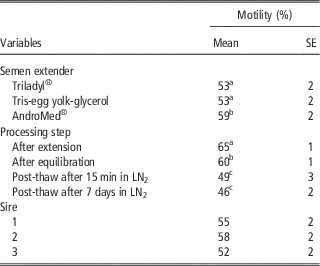
The results of Trial 1, presented in Table 1, indicate that motility of semen cryopreserved in AndroMed® extender (59±2%) was higher than in Tris-egg yolk-glycerol (53±3%) or Triladyl® extender (53±2%) (P<0.05). Motility decreased with consecutive processing steps from 65±1% immediately after addition of extender through 60±1% after the 2 h equilibration at 4°C (P<0.05) to 49±3% immediately after thawing after having resided 15 min in liquid nitrogen (P<0.05) and 46±2% after having resided 7 days in liquid nitrogen. The differences between 15 min and 7 days in liquid nitrogen were not significant; nor were differences among different sires (55±2%, 58±2% and 52±2%, P>0.05).
Spermatozoan motility (%) as affected by semen extender, processing step and individual sire

LN2=liquid nitrogen.
a,b,cMeans with different superscripts differ (P<0.05). The trial was conducted with nine replications (ejaculates) (Trial 1).
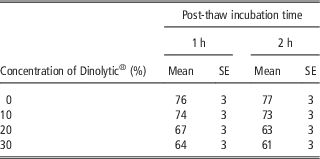
In Trial 2, mixing of frozen-thawed semen with diluent containing 0%, 10%, 20% and 30% Dinolytic® resulted in motility rates of 76±3%, 74±3%, 67±3% and 64±3%, respectively; the differences being not statistically significant (Table 2). The difference in motility rate after 1 and 2 h of incubation (72±1% v. 68±3%) were not significant either. The only significant difference was recorded among individual bulls (73±3%, 75±3% and 64±3%; P<0.05).
Spermatozoan motility (%) as affected by the amount of Dinolytic® contained in AndroMed® extender

The trial was conducted with three replications (36 straws with frozen semen per replicate) (Trial 2). No significant differences were recorded.
In the pilot insemination trial (Trial 3) conducted with straws containing separate columns of semen and extender with 0%, 30% and 60% Dinolytic®, separated by an air bubble, pregnancy rates of 44%, 41% and 56%, respectively, were achieved. Pregnancy rates achieved by the two inseminators were 48% and 46%, respectively; for cows of first (n=36), second (n=24) and third parity (n=24), they were 47%, 58% and 29%, respectively. In vitro assessment of sperm quality revealed average motility rates of 50%, 50% and 30% and intact cell membranes in 69%, 67% and 60% of spermatozoa, respectively. Given the limited number of inseminations, statistical analysis of the field data was not considered appropriate.
Discussion
Motility of frozen-thawed spermatozoa was slightly higher in the phytoextender AndroMed® than in customized Tris-egg yolk and Triladyl® extenders, both of which are egg yolk based. In the opinion of Vishwanath and Shannon (Reference Varnavskij2000), yolk globules might interfere with spermatozoan motility, whereas Aires et al. (Reference Aires, Hinsch, Mueller-Schloesser, Bogner, Mueller-Schloesser and Hinsch2003) suspect that it is due to the higher viscosity of the egg yolk containing extenders. In the literature it is controversial what type of extender is preferable. Nehring and Rothe (Reference Mueller-Schloesser, Hinsch, Boehm, Schill and Hinsch2003) rate the phytoextender AndroMed® lower than Triladyl®, especially with low sperm numbers. Likewise, Braga et al. (Reference Braga, Franco, Rodrigues, Galeli, Oliveira, Reis, Nishikawa and Moura2006) found AndroMed® to be less suitable. On the other hand, Mueller-Schloesser et al. (Reference Mohan and Atreja1995) and Cho et al. (Reference Chelucci, Pasciu, Succu, Addis, Leoni, Manca, Naitana and Berlinguer2013) found no difference between Triladyl® and Andromed®. The first to find the AndroMed® extender preferable were Aires et al. (Reference Aires, Hinsch, Mueller-Schloesser, Bogner, Mueller-Schloesser and Hinsch2003). In accord with the present findings, others confirmed this assessment for various ruminant species (Herold et al., Reference Gabriel, Wallenhorst, Dietrich and Holtz2003; Amirat et al., Reference Amirat, Anton, Tainturier, Chatagnon, Battut and Courtens2005; Janett et al., Reference Jaeger and DelCurto2005; Akhter et al., Reference Akhter, Ansari, Rakha, Andrabi, Iqbal and Ullah2010; Mohan and Atreja, Reference Memon, Gustafsson, Graham and Crabo2014; Chelucci et al., Reference Voglmayr2015), although for sheep semen there are also controversial assessments (Fukui et al., Reference Fujikawa and Miura2008; Emamverdi et al., Reference Cross2013). Many insemination organizations are hesitant to switch from the customary egg yolk to a phytoextender, because they are concerned that the latter may not be compatible with semen from all bulls and that, with the recently recommended substantial extension of the pre-freezing equilibration time, egg yolk seems to be indispensable. Furthermore, there are cost-related considerations.
In Trial 2 of the present investigation, based on the findings of Trial 1, AndroMed® was the extender of choice. In the insemination trial (Trial 3), Steridyl®, the extender customary at the AI organization at that time, was used. Its composition is identical with that of the egg yolk containing extender Triladyl® used in Trial 1, except that, instead of added fresh egg yolk, it contains irradiated sterile egg yolk.
Differences in spermatozoan motility among trials are mainly attributable to varying circumstances such as different sires, different locations and different times of the year when experiments were conducted as well as different semen extenders. Sperm motility decreased with successive processing steps in the order extension>equilibration>freezing, leading to the conclusion that there is not a single detrimental step. According to Saacke (Reference Reddy, Murty, Rao, Rao and Rao1983), a critical temperature zone sperm cells have to pass through twice during a freeze-thaw procedure lies between −10°C and −50°C. Other authors (Mazur, Reference Ledwozyw, Pruszkowska and Kadziolka1984; Fujikawa and Miura, Reference Emamverdi, Zhandi, Zare Shahneh, Sharafi and Akbari-Sharif1986; Tyler et al., Reference Salamon and Maxwell1996) are of the opinion that the principal critical stage is during transition between small and large ice crystals taking effect near −80°C.
PGF2α is a normal component of bovine semen (Voglmayr, Reference Vishwanath and Shannon1973; Ledwozyw et al., Reference Janett, Keo, Bollwein, Haessig and Thun1986; Jaeger and DelCurto, Reference Herold, Gerber and Aurich2012), in Murrah buffalo at even close to 10 times higher concentration (Reddy et al., Reference Nehring and Rothe1992). Dinoprost is the tromethamine salt of synthetically produced natural PGF2α . Upon injection it dissociates and acts like endogenous PGF2α until metabolized and eliminated from the system, which occurs within 1 to 3 h. Dinolytic®, the commercially available preparation used in the present investigation, contains the preservative benzyl alcohol. It cannot be ruled out that the preservative constitutes at least part of the problem when diluting and cryopreserving semen in Dinolytic® containing extender. Cross (Reference Cho, Cho, Han, Kang, Cho, Chae, Kim, Park, Kang, Kim, Ko, Kim and Ko2003) observed that in human semen incubation with benzyl alcohol produced effects on motility and viability ranging from no apparent change to highly deleterious, depending on the concentration. The concentration of 30% (v/v) Dinolytic® tolerated by bovine semen when added after thawing in the present study agrees with reports on bovine semen by Varnavskij (Reference Tyler, Kime, Cooke and Driscoll1981) and Memon et al. (Reference Mazur1984), reviewed by Salamon and Maxwell (Reference Saacke1995).
When accommodating semen and Dinolytic® in a single straw separated by an air bubble, intermingling takes place during the process of insemination. As contact between semen and Dinolytic® lasts only seconds and dilution in uterine secretion is to be expected immediately afterwards, addition of Dinolytic® at a concentration of 60% was risked, expecting that it might elicit more intense myometrial contractility. A few straws exploded during thawing. Otherwise the two-column straw technique met expectations in that insemination results were respectable and spermatozoan motility and viability proved to be satisfactory. In fact, pregnancy rate was highest in the group of cows inseminated with semen containing the highest concentration (60%) of Dinolytic®. Obviously the limited amount of data does not permit conclusive statements; nevertheless, the results are meaningful enough to justify a large-scale field investigation, which is envisaged.
In conclusion, from the current investigation it may be deduced that, amongst the extenders tested, AndroMed®, containing soybean lecithin instead of egg yolk as macromolecular component, was best suited for cryopreserving bovine semen. Furthermore, it was found that spermatozoa will tolerate addition of an equal part of a 30% (v/v) Dinolytic® solution if it occurs after thawing. Insemination of cows with two-column straws allowing intermingling of Dinolytic® containing extender and extended semen after thawing during the insemination process resulted in fertilization rates justifying implementation of a large-scale field study.
Acknowledgments
The investigation was supported by Foerderverein Biotechnologieforschung e.V. (FBF), Bonn, Germany. The authors are indebted to Andrea Hartmann and Dirk Teuteberg from the Goettingen University AI station as well as Gertrud Fuerst and Sandra Dirks from Georgsheil AI station for technical assistance. AndroMed® and Triladyl® extenders were made available by Minitueb, Tiefenbach, Germany and Dinolytic® by Zoetis, Berlin, Germany. Gottfried Brem from the Veterinary University Vienna deserves credit for the idea of the two-column straw.