Introduction
The emperor penguin (Aptenodytes forsteri Gray, Reference Gray1844) is an iconic Antarctic species as it is the largest living representative of the family Spheniscidae with a geographical range the most southerly of all penguins. Scientists, birders, readers of Antarctic history and movie goers alike have been fascinated by the emperor's extraordinary calendar of autumn courtship and mating in the cold far south; its egg laying, incubation and hatching in the dead of the Antarctic winter unlike any other avian species; and the race to get the chicks fed and mature enough for the moult and independence before the summer season runs out.
The adult emperor ranges in height from 100 to 130 cm and in weight from 20 to 40 kg. The next largest living penguin species is the king penguin (Aptenodytes patagonicus), adults ranging in height from 85 to 95 cm and in weight from 9.5 to 17 kg. The emperor and king are the only two living Aptenodytes species. The emperor's range is circumpolar, about 66–78°S, whereas the king is found on sub-Antarctic islands at about 45–55°S; emperors seldom stray north of their range and kings are rarely observed south of theirs (Williams, Reference Williams1995, pp. 15–16, 144, 153, Plate 1). Given the emperor's range, it is no surprise that it was the last living penguin species to be discovered and only when our forebears had the means to penetrate the highest south latitudes. This report examines the history of human awareness of the emperor penguin up to 1911, the year of the remarkable ‘winter journey’ from Cape Evans to Cape Crozier during the British Antarctic Expedition under Robert F. Scott.
The first voyage of exploration that ventured well into the range where emperors could have been recorded was the second voyage of James Cook in 1772–1775 on the Resolution and Adventure, an intended high south latitude circumnavigation. When George Robert Gray, chief ornithologist of the British Museum, examined emperor specimens brought back by James Clark Ross from his Antarctic voyage of 1839–1843, he attributed discovery of the emperor to naturalist Johann Reinhold Forster who accompanied Cook, and Gray thus named the emperor Aptenodytes forsteri in Forster's honour (Gray, Reference Gray1844):
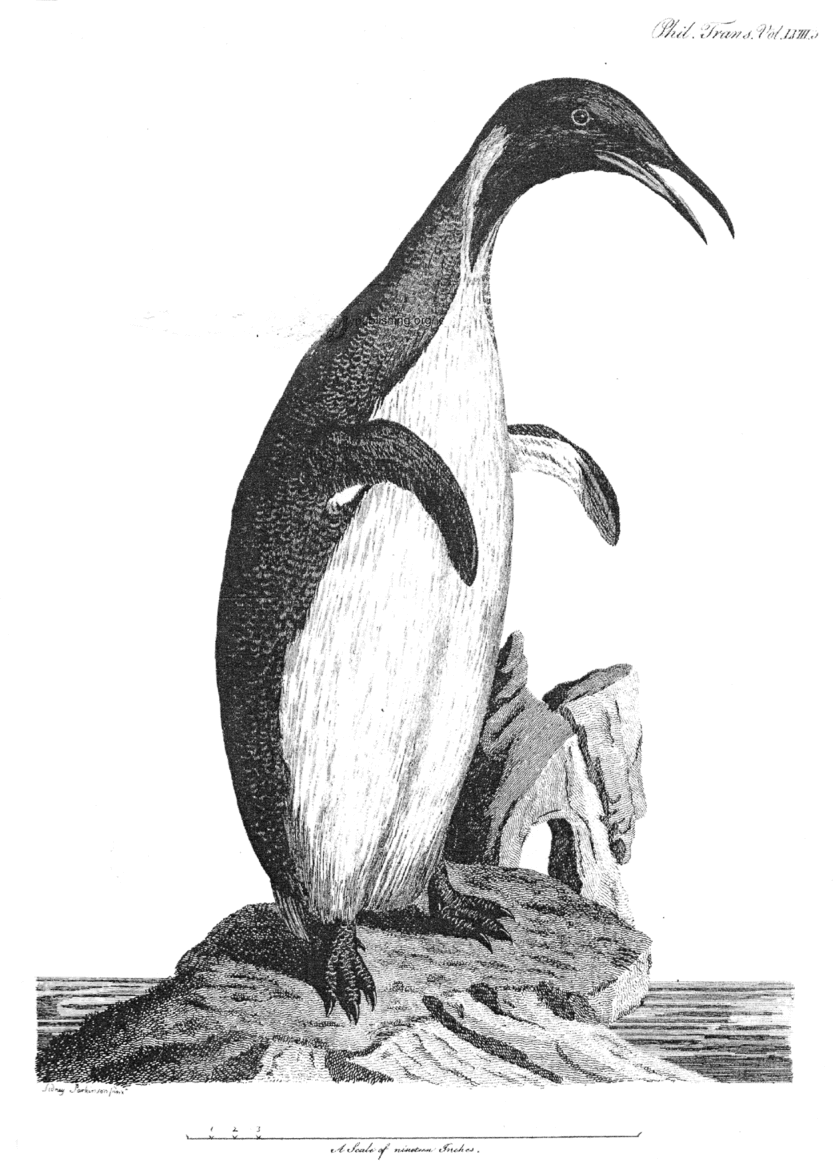
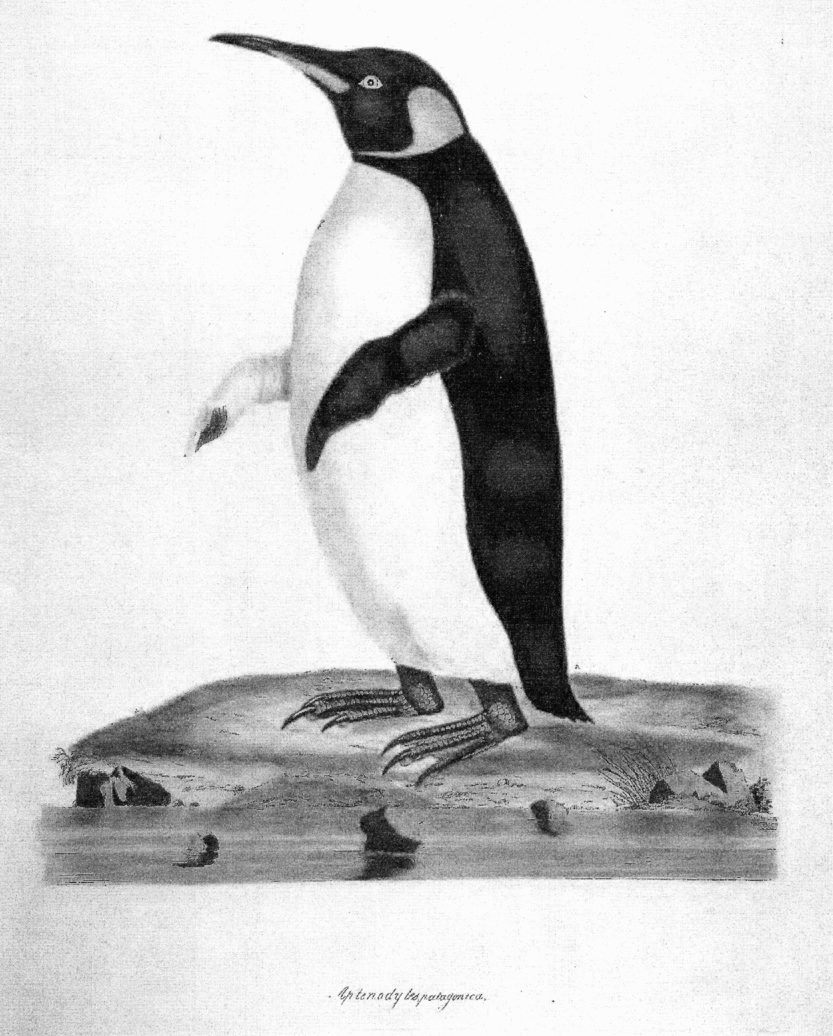
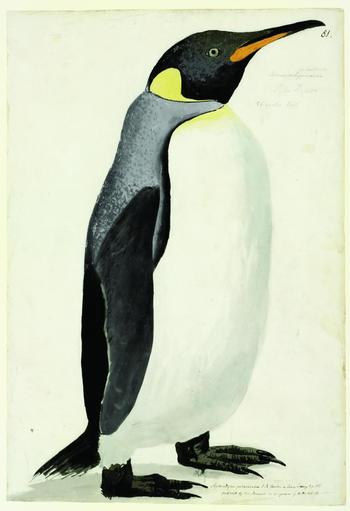
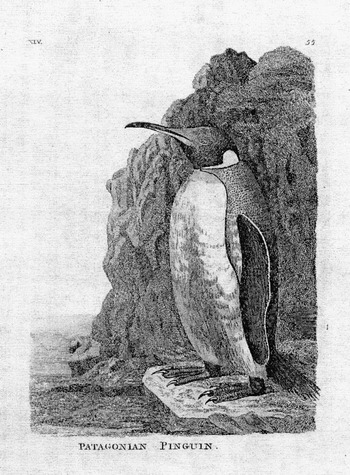
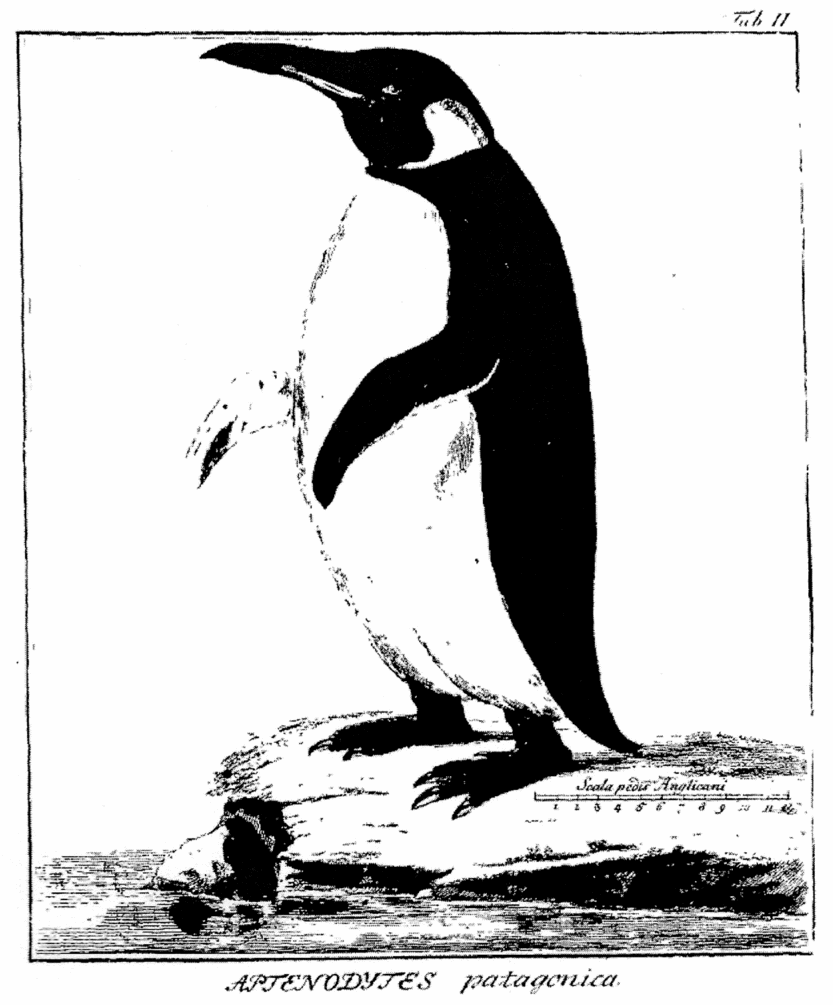
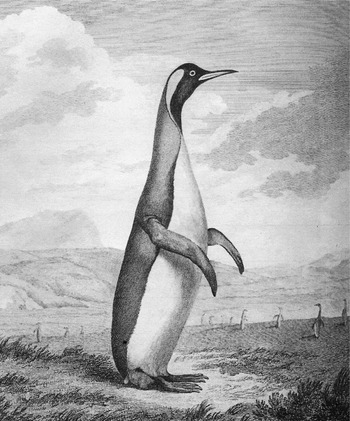
The Antarctic Expedition having brought home several specimens of this genus, we are now enabled to clear up the doubt which has long existed with regard to the question, whether there be more than one species. The result of a careful comparison is, that there are two species confounded under the appellation of Aptenodytes patachonica. The Patagonia Penguin of Pennant (in the Phil. Trans. xviii. 91) [Pennant, Reference Pennant1768, pp. 91–99] [Fig. 1] is I believe the original figure, but on comparing it with those of most modern authors, there can be no doubt that they are distinct. The author who first gave the Latin specific name was Shaw, who described the figure of J. F. Miller (Illustr. Nat. Hist. t. 33.) [Miller, Reference Miller1776–1782a, Reference Miller1776–1782b, Tab. XXIII; Miller & Shaw, Reference Miller and Shaw1796] [Fig. 2]. This figure was copied from the drawings of the Forsters [Fig. 3], who accompanied the great Cook in his second expedition; and the same figure was also copied by Pennant in his ‘Genera,’ t. 14 [Pennant, Reference Pennant1781, Plate XIV] [Fig. 4], and by J. R. Forster in the ‘Commentationes Gottingenses,’ iii. t. 11 [Forster, Reference Forster1781, Tab. II] [Fig. 5]. Now Shaw's Aptenodytes patagonica, taken from Forster's drawings [Fig. 3], is not the Patagonian Penguin of Pennant in the ‘Philosophical Transactions,’ but a distinct species, which the [Ross] voyagers term the “Emperor,” while that of Pennant is their “King.” . . . The “Emperor” is unquestionably the Aptenodytes Patachonica of Shaw in Miller's ‘Illustrations,’ [Fig. 2] but not of the same author in the Leverian Museum [Shaw, Reference Shaw1792, pp. 147–148] [Fig. 6], where the bird figured under that name is the King.” It seems desirable therefore, to avoid confusion, both Pennant and Shaw having on different occasions given the name of Patagonian Penguin and Aptenodytes Patachonica to each of the two species, to suppress those names altogether, and to call Pennant's species (the “King”) Aptenodytes Pennantii, and Forster's (the “Emperor”) Aptenodytes Forsteri.”
Thomas Pennant, unknown artist, 1768.

John Frederick Miller, artist, 1776-1782.

Georg Forster, artist, 17 January 1775. © The Trustees of the Natural History Museum, London.

Thomas Pennant, unknown artist, 1781.

Johann Reinhold Forster, unknown artist, 1781.

George Shaw, unknown artist, 1792.

However, Gray was in all probability mistaken. The illustrations produced by Georg Forster (J. R. Forster's son, assistant, and illustrator on the voyage) and John Frederick Miller (with accompanying description by George Shaw of the natural history section of the British Museum) (Shaw, Reference Shaw1792, pp. 147–148), as well as the ones authorised by Thomas Pennant, were all of the king penguin (Figs 1–6). The original texts accompanying the figures support identifications as the king. Inaccuracies in the depictions, however, probably contributed to Gray's ‘doubt which has long existed’. After all, most of the illustrators of the period had never seen a living penguin. In particular, Georg Forster's illustration (Fig. 3) probably created difficulties for Gray. The general body habitus and yellow colour of the patch and upper breast suggest the emperor. But some kings appear chunky and are yellowish rather than orange; the head pattern in Forster's painting is typical for the king; and a contemporary pencilled notation on the illustration at upper right gives the height as 3 feet (91.4 cm) and date as 17 January 1775, the day Cook first landed at South Georgia (at Possession Bay). Gray obviously could not have had at his disposal data on variation in colourations, sizes and ranges of the king and emperor. He could not have known that an emperor at South Georgia would have been accidental. Averil Lysaght of the British Museum considered illustrations attributed to Georg Forster to be of the king penguin (Lysaght, Reference Lysaght1959, pp. 291–292, 314). Nevertheless, Gray, with Ross's specimens in hand, could now be confident—and he was correct—in defining two distinct species of the largest penguins.
No evidence exists, however, that Cook, either of the Forsters or other scientists aboard, all of whom were keen observers, ever identified the emperor based on the first-hand narratives (Anonymous, 1776; Cook, Reference Cook1777; Forster, Reference Forster1777; Marra, Reference Marra1775; Sparrman, Reference Sparrman and Rutter1944), primary scientific reports (Forster, Reference Forster1778, Reference Forster1788, Reference Forster and Lichtenstein1844), J. R. Forster's definitive treatise on the penguins ‘Historia Aptenodytes’ (Forster, Reference Forster1781) and the important secondary sources (Beaglehole, Reference Beaglehole1961, Reference Beaglehole1974; Fogg, Reference Fogg1992; Hoare, Reference Hoare1976, Reference Hoare1982; Joppien & Smith, Reference Joppien and Smith1985; Murray-Oliver, Reference Murray-Oliver1969; Steiner & Baege, Reference Steiner and Baege1971).
Additional evidence against an emperor sighting comes from Cook and the Forsters’ observations at South Georgia in January 1775 when they would never again be in the emperor's range. The Forsters gave thorough descriptions of the kings there and estimated body weight as 40 lbs. (18.2 kg) (Forster, Reference Forster1777, II: pp. 528–529; Hoare, Reference Hoare1982, IV: p. 715). And Cook wrote, ‘Here were flocks of penguins, the largest I ever saw. . .’, giving the kings’ weights as 29–38 lbs. (13.2–17.3 kg) (Cook, Reference Cook1777, II: p. 214). Cook's statement in particular is especially persuasive evidence that they never saw the appreciably larger emperor penguin. Or, if they did, perhaps viewing from a distance, they did not appreciate dissimilarity from the king.
Of passing note and interest is that when Cook was at his farthest south, 71°10′S, 106°54′W, on 30 January 1774, both he and J. R. Forster heard penguins but did not see them owing to dense fog (Cook, Reference Cook1777, I: p. 268; Hoare, Reference Hoare1982, III: p. 451). At that location, the only possible penguin species would have been the Adélie and the emperor. J. R. Forster described the sounds as ’croaking’; while such a description is not sufficiently specific to designate which species the men heard, of interest is that Edward Wilson, ornithologist and head of science during the Antarctic expeditions of Robert F. Scott in 1901–1904 and 1910–1913, described the call of the Adélie penguin as a ‘harsh croak’ (Wilson, Reference Wilson1907, p. 18). The vocalisation of the emperor is ‘trumpeting’ (Williams, Reference Williams1995, pp. 151–152). J. R. Forster probably never saw with certainty the Adélie penguin since he did not describe this species in ‘Historia Aptenodytes’ (Forster, Reference Forster1781).
Gray's attribution of the emperor's discovery to J. R. Forster was perpetuated by Ross himself in his 1847 narrative (Ross, Reference Ross1847, II: pp. 158–159). Ross was presumably content to accept and repeat Gray's Reference Gray1844 assessment as he himself was not an ornithologist although he had a background in zoology. Credit to Forster continues to be found in important publications to this day (Wienecke, Reference Wienecke2010). The binomial Aptenodytes forsteri has probably helped serve to perpetuate Gray's problematic assertion, yet it appears to be a misnomer. I would suggest that until such time evidence surfaces proving Cook and the Forsters discovered the emperor penguin, attribution to them ought no longer to be assumed.
To whom, then, may the discovery—or at least the first convincing published description—of the emperor penguin be attributed? It would appear to be the Russian navigator Thaddeus von Bellingshausen during his circumnavigation of Antarctica on the Vostok and Mirny in 1819–1821, the first circumnavigation undertaken after Cook. In Bellingshausen's Russian language narrative (Bellingshausen, Reference Bellingshausen1831), only much later translated into English (Bellingshausen, Reference Bellingshausen and Debenham1945), he provided a description of the emperor on 15 December 1820, his location having been 67°15′30″S, 161°27′50″W the day before:
Mr. Ignatiev returned with some booty, as he brought back a penguin of the Royal species, an unusually large one, 3 feet [91.4 cm] in height and weighing 59 lb [26.8 kg] (Bellingshausen, Reference Bellingshausen and Debenham1945, II: p. 388).
It had a sharp beak and black feet. Yellow patches extend from the ears on each side to the front part of the neck and merge into the white breast (Bellingshausen, Reference Bellingshausen and Debenham1945, II: p. 429).
Bellingshausen's descriptions of weight and head pattern conform to no other species. He did not state the bird represented a new species, surprising because the ships’ parties including the expedition artist Pavel Mikhailov encountered the distinctly different king penguin at Macquarie Island (Bellingshausen, Reference Bellingshausen and Debenham1945, II: p. 364). The given height was short for an emperor, but it may have been a rounded measurement. The atlas of 64 plates and charts accompanying the 1831 narrative (Bellingshausen, Reference Bellingshausen1831) included illustrations of the macaroni and chinstrap penguins but not the emperor; the atlas was not intended to show all bird species observed. Gray was probably unaware of Bellingshausen's report since he did not mention it. Gray would have been disadvantaged by lack of a translation of the rare Russian original; the book was not translated until 1902 (into German).
Did the early 19th century sealers in the region of the Antarctic Peninsula sight the emperor penguin? Depending on location, occurrence of the emperor is infrequent to rare. The English merchant captain William Smith on the Williams discovered the South Shetland Islands on 19 February 1819 when he sought a more southerly route for favourable weather between Buenos Aires and Valparaiso. He confirmed his land discovery in October and landed on King George Island. In December of the same year the British Admiralty sent William Bransfield south from Valparaiso with Smith as pilot, again on the Williams, for surveys. British and American sealers were already heading south on speculation that Smith's observations were correct. Intense sealing activity lasted well into the 1820s before the depletion of seals turned this enterprise unprofitable.
Only occasional observations on the wildlife of the South Shetland Islands during that period were recorded. A member of Bransfield and Smith's party mentioned five kinds of penguins (Campbell, Reference Campbell2000, p. 87). Four were surely the Adélie, gentoo, chinstrap and macaroni. Which was the fifth? Both the king and emperor were possible if improbable. The American scientist James Eights who accompanied Benjamin Pendleton and Nathaniel Palmer in 1829–1830 on the Seraph and Annawan to the South Shetland Islands and reported his observations described in detail abundant king penguins but probably included his visit to Isla de los Estados (Staten Island) on the way south without site clarification. Eights did not describe the emperor (Eights, Reference Eights and Fanning1838, p. 211). Some of the sealers (who were largely interested in profit and not birds) may have observed emperors, possibly even just before Bellingshausen, but no published accounts exist from the sealers and explorers other than Bellingshausen's through 1840 (Bertrand, Reference Bertrand1971; Dumont d'Urville, Reference Dumont d'Urville1842–53; Duyker, Reference Duyker2014; Eights, Reference Eights and Fanning1838; Fanning, Reference Fanning1833; Fogg, Reference Fogg1992; Mitterling, Reference Mitterling1959; Morrell, Reference Morrell1832; Murray, Reference Murray1901, pp. 225–238, 305–347, 436–464; Rosenman, Reference Rosenman1987; Smith, Reference Smith1844; Webster, Reference Webster1834; Weddell, Reference Weddell1825).
The United States Exploring Expedition of 1838–1842 under Charles Wilkes, with a starting fleet of six ships, included extensive investigation of the Antarctic regions. On 23 January 1840, Wilkes on the Vincennes recorded the following:
Mr. Eld's boat succeeded in taking a king-penguin of enormous size, viz.: from tip of tail to the bill, forty-five inches [114.3 cm]; across the flippers, thirty-seven inches [94.0 cm]; and the circumference of the body, thirty-three inches [83.8 cm]. . . . [He] now graces the collection at Washington. In his craw were found thirty-two pebbles, from the size of a pea to that of a hazel-nut (Wilkes, Reference Wilkes1845: II: p. 299).
The bird was officially registered at the Smithsonian Institution in volume 4 of the hand ledger catalogues along with many of the expedition's specimens:
USNM 15666, Aptenodydes patachonica [sic], Lat. 66°52′ S. Long. 150°25′ E. Jan 23, 1840. U. S. Ex. Ex. Captured alive by Midshipman Eld & a party from the “Peacock”. Prepared by T. R. Peale. When entered: 1859 Sept. 5.
This bird was clearly an emperor; Wilkes's report is only the second documented identification. The principal significance to Wilkes seemed to be that the pebbles meant his ships were near land. Titian R. Peale, the ornithologist and artist aboard the Peacock, like Bellingshausen, did not appreciate that this penguin was distinct from the king, referring to this only specimen brought home as a ‘Patagonian Pinguin [sic]. Aptenodytes Patachonica.’ in the official report (Peale, Reference Peale1848, p. 258), while recording no comment in his diary (Poesch, Reference Poesch1961, p. 166). Zoologist John Cassin readdressed Peale's report ten years later, continued to refer to the bird as Aptenodytes patachonica, but stated that the Wilkes specimen ‘appears to be that described by Forster and to which Gray has given his name’ (Cassin, Reference Cassin1858a, pp. 349–350.). Cassin's text thus indicated ongoing confusion in nomenclature of the two species and perpetuating who he thought had discovered the species. He did not illustrate the emperor in the atlas of plates (Cassin, Reference Cassin1858b).
Jules S.-C. Dumont d'Urville's voyage of 1837–1840 on the Astrolabe and Zelée sailed within the emperor's range, but the explorers did not identify the species. However, Edward Wilson described an egg he personally examined that Dumont d'Urville had brought back (Wilson, Reference Wilson1907, pp. 28–30). Based on Wilson's own emperor and king penguin egg size data, similar to modern data (Williams, Reference Williams1995, pp. 150, 158), Wilson considered Dumont d'Urville's specimen at 10.9 cm x 7.7 cm small for an emperor but average for a king. However, considerable overlap in egg sizes exists between the two species (Williams, Reference Williams1995, pp. 150, 158). For unclear reasons, Wilson seemed convinced the egg was that of the emperor, but this conclusion is better considered speculation.
James Clark Ross's voyage of discovery and research to the Antarctic regions on the Erebus and Terror took place in 1839–1843. On 31 January 1841 at 77°6′S, 189°6′ (170°54′W) while sailing along the face of the Ross Ice Shelf, Ross reported that ‘a king penguin of unusual size was seen on a piece of ice’ (Ross, Reference Ross1847, I: p. 220). On 4 February 1841 the surgeon and zoologist Robert McCormick reported large penguins, and the following day shot and wounded three of them, two weighing 66 lbs. (30.0 kg) each and the third 57 lbs. (25.9 kg) (McCormick, Reference McCormick1884, I: p. 167). The ships were not far from the Cape Crozier emperor penguin rookery that went undiscovered until 1902. The following year, in January 1842, John E. Davis, second mate on the Terror, commented on penguins weighing upwards of 70 lbs. (31.9 kg) (Davis, Reference Davis1901, p. 16). Penguins of such size could only have been emperors, even without further description. Gray states it was the explorers themselves who assigned the common name “emperor penguin” to this species (Gray, Reference Gray1844).
On 27 January 1842, McCormick provided the first description of the juvenile emperor at 67°39′S, 155°59′E., where he saw two on sea ice. The birds were advanced chicks in grey plumage, not yet moulted as would be expected for that time of year. He was able to secure them for the government collection. They weighed 37 and 35 lbs. (16.8 and 15.9 kg) (McCormick, Reference McCormick1884, I: p. 265).
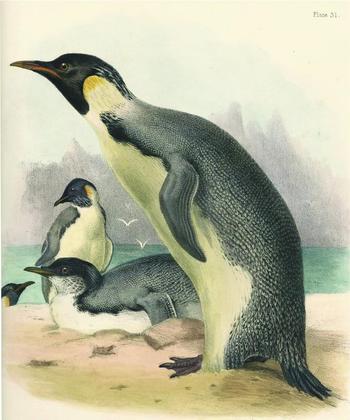
The first illustration of the emperor ever produced was prepared under Gray's direction for publication in The Zoology of the Voyage of H.M.S. Erebus and Terror (Richardson & Gray, Reference Richardson and Gray1844–1848, Reference Richardson and Gray1874–1875). Plate 31, titled ‘APTENODYTES FORSTERI G. R. Gray’, accurately depicts adults and a juvenile (Fig. 7). At the lower left, the plate bears the imprint ‘Wolf del et lith’. Joseph Wolf was German-born and one of the finest wildlife illustrators of his day; he moved his work to the British Museum in 1848. The plate also bears the imprint of ‘Hullmandel & Walton’ at lower right. Charles Joseph Hullmandel and Joseph Fowell Walton collaborated as lithographers and printers; Hullmandel died in 1850. Thus the plate was probably created and printed in the 1848–1850 time frame.
George Robert Gray; Joseph Wolf, artist; 1848-1850.

Publication of the Zoology took place in parts from 1844–1848, then lack of funding resulted in a hiatus until Reference Richardson and Gray1874–1875 when the project was completed, including Plate 31. Gray died in 1872; his older brother John Edward Gray, keeper of zoology at the British Museum, oversaw the completion of the report on birds arranged by Richard Bowdler Sharpe, the museum's bird curator. Ironically, J. E. Gray died in March 1875 just before the final bird report containing the emperor plate was published in April (Richardson & Gray, Reference Richardson and Gray1875; Rosove, Reference Rosove2001, p. 315, Reference Rosove2008, p. 25; Sharpe, Reference Sharpe1875). Sharpe's text continued to reveal ongoing confusion over the scientific name of the emperor, seemingly equating Aptenodytes forsteri and Aptenodytes patachonica (Sharpe, Reference Sharpe1875, pp. 38–39).
By now Antarctic explorers were aware of the emperor penguin, and emperors were observed and commented upon without elaboration during the Dundee Whaling Expedition (1892–1893) (Murdoch, Reference Murdoch1894, pp. 238–240) and the voyages of Carl Larsen (1892–Reference Murdoch1894) (Kløver, Reference Kløver2016, p. 61), Henryk Johan Bull (1893–1895), Adrien de Gerlache (1897–1899) and Carsten Borchgrevink (1898–1900) (the latter with photographs of the species) (Sharpe, Reference Sharpe1902, pp. 106, 109).
The next remarkable episode in the history of mankind's interaction with the emperor penguin occurred during the National Antarctic Expedition of 1901–1904 on the Discovery under Robert F. Scott, when the first emperor breeding colony was serendipitously discovered. On 31 January 1902, Scott, Wilson and the chief engineer and photographer Reginald Skelton all commented on large numbers of emperors at Cape Crozier, the easternmost extension of Ross Island where the Ross Ice Shelf abuts and flows around it. Wilson and Skelton were satisfied the site was a breeding colony, but Scott hesitated, desiring stronger evidence (Savours, Reference Savours1966, pp. 109–110; Scott, Reference Scott1905, I: p. 187; Skelton, Reference Skelton2004, p. 49).
The following season, Skelton led an early spring overland party from the ship anchored in Winter Quarters Bay in the southernmost recess of McMurdo Sound to Cape Crozier. On 12 and 18 October 1902, Skelton and his party saw several hundred huddled emperors, with discolouration of the ice and a number of dead chicks attesting to the birds’ lengthy residence there (Skelton, Reference Skelton2004, pp. 118–121). Evidence of a breeding colony was thus convincing. Scott and Wilson were elated when Skelton brought the news back to the ship (Savours, Reference Savours1966, pp. 205–206; Scott, Reference Scott1905, II: pp. 5–8).
Expedition members including Wilson made further 160 km round trips to Cape Crozier, making on-site observations, preparing skins, and bringing back to the ship frozen eggs and chicks whether alive or dead. Wilson found to his dismay on a visit in mid-September the following year that all eggs were already hatched; he knew that to obtain unhatched, viable eggs some future party would require a mid-winter arrival. Unbeknownst to Wilson, he was destined to head such a party eight years later. Meanwhile, his 31-page treatise on the emperors in the expedition's reports was an extraordinary revelation of physical descriptions, life cycle, breeding habits, behaviour, locomotion on land and in water, diet, and predators. The text was supplemented by Wilson's stunningly beautiful, meticulously detailed paintings and sketches of adults, chicks and eggs, supplemented by photographs (Wilson, Reference Wilson1907, pp. 1–31, Plates I–VII).
No further significant contributions to the knowledge of emperor penguins emerged from the Heroic Era of Antarctic exploration. Even so, one episode worthy of note is the famous ‘winter journey’ that took place during the British Antarctic Expedition of 1910–1913 on the Terra Nova (better known as ‘Scott's Last Expedition’). Wilson, again in charge of science, believed the emperor penguin was a primitive species, and as such, embryologic study of its eggs might shed light on the relationship of birds to reptiles. Wilson organised a mid-winter overland journey from the expedition base at Cape Evans to Cape Crozier. This round trip, about 210 km, would be lengthier than the trips from Winter Quarters Bay in 1902–1903, and under arrestingly frigid temperatures in darkness. Wilson took with him his assistant Apsley Cherry-Garrard and Henry ‘Birdie’ Bowers, keeper of stores. The trek was 36 days of unimaginable difficulty and suffering lasting from 27 June to 1 August 1911 that Cherry-Garrard called ‘the weirdest bird's-nesting expedition that has ever been or ever will be’ (Cherry-Garrard, Reference Cherry-Garrard1922, I: p. 234). The rationale and details of the journey are well known (Cherry-Garrard, Reference Cherry-Garrard1922, pp. 230–300; King, Reference King1972, pp. 141–161; Wilson, Reference Wilson, Bowers and Cherry-Garrard1913, II: pp. 1–77); suffice to say that while the three eggs the men brought back yielded no new scientific insights, the ‘winter journey’ remains one of the most enduring tales of hardship for the sake of science in the annals of Antarctic exploration or any other venue. The Scott expeditions significantly advanced scientific study of the emperor penguin that continues to this day. Since 1902, over 40 emperor colonies have been identified (Fretwell et al., Reference Fretwell, LaRue, Morin, Kooyman, Wienecke, Ratcliffe and Trathan2012).