Introduction
It is now widely acknowledged that deficits in verbal memory, attention and executive functions may be found in euthymic bipolar disorder (BD) patients, and they have been proposed as trait markers of these disorders in a way that most people would agree with (Glahn et al. Reference Glahn, Bearden, Niendam and Escamilla2004; Savitz et al. Reference Savitz, Solms and Ramesar2005; Robinson & Ferrier, Reference Robinson and Ferrier2006). Among cognitive functions, decision-making difficulties are included in clinical descriptions of both depressive and manic episodes (DSM-IV). Observational evidence suggests that patients who have experienced a depressive episode often have difficulty in making decisions; this includes even minor problems in tasks such as dressing. However, manic patients are frequently involved in a range of risky behaviors, such as spending sprees and sexual indiscretions, that have high potential for painful consequences. By contrast, a significant percentage of clinically euthymic BD patients can make important decisions in daily situations without any problems, even in a highly demanding context.
Bechara et al. (Reference Bechara, Damasio, Damasio and Anderson1994) developed an experimental paradigm, the Iowa Gambling Task (IGT), intending to simulate real-life decision-making processes. The original experimental findings demonstrated the importance of the integrity of the ventromedial prefrontal cortex in normal performance in the IGT (Bechara et al. Reference Bechara, Damasio, Damasio and Anderson1994, Reference Bechara, Tranel and Damasio2000). However, later research also highlighted the importance of other prefrontal regions for this task, including the dorsal and medial prefrontal cortex (Ernst et al. Reference Ernst, Bolla, Mouratidis, Contoreggi, Matochik, Kurian, Cadet, Kimes and London2002; Manes et al. Reference Manes, Sahakian, Clark, Rogers, Antoun, Aitken and Robbins2002). The IGT and another decision-making paradigm, the Cambridge Gamble Task (Rubinsztein et al. Reference Rubinsztein, Paykel and Sahakian2000; Murphy et al. Reference Murphy, Rubinsztein, Michael, Rogers, Robbins, Paykel and Sahakian2001; Rubinsztein et al. Reference Rubinsztein, Michael, Underwood, Tempest and Sahakian2006), have been used most frequently in studies in BD over the past decade. Prior research consistently showed, according to clinical observations, that both manic (Clark et al. Reference Clark, Iversen and Goodwin2001; Murphy et al. Reference Murphy, Rubinsztein, Michael, Rogers, Robbins, Paykel and Sahakian2001; Adida et al. Reference Adida, Clark, Pomietto, Kaladjian, Besnier, Azorin, Jeanningros and Goodwin2008) and depressive BD patients (Murphy et al. Reference Murphy, Rubinsztein, Michael, Rogers, Robbins, Paykel and Sahakian2001; Rubinsztein et al. Reference Rubinsztein, Michael, Underwood, Tempest and Sahakian2006) had impairments in decision-making cognition. However, studies remain controversial regarding the decision-making abilities of euthymic patients, and no studies have assessed specifically the decision-making performance of patients with BD type II (BD-II). In earlier studies, euthymic patients with BD type I (BD-I) demonstrated a similar performance to that of healthy controls (Rubinsztein et al. Reference Rubinsztein, Paykel and Sahakian2000; Clark et al. Reference Clark, Iversen and Goodwin2002), suggesting that decision-making impairments are state dependent. By contrast, more recent studies on euthymic patients reported an overall IGT score in the impaired range (+1.0) (Christodoulou et al. Reference Christodoulou, Lewis, Ploubidis and Frangou2006) and also found that the diagnosis of BD was linked with low decision-making performance (Jollant et al. Reference Jollant, Guillaume, Jaussent, Bellivier, Leboyer, Castelnau, Malafosse and Courtet2007), suggesting that it is a trait maker of BD.
Further preliminary evidence suggests an association between impairments in decision making and vulnerability to suicidal behavior. Two studies with mixed samples of psychiatric patients (affective disorders, anxiety disorders, eating disorders and substance abuse) found that patients with a history of suicide attempt had lower performance in the IGT than affective and healthy controls (Jollant et al. Reference Jollant, Bellivier, Leboyer, Astruc, Torres, Verdier, Castelnau, Malafosse and Courtet2005, Reference Jollant, Guillaume, Jaussent, Bellivier, Leboyer, Castelnau, Malafosse and Courtet2007). The implications of these findings are highly significant for our understanding of BD, as nearly one-third of patients admit at least one suicide attempt and 10–20% do commit suicide (Muller-Oerlinghausen et al. Reference Muller-Oerlinghausen, Berghofer and Bauer2002). To our knowledge, only one previous study (Malloy-Diniz et al. Reference Malloy-Diniz, Neves, Abrantes, Fuentes and Correa2009) has explored specifically the relationship between impaired decision making and vulnerability to suicidal behavior in BD. In that study, patients with BD-I, having mild depressive to mild hypomanic symptoms, were divided into those with (n=18) and without (n=21) a history of suicide attempt. Suicide attempt patients scored worse than non-suicide attempt patients on measures of decision making without differences between groups in measures of verbal memory, attention and executive functions (Malloy-Diniz et al. Reference Malloy-Diniz, Neves, Abrantes, Fuentes and Correa2009).
From a practical perspective, it is important to understand the decision-making cognition of euthymic bipolar patients because of its impact on the vocational and social challenges that patients face in their daily life; and, for obvious reasons, it is crucial to understand its possible connection with the risk of future suicide. Therefore, the main aim of this study was to explore performance in a decision-making paradigm in a large sample of BD-I and BD-II patients with stringent euthymia criteria. An additional aim was to compare performance in a decision-making task between patients with and without a history of suicide attempt. Based on previous studies we hypothesized that BD patients with a history of suicide attempt would show poor performance in decision-making cognition.
Method
Eighty-five subjects with BD (48 BD-I and 37 BD-II) were selected consecutively from the out-patient population of the Bipolar Disorder Program of Favaloro University with the following inclusion criteria: age 18–60 years; diagnosis of BD-I or BD-II according to DSM-IV using the SCID (First et al. Reference First, Spitzer, Gibbon and Williams1996); euthymic [defined by a Hamilton Depression Rating Scale (HAMD) score ⩽8 and a Young Mania Rating Scale (YMRS) score ⩽6] for at least 8 weeks. Exclusion criteria were: antecedent history of substance abuse, history of mental retardation, neurological disease, or any clinical condition that could affect cognitive performance. In addition, 34 healthy controls matched by age and years of education were included; these had no antecedence of neurological disease, or history of psychotic or affective disorders in themselves or in a first-degree family member, and were not taking psychotropic medication. The study was approved by the Hospital Ethics Committee and all subjects gave written informed consent for their participation after receiving a complete description of the study.
Clinical assessment
In addition to the SCID, all subjects were evaluated with the HAMD (Hamilton, Reference Hamilton1960) and the YMRS (Young et al. Reference Young, Biggs, Ziegler and Meyer1978). Additional clinical information was obtained from clinical charts and direct patient interviews. A suicide attempt was defined as a self-damaging act carried out with some intent to die and distinguished from other self-destructive types of behavior, such as self-mutilation or substance abuse.
Neurocognitive assessment
Patients and healthy controls completed a neurocognitive battery selected to assess: (1) attention [Backward Digit Span (Wechsler, Reference Wechsler1955) and the Trail Making Test Part A (Reitan, Reference Reitan1958)]; (2) verbal memory [Memory Battery of Signoret (Signoret & Whiteley, Reference Signoret and Whiteley1979)]; and (3) executive functions [Semantic and Phonological Fluency (Benton et al. Reference Benton, Hamsher and Sivan1983); the Trail Making Test Part B (Reitan, Reference Reitan1958); and the Wisconsin Card Sorting Test (WCST; Heaton, Reference Heaton1981)]. In addition, the estimated pre-morbid IQ was calculated by the Wechsler Adult Intelligence Scale (WAIS) vocabulary subtest (Wechsler, Reference Wechsler1955).
The IGT (Bechara et al. Reference Bechara, Damasio, Damasio and Anderson1994)
This computerized task involves the subject making 100 choices from four decks of cards, A B C and D. Each card choice results in the subject either winning or losing money, and at the start of the task, the reward and punishment contingencies of the different decks are unknown. Healthy controls will sample from the four decks and realize, over time, that decks A and B provide high rewards, but the occasional high losses more than cancel them out, so that there is a net loss over time. These decks are effectively ‘high risk’. Decks C and D, by contrast, provide smaller wins but the punishments are also less, and repeated picks result in overall profit. These decks are ‘low risk’. The dependent variable on this task is the Net Score, calculated by subtracting the number of choices from the risky decks (A+B) from the choices from the safe decks (C+D). For the purpose of analysis, the task is divided into five blocks, each of 20 consecutive card choices, to quantify the change in decision making across the course of the task.
One experienced psychiatrist (S.A.S.) clinically examined all subjects. All neuropsychological tests were administered by another physician (D.M.) in a quiet testing room, according to a standardized order.
Statistical analysis
The three groups (BD-I, BD-II and healthy controls) were compared in clinical and demographic variables using an ANOVA and χ2 tests as appropriate. A Tukey post-hoc comparison procedure was used followed by an ANOVA when significant main effects were present. Cognitive variables were normally distributed (as assessed by the Kolmogorov–Smirnov test) and were analyzed with a parametric statistical test (ANOVA/Tukey) thresholded at p<0.05 (two-tailed). Group differences in the chronological selection of advantageous versus disadvantageous decks in the IGT were examined using a repeated-measures ANOVA with group (BD-I, BD-II and healthy controls) as a between-subject factor and time (five blocks of 20 trials) as a within-subject factor. Finally, Pearson correlation coefficients were calculated to test for the associations between clinical variables and performance on the IGT. We repeated these analyses to compare patients with and without a history of suicide attempt.
Results
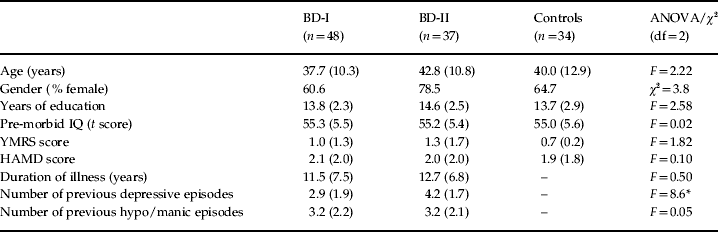
The clinical and demographical features of the bipolar patients and healthy controls are shown in Table 1; no differences were found between groups in terms of age, gender, years of education, pre-morbid IQ, and scores on the YMRS and HAMD. Patients with BD-II had a significantly higher number of previous depressive episodes than BD-I patients. All patients were receiving mood stabilizers at the time of testing; 34% were also receiving antidepressants, 48% benzodiazepines, and 58% antipsychotics. Patients with BD-I had higher exposure to antipsychotics than those with BD-II (69.76% v. 46.87%, χ2=4.0, df=1, p=0.045); no differences were found between patients groups in terms of exposure to other groups of psychotropic medications.
Clinical and demographic characteristics of bipolar patients and healthy controls

BD, Bipolar disorder; YMRS, Young Mania Rating Scale; HAMD, Hamilton Depression Rating Scale; df, degrees of freedom.
Values are expressed as mean (standard deviation).
* p<0.01.
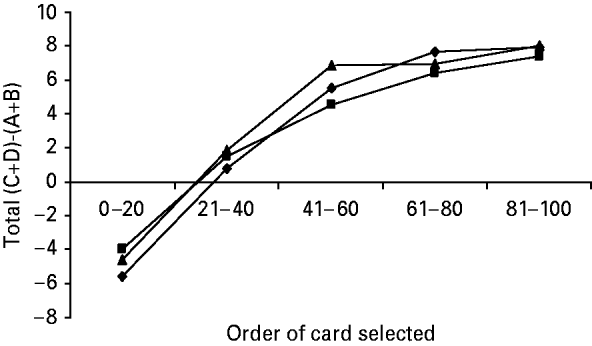
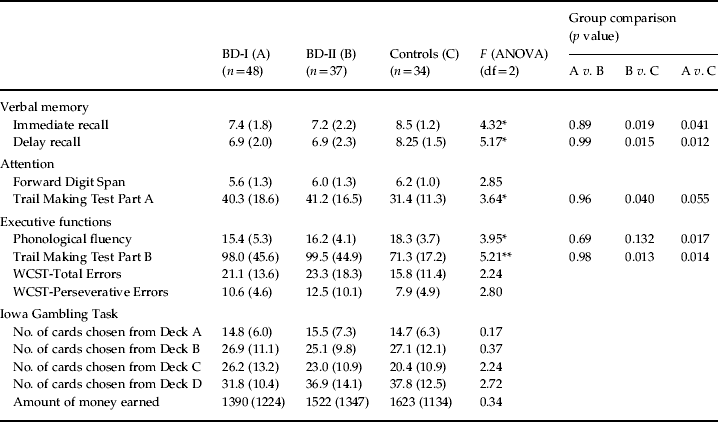
The results of the neurocognitive evaluation of bipolar patients and healthy controls are shown in Table 2. Patients showed poorer performance than healthy controls in measures of verbal memory, attention and executive functions. By contrast, no differences between groups were found in the selection of decks or the amount of money earned in the IGT (Table 2). Regardless of the chronological selection of cards, there was significant main effects for block (F=6.45, p<0.001), whereas effects for group (F=0.14, p=0.87) and interaction effect did not reach significance (F=0.53, p=0.59) (Fig. 1). There was a significant correlation between cards chosen from deck C and years of education (R=0.25, p=0.024) and between amount of money earned and pre-morbid IQ (R=0.26, p=0.017); no other associations were found between IGT performance and clinical/demographic variables. The two studies that reported impaired decision-making performance in euthymic BD did not include a control group (Christodoulou et al. Reference Christodoulou, Lewis, Ploubidis and Frangou2006; Jollant et al. Reference Jollant, Guillaume, Jaussent, Bellivier, Leboyer, Castelnau, Malafosse and Courtet2007). We used data from the study by Malloy-Diniz et al. (Reference Malloy-Diniz, Neves, Abrantes, Fuentes and Correa2009), which included patients with mild depressive to mild manic symptomatology, to calculate the effect size. With a sample of 34 subjects per group (the number of healthy controls in our study) and a security level of 95%, the power of our study was 79.86% to detect such a difference. Similarly, no correlations were found between IGT measures and neurocognitive variables. These results were unmodified when the number of previous depressive episodes and exposure to antipsychotics were included as covariables.
Decision making on the Iowa Gambling Task (IGT) over time in healthy controls (–◆–) and in patients with bipolar disorder (BD) type I (–▪–) and BD type II (–▴–).

Neurocognitive evaluation of bipolar patients and healthy controls

BD, Bipolar disorder; WCST, Wisconsin Card Sorting Test; df, degrees of freedom.
Values are expressed as mean (standard deviation).
* p<0.05, ** p<0.01.
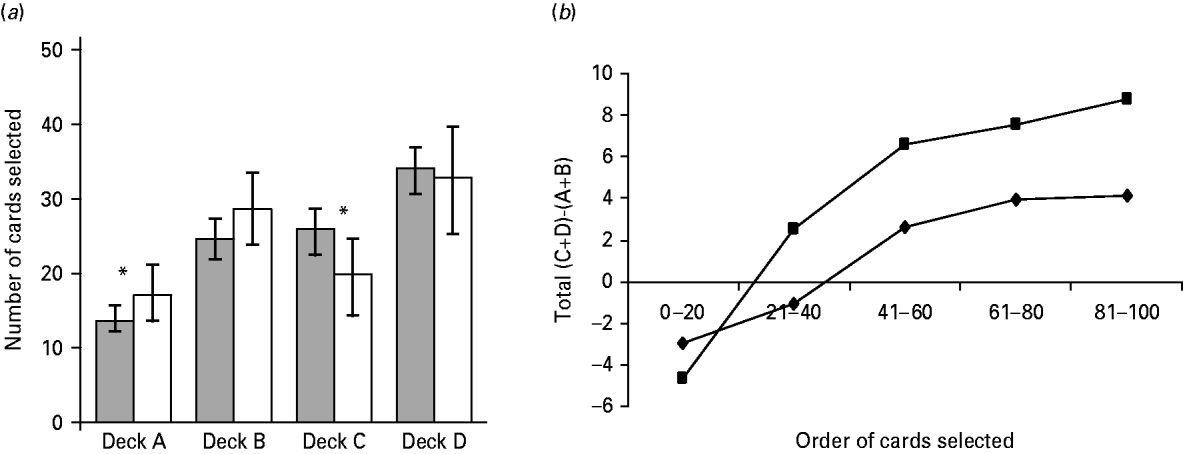
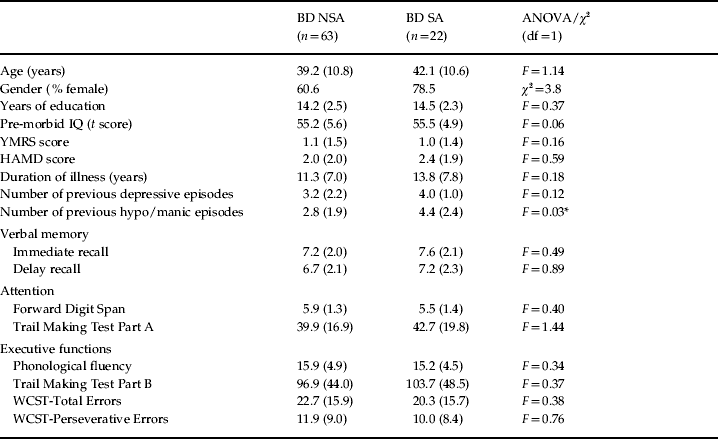
Twenty-six per cent of the patient sample had at least one previous suicide attempt. When BD patients with and without a history of suicide attempt were compared post hoc as two separate groups, those BD patients with a history of suicide attempt had a higher number of previous hypo/manic episodes than those without a history of suicide attempt (Table 3). Patients with a history of suicide attempt had a higher exposure to antipsychotics than those without (77.27% v. 31.02%, χ2=5.3, df=1, p=0.021); no differences were found between these groups in exposure to other groups of psychotropic medications. No statistically significant differences were found between these groups in terms of cognitive variables (Table 3). Suicide attempt patients selected more cards from deck A [mean (s.d.)] [17.7 (8.2) v. 14.3 (5.8), F=4.20, df=1, p=0.044] and fewer cards from deck C [19.9 (10.8) v. 26.2 (12.3), F=4.25, df=1, p=0.042] than non-suicide attempt patients (Fig. 2). Regardless on the chronological selection of cards, there was a significant main effect for block (F=5.99, p=0.006), whereas the effect for group approached significance (F=3.89, p=0.052) and the interaction effect was not significant (F=1.55, p=0.21) (Fig. 2). These results were unmodified when the number of previous hypo/manic episodes, gender and exposure to antipsychotics were included as covariables.
Performance on the Iowa Gambling Task (IGT) in bipolar disorder (BD) patients with and without a history of suicide attempt. (a) Cards selected from decks A, B, C and D (* p<0.05). □, Suicide attempt;  , non-suicide attempt. (b) Chronological selection of cards. –◆–, Suicide attempt; –▪–, non-suicide attempt.

Clinical, demographic and neurocognitive variables of bipolar patients regarding their history of suicide attempts

BD NSA, Bipolar disorder patients without a history of suicide attempt; BD SA, bipolar disorder patients with a history of suicide attempt; YMRS, Young Mania Rating Scale; HAMD, Hamilton Depression Rating Scale; WCST, Wisconsin Card Sorting Test; df, degrees of freedom.
Values are expressed as mean (standard deviation).
* p<0.05.
Discussion
We have confirmed previous findings in BD patients meeting strict euthymia criteria presenting with persistent impairments in verbal memory, attention and executive functions. This research shows an important negative finding: patients with remitted BD-I and BD-II did not demonstrate overall impairments in decision making. Additionally, patients with a history of suicide attempt scored worse than non-suicide attempt patients on measures of decision making without differences between groups in measures of verbal memory, attention and executive functions. The results of this study are of theoretical and clinical importance.
Our findings of preserved decision-making abilities are in agreement with two previous studies that compared decision-making performance between euthymic BD patients and healthy controls (Rubinsztein et al. Reference Rubinsztein, Paykel and Sahakian2000; Clark et al. Reference Clark, Iversen and Goodwin2002), and, for the first time, provide evidence that these findings may extent to BD-II. However, our results are inconsistent with two recent studies that reported an overall IGT score in the impaired range in BD (Christodoulou et al. Reference Christodoulou, Lewis, Ploubidis and Frangou2006) and that the diagnosis of BD is linked with poor decision-making performance (Jollant et al. Reference Jollant, Guillaume, Jaussent, Bellivier, Leboyer, Castelnau, Malafosse and Courtet2007). Notwithstanding this important difference, methodological factors may in fact account for this controversial pattern of results. It is noteworthy that the study of Christodoulou et al. (Reference Christodoulou, Lewis, Ploubidis and Frangou2006) was not designed specifically to assess decision-making performance and (therefore, presumably) it did not include a control group. Therefore, it is difficult to interpret their results because some variables that may influence decision-making performance, such as pre-morbid IQ, years of education, or subclinical symptoms, were not adequately controlled for. Similarly, the study of Jollant et al. (Reference Jollant, Guillaume, Jaussent, Bellivier, Leboyer, Castelnau, Malafosse and Courtet2007) also did not include a control group and, although the authors reported that patients were euthymic, symptoms of mania were not formally evaluated.
The results of the present study and the impairments in decision making shown in patients with BD manic (Clark et al. Reference Clark, Iversen and Goodwin2001; Murphy et al. Reference Murphy, Rubinsztein, Michael, Rogers, Robbins, Paykel and Sahakian2001; Adida et al. Reference Adida, Clark, Pomietto, Kaladjian, Besnier, Azorin, Jeanningros and Goodwin2008) and depressive (Murphy et al. Reference Murphy, Rubinsztein, Michael, Rogers, Robbins, Paykel and Sahakian2001; Rubinsztein et al. Reference Rubinsztein, Michael, Underwood, Tempest and Sahakian2006) episodes lend support to the hypothesis that decision-making impairments might be a state marker more than a trait marker in BD. Long-term follow-up studies have shown high levels of sustained symptomatic morbidity (around 50% of the time) in patients with BD-I and BD-II, almost all of which is accounted for by subsyndromal symptoms (Judd et al. Reference Judd, Akiskal, Schettler, Endicott, Maser, Solomon, Leon, Rice and Keller2002, Reference Judd, Akiskal, Schettler, Coryell, Endicott, Maser, Solomon, Leon and Keller2003). In a recent study, BD-I patients with mild depressive to mild hypomanic symptoms had lower performance on the IGT than matched controls (Malloy-Diniz et al. Reference Malloy-Diniz, Neves, Abrantes, Fuentes and Correa2009), suggesting that even minor symptoms might impact on decision-making performance. Taken together, impairments may fluctuate in parallel with affective symptoms in patients with BD, and therefore patients only acquire full decision-making cognitive performance when symptomatic recovery is achieved for a reasonable period of time. It has been suggested that impairments in decision making during affective episodes may be an epiphenomenon of traditional cognitive impairments (Clark et al. Reference Clark, Iversen and Goodwin2001). In others words, the impairments in sustained attention or learning of BD patients suffering manic or depressive episodes (Martinez-Arán et al. Reference Martinez-Arán, Vieta, Reinares, Colom, Torrent, Sanchez-Moreno, Benabarre, Goikolea, Comes and Salamero2004) may result in a poor performance in decision-making tasks. Another possibility is that decision-making performance is influenced directly by mood fluctuations in the manic and depressive episodes of bipolar patients (Rolls & Grabenhorst, Reference Rolls and Grabenhorst2008).
Evidence for preserved decision-making skills in euthymic BD contrasts with the findings from studies with patients with stable schizophrenia (Ritter et al. Reference Ritter, Meador-Woodruff and Dalack2004; Shurman et al. Reference Shurman, Horan and Neuchterlein2005; Martino et al. Reference Martino, Bucay, Butman and Allegri2007). Several studies that compared neurocognitive performance between BD and schizophrenia showed that differences among these disorders are quantitative rather than qualitative, with BD patients having an intermediate level of performance between schizophrenics and controls (Seidman et al. Reference Seidman, Kremen, Koren, Faraone, Goldstein and Tsuang2000; Daban et al. Reference Daban, Martinez-Arán, Torrent, Tabaréz-Seisdedos, Balanza-Martinez, Salazar-Fraile, Selva-Vera and Vieta2006; Toulopoulou et al. Reference Toulopoulou, Quraishi, McDonald and Murray2006). The decision-making abilities may represent a qualitative cognitive difference that could contribute to understanding the different functional outcome between these disorders. Further studies comparing performance in decision making between BD and schizophrenia are needed to test this hypothesis.
Our study also found that BD patients with a history of suicide attempt selected more cards from a risky deck and fewer cards from a safe deck than those patients without a history of suicide attempt. Moreover, there was a trend towards significance between groups in the chronological selections of cards. These results are not explained by different general cognitive profiles because both groups of patients demonstrated a similar level of performance in verbal memory, attention and executive functions. Similarly, poorer decision-making performance seems to be associated with susceptibility rather than state, as all patients being evaluated were euthymic and without suicidal ideation. Our finding of lower performance in IGT measures among patients with a history of suicide attempt is consistent with two previous studies in a mixed sample of psychiatric patients (Jollant et al. Reference Jollant, Guillaume, Jaussent, Bellivier, Leboyer, Castelnau, Malafosse and Courtet2007) and patients with BD (Malloy-Diniz et al. Reference Malloy-Diniz, Neves, Abrantes, Fuentes and Correa2009), lending additional support to the hypothesis that lower performance in decision making may represent a vulnerability factor to suicidal behavior. Although patients with a history of suicides attempt selected more cards from a risky deck (A) and fewer cards from a safe deck (C) than non-suicide attempt patients, they nonetheless chose more cards from the safe decks than from the risky decks overall and therefore did not closely resemble the patients with ventral prefrontal cortex lesions, who more or less ignored the safe decks (Bechara et al. Reference Bechara, Damasio, Damasio and Anderson1994, Reference Bechara, Tranel and Damasio2000). The impulsivity traits may be a behavioral mediator between decision making and vulnerability to suicide attempt. Indeed, several studies have shown a relationship between impulsivity traits and suicidability (for a review, see McGirr & Turecki, 2008). A recent study by Rihmer & Benazzi (Reference Rihmer and Benazzi2010) reported that impulsivity was a strong independent predictor of suicidality among patients with BD. However, the relationship between impulsivity and decision-making abilities is inconclusive. Christodoulou et al. (Reference Christodoulou, Lewis, Ploubidis and Frangou2006) reported that higher levels of impulsivity were associated with a lower score on the IGT whereas Jollant et al. (Reference Jollant, Guillaume, Jaussent, Bellivier, Leboyer, Castelnau, Malafosse and Courtet2007) did not find any relationship between impulsivity and performance in the same decision-making paradigm. Alternatively, the relationship between decision making and suicidal behavior might be mediated by serotoninergic function. The ventral prefrontal cortex is innervated by serotoninergic neurons of the dorsal and median raphe nuclei in the mid-brain. Suicidal behavior is known to be associated with low serotonergic activity in the peripheral fluids and brains of suicide victims, and with several serotonin-related genes (Mann, Reference Mann2003). Moreover, a decreased serotonergic function has been related to impairments in decision-making performance (Rogers et al. Reference Rogers, Tunbridge, Bhagwagar, Drevets, Sahakian and Carter2003). Taken together, these data suggest that a possible common factor between lower performance in decision making and suicidal behavior may be decreased serotonergic function; further studies are needed to clarify the nature of this relationship, if, of course, it exists at all.
Some limitations in our work need to be acknowledged. A larger sample size might have demonstrated clearer differences between groups in performance on the IGT between patients with and without a history of suicide attempt. Nevertheless, this study features the largest number of subjects to date in assessing decision-making abilities in BD patients and it is the first to include a sample of BD-II. Patients with BD-I had a greater history of psychosis than those with BD-II. This difference may be considered inherent to bipolar subtype because psychotic symptoms represent a baseline diagnostic difference between the two diagnostic categories. Although some studies have reported that a history of psychosis might have a deleterious effect on cognition in BD (Albus et al. 1996; Martinez-Arán et al. Reference Martinez-Arán, Vieta, Reinares, Colom, Torrent, Sanchez-Moreno, Benabarre, Goikolea, Comes and Salamero2004), the specific effect of psychotic symptoms on cognitive functioning is inconclusive. Indeed, recent studies did not reveal any relationship between a history of psychosis and cognitive impairments (Selva et al. Reference Selva, Salazar, Balanzá-Martínez, Martínez-Arán, Rubio, Daban, Sánchez-Moreno, Vieta and Tabarés-Seisdedos2007) or that bipolar-relative dyads with more expression of cognitive impairment had less expression of psychotic symptoms (Jabben et al. Reference Jabben, Arts, Krabbendam and van Os2009). It is improbable that our finding of similar performance on the IGT between patients with BD-I and BD-II would be influenced by a different history of psychotic symptoms. Moreover, when we compared patients with and without a history of suicide attempt, who were different in IGT performance, both groups were comparable in terms of psychotic symptoms. Furthermore, all patients were taking psychotropic medications and the effects of these medications cannot be excluded altogether from the interpretation of the findings. Finally, we have not included any scale to characterize the nature of the previous suicide attempts (i.e. violent or non-violent) among patients. However, previous studies have not found any relationship between decision-making skills and previous suicidal characteristics (Jollant et al. Reference Jollant, Bellivier, Leboyer, Astruc, Torres, Verdier, Castelnau, Malafosse and Courtet2005, Reference Jollant, Guillaume, Jaussent, Bellivier, Leboyer, Castelnau, Malafosse and Courtet2007).
In summary, in this work, patients with BD-I and BD-II meeting strict clinical criteria for euthymia demonstrated no significant impairments in a well-established decision-making paradigm. The results suggest that these deficits are not a trait marker of the disorder but they are state dependent. Decision-making processes are crucial in the successful negotiation of the social and vocational challenges of daily life. Longitudinal studies across different affective states in bipolar patients, assessing clinical and cognitive symptoms in parallel with brain functional paradigms, should be good tools for assessing this problem. In addition, this study contributes to our understanding of the possible relationship between decision-making skills and suicidal behavior. Future research assessing measures of serotoninergic function combined with functional neuroimaging techniques and a decision-making paradigm would provide an ambitious, yet potentially very useful, means to shed light on this fascinating relationship.
Acknowledgments
This project was partially supported by a fellowship for D. Martino from the National Council of Scientific and Technical Research (CONICET), Buenos Aires, Argentina.
Declaration of Interest
None.