Introduction
Loess is defined as a wind-blown deposit, composed of silt, fine sand, calcite, and clay (Muhs Reference Muhs2018). This type of soil is located in arid and semi-arid regions (Li et al. Reference Li, Vanapalli and Li2016). It has aroused considerable interest from members of the scientific community particularly in geotechnical characterization, microstructure, deformation sensitivity, collapsibility, etc. (Yuan and Wang Reference Yuan and Wang2009; Marschalko et al. Reference Marschalko, Yilmaz, Fojtova, Lamich and Bednarik2013; Chen et al. Reference Chen, Li, Fu and Yuan2019). Results from previous studies showed that loess can be characterized by an open structure. It may collapse and deform due to disturbances such as loading and wetting. This frequently causes geotechnical disasters such as landslides and settling (Delvoie Reference Delvoie2017). The fragility of loess inter-particle forces remains the principal cause of these disasters. In order to cope with these problems, resistance-improvement techniques have been proposed. They consist of strengthening and stabilizing the inter-particle bonds (Jefferson et al. Reference Jefferson, Rogers, Evstatiev and Karastanev2005). Most techniques rely on adding cementing agents, such as clay and lime (Pei et al. Reference Pei, Zhang, Wu and Liang2015; Tabarsa et al. Reference Tabarsa, Latifi, Meehan and Manahiloh2018). Recent studies explored possible improvement in loess stability and revealed that adding cement, nano clay, fly ash, and polymers can: (1) produce a change in plasticity; (2) improve compressibility; and (3) increase optimal moisture content, California Bearing Ratio (CBR) (Zhang et al. Reference Zhang, Jiang, Su and Zhou2017), and cohesion; and (4) improve the shear strength. In contrast, the maximum dry density, friction angle, deformation, and loess collapsibility were reduced (Zhang et al. Reference Zhang, Jiang, Su and Zhou2017; Tabarsa et al. Reference Tabarsa, Latifi, Meehan and Manahiloh2018; Kong et al. Reference Kong, Zhang, Wang and Peng2018; Phoak et al. Reference Phoak, Luo, Li and Yin2019; Ma and Ma Reference Ma and Ma2019).
Due to their hydration and dehydration capacities, clay minerals possess many useful properties for stabilizing liquefied soils. They are, therefore, utilized as binders, plasticizers, and lubricants (Evstatiev Reference Evstatiev1988; Firoozi et al., Reference Firoozi, Olgun, Firoozi and Baghini2017). Among the clay materials, montmorillonite in bentonite is characterized by a large water-retention capacity, and by absorption and adsorption properties. Injecting clay into the loess can, therefore, reduce porosity, decrease or eliminate collapsibility, and increase the deformation modulus (Evstatiev Reference Evstatiev1988; Jefferson et al. Reference Jefferson, Rogers, Evstatiev and Karastanev2005). Other techniques have shown that the addition of lime significantly improves the properties of clayey soils by reducing sensitivity to water and increasing the mechanical strength (Bell Reference Bell1996; Calik and Sadoglu Reference Calik and Sadoglu2014; Babu and Poulose Reference Babu and Poulose2018). Soil resistance is, thereby, reinforced (Ghobadi et al. Reference Ghobadi, Abdilor and Babazadeh2014; Gao et al. Reference Gao, Qian, Li, Chen and Jia2018).
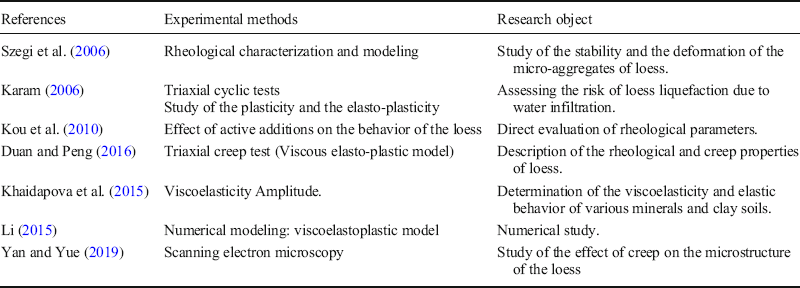
Rheology has many advantages for exploring and evaluating the performance of additives. Its ability to help in examining the modification of soil mechanical properties has been proven (Moreno Reference Moreno, Jürgen Buschow, Cahn, Flemings, Ilschner, Kramer, Mahajan and Veyssière2001). Indeed, rheological research has focused on the risks of liquefaction, landslide, and loess collapse as shown in Table 1 where the results note the existence of a relationship between the soil rheological parameters and the degradation forces of the inter-particle bonds. Rheological characterizations have shown that the loess suspension is non-Newtonian and, therefore, complex. The most suitable models for loess were of the complex type (Tang and Kung Reference Tang and Kung2010; Zhu et al. Reference Zhu, Zhu and Yu2017).
Literature relevant to the application of rheology

The purpose of the present study, initially, was to identify the physical-chemical and rheological characteristics of the loess of the Ghardaïa region which is located 600 km south of Algiers. This region is part of the Algerian desert center. It represents one of the significant agglomerations of human population in southern Algeria and is characterized by restrictive living conditions. The search for possible development opportunities in these regions is a permanent challenge for local public authorities. The socio-economic development represents not only a vector for stabilizing the population but also an opportunity for preserving the heritage of the M’zab region. In addition to socio-economic reasons, the Ghardaïa region has been selected as a study site because loess occurs in a large proportion of the area. The building and public works infrastructure are threatened by an ongoing risk of instability and collapse due to the effect of changes in soil properties under mechanical effects.
To cope with the combined geo-risks in this region, attempts to improve the geotechnical and rheological characteristics of loess remain a priority for researchers. The second purpose of this study was to examine the possible improvements in stability and resistance performances of Ghardaïa loess achieved by adding bentonite and lime.
Materials and Methods
Materials
The loess used came from the Ghardaïa region. Soils representative of two types of loess were sampled. The first sample was collected at the Daïa Ben Dahoua site (10 km NW of Ghardaïa town − S1). The second was from the Metlili site (42 km SW of Ghardaïa town − S2). Both samples were extracted as intact blocks from a depth of 0.8–1.0 m. They were then cut and placed in boxes (Absi et al. Reference Absi, Bonnechère, Goguel, Kérisel, La Rochelle, L'Hériteau, Panet, Rat, Salençon and Schlosser1983).
For the present study, bentonite and lime were chosen as additives due to their performance, cost, and local availability. The bentonite used was extracted from Maghnia mine (Hammam Boughrara, 600 km west of Algiers) by the E.N.O.F Company. Substantial quantities were available at exceptionally economical prices. This bentonite is characterized by a large water-retention capacity. Its chemical composition is rather siliceous (SiO2 = 62.4%) followed by alumina (Al2O3 = 17.33%) (Table 2). The SiO2/Al2O3 ratio of the bentonite is ~3.41. This value is the index of a montmorillonite (Grim and Guven Reference Grim and Guven1978). Quicklime from the ERCO Company (Hassasna commune, Saida Province, SW Algeria) was selected because of its proximity to the experimental sites (Saida, SW Algeria). Its chemical composition showed a significant percentage of free calcium oxide, CaO (83.3%), and a small amount of insoluble materials (<1%) (Table 3).
Chemical composition (wt.%) of the bentonite used (Maghnia, Algeria)

Chemical composition (wt.%) of the lime used (Saida, Algeria)

Method and Instrumentation
Analysis of the effects of the additive on the physical-chemical (grain-size, plasticity, pH, and electrical conductivity) and rheological properties of Ghardaïa loess was performed. Various concentrations of bentonite (2, 4, 6, and 8 wt.%) and lime (1, 3, 5, 7, and 10 wt.%) were applied. The measurement step was performed to examine closely the changes in behavior of the samples.
Geotechnical identification included several physical, chemical, and mechanical tests. The experiments were carried out according to French standard testing procedures. The grain-size analysis was achieved by dry sieving after washing according to French standard test NF P94-056, and by sedimentary methods according to\the norm NF P94-057. The study of consistency limits of samples was based on the Atterberg limits, using the Casagrande device and rolling method according to the standard NF P94-051. The pH was measured using a pH meter (Model C863, Consort nv, Parklaan, Belgium) as per ASTM D4972 (2007). The electrical conductivity was determined using a conductivity meter (Model EC 215, Hanna Instruments, Woonsocket, Rhode Island, USA). Chemical analysis of loess samples was performed using the LAB-X3500 analyzer (Oxford Instruments Analytical, Oxfordshire, UK), equipped with an energy-dispersive X-ray fluorescence (EDXRF) spectrometer. X-ray diffraction (XRD) analyses were carried out with a Rigaku Miniflex 600 (Rigaku, Tokyo, Japan) X-ray diffractometer, using CuKα radiation at 40 kV and 15 mA. Samples were then scanned in the range of 5–50°2θ with a step size of 0.02°2θ. Data analysis was performed using Bruker DIFFRAC plus EVA diffraction software.
In order to investigate the rheological behavior of loess suspensions without additives, several loess concentrations were considered [30–55 wt.%]. On the other hand, the effect of the additives (bentonite or lime) on the loess suspension at 30 wt.% was examined. This value was sufficient to indicate the effect of each additive and to meet the optimum conditions for the experimental means and materials.
Loess-water suspensions were prepared by first adding the required amount of distilled water (45–70 wt.%) and stirring vigorously at 500 rpm. The loess powder was then added incrementally until the desired suspension concentration (30–55 wt.% ) was reached. For example, to achieve a 30 wt.% suspension, 70 g of water was added to a 200 mL beaker and stirred vigorously at 500 rpm; then 30 g of the loess powder was added incrementally. To ensure good homogenization, the suspension was stirred continuously for a further 24 h. The loess-additive suspensions were prepared in the same way, beginning with a 30 wt.% suspension to which the additive (bentonite or lime) was added incrementally under stirring, followed by another 24 h of stirring.
The rheological tests were applied using a controlled-stress rheometer (AR2000, TA Instruments, Paris). The device is equipped with cone-plane geometry (diameter of 60 mm, angle of 2°). A pre-shear procedure was applied for 1 min at a shear rate of 500 s–1. After the pre-shear and to achieve reproducible results, the suspensions were left to rest for 2 min. Flow curves were acquired by applying an increasing shear stress ramp, at a constant stress rate of 0.05 Pa s–1. During all tests, the temperature was maintained at 20°C.
RESULTS AND DISCUSSION
Physical-chemical Test Results of Loess Samples
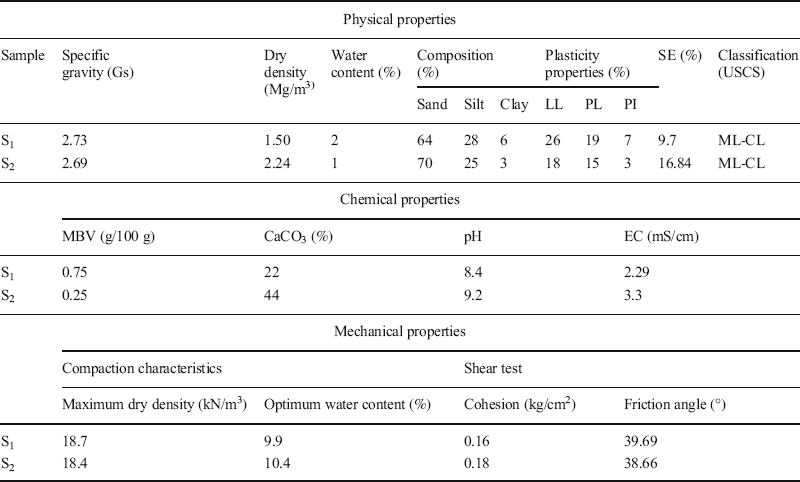
The loess grain-size distribution curves showed that most of the grains in both samples were sand-sized; sample S1 was composed of 64% sand, 28% silt, 6% clay, and 2% coarse sand; sample S2 was even sandier, with 70% sand, 25% silt, 3% clay, and 2% coarse sand (Fig. 1). These results (Table 4) are in good agreement with those of Coudé-Gaussen (Reference Coude-Gaussen1987).
Grain-size distribution curves of loess samples

Physical, chemical, and mechanical properties of the Ghardaïa loess samples

USCS: Unified Soil Classification System
Based on the plasticity characteristics defined by Gibbs and Holland (Reference Gibbs and Holland1960), the Ghardaïa loess samples were classified as silty loess (sample S1) and sandy loess (sample S2). Sand equivalent test results (SE, %) showed a value of 9.7% for sample S1 and 16.84% for sample S2 (Table 4). In reference to the classification approaches of Dreux and Festa (Reference Dreux and Festa1998), both samples were classified as clayey sands. Low MBV (Methylene Blue value (g/100 g)) values were acquired (Table 4). This confirmed that the plasticity of the samples was low. The cohesion values obtained via the direct shear test were equally low. Indeed, they developed significant internal friction angles. The calcimetry results showed that sample S2 is more carbonated than sample S1 (Table 4).
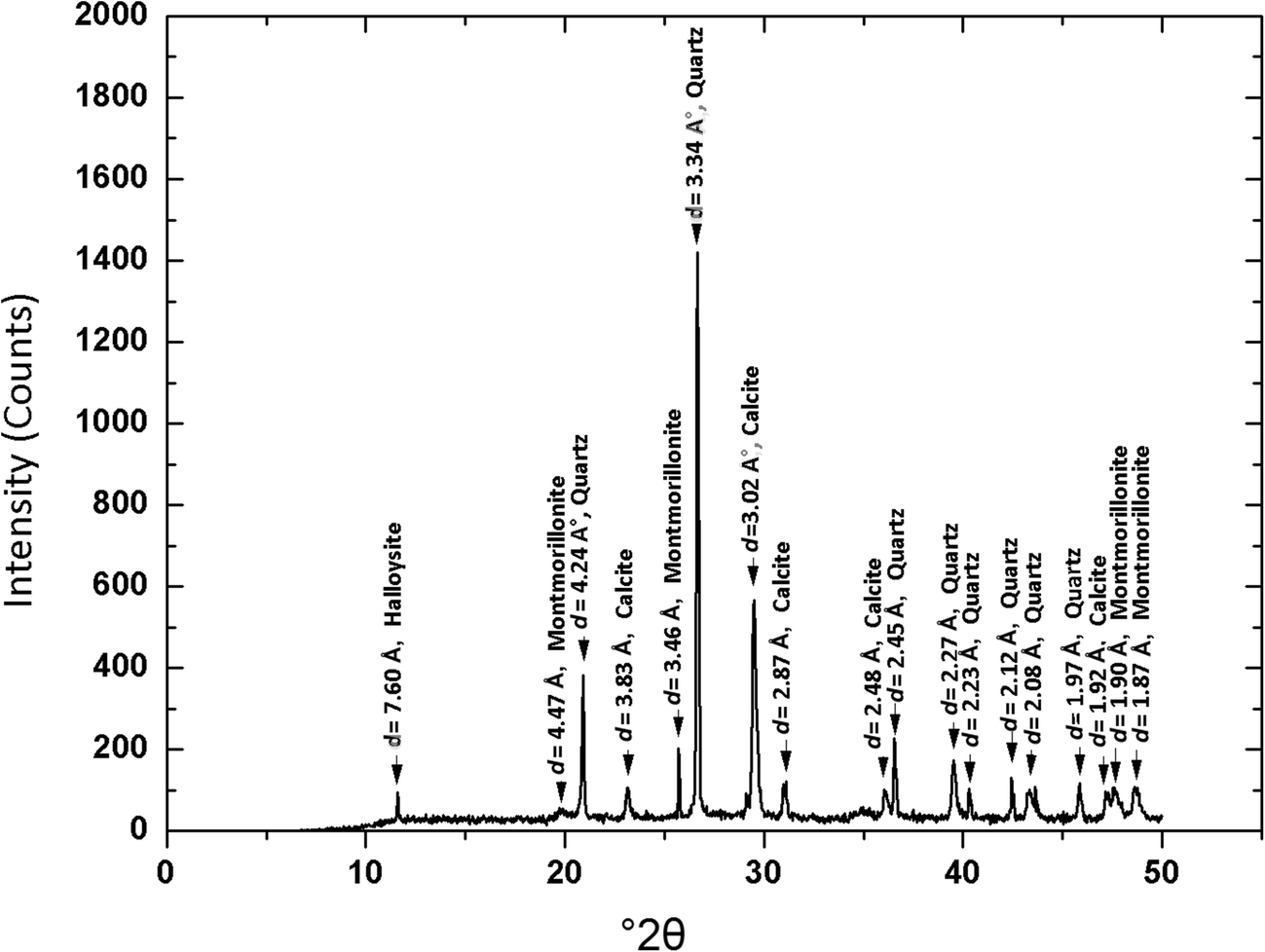
Chemical analysis showed that both samples of Ghardaïa loess were composed mostly of silica (Table 5). The samples were carbonated and rich in calcite. In contrast, very small iron oxide contents were found (1% and 2% for both samples). The aluminum content did not exceed 5%. X-ray diffraction analysis showed that the dominant mineral phases in both samples were silica and carbonates (Figs. 2 and 3). Silica was crystallized as quartz (SiO2) and the carbonates as calcite (CaCO3). The X-ray diffraction (XRD) analysis also established that the samples contained some clay minerals: montmorillonite and halloysite in S1and montmorillonite and kaolinite in S2.
Chemical composition (wt.%) of the Ghardaïa loess samples

XRD trace of sample S1

XRD trace of sample S2

The pH analysis showed that Ghardaïa’s loess is basic, with values 8.4 for S1 and 9.6 for S2. The measured electrical conductivities were 2.27 mS/cm for S1 and 3.3 mS/cm for S2.
The Effect of Bentonite and Lime on the Grain-size Distribution
The results revealed that, after adding bentonite, the texture of the mixtures was modified. As expected, adding bentonite increased the ratio of fine particles and reduced the coarse fraction (Fig. 4a,b). Bentonite increased the clay fraction in mixtures and changed the grain-size configuration to a finer texture (Yssaad and Belkhodja Reference Yssaad and Belkhodja2007; Hassan and Mahmoud Reference Hassan and Mahmoud2013).
Effect of bentonite and lime on the grain-size distribution of samples: a effect of bentonite on S1 grain-size distribution; b effect of bentonite on S2 grain-size distribution; c effect of lime on S1 grain-size distribution; and d effect of lime on S2 grain-size distribution

With lime treatment, a distinction was observed between the reactions of the two loess samples. The effect on sample S1 was manifested by a slight increase in the coarse grain fraction and a decrease in the fine fraction (Fig. 4c,d). The genesis of large particles was induced by particle agglomeration and flocculation caused by lime. The presence of lime induced cation exchange reactions (Bell Reference Bell1996).
Unlike sample S1, lime treatment of sample S2 caused a slight increase in the fine fraction and a decrease in large particles (Fig. 4d). Because of the small clay fraction in sample S2, the cation exchange reactions were weak. The difference in clay quantity in the loess samples explained the difference between the two reactions (Bell Reference Bell1996). For lime treatments, the quality and initial quantity of clay in the sample influenced the sensitivity. Dash and Hussain (Reference Dash and Hussain2012) stated that the effect of lime on soils depends on several factors: nature, mineralogy of soil, and the lime content.
The Effect of Bentonite and Lime on Plasticity
The addition of bentonite and lime also modified the plasticity properties of the samples. Adding bentonite to the basic samples increased liquid limits (LL) and plastic limits (PL). For an 8% concentration, the LL increased by 31.5% for sample S1 and by 40% for sample S2. For both samples, the increase in the PL was 27% and 32%, respectively. The increase in the plasticity index (PI) was more significant: it was 50% for sample S1 and 62% for sample S2 (Fig. 5a,b). Due to its water-retention capacity, bentonite favors the hydration of loess mixture particles and increases the plasticity (Yassad and Belkhodja Reference Yssaad and Belkhodja2007; Wayal et al. Reference Wayal, Ameta and Purohit2012; Elmashad Reference Elmashad2018; Zhang et al. Reference Zhang, Sun, Chen, Song and Zhang2019).
Effect of bentonite on the plasticity properties of a S1 and b S2; and of the lime on the plasticity properties of c S1 and d S2

For both loess samples, the lime-treatment results showed a significant change in the plasticity parameters (LL, PL, and PI) (Fig. 5c,d). The effect was notable when considering the increase in liquid and plastic limits. Arabi and Wild (Reference Arabi and Wild1989) observed comparable results. For sample S1, the PI increased with low lime concentrations and remained stable from the 5% concentration. The PI decreased for sample S2, however. For both samples, the quantity and quality of the clay minerals can explain the difference in the plasticity parameter.
Bell’s study (Reference Bell1996) revealed that adding lime in the presence of quartz and kaolinite increased plasticity, so the increase in the plasticity of sample S2 may be explained by the presence of quartz and kaolinite. However, it decreased with the amount of montmorillonite present. This explains the decrease in the PI of sample S1. All clay soils react with lime. Clay minerals in the soil, even in small amounts, contribute to the modification of the physical properties including the plasticity of treated soil (Acevedo et al. Reference Acevedo, Rocha and Bertolino2017; Bessaim et al. Reference Bessaim, Bessaim, Missoum and Bendani2018; Elgamouz et al. Reference Elgamouz, Tijani, Shehadi, Hasan and Kawam2019).
The Effect of Bentonite and Lime on the pH and Electrical Conductivity
The chemical sensitivity of the samples treated by bentonite and lime was explored through the evolution of pH and electrical conductivity (EC) (Fig. 6). For both loess samples, adding bentonite increased the pH progressively (Fig. 6a,b). The results were in agreement with those observed by other researchers (Semalulu et al. Reference Semalulu, Magunda and Mubiru2016; Alghamdi et al. Reference Alghamdi, Aly, Al-Omran and Alkhasha2018). On the other hand, the increase in EC was more significant, as much as 8% (Fig. 6a,b). The results were in agreement with those of Yssaad and Belkhodja (Reference Yssaad and Belkhodja2007) and Kaufhold et al. (Reference Kaufhold, Dohrmann, Koch and Houben2008). The increase may be explained by the release of the exchangeable cations (Na+, Ca2+, and Mg2+), following the dissolution of clay minerals. Adding bentonite improved the cation exchange capacity (CEC) in the treated medium (Yssaad and Belkhodja Reference Yssaad and Belkhodja2007; Satje and Nelson Reference Satje and Nelson2009). After 24 days of curing time, the pH of bentonite-treated samples decreased. In contrast, the EC values increased with the increase in the amount of bentonite (Fig. 6a,b).
Effect of bentonite and lime on the pH and electrical conductivity (EC) of samples after 1 day and 24 days of curing time: a effect of bentonite on the pH and EC of sample S1 and b of sample S2; c effect of lime on the pH and EC of sample S1 and d of sample S2

As for lime treatment, the pH increased rapidly from the first concentration (for 1% lime, the pH increased by 30%). Then, with the addition of more lime, it gradually increased and stabilized at a lime concentration of 10% (Fig. 6c,d). These results were in good agreement with those of Bessaim et al. (Reference Bessaim, Bessaim, Missoum and Bendani2018) and Zhang et al. (Reference Zhang, John, Bora and Kyle2020). Dissolution of the lime particles in the various suspensions made the medium more basic. By increasing the concentration of lime, dissolution generated more calcium and hydroxyl ions, allowing saturation of the suspension with an increase in pH (Al-Mukhtar et al. Reference Al-Mukhtar, Khattab and Alcover2012; Vitale et al. Reference Vitale, Deneele, Paris and Russo2017; Dhar and Hussain Reference Dhar and Hussain2019).
A noticeable increase in EC was observed with the addition of lime (Fig. 6c,d). Similar results were reported by others (Lima et al. Reference Lima, Gustav Loch and Kleingeld2010; Bellil et al. Reference Bellil, Abbeche and Bahloul2018; Dhar and Hussain Reference Dhar and Hussain2019). The increasing trend can be justified by the generation of calcium and hydroxyl ions, resulting from the dissolution of lime in the pore structure of the soil (Zhang et al. Reference Zhang, John, Bora and Kyle2020). After 24 days of curing time, both the EC and pH values decreased (Fig. 6c,d). The main cause of this decrease was lime consumption during the development of the pozzolanic reaction (Dhar and Hussain Reference Dhar and Hussain2019). During the curing time, the pH of the lime-treated samples was >12. This indicated that the medium was favorable for the formation of calcium-silicate-hydrate (C-S-H) and calcium-aluminate-hydrate (C-A-H) gel products (Dash and Hussain Reference Dash and Hussain2012).
Rheological Behavior of Loess Suspensions at Different Mass Concentrations
For both loess suspensions, the rheological test results were analyzed via the flow and viscosity curves (Fig. 7).The shear-stress vs. shear-rate rheograms showed that at mass concentration C m = 40% the yield stress is non-zero. Suspension behavior becomes, non-Newtonian, therefore. To predict the sensitivity and response of the soil to external disturbances, the choice of a model capable of describing the stress-strain-resistance characteristics is important (Li Reference Li2015).The Bingham, Ostwald, and Hershel-Buckley models were tested. Comparison tests between the different models confirmed the performance of the Hershel-Buckley model (τ = τ0 + kγ n , where τ = shear stress, Pa, τ0 = yield stress, Pa, n = flow behavior index (-), and γ = shear rate, sˉ1). This model stood out for its simplicity and proved to be efficient at representation of experimental results including the rheological behavior of both samples (Fig. 7a,b). Several researchers also reported that clay suspensions are best described by the Herschel-Bulkley law (Malfoy et al. Reference Malfoy, Pantet and Righi2003; Kelessidis and Maglione Reference Kelessidis and Maglione2008; Maciel et al. Reference Maciel, Santos and Ferreira2009; Benyounes et al. Reference Benyounes, Mellak and Benchabane2010). Maciel et al. (Reference Maciel, Santos and Ferreira2009) reported that using the Herschel-Bulkley model fitted to values in a wide shear-rate range, including small values, provided theoretical yield stress that is extremely close to real yield stress, with an uncertainty that is sufficiently small for conventional practical applications. Other studies indicated that the loess suspension can be represented by the Bingham model (Szegi et al. Reference Szegi, Gál, Michéli and Tombácz2004, Reference Szegi, Tombácz, Czibulya, Akagi and Zsolnay2006).
Flow curve and viscosity of samples S1 and S2 at various concentrations

For both samples, the flow curves indicated that the shear stress increased with concentration. It is more significant for sample S1 than for S2. Indeed, the plasticity of the first sample was greater than that of the second.
The viscosity curves showed that it decreased as a function of the shear rate (Fig. 7c,d). For high shear rates, the suspensions became more fluid. In this manner, the suspensions reflected a shear-thinning character. This confirmed that the shear contributed to destroying the initial structure of the suspension. The shear-thinning phenomenon was due to the reorganization and alignment of the particle chains in the direction of flow (Barnes et al. Reference Barnes, Hutton and Walters1989).Viscosity increased with loess concentration. The particle−particle interactions increased when particle concentrations increased. Particles were reorganized into aggregates and became susceptible to deformation or orientation by hydrodynamic forces. The creation of flocs in the form of chains increased the viscosity more (Barnes et al. Reference Barnes, Hutton and Walters1989).
The evolution of the Herschel-Bulkley parameters was investigated for various concentrations. For both samples, the yield stress and the consistency index increased rapidly with concentration. In contrast, the value of the flow index decreased (Fig. 8). The results confirmed the effect of suspension concentration on the flow. Benedini and Margaritora (Reference Benedini and Margaritora1974) indicated that the flow becomes more complex as the concentration of the suspension increased.
The evolution of Herschel-Bulkley rheological parameters as a function of S1 and S2 concentrations

The Effect of Bentonite and Lime on the Rheological Behavior of Loess Suspensions
The effect of additives on the rheological behavior of suspensions was further examined by analyzing flow and viscosity curves (Figs. 9 and 10). The results showed that the behavior of the suspensions changed, for a critical concentration (30 wt.%), from Newtonian to non-Newtonian. This behavior change was attributed to particle−particle interactions and the nature of their bonds according to Cheng (Reference Cheng1980) who also explained that, below critical (low and medium) concentrations, the effects of hydrodynamic interactions dominated and caused the viscous dissipation of the suspension. For elevated concentrations, the particle−particle contact effect dominated over the hydrodynamic effects. The particle−particle contact generated friction interactions. Hence, the behavior of mixtures became non-Newtonian (Phillips and Davies Reference Phillips and Davies1991).
Effect of bentonite and lime on S1 and S2 flow behavior at a concentration of 30 wt.%

Effect of bentonite and lime on S1 and S2 viscosity at a concentration of 30 wt.%

Analysis of the flow and viscosity curves showed that the shear stress and viscosity increased with added concentrations. Bentonite and lime promoted flocculation between particles, reduced the pore volume of the loess, and generated bonds that made a denser suspension (Gao et al. Reference Gao, Qian, Li, Chen and Jia2018; Bellil et al. Reference Bellil, Abbeche and Bahloul2018; Zhang et al. Reference Zhang, Sun, Chen, Song and Zhang2019).
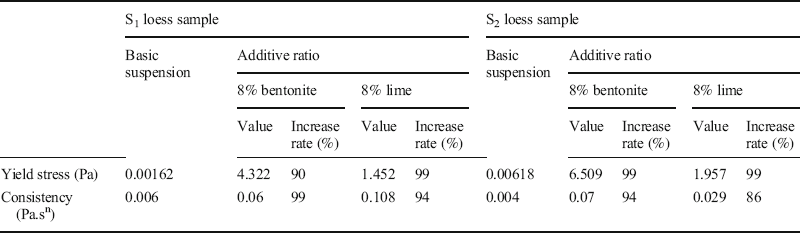
For both samples, the evolution of the Herschel-Bulkley parameters showed that yield stress and consistency were increased as a function of the additive concentrations (Fig. 11). The suspension resistance to mechanical impact was thereby reinforced. Some indicative data on the increase rate in the yield stress and consistency of base suspensions (Table 6) revealed that adding 8% of bentonite or lime caused a significant increase in the rheological parameters (yield stress, consistency index) with an increase of 86–99%.The flow index evolution was marked by a significant decrease as a function of concentration. The increase in the inter-particle interactions induced by the additive may explain this phenomenon. Consolidation developed by agglomeration of the particles modified the rheological and mechanical behavior of the suspension. The main consequence of this change was reinforcing the inter-particle cohesion and improving their cementing. The increase in yield stress and consistency index reflected the cementing character induced by additives (Szegi et al. Reference Szegi, Gál, Michéli and Tombácz2004; Karam Reference Karam2006).
The evolution of S1 and S2 Herschel-Bulkley rheological parameters as a function of added bentonite and lime concentrations: a effect of bentonite on S1 and b on S2; c effect of lime on S1; and d on S2

Rate of increase in Herschel-Bulkley parameters of basic loess suspensions for samples S1 and S2 in the presence of 8% bentonite and lime

The cementing character may be explained by the sum of several factors, such as cationic interactions, hydration, flocculation, and agglomeration of particles (Fuenkajorn and Daemen Reference Fuenkajorn and Daemen1996; Luckham and Rossi Reference Luckham and Rossi1999; Wayal et al. Reference Wayal, Ameta and Purohit2012; El Mohtar et al. Reference El Mohtar, Bobet, Santagata, Drnevich and Johnston2013). In the case of bentonite treatment, the cohesion phenomenon of suspensions observed during the experiments can be explained by particle hydration and flocculation due to bentonite swelling (Saba et al. Reference Saba, Barnichon, Cui, Tang and Delage2014; Gamal et al. Reference Gamal, Elkatatny, Basfar and Al-Majed2019). Bentonite was usually used as a binder and bonding agent, most notably for fine-grained soils (Fuenkajorn and Daemen Reference Fuenkajorn and Daemen1996). Luckham and Rossi (Reference Luckham and Rossi1999) reported that bentonite is an effective rheological control agent for stabilizing materials.
As with bentonite, adding lime produced the flocculation and agglomeration of clay particles. The CEC, leading to flocculation and agglomeration of clay particles contained in loess, is thus increased (Al-Mukhtar et al. Reference Al-Mukhtar, Khattab and Alcover2012; Vitale et al. Reference Vitale, Deneele, Paris and Russo2017; Dhar and Hussain Reference Dhar and Hussain2019). This resulted in a modification of the rheological properties of the treated suspensions. The modification manifested itself by increasing the rheological parameters caused by the physical-chemical reactions between clay minerals from the loess and lime (Amadi and Okeiyi Reference Amadi and Okeiyi2017; Vitale et al. Reference Vitale, Deneele, Paris and Russo2017; Dhar and Hussain Reference Dhar and Hussain2019). Bell (Reference Bell1996) and Vitale et al. (Reference Vitale, Deneele, Paris and Russo2017) reported that flocculation is due to the form of Ca(OH)2 or CaOH+ bridges between clay layers.
In lime-treatment results, the influence of the silica (SiO2) and alumina (Al2O3) constituents of clay minerals was marked. The results showed that for sample S1, where the ratio of these elements is greater than that of sample S2, the consistency value increased to almost double (Table 6). The dissolution of silica (SiO2) and alumina (Al2O3) led, therefore, to a chemical reaction. This reaction is called a pozzolanic reaction and it generates more resistance products. These products are calcium-silicate-hydrate, calcium-aluminate-hydrate, and calcium-aluminosilicate-hydrate. These elements reinforce the inter-particle liaisons (Dash and Hussain Reference Dash and Hussain2012; Cherian and Arnepalli Reference Cherian and Arnepalli2013; Al-Swaidani et al. Reference Al-Swaidani, Hammoud and Meziab2016; Vitale et al. Reference Vitale, Deneele, Paris and Russo2017).
The results showed that the gradual addition of lime is accompanied by a rapid and then progressive increase in pH. From the concentrations explored, the pH of the mixtures reached 12 (Fig. 6c,d). The medium, thereby, became favorable for the dissolution of silica and alumina of clay particles. Little (Reference Little1999) reported that the critical value for provoking a pozzolanic reaction was pH>10. Other research suggests pH>12 (Dash and Hussain Reference Dash and Hussain2012; Al-Mukhtar et al. Reference Al-Mukhtar, Khattab and Alcover2012).
The results of the loess treatment with bentonite and lime confirmed the improvement in terms of mechanical resistance of the treated samples. For both of the samples examined, bentonite treatment presents better results than lime treatment. Bentonite enhanced the shear strength by twice as much as lime.
Conclusions
The purpose of the present study was to determine the physical-chemical and rheological parameters of the Ghardaïa loess (southern Algeria) and focused on analyzing the effects of adding bentonite and lime on the physical-chemical and rheological properties of the loess. The main conclusions of this study are:
• Adding bentonite to both loess samples increased the ratio of fine particles and, therefore, reduced the proportion of large particles. This change in the sample texture modified considerably the plasticity properties. Thus, increasing the bentonite content in mixtures improved the liquid and plastic limits. The plasticity index increased as a result, due to hydration of the loess particles caused by the bentonite swelling.
• The effect of lime on the physical properties differed in the two samples. In the presence of lime, the grain-size analysis of sample S1 showed a decrease in the proportion of fine particles and an increase in the proportion of large particles. The plasticity index decreased gradually as the lime content increased. Adding lime to sample S2 resulted in a moderate increase in the fine fraction. The coarse particle fraction was reduced slightly. For sample S2, the plasticity index increased slightly as the lime percentage increased and then remained stable at 5%. This is related to the difference in the composition, quality, and quantity of clay minerals presented in both loess samples.
• Adding bentonite and lime increased the pH and electrical conductivity of the samples. With bentonite treatment, the increase in exchangeable cations (Na+, Ca2+, and Mg2+) and the CEC induced by the additive may explain the increase in these parameters. For lime treatment, the increases in pH and EC values were explained by the generation of calcium and hydroxyl ions, resulting from lime hydration in the loess pore structure. After 24 days of curing, the pH and EC values of both samples were reduced. This reduction is due to lime consumption during the development of the pozzolanic reaction.
• Rheological analysis showed that the Ghardaïa loess suspension exhibited non-Newtonian behavior. For the concentrations investigated, the flow curves showed that the Herschel-Bulkley model best represented the rheological behavior. The presence of bentonite and lime in the suspensions increased viscosity, yield stress, and consistency. However, the flow index decreased with increase in the concentration of additives. Several phenomena may explain the increase in parameters such as hydration, flocculation, agglomeration, and pozzolanic reactions induced by additives. Adding bentonite and lime provided mechanical strength and reinforced the cohesion of the particles.
• At the end of this study, the conclusion was that adding bentonite gave better results than did the addition of lime. This is justified by the fact that bentonite improved the shear strength of the loess suspension by twice as much as lime. The results offered a technical database that may be used for a number of problems associated with loess use in the study region. The indicators identified may be valuable for local technical and economic problems, particularly for construction works.
ACKNOWLEDGMENTS
The authors thank Dr Karim Bekkour from the Laboratory of Engineering, Computing, and Imaging (ICube) (Strasbourg, France), who facilitated the rheological measurements. Thanks also to the members of the laboratory (L.T.P.O) of Saida.
Compliance with Ethical Statements
Conflict of Interest
The authors declare that they have no conflict of interest.