


The amino acid l-glutamate is primarily consumed in the form of monosodium glutamate (MSG) and is known to elicit a distinguishable fifth taste termed ‘umami’. MSG has been shown to improve the sensory characteristics of many different foods(Reference Bellisle1) and is commonly used as a flavour enhancer. The highly palatable savoury umami taste can also be achieved by pairing MSG with the nucleotides inosine 5′-monophosphate and guanosine 5′-monophosphate (MSG+)(Reference Bellisle1, Reference McLaughlin2).
Enhancing the palatability of foods could potentially lead to overeating; however, evidence that MSG is associated with excess energy intake is mixed. Whereas some short-term experimental studies on satiation in relation to MSG intake have reported that MSG supplementation could lead to a more rapid recovery of hunger, no significant differences in hunger ratings or differences in subsequent energy intake were observed(Reference Rogers and Blundell3). Other behavioural studies have reported that adding MSG to some foods can lead to higher energy intakes at a subsequent meal compared with an equal energy control without MSG, even when no effects on hunger ratings were observed(Reference Luscombe-Marsh, Smeets and Westerterp-Plantenga4). In addition, that study reported that the addition of MSG in combination with the nucleotide ionosine monophosphate-5 (IMP-5) did not lead to higher energy consumption at a subsequent meal relative to the control and concluded that further investigation into the impact of MSG, alone as well as in combination with nucleotides, was warranted(Reference Luscombe-Marsh, Smeets and Westerterp-Plantenga4).
The results of longer-term human studies and animal model studies have been equally inconsistent. Whereas some have found a negative relationship or no link between MSG consumption and body weight(Reference Shi, Luscombe-Marsh and Wittert5–Reference Kondoh and Torii7), others have suggested a link between MSG, energy overconsumption and weight gain(Reference Hermanussen, Garcia and Sunder8–Reference Hirata, Andrade and Vaskevicius10).
The inconsistencies observed in short-term studies could be due to differences in the macronutrient composition of the preloads used in the different studies. Appetite-enhancing effects of MSG were observed when MSG was administered as part of a protein-rich preload(Reference Luscombe-Marsh, Smeets and Westerterp-Plantenga4). Physiological and metabolic studies have shown that MSG, when consumed as part of a protein-rich meal, promoted more rapid gastric emptying relative to a carbohydrate-rich meal(Reference Zai, Kusano and Hosaka11). More rapid gastric emptying has also been associated with an earlier return of hunger following a meal(Reference Benini, Castellani and Brighenti12). These studies have indicated that the effects that MSG has on appetite may be dependent on the protein or carbohydrate content of the preloads used.
The present study was designed to examine the impact of MSG on motivational ratings (MR) of hunger and fullness and on energy intakes at a subsequent test meal for female participants. Participation was limited to females since previous satiety research has shown that males consume higher amounts of energy in similar designs regardless of experimental condition(Reference Monsivais, Perrigue and Drewnowski13), possibly masking effects. MSG and MSG supplemented with nucleotides were delivered in a chicken broth. The main hypothesis for the present study is that chicken broth supplemented with MSG or MSG+ nucleotides would not lead to an increase in subjective feelings of satiety post-ingestion or energy intake at a subsequent meal relative to an equal energy control chicken broth. To assess this, the broths containing MSG and nucleotides were compared with two control conditions; one being an equal energy control (base broth) and the other being a higher-energy broth with added fat (BAF). The inclusion of an equal energy control is similar to previous studies investigating the impact of MSG supplementation on satiety and energy intake(Reference Luscombe-Marsh, Smeets and Westerterp-Plantenga4). The inclusion of a higher-energy control condition was based on the need to power the study on previously established effects of the energy content of a preload on subsequent meal energy intake(Reference Monsivais, Perrigue and Drewnowski13, Reference Perrigue, Monsivais and Drewnowski14).
Participants and methods
Participants
Participants were recruited at the University of Washington (Seattle, WA, USA) using advertisements on websites and flyers. Inclusion criteria were healthy women in the age range 18–25 years, BMI ranging from 18·5 to 24·9 kg/m2, non-smoking, on no prescribed medications. Women on the oral contraceptive pill for longer than 3 months were allowed to participate because previous studies have indicated that being on the oral contraceptive pill does not affect energy intake in the short term(Reference Tucci, Murphy and Boyland15). Participants also had to have no known food allergies or food restrictions, weight stable (not having gained or lost more than 4·5 kg in the past 3 months) and not diet restrained (assessed using the Three Factor Eating Questionnaire(Reference Stunkard and Messick16) and the Eating Disorders Inventory(Reference Garner, Olmstead and Polivy17)). Participants scoring < 23 on the Eating Disorders Inventory and < 10 on the Three Factor Eating Questionnaire were allowed to participate. Participants' height and weight were measured using a Physician's Scale and Stadiometer (Detecto, Webb City, MO, USA), and BMI was calculated. The present study was conducted according to the guidelines laid down in the Declaration of Helsinki, and ethical approval for all study procedures was obtained by the University of Washington Human Subjects Division, and all participants provided informed consent. Participants were compensated for participation following study completion.
A total of thirty-nine female participants, aged 18–25 years, were enrolled in the study, three of which dropped out of the study before completion and thus thirty-six completed the study. Of those subjects, one failed to follow the directions and was excluded from the analysis resulting in a total sample of thirty-five participants.
Study design
A repeated-measures (within-subjects) crossover design was used, with each subject serving as her own control. The order of preloads for each participant was based on a Latin Square design in order to counterbalance the presentation of different conditions. This aspect of the design made it possible to conduct the present study using only women as participants, regardless of an individual's stage of the menstrual cycle, which has been shown to affect short-term energy intake(Reference Garner, Olmstead and Polivy17). Participants came to the laboratory on four different study dates, at least 1 week apart, on the same day of the week for each session. They were asked not to consume anything other than water after 22.00 hours the night before each study session, as well as to refrain from drinking alcohol for 24 h, and to keep their exercise regimens as normal as possible before each study session. Participants arrived at 08.45 hours on test days and sat in separate cubicles in the laboratory. They were asked to remain quiet during the study session. They were informed briefly on the procedure of the study and asked to remain seated for the length of the study with the exception of stretching and use of the bathroom. On each laboratory visit, participants completed baseline MR at 09.00 hours. Immediately after the baseline MR, they consumed preload 1 as their breakfast consisting of a serving of broth (240 ml) and a slice of plain white toasted bread (32 g, 418·4 kJ). Participants were asked to consume the entire serving within 10 min. Participants then completed computer-based questionnaires every 15 min to measure subjective hunger, desire to snack, desire to eat, fullness and thirst. The second serving of the preload (preload 2) was served alone at 11.15 hours. The soups were given twice in this double preload design because of the inclusion of the high-energy control, which needed to be given in two doses to make the energy ingested in one serving of soup more reasonable. At preload 2, participants rated the sensory and hedonic characteristics of the broth. At noon, an ad libitum test lunch was served. Participants remained in the laboratory until 12.30 hours, completing final MR before departing.
Motivational ratings
Appetite, hedonic and sensory ratings were recorded using a computerised visual analogue scale (VAS). The VAS software was custom-written using the graphical programming software LabView version 6.1 (National Instruments, Austin, TX, USA) running on nine identical Apple Macintosh G3 computers (Apple, Cupertino, CA, USA). Motivational scales were presented on the computer monitor, one scale per screen. Each participant positioned a cursor along the 100 mm bar displayed on a flat-panel liquid crystal display computer monitor using a mouse. The VAS bars were anchored at each extreme with labels ‘not at all…’ and ‘extremely…’(Reference Drewnowski, Massien and Louis-Sylvestre18).
Appetite ratings included hunger, desire to snack, desire to eat, fullness and thirst. The VAS was also used for quantifying a number of sensory and hedonic attributes of each broth. Hedonic value was defined by ratings of liking and pleasantness. Sensory ratings included savoury, salty, creamy, bitter, sour and sweet.
Test broth preloads
The base broth used to prepare all four preloads was Safeway™ (Pleasanton, CA, USA) Fat Free Reduced Sodium Chicken broth. This broth contained 420 mg of Na per serving (240 ml) and 63 kJ of energy per serving. MSG and nucleotides were obtained in crystallised form from Ajinomoto, Inc. (Fort Lee, NJ, USA) The levels used were similar to those used in previous studies of MSG and satiety(Reference Luscombe-Marsh, Smeets and Westerterp-Plantenga4) and corresponded to amounts found in commercial food products such as soups in both Eastern and Western countries(Reference Bellisle1). Diamond Crystal® Pure and Natural Kosher Salt (Minneapolis, MN, USA) was added by first preparing a 10 % (w/v) Na solution with distilled water and then using the salt solution to achieve the desired Na concentration of 600 mg for each condition. NaCl was added to each broth to assure equal Na levels across conditions. Lucerne® Unsalted Sweet Cream Butter (Pleasanton, CA, USA) was the source of fat used to increase the energy content of the base chicken broth. The butter contained 11 g of fat, 7 g of which were saturated fat. There was no trans-fat contained in the butter. The butter was dissolved in the soups through heating and stirring before serving the soups at 09.00 hours.
The four broths were (1) base chicken broth (base broth), (2) chicken broth with MSG and nucleotides (MSG+), (3) chicken broth with MSG, and (4) chicken BAF. Broths were prepared at the University of Washington Satiety Laboratory Kitchens. Each broth was prepared the night before each testing day and was stored in a refrigerator at 2·2°C. The broths were transferred each study day morning to a 4 quart (3·8 litres) capacity Crock Pot® brand slow cooker (Boca Raton, FL, USA) to be heated to a temperature of 60°C before being served to the participants. The broths were then held at that temperature until the second preload serving.
The test broths were blinded to both subjects and the investigators serving the broths using codes applied by a research assistant. The broths were served heated, with napkin and spoon, in unmarked paper bowls. The characteristics of the four test broths are presented in Table 1.
Test broth characteristics
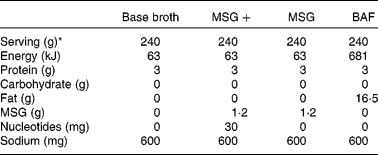
MSG+, monosodium glutamate+ the nucleotides inosine 5′-monophosphate and guanosine 5′-monophosphate; MSG, monosodium glutamate; BAF, broth with added fat.
* Servings were provided twice over the testing session.
Breakfast and test lunch composition
The breakfast consisted of one serving of the preload broth and a slice of Franz® Texas Toast (418·4 kJ, 1 g fat, 18 g carbohydrate and 3 g protein) (Portland, OR, USA). Toast was given alongside the 09.00 hours preload serving to supply participants with a moderate amount of energy.
The tray lunch provided at 12.30 hours included a variety of foods, both savoury and sweet. Each lunch consisted of a selection of two grains (crackers and pita bread), two fruits (apples and banana), two vegetables (snap peas and carrots), two cheeses (havarti and cheddar), two meats (ham and turkey), two sweets (rice treat and chocolate candies), one yogurt, one ice cream cup, hummus (garbanzo bean spread), potato chips and 591 ml of still water served chilled, in an opaque cup with a lid and a straw.
Participants were told that they could have as much or as little as they would like of any food or water and could request unlimited additional portions. All foods and water were pre-weighed at the time of serving. Plate waste was collected and weighed by the experimenters. Food energy and nutrient values were calculated with Food Processor software 8.1 (ESHA Research, Salem, OR, USA) and from the manufacturer's food labels.
Statistical analyses
Data analysis used the Statistical Package for the Social Sciences version 17.0 for Windows. Our previous studies have shown that population distributions of MR (collected by VAS) and energy intake at lunch are normally distributed(Reference Almiron-Roig, Flores and Drewnowski19–Reference Tsuchiya, Almiron-Roig and Lluch21). Thus, analyses of MR used a repeated-measures ANOVA with the preload broth (four preload types) and time (twelve ratings from 09.15 to 12.00 hours) as the within-subject factors. Since the study design included two preloads served over 2 h apart, we also conducted a second analysis of the effect of the first and second preloads alone on MR, using the nine ratings before the second delivery of the preload (P1, 09.15–11.15 hours) for one analysis using a repeated-measures ANOVA and the four ratings from 11.15 to 12.00 hours (P2) for another repeated-measures ANOVA. Analyses of lunch intakes were also conducted using repeated-measures ANOVA with the four preload broths as the repeated measures. Pairwise comparisons were made when ANOVA was significant. Differences in palatability and sensory scores were also analysed by repeated-measures ANOVA with the preload broth as the within-subject factor.
Study power and sample size
Sample size calculations were based on a standard formula(Reference Rosner and Crocket22) using variance data from our previous studies on satiety(Reference Monsivais, Perrigue and Drewnowski13, Reference Perrigue, Monsivais and Drewnowski14). A sample of thirty-five subjects was sufficient to detect a difference of ≥ 418 kJ in compensation, with a power of 80 % and α = 0·05. The necessary sample size was based on expected largest difference in energy compensation between any two preload broths. In the present study, the inclusion of the positive energy control (BAF) was based on the difference in energy between the base broth and the BAF, which was 1236 kJ (1362 − 126 kJ); however, the expected difference in energy intakes between these two conditions at lunch was of the order of 523–837 kJ.
Results
Participants
Mean BMI for the thirty-five female subjects was 21·6 (sem 1·8) kg/m2. Mean age was 24·7 (sem 4·6) years.
Effects of the preloads on appetite
Temporal profiles of hunger and fullness ratings are shown in Fig. 1. For hunger ratings, there was a significant main effect of time (P < 0·001) and a significant main effect of the broth (P = 0·03) over the entire testing period (09.15–12.00 hours), but there was no broth × time interaction (P>0·10). Pairwise comparisons of means by the preload broth showed a significant difference between the mean base broth (42·07 (sem 3·52 mm)) and the mean BAF (50·00 (sem 3·29) mm; P = 0·03). When comparing the three equal energy preloads, the MSG and MSG+ conditions were not statistically different from the control (Fig. 2).
Hunger ratings from 09.00 to 12.30 hours of the following four preload broths that were consumed: (1) base broth (○); (2) monosodium glutamate (MSG)+ the nucleotides inosine 5′-monophosphate and guanosine 5′-monophosphate (MSG+; Δ); (3) MSG (▲); (4) broth with added fat (●). Values are means, with standard errors represented by vertical bars (n 35). VAS, visual analogue scale.

Time-averaged means over the entire study session for (A) hunger, (B) desire-to-eat, (C) desire-to-snack and (D) fullness ratings for the broth conditions: (1) base broth; (2) monosodium glutamate (MSG)+ the nucleotides inosine 5′-monophosphate and guanosine 5′-monophosphate (MSG+); (3) MSG and (4) broth with added fat (BAF). Values are means across time periods (n 35), with their standard errors represented by vertical bars. a,b Mean values with unlike letters were significantly different (P < 0·05). For hunger (P = 0·03), desire to snack (P = 0·04) and fullness (P = 0·01), there was an overall effect of the broth condition according to the repeated-measures ANOVA. Pairwise comparisons found that for hunger, there was a significant difference between the BAF and base broth conditions (P = 0·03). There was also a significant difference between the BAF and the base broth for desire to snack (P = 0·04). For fullness, there was a significant difference between the BAF and the MSG+ broth (P = 0·02). VAS, visual analogue scale.

Restricting the analysis of hunger ratings to the time between the second preload and lunch (P2) also showed a significant main effect of time (P < 0·001) and broth (P = 0·008). Pairwise comparisons of means now showed that the MSG broth (48·75 (sem 2·91)) was associated with significantly lower hunger when compared with the base broth (55·27 (sem 3·22 mm); P = 0·03). The BAF (44·61 (sem 3·54) mm) was also associated with lower hunger compared with the base broth (P < 0·001) (Fig. 3).
Time-averaged means for preload 2 (A) hunger, (B) desire-to-eat, (C) desire-to-snack and (D) fullness ratings of the broth conditions: (1) base broth; (2) monosodium glutamate (MSG)+ the nucleotides inosine 5′-monophosphate and guanosine 5′-monophosphate (MSG+); (3) MSG; (4) broth with added fat (BAF). Values are means across the time period (preload 2; n 35), with their standard errors represented by vertical bars. a,b,c Mean values with unlike letters were significantly different (P < 0·05). For preload 2 hunger (P = 0·008) and desire to snack (P = 0·01), there was an overall effect of broth condition according to the repeated-measures ANOVA. Pairwise comparisons found that for hunger, there was a significant difference between the BAF and the base broth (P < 0·001), between the base broth and the MSG broth (P = 0·03), and between the BAF and the MSG+ broth (P = 0·02). The same analysis for desire to snack revealed a significant difference between the BAF and the base broth (P < 0·001), between the base broth and the MSG broth (P = 0·03), and between the BAF and the MSG+ broth (P = 0·04). For desire to eat, ANOVA did find a significant effect of broth condition (P = 0·01). Pairwise comparisons indicated that the base broth and the BAF were significantly different (P < 0·001). For fullness, ANOVA did find a significant effect of broth condition (P = 0·01). Pairwise comparisons indicated that there was a significant difference between the BAF and the MSG+ broth (P = 0·03) as well as a difference between the BAF and the MSG broth (P = 0·02). VAS, visual analogue scale.

Ratings for the desire to snack also showed significant main effects of the preload broth (P = 0·04) and time (P < 0·001), but showed no interaction between the two (P>0·10). Pairwise comparisons showed that the BAF (50·44 (sem 4·09) mm) significantly suppressed desire to snack compared with the base broth (61·10 (sem 4·00) mm). Restricting the analyses to the P2 period also showed a significant main effect of broth (P = 0·01). Comparisons of means for the P2 period showed that the MSG broth (59·26 (sem 3·58) mm) suppressed desire to snack relative to the base broth (67·95 (sem 3·82) mm) (P = 0·03). The BAF suppressed desire to snack relative to the base broth (P < 0·001).
Ratings for desire to eat showed a significant effect of time (P < 0·001) and a marginally significant main effect of broth for the entire session (P = 0·07). Analysis of the P2 period showed a significant main effect of broth (P = 0·01). Comparisons of means for the P2 period confirmed that the effect was largely due to the difference between the BAF (45·89 (sem 3·43) mm) and the base broth (52·46 (sem 3·20) mm) (P < 0·001).
Fullness ratings were opposite those for hunger, desire to snack and desire to eat. Analysis of fullness ratings over the entire test session showed a significant main effect of time (P < 0·001) and of broth (P = 0·01), but no interaction between the two (P>0·10). Comparisons of means showed that the significant difference was only between the BAF (41·26 (sem 2·97) mm) and the MSG+ broth (32·93 (sem 2·49) mm) (P = 0·02). Analysis of P2 for fullness showed a significant main effect of broth (P = 0·01). Comparisons of means showed that there was a significant difference between the BAF (38·65 (sem 3·42) mm) and the MSG+ broth (29·47 mm) (P = 0·003 ), between the BAF and the MSG broth (29·87 (sem 2·19) mm; P = 0·005) and between the BAF and the base broth (32·82 (sem 2·64) mm; P = 0·02). However, the base broth and broths supplemented with MSG and the nucleotides were not different from each other.
Energy, water and macronutrient intakes at lunch
Energy and macronutrient intakes at the test lunch are shown in Table 2. The base broth (2945 (sem 143) mm) was associated with the most energy consumption at the test meal, and the BAF (2587 (sem 151) mm) was associated with the least energy consumption. Analyses showed that energy consumption varied significantly among the broths (P = 0·04). Pairwise comparisons showed that there was a significant difference between the BAF and the base broth (P = 0·03), as well as a difference between the BAF and the MSG+ broth (2940 (sem 139) mm; P = 0·045). No other significant differences were observed. There was not a significant effect of broth condition on the amount of water consumed.
(Mean values with their standard errors)

MSG+, monosodium glutamate+ the nucleotides inosine 5′-monophosphate and guanosine 5′-monophosphate; MSG, monosodium glutamate; BAF, broth with added fat.
a,b Mean values within a row with unlike superscript letters were significantly different (P < 0·05).
We also examined the percentage of energy intake that was consumed as protein, fat and total carbohydrates at the test meal in order to see whether the preload broth exerted an influence on the balance of macronutrients consumed. Analyses showed that percentage energy from carbohydrates differed significantly by broth (P = 0·04). Pairwise comparisons of the broths showed that there was a significant difference between the BAF (51·8 (sem 2·1) %) and the base broth (47·6 (sem 1·4) %) (P = 0·006), as well as between the BAF and the MSG broth (48·3 (sem 1·4) %; P = 0·044). The repeated-measures ANOVA on percentage energy from protein and sugar did not show any significant effect of broth condition. However, there was a significant effect of broth condition on the percentage energy consumed from fat (P = 0·02). Pairwise comparisons indicated that there was a significant difference between the BAF (31·7 (sem 1·4) %) and the base broth (35·8 (sem 1·1) %) (P = 0·01), as well as a significant difference between the BAF and the MSG broth (35·4 (sem 1·1) %; P = 0·02). No other differences were observed.
Hedonic and sensory ratings
For the pleasantness and liking ratings, the MSG broth was rated the highest followed by the MSG+ broth, the base broth and the BAF. For these ratings, there was a significant variation among the broth conditions (P < 0·001). Analysis of the pairwise comparisons showed that liking for the BAF (28·83 (sem 4·13) mm) was significantly different from all the other broths (base broth, 44·66 (sem 3·43) mm, MSG+, 43·50 (sem 3·96) mm and MSG, 48·35 (sem 3·84) mm; all P < 0·01). The same was true for pleasantness. There were no significant differences among the broths in the rated sensory attributes: savoury, salty, creamy, bitter, sour and sweet (P>0·10).
Discussion
The present double-blinded study used a double preload design and recorded MR and food consumption in a test lunch. Study controls were an equal energy base broth and a higher-energy BAF, each without MSG. The present study was powered on the expected difference in energy intakes between the BAF and the base broth, and the mean difference in energy intake between those broths (358 kJ) was significant. The next largest deviation from the base broth was the MSG broth, with a mean difference in the energy intake of 108 kJ, which was not significant. This may have been due to the fact that the present study was not adequately powered to be able to detect differences of this magnitude. The analysis of the percentage of energy consumed as carbohydrate and fat also indicated that there was a difference between the BAF and the base broth. This difference was probably due to the fat consumed in the BAF condition.
The lack of a significant difference in MR between the low-energy broths when analysed over the entire session was consistent with previous research investigating the satiating effects of added MSG(Reference Rogers and Blundell3, Reference Luscombe-Marsh, Smeets and Westerterp-Plantenga4). The lack of a significant difference in terms of energy intake at a test lunch was also consistent with previous research(Reference Rogers and Blundell3). However, those authors have reported that the addition of MSG can lead to a ‘more rapid recovery of a motivation to eat’(Reference Rogers and Blundell3), a finding that is not supported by the present study.
Analysis of the hunger and desire-to-snack ratings after the second preload indicated that there was a hierarchy in satiety with the BAF causing the strongest feelings of satiety, followed by the MSG broth, the MSG+ broth and with the base broth associated with the least satiety. In addition, MSG was found to significantly reduce feelings of hunger and desire to snack, relative to the base broth after the second preload serving.
There are a few possible reasons that the differences among the equal energy broths were greatest and statistically significant only when measured after the second preload. First, it is possible that the satiating effect of 418 kJ of toast served with the broths for breakfast masked any differences between the MSG-containing preloads and the control. Indeed, the equal energy broths all contained such a small energy load that the satiating power of MSG may have been overwhelmed by the energy contained in the toast. Second, the effect of MSG on satiety may depend on the cumulative dose, meaning that, while the concentration of MSG in the preloads of the present study was similar to that of past studies(Reference Rogers and Blundell3, Reference Luscombe-Marsh, Smeets and Westerterp-Plantenga4) (i.e. 0·4–0·6 %), the present study used a double preload design that gave participants twice the total dose of MSG over 3 h. Results could also be a combination of these factors, and future studies should be designed to explore these possibilities.
The present findings also contrast with an earlier study showing that MSG increased energy intake relative to a control broth(Reference Luscombe-Marsh, Smeets and Westerterp-Plantenga4). While that study and the present one used a similar design, the preloads differed in their macronutrient composition. The preloads used in the present study had a relatively low level of protein (3 g), while those in the earlier study had a relatively high amount of protein (>30 g). As mentioned previously, MSG in the presence of a high-protein meal may accelerate gastric emptying(Reference Zai, Kusano and Hosaka11), which has been shown to reduce satiety and promote hunger(Reference Benini, Castellani and Brighenti12). The facts that the time between MSG presentation and the test meal in the present study (45 min) was similar to that in the previously mentioned MSG satiety study (50 min), and that the concentrations of MSG were similar between the two studies (0·5 and 0·6 %, w/w) lend credence to that notion.
One limitation of the present study was that it was conducted using only women as participants. While this was done to minimise variability in energy intake, future studies should include both sexes. Future research in this area of eating behaviour should also focus on illuminating any differences in energy intake and feelings of satiety that can be caused by the addition of MSG. As the present study was powered to detect an effect on energy intake that was due to the energy difference between the BAF and the base broth, future studies should be powered by the observed differences in energy intake between the base broth and the MSG broth. In addition, since the satiating effects of MSG may depend on the total dose, future studies may have to incorporate more presentations of a MSG over the course of the study day. Indeed, in the present study, the effects of MSG on feelings of satiety did not become wholly apparent until after the second preload. It will also be important in future research to explore these effects in a demographically more diverse sample and using different preload characteristics (e.g. macronutrient composition), in order to generalise these findings to a broader population and base of foods.
Additional research should be directed towards the supplementation of MSG and other glutamate-based compounds in foods and the relative effects on taste. There are current recommendations to reduce the Na content of the American diet, which may require that manufacturers reduce the Na content of processed foods such as soups or broths(23). MSG as well as calcium diglutamate supplementation has been shown to maintain soup palatability when Na levels are decreased(Reference Ball, Woodward and Beard24–Reference Yamaguchi and Takahashi26). Thus, more research is needed to ascertain the amount and forms of glutamate that can assist in maintaining palatability when Na levels are reduced.
Conclusion
Supplementing chicken broth with MSG can lead to some stronger feelings of satiety but does not alter energy intake at the next meal relative to an equal energy broth without added MSG.
Acknowledgements
The present study was supported by a research grant provided by Ajinomoto, Inc. to the University of Washington. There are no conflicts of interest for any authors of the present study. B. E. C. designed the study, collected the data, analysed the data and wrote the manuscript. P. M. and A. D. designed the study and contributed to the manuscript. M. M. P. collected the data.



