In 1949, British Columbia (BC) adopted legislation permitting IndigenousFootnote 1 children to be educated with their non-Native peers in the province's public schools. The adoption of this law occurred two years before the passage of federal legislation that would allow integrated schooling. Existing scholarship has tended to frame integrated education for Indigenous students around national developments,Footnote 2 implying that provincial policymakers simply imported federal directives into provincial school systems. Nevertheless, BC has never simply been an importer of educational developments from elsewhere. In her seminal article “Transfer, Imposition or Consensus? The Emergence of Educational Structures in Nineteenth-Century British Columbia,” historian Jean Barman illustrated that although the province's emerging educational structures were “usefully informed by events elsewhere,” they took on their own distinct direction based on the needs of local families, which prompted a consensus among key advocates of public education.Footnote 3 More recently, Nancy Beadie and her colleagues have argued that the history of education in the North American West should be considered distinct for various reasons, not the least of which are matters of race, racism(s), and racialization. In a 2016 special issue of the History of Education Quarterly, the editors invited historians of education “to transcend the nation-state as a point of reference” by focusing on the Pacific region.Footnote 4
Since the late 1970s, various historians have advocated a stronger role for historical research in policy studies.Footnote 5 Elisabeth Hansot and David Tyack offered several advantages of historical approaches to policy study, including, for example, the psychological distance afforded by historical analysis and the benefits accrued by longitudinal meta-analyses that can help in determining why certain problems appear to merit attention at specific times in history.Footnote 6 The importance of historical perspectives for policy analysis was highlighted early on by Harold Silver, who warned that “policy analysts and policy makers have in a loose sense all become historians now, at least in the assumptions that they often make about the past.”Footnote 7 Despite these views, historical scholarship bearing on the development of twentieth-century policies, legislation, and government initiatives in Canadian education has been sparse.Footnote 8 This is unfortunate, given that educational policy research has been conceptually complicated by a lack of historical perspective, even though policies are rooted in and grow from the past. Although scholars agree that policy development is a complex enterprise, comprised of multiple interdependent factors, including policy actors, institutions, and ideas, there is less agreement on the relative influence that each of these components wields.Footnote 9 Detailed historical analyses can potentially illuminate policy determinants, issues of implementation, and long-term impacts. For example, in his 2010 study, Wayne Urban illustrated that the National Defense Education Act in the United States had less to do with science promotion (as most scholars have claimed) than with the deep-rooted liberal ideas of political figures Carl Elliott and Lister Hill as well as liberal-minded civil servant allies who helped to implement the legislation.Footnote 10
This paper examines how and why BC followed its own policy path with respect to the schooling of Indian children in the years immediately following World War II. In particular, I focus on the factors that enabled the province's 1949 policy shift from segregated to integrated schooling. I argue that the policy actors were shaped by the discourse of ethical liberalism, an ideology that dominated BC's educational politics for much of the first half of the twentieth century. Ethical liberalism essentially promoted individuals’ civil rights as well as the notion of equality of opportunity through government redistribution of resources.Footnote 11 Ethical liberal discourse, which arose in the aftermath of two world wars and the Depression, fostered the development of social welfare policies in Canada, including old-age and veterans’ pensions, family allowance (also known as baby bonuses), employment insurance, and socialized medicine. The policy actors who I examine were driven by a strong desire to enhance social harmony by achieving greater social equality. Furthermore, BC's early implementation of integrated schooling was due, in part, to Canada's political institutions, which have facilitated regional autonomy in matters such as education.
In this paper, I briefly examine the political and legislative context of schooling in Canada. I then summarize research to date examining the shift from segregated to integrated schooling. The main focus of the article is on the reformers whose efforts led to integrated schooling in advance of federal developments and the ideas and governance structures that facilitated reform. The questions that guided this research were: Who was involved in the development of integrated schooling in BC? Through what means did the policy actors advance the integration of Indigenous youngsters into BC's public schools? What factors contributed to these initiatives? To what extent did provincial reformers work with federal authorities who had legal (constitutional) jurisdiction over Indigenous schooling? This study contrasts the ethical liberal agenda of BC's progressive-minded policy actors with the more fiscally focused workings of officials and policymakers operating within Canada's federal government.
Background: Indigenous Education in Canada
Canada's Indigenous education policy has been a key part of its broader social policy to assimilate Indian populations. Initially, European traders depended on Indigenous peoples to access natural resources for economic exchange, particularly during the fur trade. Aboriginal populations were also important for protecting colonial interests against American incursions.Footnote 12 By the early 1800s, economic activity had shifted and the colonial government's Indian Department took responsibility for managing the marginalization of Indigenous communities that resulted from colonial settlement.Footnote 13 As more settlers took up residence into the late 1800s, Indigenous peoples were increasingly displaced and suffered the effects of disease, alcohol, and the decline of traditional activities to sustain themselves, such as fishing and hunting.Footnote 14 According to historian J. R. Miller, “The Indian was now a liability to people who wished to reduce the forests to tidy farms, tame the rivers by means of canals to haul their goods, and develop manufacturing.”Footnote 15
By the time the process of Confederation made the colonies a nation in 1867, the Canadian government was implementing increasingly restrictive measures to curtail the livelihoods, and indeed the very presence, of Indigenous peoples.Footnote 16 Throughout the 1880s, amendments to the Indian Act outlawed traditional ceremonies, such as the Potlatch; replaced traditional Indian governance structures with elected councils that had limited powers and were subject to government dismissal; and empowered federal Indian Affairs ministers to spend band funds without band members’ consent.Footnote 17 The situation in British Columbia was more dire than elsewhere, since provincial authorities defied federal guidelines for reserve land allocation. Whereas governments east of the Rocky Mountains negotiated reserve allotments of a hundred acres or more per family, British Columbia set the upper limit at merely ten acres.Footnote 18 In addition to destructive social policies that appropriated Indigenous lands for resource extraction and colonial settlement, the federal government established education policies that aimed to assimilate Indigenous children through instruction in the English language, Christian morality, and agricultural work.Footnote 19
Unlike other English-speaking industrialized countries, such as the United States, the United Kingdom, or Australia, Canada does not have a national department of education, a situation that has severely limited the federal government's reach over educational matters. The reason for this is that authority over public schooling in Canada was conferred upon the provinces with the signing of the 1867 British North America Act. However, the federal government retained jurisdiction in three areas considered to be in the national interest: Indian affairs, the schooling of children of armed forces personnel and labor-market (post-secondary) training.Footnote 20 Canada's constitution thus warranted the segregation of Native children from their non-Native peers in missionary-run day schools as well as in industrial and boarding (later residential) schools managed by various denominations on behalf of the Canadian government.
The scholarly literature on Indian day schools is sparse compared to scholarship on residential schools.Footnote 21 Although a thorough treatment of these two forms of schooling is beyond the scope of this paper, this discussion merits mentioning a few key elements of Indigenous schooling in Canada. After the nation was established in 1867, Indian Affairs officials initially relied on church-run, on-reserve day schools to educate Native children and to encourage communities to adopt “Western ways,” since church personnel had long-standing missions that included schools on or near Indian lands. Much like provincial rural schools, Indian day schools imparted the fundamentals of reading, writing, and arithmetic to Indigenous students in rustic, usually one-room settings. However, by the mid-1870s the federal Department of Indian Affairs (DIA) considered day schools to be “a very imperfect means of education,” since children could return daily to their Native languages and customs on their reserves.Footnote 22 Irregular attendance also plagued the day schools, given that children would accompany their families on extended excursions during the autumn and spring fishing and hunting seasons.Footnote 23
In the late 1870s, Prime Minister John A. MacDonald dispatched Nicholas Flood DavinFootnote 24 to the United States to tour and report on the American Indian boarding school system. Davin was impressed with the American schools and, in 1879, after consulting with various church officials, presented a report to the government recommending that Canada adopt such a system.Footnote 25 Support for such schools soon spread among government officials, and by the 1890s the Canadian government had embraced the boarding school model that provided a general academic curriculum to children aged eight to fourteen and industrial schools that trained fifteen-to-eighteen-year-olds in practical skills such as carpentry, cabinet making, and shoemaking.Footnote 26 By 1923, federal authorities officially phased out the terms boarding and industrial and adopted residential to describe schools where children boarded away from their families for ten months or more up to the age of sixteen.Footnote 27 Both individuals and whole communities were negatively affected by the removal of children as young as six from their families and their long-term attendance at boarding facilities. School officials stressed to the children that their families and cultures were inferior, something used to justify physical punishment for minor transgressions, such as speaking one's language. Siblings were purposely segregated to discourage linguistic and cultural retention and to promote each child's absorption into Canadian social mores.Footnote 28
Due to the financial austerity exercised by federal policymakers, residential schools were poorly funded and relied to a large extent on the human resources of the churches and the children who attended them. Daily school maintenance was achieved by implementing a “half-day system” whereby students spent only half their day studying academic subjects and the remainder of the time performing manual labor. Reforms to the DIA after 1896 brought widespread reductions in staff and salaries and centralized decision-making power with senior federal officials, such as Duncan Campbell Scott, an accountant devoted to minimizing costs.Footnote 29 Scott served as Superintendent General of Indian Affairs from 1913 to 1932 and was mainly guided by principles of fiscal parsimony.Footnote 30 Throughout Scott's tenure
enforced economy … led the schools’ officers to cram too many students into dormitories, seal up the schools to save heat in the cold months, and skimp on foods that would have helped to provide the children with a nourishing diet. The result was abominable health conditions that escalated death rates.Footnote 31
Chronic underfunding also meant that many Indigenous children did not attend school at all. Indeed, during the 1945–46 school year, of BC's twelve thousand Indian youngsters under seventeen years of age, only forty-one hundred were enrolled in any form of schooling.Footnote 32 Among the most disturbing revelations about residential schools in Canada are former students’ stories of both physical and sexual abuse at the hands of religious personnel, teachers, administrators, and educational assistants.Footnote 33
These facts prompted Barman to conclude that Canadian residential schools—like the government's overall assimilation policy—were a “dismal failure.”Footnote 34 Rather than prepare Indigenous children to enter into the social and economic mainstream, poor levels of education and estrangement from their communities marginalized them from both home and society. It would take Canada until 2005 to finally recognize the negative effects of the residential schools and agree to allocate $2 billion in reparations to former pupils. Three years later, the federal government issued an official apology for the schools’ destructive impact on Aboriginal culture, heritage, and language. This apology was followed by the establishment of the Truth and Reconciliation Commission (2008–2015) that toured the country and collected briefs from former students in order to advise the federal government on how to reconcile Canada's broken relationship with Indigenous peoples.Footnote 35
Indigenous peoples’ responses to Western-style schooling have in no way been uniform. However, both individual students and whole communities have tended to hold more favorable attitudes toward on-reserve day schools than off-reserve residential schools. Prior to Confederation, the Tsimshian of northwest British Columbia “desired (and even demanded) missionary educators” who could help communities to become literate and, thus, more independent in a changing world.Footnote 36 There is also evidence to suggest that “it was the Natives [not government officials] who proposed the inclusion of guarantees of schooling” in the treaty negotiations.Footnote 37 Indeed, in Upper Canada as early as the 1840s, “band after band responded positively” to the concept of Western-style schooling, contributing “one quarter of their annual treaty payments for an education fund.”Footnote 38 Throughout the closing years of the nineteenth century and the first half of the twentieth, Indigenous groups at Campbell River and Cape Mudge, BC, repeatedly requested on-reserve schooling from federal authorities, who consistently dragged their heels, citing lack of funds.Footnote 39 Recalling his educational experiences at Cape Mudge during the early twentieth century, former Chief Harry Assu noted that he and his classmates “liked [the teacher, Mr. Rendle] and … liked school. There were around twenty of us. We behaved in school. We wanted to learn.”Footnote 40
Indigenous reactions to the residential schools were more negative. Barman, Yvonne Hébert, and Don McCaskill noted that throughout the first half of the twentieth century, Indigenous parents and community leaders “repeatedly brought the discriminatory and inherently contradictory conditions of schooling to the attention of the Department of Indian Affairs,” but government authorities were not sympathetic to their concerns.Footnote 41 However, government indifference could not prevent individual students from resisting residential schools. From ridicule and nicknaming of teachers to failure to cooperate in class, students registered their resistance in multiple ways. A comical example can be found in the work of Miller, who recounts a scenario from Elkhorn school during the 1940s. Apparently several boys sprayed one of the school's pigs with water, causing it to freeze. School officials were mystified by the pig's death and decided to incinerate it. When the boys offered to dispose of the animal, they defied authority by roasting the pig for a snack.Footnote 42 More tragic examples include students running away from the schools, often with fatal results due to exposure to the cold or wild animals.Footnote 43
Despite the fact that Canada's last residential school did not close until 1997, public sentiment had turned against segregated schooling by the early 1940s. Some historians have argued that the horrors of World War II prompted Canadians to acknowledge the immorality of race-based segregation.Footnote 44 Historians have also argued that financial exigency was an important force propelling federal officials to shift policy directions.Footnote 45 That is, throughout the 1930s and early 1940s, education systems in Canada suffered from extreme financial deprivation, as both federal and provincial authorities lost revenues during the Great Depression and then diverted funding to support war-related initiatives. Integrated schooling would enable both federal and provincial officials to achieve financial efficiencies in both operating and capital costs.Footnote 46
In 1946, the Canadian government established a Special Joint Committee (SJC) of the Senate and the House of Commons that spent two years considering briefs and presentations from individuals and organizations across Canada on how to address Indigenous peoples’ grievances over substandard housing, poor education, inadequate social services, and lack of enfranchisement. In response to the SJC's recommendations, the federal government adopted a policy of promoting the education of Aboriginal children “in association with other children.” This policy was not legalized until 1951, when revisions to the federal Indian Act enabled the minister of Indian Affairs to “enter into agreements with provincial governments, territorial councils, school boards or religious or charitable organizations for the schooling of Aboriginal children living on reserve.”Footnote 47
Indigenous Policy Actors
Attributing the push for integrated schooling to changes in Canadian moral sentiments and government’s financial exigency does not explain why BC integrated its schools two years ahead of federal legislation. Such attribution also downplays the key role Indigenous peoples themselves played and the extent to which educational reform was intertwined with their advocacy for general Indian rights. Since the earliest influx of settlers and the establishment of reserves during the mid-1800s, Indigenous peoples in BC have protested the theft of their land, their limited reserve allocations, lack of land title and treaties, as well as their general lack of rights under Canadian law. In 1875, Coast Salish chiefs launched protests at provincial government offices on the mainland. The British Colonist newspaper reported that “the Indians have complained, and have had good reason to complain, of their treatment on the question of their land reserves.”Footnote 48 The protests were followed by delegations of Nisga'a peoples (from northeastern BC) to the government in Victoria in 1881 and to Ottawa in 1885. In both cases, Indigenous representatives were rebuffed. A 1906 meeting at Cowichan on Vancouver Island authorized three chiefs—Joe Capilano (from Squamish), Basil David (Shuswap) and Chillihitza (Okanagan)—to travel to London to launch grievances with King Edward VII. Despite verbal sympathy, the king did not intervene. Three years later, North Coast and Coast Salish leaders agreed to form the Indian Rights Association, which sought to advance province-wide Indian rights. One of the key members recruited to the committee was Reverend Peter Kelly.
Kelly was born in 1885 to a prominent Haida family in Skidegate, where he attended the mission day school. At age fourteen, he transferred to the Methodist-run Coqualeetza Industrial Institute located just south of Chilliwack in BC's lower mainland. He was one of the first graduates of Chilliwack High SchoolFootnote 49 and in 1913, he enrolled in theology at the Methodist-run Columbia College at New Westminster. Kelly was ordained in 1916 and assigned to minister at Hartley Bay, followed by Nanaimo.Footnote 50 Throughout his years of ministering, he remained politically active, first in the Indian Rights Association and later in the Allied Tribes of British Columbia and the Native Brotherhood of British Columbia. Unlike some other Indigenous leaders of the time, Kelly believed that assimilation was inevitable, and he promoted interactions between members of his Aboriginal parish and white Europeans through sporting and other social events.Footnote 51 From the 1920s into the 1950s, Kelly was a strong advocate for increased citizenship rights for Indigenous peoples and he lobbied Ottawa regularly. He made no fewer than ten visits to Ottawa to agitate for changes to the Indian Act, including, but not limited to, the right of Indigenous peoples to vote and receive social benefits, the implementation of integrated schooling, and more band-level control over local affairs.Footnote 52
In light of pressure from Native advocacy groups, the federal government agreed to establish a royal commission (the McKenna-McBride Royal Commission) in BC in 1913 to investigate Indigenous claims to land titles and the question of undersized reserves. The statement of Alfred Adams, an early Indian rights advocate who addressed the commissioners, encapsulates the intentions of the Native representatives:
On these Islands our forefathers lived and died, and here we also expect to make our home until called away to join them in the Great Beyond. Here we are raising our families, and all we have in this world, with the traditions and associations, lands and household goods, are bound up on the islands that once were our own but are now becoming the homes of others. Since the coming of our white friends, we have been wards of the government, and the limits of our land have been drawn, giving to us an interest in six acres apiece of the many thousands over which we formally roamed.Footnote 53
After three years of hearings, the commission members ruled against the Natives’ claims.Footnote 54 In 1916, Kelly and Andrew Paull, who had served as an interpreter to the commission, organized a North Vancouver Conference that brought together sixteen tribal groups from across BC to work together for greater rights.Footnote 55 They dissolved the Indian Rights Association and established the Allied Tribes of BC, making Kelly chair. Although in 1924 the federal government approved the McKenna-McBride recommendations, seeking to close the matter permanently, the allied advocates for Indigenous rights could not be stopped. On behalf of the Allied Tribes, Kelly drafted a petition to the Canadian government calling for a special federal committee to reconsider the land question.Footnote 56 When the committee members finally met in 1927, Kelly appealed to their sense of fair play, asking, “Why not keep unblemished the record of British fair dealing with native races? Why refuse to recognize the claim of certain tribes of Indians in one corner of the British Dominions, when it has been accorded to others in another part of the same Dominion?”Footnote 57 According to Kelly, “gradually [Aboriginal peoples in BC] have been hemmed in, little by little, until the things which they enjoyed in the past have been taken away from them.”Footnote 58 Snubbed by the committee, he lamented:
The Indians have no voice in the affairs of this country. They have not a solitary way of bringing anything before the Parliament of this country, except as we have done last year by petition, and it is a mighty hard thing. If we press for [our rights], we are called agitators, simply agitators, trouble makers, when we try to get what we consider to be our rights … it has taken us between forty and fifty years to get to where we are to-day.Footnote 59
In response, the Canadian government simply amended the Indian Act, rendering it illegal to request or receive moneys for legal or other services for the purposes of pursuing Indian land claims.Footnote 60 This turn of events led to the demise of the Allied Tribes, but did not mark the end of Indigenous advocacy. Indigenous fishermen were undeterred by the law, and in 1931 they established the Native Brotherhood of BC under the auspices of advocating for Aboriginal hunting, fishing, trapping, and timber-harvesting rights, rather than land claims. By the 1940s, Kelly found himself involved in the activities of the Brotherhood, including drafting missives to government.
By the mid-1940s, the Brotherhood had added education to its list of grievances. When the government established the SJC to inquire about Indigenous affairs in 1946, Kelly presented on behalf of the Brotherhood:
The reason we are stressing so much the necessity of Indians attending the public schools of the land is that the growing generation will meet with the other children and compete with them … and play with them; and will develop with them and will think as they do and see as they do. … As our brief points out, we would like the Indian to hold onto his aboriginal rights and not to take all that away from him, at one stroke, but to extend to him the right of citizenship.Footnote 61
Other presenters included William Scow, Guy Williams, and Thomas Gosnell, who agitated for better education for Indigenous children as well as the federal franchise. According to Scow:
This is our most critical hour, the hour for which we have waited 80 years. For over three-quarters of a century, ever since the enactment of the Indian Act, our people have suffered discrimination and exploitation. Now at long last our chance has come to present to the people of Canada our hopes and desires in the revision of that Act, so that we may walk as free men in this land of our fathers.Footnote 62
In 1947, the Brotherhood also submitted a brief to the BC government asking that the administration of Indian education be shifted to the province.Footnote 63 In a 1949 letter to officials in Ottawa, the National Indian Brotherhood (NIB) indicated that, initially, Indians “hailed” the 1946 establishment of the SJC to examine Indian well-being. However, their hope was soon followed by disappointment at Ottawa's unwillingness to permit Native Canadians to serve on the committee and speak for themselves. They demanded that the SJC be reconstituted to include Native members and that a claims commission be created “to deal with all the many claims of Indians across Canada.”Footnote 64
Although federal officials did not respond favorably to the Brotherhood's request, BC's provincial officials sought to address Indigenous grievances using a two-pronged approach. In 1949, the BC government passed legislation to extend the franchise to Native peoples. In response to the news of enfranchisement, Kelly exclaimed, “My family and I will now vote for the first time … For the first time the door is opened to us and if all villages march shoulder to shoulder … we will go through that door in final triumph.”Footnote 65 BC Premier Byron Johnson assigned Minister of Labor John Cates to tour the province to explain and field questions about the franchise.Footnote 66 BC's newly enfranchised Natives welcomed Cates as the representative of Premier Johnson, whose election campaign included promises of significant reform to Native living conditions. For example, according to Harold Sinclair, district vice president for the Interior Skeena District Indians in northern BC, Cates was well received. Sinclair had written to the premier, holding him accountable to promises delivered during a campaign speech in the region. Johnson had allegedly stated “that the Door is now open, And that the Light, now shinneth <sic>, upon our native People, [and] that the Light will never more be dimmed, neither the door be shut.” Evoking the patriarchal rhetoric that characterized Indigenous-settler relations at the time, Sinclair closed the letter by calling Johnson “our Great White father” who would “uplift” Indigenous peoples and “remedy [their] wounded hearts.”Footnote 67
The second strategy the provincial government initiated was to form an Indian Advisory Committee in 1950, whose role it was to collaborate with other branches and levels of government to collect and correlate information relating to the civil and territorial rights of BC's Indians and to report to the provincial legislature.Footnote 68 As BC busied itself exploring Indian grievances, Ottawa dragged its heals pondering the SJC's 1948 recommendations, a situation that infuriated BC's legislators and citizens alike. By 1950 the federal government had drafted Bill 267 to address the SJC's recommendations and tried to rush its passage at the end of parliament's spring sitting. Both Indigenous and non-Indigenous peoples criticized it for merely calling for administrative changes, some of which had already been introduced prior to the bill's first reading.
One of the most contentious issues pertained to the fact that education was to remain denominationally divided, prompting many Indigenous leaders to voice bitter disappointment in a system that had outlived its usefulness. In the words of Paull: “[The choice of where to send a child to school] is a matter that belongs to the father and mother … Britain fought against religious control … and so did many Indians.”Footnote 69 According to Kelly, churches had done “an invaluable job in pioneering education” for Native people, but the time had come when “education should be part of the non-denominational school system.”Footnote 70 Other Indigenous leaders voiced concerns about the bill directly to Ottawa, including Cowichan chief Edward Elliott and Frank Calder, a member of the BC Legislative Assembly and former residential school attendee. They both believed that schooling should be nonsectarian.Footnote 71 Newspaper editors filled their columns with condemnation of the bill. BC's attorney general, Gordon Wismer, Vancouver mayor Charles Thompson, and Vancouver Park Board chair Rowe Holland all telegrammed the federal minister, pressing him to postpone it. The Civil Liberties Union of BC launched a letter-writing campaign to stop its passage. This opposition forced Ottawa to withdraw the bill and redraft it.Footnote 72
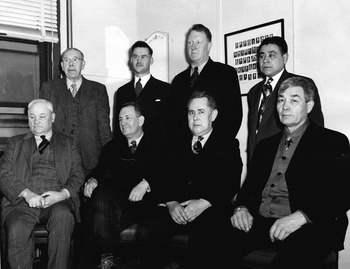
Indian Advisory Committee, back row, left to right: George Bruce, Reginald Kelly, Charles Cates, Ed Bolton. Front row, left to right: Laurence Guichon, Minister of Labour John Cates, Chief William Scow, Ernest Brewer. (Courtesy of City of Vancouver Archives, Major Matthews Collection, Port P1210.)

Whereas the Brotherhood's educational advocacy at the federal level led to frustration, their missives fell on receptive ears provincially. In addition to extending the franchise, the BC government revised the Public Schools Act in 1949, authorizing “the Minister or a Board of School Trustees to enter into an agreement” with federal Indian Affairs officials “for the education of Indian children resident in their respective districts.”Footnote 73
William Straith: Education Minister and Integrated Schooling Advocate
Within government circles, the passage of BC's integrated education legislation has largely been attributed to William T. Straith, the province's minister of education between 1947 and 1949. A lawyer by profession, Straith possessed a strong sense of social justice, likely due in part to his upbringing. He was born in 1894 in the rural community of Innerkip, Ontario, roughly 130 kilometers southwest of Toronto. As one of ten children born to a Methodist minister and a stay-at-home mother, Straith and his siblings faced social and economic hardship due to his father's untimely death.Footnote 74 As a child, Straith and his brothers were hired out as farmhands to help support the family, and as a young man he paid for his legal studies through employment as a teacher. During World War I, he served as a stretcher-bearer overseas.Footnote 75
Called to the BC Bar in 1922, Straith later served as a member of the BC Legislature from 1937 to 1952. Prior to serving provincially, he was a school trustee and alderman in Victoria. He was also a longtime member of the Kiwanis Club, the Canadian Club, and the YMCA. Although he was a member of the Liberal Party, he was known to support resolutions brought forth by the left-of-center Co-operative Commonwealth Federation (CCF), founded in 1932 and which later morphed into the New Democratic Party. For example, in 1947, he voted in favor of a CCF resolution criticizing his own government for not granting voting rights to Canadians of Japanese heritage.Footnote 76 He also supported legislation ensuring the rights of employees to organize and negotiate their employment conditions through mediation, conciliation, and arbitration.Footnote 77
On March 2, 1949, Straith introduced Bill 18 into the BC Legislature, an Act to Amend the Public School Act, which enabled the integration of Indigenous children into the province's schools.Footnote 78 Straith drafted the bill with the help of Labour Minister Cates, who was close to the premier and often served as his representative at official state affairs.Footnote 79 The bill passed effortlessly through second and third readings and was adopted as law on March 22.Footnote 80 The goal of the legislation and subsequent agreements was reportedly to “assist in removing the allegation that there are any ‘second-class citizens’ in British Columbia.”Footnote 81 Newspaper coverage was favorable, and in 1950, the editor of the Daily Colonist lauded Straith, who had “pressed for this change and done much to bring it into active accomplishment.”Footnote 82 Yet, another year would pass before Ottawa would revise the Indian Act to legalize the education of Indian children within provincial systems.Footnote 83
The fact that Straith's legislation proceeded without debate through the three mandatory readings reveals BC's progressive political context, which gave education officials wide latitude in achieving social reforms in the 1940s.Footnote 84 In 1949, BC's government consisted of a coalition between Liberals and Conservatives, led by Liberal premier Johnson. This unusual alliance was formed mainly to stave off incursions of the CCF, whose socialist platform appealed to growing numbers of British Columbians who had suffered personal and economic hardship through two world wars and the Depression.Footnote 85 Initially elected in 1945 under the premiership of John Hart, the coalition was quick to institute mandatory health insurance funded by a 3 percent provincial sales tax. During its tenure, the coalition also expanded the province's transportation system—enhancing both rail travel and highways—and established the first hydroelectric project on the Nechako River (the Kenney Dam). Though construction of the dam displaced Indigenous peoples due to flooding of their lands, BC legislators were unconcerned, motivated as they were to the larger liberal goal of “social progress.” It was within this social setting that the province was among the first jurisdictions to both integrate Indigenous children into public schools and grant Native peoples the right to vote in provincial and municipal elections.Footnote 86
Straith's lifelong concern for individual human rights was reflected in his widespread advocacy for what he believed to be equality of educational opportunities.Footnote 87 He never tired of stating that “every child, regardless of race, religion or geography, should have an equal chance to learn”Footnote 88 and that his department was “concerned only in education for children—not black or white, not those of certain racial origin or religious denominations—only children.”Footnote 89 He avidly believed in world peace and praised teachers for studying the United Nations in social studies classes. While addressing the graduation assembly at Victoria College, he argued that only education could pave the way to world peace.Footnote 90 He was a staunch opponent of independent schools, arguing that they threatened democracy, which he alleged could only be defended by public education.Footnote 91 With respect to the integration of Indigenous pupils into the provinces’ public schools, he argued that there would be no second-class citizens in British Columbia.Footnote 92 He spoke out against racial, religious, and monetary discrimination in the public school system. Furthermore, Straith was a strong advocate of the arts and insisted on presenting Indigenous students with scholarships awarded by the Society for the Furtherance of British Columbia Indian Arts and Crafts, even when the children attended residential and not public schools.Footnote 93
Though Straith was known to oppose suggestions of federal incursions into provincial affairs, he was not averse to cost-sharing agreements or to exerting his own influence on legislators in Ottawa.Footnote 94 A case in point occurred in 1948, when Straith learned that both federal and provincial governments were planning to build separate schools for white and Indian pupils in the northwestern town of Hazelton. He quickly traveled to Ottawa to persuade the minister of Indian Affairs to work with provincial officials to co-construct one integrated school. Straith's argument that building two schools would be “inefficient” prevailed, and Ottawa agreed to pay both tuition and capital costs for one school on a “pro-rata” basis.Footnote 95 At first glance, Straith's “efficiency” argument seems to contradict his characterization as a social justice advocate. However, the concept of social efficiency was totally compatible with the brand of liberalism adopted within educational circles in BC during the first half of the twentieth century. Jean Mann's insightful analysis of BC's progressive education reformers argues that they were equally concerned with preserving the “progressive” state for the purposes of efficiency and with meeting individual children's needs.Footnote 96 I suspect, as well, that Straith was an effective negotiator and opted to communicate with federal officials using discourse that was familiar to them: the language of financial frugality.
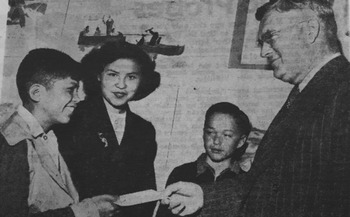
Straith presenting scholarships to residential school students in 1949. (Photo courtesy of The Province [BC] newspaper)

Although Straith's equality-of-opportunity discourse focused on equalizing the rights of individuals, he believed strongly that it was the role of state officials to preserve democracy for the benefit of the collective. In a 1948 written address to the graduates of Victoria's normal school, he noted that the role of the teacher was to help young people to realize their “true … obligations as citizens; … the building of a better more enlightened citizenry.”Footnote 97 In other addresses to the normal school graduates, he stressed that teaching was not a job but rather a calling and a noble profession. He added that among the “province's rich and varied resources” none was “so precious as the youth of the communities in which [the normal school graduates would] serve.”Footnote 98
Straith's firm belief in the progressive power of education is further reflected in the number of school openings that he officiated throughout his tenure. Each year, he traveled twenty-five thousand miles, cutting ribbons at some schools to mark their official openings while simply visiting and chatting with teachers, trustees, and children at others in an attempt to better understand their circumstances.Footnote 99 In an eleven-month period in 1951, he attended the openings of sixty-five new schools. This included the first integrated school built at Hazelton, of which the approval for construction—Straith was proud to announce—passed through a district plebiscite by a margin of ten to one.Footnote 100 That the plebiscite passed by such a wide margin further confirms changing public sentiments regarding racial segregation. Indeed, in previous decades, ratepayers throughout the province were known to vote against integrated schooling on numerous occasions.Footnote 101
Other Policy Actors
It is important to note that other “grassroots” players advocated for integrated schooling as part of a push for broader human rights. For example, in 1946, Maisie Hurley, a self-styled human and legal rights advocate, established the Native Voice newspaper. Bypassing mainstream media, Hurley was able to raise awareness among non-Indigenous people of Natives’ deplorable living conditions. In addition to editing and producing the Native Voice, Hurley and her lawyer husband, Tom, worked tirelessly to provide legal representation to Indigenous people, essentially establishing the precursor to legal aid and helping to eliminate some of BC's more restrictive laws circumscribing Indians’ lives.Footnote 102
The Campbell River and District Liberal Association consistently lobbied both the provincial and federal governments. In March 1949, the association presented a resolution pushing the federal government to revise the “out-moded” Indian Act. In a letter to BC's premier in April of the same year, John Anderson, president of the association, implored the premier to give the complaints of the Brotherhood his “deepest consideration” since they had
fought long and hard for something which is long overdue. The Indian has been treated as a ward and child; held down; looked down upon by some and really allowed the barest of existence; and all under an antiquated, and virtually Victorian Indian Act.Footnote 103
As these examples illustrate, the passage of integration legislation occurred within a social context that witnessed the temporary convergence of political and grassroots interests advocating for expanded Native rights.
Conclusion
By today's standards, the integration of Indigenous children into provincial schools—like Canada's broader assimilation policy—seems reprehensible. Indeed, scholars have argued that the purpose of Western-style education was to strip Indigenous peoples of their lands, languages, and cultures and to replace these with gendered and class-based Western values and mores to support Canada's expanding capitalist democracy.Footnote 104 However, in summing up policy developments pertaining to integrated schooling, it is important to keep in mind that during the immediate postwar era, integration was considered by many to be a significantly better option than the existing policy of segregation in federal residential and day schools. That Indigenous reformers such as Kelly, Elliot, Calder, and others supported integration illustrates the desire of politically well-connected Indigenous leaders to wind down the federal system of Aboriginal schooling—which they considered to be inferior to provincial schools.
The integration of Indigenous children into BC's public schools occurred before federal legislation that would enable it and was considered a progressive move for its time. During the 1940s, the idea of integrating Indigenous with non-Indigenous schoolchildren challenged racial hierarchies that had become well entrenched in BC, which historians dubbed a “white man's province.”Footnote 105 That BC's Indian integration and enfranchisement initiatives predated Ottawa's by two and eleven years, respectively, illustrates the extent to which BC charted its own course. Barman's observations on the establishment of BC's education system merit repeating since—in the case of integrated education—developments in the province were “usefully informed by events elsewhere” but ultimately took on their own direction.Footnote 106
The independent path that BC education reformers followed reflected a confluence of elements, including policy actors, ideas, and institutions. It is clear that integration in BC would not have occurred without the actions of Aboriginal advocates such as Scow and Kelly. Articulate, passionate, and determined, these advocates were not only leaders among the communities they represented but were also politically well connected at the provincial level. In terms of legislators, the most influential government actor was Straith, the education minister and an active member of Johnson's coalition cabinet from 1947 to 1952. Along with Cates, he drafted the bill of proposed changes to the School Act and shepherded it through the legislature into law. As a high-profile politician, Straith found himself in multiple venues from which to promote the virtues of equal educational opportunities. From remote provincial villages where he presided over school openings, to lecture halls where he addressed civic leaders and recent college graduates, Straith tirelessly promoted the notion that education was the greatest safeguard not only of individual rights and freedoms but of the democratic state as a whole. Like Indigenous and non-Indigenous reformers of the time, Straith's words and actions sought to ameliorate the state overall by equalizing human rights.Footnote 107
BC's move to integrated schooling was also facilitated by the social-political context within which the policy actors found themselves. British Columbia—like Canada and other jurisdictions—was a rapidly changing society as postwar sentiments began to favor a greater role for governments in attempting to equalize unequal social conditions.Footnote 108 Shifting attitudes led to a rise in the popularity of the far-left-of-center CCF party, which in turn prompted the development of Johnson's coalition government that favored heavy state intervention in the social lives of British Columbians. Thus, the idea of desegregating Indigenous schooling sat well with British Columbia's prevailing political ideology: ethical liberalism. The period of time between 1945 and 1975 has been referred to as the “postwar liberal consensus,” during which Canadians increasingly expected the state to endeavor to guarantee minimum living standards and social opportunities for all individuals “as a matter of right.”Footnote 109 According to historian Ian McKay, liberalism was so strong in early twentieth-century Canada that it “vanquished its enemies within and without.”Footnote 110 So ubiquitous was liberal discourse in promoting human rights that it was even embraced by Indigenous reformers such as Kelly, Sinclair, Calder, and Elliott, whose collectivist values and traditions liberalism has sought to erase.
It is important to note, however, that not all Indigenous groups supported integrated education—or even enfranchisement. Paull, elected president of the North American Indian Brotherhood in 1947, criticized the Brotherhood's policy direction, going so far as to state that the Indigenous peoples of BC wanted “to remain wards of the [federal] government.”Footnote 111 Indeed, only 8 percent of the briefs and presentations made by Native peoples to the 1946–1948 federal SJC supported integrated schooling, whereas 37 percent of their submissions called for continuing residential schooling.Footnote 112 Although 13 percent of the briefs called for the immediate end to denominational control of Indigenous schooling, 23 percent called for continuing denominational control. For example, BC's Lower Kootenay Band stated that it “did not want [their] children sent to non-religious schools” fearing that parental choice would be compromised if education were taken out of the hands of local religious authorities.Footnote 113 In short, Indigenous peoples in BC—and more broadly across Canada—have never spoken with one voice and should not be considered monolithic.Footnote 114 That Indigenous activists such as Kelly, Calder, and Scow pursued the same integration agenda as BC legislators like Straith and Cates says as much perhaps about these reformers’ political connections and ideologies as it does about the desires of the province's diverse Indigenous peoples. Nevertheless, the “liberal consensus” that paved the way for Indigenous children to attend provincial schools would not hold. In 1972, the NIB issued its policy paper Indian Control of Indian Education, arguing that integrated schooling had been a failure:
Integration in the past twenty years has simply meant the closing down of Indian schools and transferring Indian students to schools away from their Reserves, often against the wishes of the Indian parents. … Indian children will continue to be strangers in Canadian classrooms until the curriculum recognizes Indian customs and values, Indian languages, and the contributions which the Indian people have made to Canadian history. …Footnote 115
With this document, the NIB encouraged Indigenous people to “reclaim … [the] right to direct the education of … [their] children.”Footnote 116 When the federal minister of Indian Affairs accepted the paper and agreed to it in principle, the door was opened to the—admittedly slow—shift of educational control from federal authorities to local Indigenous communities.Footnote 117
The ability of education reformers to usher integration into BC's schools rapidly and successfully at the end of the 1940s evokes David Tyack and Larry Cuban's finding that for educational reforms to succeed, certain conditions must be met. Among these is the necessity of “influential constituencies interested in seeing them continue [emphasis in the original].”Footnote 118 In the words of Tyack and Cuban, “Not all reforms are born equal; some enjoy strong political sponsors while others are political orphans.”Footnote 119 In the case of integrated schooling for Indigenous children, there is no doubt that the initiative had strong political backing within the halls of government from Straith, Cates, and Johnson. Support was also significant among Indigenous policy actors such as Elliott, Kelly, and various other members of the Brotherhood, as well as among non-Indigenous advocates, including Maisie Hurley, the Campbell River District chapter of the Liberal Party and various newspaper editors.
The advocacy work of BC's education reformers was also facilitated by national developments and structures, particularly Canada's division of constitutional powers, which conferred control over education to the provinces. This provided BC legislators with the latitude to bypass the federal government in opening provincial schools to Indigenous students. Although scholars have characterized policy-making in federal political systems as “long, drawn-out, and often rancorous,”Footnote 120 this did not appear to be the case in the domain of education directly following World War II. The ease with which the reformers navigated federal authority to pass provincial legislation seems remarkably simple when one considers the bitter federal–provincial negotiations that have characterized more recent dealings.Footnote 121
BC's coalition era, spanning 1944 to 1952, has provided fertile ground for understanding Indigenous education reform during an era of “ethical liberalism.” This paper has also illustrated the importance of examining local and regional education initiatives in addition to those of the nation-state.Footnote 122