


1. Introduction
Explanation in phonology has become increasingly concerned with the integration of sound change and synchronic variation. This has led to the development of ‘amphichronic’ models (Kiparsky Reference Kiparsky2006) such as the life cycle of phonological processes (Kiparsky Reference Kiparsky and Newmeyer1988, Bermúdez-Otero Reference Bermúdez-Otero, Honeybone and Salmons2015), which predicts an ordered set of synchronic grammars resulting from pathways of change, and theories such as Evolutionary Phonology, which seeks to explain cross-linguistic generalisations by reference to patterns of language change (Blevins Reference Blevins2004, Reference Blevins2006).
A key component of amphichronicity is the way in which synchronic and diachronic accounts can mutually inform one another: specifically how contemporary speakers’ grammars can reflect diachronic trajectories of change and, conversely, how theories of language change make predictions regarding synchronic variation which can then be tested empirically (see e.g. Turton Reference Turton2017 on /l/-darkening).
This paper is concerned with the variable presence of post-nasal [ɡ] in words such as young [jʊŋɡ]
 $ \sim $
[jʊŋ] and wrong [ɹɒŋɡ]
 $ \sim $
[ɹɒŋ] in the dialects of British English spoken in the North West and West Midlands of England. This is the last vestige of a process of post-nasal /ɡ/-deletion that applies variably in these regions, but has advanced in all other varieties of British English to the point where such words only ever contain the bare velar nasal (Wells Reference Wells1982). The diachronic trajectory of this change has been discussed in great detail in expositions of the life cycle of phonological processes (e.g. Bermúdez-Otero Reference Bermúdez-Otero, Oostendorp, Ewen, Hume and Rice2011; Bermúdez-Otero & Trousdale Reference Bermúdez-Otero, Trousdale, Nevalainen and Traugott2012), but the predictions made by the life cycle regarding present-day patterns of variation have yet to be scrutinised empirically. Drawing upon data from a corpus of sociolinguistic interviews conducted with speakers of northern Englishes, the goal of this paper is to investigate variation in the realisation of /ŋɡ/ clusters in the north of England with a specific focus on testing these predictions.
Results suggest that variation in [ɡ]-presence is predicted most strongly by its morphophonological sensitivity, which patterns in ways predicted by the life cycle. However, the pattern is somewhat distorted by what appears to be a recent innovation entering the grammar from below: not only has the effect of a following pause changed from being deletion-favouring to deletion-inhibiting, the magnitude of this change points to the presence of an entirely new process of pre-pausal [ɡ]-insertion. These results provide further empirical evidence to support the life cycle of phonological processes, and in doing so speak to theories of language change and of the underlying architecture of grammar.
The structure of this paper is as follows. Section 2.1 outlines existing work on the diachronic development of /ɡ/-deletion across centuries of linguistic change, and how this fits in with the theory of the life cycle; Section 2.2 makes explicit the predictions about how /ɡ/-deletion should behave synchronically, which emerge naturally from assumptions about the architecture of grammar and the stratal-cyclic nature of the phonological module. The methodology of this study is described in Section 3. The results are split into three parts. Section 4.1 presents evidence of apparent time change, which sees a dramatic increase in the rate of pre-pausal [ɡ]-presence in recent decades. Section 4.2 shows that the results of this innovation are synchronically reflected in patterns of inter-speaker variation: clustering analysis identifies a group of relatively older speakers with very low rates of [ɡ]-presence pre-pausally, reflecting the outcome of the life cycle of the original deletion process, alongside a group of relatively younger speakers with high rates of pre-pausal [ɡ]-presence brought about by an innovative insertion process active in this environment. Finally, Section 4.3 presents evidence for domain-specific rates of application, testing another of the life cycle’s predictions and providing further insight into the diachronic trajectory of change. In Section 5.1 a new amphichronic account is proposed for (ng) variation in light of this new synchronic data; this is accompanied by a revised formulation of the life cycle’s predictions in Section 5.2 and a discussion of possible motivations behind this new innovation in Section 5.3. In Section 5.4, these results are discussed in the wider context of homorganic nasal + stop cluster reduction in the history of English.
2. Amphichronicity and the life cycle of phonological processes
The life cycle of phonological processes is an ‘amphichronic’ approach to variation and change in that it seeks to combine diachronic and synchronic accounts that mutually inform one another (Kiparsky Reference Kiparsky and Newmeyer1988, Bermúdez-Otero Reference Bermúdez-Otero and Lacy2007, Bermúdez-Otero & Trousdale Reference Bermúdez-Otero, Trousdale, Nevalainen and Traugott2012, Ramsammy Reference Ramsammy2015, Sen Reference Sen2016): it specifies an architecture of grammar, which in turn makes predictions regarding synchronic variation, and pathways of change defined by that architecture. Bermúdez-Otero (Reference Bermúdez-Otero, Honeybone and Salmons2015) provides a detailed exploration of amphichronicity and the life cycle itself, but the central points will be summarised here to provide background for the current study.
The life cycle assumes a classical modular feed-forward architecture of grammar, built of separate components that see information travel serially through the grammar along interfaces that connect only adjacent modules, e.g. a phonology–phonetics interface, and a morphology–phonology interface, but no morphology–phonetics interface.Footnote 2 Building upon ideas from Lexical Phonology (Kiparsky Reference Kiparsky, van der Hulst and Smith1982a, Reference Kiparskyb), the life cycle also assumes stratification of the phonological module itself, into three domains:
-
• stem level, where phonological rules apply to the stem.
-
• word level, where rules apply to the word (i.e. after suffixation), but do not see across word boundaries.
-
• phrase level, where rules can see across word boundaries.
The life cycle predicts that an innovation starting out as purely extra-grammatical should eventually undergo phonologisation; one possible mechanism through which this could occur is Ohalian hypocorrection (Ohala Reference Ohala, Masek, Hendrick and Miller1981), in which a learner misinterprets a form arising through physiological means as an actual phonetic target. At this point the process begins applying instead as a gradient rule of phonetic implementation, assigning phonetic targets to phonological categories. If this gradient effect increases sufficiently in magnitude, the rule may – at a later date – undergo stabilisation and be reanalysed as a categorical phonological rule. When this change takes place, this new phonological process begins applying in the widest morphosyntactic domain, i.e. the phrase level. Over time, the process may undergo successive rounds of domain narrowing into more embedded strata, applying later at the word level and eventually at the stem level. These modules, and the diachronic processes that govern progression between them, are illustrated in Figure 1.
The life cycle of phonological processes in a modular architecture. Adapted from Bermúdez-Otero Trousdale (Reference Bermúdez-Otero, Trousdale, Nevalainen and Traugott2012: 700).
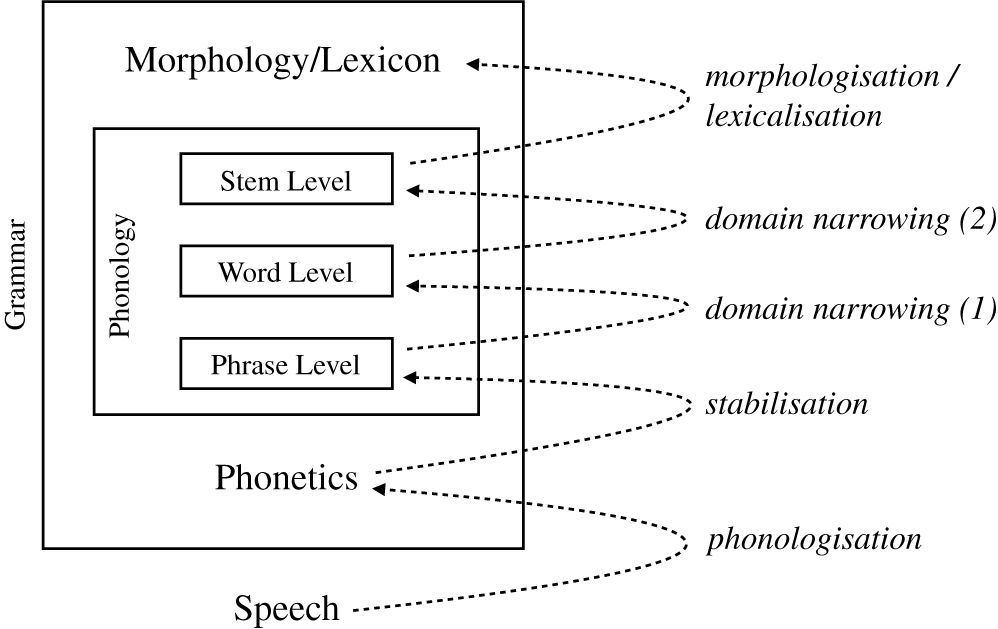
While in historical innovations the direction is from lower to higher modules, in synchronic derivation information travels downwards; that is, the phonological computation of an underlying form first involves stem-level phonology, before being subject to word-level and then phrase-level processes, and finally rules of phonetic implementation.
The cyclic stratification of the phonological module and the process of domain narrowing that sees phonological rules progress through these strata both form a crucial component of this study, and as such they will be discussed in more detail in specific relation to /ɡ/-deletion.
2.1 Diachrony of (ng)
The presence of post-nasal [ɡ] in words such as sing and young – occasionally referred to as ‘velar nasal plus’ in dialectological and sociolinguistic literature – is a dialectal feature exclusive to varieties spoken in the North West and West Midlands of England (Wells Reference Wells1982). Variation in these clusters will hereafter be referred to as (ng), not to be confused with the more geographically widespread variation in suffixal -ing.
The presence of post-nasal [ɡ] was not always so regionally restricted; up until the Late Modern English period [ŋɡ] was present in all regional varieties, before it began to undergo deletion. This coda-targeting deletion process, formalised in (1), applies only probabilistically in the North West and West Midlands of England, setting them apart from all other varieties of British English in which the deletion has run its course and such words are invariably realised with the bare velar nasal. Crucially, there is historical evidence to suggest that this deletion rule progressed through the grammar in ways predicted by the life cycle of phonological processes.

Based on reports from eighteenth-century orthoepist James Elphinston, the behaviour of post-nasal /ɡ/-deletion at various stages of its life cycle has been reconstructed to provide historical evidence of domain narrowing during the Late Modern English period (Garrett Reference Garrett, Blevins, Hanson and Inkelas2009; Bermúdez-Otero Reference Bermúdez-Otero, Oostendorp, Ewen, Hume and Rice2011; Bermúdez-Otero & Trousdale Reference Bermúdez-Otero, Trousdale, Nevalainen and Traugott2012). In Elphinston’s speech, /ŋɡ/ clusters exhibit stylistic stratification such that in formal speech (Elphinston’s conservative register) [ɡ] is always present before a vowel, but in casual speech (his more innovative register) it is only present before a vowel within the same word. This is said to reflect the direction of change, specifically the effects of domain narrowing from phrase level to word level.
This is illustrated in Table 1. When deletion is a phrase-level process (Stage 1), it only applies when /ŋɡ/ is invariably in coda position, i.e. when phrase-final or followed by a consonant-initial word. At this stage it is bled by phrase-level resyllabification in contexts such as sing it when a vowel-initial word follows, because the /ɡ/ can resyllabify as an onset at the phrase level – i.e. [sɪŋ.ɡɪt] – and thus save itself from deletion in the coda. Only when deletion progresses to the word level (Stage 2), where it is blind to phrasal content, can it apply to word-final /ŋɡ/ regardless of what follows. This is because, although a pre-vocalic environment might present the opportunity for resyllabification of the word-final /ɡ/, the deletion rule now takes place in a more embedded domain involving earlier computation; in other words, it is now in a counter-bleeding relationship with phrasal resyllabification. The next stage of the life cycle involves deletion progressing to the stem level (Stage 3) where it now applies before word-level suffixation, evidenced by [ɡ]-absence in words such as singer in almost all varieties of Present Day English; in such cases, deletion can apply to the stem sing where [ɡ] is in the syllable coda, before it has chance to become an onset through word-level suffixation of -er. Footnote 3
The life cycle of post-nasal /ɡ/-deletion, highlighting the effects of domain narrowing on its application in different morphophonological environments. Adapted from Bermúdez-Otero (Reference Bermúdez-Otero, Oostendorp, Ewen, Hume and Rice2011: 2024).

Simulations of grammar acquisition by Lignos (Reference Lignos2012) provide further evidence for domain narrowing in the evolution of post-nasal /ɡ/-deletion: drawing upon a corpus of child-directed speech (CHILDES; MacWhinney Reference MacWhinney2000) and appealing to Yang’s Tolerance Principle (Yang Reference Yang2005), Lignos shows that the probability of input restructuring is dependent on the level of ambiguity between positing rules in different domains. This ambiguity can be quantified by calculating the number of exceptions to each stage using actual corpus frequency data; if this level of ambiguity is high enough and the number of exceptions does not exceed tolerance, reanalysis will occur and the rule will move up into a higher domain.
Take the example of phrase-level to word-level domain narrowing. For input restructuring to take place between these domains, learners must posit a [ɡ]-less form as the input to the phrase level, rather than [ɡ]-less forms being derived from a phrase-level deletion process. When /ɡ/-deletion takes place at the phrase level, the alternation is transparent: [ɡ] is present before a vowel, and absent before a consonant or pause. For a learner to produce this alternation, they must model their input to the phrase level as [sɪŋɡ], which then undergoes phrase-level deletion if pre-consonantal or pre-pausal but not in pre-vocalic position. However, given that pre-consonantal and pre-pausal environments are three times as common as pre-vocalic environments (Bybee Reference Bybee, Barlow and Kemmer1998: 73), the chances of the learner incorrectly positing a [ɡ]-less form as input to the phrase level, and thus deletion climbing up into the higher word-level domain, is relatively high.
Despite this uneven distribution of phonological environments, the Lignos (Reference Lignos2012) simulations suggest that the first round of domain narrowing encountered more resistance than the second; input restructuring from phrase level to word level only takes place under certain conditions on post-lexical resyllabification, e.g. that it is not onset maximising and only takes place before vowel-initial words, not words with initial sonorous consonants such as [l] or [ɹ]. In contrast to this, the rule’s development from the word level to the stem level progressed with relative ease. As explained by Bermúdez-Otero (Reference Bermúdez-Otero, Honeybone and Salmons2015: 386), the vulnerability of word-level processes to this kind of analogical change in English is not surprising given its ‘impoverished’ inflectional system and the consequence that stem-final consonants rarely surface as onsets; this is further reflected by processes that remain stuck at the word level in languages where word-level suffixes beginning with vowels are used more frequently, such as coda devoicing in Dutch (Booij Reference Booij1995).
2.2 Synchronic predictions
In addition to laying out a diachronic trajectory of change, the life cycle also makes falsifiable predictions with respect to how /ɡ/-deletion should behave synchronically. These predictions naturally fall out from the architecture of grammar and in particular the stratified nature of the phonological module. When a rule progresses into a higher domain, it often leaves behind an avatar in the original stratum; this entails the possibility that, for speakers in the North West and West Midlands of England who still have a synchronic grammar producing variation in (ng) clusters, there can in fact exist three phonological deletion rules: one that applies to stems, one that applies to words, and one that applies post-lexically. All are probabilistic in nature, i.e. they are processed with some variable rate of application.
If we consider the four morphophonological environments from Table 1 from a synchronic standpoint instead, as in Table 2, it is clear to see that certain tokens of (ng) will meet the criteria for deletion in more of the morphosyntactically defined phonological strata than others.
Eligibility for deletion by morphophonological environment. Representations with onset [ɡ], where deletion cannot apply, are in grey.

Specifically, the post-nasal [ɡ] is in onset position throughout the derivation of finger-type words, as there is no stem fing in which [ɡ] is in the coda. Consequently, these tokens should exhibit no evidence of phonological deletion; singer-type tokens are only subject to deletion once – at the stem level – because upon reaching word-level computation the [ɡ] will move to the onset of the second syllable. Tokens such as sing it are exposed to two rounds of deletion, with [ɡ] in the coda at the stem and word levels before undergoing resyllabification across word boundaries at the phrase level to become an onset of the following vowel-initial word. Pre-consonantal tokens (e.g. sing tunes) meet the criteria for deletion in all three cycles, as do pre-pausal tokens, because in neither case can the [ɡ] resyllabify as an onset to bleed the coda-targeting deletion rule. For convenience, these five sets of morphophonological environments will hereafter be referred to using the following labels:
-
• finger: pre-vocalic /ŋɡ/, word-medial (stem-medial)
-
• singer: pre-vocalic /ŋɡ/, word-medial (stem-final)
-
• sing it: pre-vocalic /ŋɡ/, word-final
-
• sing tunes: pre-consonantal /ŋɡ/, word-final
-
• sing||: pre-pausal /ŋɡ/, word-final
The prediction is clear: /ɡ/-deletion applies cyclically and, as a consequence, tokens that meet the criteria in more cycles should be exposed to more rounds of probabilistic deletion during the derivation, so on the surface should be less likely to exhibit [ɡ]-presence. That is, we expect a cline of [ɡ]-presence, decreasing from singer to sing it to sing tunes and pre-pausal sing||.
Although synchronic variation in (ng) has yet to be analysed within a cyclic framework, there have been claims that deletion is more frequent pre-consonantally than pre-vocalically (Knowles Reference Knowles1973, Upton, Sanderson & Widdowson Reference Upton, Sanderson and Widdowson1987, Watts Reference Watts2005). Given these reports, and the diachronic evidence of the life cycle of /ɡ/-deletion as discussed in Section 2.1, synchronic variation in (ng) may well be amenable to such an analysis.
This kind of empirical prediction is also not new to the field of variationist linguistics: it actually builds on earlier work in the Lexical Phonology framework, such as Guy’s (Reference Guy1991a, Reference Guy1991b) study of /td/-deletion in American English. One of the most robust predictors of variation in (td) is the morphological category of the word (Wolfram Reference Wolfram1969, Guy Reference Guy and Labov1980, Neu Reference Neu and Labov1980, Santa Ana Reference Santa Ana1992, Fruehwald Reference Fruehwald2012), such that regular past tense items (e.g. missed) exhibit less deletion than irregular ‘semi-weak’ items (e.g. kept), which in turn exhibit less deletion than monomorphemic items (e.g. mist).Footnote 4 In this pair of influential papers, Guy (Reference Guy1991a Reference Guy1991b) argues that this effect stems from repeated exposures to a deletion process: the word-final [t]/[d] attaches later in the derivation when it belongs to a past tense morpheme compared to a monomorphemic item where the targeted segment is part of the stem and present throughout the derivation. The intermediate status of semi-weak items is said to result from how inflectional endings attach at different levels depending on their regularity: irregular inflection operates at level 1 and is thus exposed to fewer rounds of deletion than items with regular past tense inflection (which attaches at level 2).Footnote 5
Guy (Reference Guy1991b: 8) assumes the same rate of application in each domain. To exemplify, if we adopt a hypothetical application rate of 50%, a word that meets its structural description once in the derivation should have 50% segment presence. This should decrease to 25% for words exposed to two rounds of deletion, and decrease further still to 12.5% for words exposed to three rounds. However, this is not necessarily a safe assumption to make. As Turton (Reference Turton2016) explains in relation to /l/-darkening, under a life cycle framework we would expect a correlation between the rate of application and the depth of the cyclic domain in which it applies, at least while the change is active and in progress; that is, because a rule will have been active for longer at the phrase level, where it began, it should apply at higher rates than in a more embedded domain, such as the stem level, where it is much younger. This is referred to as the Variation Corollary of the Russian Doll Theorem, and is formulated as follows:
If a phonological process
 $ \pi $
shows a rate of application
 $ x $
in a small embedded domain
 $ \alpha $
, then
 $ \pi $
will apply at a rate equal to or greater than
 $ x $
in a wider cyclic domain
 $ \beta $
. (Turton Reference Turton2016: 139)
Testing these predictions regarding the synchronic behaviour of post-nasal /ɡ/-deletion, both of which are rooted in its diachronic pathway of change, forms the basis of this paper.
3. Methodology
In order to test these predictions, data is drawn from a collection of sociolinguistic interviews conducted in the North West of England. Although using a prepared sentence list would make it possible to elicit tokens in different morphophonological environments, thus providing more data as well as controlling for possible confounds of speech rate, it would also have introduced a stylistic confound. The use of conversational data minimises the effects of the ‘observer’s paradox’ (Labov Reference Labov1972) and provides a more reliable insight into the variation of these /ŋɡ/ clusters, which may well be levelled in more formal speech styles.
3.1 Sociolinguistic interviews
In total, the corpus contains 30 sociolinguistic interviews, largely conducted between 2015 and 2017. On average, these lasted for about an hour and were structured to follow typical conventions as described by Tagliamonte (Reference Tagliamonte2006: 37–49) and as used by Labov (Reference Labov, Baugh and Scherzer1984) in Philadelphia. The interviews consisted of open-ended questions about a number of topics such as childhood, school life, the neighbourhood, and travel. Many of the questions were designed specifically to elicit narratives of personal experience, which provide the most direct access to a speaker’s vernacular (Labov Reference Labov and Hogan2010). The interviews were followed up with two elicitation tasks, a word list and a reading passage, which contain tokens of (ng) but are not subject to analysis in this paper for the aforementioned reasons.
These interviews were recorded using a Sony PCM-M10 recorder and a lavalier microphone, saved in uncompressed WAV format at a sampling rate of 44.1KHz. They were later transcribed orthographically using ELAN and force-aligned using the FAVE suite (Rosenfelder et al. Reference Rosenfelder, Fruehwald, Evanini and Yuan2011) to produce a time-aligned phone- and word-level TextGrid allowing for more efficient analysis.
3.2 Participants
The 30 participants of these interviews were all born and raised in the North West of England, specifically from the urban centres of Greater Manchester and Blackburn and their surrounding regions.
The population sample is stratified by speaker sex and is evenly distributed with respect to date of birth (DoB); this is summarised in Table 3, which discretises speakers into age groups solely for demonstration purposes (the analysis does not rely on any such arbitrary classification). The distribution of speaker ages is particularly important as it allows for an apparent time investigation of possible diachronic change, where the vernacular of older speakers is said to be representative of an earlier stage of the development of this dialect. This is made further possible by the inclusion of two interviews conducted by William Labov in Manchester in 1971, providing extra time depth with date of births spanning almost a century – from 1907 to 1998.
The age and sex distribution of subjects. Cells include the average age of each group, alongside the number of subjects and tokens (denoted by N).

Socioeconomic status was controlled for by ensuring that all participants were upper working class, where class is operationalised using a composite measure similar to that employed by Labov (Reference Labov2001) in his study of Philadelphia neighbourhoods and Trudgill (Reference Trudgill1974) in his study of the Norwich speech community. Although this measure is based primarily on occupational history, reflecting traditional distinctions between blue-collar and white-collar professions (which are further subcategorised into skilled/unskilled labour and managerial positions), it also takes into account education and upbringing. For younger participants, almost all of whom are students, this classification was based primarily on their parents’ occupations (see Baranowski Reference Baranowski2017: 303 for a similar operationalisation of social class in Manchester). A full list of speaker demographic information is given in the Appendix.
3.3 Data annotation
The envelope of variation is defined as any underlying /ŋɡ/ cluster that appears in stem-final position with primary stress, such as young, sing-er, wrong, hang-ing, i.e. words that are invariably realised with the plain velar nasal [ŋ] in most varieties of the English-speaking world. Tokens of pre-vocalic /ŋɡ/ that appear in monomorphemic words or words derived from bound roots, such as finger, bungalow, elongate, tango, etc., were excluded from the analysis after confirming that they do indeed invariably surface with [ɡ]-presence (n = 140).
The dependent variable was manually coded in a binary fashion, based on categorical presence/absence of a post-nasal stop. Two rounds of coding were independently conducted: first, auditory coding was conducted by the author for all tokens; second, the forced alignment process discussed in Section 3.1 was adapted with a variable pronunciation dictionary, meaning that it would decide on either a [ɡ]-ful or [ɡ]-less transcription for each token based objectively on comparisons with trained acoustic models (see Bailey Reference Bailey2016 for details on this methodological approach). These two sets of judgements were then compared and, in cases of disagreement (approximately 12% of the dataset), the tokens were revisited and a decision was reached by the author alongside another trained phonetician. Prototypical examples of tokens with and without post-nasal [ɡ] are given in Figure 2.
Example spectrograms and waveforms of young with [ɡ]-absence (left) and hang with [ɡ]-presence (right).

During the auditory coding some phonetic variability was encountered in the realisation of post-nasal [ɡ]; although a detailed phonetic analysis is beyond the scope of this paper, many tokens were impressionistically noted as surfacing without voicing and occasionally with an ejectivised release (particularly in phrase-final position). While this paper is concerned primarily with patterns of variation in the presence/absence of post-nasal [ɡ], a fine-grained analysis of phonetic variation would make an interesting avenue of future research.
Each token was annotated for the immediate phonological environment, specifically whether the underlying /ŋɡ/ cluster is followed by a vowel, obstruent, glide, liquid, or nasal. Tokens that appear at the end of an ELAN breath group were coded as being pre-pausal with no following segment; broadly speaking these breath groups are defined as stretches of speech in between periods of silence lasting approximately 100 ms or longer. This phonological environment, along with the morphological composition of the word, defines the relevant environments outlined earlier in Section 2.2. Additional predictors were also considered, such as speech rate (measured in syllables per second) and word frequency (measured along the Zipf-scale; see Van Heuven et al. Reference Heuven, Walter, Mandera, Keuleers and Brysbaert2014).
Although in Garrett & Blevins (Reference Garrett, Blevins, Hanson and Inkelas2009) it was argued that Elphinston’s post-nasal [ɡ] undergoes resyllabification before liquids as well as vowels, in this data there is no evidence that the synchronic system works in this way; there is no significant difference between the rates of [ɡ]-presence before liquids (10.7%, n = 28), nasals (5.6%, n = 18), obstruents (9.9%, n = 625), or glides (11%, n = 73) (
 $ {\chi}^2 $
= 0.49, df = 3, p = 0.92). This suggests that phrase-level resyllabification of post-nasal [ɡ] is not onset-maximising, and that only pre-vocalic tokens should therefore be included in the sing it environment. It is particularly interesting that resyllabification occurs only if the following word is vowel-initial but not if the word begins with a sonorous consonant, even if resyllabification would form a phonotactically valid complex onset; the simulations reported by Lignos (Reference Lignos2012), discussed earlier in Section 2.1, suggest that such a restriction was also in place during the diachronic development of this process.
In total, the interviews contain 1,444 tokens of (ng) from spontaneous, conversational speech; the 446 elicited tokens from the word list and reading passage are not discussed in this paper.
4. Results
The results of this analysis reveal that synchronic variation in (ng) is strongly predicted by morphophonological factors in ways predicted by the life cycle of phonological processes: there is an almost perfectly linear relationship between the rate of [ɡ]-presence and the number of times it appears in a deletion-targeting environment (i.e. the coda) throughout the cyclic derivation. Across the entire sample of speakers, post-nasal [ɡ] is present 82% of the time (n = 179) when deletion has one chance to apply (i.e. singer, before a tautolexical vowel), 57% of the time (n = 211) when deletion has two chances to apply (i.e. sing it, before a hetero-lexical vowel), and just 22% of the time (n = 914) when deletion can apply in all three cyclic domains (i.e. sing tunes and sing||, before a consonant or pause).
However, the existing discussion of cyclic coda-targeting rules, at least in the case of post-nasal /ɡ/-deletion, makes an implicit assumption that should not be overlooked: cases in which an underlying /ɡ/ is subject to three rounds of deletion – the category of tokens that shows the highest overall rate of surface [ɡ]-absence – actually encompass two distinct phonological environments. The deletion rule can apply at the stem, word, and phrase levels if the underlying /ɡ/ occurs pre-consonantally or phrase-finally, because in neither case is it possible for the /ɡ/ to resyllabify as an onset and save itself from deletion in any of the cyclic domains. Although this makes logical sense from a purely cyclic position, the two environments are prosodically different, and when they are considered separately it becomes clear that they condition (ng) variation in drastically different ways.
As indicated by Figure 3, the pre-pausal environment is strongly [ɡ]-favouring; in fact, when we aggregate over the whole population sample in this way, a following pause is second only to a following tautolexical vowel in the degree to which it favours [ɡ]-presence. When we look at this on a speaker-by-speaker basis, as in Figure 4, it is clear that this distinctive V-shaped pattern is evident for many speakers in this sample; there are in fact a number of speakers who never show [ɡ]-absence in pre-pausal position (see, for example, GraceG, MollyF, WendyJ, etc.).
The rate of [ɡ]-presence by morphophonological environment.

The rate of [ɡ]-presence by morphophonological environment, for individual speakers. Plot labels indicate date of birth of each speaker, alongside age at time of recording.

The high rate of pre-pausal [ɡ]-presence is particularly problematic if it is assumed that surface variability in (ng) is derived purely from cyclic application of a probabilistic /ɡ/-deletion rule, hereafter referred to as an Elphinstonian grammar in light of the historical evidence discussed in Section 2.1. To be more specific, an Elphinstonian grammar refers to a system in which the distribution of [ŋ] and [ŋɡ] involves cyclic application of deletion alone; empirically, this in turn leads to a falsifiable prediction: that there cannot be more [ɡ]-presence pre-pausally than before a hetero-lexical vowel, since the former environment is subject to three rounds of deletion and the latter only two.
Consider the simulations in Figure 5, all of which are consistent with a cyclic account of (ng). A hypothetical dataset of 1,200 tokens, equally split between the four morphophonological environments under consideration, is input to a simulated grammar. Each token in this dataset is exposed to either one, two, or three probabilistic deletion rules depending on its morphophonological properties and the syllabic status of [ɡ] in each cyclic domain, with all three deletion rules having their own domain-specific rate of application as discussed in Section 2.2. The stem-level deletion rate (
 $ {R}_{SL} $
) is set at 20%, the word-level rate (
 $ {R}_{WL} $
) at 30%, and the phrase-level rate (
 $ {R}_{PL} $
) at 70% for pre-consonantal tokens. These absolute values are arbitrarily chosen, but the purpose of this simulation is to demonstrate the range of possible scenarios when the phrase-level deletion rule treats pre-pausal tokens differently from pre-consonantal tokens.
Simulated grammars (100 iterations) with the following domain-specific rates of application of /ɡ/-deletion:
 $ {R}_{SL} $
= 0.2;
 $ {R}_{WL} $
= 0.3; pre-consonantal
 $ {R}_{PL} $
= 0.7; pre-pausal
 $ {R}_{PL} $
= 0.7 in (a), 0.3 in (b), and 0 in (c).

In (a), the phrase-level deletion rule is not sensitive to pause, which likely approximates Elphinston’s own system given that he does not report any such effect; in (b), the phrase-level deletion rule applies at a lower rate pre-pausally than pre-consonantally; in (c), it is blocked completely before pause. Crucially, as evidenced by these simulations, in an account driven by cyclic deletion alone, the rate of [ɡ]-presence pre-pausally cannot be greater than before a hetero-lexical vowel (i.e. sing it); at most they can be equal, which would reflect the scenario in (c) in which the phrase-level deletion rule is blocked in this environment. In this scenario, the tokens are still exposed to two probabilistic deletion processes at the stem and word levels, just like the sing it tokens, but are subject to no further deletion at the phrase level.
However, as is shown in Figure 4, there are clearly a number of speakers for whom the rate of [ɡ]-presence pre-pausally is higher than in sing it; this is incompatible with an account that solely involves cyclic deletion in non-onset positions.
In light of this, there are two likely explanations: either synchronic variation in post-nasal [ɡ]-presence is not derived through cyclic application of a deletion rule, or there has been a separate innovation in the development of this dialect, distorting what would otherwise be a perfectly Elphinston-compliant pattern of variation as predicted by the life cycle of phonological processes. In the following section, I provide strong empirical evidence for the latter explanation.
4.1 Change in progress
Importantly, the inter-speaker variation with respect to the behaviour of pre-pausal (ng) is not unconstrained but rather shows a strong correlation with date of birth. As illustrated in Figure 6, we have apparent time evidence of change in progress towards increasing [ɡ]-presence in pre-pausal position, suggesting that this is actually a relatively recent innovation in this community.
(Colour online) Apparent time change in the rate of pre-pausal [ɡ]-presence; pre-consonantal environment included as a baseline for comparison. Individual speaker means are plotted as points; lines reflect linear models with 95% confidence intervals.

This change finds statistical support from mixed-effects logistic regression. The best-fitting model, with [g]-presence as the dependent variable, includes the following predictors: morphophonological environment and date of birth (and their interaction), as well as speech rate. As reported in the model summary in Table 4, the interaction only reaches significance in the pre-pausal environment. Further evidence for this effect comes from ANOVA comparisons between nested models with and without the environment–date of birth interaction; the inclusion of this interaction leads to a statistically significant decrease in AIC (1039, cf. 1055; p < 0.001) and therefore a better-fitting model. Of the other factors considered, speech rate has a significant effect such that the probability of [ɡ]-presence decreases in faster speech rates. A model including word frequency was also tested, but this had no significant effect and its inclusion in the model did not lead to a significant increase in the amount of variation explained.
Mixed-effects logistic regression model; [ɡ]-presence as the application value; random intercepts of speaker and word; sing tunes as the environment reference level.

The significant interaction between morphophonological environment and date of birth supports the claim of change in progress. The results suggest that younger speakers actually have a new system: normal cyclic application of /ɡ/-deletion, giving rise to the monotonic patterning in the singer, sing it, and sing tunes environments, overlaid with this pre-pausal innovation at the phrase level. Crucially, as explained earlier (and demonstrated by the simulations in Figure 5) this innovation cannot simply be a blocking of the phrase-level deletion process, but instead must be a new process of [ɡ]-insertion superposed upon the existing phrase-level deletion rule. That is, although some of the pre-pausal tokens of [ɡ] are ‘survivors’ of deletion, under the analysis proposed here many of them are in fact likely to have been inserted as a result of this new innovation.
Regardless of the nature of this pre-pausal innovation, the evidence of this diachronic change suggests that there was once a point in the history of this dialect at which there was more [ɡ]-presence before a hetero-lexical vowel than before a pause, i.e. a system that develops through /ɡ/-deletion progressing along its life cycle with no separate innovation.
Importantly, we do not have to rely on Elphinston’s testimony for this, as there are in fact a number of speakers in this data set who show such a pattern (see e.g. FredN and DotV in Figure 4, both born in the 1950s). Although there is not enough statistical power to diagnose significant differences between environments at the level of the individual, it is possible to aggregate over groups of speakers who show similar patterns of variability. This grouping can also be carried out in an objective manner using cluster analysis rather than by subjectively hand-picking speakers.
4.2 Clustering analysis
Given the degree of heterogeneity within this community, it is clear to see how aggregating over the whole population sample would be problematic in obscuring this inter-speaker variation. Having presented evidence of this apparent time change, highlighting that the probability of a speaker having a particular system of (ng) variation is correlated with date of birth, one option would be to discretise the time dimension and group speakers based on age. However, due to the complex nature of linguistic change and the many external factors by which it can be influenced, it is unlikely that all speakers within a single date of birth cohort are equally advanced in this change. This means such aggregation may conflate speakers with theoretically (and empirically) different systems. It also necessitates the use of arbitrary boundaries if date of birth is to be split into discrete groups.
By instead performing cluster analysis, it is possible to aggregate one level above the individual and avoid all of the aforementioned problems. Clustering is a method widely used in statistical data analysis in which sets of objects are grouped together based on some quantifiable similarity. In this case, it is possible to perform hierarchical clustering based on the pattern of (ng) variation across all four morphophonological environments, such that speakers with similar ‘systems’ are clustered together. Using this method, speakers are grouped together based on their actual behaviour, circumventing the need to impose top-down categories based on external sociodemographic information. The method employed here uses the hclust function in R, and takes an agglomerative ‘bottom-up’ approach in which each speaker starts off in their own cluster and pairs of the most similar speakers, as determined by Ward’s criterion (Ward Reference Ward1963), are grouped together in a hierarchical fashion moving upwards.
The results of hierarchical classification are given in Figure 7, where the three main clusters are characterised by the behaviour of word-final (ng) in pre-vocalic and pre-pausal environments.
Results of hierarchical cluster analysis, based on relative rates of [ɡ]-presence in each of the four morphophonological environments under study.

Plotting cluster-wide patterns of variation, Figure 8 reveals that the speakers in cluster #1 are those with the most conservative grammars with respect to this variable, and that the most innovative speakers are grouped together in cluster #3. Although the central point of this clustering analysis is to identify groups of speakers with similar patterns of /ŋɡ/ variation, it is also interesting to note that there is an apparent correlation between group membership and date of birth, with the group of most conservative speakers having a median date of birth of 1955, which increases to 1980 for the group of most innovative speakers (speakers in the remaining cluster have a median date of birth of 1966). These speakers in cluster #1 demonstrate a pure Elphinstonian system of /ɡ/-deletion, with no evidence of phrase-level innovation and a significantly lower rate of word-final [ɡ]-presence pre-pausally than pre-vocalically (
 $ {\chi}^2 $
= 4.09, df = 1, p = 0.043).Footnote
6 The perfectly monotonic pattern of variation means that, for these five speakers, no recent phrase-final innovation has taken place: their grammars reflect a conservative system in which the alternation between [ŋ] and [ŋɡ] is derived solely through cyclic deletion.
Average rates of [ɡ]-presence by morphophonological environment for the clusters of most conservative (left) and most innovative (right) speakers identified in the hierarchical classification (error bars signify 1 s.d.).

4.3 Domain-specific deletion rates
The life cycle makes predictions not only about the relative proportion of [ɡ]-presence in different morphophonological environments, but also regarding the rates of deletion in each of the three cyclic domains. This concept, discussed earlier in Section 2.2, has already been tested by Turton (Reference Turton2016) for /l/-darkening and the same methods can be applied here to calculate domain-specific rates of deletion. Recall that the prediction, made explicit by Turton (Reference Turton2016) as the Variation Corollary of the Russian Doll Theorem, is that as long as the change is active and in progress, stem-level deletion should apply at lower rates than word-level deletion, which in turn should be lower than phrase-level deletion (contra Guy Reference Guy1991a, Reference Guyb, who assumes the same rate of application across all strata). This follows naturally from the fact that deletion began at the phrase level, and has therefore been active longest here, before climbing up into more embedded domains.
Calculating domain-specific rates of deletion is fairly trivial from a mathematical standpoint; singer-type tokens are only subject to deletion in one cycle – at the stem level – which means the rate of [ɡ]-presence in this environment tells us what the rate of retention is at the stem level. This is shown in (2), where
 $ R $
is the retention rate and
 $ D $
is the deletion rate (simply
 $ 1-R $
):

Tokens in the sing it environment are subject to two rounds of deletion – at the stem and word levels – and since we have already calculated the rate of application at the stem level, we can isolate the WL process as in (3):

It would be unwise to aggregate over the whole population for the pre-pausal environment given the vigorous change taking place here, so the phrase-level calculations are based solely on pre-consonantal (ng). Tokens in this environment are subject to three rounds of deletion – at the stem, word, and phrase levels – so we can simply apply the same methods as before to isolate the phrase-level deletion rate; this is done in (4):

These cyclic-specific deletion rates are illustrated in Figure 9 for a hypothetical input of 1,000,000 tokens of (ng), indicating the number that are predicted to undergo deletion in each cycle. The domain-specific rates fall in line with predictions, decreasing from phrase (83%) to word (30%) to stem (18%) levels, but perhaps most interesting of all is how the word-level deletion is much closer to the stem level rather than the phrase-level process. Recall that the simulations carried out by Lignos (Reference Lignos2012), discussed in Section 2.1, suggest that the domain narrowing from word to stem level progressed fairly rapidly for (ng), most likely due to the reduced inflectional system of English and as a consequence of this the vulnerability of stem-final consonants to coda-targeting rules (Bermúdez-Otero Reference Bermúdez-Otero, Honeybone and Salmons2015). This is arguably also reflected here: taking the domain-specific rate of application as a proxy for the age of each deletion rule, it suggests that domain narrowing from phrase level to word level took much longer than the narrowing from word level to stem level.
The phonological derivation of 1,000,000 (ng) tokens based on cycle-specific deletion rates, illustrating the number of tokens deleted in each cyclic domain.

In summary, not only do these domain-specific deletion rates fall in line with the predictions made by the life cycle and the Variation Corollary of the Russian Doll Theorem, they also corroborate the results from independent simulations and as a result shed light on the speed at which /ɡ/-deletion underwent successive rounds of domain narrowing.
5. Discussion
The results presented in Section 4 cast new light on the synchronic variation in (ng); at this point it is important to situate these results in the existing knowledge of the diachrony of (ng), and as such complete the amphichronic picture as was set out at the beginning of this paper.
5.1 A diachronic and synchronic account of (ng)
From a number of historical sources we can attest the presence of [ŋɡ] (alongside other homorganic nasal + stop clusters) both word-medially and word-finally in Proto-Germanic (Ringe Reference Ringe2006) and Old English (OE) (McCalla Reference McCalla1984, Voyles Reference Voyles1992, Hogg Reference Hogg2002), e.g. OE hringan ‘to ring’ and hring ‘ring’. From Elphinston’s testimony, we also know that this remained the case up until Late Modern English, at which point a process of /ɡ/-deletion had begun progressing through the grammar along a trajectory predicted by the life cycle of phonological processes, i.e. beginning in the phrase-level domain, before undergoing successive rounds of domain narrowing into more embedded morphosyntactic domains (Garrett & Blevins Reference Garrett, Blevins, Hanson and Inkelas2009, Bermúdez-Otero Reference Bermúdez-Otero, Oostendorp, Ewen, Hume and Rice2011, Bermúdez-Otero & Trousdale Reference Bermúdez-Otero, Trousdale, Nevalainen and Traugott2012).
The fact that this rule has run to completion in all other dialects outside of the North West and West Midlands, such that [ŋɡ] only occurs in a restricted set of environments,Footnote 7 lends support to this diachronic account. In this paper, it has been shown that the synchronic system of (ng) variation in the North West of England reflects this diachronic trajectory of /ɡ/-deletion, but also that it shows evidence of a more recent innovation: there appears to be a separate process of [ɡ]-insertion taking place in pre-pausal contexts, with the surface effects of this process increasing in magnitude in apparent time.
It warrants mention that this proposal produces a ‘Duke of York’ derivation in which the post-nasal /ɡ/ undergoes deletion only for another to be inserted in its place. The acceptability of such derivations is widely debated (see e.g. Pullum Reference Pullum1976, cf. McCarthy Reference McCarthy, Féry and Vijver2003), but there is strong empirical evidence – from analyses that also involve stratal models of phonology – that they do in fact exist (see e.g. Rubach Reference Rubach2003 on velar palatalisation and labial fission in Polish, Bermúdez-Otero Reference Bermúdez-Otero2006 on voicing and continuancy in Catalan, and Gleim Reference Gleim2019 on insertion and deletion of epenthetic vowels in Arapaho).
Of course, this can be avoided by adopting an alternative explanation, where synchronic variation in (ng) is detached from the historical facts and the surface alternation between [ŋ]
 $ \sim $
[ŋɡ] in these northern varieties does not stem from cyclic phonological deletion at all. However, there are a number of arguments against this. Firstly, to motivate a morphophonological analysis of this process one need only look to pairs of phonologically similar words such as finger
 $ \sim $
singer, in which the most obvious and uncontroversial difference is in morphological structure. In the dialects under study, deletion is completely blocked in the former, morphologically simplex item but is free to apply to the latter, morphologically complex item. Furthermore, treating these morphosyntactic environments (i.e. finger, singer, sing it, sing tunes, sing||) independently from one another overlooks the fact that, setting aside the pre-pausal tokens, the behaviour of (ng) falls in line with the predictions made by the life cycle as outlined in Section 2.2. Given the strength of the correlation between pre-pausal [ɡ]-presence and date of birth, it is also highly likely that an earlier stage of the dialect did behave in this purely Elphinstonian manner. Indeed, results from the clustering analysis reported in this paper suggest that for some of the older speakers in this corpus this is exactly the case.
Although this paper provides evidence of innovation at the phrase level, it is difficult to pinpoint exactly when this change actually took place. It is not possible to conclusively identify [ɡ]-insertion at work until it applies at such a rate that, under this framework at least, it would be impossible for it not to be active, i.e. until the rate of pre-pausal [ɡ]-presence exceeds the rate of pre-vocalic [ɡ]-presence in sing it. At this point, we know that insertion must be active at the phrase level, but of course the innovation could have taken place even in a more conservative grammar.
When the rate of pre-pausal [ɡ]-presence begins to increase, it remains apparently compliant with a purely cyclic analysis as long as it remains lower than the rate of [ɡ]-presence before a hetero-lexical vowel, although the actual likelihood of there being no separate innovation decreases. In other words, there is a point at which the dialect starts to show conclusive evidence of insertion, but that is not necessarily the point at which the innovation was genuinely actuated; it may have already begun at an earlier stage of the dialect.
It is also important to note that even in a purely Elphinstonian system of cyclic /ɡ/-deletion, it is permissible to have slightly more [ɡ]-presence in pre-pausal position relative to the sing it environment, simply because of the anti-conservative nature of how this environment has been defined and coded. All cases of word-final (ng) before a vowel-initial word were coded as belonging to the sing it environment, but in reality not all of these post-nasal stops will have undergone phrase-level resyllabification due to its sensitivity to prosodic factors such as speech rate and the temporal distance between the two words.
It is highly likely that some tokens coded in the sing it category were not resyllabified as onsets at the phrase level and were therefore subject to three rounds of deletion rather than two; as such, the surface rate of [ɡ]-presence in this category may have been underestimated.Footnote 8
5.2 Life cycle predictions
In light of these results, I suggest a reformulation of the life cycle’s predictions that has not thus far been made explicit, specifically with respect to what we expect to find in surface-level patterns of variation.
The theory of the life cycle states that changes enter the grammar from below and over time undergo progressive rounds of domain narrowing, climbing up into higher, more embedded strata; as such, its effects are first seen at the phrase level, then at the word level, and even later at the stem level. Given this trajectory of change, it is also predicted that the rate of application of a process should be inversely correlated with the narrowness of the morphosyntactic domain in which it applies; that is, because a process travelling along this life cycle will have been active longest in lower levels, it should apply at higher rates in those domains (see Turton Reference Turton2016 on the Variation Corollary of the Russian Doll Theorem). However, this prediction only holds if there have been no further developments at the phrase level. If such a development has taken place, the surface pattern of variation will show traces of the life cycle of the original process along with the superimposed effect of the new development at the phrase level, where it has entered the grammar from below. This is exactly what has been described here for (ng) in the North West of England, i.e. a pattern of variation compatible with a life cycle of /ɡ/-deletion, overlaid with a new phrase-level innovation, evidence of which is provided from clear apparent time change over the past century.
5.3 Why has this innovation taken place?
Any discussion of why this innovation has taken place encounters issues relating to the actuation problem (Weinreich, Labov & Herzog Reference Weinreich, Labov, Herzog, Lehmann and Malkiel1968), but we can speculate as to the possible motivations behind this change. It is possible that social evaluation plays a role in this change; one might expect such an effect to be registered most strongly in this environment given the salience of phrase-final position (see Sundara, Demuth & Kuhl Reference Sundara, Demuth and Kuhl2011; Dube et al. Reference Dube, Kung, Peter, Brock and Demuth2016 for experimental evidence). Specifically, it could be the case that this change in production reflects a change in how the northern [ŋɡ] form is evaluated, accruing local prestige with this evaluation concentrated in an environment where its presence is highly salient. While it has been claimed that [ŋɡ] does indeed have local prestige in these northern communities (Beal Reference Beal, Kortmann and Schneider2004: 127; Foulkes & Docherty Reference Paul, Docherty and Britain2007: 64), results from an independent perception experiment indicate a more complex attitudinal landscape: in Bailey (Reference Bailey2019a), a matched-guise task reveals no shared evaluative norm with respect to this variable, with subjects just as likely to express negative evaluations of this form as they are positive evaluations. The results from this task also suggest that this is a variable with a relatively low social profile, with many respondents showing no awareness that this is a dialectal form associated with these regions. Taken together, this makes a socially-motivated explanation of change highly unlikely.
The new pre-pausal behaviour could instead be seen as a prosodic strengthening mechanism, alongside other phonetic correlates such as pre-boundary durational lengthening (Delattre Reference Delattre1966, Lehiste, Olive & Streeter Reference Lehiste, Olive and Streeter1976, Turk & Sawusch Reference Turk and Sawusch1997, Cho, Kim & Kim Reference Cho, Kim and Kim2013). Parallels can also be drawn with increasing rates of ejectivisation for voiceless stops in Glasgow English. McCarthy & Stuart-Smith (Reference McCarthy and Stuart-Smith2013) remark on the rate at which ejectivisation is observed not only for velar [k] relative to other stops, but also following a nasal and when in phrase-final position. Voicing aside, this is of course the same segmental and prosodic environment as discussed here in the context of increasing phrase-final [ŋɡ]. Although a similar change in ejectivisation would need to be attested in these same varieties of British English, taken together, these two phrase-final phenomena could be considered to be part of the same boundary-marking ‘velar fortition rule’, which may in turn have discourse-pragmatic functions relating to turn-taking and the negotiation of conversation (see also Ogden Reference Ogden2009: Chapter 10.3.1). In Bailey (Reference Bailey2019b) there is a deeper exploration of how pause interacts with intonational phrasing to condition (ng) variation, but further work is necessary to provide more insight into the interactional properties of these pre-pausal tokens, e.g. differentiating turn-final tokens from examples where a speaker pauses in conversation but then continues speaking.
That this heterogeneity is restricted to pre-pausal position may not even be that surprising given evidence of other processes that behave in similarly unpredictable ways before pause, particularly when compared to the consistency of how following vowels and consonants condition the variation. Take the example of /s/-debuccalisation in South American varieties of Spanish, which is activated pre-consonantally, blocked pre-vocalically, but shows inter-dialectal variation with respect to its application pre-pausally (Harris Reference Harris1983, Kaisse Reference Kaisse and Zagona1996). A similar state of affairs has been attested for /t,d/-deletion across varieties of English: while the ranking of segmental constraints is consistent with respect to vowels and consonants, the effect of a following pause is dependent on the dialect in question (Guy Reference Guy and Labov1980; also compare Tagliamonte & Temple Reference Tagliamonte and Temple2005 on York English with Hazen Reference Hazen2011 on Appalachian English).
Exactly why pauses have such variable behaviour on probabilistic lenition processes is not clear. In discussing the sensitivity of /t,d/-deletion to the immediate phonological environment, Guy (Reference Guy and Labov1980) invokes the feature-dissimilatory effects of the Obligatory Contour Principle (McCarthy Reference McCarthy1986, Yip Reference Yip1988), i.e. how the cline of deletion rates from pre-obstruent to pre-liquid/glide to pre-vocalic positions reflects how featurally similar those segments are to the coronal stop undergoing deletion. Pauses by their very nature do not fit into this typology and are therefore argued to be “susceptible to differing analyses by different speakers or dialects” (Guy Reference Guy and Labov1980: 27). While this is reflected by inter-dialectal differences in the effect of pause on /t,d/-deletion, in the case of (ng) it would appear to be registered in diachronic instability, assuming the contextual sensitivity of these processes is indeed driven by the Obligatory Contour Principle.
5.4 Homorganic + stop clusters
As mentioned earlier in this discussion, [ŋɡ] is just one of a number of homorganic nasal + stop clusters historically present in earlier varieties of English. Others, such as [mb], [nt], and [nd] have also been subject to reduction at some point in the history of the English language, but the point at which this occurs, and the magnitude of this reduction, is dependent on the place of articulation. We can therefore construct a markedness-driven implicational hierarchy of nasal + stop reduction as follows:
-
• most marked: [mb], which is reduced to [m] in all varieties during the Late Middle English period, such that in Present Day English [mb] clusters only appear when tautosyllabic in monomorphemic or root-based items, e.g. bombard [ˌbɒmˈbɑːd], cf. bomb [bɒm], bombing [bɒmɪŋ] (Borowsky Reference Borowsky, Hargus and Kaisse1993, Bermúdez-Otero Reference Bermúdez-Otero, Oostendorp, Ewen, Hume and Rice2011).
-
• less marked: [ŋɡ], which is reduced to [ŋ] in most regional varieties during the Late Modern English period (Bermúdez-Otero Trousdale Reference Bermúdez-Otero, Trousdale, Nevalainen and Traugott2012), but still exhibits variation in the North West and West Midlands of England (Knowles Reference Knowles1973, Watts Reference Watts2005, this paper).
-
• least marked: [nt]/[nd], which are variably reduced to [n] in almost all regional varieties of Present Day English as part of a widespread process of /t,d/-deletion in consonant clusters (see Tagliamonte & Temple Reference Tagliamonte and Temple2005, Tanner, Sonderegger & Wagner Reference Tanner, Sonderegger and Wagner2017, Baranowski & Turton Reference Baranowski and Turton2020, all on British English). Crucially, the variation is stable with no evidence that this reduction process is running to completion.
Interestingly, parallels can be drawn between this ordering of environments and more general cross-linguistic markedness constraints on place of articulation; although it is a contested issue, there is fairly widespread agreement on coronals being universally less marked than labials and dorsals (see Prince & Smolensky Reference Prince and Smolensky1993, Hume Reference Hume1996, Wilson Reference Wilson2001), and in the history of English we observe that only coronal nasal + stop clusters survive in all varieties. Although Rice (Reference Rice1996) argues that both coronal and dorsal are unmarked, it is nevertheless difficult to argue against labials having the weakest case for unmarkedness (though see Hume Reference Hume2003 for an exception to this). It is therefore fitting that they should be the first to undergo nasal + stop reduction in the history of English, and the only type to be lost in all dialects without exception.
6. Conclusion
In this paper it has been shown how the pattern of (ng) variation among speakers of north-west British English is highly structured and predicted almost entirely by internal factors that fall out naturally from the architecture of grammar and the way that /ɡ/-deletion has progressed through it. In this way, the synchronic variation here reflects centuries-old linguistic change from the Late Modern English period – discussed in Bermúdez-Otero & Trousdale Reference Bermúdez-Otero, Trousdale, Nevalainen and Traugott2012) – as well as a relatively recent innovation that has been explored in this paper.
The results of this study suggest that a change has been taking place in these north-western varieties of British English with respect to how (ng) behaves pre-pausally: this environment has changed from being [ŋ]-favouring to [ŋɡ]-favouring, and as a result we have seen a change from a purely cyclic grammar, in which [ɡ]-presence is determined solely by cyclic application of deletion, to a grammar that shows highly divergent behaviour at the phrase level. This contemporary system exhibits evidence of pre-pausal [ɡ]-insertion overlaid on the original cyclic deletion rule, which means that for these younger speakers there are two sources of [ɡ]-presence: it can either surface through resyllabification bleeding the cyclic deletion rule, or through some new prosodic privilege of being pre-pausal. Crucially, cluster analysis reveals that within this population sample there is evidence of both types of grammar without needing to extrapolate from the apparent time change, i.e. evidence that a purely cyclic system of /ɡ/-deletion was present at an earlier stage of the dialect prior to the actuation of this innovation.
The implications of these results range in scope from issues specific to the life cycle theory to more general considerations in diachronic and synchronic phonological analysis and variationist linguistics.
The theory of the life cycle predicts an ordered set of synchronic grammars which result from a pathway of change involving cyclic application of a phonological /ɡ/-deletion rule (Bermúdez-Otero Reference Bermúdez-Otero, Honeybone and Salmons2015). However, the results presented in this paper indicate that patterns of variation that may on the surface appear to be incompatible with predictions may in fact naturally occur through later innovation. That is, just because a process is progressing along its life cycle does not mean that there will be no further innovation entering the grammar from below; these superposed processes, which emerge through separate innovations, can distort what would otherwise appear on the surface to be a perfectly regular pattern of variation in line with predictions. This provides an important caveat for existing formulations of the life cycle and their application to diachronic change and synchronic variation (see e.g. Ramsammy Reference Ramsammy2015, Sen Reference Sen2016, Turton Reference Turton2016, Reference Turton2017).
The variable patterning of (ng) largely fulfils the two predictions made explicit in Section 2.2, namely the way that [ɡ]-presence varies across different morphophonological environments and how the domain-specific rates of deletion reflect the age of the process in each cyclic domain. In showing this, it lends support not just to a theory of language change, but also to an architecture of grammar more generally, i.e. a modular architecture in which the phonological component is further stratified into stem-, word-, and phrase levels, across which /ɡ/-deletion can apply cyclically in ways not dissimilar to classical Lexical Phonology (Kiparsky Reference Kiparsky, van der Hulst and Smith1982a, Reference Kiparskyb, Guy Reference Guy1991a, Reference Guyb).
More generally this account of (ng) highlights the importance of amphichronic explanation in variationist linguistics: by considering the way in which /ɡ/-deletion has progressed through the grammar, specifically through narrowing of its morphosyntactic domain and cyclic application across a stratified phonological module, it provides an explanation for why these morphophonological environments pattern in the observed way. The reverse also applies; that is, not only does the diachronic account of this variable provide an explanation for its synchronic variation, this synchronic behaviour can be interpreted as further evidence for diachronic accounts of the life cycle of /ɡ/-deletion.
Appendix
Sociodemographic information for the 30 participants of the sociolinguistic interviews. M = Manchester; GM = Greater Manchester; L = Lancashire.



