
I. INTRODUCTION
Considering the circumstances of high-speed deformation, such as collisions between automobiles, trains, ships, or airplanes and their surrounding objects and the explosive load generated in industrial accidents, military operations, and terrorist attacks, metallic plates became invalid due to the formation of adiabatic shear band (ASB). Reference Xu and Bai1 Therefore, it was crucial to improve the anti-adiabatic shear ability of material. The first and most important step was to clarify the formation mechanism of the high-speed deformation characteristic microstructure to improve the anti-adiabatic shear ability of the material.
For common metallic materials, such as steel, aluminum, and copper, the adiabatic shear behavior has been the focus of a large amount of research. The thermoplastic instable model proposed by Zener and Hollomon has been generally accepted, which revealed the formation mechanism of ASB from the mechanical point of view. Reference Bai, Xue, Xu and Shen2,Reference Xu, Kamado and Honma3 The formation of ASB resulted from mutual competition among strain strengthening, strain rates strengthening, and thermo-softening. ASB was formed at the point where the thermo-softening was stronger than the strain strengthening and strain rate strengthening.
From a microstructural point of view, the ASB can be divided into three parts: the center exquiaxed grain zone, transition zone, and matrix. The transition zone is a severely deformed area induced by shear stress, which presents as an elongated deformed structure along the direction of shear stress. Additionally, the center exquiaxed grain results from dynamic recrystallization, but it is different from the classic dynamic recrystallization. The classic dynamic recrystallization is controlled by a diffusion mechanism, which can be implemented by diffusion with vacancy migration introduced by deformation defects. However, the velocity of this diffusion mechanism is too low to accomplish the whole dynamic recrystallization via the high-angle grain boundary's migration.
Dynamic recrystallization mechanisms introduced by high-speed deformation include (i) the mutual mechanism of the grain mechanical fragment, grain boundary migration, and subgrain coarsening, Reference Andrade and Meyers4 (ii) subgrain coarsening assisted by mechanics, Reference Hines5 and (iii) recrystallization induced by progressive subgrain misorientation. Reference Nesterenko and Meyers6 The last mechanism has been generally accepted and is controlled by the mechanical rotation of the subgrain followed by dislocation climbing and annihilation by diffusion. Grains underwent subgrains, rotation of subgrains, the formation of a larger grain boundary in the subgrains, the formation of grain boundaries, and exquiaxed grains. Reference Hines and Vecchio7–Reference Xu, Zhang and Bai9 Compared with others, the last mechanism takes the effect of the large plastic strain into account. However, it ignores the intergrain coordination and temperature effect, and the temperature is difficult to be determined during the high-speed deformation.
Researchers have established the microstructural evolution model of ASB. Dislocations are formed at the beginning of high-speed deformation, belonging to the stage of uniform deformation. Grains that are locally distributed along the shear direction are largely deformed, and considerable amounts of dislocations are formed. Based on the generally accepted mechanism, the dynamic recrystallization grain is formed by dislocation climbing and annihilation. Thus, the ASB and dynamic recrystallization occur in the local zone. The dynamic recrystallization grains are deformed along the shear stress, resulting in the dislocation pile phenomenon to cause stress concentration. Therefore, microholes and microcracks are formed and combined to develop into impacted cracks. This model is widely accepted. Reference Murr, Ramire, Gaytan, Lope, Martinez, Hernande and Martine10
Due to their high specific strength, corrosion resistance, and nonmagnetic properties, titanium and its alloys have been widely used in the aviation and military industries, Reference Banerjeea and Williams11 such as first class rocket motor shells, ALFA class nuclear submarines, titanium ships, and M2 tank top armor. Reference Ge, Zhao and Zhou12 Therefore, the high-speed deformation behavior should be considered.
Yang et al. Reference Yang and Wang13 reported that the adiabatic shear phenomenon occurred in commercial pure titanium during explosive welding between commercial pure titanium and A3 steel. The center zone of ASB presented as exquiaxed grains, which had the dynamic recrystallization texture of (28°, 54°, 0°), (60°, 90°, 0°), and (28°, 34°, 30°). Dynamic recrystallization occurred in the ASB of Ti–6Al–4V. Reference Xu, Bai and Meyers14–Reference Bhav Singh and Sukumar16 Additionally, after the formation of ASB, microholes and microcracks were combined to develop into impacted cracks, which caused the material's final failure. Finer grains in the ASB resulted from the dynamic recrystallization through microstructural analysis. Reference Li, Xu and Bassim17–Reference Peng, Jonsson and Roven19 However, there was no further analysis from the perspective of microstructural evolution, and the occurrence of dynamic recrystallization did not possess sufficient evidence.
For the prophase of the ASB's formation, efforts have focused on the micro-orientation of substructure (dislocation and twins) and its evolution by the Bhabha Atomic Research Centre and Chongqing University. It is reported from the Bhabha Atomic Research Centre Reference Gurao, Kapoor and Suwas20 that the deformation at a strain rate of 1500 s−1 is characterized by extensive twinning and evolution of a texture that is similar to that at a low strain rate, and a visco-plastic self-consistent model is established for the texture, stress–strain response and twinning behavior. Zhang Reference Tu, Zhang, Lou and Liu21,Reference Zhang, Tu and Liu22 investigated the mechanism of high-speed deformation twinning to describe the mechanism of the {10–12} and {10–11} twins by establishing a physical model. In addition, the anisotropy of titanium's mechanical properties is studied under the forced sheared conditions, suggesting that the adiabatic shear behavior of column samples axis parallel to the normal rolling direction of the as-rolled plate is the most sensitive. Reference Chang23
The high-speed deformation characteristic microstructures includes adiabatic shear band (ASB) and dynamic recrystallization grains, and their mechanical formation mechanisms are in agreement with the instable model. However, the microstructural model still survives a controversy without considering the twinning behavior of hexagonal close-packed (hcp) metallic material. Therefore, the high-speed deformation behavior and formation mechanism of ASB still require further study and discussion in theory.
In this paper, the high-speed deformation is achieved in the split Hopkinson bar (SHPB), which could control the strain rate and limit the strain. The formation mechanism of ASB is analyzed by characterizing the evolution of the microstructure and micro-orientation. Additionally, this paper aims to provide an initial theory for preparing titanium plates with improved anti-impact properties.
II. EXPERIMENTAL PROCEDURE
As-annealed commercial pure titanium was selected as a model material, and the chemical composition is shown in Table I. The microstructure consisted of equiaxed α-phase grains with an average size of 50 μm, and no twins were seen at ambient temperature. Cylindrical specimens with dimensions of Φ4 × 4 mm were cut from the titanium by electrical discharge cutting. The error of the dimensions was controlled within the range of 0.02 mm, and the roughness of the specimens' surface was 1.6.
Chemical composition of commercially pure titanium (wt%).

The device used to analyze the high-speed deformation was the split Hopkinson pressure bar (SHPB), which could control the strain rate at a certain strain rate by adjusting the gas pressure. The strains were limited by blocking rings with thicknesses of 3.80, 3.60, 2.80, and 2.00 mm. The high-speed deformation was performed at ambient temperature. The contacting surface between the sample and bar was coated with vaseline to minimize the transverse friction. Additionally, the dynamic mechanical response was simulated using the data obtained by the strain gauges, and the deformed samples were analyzed.
The misorientation of the as-annealed and as-impacted titanium plates were analyzed by electron backscatter diffraction (EBSD). Samples for EBSD were ground and electro-polished, and the electro-polishing was accomplished using a solution of 60% perchloric acid (6 mL) and glacial acetic acid (94 mL). The electro-polishing was performed at 35–40 V for 120 s at ambient temperature. These samples were examined in a Quanta FEG 650 scanning electron microscope (FEI Company, Hillsboro, Oregon), and the backscatter signal data were obtained by a Nordlys collection probe. HKL Channel 5 software was used to process the data to obtain the misorientation of grains in ASB.
Longitudinal sections of samples were analyzed by a JEM-2010F transmission electron microscope (TEM; JEOL Ltd., Tokyo, Japan). Samples were mechanically polished to thin sheets. Disks with a diameter of 3 mm were twin-jet electro-polished in a 60% HClO4 50 mL–CH3(CH2)3OH 350 mL–CH3OH 600 mL solution at 248 K and 20 V. Substructures were observed at 200 kV with standard TEM techniques.
III. RESULTS AND DISCUSSION
A. Microstructure and micro-orientation of the as-annealed α-Ti
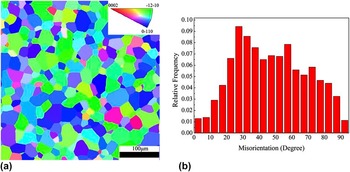
As-annealed commercial pure titanium was studied in this paper, and the microstructure and misorientation are shown in Fig. 1. Figure 1(a) shows the inverse pole figure (IPF) orientation distribution map, which reveals that the microstructures consists of equiaxed grains with an average size of 50 μm. The distribution of misorientation was random in Fig. 1(b), which indicated that recrystallization occurred during the annealing treatment. Therefore, the initial microstructure revealed recrystallization grains with an average size of 50 μm.
(a) IPF orientation distribution map and (b) misorientation distribution of the as-annealed commercial pure titanium.

Considering none precipitated phases and substructures, i.e., dislocation boundaries and twins, as-annealed commercial pure titanium can be selected as a model material of the hcp metallic material.
B. High-speed deformation mechanism of as-annealed α-Ti
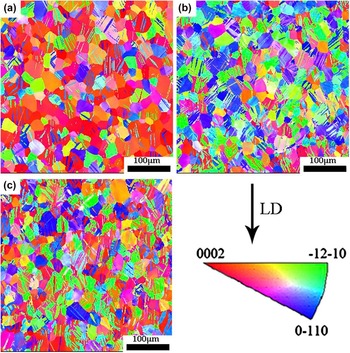
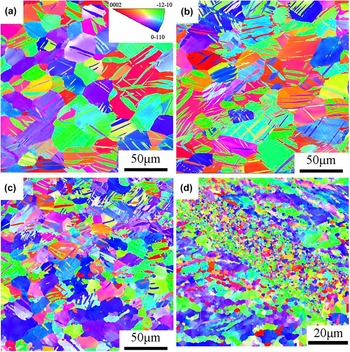
At the strain rate of 1500 s−1, strain was limited to 0.05, 0.10, and 0.15 using blocking rings with thickness of 3.80, 3.60, and 3.4 mm, respectively. Twins were formed inside the grain, shown in Fig. 2. The twin's density was increased with the strain, and grains were flattened along the direction of the stress. From the perspective of the micro-orientation, the orientation of [0002] was transformed into orientations of [0−110] and [−12−10], and it was beneficial to stimulate the {11–22}〈11–23〉 dislocations slipping system.
IPF orientation distribution map of the commercial pure titanium deformed at a strain rate of 1500 s−1 and strain of (a) 0.05, (b) 0.10, and (c) 0.15.

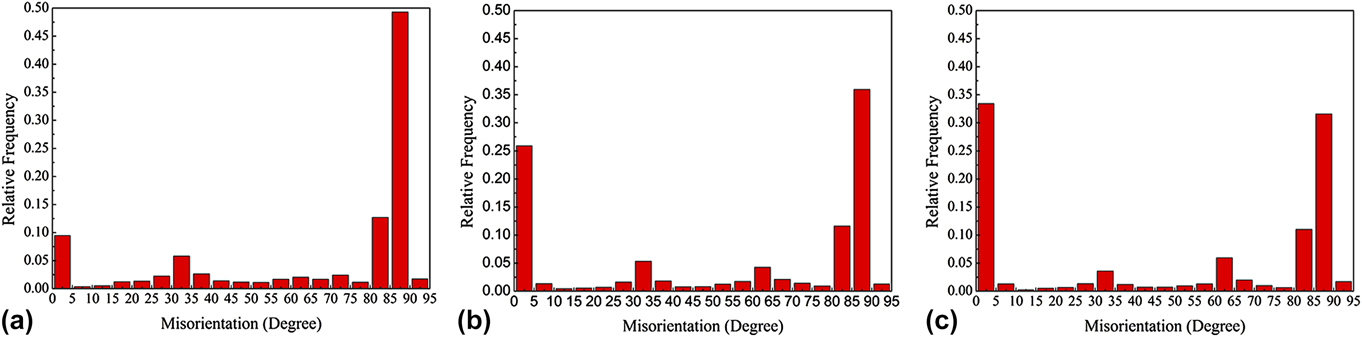
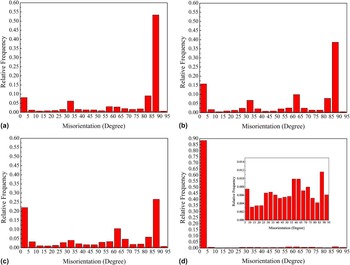
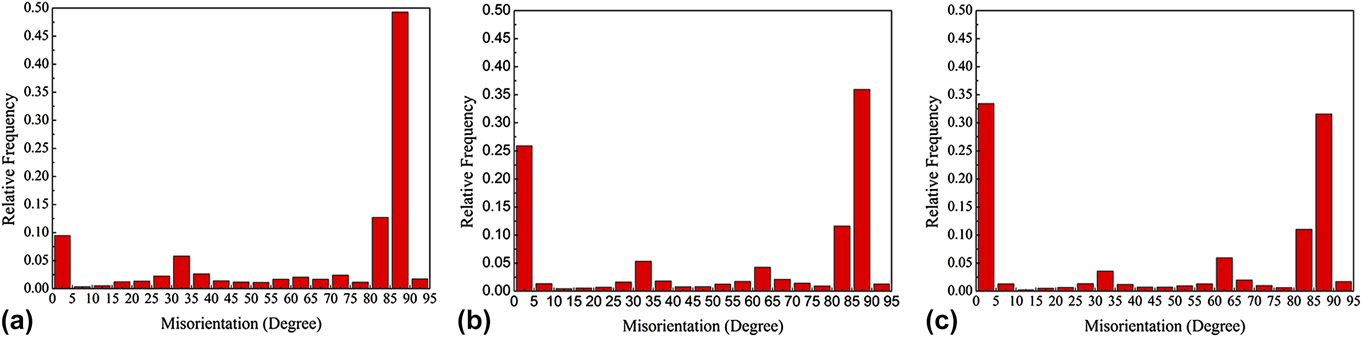
The misorientation distribution of α-Ti plates compressed at different strains and the same strain rate of 1500 s−1 is shown in Fig. 3. There were three distinct peaks at the 35°, 65°, and 87.5° positions of the misorientation distribution for samples deformed at strains of 0.05, 0.10, and 0.15, which was due to the twinning behavior, and was consistent with the microstructure in Fig. 2. The content of the low-angle grain boundary was increased with the strain from 0 to 0.15, which may be attributed to the formation of incidental dislocation boundaries (IDBs) and the geometrically necessary dislocation boundaries (GNBs).
Misorientation distribution of commercial pure titanium deformed at a strain rate of 1500 s−1 and strain of (a) 0.05, (b) 0.10, and (c) 0.15.
The content of twins was counted by Image-pro Plus soft-ware, and the results are presented in Table II. The total twin's density was 22.64, 33.00, and 33.70%, when induced by high-speed deformation at strains of 0.05, 0.10, and 0.15, respectively. The twin's density was increased with strain from 0 to 0.15. However, the increasing rate of the twin's density was slowed with the increase in the strain from 0.10 to 0.15.
Total twins density of commercial pure titanium deformed at a strain rate of 1500 s−1 and strain of 0.05, 0.10 and 0.15.

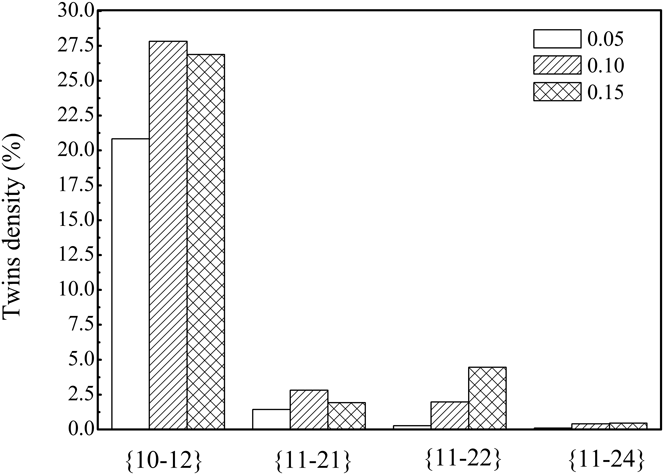
According to the misorientation distribution and rotation axis distribution of the misorientation peaks, the types of deformed twins were {10–12}, {11–21}, {11–22}, and {11–24}. The densities of different twins are shown in Fig. 4. The content of the {10–12} twin was the largest in the plane parallel to the loading direction and became the most active twin in Fig. 4. This may be attributed to the strain energy of various twins, which were proportional to the square of the twin strain. The lower the energy of the twin was, the easier the formation of the twin became. The shear strain of {10–12} was 0.175 (Ref. Reference Yoo24), and the {10–12} twin became the twin with the lowest shear strain energy. Therefore, the {10–12} twin was the most active at the beginning of deformation. Under the action of stress, the {11–22} and {11–24} contraction twins were increased with strain to coordinate the dislocation slipping.
Twins density of commercial pure titanium deformed at a strain rate of 1500 s−1.

The intergrain microstructure of the commercial pure titanium impacted at a strain of 0.11 was analyzed by TEM in Fig. 5. The substructures consisted of forest dislocations, IDBs and GNBs. At a strain of 0.05 [Fig. 5(a)], the initial recrystallization grain boundary was not fragmented, and the dislocation pile-up phenomenon occurred near the initial grain boundary. The countable forest dislocation appeared inside the grains. Additionally, annular dislocations and parallel arranged dislocations were distributed inside the grains. GNBs were extended from the initial grain boundary, but not absolutely, and dislocation cells with nonuniform size distributed between the GNBs, shown in Fig. 5(b). At a strain of 0.10 [Figs. 5(c) and 5(d)], the forest dislocation also distributed inside the grains, and the dislocation step was observed. In addition, GNBs with different spacing were formed and parallel to each other. At a strain of 0.15 [Figs. 5(e) and 5(f)], the spacing of the GNBs became narrower.
Detailed microstructure of commercial pure titanium deformed at a strain rate of 1500 s−1 and strain of 0.05, 0.10, and 0.15. (a) 0.05, triangular grain boundary, (b) 0.05, GNB, (c) 0.10, GNB, (d) 0.10, dislocation line, (e) 0.15, GNB, and (f) 0.15, narrow dislocation boundary.

During high-speed deformation, there were IDBs and GNBs inside the grain. The IDBs were formed by interaction between the simulated slipping dislocation and forest dislocation. The GNBs were formed to coordinate the deformation of adjacent dislocation cells. These were the dislocation boundaries with the lowest energy. Additionally, the misorientation of the IDB and GNB was small, so it was consistent with the content of the low-angle grain boundary above.
On the basis of the results obtained above, the main plastic deformation mechanism of the as-annealed commercial pure titanium was dislocation slipping coordinated with twinning. The misorientation of the titanium was distributed randomly. At the beginning of high-speed deformation, grains in which dislocation slipping was easier to be stimulated were deformed by dislocation slipping without the help of twinning. Meanwhile, grains in which it was difficult to stimulate dislocation slipping required the coordinating action of twinning to transform the grain orientation with a lower Schmidt factor to be beneficial for dislocation slipping. Therefore, the twin's density was increased dramatically, and the dislocation slipping was relatively weak. During the high-speed deformation, dislocation slipping became the main plastic deformation mechanism instead of twinning to generate the IDBs and GNBs.
C. Evolution of the high-speed deformation characteristic microstructure and its formation mechanism
1. Evolution of the high-speed deformation characteristic microstructure
At the strain rate of 1500 s−1, the strains were limited to 0.05, 0.10, and 0.15 using blocking rings with thicknesses of 3.80 mm, 3.60 mm, and 3.4 mm, respectively. Figures 6(a)–6(d) show the IPF orientation distribution map of the α-Ti deformed at strains of 0.05, 0.10, 0.30, and 0.50, respectively, and the loading direction was parallel to the width of this picture.
IPF orientation distribution map of commercial pure titanium deformed at a strain rate of 5400 s−1 and strain of (a) 0.05, (b) 0.10, (c) 0.15, and (d) 0.50.

From the microstructural perspective, the microstructure varied between exquiaxed grains with twins, squashed grains, fragmented grains, and highly localized bands with finer grains. The first three types of microstructures were identical to those of the sample deformed at a strain rate of 1500 s−1. The color of the twin was mainly green with a small amount of blue in Fig. 6, suggesting that the axial direction of the twin was parallel to the 〈−12−10〉 and 〈1–100〉 directions in this section. At a strain of 0.30, the initial grain boundary was indistinct. Then, ASB was generated at an angle of nearly 45° to the loading direction at a strain of 0.50, which was a highly localized zone parallel to the shear stress. The grains inside the ASB became finer and were 0.5–1.0 μm in size.
ASB was formed at the strain rate of 5400 s−1 and strain of 0.50, shown in Fig. 6(d). However, Fig. 7 shows that the uniform microstructure was formed without ASB at a strain rate of 4000 s−1 and strain of 0.50, indicating that the occurrence of the ASB depended on the strain rate and the strain. We argued that the critical strain rate for the formation of ASB was ranged from 4000 to 5400 s−1 at a strain of 0.50. Therefore, ASB and its finer grains were high-speed deformation characteristic microstructures in α-Ti.
Optical microstructure of commercial pure titanium deformed at a strain rate of 5400 s−1.

Figure 8 shows the misorientation distribution of α-Ti compressed at a strain rate of 5400 s−1. There were three distinct peaks at the 35°, 65°, and 87.5° positions of the misorientation distribution for samples deformed before the formation of ASB, which was due to the twinning behavior. The content of low-angle grain boundary was increased gradually. The twin's density showed a trend of increasing and then decreasing, presented in Table III. The twin density was increased from 23.08 to 27.92% at a strain from 0.05 to 0.10 and then decreased to 18.68% at a strain of 0.15. After the generation of ASB, the initial twin boundary was fragmented, but a small amount of initial misorientation was still remained.
Misorientation distribution of commercial pure titanium deformed at a strain rate of 5400 s−1 and strain of (a) 0.05, (b) 0.10, (c) 0.15, and (d) 0.50.

Total twins density of commercial pure titanium deformed at a strain rate of 5400 s−1.

The independent dislocation slipping systems were so rare that twins were needed to transform the grain orientation with a lower Schmidt factor to the beneficial orientation for further dislocation slipping. Twins were formed inside of grains, and a small amount of grains were squashed along the loading direction. Then, grains were deformed and squashed at a strain of 0.10, and the twin's density increased to 27.92%. In addition, the content of low-angle dislocation boundary was increased to 17.89%. The dislocation was stimulated to generate IDBs and GNBs during the deformation at the strain ranged from 0.05 to 0.10, which caused an increase in the low-angle boundaries. At a strain of 0.15, grains were fragmented, and boundaries with the initial misorientation were accounted for 18.68%, but the content of low-angle grain boundaries grew to 45.02%.
The amount of dislocation slipping system was different in various zones inside of one grain, so that the grain was fragmented during the plastic deformation. The dislocation substructure was not distributed randomly, but IDBs and GNBs were formed. The initial grain boundary became indistinct, as did the twin boundary.
The ASB was generated at a strain of 0.50, as a locally deformed band. Deformation was a process of accumulating the plastic deformation work. A portion was converted into the dislocation storage energy, whereas the remaining was converted to an adiabatic temperature rise. A considerable amount of plastic deformation work was converted to heat that cannot escape in time to be used for the narrow band. The cross-slipping and climbing of dislocations were easy to be stimulated by the action of heat, which resulted in the generation of subgrains and recrystallization grains. Therefore, finer grains were formed in the center of the ASB. However, the misorientation induced by twinning remained both in locally deformed and the uniformly deformed zone, such as 35°, 64°, and 85°. In addition, the content of the low-angle grain boundary was 90%.
Therefore, the formation of ASB was divided to three stages: (i) as-annealed α-Ti was deformed by dislocation slipping and twinning to accumulate the plastic deformation work; (ii) a large amount of plastic deformation work was converted to an adiabatic temperature rise; and (iii) the microstructure of the ASB became finer due to the combination of the shear stress and the adiabatic temperature rise.
2. ASB and its micro-orientation
The finer microstructure and its micro-orientation require further study to discuss the formation mechanism of ASB. To improve the impacted index, the cross-section of a sample was observed and the loading direction was perpendicular to the picture.
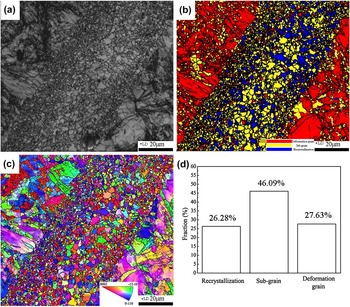
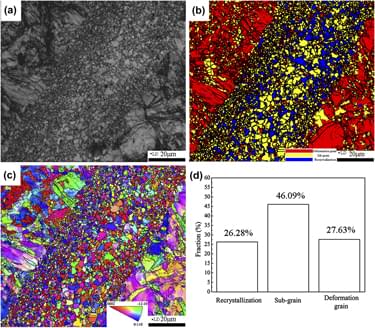
Figure 9 shows the microstructure and micro-orientation of ASB in the α-Ti deformed at a strain rate of 5400 s−1. The image quality (IQ) figure indicated that the microstructure of ASB was nearly restructured, indicated in Fig. 9(a), and the impacted index reached 75%. Importantly, the impacted index of the finer grains in the center zone was 90%. As shown in Fig. 9(b), the width of the ASB deformed at a strain rate of 5400 s−1 was approximately 50 μm, and the finer grain size was 0.5–1.0 μm. On the gradient of misorientation, the microstructure was divided into deformed grains, subgrains, and dynamic recrystallization grains at misorientations of 3° and 5.7° in Fig. 9(b).
ASB induced by deformation at a strain rate of 5400 s−1, (a) IQ, (b) dynamic recrystallization distribution, (c) IPF orientation distribution map, and (d) content of dynamic recrystallization grains.

The microstructure surrounding the finer grain was a deformed structure marked in red. Because the loading direction was perpendicular to the picture, the deformed microstructure did not present grains stretching along the direction of the shear stress. Figure 10 is the microstructure inside the grain parallel to the loading direction, and the microstructure presented as a GNB along the direction of shear stress, which is the classical deformed microstructure. Finer grains included the subgrains and dynamic recrystallization grains, shown in Figs. 9(b) and 9(d). For this localized zone with shear stress, the contents of subgrains and dynamic recrystallization grains were 46% and 26.28%, respectively, which indicated that the content of dynamic recrystallization grains was increased during further deformation.
Deformed microstructure in the transitional zone of ASB induced by deformation at a strain rate of 5400 s−1.

The contents of the subgrains and dynamic recrystallization grains are significantly increased, but the deformed grains remained. Compared with the subgrains and dynamic recrystallization grains, the deformed grains were fine and did not stretch along the direction of the shear stress, so we argued that the red grains inside the ASB were the initially deformed grains. Therefore, the subgrains and dynamic recrystallization grains were generated from the deformed grains with the shear stress and the adiabatic temperature rise.
To prove this argument, the deformed structure generated before the formation of ASB is illustrated in Fig. 11. A fibrous microstructure along the shear stress was formed in the center region of this picture. Thus, the microstructure generated before the formation of the ASB was deformed grains.
The microstructure before the formation of the ASB.

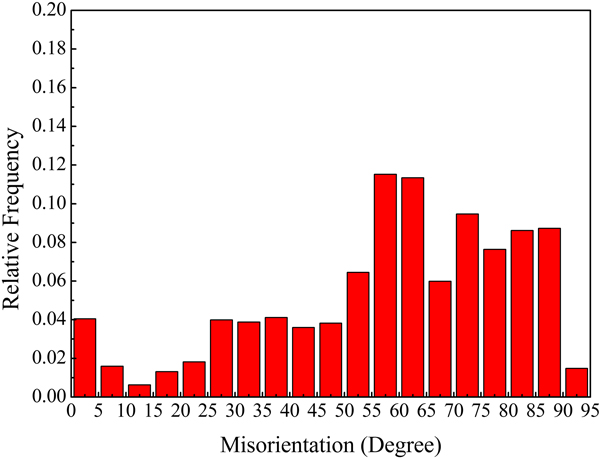
Figure 9(c) shows the IPF orientation map and the misorientation distribution of ASB. The whole microstructure included finer grains inside the ASB and transition zone. However, sizes of finer grains were different but regularly distributed. In addition, the size of the finer grain was symmetrical about the center line of the ASB and the grain size was decreased away from the center line. Micro-orientation distribution of ASB is shown in Fig. 12. The micro-orientation was randomly distributed, which was attributed to the dynamic recovery and dynamic recrystallization.
Misorientation distribution of grains in the center zone of the ASB induced by deformation at a strain rate of 5400 s−1.

The size of grains inside the ASB was larger, which was attributed to the temperature and cooling rate. The more localized the shear stress in the center zone was, the greater the plastic deformation work was, which was converted to an adiabatic temperature rise to promote the growth of the finer grains. The closer the distance to the center zone in the ASB was, the more difficult it was to radiate the adiabatic temperature rise, which made the cooling rate too slow to promote the growth of grains.
The dynamic recrystallization occurred in the center zone of ASB. Therefore, the temperature induced by self-deformation was still equal to or below the dynamic recrystallization temperature. However, the deformed adiabatic temperature rise needs quantitative calculation.
3. High-speed deformed adiabatic temperature rise of as-annealed α-Ti
The Johnson–cook mode Reference Daridona, Oussouaddib and Ahzi25 that reflects the constitutive relationship of titanium's high-speed deformation is presented in Eq. (1). A, B, and C are constants.
 $$\sigma = \left( {A + B{\varepsilon ^n}} \right) \cdot \left( {1 + C\,\ln \,\dot \varepsilon } \right) \cdot \left[ {1 - {{\left( {{T^*}} \right)}^m}} \right]$$
In this equation,
 ${\dot \varepsilon ^*}$
is the related strain rate, and
 ${\dot \varepsilon ^*} = {{\dot \varepsilon } \over {{{\dot \varepsilon }_0}}}$
, ε0 = 1 s−1.
 ${T^*}$
is the homologous temperature, and
 ${T^*} = {{T - {T_\tau }} \over {{T_{\rm{m}}} - {T_\tau }}}$
. Additionally,
 ${T_\tau }$
is 298 K and T
m is the material's melting temperature.
A, B, n, C, and m could be determined by fitting from the stress–strain data. Following consideration of the experimental circumstances, the deformation at ambient temperature was discussed. Therefore, when T was 278 K, Eq. (1) could be converted to Eq. (2):
 $$\sigma = \left( {A + B{\varepsilon ^n}} \right) \cdot \left( {1 + C\,\ln \,\dot \varepsilon } \right)\quad .$$
First step: fitting the first item.
Ordering
 $\dot \varepsilon = 1 {{\rm{s}}^{ - 1}}$
, then
 ${\dot \varepsilon ^*} = 1$
, so Eq. (2) could be transform to Eq. (3):
 $$\sigma = \left( {A + B{\varepsilon ^n}} \right)\quad .$$
The stress–strain curve at the strain rate of 1 s−1 was fitted to Eq. (4):
 $$\sigma = \left( {13.702 + 1035.80 \cdot {\varepsilon ^{0.4845}}} \right)\quad .$$
Second step: the stress–strain curves at different strain rates were fitted at ambient temperature, which was lower than the critical strain rate for the formation of ASB. Meanwhile, ε was 0.015 at the beginning of plastic deformation. Thus, the fitted result is shown in Eq. (5):
 $$\sigma = \left( {13.702 + 1035.80 \cdot {\varepsilon ^{0.4845}}} \right) \cdot \left( {1 + 0.42 \cdot \ln {{\dot \varepsilon }^*}} \right)\quad .$$
Therefore, the stress function of the strain and strain rate was derived and was combined with Eq. (6) to calculate the adiabatic temperature rise. Reference Wang, Li, Wang, Li and Nie26,Reference Xu, Zhong and Chen27
 $$\Delta T = {\beta \over {\rho c}}\int {\sigma \,d\varepsilon }$$
In Eq. (6), β is the conversion rate of the plastic deformation work and was nearly 0.90. ρ is material's density, and the density of commercial pure titanium was 4.54 × 10³ kg/m3. In addition, c is the heat capacity, which was 500 J (kg K)−1.
The adiabatic temperature rise of commercial pure titanium was 468.23 K at a strain rate of 5400 s−1 and strain of 0.50, so the temperature localized in the adiabatic shear band was 761.23 K. The melting point of commercial pure titanium is 1933.5 K. The disappearance of the point defect occurred in the temperature range from 322.95 to 605.15 K and polygonization occurred in the temperature ranged from 721.35 to 854.15 K. Therefore, the temperature localized in the adiabatic shear band reached the range of the polygonization during recovery to generate subgrains. With the action of shear stress, misorientation became larger by dislocation slipping, and the adiabatic temperature rise was accumulated, which made the subgrains develop into dynamic recrystallization grains.
D. Model establishment
Combined with the microstructural and micro-orientation evolution of α-Ti during the high-speed deformation, the uniformly deformed microstructure was generated at the beginning of compression. ASB was generated from the deformed microstructure with the shear stress and the adiabatic temperature rise, which provided strong evidence for establishing a model for the formation of ASB.
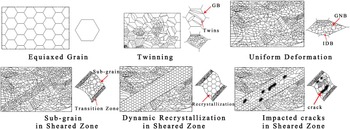
Considering that the evolution and extension model for ASB was not suitable for α-Ti, a suitable model for α-Ti during the high-speed compression was established based on the above results. In Fig. 13, the line represents the grain boundary. In addition, the width of the line represents the misorientation of the grain boundary. The wider the line is, the larger the misorientation is. Inside the grains, the lens-like structure represents twins, and the strip structures represent GNBs, among which the cell structure was called the dislocation cell.
Model for the formation and extension of the ASB in α-Ti.

This model was based on as-annealed commercial pure titanium, and the external condition was that a strain rate at the critical value. This model included the stage of the exquiaxed grains, coordinated deformation by twinning, uniform deformation, subgrains in the adiabatic shear band, dynamic recrystallization grains in the adiabatic shear band and impacted cracks.
The initial microstructure contained exquiaxed grains without dislocation boundaries and twins. Considering the lower amount of independence of dislocation systems, several grains in which it was difficult to stimulate dislocation slipping required the coordinated action of twinning to transform the grain orientation with a lower Schmidt factor to higher one for dislocation slipping. Dislocation slipping was the main plastic deformation mechanism. When the grain orientation was transformed to a beneficial orientation for dislocation slipping, dislocation slipping was stimulated to form the uniformly deformed microstructure. When the strain reached the critical strain for the formation of ASB, subgrains and a small amount of dynamic recrystallization grains were generated in the center of the ASB. Following this deformation, subgrains were changed to dynamic recrystallization grain with the shear stress and the adiabatic temperature rise, whose surrounding microstructure was the classical deformed microstructure, called GNBs and IDBs. The dynamic recrystallization grains were deformed along the shear stress, which resulted in microholes and the microcracks. Finally, these microholes and microcracks were combined to become impacted cracks, which led to the final failure.
IV. CONCLUSION
-
(1) Twinning was the main plastic deformation mechanism at a strain rate of 1500 s−1 and strain of 0–0.10; dislocation slipping was the main plastic deformation mechanism, which resulted in the formation of IDBs and GNBs to increase the low-angle grain boundary.
-
(2) Compared with the microstructure induced by the deformation at a strain rate of 1500 s−1, the high-speed deformation characteristic microstructure was ASB with a width of 50 μm. The grains inside the ASB were 0.05–1.0 μm in size. However, the high-speed deformation mechanism was similar to the one at the strain rate of 1500 s−1.
-
(3) As-annealed commercial pure titanium was deformed by dislocation slipping and twinning to accumulate the plastic deformation work. Then, plastic deformation work was converted to an adiabatic temperature rise, which was locally distributed in the ASB. Combined with the shear stress and the adiabatic temperature rise, the ASB was generated and extended.
-
(4) Considering the formation mechanism of the high-speed deformation characteristic microstructure in α-Ti, the model for the formation of high-speed deformation characteristic microstructure in α-Ti was established, including stages of exquiaxed grains, coordinating deformation by twinning, uniform deformation, subgrains in the adiabatic shear band, dynamic recrystallization grains in the adiabatic shear band and impacted cracks.
ACKNOWLEDGMENTS
This research was supported by the National Natural Science Foundation of China (Project No. 51371013) and Beijing Municipal Natural Science Foundation (Project No. 2162004).