1. Introduction
On 1 October 2014 Japan’s Cabinet Order No. 302 concerning its OLFootnote 1 to the west and north of Oki-no-Tori Shima (Area 302) took effect.Footnote 2 It was done in accordance with Article 2(2) of Japan’s Law on the Exclusive Economic Zone (EEZ) and the Continental Shelf.Footnote 3 This apparently was to implement Article 76(8) of UNCLOS,Footnote 4 which indicates that the recommendations made by the CLCS serve as the basis for the establishment of such OL.Footnote 5
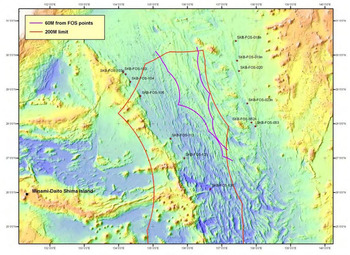
Located in the West Pacific Ocean as the southernmost point (20°25'31" North Latitude (NL)) of Japan’s territory, Oki-no-Tori Shima, in its natural condition, actually consists of two eroding protrusions from the sea no larger than king-size beds which ‘certainly meets the description of an uninhabitable rock’ under UNCLOS Article 121(3) according to late Professor Van Dyke.Footnote 6 Hundreds of millions of dollars have been spent by Japan to keep it from further erosion with the protection of concrete construction and titanium net.Footnote 7 Its legal capability to generate an EEZ and a continental shelf has been challenged openly in the United Nations and the CLCS between 2009 and 2012 when the CLCS processed Japan’s submission of information on the OL.Footnote 8 Finally in 2012 the CLCS adopted the recommendations prepared by the sub-commission for Japan, except for those concerning the OL to the south of Oki-no-Tori Shima, i.e., the Southern Kyushu-Palau Ridge Region (KPR Region).Footnote 9 Apparently the CLCS distanced itself from the dispute concerning the legal status of Oki-no-Tori Shima as a fully- or less-entitled island under Article 121 of UNCLOS,Footnote 10 authoritatively explored later by the Proelss Commentary authored by Professor Talmon.Footnote 11 For the Shikoku Basin Region (SKB Region) to the north of Oki-no-Tori Shima, the CLCS recommendations specified an area (see Figure 1) smaller than what Japan initially submitted.Footnote 12
‘Bathymetric map showing outer edge formula lines in the Shikoku Basin Region’ in Summary of Recommendations of The CLCS in Regard to the Submission Made by Japan, 12 November 2008, available at www.un.org/depts/los/clcs_new/submissions_files/jpn08/com_sumrec_jpn_fin.pdf.

This article addresses the situation that the northern part of Area 302 went beyond the CLCS recommendations concerning the SKB Region in different ways and the ensuing issue of whether Japan has violated UNCLOS Article 76(8) with such OL. Central questions are as follows: What kind of obligations does a coastal state have under UNCLOS to handle the CLCS recommendations when establishing its OL? What are the legal consequences of an OL establishment inconsistent with these obligations? The second section of this article discusses the rules governing implementation of Article 76(8), the consequences of breaking these rules, and the legitimacy of the CLCS postponement decision concerning Japan-submitted OL generated by Oki-no-Tori Shima. The third section will examine the factual situations of Area 302 against the relevant rules. Conclusions and reflections on Article 76(8) will be offered in the fourth section.
2. The Law
2.1 UNCLOS Article 76(8) and three possibilities
The point of departure is UNCLOS Article 76(8), which reads:
Information on the limits of the continental shelf beyond 200 nautical miles from the baselines from which the breadth of the territorial sea is measured shall be submitted by the coastal State to the Commission on the Limits of the Continental Shelf set up under Annex II on the basis of equitable geographical representation. The Commission shall make recommendations to coastal States on matters related to the establishment of the outer limits of their continental shelf. The limits of the shelf established by a coastal State on the basis of these recommendations shall be final and binding.Footnote 13
The three sentences above describe the steps to be taken for establishing the OL and the governing rules. The first sentence obligates the coastal state to submit the ‘information’ to the CLCS. The second sentence requires the CLCS to make ‘recommendations’ for the coastal states according to the rules indicated by Article 76.Footnote 14 The third sentence provides the legal effect of the OL establishment when based on the recommendations.Footnote 15 Something is missing here. What happens between the CLCS adoption of the recommendations and the OL establishment by the coastal state? How should the coastal state treat the CLCS recommendations? There are three possibilities, as follows:
First, the coastal state has the right or discretion to handle the CLCS recommendations when establishing the OL. In other words, the coastal state may claim a bigger area than what the recommendations specify. Second, the coastal state is bound to strictly follow the recommendations. The OL established shall neither go beyond nor be less than what the recommendations indicate. Third, the coastal state may not go beyond the recommendations in OL establishment. It has, however, the right and discretion to establish its OL encompassing a smaller area.Footnote 16
At first sight the term ‘recommendations’Footnote 17 stands for something that is not legally binding but acts as technical advice for the coastal state to consider in OL establishment. However, its meaning cannot be determined without considering the context as required by Article 31 of the 1969 Vienna Convention on the Law of Treaties (VCLT). As that provision indicates, annexes to a treaty constitute part of context.Footnote 18 Perhaps, the answer for the foregoing three options can be found in Annex II to the UNCLOS (UNCLOS Annex II), as context for UNCLOS Article 76(8).Footnote 19
2.1.1 The context of Article 76(8) and Possibility One
Under Article 7 of UNCLOS Annex II, coastal states shall establish the OL ‘in conformity with’ Article 76(8).Footnote 20 Hence, they are bound to submit the ‘information’ to the CLCS and to use the recommendations of the CLCS, as implied by the second sentence of Article 76(8). The third sentence of Article 76(8) presupposes that the coastal states must treat the CLCS recommendations as the ‘basis’ for OL establishment. How seriously must the coastal states take the recommendations that are seemingly non-binding but constitute the basis for OL establishment?
Article 8 of Annex II is enlightening, it reads: ‘In the case of disagreement by the coastal State with the recommendations of the Commission, the coastal State shall, within a reasonable time, make a revised or new submission to the Commission.’Footnote 21 In other words, with such a disagreement the coastal state has four options: (ii) to revise the submission or make a new submission and wait for new recommendations; (ii) to establish the OL agreeable to such recommendations; (iii) to abandon OL establishment; or (iv) to establish its OL sticking to the original submission disagreeable with the CLCS recommendations while breaching Article 8.Footnote 22
Bearing in mind Article 8 of Annex II and Article 76(8), UNCLOS surely discourages, if not disallows, the coastal state to establish the OL disagreeable to the recommendations.Footnote 23 Taking these two provisions into account, the reference and non-binding character of the term ‘recommendations’ does not entirely reflect the CLCS functions under UNCLOS. Possibility One, thus, seems incorrect. The coastal state most probably should not go beyond what the recommendations specify in OL establishment.Footnote 24 This interpretation is also consistent with another context, i.e., Article 76(1)–(7).
Article 76(1) provides two kinds of OL that are either the outer edge of the continental margin, or simply 200 M if the ‘outer edge’ falls short of 200 M. Under Article 76(2) the outer continental shelf of a coastal state ‘shall not extend beyond’ the ‘limits’ defined by Article 76(4)–(6). Article 76(3) defines the ‘continental margin’. Article 76(4)–(6) governs how the ‘outer edge’ of continental margin can be located and legally maximized,Footnote 25 and Article 76(7) provides the rules governing the OL drawing. The terms ‘outer edge’, ‘margin’, ‘200 M’, ‘not extend beyond’, ‘limits’, ‘not exceed’ and ‘not exceeding’ found in Article 76(1)–(7) are all about locating the maximum maritime entitlement to a continental shelf that a coastal state can claim under Article 76.Footnote 26
With the above in mind, the coastal state may be criticized for violating Article 76 if establishing OL broader than what the recommendations specify.Footnote 27 Otherwise, Article 76(1)–(7) would become a self-determining clause irreconcilable withFootnote 28 the functions of the CLCS.Footnote 29 As a group of technical experts,Footnote 30 the CLCS authoritatively applies Article 76Footnote 31 to evaluate the information submitted.Footnote 32 The result of such an application is formulated as the recommendations for the very coastal state to use as the basis for establishing the OL, in a verifiable manner through the UN Secretary-General.Footnote 33
2.1.2 Possibility Two put in context
Does UNCLOS impose upon the coastal state a duty to strictly follow the CLCS recommendations? If so, the OL established by the coastal state shall not be narrower than what the recommendations draw. This option seems hardly correct, for the following contextual and practical reasons:
As context of Article 76(8), Article 77(1) provides that the coastal state exercises over the continental shelf sovereign ‘rights’ for the purpose of exploring it and exploiting its natural resources.Footnote 34 Obviously, the coastal state has the freedom ‘not to’ make full use of such ‘rights’. Moreover, how far a coastal state can go in drawing the OL is governed by more than one formula indicated by Article 76(4)–(6).Footnote 35 Article 76(2) further provides that the OL of a coastal state shall not extend beyond the limits provided for in Article 76(4)–(6).Footnote 36 In other words, Article 76 only provides the maximum for the coastal state to fix the OL. The coastal state may finally choose not to draw the OL according to the maximal allowance specified by the CLCS recommendations. In the end, drawing conservative OL may better facilitate boundary delimitation negotiations in settling overlapping issues.
2.1.3 Possibility Three prevails
As argued above, it would be inconsistent with Article 8 of UNCLOS Annex II for the coastal State to establish an OL disagreeable with the CLCS recommendations. UNCLOS Article 76(1)–(7) dictates that the maritime entitlement to a continental shelf a coastal state enjoys shall not ‘extend beyond’ the maximal limits laid down thereby in technical terms. And the CLCS serves to provide technically authoritative recommendations representing its evaluation for the consistency of the ‘information’ with the criteria from Article 76(3)–(6). On the other hand, the idea of maritime entitlement to a continental shelf a coastal state possesses is a sovereign right. A coastal state may, as a matter of course, decide not to draw the OL according to the maximal allowance specified by the recommendations.
In other words, UNCLOS only requires the coastal state ‘not’ to ‘exceed’ what the CLCS recommendations specify. The coastal state has discretion to establish its OL enclosing a smaller continental shelf. Possibility Three seems the closest to the meaning of ‘recommendations’ and ‘on the basis of’ within Article 76(8).Footnote 37
2.2 Two situations inconsistent with Article 76(8)
Based on the foregoing, there may be two situations where the coastal state establishes the OL not on the basis of the CLCS recommendations. Situation One is where the recommendations exist but the OL established exceed what the recommendations portray. Situation Two is that the coastal state proceeds to establish the OL without the recommendations.
Sometimes, the draft recommendations prepared by the sub-commission are not adopted by the Commission (CLCS). If the disappointed coastal state moves forward with establishing the OL, how should the situation be classified? Perhaps, this should better be categorized as Situation Two. It is because relevant CLCS rules distinguish ‘the recommendations of the Commission’ from ‘the recommendations prepared or drafted by the sub-commission’.Footnote 38
2.2.1 Legal consequences of Situation One
In case the CLCS recommendations exist but the OL established extend beyond what the recommendations draw, the following legal questions may probably arise.
First, as mentioned above, Article 7 of UNCLOS Annex II requires the coastal state to establish the OL ‘in conformity with’ Article 76(8). The coastal state is therefore bound to use the CLCS recommendations indicated by Article 76(8) when establishing the limits. The duty to use and take seriously the recommendations is reinforced by Article 8 of Annex II, which obligates the coastal state to establish the OL agreeable to the recommendations. Thus, when Situation One occurs, the coastal state would probably infringe Articles 7–8 of UNCLOS Annex II, as well as Article 76(8).Footnote 39
Second, UNCLOS Article 134(4) provides that ‘nothing in this article affects the establishment of the outer limits of the continental shelf in accordance with Part VI …’. This is premised on an obligation for the coastal state to establish the OL according to UNCLOS Part VI, including Article 76. If such an obligation is performed by the coastal state in good faith, the OL so established do not encroach upon the Area under Part XI.Footnote 40 If Situation One happens, the OL establishment may be seen as encroaching upon the Area, which is ‘the sea-bed and ocean floor and subsoil thereof, beyond the limits of national jurisdiction’ under Article 1(1)(1).Footnote 41 Under such a circumstance, one might ask whether Article 134 or Part XI procedures would turn around to ‘affect’ such questionable OL as excessive limits of national jurisdiction.Footnote 42 Some ‘excusable’ OL should be mentioned. A coastal state receiving the CLCS recommendations may sometimes find it difficult to know the weakness a new or revised submission should address. It is because certain parts of the draft recommendations prepared by the sub-commission were not taken by the CLCS, which did not provide sufficient explanations.Footnote 43
Third, UNCLOS Article 136 provides that ‘the Area and its resources are the common heritage of mankind’.Footnote 44 In contrast, Article 77(2) provides that the rights referred to in Article 77(1) (i.e., the rights of the coastal state over its continental shelf) are ‘exclusive’.Footnote 45 When the coastal state takes the Area as its own continental shelf, its claims and activities there with an exclusive nature will be inconsistent with the common nature and the rules of the Area under Articles 136.
Fourth, UNCLOS Article 137(1) binds every state not to claim or exercise sovereignty or sovereign rights over the Area or its resources. In other words, every state is prohibited from turning the Area into its own territorial sea or continental shelf. If Situation One occurs, Article 137(1) prohibits other states from recognizing such claim or exercise of sovereignty or sovereign rights.Footnote 46
Fifth, under Article 137(2) all rights in the resources of the Area are vested in mankind as a whole, on whose behalf the Authority shall act.Footnote 47 When Situation One occurs, the Authority might be called upon to address Situation One through, perhaps, Article 187(b)(i) judicial means on behalf of mankind when exploration or exploitation activities occur.Footnote 48 It might be interesting to see if the omission of the Authority in this situation would even get itself into controversies under the same provision.Footnote 49
2.2.2 Legal consequences of Situation Two
In case the coastal state moves ahead by establishing the OL without the CLCS recommendations, certain legal issues will occur. First, Article 7 of UNCLOS Annex II together with UNCLOS Article 76(8) request the coastal state to obtain the recommendations ‘before’ its OL establishment.Footnote 50 When Situation Two occurs, the coastal state may be challenged as breaching these two articles. However, it is one thing to address the OL establishment without the recommendations as a basis, thus causing legal controversies. It is another thing to admit that the coastal State has an inherent entitlement to a continental shelf beyond 200 M, where it physically exists. This inherent right would not be affected by the questionable OL.Footnote 51
Second, also discussed already, UNCLOS Article 134(4) implies that the coastal state has a general obligation to establish the OL according to Part VI, including Article 76.Footnote 52 The fact that the coastal state has established the OL without obtaining any recommendations in advance may be viewed as ignoring this obligation. However, there are some submissions blocked indefinitely during the CLCS review process due to dispute. Is the submitting coastal state forced to wait in paralysis? This will be discussed in Section 2.3.
Third, Article 76 is a set of rules governing how the OL can be both maximized and confined so as to fairly preserve the Area as Common Heritage of Mankind.Footnote 53 The information prepared by a coastal state needs to be verified or endorsed by the CLCS experts’ technical evaluation.Footnote 54 The recommendations must be taken as the ‘basis’ by the coastal state when establishing the OL. The OL establishment before acquiring any recommendations will undermine its opposability or legality and be suspected as encroaching upon the Area.Footnote 55
Fourth, UNCLOS Article 137(1) prohibits every state from ‘claiming’ or exercising sovereignty or ‘sovereign rights’ over the Area or its resources. When Situation Two occurs, the coastal state may be suspected of claiming sovereign rights over part of the Area because the recommendations as the technically authoritative basis of OL establishment are lacking. Situation Two could then be considered as violating Article 137(1).Footnote 56
2.3 Possible justifications for the CLCS inaction
The second sentence of Article 76(8) says: ‘The Commission shall make recommendations to coastal States on matters related to the establishment of the outer limits of their continental shelf’ (emphasis added). Obviously, under such an obligation to produce recommendations, the CLCS must have very good reasons for not doing so. In fact, the related CLCS and UNCLOS rules provide the justifications for such an omission, as follows.
2.3.1 Non-prejudicial obligation
The CLCS actions are regulated by the ‘non-prejudicial obligation’.Footnote 57 Article 9 of UNCLOS Annex II provides that: ‘The actions of the Commission shall not prejudice matters relating to delimitation of boundaries between States with opposite or adjacent coasts.’Footnote 58 Article 5(b) of Annex I to the Rules of Procedure of the CLCS (Rop-Annex I) provides that: ‘… the recommendations approved by the Commission … shall not prejudice the position of States which are parties to a land or maritime dispute’.Footnote 59 A question arises: Who can decide if and when the position of the party states will be jeopardized by the CLCS actions? The answer lies in Article 1 of Rop-Annex I: ‘The Commission recognizes that the competence with respect to matters regarding disputes which may arise in connection with the establishment of the outer limits of the continental shelf rests with States.’Footnote 60
Simply put, it is up to ‘states’ (not the CLCS) to decide whether or not a dispute exists within the meaning of Article 5(a) of Rop-Annex I.Footnote 61 If such a dispute exists, a state party to the dispute (State A) can choose to stop the CLCS from considering a submission. State A can notify the CLCS of a land or maritime dispute in a submission so as to prevent its rights from being jeopardized. The submitting state may try to persuade State A that latter’s rights will neither be jeopardized by the submission, nor by the CLCS recommendations. State A, if so convinced, has to give ‘its consent’ to the CLCS. Should the consent from ‘all’ the states parties to the land or maritime disputes be collected, the CLCS would be absolved from its obligation not to consider and qualify the submission involving the disputes. In short, the general rule for the CLCS is a hands-off policy unless the green light is given.Footnote 62 This is provided by Article 5(a) of Rop-Annex I as follows:
In cases where a land or maritime dispute exists, the Commission shall not consider and qualify a submission made by any of the States concerned in the dispute. However, the Commission may consider one or more submissions in the areas under dispute with prior consent given by all States that are parties to such a dispute.Footnote 63
2.3.2 Maritime entitlement disputes ‘delaying’ CLCS adoption of recommendations for Japan
Which disputes can trigger the ‘non-prejudicial obligation’ and bar the CLCS from considering the submission or giving recommendations? As indicated by Article 9 of UNCLOS Annex II and Articles 2 and 5(b) of Rop-Annex I, they are (i) boundary delimitation disputes between states with opposite or adjacent coasts,Footnote 64 and (ii) land or maritime disputes.Footnote 65 The title of Rop-Annex I is interesting: ‘Submissions in case of a dispute between states with opposite or adjacent coasts or in other cases of unresolved land or maritime disputes.’Footnote 66 Here, the term ‘in other cases of’ may suggest two things.
Firstly, the ‘maritime disputes’ include but are not limited to the ‘dispute between opposite or adjacent states’, that is maritime boundary delimitation disputes.Footnote 67 Secondly, the residual disputes include those ones not between opposite or adjacent states. Perhaps, certain maritime disputes that are not boundary delimitation ones between neighbouring states are conceived here.Footnote 68 What are they?
It is possible that one of these remaining maritime disputes is a ‘maritime entitlement dispute’ concerning whether a maritime feature may generate maritime entitlement to a continental shelf,Footnote 69 e.g., a dispute concerning its legal status under UNCLOS Article 121. It concerns whether the maritime feature qualifies as (i) a ‘fully entitled island’ capable of generating a territorial sea, EEZ and continental shelf under Article 121(2), or (ii) a ‘less entitled island’, i.e., a ‘rock’ under Article 121(3) that ‘cannot sustain human habitation or economic life of its own’ and without an EEZ and a continental shelf.Footnote 70 This article was finally interpreted, not without controversies, by the 2016 award rendered by a UNCLOS Annex VII Tribunal initiated by the Philippines against China between 2013 and 2016.Footnote 71
Earlier, from 2009 to 2012, the CLCS has faced Japan-Korea and Japan-China maritime entitlement disputes.Footnote 72 It did prevent the CLCS from taking some actions from the beginningFootnote 73 to the end.Footnote 74 Japan’s position was that Oki-no-Tori Shima is capable of generating a continental shelf, including an outer continental shelf.Footnote 75 Without invoking 5(a) of Rop-Annex I, Korea and China requested the CLCS to ‘set aside’ and ‘not to take any action’ for that part of Japan’s submission as (i) Oki-no-Tori Shima is a rock as defined by Article 121(3) and not entitled to an EEZ nor a continental shelf, let alone an extended continental shelf ‘as defined in Article 76’; (ii) Japan’s inclusion of this rock in its submission constitutes an ‘inconformity with’ the UNCLOS; and (iii) ‘the legal status of Oki-no-Tori Shima is not a scientific or technical matter’ involving the OL establishment ‘but rather a matter concerning the interpretation and application of Article 121’ and ‘the ground to claim continental shelf’, which is beyond the purview and mandate of the Commission.Footnote 76
Japan in turn urged the CLCS to ignore these objections because (i) the Chinese and Korean Note Verbales (NVs) were related to the interpretation of Article 121 that is beyond the CLCS mandate;Footnote 77 (ii) for the maritime areas surrounding Oki-no-Tori Shima, the only party state to the maritime boundary dispute with Japan is Palau.Footnote 78 Obviously, Japan does not consider the term ‘maritime dispute’ in Article 5(a) of Rop-Annex I capable of covering maritime entitlement disputes under Article 121.Footnote 79 For Japan, Article 5(a) is inapplicable to the Oki-no-Tori Shima issues.Footnote 80
It is important to observe how the CLCS handled the issues concerning the legal status of this feature so as to clarify whether a maritime entitlement dispute not between opposite or adjacent states falls within the title and Article 5(a) of Rop-Annex I.Footnote 81 The wording used by the CLCS is noteworthy. For the KPR Region, the CLCS neither used the word ‘dispute’ to describe the Japan-Korea and Japan-China debates, nor invoked Article 5(a) of Rop-Annex I. The CLCS used the term ‘matters’ instead. Actually, the NVs from China and Korea did not even mention Article 5(a). The question thus arises as to whether Article 5(a) constituted the de facto legal basis underlying the CLCS postponement decision.Footnote 82
There are good reasons to believe that Article 5(a) did not constitute the de facto legal ground for the CLCS postponement decision concerning the Oki-no-Tori Shima case. In applying Rop-Annex I, the CLCS should consider the context and observe the relevant rules with higher ranking. UNCLOS Article 76(10) and Article 9 of UNCLOS Annex II provide that the question or matter relating to boundary delimitation of the continental shelf between opposite or adjacent States constitute the object of the ‘non-prejudicial obligation’ incumbent upon the CLCS. Such an obligation scope should probably control the interpretation and application of the term ‘maritime dispute’ under Article 5(a) of Rop-Annex I which is subordinate to the foregoing rules.Footnote 83 As Article 5(a) most probably did not serve as the legal ground underlying the CLCS postponement decision for the KPR Region OL, can the CLCS decision still be justified?
2.3.3 Possible justifications for CLCS postponement
To begin with, the CLCS has the mandate to interpret and apply Article 76 of UNCLOS, starting with paragraph one:Footnote 84
The continental shelf of a coastal State comprises the seabed and subsoil of the submarine areas that extend beyond its territorial sea throughout the natural prolongation of its land territory to the outer edge of the continental margin, or to a distance of 200 nautical miles from the baselines from which the breadth of the territorial sea is measured where the outer edge of the continental margin does not extend up to that distance.Footnote 85
Obviously, the first choice for a coastal state is to claim the extended continental shelf. In this case the CLCS comes in. The application by the CLCS of Article 76(1) precedes that of Article 76(4). Sections 2.2.1–2.2.2 of the Scientific and Technical Guidelines explain as follows:
2.2.1. Both the basis for entitlement to delineate the outer limits of an extended continental shelf and the methods to be applied in this delineation are embedded in article 76. However, it is clear that the positive proof of the former precedes the implementation of the latter, as stated in article 76, paragraph 4(a) …
2.2.2. The Commission defines the term ‘test of appurtenance’ as the process by means of which the above provision is examined. The test of appurtenance is designed to determine the legal entitlement of a coastal State to delineate the outer limits of the continental shelf throughout the natural prolongation of its land territory to the outer edge of the continental margin, or to a distance of 200 nautical miles … where the outer edge of the continental shelf does not extend up to that distance.Footnote 86
Precisely, the CLCS determination of (or proof-finding process for) the ‘basis for the legal entitlement’ under Section 2.2.2 is its application of Article 76(1) to a particular submission. The CLCS need not touch Article 76(4) after this exercise without ‘positive proof’ of the ‘basis’ concerning the extended continental shelf. In searching for such an evidence or applying Article 76(1), the CLCS cannot ignore Article 121 as an inherent factor, ‘context’ under Article 31 of VCLT, and yardstick for such an entitlement. As rightfully put by Section 1.1 of the Scientific and Technical Guidelines, the CLCS:
… recognizes the integral character of [UNCLOS]. These Scientific and Technical Guidelines form the basis for the Commission to make its recommendations with respect to submissions prepared by States according to article 76 and Annex II to the Convention in a manner that is consistent with the Convention and international law.Footnote 87
Accordingly, the CLCS must carefully examine the submarine areas extending ‘beyond’ the territorial sea of the submitting state ‘throughout’ the natural prolongation of its land territory ‘to’ the outer edge of the continental margin, as claimed. The terms ‘extend beyond its territorial sea’, ‘throughout’, and ‘to’ indicate that, before making a submission, the coastal state must possess maritime entitlement ‘beyond’ its territorial sea according to UNCLOS. Such a premise constitutes the subject of Article 76(1) starting with ‘[t]he continental shelf of a coastal State’. Irregularity in this regard rarely occurs, as shown by most of the submissions before the CLCS. Although ‘bad faith is not presumed’,Footnote 88 caution must be exercised if an anomaly arises. Equally critical is the linking term ‘of’ in the phrase ‘natural prolongation of its land territory’. It means that the submitted ‘natural prolongation’ (i.e., continental shelf) appertains to a certain ‘land territory’Footnote 89 or a certain ‘land territory’ is legally capable of producing ‘natural prolongation’. In other words, when applying Article 76(1) term ‘of’ to a particular submission the CLCS should be assured that the land territory concerned is capable of creating maritime entitlement to the continental shelf. The CLCS, if reminded otherwise,Footnote 90 should pause and see whether that ‘land’ appears to be a ‘rock’ defined by Article 121(3)Footnote 91 as challenged.Footnote 92
It is true that the CLCS is neither authorized to interpret nor apply Article 121(3),Footnote 93 nor is it a dispute settlement body.Footnote 94 It is also true that the CLCS has the mandate to interpret and apply Article 76(1). It cannot turn a blind eye to the situation in which a coastal state is making a submission while the very ‘basis’ for its entitlement to the continental shelf is notoriously disputed. Otherwise, the CLCS may be seen as not executing its official duty ‘according to article 76 and Annex II to the Convention in a manner that is consistent with the Convention and international law’.Footnote 95
As the maritime entitlement dispute not between opposite or adjacent states was not deemed as the ‘maritime dispute’ under Article 5(a) of Rop-Annex I by Korea, China, Japan, and the CLCS in the Oki-no-Tori Shima case, the provision was not applied by the CLCS.Footnote 96 Therefore, the CLCS actions taken for this case should be distinguished from those to which Article 5(a) was applicable. The CLCS in fact established a sub-commission to prepare for draft recommendations for the entire Japanese submissions, including the parts surrounding Oki-no-Tori Shima. This is not conceived by Article 5(a) when a ‘dispute’ has been notified while the ‘consent’ is missing. What is now awaited is the resolution of such Japan-China and Japan-Korea ‘matters’.Footnote 97 This label has not been used in those cases to which Article 5(a) applied, either. Moreover, the CLCS decision makes it possible for the ‘matters’ to be resolved by means of an authoritative interpretation of Article 121 from a competent agency. In fact, when handling the Oki-no-Tori Shima case the CLCS had thought of seeking an interpretation of Article 121 elsewhere.Footnote 98 Such an option is wanting in Article 5(a).
Summing up, the application of the Article 76(1) phrase ‘extend beyond its territorial sea throughout the natural prolongation of its land territory’ to a specific submission makes Article 121(3) an unavoidable context for the CLCS to consider, once alerted.Footnote 99 If such an application puts in doubt the capability of the critical maritime feature to generate entitlement to the continental shelf, the CLCS would also be in doubt as to whether the submission itself even qualifies as the ‘information’ heading Article 76(8) to begin with.Footnote 100 When this happens, the CLCS would find itself in a difficult situation if it were to proceed with reviewing the ‘information’, which in essence is an application of UNCLOS Article 76(3)-(6), or producing recommendations.Footnote 101 The situation would become even harder when the maritime feature in question is an internationally renowned ‘rock’ like Oki-no-Tori Shima apparently fulfilling all the requirements of Article 121(3). Thus, before receiving an external and authoritative interpretation of Article 121 capable of settling the issues as requested by Korea and China implicitly, the CLCS postponement in adopting the draft recommendation for the KPR Region was probably excusable, if not justified.Footnote 102
3. The factual analysis
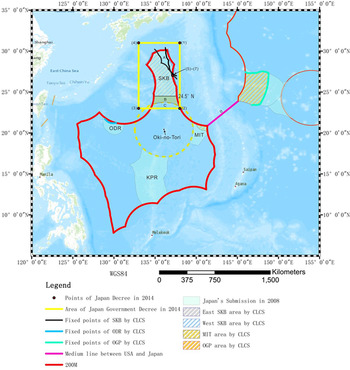
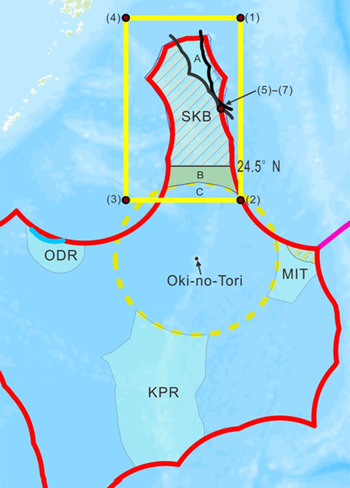
The 2014 Japan’s Cabinet Order No. 302 declares two areas as its outer continental shelf (see Figures 2 and 3). To the west of the Oki-no-Tori Shima is the ODR Region (Oki-Daito Ridge).Footnote 103 To the north of Oki-no-Tori Shima is the SKB Region.Footnote 104 Order No. 302 provides 257 co-ordinates to delineate the ODR Region. Seven co-ordinates were used to locate the SKB Region.Footnote 105 ODR Region as claimed by Order No. 302 seems agreeable to the CLCS recommendations. It is the SKB Region claimed by Japan that disagrees with the related CLCS recommendations.
Japan’s outer continental shelf claims surrounding Oki-no-Tori Shima and the CLCS recommendations.
Source: Drawn by Dr. Yin-Xia Fang for the authors

Japan’s outer limits of continental shelf under the 2014 Cabinet Order.
Source: Drawn by Dr. Yin-Xia Fang for the authors

Figure 1 shows the CLCS recommendations concerning the SKB Region.Footnote 106 In the upper middle part of Figure 1 there are two purple lines crossing on their southern parts to sandwich two triangles which were ‘not recommended’ as Japan’s outer continental shelf by the CLCS in 2012. The northern triangle is Area A in Figures 2 and 3. Figure 3 provides a bigger rectangular area to the north of Oki-no-Tori Shima identified by Point/Co-ordinate (1)-(4) listed in Order No. 302. According to this Order all the areas within this rectangle, except Japan’s EEZ and the area encompassed by Point/Co-ordinate (5)-(7),Footnote 107 are Japan’s outer continental shelf.Footnote 108 Being claimed as part of Japan’s outer continental shelf, Area A clearly goes beyond the CLCS recommendations concerning the SKB Region. Based on the aforementioned discussion, Situation One occurs for Area A.
At the bottom of the rectangular area are Areas B and C. Claimed as Japan’s outer continental shelf, Area B is between (to the North) 24.5 degree NL and (to the South) the outer limits of Japan’s EEZ generated by Oki-no-Tori Shima (see Figure 3). The 24.5 degree NL is the southernmost border where the SKB Region ends, as recommended with no explanation by the CLCS (see bottom of Figure 1).Footnote 109 As the Japan-claimed outer continental shelf marches beyond the southern border under the recommendations, Situation One occurs again in the northern part of Area B bordering 24.5 degree.
Not based on any CLCS recommendations, the southern border of Area B is the outer limits of Japan’s EEZ generated by Oki-no-Tori Shima. Situation Two may have occurred here. To be submitted, the legal problems of the southern border of Area B are identical with those of the northern border of Area C. This article has addressed the issues arising from Japan’s submission to the CLCS concerning, inter alia, the KPR Region bordering the southern limits of the EEZ generated by Oki-no-Tori Shima. Due to the Japan-Korea and Japan-China maritime entitlement disputes (or ‘the matter’ according to the CLCS) concerning Oki-no-Tori Shima under UNCLOS Article 121, the CLCS was unable to adopt the draft recommendations prepared by the sub-commission concerning the KPR Region (See Figure 2).Footnote 110 Apparently, the same maritime entitlement matters/disputes also caused the CLCS to avoid using the outer limits of the disputed EEZ as the southern border for its recommendations on the SKB Region. Instead, the line moved northward and stopped at 24.5 degree NL. This probably displays the CLCS’s reluctance to be seen as endorsing Japan’s claim that Oki-no-Tori Shima is a fully-entitled island under Article 121.
Ever since 1988 the legal capability of Oki-no-Tori Shima to generate an EEZ and a continental shelf under UNCLOS Article 121 has been openly questioned by Professor Van Dyke.Footnote 111 Scholars may ask how China and Korea had been responding to that reminder between 1988 and 2009. If no response had been made, would such an inaction undermine the Chinese and Korean legal positions against Japan’s 2009 Submission? The answer may probably lie in Japan’s reaction to the Chinese and Korean NVs. To begin with, Japan considers Oki-no-Tori Shima capable of generating a continental shelf.Footnote 112 As indicated by Japan in the CLCS meeting, the Chinese and Korean NVs should not be considered by the CLCS as they were related to the interpretation of Article 121(3) which went beyond the CLCS mandate and was not mentioned by Rop.Footnote 113 Had the 1998–2009 Chinese and Korean reaction of any sort been interpreted by Japan as acquiescence for its claim that Oki-no-Tori Shima may generate a continental shelf under Article 121, the matters or issues relating to the interpretation of Article 121(3) or the legal status of Oki-no-Tori Shima thereunder pointed out by the Chinese and Korean NVs could not have emerged. Then, Japan’s post-2009 legal position in the CLCS should have been different.
Clearly, the Japan-China and Japan-Korea maritime entitlement disputes/matters over the legal status of Oki-no-Tori Shima under UNCLOS Article 121(3) remain unsettled after 2012 onward.Footnote 114 Four years later, the 2016 award’s interpretation of Article 121(3) came along,Footnote 115 which cannot be overlooked by the CLCS.Footnote 116 A simple exercise can be done by applying Article 121(3), as interpreted, to Oki-no-Tori Shima that is 51,000 times smaller than Itu Aba. Also known as Taiping Island, Itu Aba is about 0.51 square kilometres. It can sustain some (though not ‘sizable’ according to the Tribunal) human population with its fresh water, soil, and natural environment. Still, the Tribunal held Itu Aba to be ‘a rock’ under Article 121(3) as interpreted. In comparison, Oki-no-Tori Shima has no fresh water and soil at all in its natural conditions. Contrasting with Itu Aba, Oki-no-Tori Shima obviously should be more ‘uninhabitable’ and less ‘entitled’.Footnote 117 Even putting aside the 2016 award’s interpretation of Article 121,Footnote 118 Oki-no-Tori Shima still cannot meet the tests of ‘sustain’ and ‘human habitation’ under Talmon’s comments.Footnote 119 All in all, with this 2016 Award’s interpretation it is doubly hard for the CLCS to change its 2012 postponement decision still awaiting resolution of the ‘matters’ among Japan, Korea and China.Footnote 120 Looking ahead, Situation Two will probably stay in the southern part of Area B for quite a while.
4. Concluding remarks
The International Court of Justice once said in the Anglo-Norwegian Fisheries case concerning the straight baselines established by Norway:
The delimitation of sea areas has always an international aspect; it cannot be dependent merely upon the will of the coastal State as expressed in its municipal law. Although it is true that the act of delimitation is necessarily a unilateral act, because only the coastal State is competent to undertake it, the validity of the delimitation with regard to other States depends upon international law.Footnote 121
Therefore, other states may oppose the validity of the OL established by the coastal state.Footnote 122 Regarding the OL dividing areas of national jurisdiction and the Common Heritage of Mankind (the Area) under UNCLOS Article 1(1)(1),Footnote 123 other states are even obligated by Article 137(1) not to recognize those encroaching upon the Area.Footnote 124 Moreover, once the OL are not established according to Part VI of UNCLOS, the validity of such limits would probably be ‘affected’ or undermined by operation of certain articles of Part XI, as indicated by Article 134(4).Footnote 125
This article has addressed the legal problems arising from the 2014 Cabinet Order No. 302 of Japan promulgating the OL, inter alia, to the north of Oki-no-Tori Shima. In the so-far-unchallenged rectangular area indicated by Figures 2 and 3, Area A as part of Japan’s outer continental shelf obviously exceeds the 2012 CLCS recommendations concerning the SKB Region. Area B also has this problem in its northern border, as the 2012 recommendations concerning the SKB Region ends at 24.5 degree NL. The area to the south of that border claimed as Japan’s outer continental shelf exceeds what the recommendations specify, too. On the other hand, the southern border of Area B is the outer limits of the EEZ generated by Oki-no-Tori Shima, whose legal status as a fully entitled island claimed by Japan was not endorsed by the 2012 CLCS recommendations. This was proven by the CLCS non-adoption of the recommendations prepared by the sub-commission concerning the KPR Region. In other words, the problems concerning the southern border of Area B is not that it goes beyond the CLCS recommendations, but that no recommendations exist to serve as the basis of such a border.
This article has also attempted to identify all the UNCLOS provisions that would be violated when (i) the OL established by the coastal state go beyond the recommendations (i.e., Situation One), and (ii) the coastal state proceeds to establish the OL when the recommendations are unavailable (i.e., Situation Two).Footnote 126 It is arguable that Japan’s 2014 Cabinet Order No. 302 may have violated all these provisions. It remains to be seen whether such a situation will attract attention from the international community as UNCLOS contracting parties not only have the right to challenge such an OL establishment inconsistent with UNCLOS rules, but have an obligation to refrain from recognizing a possible encroachment upon the Area. Due to page limits, the legal procedures of such a violation of provisions in UNCLOS Parts VI and XI, as laid down by Section 5 of Part XI, will be treated separately.
The term ‘on the basis of’ under the third sentence of UNCLOS Article 76(8) seems to outlaw the situation where the coastal state establishes the OL exceeding what the CLCS recommendations draw. On the other hand, when lacking the recommendations while the coastal state proceeds with the OL establishment, Article 76(8) is certainly violated as no recommendations are available as the basis to underpin such an establishment. The central term ‘recommendations’, as it is, should be interpreted as ‘reference’ or ‘advice’ without legally binding force. However, its context, e.g., Articles 7–8 of UNCLOS Annex II, would probably push it towards the other side of the spectrum, i.e., ‘legally binding, authoritative, and detailed technical guidance’.Footnote 127 How far and well these terms and provisions as well as Articles 134(4), 136, 137(1)–(2), and 187(a)–(b)Footnote 128 can altogether be interpreted, applied, and effected is demonstrated by Area 302 and the way international community takes it. At stake would be the legitimate division between national jurisdiction and the Common Heritage of Mankind (the Area).
Last but not least, the CLCS postponement for Japan’s Submission concerning the KPR Region to the south of Oki-no-Tori Shima (i.e., deferring adoption of the sub-commission’s draft recommendations) is excusable, if not justified, under Article 76. Not being maritime boundary delimitation disputes between opposite or adjacent States, the Japan-Korea and Japan-China maritime entitlement disputes relating to the Article 121(3) status of Oki-no-Tori Shima were not taken as part of the ‘maritime dispute’ under Article 5(a) of Rop-Annex I by all the actors. Consequently, Article 5(a) seems irrelevant to the postponement. However, the entitlement disputes hindered the application of Article 76(1) by the CLCS, which was put in a spot light and casts serious doubt as to whether Oki-no-Tori Shima has any maritime entitlement to a continental shelf ‘beyond its territorial sea’ to begin with. Without a mandate to interpret and apply Article 121 and to settle the related disputes, the CLCS has to rely on an external competent body to provide an authoritative interpretation or a decision to settle the disputes before it can move on with its recommendation-producing job, unless Japan, Korea, and China can resolve the ‘matters’ among themselves. Pending any solution, it would seem difficult in this case for the CLCS to proceed with its application of the rest of Article 76 ‘in a manner that is consistent with the UNCLOS and international law’.