I. INTRODUCTION
Industrial and agricultural wastewaters as well as domestic waste water contain a lot of organic matters, nitrogen and phosphorus, and many other nutrients. It is easy to result in eutrophication, and the overgrowth of cyanobacteria leads to microcystins (MCs) pollution which calls for an efficient remediation solution. Reference Park, Yang, Park, Choi, van Genuchten and Lee1–Reference Song, Wang, Ren, Lv, Sun, Yan, Li and Liu3 MCs are a class of naturally produced cyclic heptapeptide toxins released by cyanobacteria during algal blooms in eutrophic waters. They have been shown to have toxic effects on the liver, nerves, kidney, and reproductive organs. Wang et al. and his colleagues studied the distribution of MCs in various tissues of Wistar rats under laboratory conditions, and they observed the highest concentration of MCs in the lungs after the kidney. Reference Wang, Xie, Chen and Liang4
Until now, more than 60 microcystin variants have been found, and among which, Microcystin-LR (MC-LR) possesses the most toxic effect and widely distributes in natural waters. Reference Dawson5 As a result, the threshold value of 1 μg/L for MC-LR in drinking water has been issued by the World Health Organization. Reference Dawson5 However, the concentrations of MCs in many water bodies are far beyond that guideline. One study showed that the level in the Poyang Lake, the largest freshwater lake in China, was 7.97 mg/L. Reference Zhang, Liao, Zhang, Wang, Luo, Chen, Zhong and Liu6 MC-LR is chemically stable and has a very slow natural degradation process. The stability of the cyclic peptide structure hinders the degradation of MC-LR efficaciously by traditional water or waste water treatments. Thus, various water treatments have been tried for MC-LR removal, such as UV/H2O2, Reference He, Zhang, de la Cruz, O’Shea and Dionysiou7 UV/O3, Reference Onstad, Strauch, Meriluoto, Codd and von Gunten8 and biotreatment Reference Dawson5 et al. The development of an efficient, safe, and low-cost method for removing MC-LR in water has become one of the important problems to be solved urgently in environmental science research. Advanced oxidation processes including chlorination, ozonation, hydroxide radical disinfection, and photocatalysis have been proved efficient to remove MC-LR, but the cost of continuous input of expensive chemical reagents is prohibitive. Therefore, photocatalysis which only uses solar light has attracted great attention as an MC-LR degradation approach. Photocatalysis has become a hopeful environmental purification technology for the removal of toxic organic contaminants, with a series of advantages, such as high efficiency, stability, and mild operating conditions et al. Reference Song, Li, Wang and Shi9 Therefore, it has a good prospect for the removal of MCs. Reference Hong, Fang, Yin, Luo, Zhao, Shi and Li10
In recent years, a number of layered compounds have been widely used in photocatalysis. The bismuth oxyhalide (BiOX) compounds are the most representative of the newly visible-light-responsive photocatalysts, which have a high photocatalytic activity and stability and can activate the molecular oxygen directly. Reference Song, Feng, Shi and Liu11 Among BiOX compounds, BiOI possesses the narrowest band gap (∼1.8 eV) compared with BiOCl and BiOBr, which can absorb visible light more efficiently, with a unique electron structure and indirect transition mode. Xiao et al. have synthesized a uniform BiOI microsphere with a 3D structure using the ethanol-water mixed solvent Reference Hao, Xiao, Zuo, Nan and Zhang12 and proved that it can effectively mineralize phenol under visible light. Although BiOI has a strong light absorption in the visible region, the photocatalysis activity remains limited by the rapid recombination of photo-induced electrons (e−) and holes (h+). This is caused by the small band gap of BiOI, which is easy to be the recombination center of photo-induced e− and h+. Reference Chen, Jiang, He, Wu and Chen13 The degradation efficiency of BiOI still needs to be improved greatly. There are many ways to reduce the probability of electron–hole pair recombination. A variety of modification methods such as doping, noble metal surface modification and forming heterogeneous with other semiconductors are used to improve the separation efficiency of photo-induced e− and h+ of BiOI. Among which, the formation of heterojunctions in composite semiconductors is a very effective method. Reference Xu, Hu, Gao, Liu, Wageh, Al-Ghamdi, Alshahrie and Fang14 Various works about the preparation of heterojunction composite photocatalysts have been reported, for example, Li et al. have successfully prepared the ZnWO4/BiOI heterojunction with high visible light activity, which greatly improved the photocatalytic activity of BiOI. Reference Lee, Kim, Kim and Suh15 Cao et al. have successfully prepared novel p–n heterojunction BiOI/BiPO4 nanocomposites with a better photocatalytic activity than pure BiOI and BiPO4. Reference Zheng, Han, Liu, Yu and Fang16 Recently, Ye et al. have successfully prepared a MnO x /BiOI composite photocatalyst by the photo precipitation method, exhibiting a higher photocatalytic activity than BiOI. Reference Li, Zhao, Jia, Sun, Sun, Cheng, Liu and Fan17
Graphite-like carbon nitride (g-C3N4) is a visible-light-responsive photocatalytic material with a band gap of 2.7 eV. Reference Cao, Xu, Lin and Chen18–Reference Zhu, Xia, Li, Ho and Yu24 So far, it is the first nonmetallic organic semiconductor photocatalytic material and has visible light activity. g-C3N4, with a simple two-dimensional stack structure, owns a range of properties, such as thermal and chemical stability, good photocatalytic activity, and low cost et al. Reference Chen, Shen, Guo, Wang, Su, Zhao and Guo25–Reference Cui, Ding, Wang, Shi, Huang, Zuo and Kang29 It is a hopeful material for the photocatalytic degradation of pollutants. The formation of heterojunctions with g-C3N4 can separate and transfer the photo-induced e− and h+ pairs effectively and improve the photocatalytic efficiency. Reference Ye, Liu, Zhao, Xie and Zan30 Thus, the heterojunction of g-C3N4 and BiOI is a promising composite photocatalyst for MC-LR removal.
In this article, BiOI is synthesized by the ultrasound-assisted hydrolysis process, and the x-g-C3N4/BiOI (x = 2, 4, 6, 8) samples are prepared by the solid phase calcination method. The photocatalysts are characterized by FESEM, HRTEM, X-ray diffraction (XRD), FT-IR, X-ray photoelectron spectroscopy (XPS), UV-vis, BET, PL, and Mott–Sckottky. The photocatalytic activity of the samples is evaluated by the removal of MC-LR under visible light irradiation. The optimized rate constant of MC-LR degradation is 0.605, which is achieved by 4-g-C3N4/BiOI. The results exhibit that the photocatalytic activities of composites are better than those of pure g-C3N4 and BiOI. It indicates that the heterojunction between BiOI and g-C3N4 is constructed well. The possible photocatalytic mechanism of g-C3N4/BiOI was proposed based on the acquisition experiments, ESR detection, and the relative band positions of these two semiconductors. This work plays a significant role in designing heterojunctions with a high photocatalytic oxidation and reduction performance for MC-LR degradation.
II. EXPERIMENTAL
A. Preparation of the g-C3N4/BiOI photocatalysts
The pure BiOI photocatalyst was prepared by an ultrasound-assisted hydrolysis method in the following procedure: 2 mmol Bi(NO3)3·5H2O powder was put into 20 mL deionized water and ultrasounded for 30 min. Then 10 mL deionized water was added to the solution and was ultrasounded continuously for 10 min. Then, 1 mmol KI was dissolved in this solution, and the color of the solution become orange. Subsequently, the brick red precipitates were generated gradually. The resulting product was washed several times with distilled and absolute ethanol. Finally, the powder was dried at 60 °C for 12 h.
A series of x-g-C3N4/BiOI composite catalysts (“x” denotes the mass ratio of g-C3N4 to BiOI) were synthesized via the solid phase calcination method. 1.0 g BiOI and several weights (2, 4, 6, and 8 g) of melamine were dissolved in absolute ethanol and stirred for 30 min for homogenous dispersion. Then the solution was dried at 80 °C for 24 h to obtain a dried powder. The samples were calcined at a heating rate of 2.3 °C/min, heated to 550 °C and kept for 4 h in a muffle furnace with a programmed temperature, and then cooled to room temperature naturally. The precipitates were collected and ground into powders, then washed with distilled water and absolute ethanol alternately for several times. The obtained product was separated by centrifugation and dried in an oven at 60 °C. g-C3N4/BiOI heterojunction nanocomposites were marked as 2-g-C3N4/BiOI, 4-g-C3N4/BiOI, 6-g-C3N4/BiOI, and 8-g-C3N4/BiOI, respectively, for the various added melamine weights (2, 4, 6, and 8 g).
B. Characterization
The crystalline phases of the as-prepared samples were characterized by XRD using an X-ray diffractometer (Bruker D8 Advance diffractometer, Bruker, Karlsruhe, Germany) with Cu Kα radiation in the 2θ range of 5–80° at a scanning rate of 7°/min. To examine the morphology of the samples, SEM images were recorded on an S-4800 FESEM (Hitachi, Tokyo, Japan). The crystal structure and high-resolution images of the photocatalyst were analyzed by high-resolution transmission electron microscopy (HRTEM; JEOL JEM-2100, JEOL Ltd., Akishima, Japan). The surface composition and chemical states of materials had been analyzed by XPS. The fourier transform infrared spectrometer (FT-IR; Nicolet Nexus 470, Thermo Nicolet Corporation, Madison, Wisconsin) was used to measure the structural information for samples using the standard KBr disk method. UV-vis diffused reflectance spectra of different samples were carried out on a UV-vis spectrometer (UV2550, Shimadzu, Tokyo, Japan) using BaSO4 as the background in the range of 200–800 nm at room temperature.
C. Photocatalytic degradation of MC-LR
The photocatalytic activities of these heterojunction nanocomposites were measured using MC-LR as the targeted pollutant under visible light irradiation. The photodegradation of the MC-LR was carried out in a photochemical reactor, using a 350 W Xe lamp (Xu Jiang Machine Factory, Nanjing, China) as light source and equipping with a glass filter (λ > 420 nm) to obtain visible light. In a typical experiment, 50 mg of the sample was added into the 10 mL MC-LR solution. Before irradiation, the suspensions were magnetically stirred for 30 min in dark conditions to achieve adsorption equilibrium.
The distance of the light source, 350 W Xe lamp, and the contained solution was of 8 cm. During the photocatalytic process, a certain amount of liquid sample was withdrawn at a regular 30 min interval and then centrifugated at 8000 rpm for 10 min to remove the catalyst particles. At present, there are several ways to detect MC-LR at home and abroad, including chemical, biological, and immunochemical methods. High-performance liquid chromatography (HPLC) is the most widely used method for the determination of MCs, HPLC has many advantages, such as accuracy and sensitivity, low detection limit, good reproducibility, and so on. Moreover, different microcystin toxins can also be analyzed simultaneously. The maximum UV absorption wave length of MC-LR is in the range of 238–240 nm. The content of microcystin was measured using HPLC, with a C18 chromatographic column (LK-C18, 4.6 × 150 mm, 5 μm). The mobile phase was a mixture of deionized water with 0.1% TFA and methanol at a ratio of 48:52. The analysis was performed under isocratic conditions at a flow rate of 5 mL/min, with an injection volume of 20 μL and an oven temperature of 37 °C. The MC-LR concentration was measured by calibrating the peak areas (at wave length of 238 nm) with external standards. The HPLC system had a detection limit of 0.1 μg/L. Before the MC-LR analysis, the sample was filtered (pore size: 0.45 μm, PES Hydrophilic).
III. RESULTS AND DISCUSSION
A. Characterization of photocatalysts
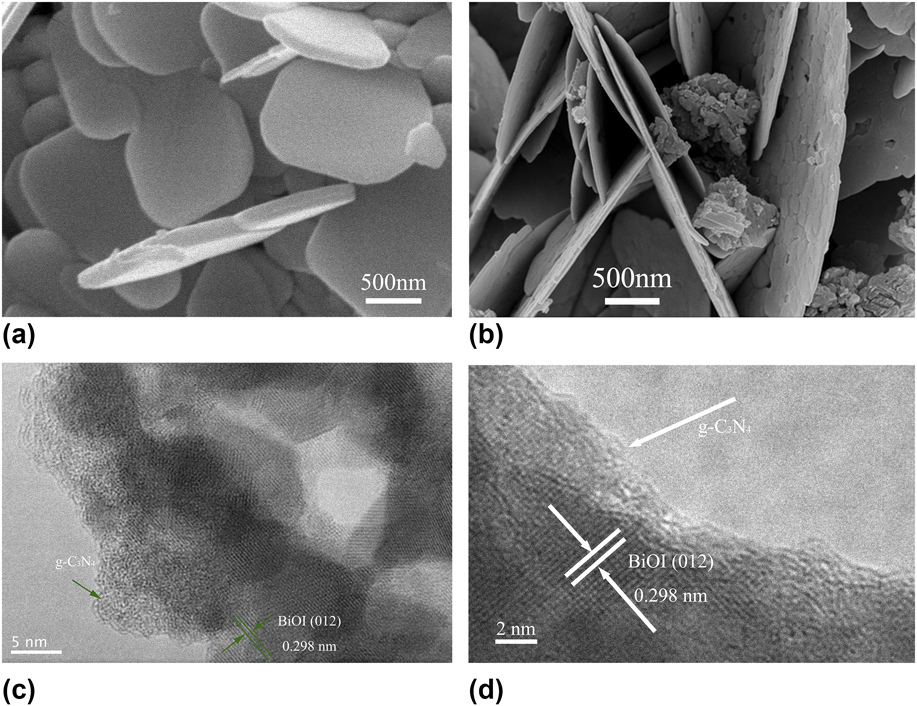
Figure 1 shows the morphology of pure BiOI and the FESEM image of the 4-g-C3N4/BiOI composite photocatalyst. In the low-magnification SEM image [Fig. 1(a)], it can be seen that the pure BiOI synthesized with the ultrasound-assisted hydrolysis method has a ball-like structure formed by irregular stacking of discs. The thickness of the nanosheet is about 30 nm and the average diameter is about 100–500 nm. Figure 1(b) displays the FESEM image of the 4-g-C3N4/BiOI photocatalyst. It is clearly observed that g-C3N4 is successfully anchored on the surface of sheet-like BiOI, and the g-C3N4 sheets are spread over different parts of the highly crystalline BiOI, suggesting the efficient bonding between g-C3N4 and the BiOI nanosheet. Moreover, the loaded g-C3N4 kept its layered structure as well.
(a) SEM image of pure BiOI; (b) FESEM image of 4-g-C3N4/BiOI; (c-d) HRTEM image of 4-g-C3N4/BiOI.

The HRTEM image of the 4-g-C3N4/BiOI composite material is shown in Figs. 1(c) and 1(d). It can further confirm the formation of a heterojunction instead of a simple composite. On the edge of the microsphere structures [Fig. 1(c)], it can be seen that there are many small nanosheets on the surface of the microsphere structure. It can be assumed that the g-C3N4 sheets are distributed on the surface of the sheet-like BiOI material uniformly. Moreover, two HRTEM images of g-C3N4/BiOI at different magnifications clearly show the lattice fringes of the single-crystal nanosheet of BiOI, indicating its good crystallinity. The clear lattice fringe with an interval of 0.298 nm could be indexed to the (012) lattice plane of tetragonal BiOI. The edge-curled topography of the nanosheets is the g-C3N4 sheet as can be seen from Fig. 1(c), and the phase interface of g-C3N4 sheets and the sheet-like nanostructure of BiOI are apparently shown in Fig. 1(d). These could also be regarded as a proof for the chemical combination between the g-C3N4/BiOI composites.
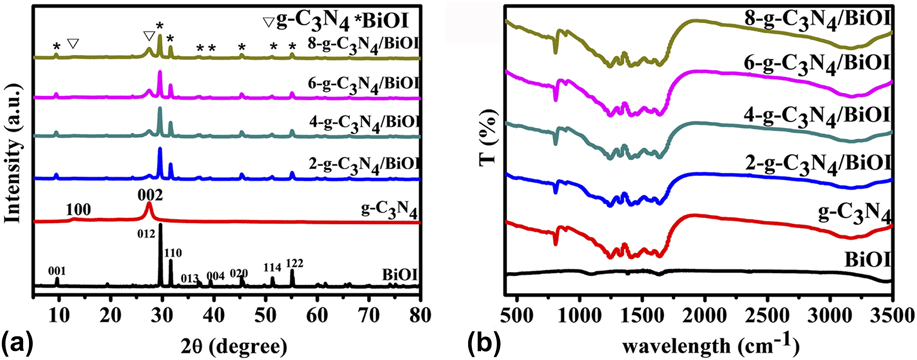
The lattice information of the photocatalysts which was detected by XRD analysis exhibits, including phase composition, purity, and crystallinity. The XRD patterns of the pure BiOI, pure g-C3N4, and the g-C3N4/BiOI composite photocatalysts with different mass ratios of g-C3N4 to BiOI are shown in Fig. 2(a). The peaks of samples at 9.68°, 29.74°, 31.74°, 37.15°, 39.46°, 45.49°, 51.49°, and 55.30° correspond to (001), (012), (110), (013), (004), (020), (114), and (122) crystal plane of BiOI, respectively. The pure BiOI diffraction peaks coincide with the standard card (JCPDS No. 73-2062), which indicates the high purity of the nanomaterial, and the structure of the BiOI is tetragonal phase. Meanwhile, it can be seen that g-C3N4 displays two distinct diffraction peaks at 13.1° and 27.4°, corresponding to the (100) and (002) plane (JCPDS No. 87-1526) of g-C3N4, respectively. The well-crystallized BiOI sample synthesized via the ultrasound-assisted hydrolysis method owns sharp diffraction peaks. In contrast, the peaks of g-C3N4 were broader and less sharp, which may be owing to the smaller crystal size. It is observed that the characteristic diffraction peaks of BiOI and g-C3N4 phases coexist in the g-C3N4/BiOI heterojunctions, which suggested the existence of BiOI and g-C3N4. There are no other impurity peaks being detected, indicating that no other impurity species were formed between BiOI and g-C3N4. In addition, with the increase of melamine weight in the g-C3N4/BiOI composites, the peaks of BiOI at 29.74° and 31.74°, which are classified as the main peaks of the BiOI, become weaker; however, the characteristic diffraction peaks of g-C3N4 at 27.4° is stronger gradually, proving that the mass ratio of m(g-C3N4)/m(BiOI) has an obvious influence on the crystal form of the g-C3N4/BiOI heterostructure.
(a) XRD patterns of the samples; (b) the FT-IR spectrum of the samples.
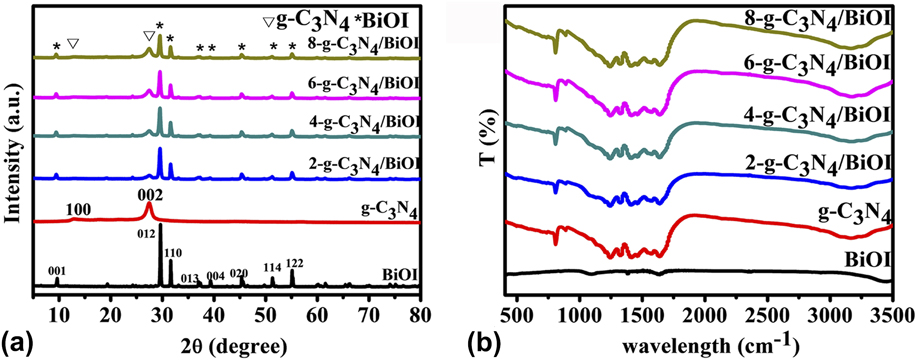
The FT-IR spectra of pure BiOI, g-C3N4/BiOI, and pure g-C3N4 are demonstrated in Fig. 2(b) to investigate their compositions and structures. The results of the FT-IR analysis show that the absorption peaks on the spectrum of pure BiOI are not apparent and the absorption peak at about 500 cm−1 belongs to the typical stretching modes of Bi–O, this is consistent with the published results, and the peak can also be observed in the spectrums of g-C3N4/BiOI composite materials. The absorption at 772 cm−1 was assigned to the asymmetrical stretching vibration of the Bi–O bond. In addition, the presence of the sharp and strong absorption at 1640 cm−1 and a broad peak at 3400–3500 cm−1 are attributed to the δ(O–H) bending vibration and ν(O–H) stretching, respectively, due to the adsorption of free water molecules on the surface of the photocatalyst BiOI.
For pure g-C3N4, the typical absorption peak at 808 cm−1 was attributed to the breathing mode of the triazine ring, which is in accordance with the previous studies. Strong absorption bands are clearly apparent in the 1200–1650 cm−1 region, which are due to the typical stretching modes of g-C3N4 heterocycles. The absorption bands between 3000 and 3500 cm−1 correspond to the H2O molecules absorbed by g-C3N4 or the stretching mode of terminal NH groups at the defect sites of the aromatic ring. After the hybridization of g-C3N4 and BiOI, the characteristic absorption peaks of g-C3N4 and BiOI can be observed in the composite samples, and the intensity of these peaks increased gradually with the increase of the g-C3N4 content from 2 to 8 g, indicating the successful incorporation of g-C3N4 in the g-C3N4/BiOI composites.
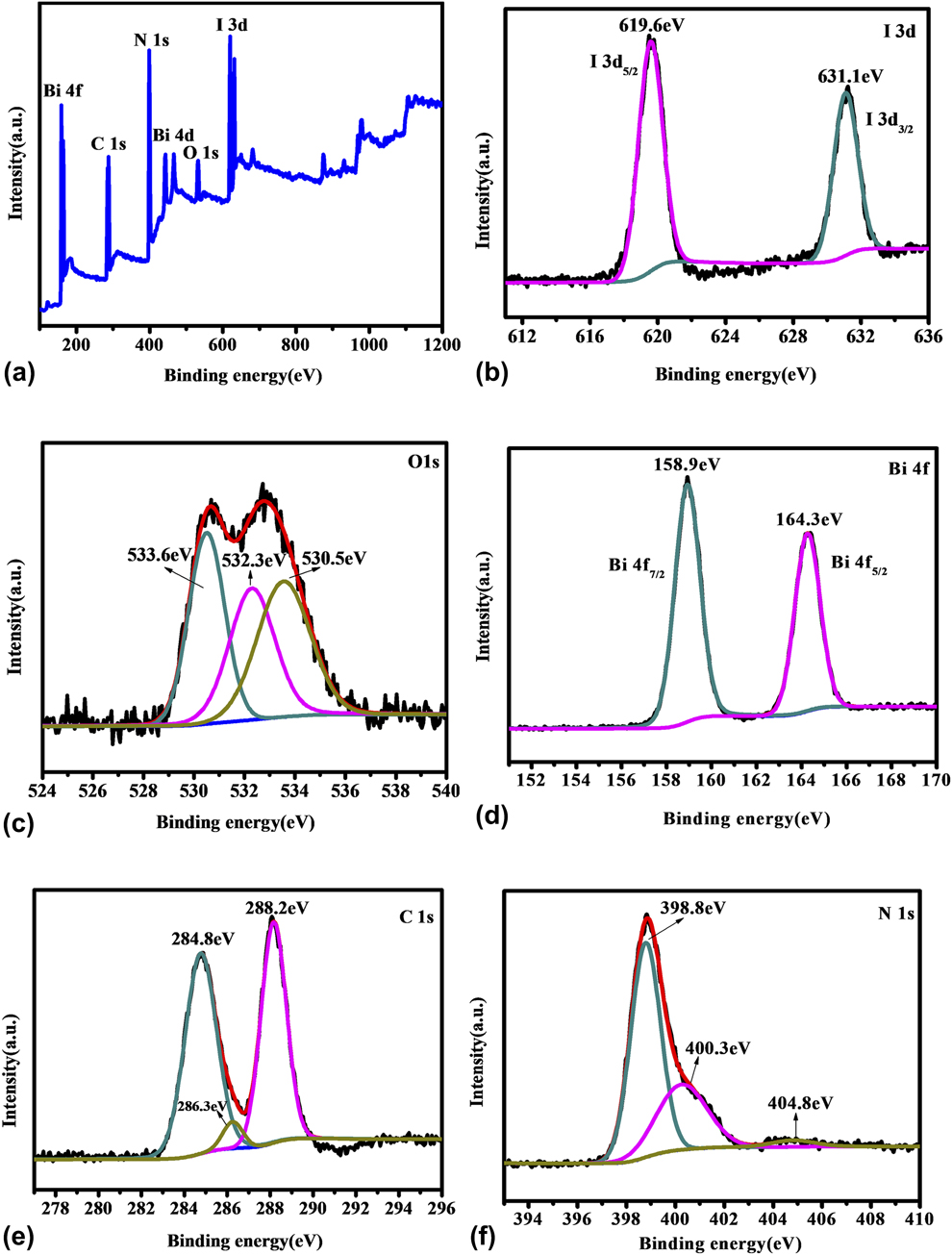
To further elucidate the interaction between g-C3N4 and BiOI, we conducted an XPS analysis to investigate the compositions and the chemical states for the g-C3N4/BiOI composite. The XPS spectra of C 1s and N 1s for g-C3N4/BiOI composites, as well as the O 1s, Bi 4f, and I 3d spectra for the composites were analyzed, and the results were presented in Fig. 3. Figure 3(a) shows the spectrum of the as-prepared 4-g-C3N4-BiOI photocatalyst which contains five elements: Bi, O, I, N, and C, and no other peaks were detected. I 3d XPS spectra of the composite is shown in Fig. 3(b). The two strong peaks at 619.6 eV and 631.1 eV are ascribed to I 3d 5/2 and I 3d 3/2 of I 3d, respectively, and indicated that the main chemical state of I in the sample is −1 in BiOI. Reference Song, Feng, Shi and Liu11 The O 1s spectra [Fig. 3(c)] consisted of three components: the peak at 530.5 eV was attributed to the Bi–O bonds in [Bi2O2] slabs of BiOI and the peak at 532.3 eV originated from the I–O bonds in BiOI, which shifted toward high energy after hybridizing with g-C3N4; whereas, the peak at 533.6 eV suggests the presence of other components such as OH, H2O, and O2 adsorbed on the surface. The two strong peaks in Fig. 3(d) at 158.9 eV and 164.3 eV corresponding to the Bi 4f transitions are respectively attributed to the binding energies of (Bi 4f 7/2) and (Bi 4f 5/2) of Bi3+, revealing the main chemical state of Bi in the material and also indicating that the valence state of Bi in the material is +3. Reference Song, Fan, Hu, Chen, Wang and Shi31 Figure 3(e) shows a high-resolution XPS spectrum of C 1s. The peak indicates the link between the carbon atoms and nitrogen atoms in the g-C3N4. Reference Masih, Ma and Rohani32 The component at 284.8 eV corresponded to C–C, which originated from pure graphitic carbon presumably formed during minor decomposition of carbon nitride. The other peaks were attributed to C=N or C≡N originating from the defect-containing sp 2-hybridized carbon atoms present in graphitic domains and the sp 2-hybridized carbon in N=C–N2 coordination, which connected with three neighboring N atoms in one double and two single bonds, respectively. The XPS of N 1s [Fig. 3(f)] in the composite could be separated into three binding energies. Except for the predominant characteristic peak at 398.8 eV, the peak at 400.3 eV was ascribed to the tertiary nitrogen N–(C)3 groups while the last peak at 404.8 eV might have resulted from π-excitation. Reference Zhou, Shen, Li, Liu, Liu and Zhang33 These results also imply that the heterojunction exists between g-C3N4 and BiOI, not a simply physical adsorption. This interaction is essential for the photogenerated charge carrier transfer and enhancing the photocatalytic performance.
(a) Survey spectrum of the as-prepared 4-g-C3N4-BiOI; (b) high-resolution XPS spectrum of I; (c) high-resolution XPS spectrum of O; (d) high-resolution XPS spectrum of Bi; (e) high-resolution XPS spectrum of C; (f) high-resolution XPS spectrum of N.

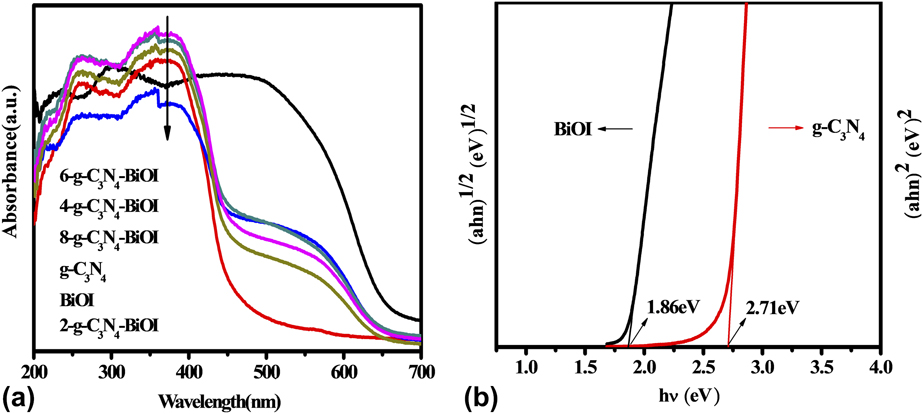
As shown in Fig. 4, the optical absorption properties of the photocatalytic materials are analyzed by UV-vis spectrometer. It can be observed obviously that the absorbance of pure BiOI to visible light is much stronger than that of pure g-C3N4 in the visible region. The visible light absorption of the g-C3N4/BiOI composite photocatalytic materials at the wave length range of 400–650 nm becomes stronger after complexing with BiOI. When the content of g-C3N4 increased, the absorption in the visible region has been enhanced, which is favorable for the formation of more photogenerated carriers, and thus the photocatalytic activity will be improved. The band gap energy has a great influence on the semiconductor photoexcitation. The band gap energy of the as-prepared semiconductor can be obtained by the following Kubelka–Munk function:
 $$\alpha h\nu = A{\left( {h\nu - {E_{\rm{g}}}} \right)^{n{\rm{/}}2}}\quad ,$$
where α, h, ν, A, and E g are absorption coefficient, Planck constant, light frequency, proportional constant and band gap energy, respectively; The value of the index n denotes the properties of the transition (n = 1 and n = 4 are respectively for a direct transition and an indirect transition). For the as-prepared samples BiOI and g-C3N4, the value of n is 4 and 1, respectively. The band gaps of BiOI and g-C3N4 are 1.86 eV and 2.71 eV, respectively. The calculation results are practically the same as previous reports, which can be obtained from Figs. 4(a) and 4(b).
(a) UV-vis diffuse reflectance spectra of the samples; (b) plots of (αhν)2 versus the photon energy.

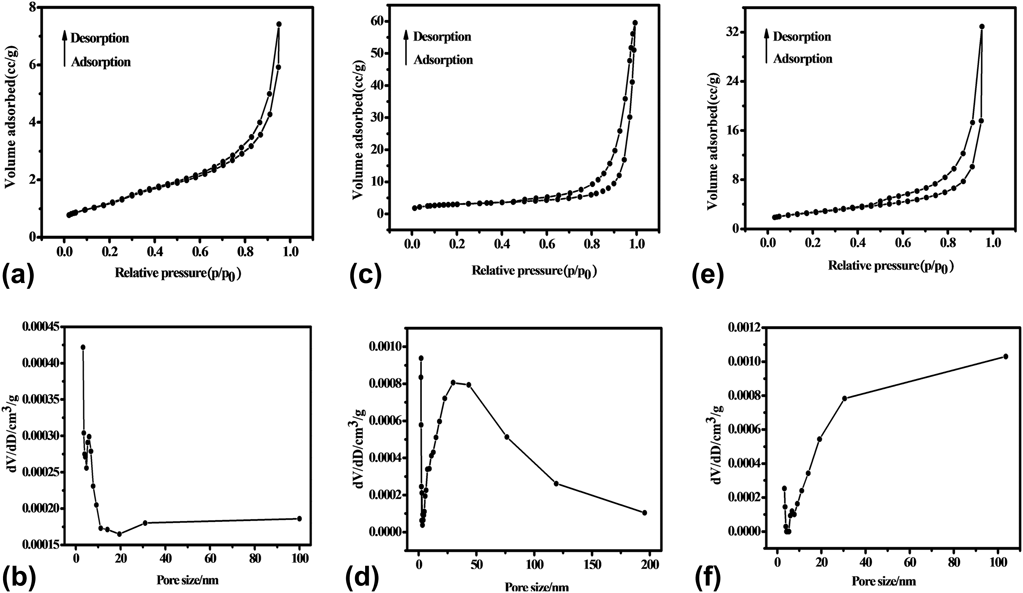
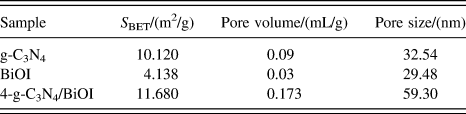
The specific surface area and pore structure of the samples g-C3N4, BiOI, and 4-g-C3N4/BiOI were tested by N2 adsorption–desorption isotherms, as shown in Fig. 5. It can be seen from the figure that the desorption isotherms of the sample are all above the adsorption isotherm with a hysteresis loop observed in the range of 0.60–1.00 P/P 0, which is related to the shape and size of the sample hole, suggesting their mesoporous structures. Table I shows the specific surface area and pore volume of the samples g-C3N4, BiOI, and 4-g-C3N4/BiOI. It can be seen from the table that the specific surface area of the composite photocatalyst 4-g-C3N4/BiOI is larger than that of the single g-C3N4 and BiOI, which may be due to the partial stripping of the bulk g-C3N4 into the dispersed fragments. The pore volume of sample 4-g-C3N4/BiOI is 0.173 mL/g, which is much larger than that of single g-C3N4 (0.09 mL/g) and BiOI (0.03 mL/g), which may be caused by the accumulation of BiOI nanoparticles in the g-C3N4 fragment surface. In addition, the pore size distribution in Fig. 5 shows that the pores of the measured samples were mainly distributed in the range of 0–50 nm, agreeing with the mesoporous structure.
Nitrogen adsorption–desorption isotherms and pore size distributions of the BiOI (a), (b); g-C3N4 (c), (d); 4-g-C3N4/BiOI (e), (f).

Surface area, pore volume, and average pore size of the g-C3N4, BiOI, and g-C3N4/BiOI composite.

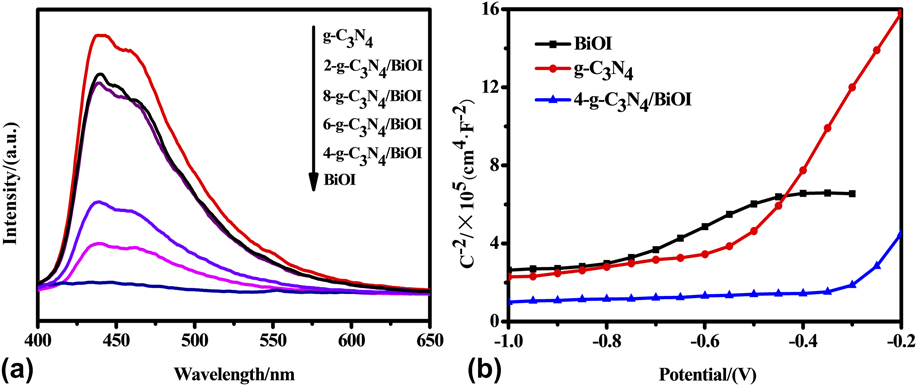
For the photocatalyst, the electron–hole separation efficiency of the material is one of the important factors affecting the photocatalytic ability of the photocatalyst. Only separated photogenerated electrons and holes can participate in redox reactions. The photocatalytic behavior of photocatalyst was studied by fluorescence photoluminescence spectroscopy. It can be seen from the PL spectrum of Fig. 6(a) that the composite photocatalyst samples showed similar curves to g-C3N4, and the peak intensity was related to the content of g-C3N4 in the samples. It can be seen that the PL intensity of the sample depends mainly on the recombination of electrons–holes in g-C3N4. The pure g-C3N4 has a strong emission peak at 445 nm, indicating that the photogenerated electron–hole recombination rate is high, and the intensity of the emission peak is obviously decreased when g-C3N4 and BiOI composited. The results show that the recombination probability of photogenerated electrons and holes in the composites is lower than that of pure g-C3N4 nanosheets. Among which, 4-g-C3N4/BiOI exhibited the lowest fluorescence intensity, indicating that the carrier had the lowest recombination probability. The recombination rate is further reduced, which is beneficial to improve the photocatalytic activity of the material.
(a) Transient PL spectrum for the pure g-C3N4, BiOI, and the g-C3N4/BiOI composite; (b) Mott–Schottky plots of the nanoporous samples g-C3N4, BiOI, and 4-g-C3N4/BiOI.

Mott–Schottky measurements were used to further elucidate changes in the electronic properties of the prepared nanomaterials. Figure 6(b) shows the Mott–Schottky curves of the samples g-C3N4, BiOI, and 4-g-C3N4/BiOI. It can be seen that the Mott–Schottky curves all have a linear portion with a positive slope, indicating that the catalyst has an n-type semiconductor property in this potential interval. The charge carrier density is inversely proportional to the linear partial slope of the Mott–schottky curve. It can be seen from the figure that the slope of the linear part of the Mott–Schottky curve of the composite catalyst 4-g-C3N4/BiOI is the smallest, compared to the pure g-C3N4 and BiOI; that is to say, the effective electron concentration of the composite is the largest. The reason is that the band structure of semiconductor BiOI and g-C3N4 is different, formatting the heterojunction after complexing, which can effectively promote the separation of the photogenerated charge and reduce the recombination probability.
B. Photocatalytic activity
MC-LR is the strongest liver tumor cancerogen, with a cyclic peptide structure. Removal of MC-LR is a challenging work for environmentalists. Photocatalysis is a promising technology for the removal of MC-LR in water purification. Therefore, it is important to study the photocatalytic activity of the visible-light-responsive photocatalyst g-C3N4/BiOI.
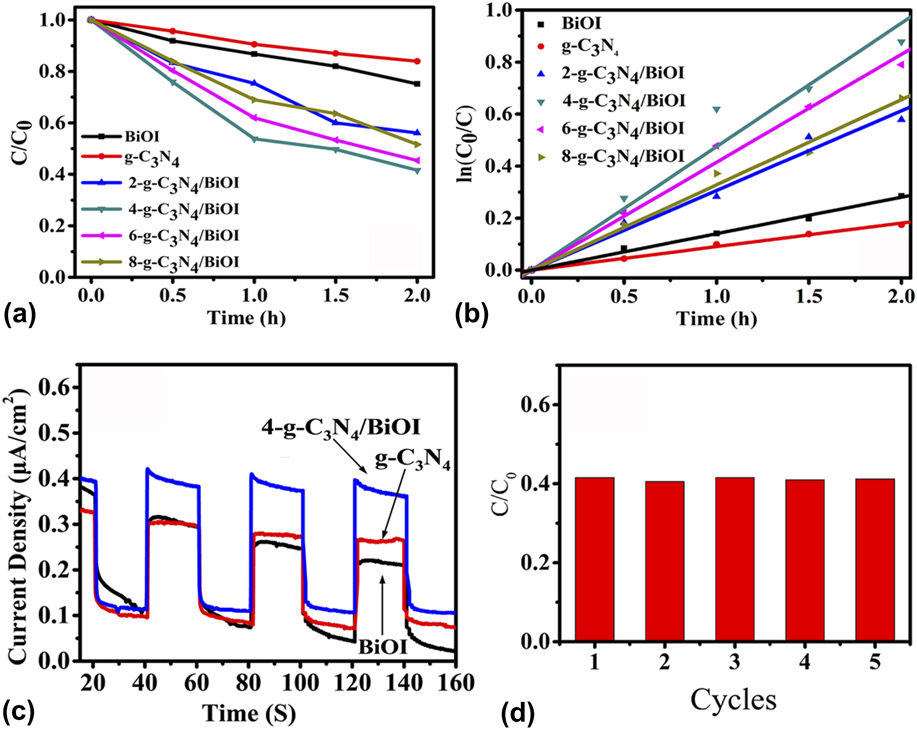
The MC-LR is degraded under visible light, and the removal and degradation rates (K) of different as-prepared samples are displayed in Figs. 7(a) and 7(b). The test is operated under the same experimental conditions as well to make a comparison. After 120 min of visible light irradiation, the removal rates of MC-LR are about 25.4%, 16.1%, 43.9%, 60.5%, 54.4%, and 48.5% for the sample of BiOI, g-C3N4, 2-g-C3N4/BiOI, 4-g-C3N4/BiOI, 6-g-C3N4/BiOI, 8-g-C3N4/BiOI, respectively. The photocatalytic activity of g-C3N4/BiOI heterojunctions exhibits an efficient improvement compared with g-C3N4 and BiOI. In addition, with the increase of the melamine component in the composites, the activity of g-C3N4/BiOI heterojunction nanocomposites is also increased, and when 4 g melamine is added in the composite catalysts, the optimal photocatalytic activity is achieved, at which 60.5% of MC-LR is removed. It indicates that the weight ratio between g-C3N4 and BiOI in 4-g-C3N4/BiOI is the best for the separation of photoinduced holes and electrons. However, the photocatalytic activity is weakened when the adding dosage of melamine exceeds 4 g, and this probably resulted from the excessive trapping sites caused by the increased g-C3N4 amount in the g-C3N4/BiOI composite which promoted the recombination of photoinduced electrons and holes. The ratio of g-C3N4 and BiOI in 4-g-C3N4/BiOI is the best one among the as-prepared samples, which owns the most efficient photoinduced carrier mobility. While the ratio of g-C3N4 and BiOI is increasing or decreasing, the carrier mobility would be decreasing. To quantify the photocatalytic abilities of these samples and analyze the reaction kinetics of the MC-LR degradation, the apparent pseudo-first-order model was investigated. ln(C 0/C) = Kt is applied, where K is the rate constant and t is the irradiation time. The photocatalytic degradation kinetics of MC-LR was tested and the results were shown in Fig. 7(b). And, the photodegradation of MC-LR by each of the samples fits to the pseudo first-order kinetics well (R 2 > 0.90). As is shown in Fig. 7(b), the rate constants (K) of the sample BiOI, g-C3N4, and g-C3N4/BiOI heterojunction composition (2-g-C3N4/BiOI, 4-g-C3N4/BiOI, 6-g-C3N4/BiOI, 8-g-C3N4/BiOI) degradation kinetics of MC-LR are 0.1371, 0.0888, 0.2973, 0.4357, 0.3982, 0.3201 h−1, respectively. The g-C3N4/BiOI heterostructure exhibits a much higher photocatalytic activity than pure BiOI and pure g-C3N4 sample under visible-light irradiation, indicating that the heterojunction degradation rates of MC-LR are much faster than those of BiOI and g-C3N4. In addition, the K of 4-g-C3N4/BiOI, which is more than 3 times as fast as the BiOI and nearly 5 times as fast as the g-C3N4, is the largest of all the photocatalysts. It indicates that the weight ratio between g-C3N4 and BiOI in 4-g-C3N4/BiOI is the best for the separation of photoinduced holes and electrons. In conclusion, the removal of MC-LR by the composite photocatalyst g-C3N4/BiOI proves that the visible-light-responsive photocatalyst g-C3N4/BiOI is of great value and can be considered to be applied in the degradation of pollutants widely.
(a) The photocatalytic degradation rates for MC-LR under visible light irradiation with different samples; (b) the degradation kinetics of MC-LR under visible light irradiation with different samples; (c) transient photocurrent response for the pure g-C3N4, BiOI, and 4-g-C3N4/BiOI composite; (d) the degradation efficiency of the 4-g-C3N4/BiOI heterostructure with an increasing number of catalytic cycles.

C. Photocurrent-time and stability analysis
In general, a higher photocurrent would mean the presence of longer-living photogenerated carriers and higher separation of the electron hole. To further study the transmission process of the electron and the photocurrent of BiOI, g-C3N4 and 4-g-C3N4/BiOI under visible light were measured, as can be seen from Fig. 7(c). When the lamp turns on, the photocurrent increased sharply, reaching a stable value. On the contrary, when turning off the light, the photocurrent rapidly decreased to the initial condition. As can be seen from the pattern, the photocurrent intensity of 4-g-C3N4/BiOI was both higher than that of pure BiOI and g-C3N4. Based on the research, the g-C3N4/BiOI heterojunction is beneficial for the separation efficiency of electrons and holes, with a higher photocatalytic activity.
The stability of the photocatalyst is of paramount importance for practical applications since it can promote an important reduction in the operational cost of the photocatalytic process, thus it is foreseeable to make the application of photocatalysis in MC-LR removal. The recycle experiments of g-C3N4/BiOI for the photocatalytic reaction under simulated solar light were investigated to evaluate the optical stability of the catalyst. After 5 recycling runs, there was no obvious change in the photocatalytic degradation efficiency of MC-LR by 4-g-C3N4/BiOI, as is shown in Fig. 7(d). The results indicate that g-C3N4/BiOI did not exhibit a significant loss of photocatalytic performance and keeps its photocatalytic performance without distinct photo corrosion during the oxidation of MC-LR. These results suggest that the composite displays very good stability and could be reused as a photocatalyst.
D. Mechanism of photocatalytic activity enhancement
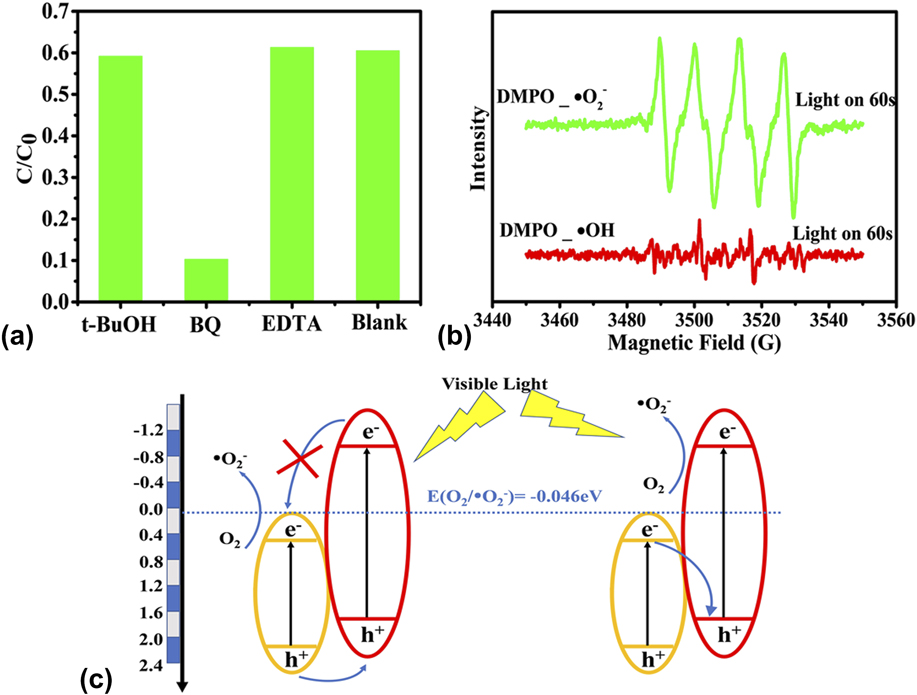
As we all know, photodegradation of organic pollutants by a semiconductor is usually completed by hydroxyl radicals (˙OH), active holes (h+), and the superoxide radicals (˙O2 −) generated. Reference Zhang, Zhang, Chen, Lin, Mohlmann, Dolega, Lipner, Antonietti, Blechert and Wang34 For the better application of the g-C3N4/BiOI photocatalyst in the photocatalytic degradation of pollutants, it is essential to understand the mechanism of MC-LR removal under visible light irradiation. Thus, to investigate the photocatalytic mechanism, various scavengers (EDTA-2Na for holes, tertiary butanol (t-BuOH) for ˙OH and BQ (p-benzoquinone) for ˙O2 −) are added into the photocatalytic degradation of MC-LR by 4-g-C3N4/BiOI. Reference Ma, Cao, Jaroniec and Qiao35 As can be seen from Fig. 8(a), the addition of BQ makes the removal efficiency of MC-LR decrease evidently, which shows that ˙O2 − plays an important role in the photocatalytic degradation of MC-LR and it is the main active species. While t-BuOH is added, the photodegradation efficiency of MC-LR changes inconspicuously. However, while adding the EDTA, the degradation efficiency increases a little. The enhancement of photocatalytic activity may result from the quenching of h+, which hinders the recombination of photogenerated electron–hole pairs. Therefore, ˙O2 − plays a main role in the photocatalytic degradation system.
(a) Scavenger experiments; (b) ESR detection; (c) schematic diagram of the separation and transfer of photogenerated charges in the g-C3N4/BiOI heterojunction under visible light irradiation.

The ESR signal reveals the evidence of these phenomenons [Fig. 8(b)]. In these ESR tests, 10 mg photocatalysts and 50 μL DMPO are dissolved in 0.5 mL deionized water and stirred for 10 min to detect the hydroxyl radicals (DMPO-˙OH). To detect the superoxide radicals (DMPO-˙O2 −), the same substances are added in 0.5 mL CH3OH and stirred for the same time. Before the irradiation, there is no characteristic peak of radicals. After irradiating for 60 s, the characteristic peak intensity of ˙O2 − is much stronger, compared with ˙OH. Reference Ferrighi, Datteo, Fazio and Di Valentin36 This phenomenon reveals that the active species is ˙O2 − and although the ˙OH plays a part in improving the photocatalytic efficiency, it is not the main active species. The results are in good consistency with the consequence of the radical experiments.
The enhancement of the photodegradation efficiency of the g-C3N4/BOI composites compared to the pure BiOI photocatalyst can be ascribed to the appropriate band structure. The band edge potentials of the conduction band (CB) and VB of BiOI and g-C3N4, designated as E CB and E VB, are calculated by the following equations Reference Amador and Yoon37 :
 $${E_{{\rm{VB}}}} = X - {E_{\rm{e}}} + 0.5{E_{\rm{g}}}\quad ,$$
 $${E_{{\rm{CB}}}} = {E_{{\rm{VB}}}} - {E_{\rm{g}}}\quad .$$
In the empirical formulas, E CB is the CB edge potential of the semiconductor, E VB is the VB edge potential of the semiconductor, X is the absolute electronegativity of the semiconductor, and the values of BiOI and g-C3N4 are calculated to be 5.94 and 4.765 eV, respectively. Reference Nasilowski, Mahler, Lhuillier, Ithurria and Dubertret38 E e is the energy of free electrons (about 4.5 eV) and E g is the band gap energy of the semiconductor. The E VB of BiOI and g-C3N4 was calculated to be 2.34 and 1.62 eV, respectively. Thus, the E CB of BiOI and g-C3N4 was estimated to be 0.54 and −1.09 eV, respectively.
The probable mechanism of photocatalytic activity was put forward on the basis of radical scavenger experiments and band energy level analysis above, as can be seen from Fig. 8(c). Under the visible light irradiation, both g-C3N4 and BiOI could be excited. The CB of BiOI was negative for g-C3N4. On the purpose of revealing the reaction mechanism more exactly, the following certificate was made. If the e− in the g-C3N4 CB transferred to the BiOI CB, the BiOI VB adsorbed O2 and cannot generate reactive radicals ˙O2 − [for the E(e−) of BiOI was more negative than the standard oxidation-reduction potentials of E(O2/˙O2 −) = −0.046 eV versus NHE]. Reference Ong, Tan, Ng, Yong and Chai39 However, the scavenger experiments revealed that ˙O2 − played an important role in the g-C3N4/BiOI systems. In addition, the CB of BiOI (0.54 eV) was closer to the VB of g-C3N4, compared with the CB of g-C3N4, the composite preferred a similar direct Z-scheme mechanism. In this way, the photogenerated electrons in the CB of BiOI were transfered to the VB of g-C3N4 at a high speed; the result was that the degradation ability of g-C3N4/BiOI to MC-LR improves significantly. Thus, according to the direct Z-scheme charge-carrier transfer process, the photogenerated electrons in the CB of g-C3N4 were easier to transfer to the VB of g-C3N4 and recombined with the photogenerated holes. In this way, the E(e−) in the VB of BiOI can be transferred to the CB of g-C3N4 and can adsorb O2 to generate reactive radicals ˙O2 − to oxidative MC-LR. What is more, the VB of BiOI (E VB = 2.34 eV) was more positive than that of E 0(˙OH/OH−) = 1.99 eV Reference Li, Cai, Shang, Yu and Zhang40 ; however, there are very few ˙OH radicals detected. Therefore, the conclusion was that the g-C3N4/BiOI system may consist of a direct Z-scheme mechanism, which could promote the separation of photogenerated carriers, and the ability of the degradating MC-LR was also improved correspondingly.
IV. CONCLUSIONS
A series of visible-light-responsive g-C3N4/BiOI microsphere photocatalysts, for MC-LR removal, have been synthesized successfully by the solid calcination method. The layered g-C3N4 anchors on the surface of BiOI microspheres. The samples are characterized by FESEM, HRTEM, XRD, FT-IR, UV-vis spectroscopy, XPS, BET, PL, and Mott–Sckottky. The photocatalytic activity of the as-prepared samples is tested by the degradation of MC-LR under visible light irradiation. The optimized rate constant of MC-LR degradation is of 0.605, which is achieved by 4-g-C3N4/BiOI. The results indicate that the photocatalytic activities of the composites are normally higher than those of pure g-C3N4 and BiOI. It indicates that the heterojunction between BiOI and g-C3N4 is constructed well. The probable photocatalytic mechanism of g-C3N4/BiOI is put forward based on radical scavenger experiments, ESR detection, and the relative band positions of these two semiconductors. The ˙O2 − plays a key role in the MC-LR photocatalytic removal.
ACKNOWLEDGMENTS
The authors are grateful for national natural Science Foundation of China (Nos. 51308078, 21477050, and 21607017), Natural Science Foundation of Jiangsu Province, China (No. BK20130252), International Scientific and Technological Cooperation in Changzhou (CZ20140017).