INTRODUCTION
Knowledge acquisition is the process of extracting, structuring and organizing knowledge from one source, usually human experts. It typically refers to the process of acquiring, processing, understanding and recalling information through one of a number of methods. Knowledge acquisition details how people experience new information, how that information is stored in the brain and how that information can be recalled for later use (Wiesen, Reference Wiesen2014). Knowledge acquisition and learning are treated as synonymous terms, both referring to a process of gaining knowledge or skill by studying, practicing, being taught or experiencing something (Kuhn et al., Reference Kuhn, Garcia-Mila, Zohar, Andersen, White, Klahr and Carver1995).
Information and knowledge are vital in agricultural development for any community. In sub-Saharan Africa, agriculture is the most important sector of the economy, because it is the main source of vital food and employment. The role of knowledge and information transfer in rural and agricultural development is widely recognized and stressed in regional development policies (Obidike, Reference Obidike2011). Education and training are two of the most powerful weapons in the fight against rural poverty and for rural development. Unfortunately, these are also among the most neglected aspects of rural development interventions by national governments and by donors (Atchoarena and Gasperini, Reference Atchoarena and Gasperini2003). In sub-Saharan Africa, many rural farmers do not have access to timely and up-to-date knowledge and information which would enable them to achieve optimal yield from their farmlands (Obidike, Reference Obidike2011). Improving farmers’ knowledge of new techniques and technologies, in addition to providing them with any physical resources necessary for implementation, can dramatically increase their level of productivity (Rosegrant and Cline, Reference Rosegrant and Cline2003).
Sources of information are important in the acquisition of knowledge. In sub-Saharan Africa, rural farmers are generally illiterate and relatively remote from formal sources of information such as extension stations and libraries (Van Crowder and Fortier, Reference Van Crowder and Fortier2000). Extension systems have undergone a deep restructuring, transformed by the trend towards liberalization, with non-governmental organizations (NGOs) and the private sector redefining their roles to fill certain niches.
Despite this, in many rural settings women do not benefit as much as men from extension programmes for farmers (Katungi et al., Reference Katungi, Edmeades and Smale2008). Moreover, women are limited by social norms in communicating with men outside their families. In these cases, extensionists can act as interlocutors. To truly speak on behalf of women, these interlocutors need to be women (World Bank, 2008), but the majority of staff within advisory services are men and rural development interventions are male-biased (Katungi et al., Reference Katungi, Edmeades and Smale2008). This article explores the gender gap in agricultural knowledge acquisition in relation to sources of information and the use of the acquired knowledge in rice farming in West Africa.
MATERIALS AND METHODS
Data collection
The study used Africa Rice Center (AfricaRice) baseline data collected in 2013 and 2014 in rice-sector development hubs in Africa. These hubs are zones where rice research products are integrated across the rice value chain to achieve development outcomes and impact. In the hubs, AfricaRice and national scientists will introduce, evaluate and validate new rice technologies, and work with development partners to facilitate the training of farmers, dissemination of technologies and establishment of linkages among actors along the rice value chain. Hubs were selected based on rice growing environment (agro-ecosystem). One hub with major agro-ecosystem was selected per country: irrigated agro-ecosystem in Niger and lowland rainfed agro-ecosystem in Benin, Côte d'Ivoire, Nigeria and Togo.
A stratified random sampling technique was used to select interviewed actors. For village sampling, the stratifying criteria were: (1) rice growing environment (agro-ecosystem), (2) village accessibility and (3) dominant crop. Accessibility in this context is related to road condition to access the village. Due to the high intensity of the field activities, villages with very limited access throughout the year were not selected. Sixteen villages were selected in each hub. A stratified random sampling was also done for households using rice activities and the gender of the household head as selection criteria. A list of all households in each village was made. Ten households were randomly selected from each of the 16 villages with adjustments to include at least 30% of the minority gender. In total, 160 rice-farming households were selected from each hub.
Data collection was automated using tablets and a web-based application that sends collected data to a central database managed by AfricaRice with online access by the national agricultural research system (NARS) partners. The computer-based data collection avoided many biases associated with paper-based questionnaires, such as mistakes in answer recording, changing of values of variables, recoding test answers for numerical variables.
Data processing and analysis
The data used concerned socio-economic and demographic characteristics, rice production, knowledge and use of rice farming techniques and equipment, relationship with farmer organizations, national and international agricultural research and extension services, access to information, etc. Data were processed with STATA 13.1. Considering the level of data collection in the hubs, we focused analysis on five countries (Benin, Côte d'Ivoire, Niger, Nigeria and Togo). The only criterion for the selection of these households was the availability of data required for the study. Some variables in the database needed for the analysis in this paper have missing data and this reduces the sample size from 640 to 499 households. Missing data were due to the fact that data were collected in many rounds and during the last rounds some households have left the villages or could not be met.
We focussed analysis on four main rice farming activities: land clearing, ploughing, crop establishment and weed management. A list of 15 methods related to these pre-harvest activities was presented to households to collect data on their level of knowledge, use and the sources of information on the known methods. These 15 methods were identified during the exploratory phase and a literature search on pre-harvest rice cultivation activities. They were: burning, mulching, uprooting, removing of weeds from the field, weeding, in-line ploughing, level ploughing, weed incorporation into the soil, broadcast sowing, sowing in rows, straight-row sowing, sowing in holes, manual weeding, mechanical weeding and use of herbicide. Each surveyed household was asked if they knew each method. So each household has a score out of 15: the number of methods presented to them that they knew about. In this study, we refer to this as the knowledge level on the rice farming methods. The same procedure was used for the use of the methods, and the sources of knowledge of the methods.
The t-test was used with STATA 13.1 to determine differences between women and men in the whole sample in their: (1) socio-demographic characteristics, (2) access to sources of information and (3) levels of (i) knowledge and (ii) use of the surveyed methods. The t-test assesses whether the means of two groups are statistically different from each other. This analysis is appropriate to compare the means of two groups.
Because of the small size of samples at the country level, the Kruskal–Wallis test was used to determine differences between women and men in their: (1) access to sources of information and (2) levels of (i) knowledge and (ii) use of the surveyed methods. The Kruskal–Wallis test is a non-parametric test, alternative to one-way analysis of variance (ANOVA) and used with one nominal variable and one ranked variable. When working with a measurement variable, the Kruskal–Wallis test starts by substituting the rank in the overall data set for each measurement value. It tests whether the mean ranks are the same in all the groups.
RESULTS AND DISCUSSION
Gender differentiation in socio-demographic information
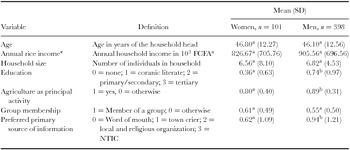
Table 1 shows some summary statistics of the socio-demographic characteristics of the sample. The surveyed household heads were on average 46 years old, both women and men. There was no gender gap for the average annual rice income (about US$ 1563 for households headed by women and US$ 1712 for households headed by men). These incomes were used to feed an average of seven individuals in both women- and men-headed households. There was a gender difference in the literacy rate with the t-test at 1%. The average illiteracy rate was about 71% for women and 58% for men (data not shown). This high illiteracy rate is consistent with UNESCO (2010), which showed that sub-Saharan Africa together with the southern Asia accounted for three-quarters (74%) of adults unable to read and write worldwide. Only 7% of female and 22% of male household heads had been educated to primary or secondary level. Considering these statistics, the goals of education for all to increase literacy levels to 50% and achieve gender equity in education by 2015 seem unlikely to be reached (Fink, Reference Fink2011).
Definition of variables and socio-economic profile of the surveyed households.

*The currency exchange rate was US$ 1 = 528.83 FCFA on 02 December 2014.
Note: Different superscript letters in the same line denote populations which are significantly different based on a t-test and a significance level of 5%.
n = sample size.
NTIC = New technologies of information and communication.
The large majority (about 82% of women and 90% of men) of the surveyed household heads were active in agriculture that provides them the majority of their incomes. This is similar to the finding of Staatz et al. (Reference Staatz, Dembélé and Mabiso2007) that showed that agriculture employed more than 50% of the population in sub-Saharan Africa (excluding South Africa). Sub-Saharan Africa's rural economy remains strongly based on agriculture relative to other world regions and the agricultural production systems are largely based on smallholder farms (Livingston et al., Reference Livingston, Schonberger and Delaney2011). However, we observed a weaker representation of women in agriculture as main activity compared to men with the t-test at 5%. This can be explained by the fact that in rural areas in West Africa, women are active in small trade which is clearly women's business (Fafchamps et al., Reference Fafchamps, Gabre-Madhin and Minten2005).
We observed a high membership of women and men in associations and this is consistent with Whitehouse (Reference Whitehouse2011), who showed that West Africans belong to social networks.
More women (73%) than men (59%) preferred word-of-mouth as the primary source of information. This is a communication strategy that can better reassure users and inspires confidence (Buttle, Reference Buttle1998).
Gender gap in access to sources of information and knowledge on rice farming technologies
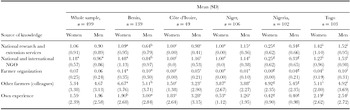
The sources of information and knowledge on rice farming technologies can be classified into three main categories: (1) formal sources including national research and extension services, and national and international NGOs; (2) informal sources including personal experiences and other farmers (colleagues); and (3) intermediary sources including farmer organizations that can be formal or informal according to their legal status. Based on the average number of times the agricultural information sources were quoted (Table 2), the main information and knowledge sources are in order of importance: (1) other farmers (average 4.80 across all respondents, cf. gender-disaggregated data in Table 2); (2) personal experiences (1.88); (3) national and international NGOs (1.01); (4) national research and extension services (0.93); and (5) farmer organizations (0.06). This high importance of colleagues in acquiring agricultural knowledge is confirmed by the high percentage of farmers that preferred the word-of-mouth from their peers as the primary source of information (Table 1). These findings reinforce the importance of other farmers in knowledge exchange and confirm the need of an effective participation of farmers in the technologies design and extension to attend any sustainable agriculture (Axinn, Reference Axinn, Scarborough, Killough, Johnson and Farrington1997; Zossou et al., Reference Zossou, Van Mele, Wanvoeke and Lebailly2012).
Average number of times the agricultural information sources were quoted in the acquisition of knowledge related to rice farming methods.

*There was a significantly difference between women and men only for national and international NGOs (according to t-test; significance level of 5%).
Note: Different superscripts within the same country and within the same source of knowledge denote populations which are significantly different based on Kruskal–Wallis test and a significance level of 5%.
n = number of households surveyed.
Gender gap in access to formal agricultural knowledge sources
There was a gap between women's and men's access to national and international NGOs with women being more advantaged (Table 2). At country level, we did not find any gap between women and men in their access to formal knowledge sources in Côte d'Ivoire, Niger, Nigeria and Togo. However, in Benin we observed a significant gap between women and men in their access both to national research and extension services and to national and international NGOs, with women having more access to these knowledge sources than men. These findings contradict previous studies which showed that in developing countries women have less access to rural development interventions and advisory services because the majority of staff within these services are men, and women are limited by social norms in communicating with men outside their families (Katungi et al., Reference Katungi, Edmeades and Smale2008; World Bank, 2008). The significant gap observed between women and men in their access to formal agricultural knowledge sources in Benin may have a bias on the result for the whole sample. One possible explanation for this gender gap in access to agricultural knowledge sources in Benin is that our analysis focused on men and women who are heads of their households. Culturally, in West Africa, the responsibility of the household returns to men who are considered as the ‘fathers of the households’. So, a woman who is a household head is either a divorcee or a widow. However, women are increasingly heading rural households in Africa due to male urban migration (Oxfam, 2008). It is supposed that these ‘non-married’ or ‘abandoned’ women have more freedom compared to a married woman and are less limited by social norms in communicating with men outside their families. Moreover, with the promotion of the gender approach in rural developing countries, more attention is given to women in development interventions. Indeed, the temporary headquarters of AfricaRice is located in Benin, the country where we noted greater access of women to formal knowledge sources. AfricaRice is a leading pan-African research organization with a mission to contribute to poverty alleviation and food security in Africa through research, development and partnership activities. With the presence of AfricaRice in Benin, a lot of research and development actions are carried out in the rice sector in the rural areas. With the promotion of the gender approach, women in Benin may benefit more from these interventions than men. The non-existence of a significant gender gap in rice farmers’ access to formal agricultural knowledge sources in Côte d'Ivoire, Niger, Nigeria and Togo may also be due to the positive impact of the promotion of a gender approach in development programmes in these countries.
Gender gap in access to informal agricultural knowledge sources
Across the whole sample, we did not observe any gender gap in access of rice farmers to informal agricultural knowledge sources. The same result was observed in Côte d'Ivoire, Niger, Nigeria and Togo. However, in Benin, we observed that women were more in relation with their colleagues to acquire information and knowledge on rice farming than men. This is consistent with Westermann et al. (Reference Westermann, Ashby and Pretty2005) who found that collaboration, solidarity and conflict resolution all increase when women are present. In addition, norms of reciprocity are more likely to operate in women's and mixed groups. Similarly, the capacity for self-sustaining collective action increased with women's presence and was significantly higher in women's groups.
Finally, for farmers’ own experience, we noted a gap between women and men in their access to rice farming knowledge in Benin, with men well above women. This suggests that women may have an aversion to risk in experimenting for the first time new technologies to develop new knowledge. Further studies are needed to better understand this question.
Gender gap in access to farmer organizations
We observed that within farmer organizations in all surveyed countries, women had approximately the same chances as men to exchange agricultural knowledge and information. This is more understandable because unlike formal agricultural knowledge sources staff, farmer organization leaders are closer to farmers and better understand their problems and socio-cultural realities (Bosc et al., Reference Bosc, Eychenne, Hussein, Losch, Mercoiret, Rondot and Mackintosh-Walker2003). Effective farmer organizations present important opportunities such as: providing research and extension services to farmers; mobilizing resources for local development; and representing the interests and collective voice of farmers. Farmer organizations are seen as an opportunity for agricultural extension due to their social capital in rural areas (Renay, Reference Renay2010). However, our study shows that farmer organizations are the last source of knowledge in the rice sector quoted by the households. The real problem may be the level of knowledge of the leaders of farmer organizations in agriculture in general and in rice in particular. The challenge would be to improve farmers’ leaders’ knowledge in agriculture.
Gender gap in the level of rice farming technologies knowledge and practice
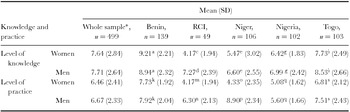
An overall view of the gender differentiation in the whole sample shows no significant difference between women and men in their levels of knowledge and use of rice farming methods. (Table 3)
Gender differentiation of the surveyed household heads’ levels of knowledge and practice of rice farming methods.

*For the whole sample, there were no significant differences between men and women for either level of knowledge or level of practice (according to t-test; significance level of 5%).
Note: Different superscripts in the same country within the same variable (knowledge/practice) denote populations which are significantly different based on Kruskal–Wallis test and a significance level of 5%.
n = number of households surveyed.
RCI = Côte d'Ivoire.
Specifically, at the country level, we did not observe any gender gap in the knowledge and use of rice farming methods in Benin, Nigeria and Togo. However, in Côte d'Ivoire, we observed a significant gender gap in the levels of knowledge and use of rice farming methods, for men over women. In Niger, a gender gap was observed in the use of methods, with men having a higher level of use of rice farming technologies than women, whereas no significant gender gap was noted in the level of knowledge of rice farming methods. This gender gap observed in some countries, with women having a low level in knowledge and use of rice farming methods, is consistent with many previous studies such as Katungi et al. (Reference Katungi, Edmeades and Smale2008) and Manfre et al. (Reference Manfre, Rubin, Allen, Summerfield, Colverson and Akeredolu2013) who all show less access of women to rural development interventions and advisory services. Most extension agents in developing countries are men, and multiple institutional and organizational problems constrain attempts to train rural women. Women are negatively affected by social constraints that forbid them from communicating freely with men who are not from their families. Furthermore, in sub-Saharan Africa, women have very little leisure time compared to men (Baden and Milward, Reference Baden and Milward1997) and this may have a negative impact on their availability to effectively communicate with agricultural advisory staff. This calls for new rural extension and learning approaches such as farmer-to-farmer video, several studies of which have shown its effectiveness (Chowdhury et al., Reference Chowdhury, Van Mele and Hauser2011; Zossou et al., Reference Zossou, Van Mele, Vodouhe and Wanvoeke2009, Reference Zossou, Van Mele, Vodouhe and Wanvoeke2010). Farmer-to-farmer videos are less male-biased than conventional extension approaches. Video has proved a powerful medium for farmer-to-farmer extension and can give voice to rural women and help to overcome gender bias and gender blindness in rural development and in sustainable agricultural production in sub-Saharan Africa.
In Benin, despite the observation of women having more access to the formal agricultural extension sources, there was no significant effect on their levels of knowledge and use of rice farming methods. The use of a technology is often related to a certain availability of financial resources and it has been shown by Baden and Milward (Reference Baden and Milward1997) that there is some evidence of a link between female headship and poverty. In this study, the women surveyed were the head of their households and are likely to be vulnerable to poverty because of their lack of property rights and dependence on men. This vulnerability of women to poverty may explain their lack of financial support to acquire and use rice farming technologies even if they have information on the effectiveness of these technologies. Farmers’ innovations are often shaped by capital limitations and mainly rely on locally available resources, of which knowledge is a key one (Zossou et al., Reference Zossou, Van Mele, Vodouhe and Wanvoeke2009).
IMPLICATIONS AND CONCLUSIONS
Except the case of Benin where we noted a possible bias due to the presence of the AfricaRice headquarters, we did not observe a significant gender gap in the access of rice farmers to formal agricultural knowledge sources. In other words, women and men seem to have approximately the same chances to access formal sources of knowledge. This finding contradicts the male-bias in rural interventions in Africa showed by World Bank (2008). This proves that the gender approach in research and development interventions is having impact in rural areas in West Africa. In fact, an increasing number of agricultural development policies highlight gender inequalities as a critical constraint to growth and recognize the contributions of women to the sector; many African countries have established a policy architecture for more gender-equitable development (Manfre et al., Reference Manfre, Rubin, Allen, Summerfield, Colverson and Akeredolu2013).
With regards to informal sources, no significant gender bias was observed in Côte d'Ivoire, Niger, Nigeria and Togo. However, in Benin we observed that women are more in relation with their colleagues compared to men. In this country, we also noted a significant gap between women and men in their knowledge improvement through personal experiences, with men more active in personal experiences. This last point needs further investigations to clarify this aversion to risk observed with women in improving their knowledge with self-experiences.
The most quoted source in acquiring knowledge and information on rice farming technologies was ‘colleague farmers’; while the least quoted source was farmer organizations. This shows the importance of enhancing farmer organizations’ leaders’ capacity as potential actors in achieving extension objectives because of their social capital in rural areas.
Results show a significant gender gap in the level of knowledge and use of rice farming technologies in some countries (Côte d'Ivoire and Niger). In Benin, despite the women's high access to agricultural knowledge, no positive impact was observed on their level of rice technique use. The vulnerability of women to poverty and lack of financial support may explain this situation. To overcome this gender bias in agricultural technology use, it is important to resort to new rural extension and learning approaches that can improve the ability of rural farmers to innovate with local resources, based on their endogenous and newly acquired knowledge. Farmer-to-farmer video is such a method for which several studies have shown its effectiveness. Once farmers know and understand the basic principle of a new technology, they are able to innovate based on the underlying principles and using locally available resources (Zossou et al., Reference Zossou, Van Mele, Vodouhe and Wanvoeke2009). Moreover, video is considered a powerful tool to solve the problem of participant selection bias in conventional training and to dilute the leadership power issue within farmer organizations. It gives a fair chance to community members to learn and reduces the dependence on group leaders. It is an excellent way to illustrate the principles of technologies and encourage rural people to create their own innovations. Farmer-to-farmer video has proven valuable, reliable and complementary to other agricultural extension approaches in African rural areas. This study shows a high percentage of farmers who preferred word-of-mouth from their peers as the primary source of information. This is an important point that shows again the opportunity that farmer-to-farmer video provides to agricultural extension, as farmers are actors in the video and this makes it more convincing. Future research will need to reach more surveyed samples in countries to draw relevant conclusions.
Acknowledgement
This work was supported by the Global Rice Science Partnership (GRiSP) and the Canada-funded project entitled ʻEnhancing food security in Africa through the improvement of rice post-harvest handling, marketing and the development of new rice-based products’. The authors also thank all national partners for their contribution to the baseline survey in rice hubs in Africa.