Intimate Partner Violence (henceforth IPV) is an important social and public health problem in different countries and societies across the world (Krahé, Bieneck, & Möller, Reference Krahé, Bieneck and Möller2005), and it takes place in a dyadic and interpersonal context. Thus, several authors consider it more appropriate and desirable to study IPV at the partner level of analysis, and not on the basis of a single individual (Armstrong, Wernke, Medina, & Schafer, Reference Armstrong, Wernke, Medina and Schafer2002; Fernández-Fuertes, Fuertes, & Orgaz, Reference Fernández-Fuertes, Fuertes and Orgaz2011; Kenny, Kashy, & Cook, Reference Kenny, Kashy and Cook2006). In this sense, having data from both members of the couple affords more accurate information concerning the existence and frequency of violence in relationships (Armstrong et al., Reference Armstrong, Wernke, Medina and Schafer2002; Szinovacz & Egley, Reference Szinovacz and Egley1995), although the collection of data from couples is costly and burdensome (Hanley & O’Neill, Reference Hanley and O’Neill1997).
Studies on the prevalence of IPV that have used the reports of both members of a couple seem to focus on two main lines of enquiry (see, for example, Brousseau, Bergeron, Hèbert, & McDuff, Reference Brousseau, Bergeron, Hébert and McDuff2011; Cunradi, Bersamin, & Ames, 2008; Hanley & O’Neil, Reference Hanley and O’Neill1997; O’Leary & Williams, Reference O’Leary and Williams2006; Perry & Fromuth, Reference Perry and Fromuth2005; Szinovacz & Egley, Reference Szinovacz and Egley1995). The first line has been to obtain IPV rates using data from both members of the couple, and then analyze how the data on victimization and perpetration change as a function of the indicator used (individual or dyadic). The second line has been to compare the degree of agreement/disagreement between the members of the couple regarding the presence of violence in their relationship and the extent to which the lack of concurrence has an effect on prevalence data.
Regarding the first line of enquiry, it seems that prevalence data change appreciably when comparing the data reported by one partner with those provided by the other or by both partners (Caetano, Field, Ramisetty-Mikler, & Lipsky, Reference Caetano, Field, Ramisetty-Mikler and Lipsky2009; O’Leary & Williams, Reference O’Leary and Williams2006; Schafer, Caetano, & Clark, Reference Schafer, Caetano and Clark1998; Szinovacz & Egley, Reference Szinovacz and Egley1995). Given that IPV is a shared experience, both members of a couple would be expected to make similar reports. This is not the case, however, as pointed out by several authors (e.g., Brousseau et al., Reference Brousseau, Bergeron, Hébert and McDuff2011; Caetano et al., Reference Caetano, Field, Ramisetty-Mikler and Lipsky2009; Szinovacz, Reference Szinovacz1983; Szinovacz & Egley, Reference Szinovacz and Egley1995). Addressing dating violence, the study carried out by Perry and Fromuth (Reference Perry and Fromuth2005) with a sample of 50 university student couples revealed that 60% of couples could be considered to be violent, since one or both members reported having received or engaged in physical violence. However, the percentage of violent couples decreased to 30% when both members of the couple were required the existence of violence in their relationship, although they did not agree on who received and who perpetrated the violence. Previously, the results of a study by Hanley and O’Neill (Reference Hanley and O’Neill1997) with a sample of 52 dating couples at university revealed a similar trend, since the percentage of violent couples varied from 33% (when at least one member reported the existence of physical violence) to 19% (when both members were reporting the existence of physical violence and agreement about the direction of the violence was not necessary).
These differences between individual and dyadic reports have led some researchers to compare the degree of concurrence between reports on IPV from both members of a couple (second line of enquiry), with the general finding that in general there is an important degree of inconsistency between partners’ reports of violence (Cunradi et al., Reference Cunradi, Bersamin and Ames2009; Hanley & O’Neil, Reference Hanley and O’Neill1997; O’Leary & Arias, Reference O’Leary, Arias, Hotaling, Finkelhor, Kilpatrick and Straus1988; Schafer, Caetano, & Clark, Reference Schafer, Caetano and Clark2002; Szinovacz, Reference Szinovacz1983; Szinovacz & Egley Reference Szinovacz and Egley1995). Studies with clinical samples have found a low level of agreement regarding the frequency of physical violence (Browning & Dutton, Reference Browning and Dutton1986) and its level of severity (Langhinrichsen-Rohling & Vivian, Reference Langhinrichsen-Rohling and Vivian1994). Jouriles and O’Leary (Reference Jouriles and O’Leary1985) compared reports of physical violence in a sample of 65 couples seeking marital therapy and 37 community couples, and observed that the relatively high rates of overall agreement obtained were due to agreement about the absence of specific violent behaviors, while agreement about the occurrence of violence was low in both samples. The same conclusion was reached by Armstrong et al. (Reference Armstrong, Wernke, Medina and Schafer2002) from a review of studies with clinical and community samples. Studies carried out with national or community samples of married or cohabiting couples have reported low levels of agreement regarding the occurrence of sexual coercion (Brousseau et al., Reference Brousseau, Bergeron, Hébert and McDuff2011; Caetano et al., Reference Caetano, Field, Ramisetty-Mikler and Lipsky2009; O’Leary & Williams, Reference O’Leary and Williams2006) or forced sex (Schafer et al., Reference Schafer, Caetano and Clark1998; Schafer et al., Reference Schafer, Caetano and Clark2002) and physical violence (Caetano et al., Reference Caetano, Field, Ramisetty-Mikler and Lipsky2009; Cunradi et al., Reference Cunradi, Bersamin and Ames2009; Schafer et al., Reference Schafer, Caetano and Clark1998; Schafer et al., Reference Schafer, Caetano and Clark2002; Szinovacz & Egley, Reference Szinovacz and Egley1995). Regarding psychological or verbal aggression, Caetano et al. (Reference Caetano, Field, Ramisetty-Mikler and Lipsky2009) found low levels of agreement in reports concerning psychological aggression, while O’Leary and Williams (Reference O’Leary and Williams2006) found a high level of agreement about the occurrence of violence, and a low level of agreement regarding the absence of psychological aggression. Finally, studies carried out on dating couples have also revealed the existence of inconsistencies between the reports of both members of couples regarding physical and verbal aggression (Hanley & O’Neil, 1997; Perry & Fromuth, Reference Perry and Fromuth2005).
The lack of agreement between the members of a couple emerges from the partners’ different estimates about the existence of violence in their relationship. The analyses of partners’ differences regarding estimations of violence are scant, and different results have been obtained, depending on the study in question. It is commonly assumed that the inconsistencies between partners’ reports are due to a tendency to underreport violence (Szinovacz & Egley, Reference Szinovacz and Egley1995). In this regard, Szinovacz (Reference Szinovacz1983) proposed that the perpetrators of violence tend to report aggression to a lesser extent than their partners. The results obtained by Jouriles and O’Leary (Reference Jouriles and O’Leary1985) revealed that male participants from the clinical sample indeed tended to underreport their aggressive behavior as compared with their partners. These differences between the aggressors and victims of violence could be due to the fact that perpetrators’ reports are biased by social desirability or the denial of negative behavior (O’Leary & Arias, Reference O’Leary, Arias, Hotaling, Finkelhor, Kilpatrick and Straus1988). However, the study by Langhinrichsen-Rohling and Vivian (Reference Langhinrichsen-Rohling and Vivian1994) found that disagreement between members of the couple emerges not only from the underreporting of male and female perpetration, but also from the underreporting of victimization. These authors concluded that the factors which explain the disagreement are more complex and varied than denial and differences in perception (Langhinrichsen-Rohling & Vivian, Reference Langhinrichsen-Rohling and Vivian1994). Regarding gender differences in reporting IPV, different results have been forthcoming. For example, in the study performed by Cunradi et al. (Reference Cunradi, Bersamin and Ames2009) with 1,000 U.S. union workers and their partners, men reported undergoing and perpetrating physical violence to a greater extent than women. However, the study carried out by Schafer et al. (Reference Schafer, Caetano and Clark1998) with a representative sample of 1,599 married or cohabiting U.S. couples found that women tend to report higher rates of victimization and the perpetration of violence than their male counterparts. These authors pointed out that women may be more prone to remembering and reporting the episodes of violence suffered and perpetrated because they are more concerned and aware of violence (Schafer et al., Reference Schafer, Caetano and Clark1998). In a later study with a representative sample of 1,025 U.S. couples, these authors (Caetano et al., Reference Caetano, Field, Ramisetty-Mikler and Lipsky2009) found that women reported being the perpetrators of psychological violence more often than their male partners reported undergoing violence, and that women identified themselves less often as being the victim of physical violence than their male counterparts identified themselves as the perpetrators of physical violence. Moreover, some differences in partners’ reports of violence have been detected in studies carried out with dating couples. For example, the study by Perry and Fromuth (Reference Perry and Fromuth2005) showed that more women reported having engaged in psychological aggression against their partners, although there were no differences between the partners’ reports of psychological victimization. The explanation given was that women were better able to recognize psychological violence because they are more sensitive to aggression. Knowledge about the underlying reasons for the lack of agreement between the members of the couple is still limited (Schafer et al., Reference Schafer, Caetano and Clark2002), and biases in reporting violence may emerge not only from methodological issues, such as the items or the scale employed (Cunradi et al., Reference Cunradi, Bersamin and Ames2009; Szinovacz & Egley, Reference Szinovacz and Egley1995) or individual differences in perception, memory, or willingness to tell the truth, but also from gender differences in understanding and labeling violence (Hanley & O’Neil, Reference Hanley and O’Neill1997).
In light of the above, it seems that reports made by one member of a couple are insufficient to obtain reliable data concerning the prevalence of dating violence, and that it is particularly important to obtain information from both members of the couple to assess whether the reports obtained from one of the partners can be extrapolated to what is really happening in the relationship.
Dating violence in Spain
IPV occurs not only within marriages or in cohabiting relationships but also in adolescent and young heterosexual couples who are not cohabiting (Frieze Reference Frieze2005; Muñoz-Rivas, Graña, O’Leary, & González, Reference Muñoz-Rivas, Graña, O’Leary and González2007b). Thus, evaluating violence in young couples is necessary, since studies carried out in different countries suggest that aggression is more frequent in young people’s relationships than in older couples (González-Lozano, Muñoz-Rivas, & Graña, Reference González-Lozano, Muñoz-Rivas and Graña2003; Jackson, Cram, & Seymour, Reference Jackson, Cram and Seymour2000; Sabina & Straus Reference Sabina and Straus2008) and seems to be an important predictor of later marital violence (White, Merrill, & Koss, Reference White, Merrill and Koss2001). In Spain, the number of investigations addressing the issue of dating violence is still low (Fernández-Fuertes et al., Reference Fernández-Fuertes, Fuertes and Orgaz2011), but studies using behavioral scales to explore different types of violent behaviors (e.g., Conflict Tactics Scales, Conflict of Adolescent Dating Relationship Inventory) have found that both men and women undergo and perpetrate dating violence, and that verbal or emotional violence is more prevalent than physical and sexual violence (Fernández-Fuertes & Fuertes, Reference Fernández-Fuertes and Fuertes2010; Fernández-Fuertes et al., Reference Fernández-Fuertes, Fuertes and Orgaz2011; Muñoz-Rivas et al., Reference Muñoz-Rivas, Graña, O’Leary and González2007b; Rojas-Solís & Carpintero, Reference Rojas-Solís and Carpintero2011). The study performed by Muñoz-Rivas et al. (Reference Muñoz-Rivas, Graña, O’Leary and González2007b) with a sample of 1,800 university students aged 18 to 27 found that at least 81% of the male participants and 77.2% of the females reported having experienced one episode of verbal aggression in a current or past relationship. Moreover, more women reported having perpetrated some form of verbal aggressive behavior (e.g., insults), and more men reported having experienced some verbal aggressive behavior (e.g. threats of physical assault). Furthermore, nearly 30% of the participants reported having assaulted their partners, and victimization was more prevalent among men. Regarding gender differences in perpetration, more women reported having slapped a partner, and more men reported having physically restrained the other person. Based on a study with a sample of 4,025 adolescents and young adults aged between 16 and 26, these authors (Muñoz-Rivas, Graña, O’Leary, & González, Reference Muñoz-Rivas, Graña, O’Leary and González2009) also found that a significantly higher percentage of men (35.7%) than women (14.9%) reported having engaged in some form of sexually aggressive behavior against their partners. Moreover, sexual victimization was significantly higher among women (25.1%) than men (21.1%). The results of the study carried out by Rojas-Solís and Carpintero (Reference Rojas-Solís and Carpintero2011) with a sample of 453 university students indicated that more men reported having experienced physical violence and perpetrated sexual aggression, whereas more women reported having engaged in verbal aggression against their partners.
In spite of the differences across studies carried out in Spain, there is consensus among authors that dating violence is a serious problem that affects a large number of young and adolescent Spaniards (Fernández-Fuertes & Fuertes, Reference Fernández-Fuertes and Fuertes2005; González & Santana, Reference González and Santana2001; Rojas-Solís & Carpintero, Reference Rojas-Solís and Carpintero2011), even those who are in stable or serious dating relationships (Muñoz-Rivas, Graña, O’Leary, & González, Reference Muñoz-Rivas, Graña, O’Leary and González2007a). In this sense, some authors (Fernández-Fuertes & Fuertes, Reference Fernández-Fuertes and Fuertes2010; Muñoz-Rivas et al., Reference Muñoz-Rivas, Graña, O’Leary and González2007b; Rodríguez-Franco, López-Cepero, Antuña, Rodríguez, & Bringas, Reference Rodríguez-Franco, Antuña, López-Cepero, Rodríguez and Bringas2012) have indicated that certain types of aggressive behavior could be perceived as normative or, at least, non-problematic in the dating relations of young Spaniards.
The present study
Although it would be desirable for studies assessing victimization and the perpetration of dating violence in Spain to consider the participation of both members of the couple (Fernández-Fuertes et al., Reference Fernández-Fuertes, Fuertes and Orgaz2011), such studies are actually based on individual reports from one partner describing his or her perpetration and victimization. Thus, the aim here is to address the above limitation and expand previous Spanish research into dating violence by incorporating the dyad level of analysis. More specifically, we aim to compare university students and their partners’ reports about the prevalence of four types of violence: verbal-emotional, threatening, sexual, and physical. First, we shall compare the data concerning the prevalence of victimization and perpetration obtained from individual reports (one partner) and dyadic ones (both partners) for the four types of violence, analyzing the differences arising depending on which member of the couple reports the violence. A further aim is to analyze interpartner agreement concerning the occurrence and absence of violence. Considering the findings from the above dyadic research and dating violence studies, it is to be expected that: (a) verbal-emotional violence would be the most prevalent type of violence reported by both men and women; (b) the prevalence data of the four types of violence would change, depending on the indicator considered (individual vs. dyadic); in particular, prevalence data would be higher when obtained from the dyadic reports (in which either partner indicates the occurrence of violence); and (c) the level of agreement between partners about the existence of violence would be low.
Method
Participants
Data were collected from a convenience sample of 118 couples as part of a wider research project addressing dating relationships. Given the focus and type of analysis used (male-female report and agreement), the criterion for inclusion was that the participants had to be currently in a serious heterosexual, non-cohabiting, dating relationship that had lasted for a minimum of one month. The sample finally included 105 couples. At least one member of the couple was studying for a three-year or full-length degree at the Universidad de Salamanca (Spain).
Procedure
The participants were invited to collaborate in a study addressing couple relationships. Thus, during the 2011–2012 academic year one of the investigators explained the interest of studies about couple relationships in several classrooms at the University of Salamanca, and invited the students and their partners to take part. The participants were asked to indicate their e-mail address and that of their partner, after which they received an e-mail message with a link to the on-line questionnaire. The participants who had not answered within 15 days received a second message prompting them to do so. A total of 176 couples agreed to participate in the research, and in 118 cases both partners answered the questionnaire (response rate: 67%). Within those couples, 105 meet the inclusion criteria.
The instructions for the questionnaire clearly explained that participation was completely voluntary and that anonymity would be respected. Accordingly, once both members of the couple had answered the questionnaire and their answers had been related, e-mail address information was duly deleted. Approval from the institutional review board was obtained to administer the survey.
Measures
Demographic information
This section of the questionnaire contained general questions about gender, age, current occupation and items related to the partner relationship, such as its duration.
Intimate partner violence
The experience of victimization and the perpetration of violence during the previous year within the current relationship was measured using the Spanish version of the Conflict of Adolescent Dating Relationship Inventory (CADRI; Wolfe et al., Reference Wolfe, Scott, Reitzel-Jaffe, Wekerle, Grasley and Straatman2001), validated by Fernández-Fuertes, Fuertes, and Pulido (Reference Fernández Fuertes, Fuertes and Pulido2006). This scale evaluates the types of violence that usually take place in dating relationships (Fernández-Fuertes et al., Reference Fernández Fuertes, Fuertes and Pulido2006) and has been used in its original or adapted versions to assess experiences of both victimization and the perpetration of violence in relationships among young people and university students (e.g., Fernández-Fuertes & Fuertes, Reference Fernández-Fuertes and Fuertes2010; Fernández-Fuertes et al., Reference Fernández-Fuertes, Fuertes and Orgaz2011; Roudsari, Leahy, & Walters, Reference Roudsari, Leahy and Walters2009; Teitelman, Ratcliffe, Morales-Aleman, & Sullivan, Reference Teitelman, Ratcliffe, Morales-Aleman and Sullivan2008). The five-factor structure of the scale has been validated through a factor analysis in both the original version (Wolfe et al., Reference Wolfe, Scott, Reitzel-Jaffe, Wekerle, Grasley and Straatman2001) and the adapted one (Fernández-Fuertes et al., Reference Fernández Fuertes, Fuertes and Pulido2006). Cronbach alpha reliability coefficients for the original and adapted versions were calculated only for the perpetration items, and fluctuated between .51 (sexual violence) and .83 (physical violence) in the original version (Wolfe et al., Reference Wolfe, Scott, Reitzel-Jaffe, Wekerle, Grasley and Straatman2001), and between .53 (threatening) and .78 (verbal-emotional) in the adapted one (Fernández-Fuertes et al., Reference Fernández Fuertes, Fuertes and Pulido2006). For the purpose of this study, four of the five subscales were selected: verbal-emotional (10 items; e.g., I insulted her/him with put downs; I ridiculed or made fun of her/him in front of others), threatening (four items; e.g., I threatened to hurt her/him; I deliberately tried to frighten her/him), sexual (four items; e.g., I kissed her/him when she/he didn’t want me to; I forced her/him to have sex when she/he didn’t want to) and physical (three items; e.g., I threw something at her/him; I kicked, hit, or punched him/her). All the subscales consider four response options, ranging from 0 (Never: this has never occurred in our relationship) to 3 (Often: this has happened on six or more occasions). The Cronbach alpha reliability coefficients in this study for the different types of violence were: .82 (20 verbal-emotional items), .64 (eight threat items), .69 (eight sexual items) and .89 (six physical items).
Data Analysis
First, the t-test and the χ² test were performed to evaluate the existence of gender differences in the demographic characteristics of the sample.
For both men and women, the victimization and perpetration data were computed in two ways for each subscale: (a) the response rates (0–3) within each subscale were added up to reflect the level of frequency of aggression during the previous year; (b) a dichotomous total scale score was calculated to reflect whether the respondent had reported the occurrence of any of the different types of violence with their current partner during the previous year. Frequency analyses were conducted to examine the prevalence rates of the different kinds of violence within couples. For different subscales, couple aggression was computed using the following categories: male perpetration reported, female victimization reported, male victimization reported, female perpetration reported, and a maximum dyadic report based on either partner indicating an occurrence of aggressive behavior as victim or perpetrator. Contingency tables with Pearson’s χ² and Cramer’s V statistics were used to identify statistically significant differences between the different prevalence rates obtained for each kind of violence and to examine gender differences.
With a view to determining the extent to which individual reports of aggression underestimated the rates of aggression identified when dyadic reports were available, we computed correction factors following the formula described by Szinovacz and Egley (Reference Szinovacz and Egley1995): e.g., underreporting by men in the perpetration of sexual violence = ([maximum dyadic report in sexual violence perpetrated by men’s reports on engaging in sexual violence] x 100) – 100. The result multiplied by the individual report (e.g., men’s reports on the perpetration of sexual violence) would be added to the individual report to obtain the couple data report.
Finally, to analyze the interpartner agreement, different indices were selected on the basis of the information they provided and their constraints. For the response rates (0–3), the Pearson and Kendall tau correlations are reported as the index of interpartner agreement about the level of frequency of violence. Kendall`s tau is a non-parametric correlation that is not adversely affected by abnormal distributions, and takes ties into account (Siegel, Reference Siegel1956). Furthermore, we calculated Cohen`s kappa for each subscale in order to gauge partner agreement about the existence of violence from a statistical perspective. Cohen`s kappa is considered to be a more appropriate measure of reliability since it is the proportion of agreement adjusted for chance (Cohen, Reference Cohen1960). Kappa is one when the agreement between rates is perfect, and zero when the agreement is exactly what would be expected from chance. Moreover, Fleiss (Reference Fleiss1981) suggests the following rule of thumb to interpret the kappa index: < .40, poor; .40 to .75 fair to good; > .75, excellent. However, kappa is affected by the distributions of data across the categories used (Byrt, Bishop, & Carlin, Reference Byrt, Bishop and Carlin1993), and may be biased when report rates are low (Feinstein & Cicchetti, Reference Feinstein and Cicchetti1990). When the rate of violence is very low, kappa may be zero regarding the non-occurrence of violence, even though there is high agreement on the occurrence and non-occurrence of violence (O`Leary & Arias, Reference O’Leary, Arias, Hotaling, Finkelhor, Kilpatrick and Straus1988). Spitznagel and Helzer (Reference Spitznagel and Helzer1985) made similar points about the unduly restrictive nature of kappa when the base rates of a behavior are either quite high or low. Thus, prevalence rates are necessary for interpreting agreement indices. We also assessed partner concordance by examining occurrence agreement, non-occurrence agreement, and the overall percentage of agreement (occurrence and non-occurrence) for the different subscales of violence. These data are reported in percentages, and are provided because indices such as Pearson, tau and kappa are too stringent (O’Leary & Williams, Reference O’Leary and Williams2006). The SPSS 20 package was used for the statistical analyses performed.
Results
Sociodemographic characteristics of the participants
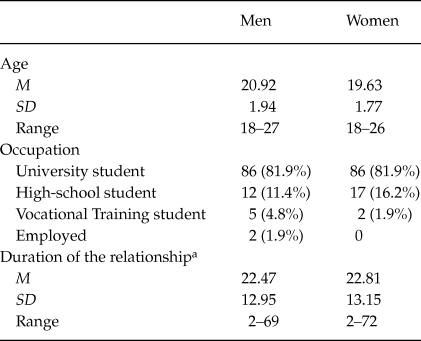
Table 1 shows the demographic characteristics of the male and female participants. The mean age was 20.2 years (SD = 1.96; range = 18–27). At the time, almost all the participants were students at university, in high school, or in vocational training. The duration of the relationship ranged from 2 to 72 months. No gender differences were found in the sociodemographic variables.
Demographic characteristics of the sample

Note: There were no gender differences in the reported variables.
a The duration of the relationship was measured in months.
Rate of violence within couples
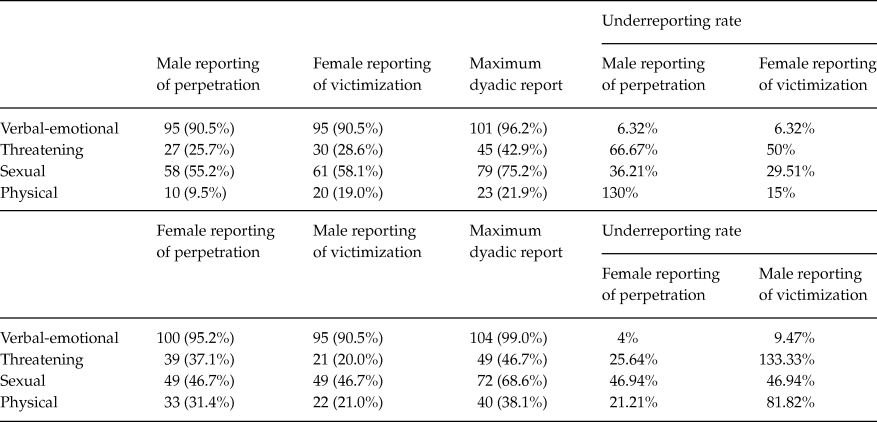
An examination of the rates in each subscale (see Table 2) revealed that, as expected, verbal-emotional violence was the type of violence most frequently experienced by both men (90.5%) and women (90.5%) and also the type most frequently committed by both men (90.5%) and women (95.2%). Thus, the percentage of participants who reported the existence of verbal-emotional violence was significantly higher than the percentage of participants who reported the second most common type of violence (sexual), not only for male, χ²(1) = 32.96, p = .001, V =.39, and female perpetration, χ²(1) = 60.09, p = .001, V =.53, but also for male, χ²(1) = 46.75, p = .001, V =.47, and female victimization, χ²(1) = 28.82, p = .001, V =.37.
Frequency and distribution of the percentage of men and women reporting having experienced and perpetrated each type of violence and underreporting rates

Note: Underreporting rate = [(Maximum dyadic report/N reported male/female) x 100] – 100.
The reported frequency rates for victimization and perpetration within the couple were similar for both genders, except as regards physical violence, with a significantly higher percentage of women (31.4%) than men (9.5%) reporting that they had physically abused their partner on some occasion during the previous year, χ²(1) = 15.47, p = .001, V =.27.
As hypothesized, the rates based on couples’ reports differed considerably from those obtained from individual reports (see Table 2), and the former rates were higher than the latter, except for verbal-emotional violence. Furthermore, comparisons between the data in maximum dyadic reports and individual ones suggest that the underestimation of violence perpetrated by men fluctuates between 6.32% for verbal-emotional aggression and 130% for physical assault when considering men’s reports, and between 6.32% for verbal-emotional violence and 50% for threats of assault when considering women’s reports. Similarly, taking into account the maximum dyadic report and the individual reports, the underestimation of violence committed by women ranges between 4% for verbal-emotional violence and 46.94% for sexual violence when considering women’s reports, and between 9.47% for verbal-emotional violence and 133.33% for threats when considering men’s reports. As an example, the rate obtained for female underreporting of sexual violence committed was 46.94%, indicating that female-to-male sexual violence as reported by either member of the couple (maximum dyadic report) exceeds women’s reports of the perpetration of sexual violence by 46.94%. Thus, the figure for women’s reports of engaging in sexual violence multiplied by a factor of 0.469 would have to be added to women’s report to obtain the maximum dyadic report of sexual violence committed by women. The results suggest that compared to maximum dyadic reports, both men and women individually tend to underreport threatening, sexual, and physical violence. However, this underreporting seems to be more important in the case of men`s victimization and perpetration of violence. Except for the perpetration of sexual violence, men’s underreporting rates are higher than women’s. In the case of male perpetration of physical violence and male victimization involving threats, male reports multiplied by a factor of 1.3 should be added to these male reports to reflect the results of the dyadic reports. In other words, these male reports should at least be doubled to arrive at the rate obtained from the couple.
Interpartner agreement
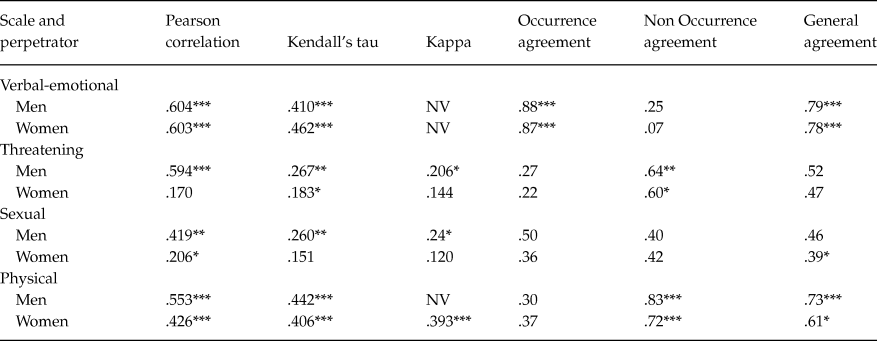
As shown in Table 3, levels of agreement varied across the different statistics used to determine agreement. Agreement indexed by the Pearson correlation and Kendall´s tau was significant for most of the subscales, except for women’s perpetration of threatening behavior and sexual violence. Although interpartner agreement was statistically significant in most of the subscales, the strength of the association between partner reports varied notably across the subscales. On the basis of Cohen`s standards (1988), the Pearson correlation between partner reports was low for most subscales, and moderate to high for male and female perpetration of verbal-emotional violence and male perpetration of threats and physical violence. This latter result indicates the existence of a moderate/high association between the level of frequency of violence reported by participants and the level reported by their partners. The interpartner agreement using the kappa index reveals its limitations due to the level of prevalence of the different types of behavior. In verbal-emotional violence, where it is very high, and in physical violence, where it is very low, it cannot be calculated (Spitznagel & Helzer, Reference Spitznagel and Helzer1985). The kappa coefficients of agreement are low, regardless of the type of violence. The only kappa result that was significant and met the criteria set by Fleiss (Reference Fleiss1981) was the degree of agreement concerning the perpetration of physical violence by women. Considering the degree of agreement shown by partners as regards the occurrence/non-occurrence of this type of behavior, the results indicate the existence of agreement only in two cases. As expected, the level of agreement between partners about the occurrence of violence was low, except for verbal-emotional aggression. Moreover, partners tended to agree about the non-occurrence of physical violence.
Agreement statistics for CADRI Scales according to the gender of the perpetrator

Note: CADRI = Conflict of Adolescent Dating Relationship Inventory; NV = not valid because some cells had a count of less than 5; *p < .05, **p < .001, ***p < .0001.
Discussion
This study contributes to the literature addressing IPV in Spain in several ways. First, in an attempt to overcome the limitations of studies that extrapolate individuals’ responses to the responses of couples, this study reports the first exploration of the prevalence rates of victimization and perpetration of dating violence at dyad level. Second, the study addresses the question of the level of agreement between the partners in a couple with respect to the existence or not of violence in their relationship.
The individual data obtained in this study are fairly similar to those reported previously (Fernández-Fuertes & Fuertes, Reference Fernández-Fuertes and Fuertes2010; Muñoz-Rivas et al., Reference Muñoz-Rivas, Graña, O’Leary and González2007a) with samples of adolescents and young adults. In those studies, around 90% of participants reported having perpetrated some kind of verbal violence, and an important percentage of couples (from 21% to 40%) stated that they had physically abused their partner. The results obtained support the hypothesis that verbal-emotional violence is the most common type of violence, and in light of our own and previous findings (Fernández-Fuertes & Fuertes, Reference Fernández-Fuertes and Fuertes2010; Muñoz et al., Reference Muñoz-Rivas, Graña, O’Leary and González2007a) it appears that the absence of episodes of verbal violence in couples’ relationships is exceptional. It is also worth wondering whether this type of violence could be considered normative by young people (Fernández-Fuertes & Fuertes, Reference Fernández-Fuertes and Fuertes2010). Along these lines, it seems that young Spaniards play down or even tolerate certain types of aggressive behavior, such as insults, criticism, or shouting (Rodríguez-Franco et al., Reference Rodríguez-Franco, Antuña, López-Cepero, Rodríguez and Bringas2012), even though previous studies carried out in other countries have shown that the consequences of such behavior for the victims and the relationship are important (Follingstad, Wright, Lloyd, & Sebastian, 1990; Vitanza, Vogel, & Marshall, Reference Vitanza, Vogel and Marshall1995) and despite the fact such types of behavior seem to be the forerunners of physical violence (Hamby & Sugarman Reference Hamby and Sugarman1999; Murphy & O’Leary Reference Murphy and O’Leary1989; O’Leary, Reference O'Leary1999).
In addition, our study suggests that sexual violence is the second most common type of violence, since the percentages of victimization and perpetration obtained exceed 50%. These results are consistent with other studies performed in Spain using the same scale with samples of adolescents and university students (Fernández-Fuertes et al., Reference Fernández-Fuertes, Fuertes and Orgaz2011; Rojas-Solís & Carpintero, Reference Rojas-Solís and Carpintero2011), but they are inconsistent with studies that have assessed dating violence with other scales, such as CTS2, which have reported lower prevalence rates (e.g., Corral, Reference Corral2009; Gámez-Guadix, Straus, & Hershberger, Reference Gámez-Guadix, Straus and Hershberger2011), perhaps because CADRI includes items of less severe violence (e.g., undesired touching and kisses) that could be more frequent in dating relationships.
Finally, no significant gender differences were found in the reports about victimization and the perpetration of verbal-emotional violence and threats, or in the reports of sexual violence. This latter result contradicts the findings of other authors indicating that men tend to be more sexually aggressive than women (Corral, Reference Corral2009; Fernández-Fuertes & Fuertes, Reference Fernández-Fuertes and Fuertes2005; Fernández-Fuertes et al., Reference Fernández-Fuertes, Fuertes and Orgaz2011; Hamby, Reference Hamby2005; Ortega, Ortega, & Sánchez, Reference Ortega, Ortega and Sánchez2008), and could be explained on the basis of methodological issues such as the specific types of behavior explored. For example, Fernández-Fuertes et al. (Reference Fernández-Fuertes, Fuertes and Orgaz2011) added two items to the sexual violence subscale of the CADRI. Similarly, Ortega et al. (Reference Ortega, Ortega and Sánchez2008) employed different items from the AAUW Sexual Harassment Survey (McMaster, Connolly, Pepler, & Craig, Reference McMaster, Connolly, Pepler and Craig2002). Furthermore, CTS2 includes specific items for measuring the use of physical force and takes other types of sexual behavior into account, such as oral or anal sex (Straus, Hamby, Boney-McCoy, & Sugarman, Reference Straus, Hamby, Boney-McCoy and Sugarman1996), which were not assessed explicitly in the scale used here. Gender differences only emerged regarding the perpetration of physical violence. A significantly higher percentage of women than men reported having abused their partner physically, as reflected in previous studies with samples of university students performed both in Spain (Fernández-Fuertes & Fuertes, Reference Fernández-Fuertes and Fuertes2010; Muñoz-Rivas et al., Reference Muñoz-Rivas, Graña, O’Leary and González2007) and in other countries (e.g., Straus, Reference Straus2008).
In comparison with the data based on responses by both members of the couple, the prevalence data obtained from the individual responses of both men and women appeared to underreport all coercive behaviors, with the exception of verbal-emotional violence. These results partially support the hypothesis that prevalence data will be higher when obtained from dyadic reports, and they are consistent with earlier North American studies using both members of the couple and similar rates or indices (Brousseau et al., Reference Brousseau, Bergeron, Hébert and McDuff2011; O’Leary & Williams, Reference O’Leary and Williams2006; Szinovacz & Egley, Reference Szinovacz and Egley1995). More specifically, men tend to underreport more than women, perhaps because women are more sensitive and aware of violence, and they recognize episodes of violence better (Perry & Fromuth, Reference Perry and Fromuth2005; Schafer et al., Reference Schafer, Caetano and Clark1998). The remarkable degree of underreporting of physical violence perpetrated by the men, a result reflected in previous studies carried out in other countries (Caetano et al., Reference Caetano, Field, Ramisetty-Mikler and Lipsky2009), together with the absence of differences between men and women as regards the victimization of this type of violence, seems to cast doubt on the existence of gender differences in the perpetration of physical violence. The male participants may have answered in a socially acceptable manner for fear of the legal consequences and sanctions contemplated in Spanish law. Moreover, they might have underreported the perpetration of physical violence because this type of behavior could be interpreted as a symptom of cowardliness and a lack of manliness (Anderson, Reference Anderson2010), and not as a masculine trait. This would possibly account for the differences between men and women in the perpetration of violence, the absence of gender differences in victimization, and the underestimation of physical abuse by men.
Furthermore, the results indicate that men underreport having been subjected to threats to a remarkable extent, perhaps because threats from women do not have the desired effect of frightening their male partners. Consistently, there is substantial evidence that men are less likely than women to experience fear or distress from IPV or interpersonal violence perpetrated by women, as noted in studies performed across North America (Langhinrichsen-Rohling, Reference Langhinrichsen-Rohling2010; Langhinrichsen-Rohling, Neidig, & Thorn, Reference Langhinrichsen-Rohling, Neidig and Thorn1995; Sears & Byers, Reference Sears and Byers2010) and in Spain (Vicario-Molina, Orgaz, & Fuertes, Reference Vicario-Molina, Fuertes and Orgaz2010), perhaps because the negative effects of IPV are more severe for women than for men, as suggested by some authors (Anderson, Reference Anderson2010; Straus, Reference Straus2011).
The differences between individual and dyadic indicators of violence are to a certain extent due to the lack of agreement between the members of the couple. The results indicate that there is only agreement with respect to the occurrence of verbal violence, which partially supports our third hypothesis. The research by Hanley and O’Neil (2006) also found high levels of agreement as regards psychological violence. Furthermore, in both their study and our own, the prevalence data regarding this type of violence surpass 90%. It is possible that agreement could be higher on types of violent behavior that are easier to retrieve and report because they are frequent in the daily interactions of a couple. However, agreement about the existence of other types of violence is low and does not surpass 50%. Neither do the members of a couple appear to be in agreement about the absence of violence, except in the case of physical violence. This is consistent with the findings reported in U.S. studies sampling married couples (Jouriles & O’Leary, Reference Jouriles and O’Leary1985; Szinovacz & Egley, Reference Szinovacz and Egley1995). Additionally, as in studies with dating couples in North America (Hanley & O’Neil, Reference Hanley and O’Neill1997; Perry & Fromuth, Reference Perry and Fromuth2005) we observed that there are aggressors without victims and victims without aggressors. This expected lack of agreement between the two members of the couple has an important effect on the prevalence of violence, leading the data to fluctuate widely, depending on the indicator used (individual or dyadic) and on whether it is necessary for both members of the couple to be in agreement. For example, according to the maximum dyadic report, 68.6% of couples have experienced at least one episode of female-to-male sexual violence. However, when both members of the couple have to be in agreement, only 24.8% of the couples stated that they had experienced that type of violence in the previous year.
One possible explanation for the lack of agreement between young men and women is that both perpetrators and victims might have different perceptions of past events (Sinclair & Frieze, Reference Sinclair and Frieze2005). In a study carried out with Spanish adolescents, Muñoz-Rivas et al. (Reference Muñoz-Rivas, Graña, O’Leary and González2007a) found that the most frequent motives alleged to justify engaging in physical aggression were joking or playing, which could lead adolescents not only to normalize and tolerate such behavior, but also consider it as not being violent, and hence not report it. Another possibility is that the consumption of alcohol and drugs, which is related to the perpetration of violence in the dating relations of Spanish youths (Muñoz-Rivas, Gámez-Guadix, Graña, & Fernández, Reference Muñoz-Rivas, Gámez-Guadix, Graña and Fernández2010), could prevent both men and women from clearly remembering their episodes of violence. In addition, when there are no injuries, the members of a couple may not perceive any violence in their relationship (Perry & Fromuth, Reference Perry and Fromuth2005). Further work needs to be done to address the question of disagreement between partners, and how both young men and women perceive and recall the episodes of violence in their relationships.
Certain limitations, however, should be borne in mind when interpreting the results and implications of the present study. First, it should be recalled that we used a convenience sample of heterosexual university students and their partners, and hence the results cannot necessarily be generalized to all young people (e.g., to non-students). Additionally, we use a community sample, and hence our results might be different from those obtained from clinical samples in which women clearly experience more violence and are subjected to systematic mistreatment (Straus Reference Straus, Gelles and Loseke2004; Reference Straus2008). Furthermore, a self-selection bias is plausible, given that couples with an extremely high level of conflict or abuse may be less likely to participate in this kind of study (Johnson, Reference Johnson1995). Finally, we did not collect data on the dynamics, reasons or consequences (e.g., injuries) of violent behavior, even though this would have provided a more complete understanding of the context in which violence occurs (Hamby, Reference Hamby2009), and some studies have found gender differences in the effects of violence, with women being more severely affected by IPV (Archer, Reference Archer2000; Straus, Reference Straus2010). Additionally, given the online questionnaire format, we cannot be sure that the participants replied individually and sincerely. Nevertheless, despite these limitations, the main strength of this research is that it questions the idea that IPV data based on individual reports can be extrapolated to what is really going on in a couple’s relationship (Armstrong et al., Reference Armstrong, Wernke, Medina and Schafer2002). Furthermore, our results support the conclusions reached by other authors (e.g., Reference Hanley and O’NeillHanley & O’Neil, 1997; Perry & Fromuth, Reference Perry and Fromuth2005; Schafer et al., Reference Schafer, Caetano and Clark2002) regarding the need to continue studying dating violence through the reports of both members of the couple. We do not deny that the rates obtained from dyadic reports may also be biased due to methodological issues (e.g., a lower response rate since both members have to agree to participate), among others. However, dyadic reports enable more information to be obtained about the levels of violence in intimate relationships, since they allow ranges of prevalence to be estimated, with a lower bound resulting from the number of cases in which the partners agree about the existence of violence, and an upper bound determined by the cases in which at least one member of the couple reports the existence of violence. Moreover, collecting data from both members of the couple can prompt the formulation of new questions about the validity of individual reports. For example, considering the results obtained in this study, can it indeed be asserted that women perpetrate more physical violence than their male partners? Not really, because even though women reported perpetrating physical violence more than men, there were no gender differences in victimization. Thus, if attempts are made to obtain more information about IPV, then the possibility that dyadic studies are more desirable should be entertained (Caetano et al., Reference Caetano, Field, Ramisetty-Mikler and Lipsky2009; Cunradi et al., Reference Cunradi, Bersamin and Ames2009). These findings do not provide easy answers, but they do pose new research questions.
The research reported in this paper was conducted as a part of a project supported by a grant from the MICINN (Ministry of Science and Innovation), grant number PSI2009-10826.