


%20--%3e%3c!DOCTYPE%20svg%20PUBLIC%20'-//W3C//DTD%20SVG%201.0//EN'%20'http://www.w3.org/TR/2001/REC-SVG-20010904/DTD/svg10.dtd'%3e%3csvg%20version='1.0'%20id='Layer_1'%20xmlns='http://www.w3.org/2000/svg'%20xmlns:xlink='http://www.w3.org/1999/xlink'%20x='0px'%20y='0px'%20width='64px'%20height='64px'%20viewBox='5.5%20-3.5%2064%2064'%20enable-background='new%205.5%20-3.5%2064%2064'%20xml:space='preserve'%3e%3cg%3e%3ccircle%20fill='%23FFFFFF'%20fill-opacity='0'%20cx='37.785'%20cy='28.501'%20r='28.836'/%3e%3cpath%20fill='%23595959'%20d='M37.441-3.5c8.951,0,16.572,3.125,22.857,9.372c3.008,3.009,5.295,6.448,6.857,10.314%20c1.561,3.867,2.344,7.971,2.344,12.314c0,4.381-0.773,8.486-2.314,12.313c-1.543,3.828-3.82,7.21-6.828,10.143%20c-3.123,3.085-6.666,5.448-10.629,7.086c-3.961,1.638-8.057,2.457-12.285,2.457s-8.276-0.808-12.143-2.429%20c-3.866-1.618-7.333-3.961-10.4-7.027c-3.067-3.066-5.4-6.524-7-10.372S5.5,32.767,5.5,28.5c0-4.229,0.809-8.295,2.428-12.2%20c1.619-3.905,3.972-7.4,7.057-10.486C21.08-0.394,28.565-3.5,37.441-3.5z%20M37.557,2.272c-7.314,0-13.467,2.553-18.458,7.657%20c-2.515,2.553-4.448,5.419-5.8,8.6c-1.354,3.181-2.029,6.505-2.029,9.972c0,3.429,0.675,6.734,2.029,9.913%20c1.353,3.183,3.285,6.021,5.8,8.516c2.514,2.496,5.351,4.399,8.515,5.715c3.161,1.314,6.476,1.971,9.943,1.971%20c3.428,0,6.75-0.665,9.973-1.999c3.219-1.335,6.121-3.257,8.713-5.771c4.99-4.876,7.484-10.99,7.484-18.344%20c0-3.543-0.648-6.895-1.943-10.057c-1.293-3.162-3.18-5.98-5.654-8.458C50.984,4.844,44.795,2.272,37.557,2.272z%20M37.156,23.187%20l-4.287,2.229c-0.458-0.951-1.019-1.619-1.685-2c-0.667-0.38-1.286-0.571-1.858-0.571c-2.856,0-4.286,1.885-4.286,5.657%20c0,1.714,0.362,3.084,1.085,4.113c0.724,1.029,1.791,1.544,3.201,1.544c1.867,0,3.181-0.915,3.944-2.743l3.942,2%20c-0.838,1.563-2,2.791-3.486,3.686c-1.484,0.896-3.123,1.343-4.914,1.343c-2.857,0-5.163-0.875-6.915-2.629%20c-1.752-1.752-2.628-4.19-2.628-7.313c0-3.048,0.886-5.466,2.657-7.257c1.771-1.79,4.009-2.686,6.715-2.686%20C32.604,18.558,35.441,20.101,37.156,23.187z%20M55.613,23.187l-4.229,2.229c-0.457-0.951-1.02-1.619-1.686-2%20c-0.668-0.38-1.307-0.571-1.914-0.571c-2.857,0-4.287,1.885-4.287,5.657c0,1.714,0.363,3.084,1.086,4.113%20c0.723,1.029,1.789,1.544,3.201,1.544c1.865,0,3.18-0.915,3.941-2.743l4,2c-0.875,1.563-2.057,2.791-3.541,3.686%20c-1.486,0.896-3.105,1.343-4.857,1.343c-2.896,0-5.209-0.875-6.941-2.629c-1.736-1.752-2.602-4.19-2.602-7.313%20c0-3.048,0.885-5.466,2.658-7.257c1.77-1.79,4.008-2.686,6.713-2.686C51.117,18.558,53.938,20.101,55.613,23.187z'/%3e%3c/g%3e%3c/svg%3e)
%20--%3e%3c!DOCTYPE%20svg%20PUBLIC%20'-//W3C//DTD%20SVG%201.0//EN'%20'http://www.w3.org/TR/2001/REC-SVG-20010904/DTD/svg10.dtd'%3e%3csvg%20version='1.0'%20id='Layer_1'%20xmlns='http://www.w3.org/2000/svg'%20xmlns:xlink='http://www.w3.org/1999/xlink'%20x='0px'%20y='0px'%20width='64px'%20height='64px'%20viewBox='5.5%20-3.5%2064%2064'%20enable-background='new%205.5%20-3.5%2064%2064'%20xml:space='preserve'%3e%3cg%3e%3ccircle%20fill='%23FFFFFF'%20fill-opacity='0'%20cx='37.637'%20cy='28.806'%20r='28.276'/%3e%3cg%3e%3cpath%20fill='%23595959'%20d='M37.443-3.5c8.988,0,16.57,3.085,22.742,9.257C66.393,11.967,69.5,19.548,69.5,28.5c0,8.991-3.049,16.476-9.145,22.456%20C53.879,57.319,46.242,60.5,37.443,60.5c-8.649,0-16.153-3.144-22.514-9.43C8.644,44.784,5.5,37.262,5.5,28.5%20c0-8.761,3.144-16.342,9.429-22.742C21.101-0.415,28.604-3.5,37.443-3.5z%20M37.557,2.272c-7.276,0-13.428,2.553-18.457,7.657%20c-5.22,5.334-7.829,11.525-7.829,18.572c0,7.086,2.59,13.22,7.77,18.398c5.181,5.182,11.352,7.771,18.514,7.771%20c7.123,0,13.334-2.607,18.629-7.828c5.029-4.838,7.543-10.952,7.543-18.343c0-7.276-2.553-13.465-7.656-18.571%20C50.967,4.824,44.795,2.272,37.557,2.272z%20M46.129,20.557v13.085h-3.656v15.542h-9.944V33.643h-3.656V20.557%20c0-0.572,0.2-1.057,0.599-1.457c0.401-0.399,0.887-0.6,1.457-0.6h13.144c0.533,0,1.01,0.2,1.428,0.6%20C45.918,19.5,46.129,19.986,46.129,20.557z%20M33.042,12.329c0-3.008,1.485-4.514,4.458-4.514s4.457,1.504,4.457,4.514%20c0,2.971-1.486,4.457-4.457,4.457S33.042,15.3,33.042,12.329z'/%3e%3c/g%3e%3c/g%3e%3c/svg%3e)
Introduction
Burn injury is a frequent source of morbidity and mortality worldwide with infections being a leading cause of death. Infectious complications with multidrug-resistant organisms are common in this population and associated with antibiotic exposure, prolonged hospitalizations, mechanical ventilation, and increased surgical procedures. Reference van, Gagnon and Conrad1 In particular, methicillin-resistant Staphylococcus aureus (MRSA) is frequently identified in burn patients occurring early during hospitalization. Reference van Duin, Strassle and DiBiase2 Despite this, studies assessing the impact of MRSA infection on outcomes in burn patients are limited, with few studies focusing on MRSA infection prevention (IP) practices.
Currently, MRSA prevention practices vary by burn unit, as no standard guidelines exist. We sought to assess IP practices for MRSA across US burn centers.
Methods
This pilot study used a survey developed by the Society for Healthcare Epidemiology of America (SHEA) Burn Infection Prevention and Control Special Interest Group to assess burn-unit infection prevention practices. The SHEA Research Network includes over 120 hospitals worldwide. Developed in Alchemer (Louisville, CO) with network staff, the survey was reviewed by experts and leadership for clarity, content validity, and flow. Invitations and reminders were emailed to 96 US facilities from April through June 2025. The survey is in the Supplement.
Responses were analyzed by facility. Those without burn units were excluded. Analyses used Microsoft Excel. Categorical variables are reported as counts and percentages and continuous variables as medians and ranges. Denominators vary with missing responses. Percentages for multiple-selection questions may not total 100%.
Results
Survey invitations were distributed to 96 US facilities participating in the SHEA Research Network. Twenty-one facilities opted out, leaving 75 facilities in the response-rate denominator. Of these, 36 responded to the survey (48.0%). Among the responding facilities, 21 did not have a burn unit. Fifteen facilities reported having a burn unit; three did not provide additional survey responses. Therefore, 12 facilities with burn units were included in the analysis.
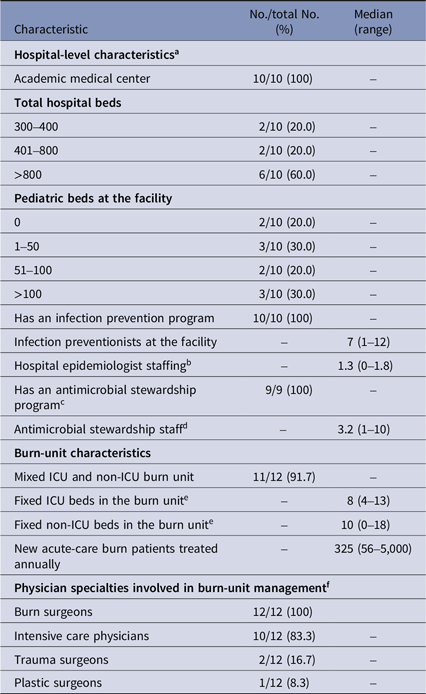
Characteristics of the responding facilities and burn units are summarized in Table 1. Most facilities had mixed burn units that included both intensive care unit (ICU) and non-intensive care unit beds. All burn units were managed by burn surgeons, and most were also managed by intensive care physicians.
Characteristics of responding facilities and burn units

Table 1. Long description
The table summarizes characteristics of responding facilities and burn units. It has 3 sections and 12 rows and 3 columns. The first section, Hospital-level characteristics, includes rows for Academic medical center, Total hospital beds, Pediatric beds at the facility, Has an infection prevention program, Infection preventionists at the facility, Hospital epidemiologist staffing, Has an antimicrobial stewardship program, and Antimicrobial stewardship staff. The second section, Burn-unit characteristics, includes rows for Mixed ICU and non-ICU burn unit, Fixed ICU beds in the burn unit, Fixed non-ICU beds in the burn unit, and New acute-care burn patients treated annually. The third section, Physician specialties involved in burn-unit management, includes rows for Burn surgeons, Intensive care physicians, Trauma surgeons, and Plastic surgeons. Each row provides the number and percentage of facilities or units with the specified characteristic, along with the median and range where applicable.
ICU, intensive care unit.
aTen facilities entered data for hospital-level characteristics.
bNine facilities provided a hospital epidemiologist staffing value.
cNine facilities selected “Yes”.
dTen facilities provided antimicrobial stewardship staffing information.
eEleven facilities responded.
fMultiple responses were allowed.
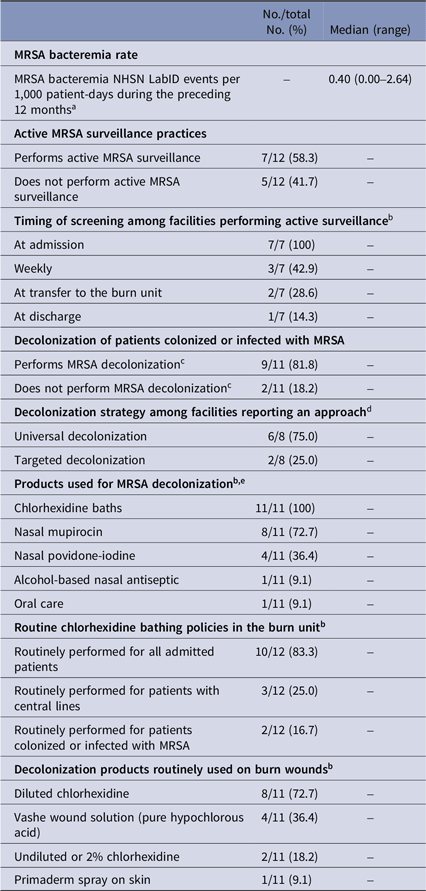
MRSA surveillance, decolonization, and wound-care practices are summarized in Table 2. Seven of 12 facilities performed active MRSA surveillance. Among facilities performing active surveillance, all screened patients at admission, and three also performed weekly screening. Most responding facilities reported decolonizing patients colonized or infected with MRSA with universal decolonization more common than targeted decolonization. Chlorhexidine baths and nasal mupirocin were the most reported products used for MRSA decolonization. Most facilities routinely performed chlorhexidine bathing for all admitted patients. Diluted chlorhexidine and pure hypochlorous acid wound solution were the most commonly reported products routinely used on burn wounds. The median MRSA bacteremia rate reported by nine facilities was 0.400 per 1,000 patient-days.
MRSA surveillance, decolonization, and wound-care practices in responding burn units

Table 2. Long description
A table with 12 rows and 3 columns summarizing MRSA surveillance, decolonization, and wound-care practices in burn units. The columns are labeled ‘No./total No. (%)’, ‘Median (range)’, and the row labels include various practices and their corresponding data. Row 1: MRSA bacteremia rate, MRSA bacteremia NHSN LabID events per 1,000 patient-days during the preceding 12 months, 0.40 (0.00-2.64). Row 2: Performs active MRSA surveillance, 7/12 (58.3), -. Row 3: Does not perform active MRSA surveillance, 5/12 (41.7), -. Row 4: At admission, 7/7 (100), -. Row 5: Weekly, 3/7 (42.9), -. Row 6: At transfer to the burn unit, 2/7 (28.6), -. Row 7: At discharge, 1/7 (14.3), -. Row 8: Performs MRSA decolonization, 9/11 (81.8), -. Row 9: Does not perform MRSA decolonization, 2/11 (18.2), -. Row 10: Universal decolonization, 6/8 (75.0), -. Row 11: Targeted decolonization, 2/8 (25.0), -. Row 12: Chlorhexidine baths, 11/11 (100), -. Row 13: Nasal mupirocin, 8/11 (72.7), -. Row 14: Nasal povidone-iodine, 4/11 (36.4), -. Row 15: Alcohol-based nasal antiseptic, 1/11 (9.1), -. Row 16: Oral care, 1/11 (9.1), -. Row 17: Routinely performed for all admitted patients, 10/12 (83.3), -. Row 18: Routinely performed for patients with central lines, 3/12 (25.0), -. Row 19: Routinely performed for patients colonized or infected with MRSA, 2/12 (16.7), -. Row 20: Diluted chlorhexidine, 8/11 (72.7), -. Row 21: Vashe wound solution (pure hypochlorous acid), 4/11 (36.4), -. Row 22: Undiluted or 2 percent chlorhexidine, 2/11 (18.2), -. Row 23: Primaderm spray on skin, 1/11 (9.1), -.
CHG, chlorhexidine; MRSA, methicillin-resistant Staphylococcus aureus; NHSN, National Healthcare Safety Network.
aNine facilities provided both patient-day data and a numeric MRSA bacteremia count. Rates were calculated as the number of MRSA bacteremia NHSN LabID events per 1,000 patient-days.
bMultiple responses were permitted.
cOne facility selected “Don’t know” and was excluded from the denominator. One facility selected “Other” and specified universal decolonization of all patients; this response was categorized as performing decolonization.
dEight facilities reported a decolonization strategy. One free-text response specifying universal decolonization of all patients was categorized as universal decolonization.
eEleven facilities selected at least one product in response to the MRSA-decolonization products question.
Discussion
This pilot survey evaluated MRSA prevention practices in 12 US burn units through the SHEA Research Network. It demonstrated substantial variability in surveillance, decolonization, and wound-care practices. This variation may reflect the limited burn-specific evidence base and reliance on practices extrapolated from general ICU infection prevention practices.
Burn patients are highly susceptible to infection with multidrug-resistant organisms due to loss of the skin protective barrier, need for invasive devices and mechanical ventilation, repeated wound excision and grafting surgeries, antibiotic exposures, and prolonged hospitalizations. Reference van, Gagnon and Conrad1,Reference Lachiewicz, Hauck, Weber, Cairns and van Duin3 MRSA is one of the most frequently encountered pathogens in burn wounds. Infections caused by MRSA can be severe and associated with sepsis, surgical graft loss, prolonged hospital length of stay, and increased mortality, especially in high-percent total body surface area burns. Reference Kalligeros, Shehadeh, Karageorgos, Zacharioudakis and Mylonakis4 Colonization is often associated with subsequent MRSA infection in this population. Reference Pangli and Papp5 Thus, early identification and reduction of MRSA colonization to prevent infection is an important target in this population. In this study, the median MRSA bacteremia rate reported by nine facilities was 0.400 per 1,000 patient-days, with variation between centers. The factors contributing to this variation were not assessed.
Nasal decolonization, universal skin decolonization, routine surveillance, and multimodal MRSA IP bundles have been assessed, each in small, single-center studies but mostly in non-burn ICU populations. Reference Huang6,Reference Huang, Septimus and Kleinman7 While these approaches may support reductions in MRSA transmission and infection, there is limited evidence to support each of these IP practices either separately or combined in burn patients. Reference Xun, Modica and Payne8 Burn patients notably differ from typical ICU patients due to open wounds and specialized wound-care practices, and evidence from ICU populations may not be fully generalizable to burn units.
The most common interventions utilized for decolonization, chlorhexidine baths and nasal mupirocin, mirror strategies utilized in ICU infection prevention bundles. More research is needed about the frequency with which surveillance should occur and regarding the practice of decolonization. Finally, burn units also reported using different antiseptic agents during wound care, including diluted or undiluted chlorhexidine, pure hypochlorous acid, and specific wound cleanser sprays. These varied practices may reflect different institutional wound care protocols or surgeon preferences. There are limited data comparing these different wound care antiseptics specifically for MRSA prevention, although small studies exist comparing some products with sterile saline. Notably, chlorhexidine, which was used by many burn centers for open wounds, may be associated with cytotoxicity and chemical burns, although clinical data in burn wounds are limited. Reference Abdel-Sayed, Tornay, Hirt-Burri, de Buys Roessingh, Raffoul and Applegate9 The successful application of universal decolonization with intra-nasal mupirocin and hypochlorous acid bathing in burn patients has been described in a single-center retrospective study. Reference Gray, Foster and Cruz10 There is also a registered randomized controlled trial comparing sterile saline, chlorhexidine, and pure hypochlorous acid in children with burn wounds (NCT06941571).
Limitations of this survey-based study include response and sampling biases. Survey response was modest, and those who responded may reflect different medical center types or resources compared with those who did not. The responding institutions for which hospital type was reported included a select group of US academic medical centers. Only SRN-affiliated centers were surveyed, which may not capture a representative cohort of American Burn Association-verified burn centers. In addition, survey responses were self-reported and were not independently validated. Responses varied by survey item, resulting in changing denominators. The survey assessed reported practices but did not measure adherence to these practices or determine whether specific practices were associated with lower MRSA bacteremia rates or other patient outcomes.
Burn units currently rely on institution-specific MRSA prevention strategies, and a lack of standardized guidance may lead to varied prevention practices. Therefore, prospective, multicenter studies are needed to assess these variations and standardize best practices. These studies should inform guidance about the utility of active versus passive surveillance, universal versus targeted decolonization, and the effectiveness of antiseptic wound care agents for prevention of MRSA infections.
Supplementary material
The supplementary material for this article can be found at https://doi.org/10.1017/ash.2026.10873.
Acknowledgements
The authors would like to thank Kristy Weinshel, MBA from Society of Healthcare Epidemiology of America for her involvement with the Burn Infection Prevention and Control Special Interest Group. We would also like to thank Nkechi N. Emetuche, MPH and Valerie M. Deloney, MBA for their help with implementing the SRN survey.
Financial support
None.
Competing interests
None of the authors have any relevant conflicts of interest.


 Open access

