1. INTRODUCTION
Japanese is a strictly head-final language with SOV word order, wh-in-situ, and postpositions, and hence its Head-External Relative Clauses (HERCs), along with attributive adjectives, are prenominal, conforming to Bach's Generalization (Bach Reference Bach1971) and Greenberg's implicational universal, cited in (2) below. In (1), the relativized head NP negi ‘scallion’ follows the relative clause.Footnote 2
(1) Head-External Relative Clauses (HERCs; prenominal) [[e i komakaku kizan-da] negii]-o tukat-ta. finely cut-pst scallion-acc use-pst‘I used the scallions that were cut finely.’
(2) Universal 24 (Greenberg Reference Greenberg and Greenberg1963: 91)
If the relative expression precedes the noun either as the only construction or as an alternate construction, either the language is postpositional, or the adjective precedes the noun or both.
In addition to prenominal HERCs, Japanese allows Head-Internal Relative Clauses (HIRCs; see Kuroda Reference Kuroda1974, Reference Kuroda1992, Reference Kuroda, Kuroda and Nakamura1999, Reference Kuroda2008; Hiraiwa Reference Hiraiwa, Schardl, Walkow and Abdurrahman2009; Bodomo & Hiraiwa Reference Bodomo and Hiraiwa2010, among many others). An HIRC is a relative clause in which the relativized head noun remains in-situ with its original case marking retained. In (3), the head noun negi ‘scallion’ appears in the object position of the embedded predicate kizan-da ‘cut-pst’ and hence must take the accusative case particle -o. In addition, the fact that it is preceded by the adverb komakaku ‘finely’ clearly indicates that it is structurally internal to the relative clause.
(3) Head-Internal Relative Clauses (HIRCs) [komakaku negi-o kizan-da no]-o tukat-ta.finely scallion-acc cut-pst NO2-acc use-pst‘I used the scallions that were cut finely.’
Case marking does not change even if the head noun is scrambled to the left of the adverb.
(4) HIRC [negi-oi komakaku ti kizan-da no]-o tukat-ta.scallion-acc finely cut-pst NO2-acc use-pst‘I used the scallions that were cut finely.’
However, Japanese has another peculiar type of relative clause – prima facie ‘left-headed’ relative clauses that Kuroda (Reference Kuroda1974, Reference Kuroda1975–76, 1976–77, 1992) called no-introduced relatives (hereafter No-RCs) and de-introduced relatives (hereafter De-RCs), exemplified in (5a) and (5b), respectively.
- (5)
(a) No-RC [negi-no komakaku kizan-da no]-o tukat-ta.scallion-NO1 finely cut-pst NO2-acc use-pst‘I used the scallions that were cut finely.’
(b) De-RC [negi-de komakaku kizan-da no]-o tukat-ta.scallion-DE finely cut-pst NO2-acc use-pst‘I used the scallions that were cut finely.’
In each example, the head of the relative clause is a thematic object of the transitive verb kizan-da ‘cut-pst’, which is usually marked by the accusative case particle -o, as we have seen in (3). In (5a), however, the head of the relative clause negi ‘scallions’ is located at the left periphery and marked by no, which is homophonous with the genitive case particle no. Similarly, in (5b), the head of the relative clause is marked by de. Kuroda called such relative clauses ‘left-headed’.
Ever since Kuroda's initial work, the phenomena have not been extensively addressed (see Martin Reference Martin1975, Kitagawa Reference Kitagawa1977 and Tsubomoto Reference Tsubomoto1981 for some sporadic discussions). These relative clauses are of special interest because what looks like the syntactic head noun, with the interesting markers no and de, is located at the left edge of the relative clause. No in Japanese is notoriously multifunctional: it is a genitive case particle, a complementizer, a pronoun, and sometimes even a copula. Likewise, de is also ambiguous: it is a copula, an instrumental, a locative, a verbal coordinator, and so on. The main aim of this paper is to uncover the syntax of these relative clauses and the nature of no and de found in them.
Let us look at the schema in (6) below. In the discussion that follows, I will call the DPs headed by no 1 and de a no-introduced NP and a de-introduced NP, respectively. The element no 2 at the end of the relative clause will be called a post-relativeNO. These two instances of no will be glossed as NO1 and NO2, respectively, to avoid an a priori conclusion about the nature of these elements for the moment.
(6) The schematic structure of No-RCs and De-RCs
[np-no 1/de … V no 2]
The main issue that I will address in this article are summarized in (7).
- (7)
(a) The syntactic structures of No-RCs and De-RCs (i.e. the positions of the no- introduced NP and the de-introduced NP).
(b) The syntactic identities of no 1 and de.
(c) The syntactic identity of the post-relative no 2.
(d) The derivation of these two types of relative clause.
Specifically, I will argue that No-RCs are derived by DP-internal inversion mediated by a silent linker head. On the other hand, following Kuroda (Reference Kuroda1992), I will argue, with substantial evidence, that De-RCs are concealed conjoined relative clauses. In other words, I will demonstrate that both relative clauses are syntactically externally-headed. The syntactic structures are represented below (we will consider the light noun projection (nP) later, in Section 3).
(8) No-RCs


(9) De-RCs
As I will show, counterparts of No-RCs and De-RCs are not found in other East Asian languages – Korean and Mandarin Chinese (and Taiwanese). Thus, it is important to uncover the principle that is involved in the difference between Japanese and those languages.
The organization of this article is as follows. Section 2 overviews previous studies and discusses the syntactic position of the no-introduced and de-introduced NPs. Section 3 proposes analyses of No-RCs and De-RCs. Sections 4 and 5 examine their syntactic structures in detail. Section 6 shows that Korean and Chinese have no counterparts of No-RCs and De-RCs, and links their absence to the absence of the appositive X-Gen Y constructions. Section 7 concludes the article.
2. Previous analyses of No-RCs and De-RCs
2.1 Kuroda (Reference Kuroda1974, Reference Kuroda1975–76, Reference Kuroda1976–77)
In a series of papers in the 1970s, S.-Y. Kuroda investigated No-RCs and De-RCs for the first time in a generative framework. To the best of my knowledge, there is no other detailed work on these constructions in other frameworks, and his work still remains the only extensive study to date (but see Ishigaki Reference Ishigaki1955 and Kondo Reference Kondo2000 for some important observations about No-RCs).
Kuroda (Reference Kuroda1975–76) focused more on semantic/pragmatic differences between these two types of relative clause and HIRCs than on their syntax. Kuroda (Reference Kuroda1976–77) took up the issue of the syntactic status of no 2 and proposed an important syntactic analysis, shown in (11) below, of a No-RC in (10), which involves ‘a major constituent break’ (Kuroda Reference Kuroda1976–77: 169) between the no-introduced NP and the rest. Thus, in the surface structure (11b), Kuroda placed the no-introduced NP outside the relative clause S. He proposed that the surface form obtains by applying Equi-NP deletion to the underlying form (11a), which deletes the second NP.
(10) No-RC [ringo-no aka-i no]-o tabe-ta.apple-NO1 red-pres NO2-acc eat-pst‘I ate a red apple.’
(11) Kuroda's (Reference Kuroda1976–77) derivation of No-RCs
(a) [NP [NP NP ] [S NP...V ] no]
(b) [NP [NP NP ] [SNP … V ] no] (Equi-NP deletion)
While his insight that the no-introduced NP is syntactically located outside the relative clause turns out to be significant and correct, Kuroda did not provide evidence for the structure that he proposed. Furthermore, the status of no 1 is left unclear. From a viewpoint of the goal of syntactic theory, an explanation of the principles that make the structure (11b) possible was missing.
Kuroda (Reference Kuroda1965: 121), on the other hand, suggested a possibility of inversion very briefly.
- (12)
(a) No-RC [ringo-no aka-i no]-o tabe-ta.apple-NO1 red-pres NO2-acc eat-pst‘I ate a red apple.’
(b) HERC [aka-i ringo]-o tabe-ta.red-pres apple-acc eat-pst‘I ate a red apple.’
He wrote: ‘[t]he above form [(12a)] has an inverted order and is clearly related to the normal form [(12b)]’. However, details were not made explicit and the analysis was not developed further in his subsequent work. In the rest of this article, I will fully develop this inversion analysis, taking Kuroda's insight as a starting point and providing substantial evidence.
As noted by Kuroda (Reference Kuroda1974: 69; 1992: 162–166), there are other traditional analyses. One possibility is to take no 1 to be a genitive case marker and the other is to regard no 1 either as an adnominal form or a continuative/participial form of the copula da (assimilating it structurally to an analysis of De-RCs, as I will show in Section 4.1 below). The latter analysis was proposed in Martin (Reference Martin1975) and Kitagawa (Reference Kitagawa1977). I will demonstrate, however, that these analyses cannot be maintained on empirical grounds.Footnote 3
Regarding De-RCs, Kuroda (Reference Kuroda1976–1977) proposed a conjunction structure, which I will eventually adopt later in this article. Under this analysis, de is taken to be a continuative form of the copula da.
(13) De-RC [[CP2 [CP1 proi ringo-de] [CP2 aka-i]] noi]-o tabe-ta. apple-DE red-pres NO2-acc eat-pst‘I ate a red apple.’ (Lit.: ‘I ate a thing that is an apple and that is red.’)
But again, substantial evidence was lacking. Thus, I will investigate the structure in detail and provide substantial empirical evidence.
2.2 Certain differences between No-RCs/De-RCs and HIRCs
At first sight, the surface sequences of No-RCs, De-RCs, and HIRCs look quite similar. Therefore, I will first establish that No-RCs and De-RCs are not HIRCs syntactically as well as semantically.
2.2.1 The Relevancy Condition
Initially, the semantic interpretations of these three types of relative clauses, exemplified in (14), seem to be the same.
- (14)
(a) HIRC [negi-o komakaku kizan-da no]-o tukat-ta.scallion-acc finely cut-pst NO2-acc use-pst‘I used the scallions that were cut finely.’
(b) No-RC [negi-no komakaku kizan-da no]-o tukat-ta.scallion-NO1 finely cut-pst NO2-acc use-pst‘I used the scallions that were cut finely.’
(c) De-RC [negi-de komakaku kizan-da no]-o tukat-ta.scallion-DE finely cut-pst NO2-acc use-pst‘I used the scallions that were cut finely.’
However, as the data in (15) illustrate, not all the HIRCs can be paraphrased by No/De-RCs. The HIRC example (15a) is ungrammatical, whereas the No-RC and the De-RC in (15b) and (15c) are well-formed.
(15)
(a) HIRC *[ookinaringo-ga oisisoona no]-o tabe-ta.big apple-nom tasty.looking NO2-acc eat-pst‘I ate the big apple that looks tasty.’
(b) No-RC [ookina ringo-no oisisoona no]-o tabe-ta.big apple-NO1 tasty.looking NO2-acc eat-pst‘I ate the big apple that looks tasty.’
(c) De-RC [ookinaringo-de oisisoona no]-o tabe-ta.big apple-DE tasty.looking NO2-acc eat-pst‘I ate the big apple that looks tasty.’
Kuroda (Reference Kuroda1974) observed that HIRCs are subject to a certain semantico-pragmatic condition. Consider the acceptability contrast below.
- (16)
(a) HIRC *Ken-wa [ringo-ga kinoo todoi-ta no]-o tot-ta.Ken-top apple-nom yesterday arrive-pst NO2-acc pick.up-pst‘Ken picked up the apple that arrived yesterday.’
(b) HERC Ken-wa [kinoo todoi-ta ringo]-o tot-ta.Ken-top yesterday arrive-pst apple-acc pick.up-pst‘Ken picked up the apple that arrived yesterday.’
Kuroda proposed what he called the Relevancy Condition (cited in (17) below) and attributed the ungrammaticality of an HIRC like (16a) to this condition (see also Hoshi Reference Hoshi1995 and Shimoyama Reference Shimoyama1999 for discussions of the Relevancy Condition). In (16a), the embedded clause and the matrix clause are not ‘tightly connected’ and hence the sentence is not felicitous. This is because the event time of the HIRC is distant from the event time of the matrix clause. In contrast, the HERC sentence (16b) is perfectly well-formed.
(17) The Relevancy Condition (Kuroda Reference Kuroda1975–76: 86)
For a p.-i. [i.e. pivot-independent – KH] relative clause to be acceptable, it is necessary that it be interpreted pragmatically in such a way as to be directly relevant to the pragmatic content of its matrix clause.
However, Kuroda (Reference Kuroda1975–76: 93) made an important observation that No-RCs and De-RCs, exemplified in (18), are not subject to the Relevancy Condition. In other words, they pattern with the HERC, like that in (16b) above.
(18)
(a) No-RC Ken-wa [ringo-no kinoo todoi-ta no]-o tot-ta.Ken-top apple-NO1 yesterday arrive-pst NO2-acc pick.up-pst‘Ken picked up the apple that arrived yesterday.’
(b) De-RC Ken-wa [ringo-de kinoo todoi-ta no]-o tot-ta.Ken-top apple-DE yesterday arrive-pst NO2-acc pick.up-pst‘Ken picked up the apple that arrived yesterday.’
This establishes that No-RCs and De-RCs are syntactically distinct from HIRCs.
2.2.2 Head positions and the left periphery
As I have already mentioned, at first sight, No-RCs are similar to HIRCs. Given a pair of sentences like those in (19), one might entertain a possibility that the No-RC in (19b) is derived by applying the Nominative–Genitive Conversion (ga/no conversion) to an HIRC (see Harada Reference Harada1971, Reference Harada1976; Watanabe Reference Watanabe1996; Hiraiwa Reference Hiraiwa2005; for discussion see also Kuroda Reference Kuroda1992: 155–157).
(19) Nominative–Genitive Conversion
(a) Naomi-wa [ringo-ga sara-no ue-ni oite-at-ta no]-o tabe-ta.Naomi-top apple-nom plate-gen on-loc put-be-pstc.acc eat-pst‘Naomi ate the apple that was put on the plate.’
(b) Naomi-wa [ringo-no sara-no ue-ni oite-at-ta no]-o tabe-ta.Naomi-top apple-gen plate-gen on-loc put-be-pstc.acc eat-pst‘Naomi ate the apple that was put on the plate.’
Nominative–Genitive Conversion is a phenomenon in which the nominative case marking alternates with the genitive case marking in certain syntactic structures (typically relative clauses) (see Harada Reference Harada1971). However, it is well known that Nominative–Genitive Conversion only applies to nominative elements. In other words, Accusative–Genitive Conversion is generally ungrammatical in Japanese. In contrast, in No-RCs, a no-introduced NP can be an object, as we have already seen in (5a). Thus, the No-RC in (5a) cannot be an instance of Nominative–Genitive Conversion).Footnote 4 Similarly, the grammatical example (18b) cannot be derived by Nominative–Genitive Conversion because its nominative counterpart, (16a), is ungrammatical due to the Relevancy Condition. Thus, because Nominative–Genitive Conversion cannot account for the derivation of all No-RCs, it follows that no in the No-RCs is not a simple genitive case particle.Footnote 5
However, for such examples as (19), for which the Relevancy Condition is irrelevant, distinguishing between the two different structures – a No-RC and an HIRC with Nominative–Genitive Conversion – is not simple. Thus, we need to seek another syntactic test.
As briefly noted by Kuroda (Reference Kuroda1975–76: 94), the no-introduced and de-introduced NPs cannot remain in their original positions (see also Kuroda Reference Kuroda1974: 64–65 for some observations on Classical Japanese). Thus, they are obligatorily placed at the left periphery of the clause, as shown in (20). Notice that the no-/de-introduced NPs cannot follow the subject, while such a restriction does not apply to HIRCs, as shown by the grammaticality of the accusative version, marked with -o, in (20a).Footnote 6
(20)
(a) In-situ [Ken-ga negi-o/*no/*de kizan-da no]-o tukat-ta.Ken-nom scallion-acc/NO1/DE cut-pst NO2-acc use-pst‘I used the scallions that Ken cut finely.’
(b) Left-dislocated [negi-o/no/de Ken-ga kizan-da no]-o tukat-ta.scallion-acc/NO1/DE Ken-nom cut-pst NO2-acc use-pst‘I used the scallions that Ken cut finely.’
The example in (20b) does not tell us where the dislocated no-/de-introduced NPs are located, although it at least shows that they must be located above TP. However, there is good evidence indicating that their position, in contrast with the position of the internal head of HIRCs, is outside of the relative clause. This can be shown by the fact that none of the elements internal to the relative clause can precede the no-/de-introduced NPs. As shown in (21c) and (21d), an adverb (high or low) cannot be scrambled to the left of the no-/de-introduced NP, in contrast with the HIRC counterpart (21b).
(21) Adverbs
(a) [negi-o/no/de komakaku kizan-da no]-o tukat-ta.scallion-acc/NO1/DE finely cut-pst NO2-acc use-pst‘I used the scallions that were cut finely.’
(b) HIRC [komakakui negi-oti kizan-da no]-o tukat-ta.finely scallion-acc cut-pst NO2-acc use-pst‘I used the scallions that were cut finely.’
(c) No-RC *komakakui negi-no ti kizan-da no-o tukat-ta.finely scallion-NO1 cut-pst NO2-acc use-pst‘I used the scallions that were cut finely.’
(d) De-RC *komakakui negi-de ti kizan-da no-o tukat-ta.finely scallion-DE cut-pst NO2-acc use-pst‘I used the scallions that were cut finely.’
The examples in (22) illustrate the same point with an instrumental expression.
(22) Instrumentals
(a) [ninniku-o/no/de hootyoo-de mizingiri-ni si-ta no]-o tukat-ta.garlic-acc/NO1/DE kitchen.knife-with mince.cut-dat do-pst NO2-acc use-pst‘I used the garlic minced with the knife.’
(b) HIRC [hootyoo-dei ninniku-o ti mizingiri-ni si-ta no]-o tukat-ta.kitchen.knife-with garlic-acc mince.cut-dat do-pst NO2-acc use-pst‘I used the garlic minced with the knife.’
(c) No-RC *[hootyoo-dei ninniku-no ti mizingiri-ni si-ta no]-o tukat-ta.kitchen.knife-with garlic-NO1 mince.cut-dat do-pst NO2-acc use-pst‘I used the garlic minced with the knife.’
(d) De-RC *[hootyoo-dei ninniku-de ti mizingiri-ni si-ta no]-o tukat-ta.kitchen.knife-with garlic-DE mince.cut-dat do-pst NO2-acc use-pst‘I used the garlic minced with the knife.’
Now returning to (19a, b), we can establish the syntactic structure of these sentences by placing another element to the left of the genitive phrase. Below, a locative phrase is scrambled to the position preceding the genitive phrase. The fact that (23b) is still grammatical means that it is an instance of Nominative–Genitive Conversion, not a No-RC).Footnote 7
(23) Nominative–Genitive Conversion and HIRC
(a) Naomi-wa [[sara-no ue-ni]iringo-ga ti oite-at-ta no]-o tabe-ta.Naomi-top plate-gen on-loc apple-nom put-be-pst NO2-acc eat-pst‘Naomi ate the apple that was put on the plate.’
(b) Naomi-wa [[sara-no ue-ni]iringo-no ti oite-at-ta no]-o tabe-ta.Naomi-top plate-gen on-loc apple-gen put-be-pst NO2-acc eat-pst‘Naomi ate the apple that was put on the plate.’
Diachronic evidence also corroborates the conclusion that No-RCs are guaranteed by a mechanism different from one that is responsible for HIRCs. Kondo (Reference Kondo2000) notes that No-RCs as well as HERCs, but not HIRCs, are found as early as in the Nara period (the 8th century). Watanabe (Reference Watanabe2004) observes that HIRCs only appeared later, in the Heian period (the 9th–12th centuries), at the time of the loss of overt wh-movement in Japanese.Footnote 8
To summarize, the above discussion leads us to the structure in (24).
(24)
The fact that no other elements of the relative clause can be scrambled to the front of the no-/de-introduced NPs and that no-/de-introduced NPs lose their original clause-internal case marking shows clearly that the head noun NP-no/-de is syntactically outside of the relative clause CP.
3. A proposal
3.1 Linker and copula
In this article, I will demonstrate that no 1 in No-RCs is a linker, whereas de in De-RCs is a continuative/participial form of the copula da.
(25) Proposal: no≠de
(a) No 1 is a linker.
(b) De is a continuative/participial form of the copula (Kuroda Reference Kuroda1976–77, Reference Kuroda1992).
The proposal is significant because of the polyfunctionality of the particles no and de in the grammatical system of Japanese.
De in Japanese may be a postposition, with locative and instrumental meanings, as illustrated in (26). It may also be the surface realization of the verbal coordinator te, the voiced form de appearing after a nasal, as in (27).
(26)
(a) De as a locative postposition Ken-ga Tsukiji-de sushi-o tabe-ta.Ken-nom Tsukiji-in sushi-acc eat-pst‘Ken ate sushi in Tsukiji.’
(b) De as an instrumental postposition Ken-ga te-de sushi-o tabe-ta.Ken-nom finger-with sushi-acc eat-pst‘Ken ate sushi with his fingers.’
(27) De as a verbal coordinator Ken-wa koron-de nai-ta.Ken-top fall-and cry-pst‘Ken fell down and cried.’
In the following sections, I will argue that de in De-RCs is not any one of these elements and is a continuative/participial form of the copula da, as exemplified by (28).
(28) Copula Naomi-wa gakusee-de mazimena zyosee da.Naomi-top student-cop honest woman cop‘Naomi is a student and an honest woman.’
The particle no in Japanese is also a multifunctional category (see Tsubomoto Reference Tsubomoto1981; Kitagawa & Ross Reference Kitagawa and Ross1982; Tonoike Reference Tonoike1990; Murasugi Reference Murasugi1991; Kuroda Reference Kuroda1992, Reference Kuroda, Kuroda and Nakamura1999; Kinsui Reference Kinsui1995; Horie Reference Horie and Ohori1998; Hiraiwa Reference Hiraiwa, Guerzoni and Matushansky2001, Reference Hiraiwa2005; Watanabe Reference Watanabe2010, among others). Even in a rough classification, it has three main functions.
(29) The functions of no in Japanese
(a) Genitive case marker
(b) Pronoun
(c) Complementizer/nominalizer
No as a genitive case marker can encode various semantic relations. Some examples are given in (30).
(30)
(a) (In)alienable possession Ken-no meKen-gen eyes‘Ken's eyes’
(b) Location Kyoto-no oziKyoto-gen uncle‘my uncle in Kyoto’
(c) Time aki-no hiautumn-gen day‘an autumn day’
(d) Object tosi-no hakaicity-gen destruction‘the destruction of the city’
In addition to its use as a genitive case marker, no is also used as a pronoun and a complementizer/nominalizer:
(31)
(a) Pronoun akai kuruma/nored car/gen‘the red car/one’
(b) Complementizer/Nominalizer Ken-wa [Naomi-ga basu-ni noru no]-o mi-ta.Ken-top Naomi-nom bus-dat ride c.acc see-pst‘Ken saw Naomi ride on the bus.’
Regarding the genitive particle no in No-RCs, I propose, however, that it is a linker, different from the uses above but identical to the following use:
(32) Linker negi-no mizingiriscallion-NO1 mince.cut‘minced scallions’
3.2 The post-relative no2
In addition to the status of no 1 and de at the left periphery in No-RCs and De-RCs, there is another important question, one about the nature of the right-peripheral no 2. This no 2 is obligatory in No-RCs and De-RCs, as well as in HIRCs.
The status of this element has been in debate since Okutsu (Reference Okutsu1974). It is well known that such an element is required when a head noun is omitted, leaving adjectives or relative clauses behind. Thus, it has been often considered to be a pronoun.
(33)
(a) akai krumared car‘a red car’
(a′) akai *(no)red NO2‘a red one’
(b) Ken-ga kyonen ka-ta kuruma.Ken-nom last.year buy-pst car‘the car that Ken bough last year’
(b′) Ken-ga kyonen ka-ta *(no)Ken-nom last.year buy-pst NO2‘the one that Ken bough last year’
Following Okutsu (Reference Okutsu1974), Murasugi (Reference Murasugi1991), and, in particular, the suggestion in Kuroda (Reference Kuroda1965: 121), I assume that no is a pronoun, inserted whenever an NP is missing. I will specifically assume, however, that it is inserted into n, which is located between the NP projection and the DP projection, as is shown in (34).
(34)
In other words, in the diagram above, no is a pro-form of the NP.
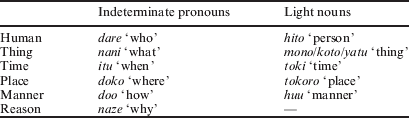
In No-RCs and De-RCs, no 2 can be replaced with what I call a light noun (see Hiraiwa Reference Hiraiwa2010). It can be an element such as yatu or mono ‘thing’ but cannot be the same noun as the one in the no-introduced NP (see Kuroda Reference Kuroda1992). Nor can it be replaced with a normal noun such as negi ‘scallion’ or yasai ‘vegetable’.Footnote 9, Footnote 10 Examples (35) and (36) illustrate these patterns.
(35) No 2 and substitution (No-RCs)
(a) [negi-no komakaku kizan-da no]scallion-NO1 finely cut-pst NO2‘The scallions that were cut finely.’
(b) [negi-no komakaku kizan-da yatu/mono]scallion-NO1 finely cut-pst thing/thing‘The scallions that were cut finely.’
(c) *[negi-no komakaku kizan-da negi/yasai]scallion-NO1 finely cut-pst scallions/vegetable‘The scallions that were cut finely.’
(36) No 2 and substitution (De-RCs)
(a) [negi-de komakaku kizan-da no]scallion-DE finely cut-pst NO2‘The scallions that were cut finely.’
(b) [negi-de komakaku kizan-da yatu/mono]scallion-DE finely cut-pst thing/thing‘The scallions that were cut finely.’
(c) [negi-de komakaku kizan-da ??negi/*yasai]scallion-DE finely cut-pst scallions/vegetable‘The scallions that were cut finely.’
Thus, no 2 (like other light nouns) is syntactically distinct from an ordinary N. The pronominal no 2 and the light nouns mono/yatu share one important distributional feature: namely, they cannot be used alone. They are bound morphemes in that they require modifiers, as shown in (37). This makes it reasonable to place modifiers in the nP domain, as indicated in (34) above. Therefore, I take (some but not all of) the light nouns to be a kind of pronoun because their exact reference must be supplied by their antecedent. In this respect, they are similar to the anaphoric pronoun one in English (thanks to an anonymous JL referee for pointing this out to me), although even more restricted in their distribution, as (37b) is unacceptable in Japanese, while one in this context is fine in English.
(37)
(a) boku-wa [oisii no/mono/yatu]-o tabe-ta.1sg.top tasty NO2/thing/thing-acc eat-pst‘I had a tasty one.’
(b) *boku-wa [no/mono/yatu]-o tabe-ta.1sg.top NO2/thing/thing-acc eat-pst‘I had one.’
(c) boku-wa [negi/yasai]-o tabe-ta.1sg.top scallion/vegetable-acc eat-pst‘I had scallions/vegetables.’
It has been well known that the pronoun no 2 in Japanese cannot refer to humans without a pejorative implication (McGloin Reference McGloin1985, Kinsui Reference Kinsui1995). Kuroda (Reference Kuroda1976–77) observed that the post-relative no 2 in De-RCs is a pronoun, whereas he does not draw a conclusion about the status of no 2 in No-RCs. Given examples like those in (38), it may appear that no 2 in No-RCs and De-RCs is not completely incompatible with human antecedents.
(38)
(a) HERC [atama-ga ii gakusee]-ga happyoo-si-ta.brain-nom good student-nom presentation-do-pst‘A brilliant student presented a paper.’
(b) HERC (no 2) ?[atama-ga ii no]-ga happyoo-si-ta.brain-nom good NO2-nom presentation-do-pst‘A brilliant one presented a paper.’
(c) No-RC (no 2) ?[gakusee-no atama-ga ii no]-ga happyoo-si-ta.student-NO1 brain-nom good NO2-nom presentation-do-pst‘A brilliant student presented a paper.’
(d) De-RC (no 2) ?[gakusee-de atama-ga ii no]-ga happyoo-si-ta.student-DE brain-nom good NO2-nom presentation-do-pst‘A brilliant student presented a paper.’
However, (38b–d) have a sense of arrogance, if not unacceptability, in that no 2 refers to humans as ‘things’. This becomes more explicit when gakusee ‘student’ is replaced with kyoozyu ‘professor’, the referent of the latter regarded as typically more deserving of respect. In this case, the sentences like those in (39b–d) are far less acceptable than those in (38b–d) (see also Kitagawa Reference Kitagawa1977 for some relevant discussion).
(39)
(a) HERC [atama-ga ii kyoozyu]-ga happyoo-si-ta.brain-nom good professor-nom presentation-do-pst‘A brilliant professor presented a paper.’
(b) HERC (no 2) *[atama-ga ii no]-ga happyoo-si-tabrain-nom good NO2-nom presentation-do-pst‘A brilliant one presented a paper.’
(c) No-RC (no 2) *[kyoozyu-no atama]-ga ii no-ga happyoo-si-ta.professor-NO1 brain-nom good NO2-nom presentation-do-pst‘A brilliant professor presented a paper.’
(d) De-RC (no 2) *[kyoozyu-de atama-ga ii no]-ga happyoo-si-ta.professor-DE brain-nom good NO2-nom presentation-do-pst‘A brilliant professor presented a paper.’
In contrast, when kyoozyu ‘professor’ and no co-occur in an HIRC, as in (40), there is no such problem of interpretation because no there is not a pronoun but a complementizer/nominalizer, as is well known (see Kuroda Reference Kuroda1992 and others).
(40) HIRC Ken-wa [kyoozyu-ga tootyaku-si-ta no]-o demukae-ta.Ken-top professor-nom arrive-do-pst NO2-acc meet-pst‘Ken met the professor as he arrived.’
Furthermore, note that mono/yatu cannot be used in HIRCs.
(41) HIRC Ken-ga [teeburu-no ue-ni ringo-ga oite-at-ta no/*yatu/*mono]-o tabe-ta.Ken-nom table-gen on-loc apple-nom put-exist-pst NO2/thing/thing-acc eat-pst‘Ken ate the apple that was put on the table.’
The data suggest that no 2 in No-RCs and De-RCs is a pronoun rather than a complementizer. It should be noted that the sentences in (39c–d) improve when no 2 is replaced with the light noun hito ‘man/person’.
(42)
(a) No-RC ??[kyoozyu-no erasoona hito]-ga ki-ta.professor-NO1 arrogant.looking person-nom come-pst‘An arrogant person who is a professor came.’
(b) De-RC [kyoozyu-de erasoona hito]-ga ki-ta.professor-DE arrogant.looking person-nom come-pst‘An arrogant person who is a professor came.’
In this section, we focused on the syntax of post-verbal no. In No-RCs and De-RCs, no is a pronoun (no 2). Hence it cannot readily refer to humans to whom respect is due, but replacing it with a human light noun improves the sentences. In contrast, the post-verbal no in HIRCs is a complementizer, which is not interchangeable with light nouns.
4. Copula and the structure of De-RCs
In this section I will focus on the syntax of De-RCs, and make some comparisons with No-RCs. Building on four pieces of evidence, I will demonstrate that de in De-RCs is syntactically distinct from no 1 in No-RCs and that De-RCs have a clausal conjunction structure.
4.1 Copula
It is intuitively uncontroversial that de in De-RCs is not an instance of those postpositions that I mentioned in the previous section. Following Kuroda (Reference Kuroda1976–77, Reference Kuroda1992), we assume here that de in De-RCs is a form of the copula da ‘to be’. One piece of evidence for this comes from the fact that de in De-RCs can be paraphrased by a continuative/participial form of the full copula de-ar-u ‘to be’, as shown in (43). The form de-atte consists of a copula de, an existential verb ar-, and a verbal coordinator -te. Although somewhat stilted, the result suggests that de in De-RCs has some affinity with a continuative/participial form of the copula.
(43) De-RC
(a) ringo-de oisisoona no-o tabe-ta.apple-DE tasty.looking NO2-acc eat-pst‘I ate the apple that looked tasty.’
(b) ?ringo-de-atte oisisoona no-o tabe-ta.apple-DE-exist tasty.looking NO2-acc eat-pst‘I ate the apple that looked tasty.’
There are two end forms of the copula in contemporary Japanese. One is da, as in (44a), and the other is de-ar-u, as in (44b). Ar-u is originally a verb of existence, and as a main verb, it is used for inanimate subjects. The continuative/participial form of the copula is de(-atte). As we can see, there is morphological parallel between the De-RCs in (43a,b) and the copula construction in (44c).
(44) Copula (de+aru)
(a) Ken-wa gakusee da.Ken-top student cop‘Ken is a student.’
(b) Ken-wa gakusee de-aru.Ken-top student cop-exist‘Ken is a student.’
(c) Ken-wa gakusee de(-atte) kyoozyu de-wa nai.Ken-top student cop-exist.cont professor cop.topneg.pres‘Ken is a student not a professor.’
The de(-atte) form also appears when coordinated with another clause. In (45a), two CP clauses are conjoined. In (45b), on the other hand, two predicate nominals are conjoined. In either case, the first copula takes the form de(-atte).
(45) Copula
(a) [[Ken-wa gakubusee-de(-atte)], Naomi-wa insee da.Ken-top undergrad-cop-exist.cont Naomi-top grad.student cop‘Ken is an undergraduate student and Naomi is a graduate student.’
(b) Naomi-wa insee-de(-atte), nihonzin da.Naomi-top grad.student-cop-exist.cont Japanese cop‘Naomi is a graduate student and a Japanese.’
Thus, the morphological and distributional evidence gives us a good reason to consider de in De-RCs as a continuative/participial form of the copula with the existential verb dropped. In contrast, the same evidence indicates that no 1 in No-RCs cannot be an (adnominal or continuative/participial) form of the copula.
4.2 Connective katu ‘and’
Another piece of supporting evidence for de being a continuative/participial form of the copula comes from the insertion of the sentential conjunction marker katu ‘and’. The example in (46) shows that De-RCs allow katu to intervene between the left-edge head NP and the rest of the relative clause, but No-RCs do not.
(46) No-RC and De-RC (katu conjunction) ookina ringo-*no/de katu oisisoona no-o tabe-ta.big apple-NO1/DE and tasty.looking NO2-acc eat-pst‘I ate the big apple that looked tasty.’
The fact that de is compatible with the connective katu is parallel to the behavior of the copula da. In (47), two copula phrases are conjoined and the first copula takes the continuative/participial form de(-atte) and the connective katu is licit (compare (45b) above).
(47) Copula (with the conjunction katu ‘and’) Naomi-wa insee-de(-atte) katu nihonzin da.Naomi-top grad.student-cop(-exist.cont) and Japanese cop‘Naomi is a grad student and a Japanese (at the same time).’
In contrast, two genitive phrases cannot usually be coordinated in this way, as shown in (48b). Instead, the entire coordinated phrase receives genitive marking, as shown in (48a). However, NPs can be coordinated, and then katu is obligatory, as in (48c). In contrast, katu is only optional with the copula de, as in (48d).
(48) NP and genitive (katu conjunction)
(a) kono hito-wa [Ken-to Naomi]-no sensee da.this person-top Ken-and Naomi-gen teacher cop‘This person is Ken's and Naomi's teacher.’
(b) *kono hito-wa [Ken-no (katu) Naomi-no] sensee da.this person-top Ken-gen and Naomi-gen teacher cop‘This person is Ken's and Naomi's teacher.’
(c) kono hito-wa [Ken-no sensee *(katu) Naomi-no sensee] da.this person-top Ken-gen teacher and Naomi-gen teacher cop‘This person is Ken's and Naomi's teacher.’
(d) kono hito-wa [Ken-no sensee] de(-atte) (katu) [Naomi-no sensee] da.this person-top Ken-gen teacher cop and Naomi-gen teacher cop‘This person is Ken's and Naomi's teacher.’
The above grammatical examples involving katu show that de in De-RCs is a copula and that no in No-RCs cannot be. Thus, they have totally distinct syntax.
4.3 Predicates and HIRCs
The third piece of evidence for the structure of De-RCs is based on a restriction on HIRCs. Since Kuroda (Reference Kuroda, Kuroda and Nakamura1999), it has been well known that HIRCs cannot appear as predicate nominals. Consider the contrast between and an HIRC and an HERC in (49). In (49a), the HIRC functions as an object. In (49b), on the other hand, the HERC serves as a predicate nominal. However, (49c) shows that the HIRC cannot appear in this position.
(49)
(a) HIRC keesatu-wa [HIRC gootoo-ga ginkoo-kara dete-ki-ta no]-o tukamae-ta.police-top robber-nom bank-from out-come-pst NO2-acc catch-pst‘The police arrested the robber who just came out of the bank.’
(b) HERC and copula ano otoko-ga [HERC ginkoo-kara dete-ki-ta gootoo] desu.dem man-nom bank-from out-come-pst robber cop‘That man is the robber who just came out of the bank.’ (Kuroda Reference Kuroda, Kuroda and Nakamura1999: 54)
(c) HIRC and copula *ano otoko-ga [HIRC gootoo-ga ginkoo-kara dete-ki-ta no] desu.dem man-nom robber-nom bank-from out-come-pst NO2cop‘That man is the robber who just came out of the bank.’ (Kuroda Reference Kuroda, Kuroda and Nakamura1999: 54)
Applying this to the No-RCs and De-RCs reveals that an entire HIRC cannot be in the de-introduced position in De-RCs, as shown in (50b). In contrast, it is felicitous in the no 1-introduced position, as shown in (50c), if not perfect due to the two adjacent instances of no (see Kuroda Reference Kuroda, Kuroda and Nakamura1999).
(50)
(a) No/De-RC and HERC [HERC teeburu-no ue-ni oiteat-ta negi]-no/de komakaku kizan-da no-o tabe-ta. table-gen on-at put-be-pst scallion-/NO1/DE finely cut-pst NO2-acc use-pst‘I used the scallions that were on the table and that were cut finely.’
(b) De-RC and HIRC *[HIRC teeburu-no ue-ni negi-ga oiteat-ta no]-de komakaku kizan-da no-o tabe-ta. table-gen on-at scallion-nom put-be-pst NO2-DE finely cut-pst NO2-acc use-pst‘I used the scallions that were on the table and that were cut finely.’
(c) No-RC and HIRC [HIRC teeburu-no ue-ni negi-ga oiteat-ta no]-no komakaku kizan-da no-o tukat-ta. table-gen on-at scallion-nom put-be-pst NO2-NO1 finely cut-pst NO2-acc use-pst‘I used the scallions that were on the table and that were cut finely.’
Another semantic restriction on predicates is that indefinite pronouns are excluded from the predicate nominal position in Japanese. In (51a), the indefinite pronoun nanika ‘something’ is a predicate in the matrix clause while in (51b), it is a predicate within the relative clause.
(51) Indefinite pronouns and predicates
(a) #sore-wa nanika desu.it-top something cop‘It's something.’
(b) #[[nanika de-aru] mono]something cop-exist thing‘the thing that is something’
The indefinite pronoun nanika expectedly cannot function as a de-introduced NP, while it is fine as a no-introduced NP:
(52)
(a) *nanika-de kizan-da no-o tabe-ta.something-DE cut.finely-pst NO2-acc eat-pst‘I ate something that was cut finely.’
(b) nanika-no kizan-da no-o tabe-ta.something-NO1 cut.finely-pst NO2-acc eat-pst‘I ate something that was cut finely.’
Once again, the data demonstrate that de is a form of the copula, whereas no is not, in support of Kuroda (Reference Kuroda1975–76, Reference Kuroda1992).
4.4 Indefiniteness and predicate nominals
The fourth piece of evidence comes from the fact that certain definite elements are excluded from the de-introduced position. The head noun in HIRCs and the no-introduced NP do not need to be indefinite in Japanese, as shown below.
(53) Definiteness and HIRC [kono/sono/anonegi-o kizan-da no]-o mazete.dem scallion-acc cut-pst NO2-acc mix.imp‘Mix these/the/those scallions that are cut finely.’
(54) Definiteness and No-RC [kono/sono/anonegi-no kizan-da no]-o mazete.dem scallion-NO1 cut-pst NO2-acc mix.imp‘Mix these/the/those scallions that are cut finely.’
In contrast, a de-introduced NP is required to be indefinite and hence is incompatible with demonstratives, as shown below.Footnote 11
(55) Definiteness and De-RC *[kono/sono/anonegi-de kizan-da no]-o mazete.dem scallion-DE cut-pst NO2-acc mix.imp‘Mix these/the/those scallions that are cut finely.’
This suggests, at first sight, that the De-RC is subject to the Indefiniteness Restriction, originally proposed for HIRCs by Williamson (Reference Williamson, Reuland and ter Meulen1987). Williamson (Reference Williamson, Reuland and ter Meulen1987) observes that the internal head noun in HIRCs must be indefinite, as shown in his Lakhota examples in (56).
(56) Lakhota (Williamson Reference Williamson, Reuland and ter Meulen1987: 171)
(a) [Mary owįža wą kağe] ki he ophewathų.Mary quilt id make ddem1sg-buy‘I bought the quilt that Mary made.’
(b) *[Mary owįža ki kağe] ki/k'ų/cha he ophewathų.Mary quilt d make d/d/id.fdem I-buy‘I bought a/the/the [previously mentioned] quilt that Mary made.’
However, as is well known, Japanese HIRCs are in fact immune to the Indefiniteness Restriction (Hoshi Reference Hoshi1995, Kuroda Reference Kuroda, Kuroda and Nakamura1999, Shimoyama Reference Shimoyama1999, among others). As shown in (57), the HIRC with a proper noun as the internal head is grammatical in Japanese.
(57) Definiteness and HIRC Taro-wa [[daidokoro-no mado-kara Lucky-ga haitte ki-ta]-no]-o tukamae-ta.Taro-top kitchen-gen window-from Lucky-nom come.in-pst-NO2-acc catch-pst‘Taro caught Lucky as she came in from the kitchen window.’ (Shimoyama Reference Shimoyama1999: 173)
Rather, such a restriction on De-RCs is actually reminiscent of Scottish Gaelic and Irish. Adger & Ramchand (Reference Adger and Ramchand2003) observe that definite DPs cannot appear in the predicate position in these languages.
(58) Gaelic (Adger & Ramchand Reference Adger and Ramchand2003: 337)
(a) Is tidsear Calum.cop.pres teacher Calum‘Calum is a teacher.’
(b) *Is an tidsear Calum.cop.pres the teacher Calum‘Calum is the teacher.’
In this respect, of relevance here is the definiteness restriction on there-constructions in English, according to which post-copular nominals must be indefinite (see Milsark Reference Milsark1979 among others).
(59) There was an/*the/*that apple on the table.
Thus, even though Japanese lacks overt determiners/articles, the fact that an NP with a demonstrative cannot appear in the de-introduced position supports my claim that de is a continuative/participial form of the copula and the de-introduced NP is a predicate nominal.
4.5 Summary and implications of the analysis
The above considerations have given us four pieces of evidence for analyzing de in De-RCs as a continuative/participial form of the copula. The structure of De-RCs is naturally considered to be conjoined relative clauses of the form ‘the NPi [RC1 … e i … is NP] and [RC2 … e i … V]’, as shown in (60), the literal meaning being ‘the things that were scallions and were cut finely’, on a par with a normal conjoined relative clause (61).
(60) De-RC (=(5b)) [[CP2 [CP1e inegi-de] [CP2 komakaku e i kizan-da]] noi]-o tukat-ta. scallion-DE finely cut-pst NO2-acc use-pst‘I used the scallions that were cut finely.’(Lit.: ‘I used the things that were scallions and were cut finely.’)
(61) Conjoined relative clauses kore-wa [[ [Ken-ga e i kat-te] Naomi-ga e i tukate-i-ru] conpyuutaai] desu.this-top Ken-nom buy-cont Naomi-nom use-Prog-pres computer cop‘This is the computer that Ken bought and Naomi uses.’
As shown in (62), a De-RC consists of two relative clauses, CP1 and CP2, and the entire relative clause modifies an NP. The predicate of the CP1 is the copula de and the empty category (=subject) in front of it is coindexed with the pronoun no 2.
(62) De-RCs
This structure makes some predictions. First, it should be possible to have more than two relative clauses in one sentence modifying the same head noun. The following example confirms the prediction:
(63) De-RC [[insee-de] [[gengogakusya-de] [yokudekiru]]] hitograd.student-DE linguist-DE excellent person‘a person who is a graduate student, a linguist, and excellent’
Second, CP1 and CP2 could be switched around, that is the relative clause containing a de-introduced NP could also appear after another relative clause. This is indeed the case, as shown in (64).
(64)
(a) De-RC [[genzai insee-de] [Ph.D.-o mezasitei-ru]] hitocurrently grad.student-DE Ph.D.-acc pursue-pres person‘a person who is currently a graduate student and pursuing a Ph.D.’
(b) RC [[Ph.D.-o mezasitei-te] [genzai insee de-aru]] hitoPh.D.-acc pursue-pres.cont currently grad.student DE-exist person‘a person who is pursuing a Ph.D. and currently a graduate student’
The example in (64a) is a De-RC and in (64b) the order between the two relative clause CPs has been reversed. Note that the verb in the preceding CP takes the continuative/participial form -te and the copula now takes the adnominal form de-aru (see Section 4.1 above).Footnote 12
5. Linker and the structure of No-RCs
In this section, I will investigate the nature of no 1 in No-RCs in detail and propose that it is related to the linking function that is one of the various functions of the particle no in Japanese. Building on this observation, I will further argue that No-RCs are derived by inversion from HERCs.
5.1 Linker and inversion
In the previous section, I demonstrated that the no 1 of the no-introduced NP in question is not an allomorph of an (adnominal or continuative/participial) form of the copula da, citing a number of differences. In this section, I claim that no 1 in No-RCs is analogous to an appositive linking element. To see this, let us examine nominal modifier constructions in (65).
(65) NP2-no NP1
(a) [teriyaki-no buri]-o tabe-ta.teriyaki-gen yellowtail-acc eat-pst‘I ate yellowtail teriyaki.’
(b) [mizingiri-no negi]-o maze-ta.mince.cut-gen scallion-acc mix-pst‘I mixed minced scallions.’
(c) [sinsimono-no kasa]-o kat-ta.for.men-gen unmbrella-acc buy-pst‘I bought a men's umbrella.’
(d) [kobuzime-no kinmedai]-o tabe-ta.kelp.prepared-gen red.snapper-acc eat-pst‘I ate sashimi of red snapper prepared with kelp.’
(e) [32GB-no iPhone]-o kat-ta.32GB-gen iPhone-acc buy-pst‘I bought a 32GB iPhone.’
The NP2-no NP1 in (66) is in a modifier–modifiee relation. In other words, NP2-no is a modifying predicate for NP1. I propose that the genitive case marking no is assigned by D whenever two NPs are adjacent (see Kitagawa & Ross Reference Kitagawa and Ross1982, and others).
(66) NP2-no NP1 (=(65))
Now let us compare (65) and (67). Interestingly, NP1 and NP2 can be switched around, as the respective pairs in (65) and (67) illustrate. Significantly, these pairs are semantically equivalent. Note that in (67), NP1 and NP2 are in an appositive relation and in this environment, de cannot be used.
(67) NP1-no NP2
(a) [buri-no/*de teriyaki]-o tabe-ta.yellowtail-NO1/DE teriyaki-acc eat-pst‘I ate teriyaki yellowtail.’
(b) [negi-no/*de mizingiri]-o maze-ta.scallion-NO1/DE mince.cut-acc mix-pst‘I mixed minced scallions’
(c) [kasa-no/*de sinsimono]-o kat-ta.umbrella-NO1/DE for.men-acc buy-pst‘I bought a men's umbrella.’
(d) [kinmedai-no/*de kobuzime]-o tabe-ta.red.snapper-NO1/DE kelp.prepared-acc eat-pst‘I ate sashimi of red snapper prepared with kelp.’
(e) [iPhone-no/*de 32GB]-o kat-ta.iPhone-NO1/DE 32GB-acc buy-pst‘I bought a 32GB iPhone.’
The appositive relation in (67) seems to be the same as the one expressed by predicative sentences like (68), where NP1 appears as the subject and topic, and NP2 as the predicate and comment.
(68) NP1-wa NP2da
(a) sono buri-wa teriyaki da.dem yellowtail-top teriyaki cop‘The yellowtail is teriyaki.’
(b) sono negi-wa mizingiri da.dem scallion-top mince.cut cop‘The scallions are minced.’
(c) sono kasa-wa sinsimono da.dem umbrella-top for.men cop‘The umbrella is for men.’
(d) sono kinmedai-wa kobuzime da.dem red.snapper-top kelp.prepared cop‘I ate sashimi of red snapper prepared with kelp.’
(e) sono iPhone-wa 32GB da.dem iPhone-top 32GB cop‘The iPhone is 32GB.’
Given the semantic identity seen in (65) and (67), I argue that the examples in (67) are derived by syntactic inversion from the underlying ‘NP2-no NP1’ construction present in (65); in both pairs NP2 is a modifier and NP1 is a modifiee.Footnote 13 Therefore, the semantic interpretation is preserved even after inversion. Specifically, I propose that the appositive particle no in (67) and no 1 of No-RCs are an instance of a linker licensed by a silent linker head (Lk), and that this Linker Phrase (LkP) mediates inversion, as stated in (69).
(69) Appositive linker no in Japanese is licensed by a linker head Lk.
It may appear confusing that the linker and the genitive case particle happen to be morphologically identical in Japanese (see Larson Reference Larson2009, Hiraiwa Reference Hiraiwa, Frellesvig and Sells2012). Theoretical studies on linkers have only begun relatively recently (Richards Reference Richards, Kitto and Smallwood1999 for Tagalog, Baker & Collins Reference Baker and Collins2006 for Kinande and Koisan languages, den Dikken Reference den Dikken2006 for English and several other languages, and Larson Reference Larson2009 for Iranian languages), and the identity of linkers is still under much debate. A rough characterization is that a linker is some functional element that establishes some sort of link. Although their properties are not completely uniform cross-linguistically, one of their important functions is that they mediate inversion by providing a specifier (see footnote 15 below and Baker & Collins Reference Baker and Collins2006).
Thus, in (70), the modified noun phrase NP negi ‘scallions’ moves to [Spec, LkP]. After movement, the NP is marked by the genitive assigned by the linker head, and the genitive case on the lower NP mizingiri ‘mince.cut’ optionally disappears (indicated in the diagram by a crossed-out -no) in the absence of any noun following it.
(70) NP1-no NP2 (=(67))
Note that in the representation in (70), the linker head itself is morphologically ‘silent’. Another possibility is that LkP is head-initial and no 1 is the head of LkP. In the absence of convincing evidence, I will assume the former hypothesis in this article.Footnote 14
With this in mind, let us consider No-RCs again.
(71)
(a) HERC [[e i mizingirini-si-ta] negii]-o tukat-ta.mince.cut-do-pst scallions-acc use-pst‘I used the scallions that were minced.’
(b) HIRC [negi-o mizingirini-si-ta no]-o tukat-ta.scallion-acc mince.cut-do-pst NO2-acc use-pst‘I used the scallions that were minced.’
(c) No-RC [negi-no mizingirini-si-ta no]-o tukat-ta.scallion-NO1 mince.cut-do-pst NO2-acc eat-pst‘I used the scallions that were minced.’
I propose that exactly the same mechanism of inversion derives No-RCs. Specifically, I argue that the No-RC in (71c) has the HERC (71a) as an underlying structure.
Let us first consider the structure of HERCs in (72).
(72) HERC
In this diagram, the external head noun negi ‘scallions’ is modified by the relative clause CP. As can be further seen in (73) below, the external NP undergoes inversion to [Spec, LkP]. This inverted NP is assigned genitive case marking by the linker head, and the n head is realized as no. This derives the surface structure of No-RCs such as that in (71c) above.
(73) No-RCs
This analysis correctly accounts for the syntactic and semantic parallels between HERCs and No-RCs shown in Section 2.1 above. Recall that it is also supported by the diachronic evidence mentioned towards the end of Section 2 that No-RCs and HERCs existed earlier than HIRCs.Footnote 15
5.2 N′-deletion
So called N′-deletion provides corroborating evidence that no 1 in No-RCs is not a genitive case marker. It is well known that a genitive modifier licenses N′-deletion in Japanese (see Saito & Murasugi Reference Saito, Murasugi and Hoji1990). Saito & Murasugi (Reference Saito, Murasugi and Hoji1990) and Lobeck (Reference Lobeck and Carter1990, Reference Lobeck1995) convincingly argue that N′-deletion is licensed under Spec–head agreement between D and its specifier and is reformulated as NP-deletion. The diagram in (74) illustrates this analysis.
(74)
Saito, Lin & Murasugi (Reference Saito, Lin and Murasugi2008) reinterpret the analysis of N′-deletion in Japanese in such a way that the deletion of the complement of D is licensed only when [Spec, DP] is occupied by a phrase with no, as shown in (75). Thus, translating this analysis into our structure, the genitive modifiers in NP2-no NP1 constructions license nP-deletion, as shown in (76) (with the raising of NP2 at least forced when deletion occurs). The square indicates the deletion domain.
(75) NP2-no
(76) NP2-no NP1
(a) [teriyaki-noburi]-o tabe-ta.teriyaki-gen yellowtail-acc eat-pst‘I ate a teriyaki yellowtail.’
(b) [mizingiri-nonegi]-o maze-ta.mince.cut-gen scallion-acc mix-pst‘I mixed minced scallions.’
(c) [sinsimono-nokasa]-o kat-ta.for.men-gen unmbrella-acc buy-pst‘I bought a men's umbrella.’
(d) [kobuzime-nokinmedai]-o tabe-ta.kelp.prepared-gen red.snapper-acc eat-pst‘I ate sashimi of red snapper prepared with kelp.’
(e) [32GB-noiPhone]-o kat-ta.32GB-gen iPhone-acc buy-pst‘I bought a 32GB iPhone.’
The proposed analysis further predicts that the NP1-no NP2 constructions should not allow ‘N′-deletion’ because no in NP1-no is not a genitive case but a linker, and the entire phrase is in [Spec, LkP], as shown in (77). The examples in (78) show that N′-deletion is in fact ungrammatical in such cases.
(77) NP1-no
(78) NP1-no NP2
(a) *[buri-noteriyaki]-o tabe-ta.yellowtail-NO1 teriyaki-acc eat-pst‘I ate teriyaki yellowtail.’
(b) *[negi-nomizingiri]-o maze-ta.scallion-NO1 mince.cut-acc mix-pst‘I mixed minced scallions.’
(c) *[kasa-nosinsimono]-o kat-ta.umbrella-NO1 for.men-acc buy-pst‘I bought a men's umbrella.’
(d) *[kinmedai-nokobuzime]-o tabe-ta.red.snapper-NO1 kelp.prepared-acc eat-pst‘I ate sashimi of red snapper prepared with kelp.’
(e) *[iPhone-no32GB]-o kat-ta.iPhone-NO1 32GB-acc buy-pst‘I bought a 32GB iPhone.’
The proposed mechanism of inverted relativization further predicts that No-RCs should not allow N′-deletion either. The prediction is indeed borne out. The no-introduced NP does not license N′-deletion, as shown in diagram (79) and the examples in (80).
(79) No-RC and deletion
(80)
(a) mazu [negi-no komakaku kizan-da no]-o irete, sonoato-ni [syooga-no komakaku kizan-da no]-o irete.first scallion-NO1 finely cut-pst NO2-acc put then-at ginger-nom finely cut-pst NO2-acc put.imp‘First put the scallions that are cut finely and then put the ginger that are cut finely.’
(b) *mazu [negi-no komakaku kizan-da no]-o irete, sonoato-ni [syooga-nokomakaku kizan-da no]-o irete.first scallion-NO1 finely cut-pst NO2-acc put then-at ginger-nom finely cut-pst NO2-acc put.imp‘First put the scallions that are cut finely and then put the ginger that are cut finely.’
Summarizing the discussions so far, I have argued that No-RCs are derived from HERCs by ‘inverting’ the head noun NP to [Spec, LkP]. This analysis captures the parallel between NP-no NP appositive constructions and No-RCs. I have also shown that the N′-deletion test lends further support to the inversion analysis.Footnote 16
5.3 Heads and split pivot
In the preceding discussions, I have argued that de-introduced NPs are predicate nominals with de being a copula. In contrast, no-introduced NPs are real heads derived via inversion, and no 2 is a pronoun. This contrasts with HIRCs, where the real head is the internal NP and the post-relative no 2 is best considered to be a complementizer. There is further evidence for this conclusion from coordination.
Consider the following sentences with subordinated HIRCs:
(81) HIRC and split pivot
(a) Ken-wa [negi-o kizam-i, syooga-o orosi-ta no]-o (ryoohoo) tukat-ta.Ken-top scallion-acc cut-cont ginger-acc grate-pstc.acc both use-pst‘Ken used finely-cut scallions and grated ginger.’
(b) Ken-wa [kabotya-o ni-te toriniku-o yai-ta no]-o (ryoohoo) tukat-ta.Ken-top pumpkin-acc cook-cont chicken-acc broil-pstc.acc both use-pst‘Ken used (both) cooked pumpkin and broiled chicken.’
Note that (81a) means that Ken used both scallions and ginger, and (81b) that he used both pumpkin and chicken. Given that the head of an HIRC is an internal NP, the entire HIRC in (81a, b) has two head nouns. Thus, the interpretation is indeed expected. Such split pivot phenomena were first observed for HIRCs by Kuroda (Reference Kuroda1975–76: 91) and subsequently discussed in Kuroda (Reference Kuroda1992). The example in (82) is three-way ambiguous, captured by the annotated English paraphrases.
(82) HIRC and split pivot (Kuroda Reference Kuroda1992: 155) [zyunsa-gadoroboo-o kawa-no hoo-e oitumette i-tta no]-gapoliceman-nom thief-acc river-gen toward track.down go-pstc.nomikioi amatte hutaritomo kawa-no nake-e tobikon-da.power exceed both.two river-gen in-to jump-pst‘A policemani was tracking down a thiefj toward the river, both of whomi,j, losing control, jumped into the river.’‘A policemani was tracking down a thiefj toward the river, whoj jumped into the river.’‘A policemani was tracking down a thiefj toward the river, whoi jumped into the river.’
On the other hand, in No-RCs and De-RCs, such a split interpretation is never available and the sentences are ungrammatical:
(83)
(a) De-RC and split pivot *Ken-wa [negi-de kizam-i, syooga-de orosi-ta no]-o tukat-ta.Ken-top scallion-DE cut-cont ginger-DE grate-pst NO2-acc use-pstIntended: ‘Ken used finely-cut scallions and grated ginger.’
(b) No-RC and split pivot *Ken-wa [negi-no kizam-i, syooga-no orosi-ta no]-o tukat-ta.Ken-top scallion-NO1 cut-cont ginger-NO1 grate-pst NO2-acc use-pstIntended: ‘Ken used finely-cut scallions and grated ginger.’
Both sentences are hopelessly uninterpretable. This is expected in the case of a De-RC like that in (83a) because the de-introduced NPs are predicate nominals and hence the pronoun no 2 has to mean ‘the x such that x is a scallion ∧ x is ginger’, which is not the intended split pivot interpretation. On the other hand, the grammaticality of the No-RC in (83b) is attributable to the fact that multiple pivots in the underlying HERC are also ungrammatical, as (84) shows.
(84) HERC *Ken-wa [kizam-i, orosi-ta negisyooga]-o tukat-ta.Ken-top cut-cont grate-pst scallion ginger-acc use-pst‘Ken used finely-cut scallions and grated ginger.’
Thus, the split pivot test lends support to the conclusion that No-RCs and De-RCs differ from HIRCs and that the post-verbal no 2 in No-RCs and De-RCs is not a complementizer.
6. A typological view within East Asia
As I mentioned at the beginning of the article, No-RCs and De-RCs are, to the best of my knowledge, typologically not common.Footnote 17 For example, No-RCs are not observed in Korean and Mandarin Chinese. Such asymmetry suggests an existence of a parameter (see Hiraiwa Reference Hiraiwa, Frellesvig and Sells2012 for discussion).
In Korean, the HIRC counterpart is grammatical as shown in (85b), but the relativized head cannot be marked by the genitive case, as shown in (85a). Mandarin Chinese, on the other hand, lacks HIRCs (Aoun & Li Reference Aoun and Li1993). It also lacks No-RCs as (86) indicates (Feng-fan Hsieh p.c. confirms that Taiwanese also lacks both of them).
(85) Korean (Heejeong Ko, p.c.)
(a) *[tomato-uy calu-n kes]-ul mek-ess-ta.tomato-gen slice-rel thing-acc eat-pst.decl‘I ate tomatoes that were sliced.’
(b) [tomato-lul calu-n kes]-ul mek-ess-ta.tomato-acc slice-rel thing-acc eat-pst.decl‘I ate tomatoes that were sliced.’
(86) Mandarin Chinese (Feng-fan Hsieh, p.c.) *fanqie-de qie-le-detomato-gen slice-perf-nml‘tomatoes that were sliced’
This is expected under the analysis suggested above. Despite their functional similarities with no, genitive markers in Korean and Mandarin Chinese crucially do not have an appositive linker, as is shown in (87) and (88) below.Footnote 18 The ungrammaticality of (88a′–c′), with the inverted order NP1-Gen NP2, is attributable to Saito et al. (Reference Saito, Lin and Murasugi2008), who argue that de in Chinese is actually a determiner head D.
(87) Korean (Chun-hye Han, p.c.)
(a) John-i [32GB-uy iPhone]-lul sa-ss-ta.John-nom 32GB-gen iPhone-acc buy-pst.decl‘John bought a 32GB iPhone.’
(b) *John-i [iPhone-uy 32GB]-lul sa-ss-ta.John-nom iPhone-gen 32GB-acc buy-pst.decl‘John bought a 32GB iPhone.’
(88) Mandarin Chinese (Feng-fan Hsieh, p.c.)
(a) tankao-de jiroucharcoal.broil-gen chicken‘charcoaled chicken’
(a′) *jirou-de tankaochicken-gen charcoal.broil‘charcoaled chicken’
(b) hong-de xin chered-gen new car‘a red new car’
(b′) *xin che-de hongnew car-gen red‘a red new car’
(c) 32GB-de iPhone32GB-gen iPhone‘a 32GB iPhone’
(d′) *iPhone-de 32GBiPhone-gen 32GB‘a 32GB iPhone’
Given that the linker plays a crucial role in inversion in NP-Gen NP constructions as well as in No-RCs, the ungrammaticality of the counterparts of No-RCs in Korean and Chinese follows, providing further cross-linguistic evidence for the proposed inversion analysis of No-RCs in Japanese.
Thus, we are led to a hypothesis that the functional head Lk is active in Japanese but not in Korean and Chinese.
(89) languagelinker
Janpaness Yes
Korean/Chinese No
Outside Asia, I only know of two languages that have what might be a counterpart of No-RCs: Farsi and Ewe. Let us briefly draw a parallel with so-called ezafe constructions in Farsi first. According to Larson & Yamakido (2008) and Larson (Reference Larson2009), ezafe constructions are found in some Iranian languages such as Modern Persian (Farsi), Kurdish (Kurmanji and Sorani) and Zazaki. The ezafe morpheme does not appear in prenominal constructions in Farsi (90a), but it appears in postnominal constructions (90b). Even though finite relative clauses do not permit it (90c), still, the non-finite relative clause (90d) and the surface form (90b) are reminiscent of No-RCs in Japanese (see Hiraiwa Reference Hiraiwa, Frellesvig and Sells2012 for more discussions on linkers).
(90) Farsi (Larson & Yamakido 2008: 44–45)
(a) kÛechektarin mivesmallest fruit‘smallest fruit’
(b) otâq-é besyar kucikroom-ez very small‘very small room’
(c) otâq-î [k'e bozorg ast]room-rel that big is‘room that is big’
(d) aks-e [čâp šode dar ruznâme]photo-ez publication become in newspaper‘the photo published in the newspaper’
In Ewe (a Kwa language, West Africa), as reported in Collins (Reference Collins and Lefebvre1994), the object of the verb is fronted to the left and receives genitive case marking in the relative examples (91) below. However, this type of construction seems to be limited to factive interpretations, in contrast with Japanese. A further investigation is left for future research.
(91) Ewe (Collins Reference Collins and Lefebvre1994: 41)
(a) Kɔsi xe Mana foKɔsi which Mana hit‘the fact that Mana hit Kɔsi’
(b) Mana me Kɔsi xe wo foMana gen Kɔsi which 3sg hit‘the fact that Mana hit Kɔsi’
7. Conclusion and further issues
In this article, I have demonstrated that No-RCs and De-RCs are externally-headed. Specifically, I have argued that No-RCs are derived from HERCs via inversion with NP-no 1 appearing at the left periphery, and that De-RCs are conjoined relatives, which lends further support to Kuroda's original observations. I have also argued that both types of relative clause are similar in that they include a post-relative no 2 which in both cases is a pronoun in n rather than a complementizer. Finally, I have proposed that the absence of No-RCs in Korean and Mandarin Chinese (and Taiwanese) is due to the fact that appositive linkers are inactive in these languages.
(92) The syntax of No-RCs and De-RCs
(a) de in De-RCs=a continuative/participial form of the copula da
(b) no 1 in No-RCs=a linker
(c) no 2 in No-RCs and De-RCs=a pronoun in n
An issue remaining for future research is a comparison of No-RCs and De-RCs with so-called Change-Relatives (Change-RCs). Semantically, No-RCs and De-RCs either require restrictive stative predicates or a change-of-state predicates. The latter type of predicate shows some interesting similarity with predicates in Change-RCs. Hoshi (Reference Hoshi1995) and Tonosaki (Reference Tonosaki1998) observe that the following HIRCs are of a special type of HIRC. Tonosaki (Reference Tonosaki1998) calls them Change-Relatives because they involve predicates which are change-of-state verbs; see examples in (93) below. Although they are known to exhibit different syntax and semantics from familiar HIRCs, they are nevertheless internally-headed in the sense that the internal head nouns retain original case marking.
(93) Change-RCs
(a) HIRC [negi-o komakaku kizan-da no]-o tukat-ta.scallion-acc finely cut-pst NO2-acc use-pst‘I used the scallions that were cut finely.’
(b) [otamazyakusi-ga kaeru-ni nat-ta no]tadpole-nom frog-cop become-pst NO2‘the frog which is the result of changing from a tadpole’
(c) [kurozatoo-o tokasi-ta no]brown.sugar-acc melt-pst NO2‘melted brown sugar’
Change-RCs appear to be similar to No-RCs in that (i) they have restrictive interpretation, (ii) no 2 can be replaced with another light noun, and (iii) they require change-of-state predicates.Footnote 19 Therefore, the ‘heads’ of Change-RCs are either nominative subjects or accusative objects that undergo change-of-state, as shown in (93). The question to ask is: What is the syntax of Change-RCs?
Cinque (Reference Cinque2009) has made a significant proposal that postnominal relative clauses seen in languages such as English and Italian originate from prenominal positioning of the relative clause and leftward movement of the relativized head noun past it. His arguments are built on a detailed typological observation about ordering of elements within noun phrases. While his particular approach is framed within a theory of antisymmetry (Kayne Reference Kayne1994), my proposal in this article and his universal mechanism share an important aspect: apparently postnominal relative clauses in Japanese are derived from prenominal relative clauses via a leftward movement of relativized head nouns. While the trigger for the movement in Japanese is a linker head and the head noun receives genitive case marking, the principle underlying the derivations might be common to both approaches.
APPENDIX 1
List of abbreviations
- 1, 2, 3
=
1st, 2nd, 3rd person
- acc
=
Accusative
- aff
=
Affix
- c, C
=
Complementizer
- comit
=
Comitative
- cont
=
Continuative form
- cop
=
Copula
- d, D
=
Determiner
- dat
=
Dative
- decl
=
Declarative form
- dem
=
Demonstrative
- ext
=
Extended aspect suffix
- ez
=
Ezafe
- f
=
Focus
- gen
=
Genitive
- id
=
Indefinite determiner
- imp
=
Imperative
- lk, Lk
=
Linker
- loc
=
Locative
- Mod
=
Mood
- n
=
Noun
- neg
=
Negation
- nml
=
Nominalizer
- nom
=
Nominative
- obj
=
Object marker
- perf
=
Perfective form
- pl
=
Plural
- pres
=
Present
- pst
=
Past
- rel
=
Relative form
- s
=
Subject
- sg
=
Singular
- subj
=
Subject marker
- t, T
=
Tense
- top
=
Topic