Introduction
Smoking cessation improves physical health and reduces the risk of premature death (Taylor et al. Reference Taylor, Hasselblad, Henley, Thun and Sloan2002; Doll et al. Reference Doll, Peto, Boreham and Sutherland2004). However, its effect on mental health is uncertain (West & Jarvis, Reference West and Jarvis2005). Cross-sectional studies consistently show a clear association between smoking and poor mental health, with current smokers having a higher prevalence of several psychiatric disorders including depression and anxiety than never- and ex-smokers (Glassman et al. Reference Glassman, Helzer, Covey, Cottler, Stetner, Tipp and Johnson1990; Breslau et al. Reference Breslau, Kilbey and Andreski1994; Breslau, Reference Breslau1995; Breslau & Klein, Reference Breslau and Klein1999; Farrell et al. Reference Farrell, Howes, Bebbington, Brugha, Jenkins, Lewis, Marsden, Taylor and Meltzer2001; Degenhardt et al. Reference Degenhardt, Hall and Lynskey2001; Benjet et al. Reference Benjet, Wagner, Borges and Medina-Mora2004; Grant et al. Reference Grant, Hasin, Chou, Stinson and Dawson2004; Wiesbeck et al. Reference Wiesbeck, Kuhl, Yaldizli and Wurst2008). This may be due to several reasons. Smoking behaviour and poor mental health may share a common aetiology based on genetic vulnerability (Kendler et al. Reference Kendler, Neale, MacLean, Heath, Eaves and Kessler1993), early childhood environment (Goodwin et al. Reference Goodwin, Fergusson and Horwood2004) and personality traits (Goodwin & Hamilton, Reference Goodwin and Hamilton2002). In addition, smoking may worsen mental health and stopping may improve it, or people with worse mental health could be more likely to start smoking and find it more difficult to stop, e.g. because they self-medicate (Breslau et al. Reference Breslau, Peterson, Schultz, Chilcoat and Andreski1998). Indeed, longitudinal studies show both that psychiatric illnesses lead to later smoking uptake (Brown et al. Reference Brown, Lewinsohn, Seeley and Wagner1996; Patton et al. Reference Patton, Carlin, Coffey, Wolfe, Hibbert and Bowes1998; Breslau et al. Reference Breslau, Peterson, Schultz, Chilcoat and Andreski1998, Reference Breslau, Novak and Kessler2004) and that starting to smoke increases the risk of subsequent psychiatric morbidity (Johnson et al. Reference Johnson, Cohen, Pine, Klein, Kasen and Brook2000; Klungsoyr et al. Reference Klungsoyr, Nygard, Sorensen and Sandanger2006; Steuber & Danner, Reference Steuber and Danner2006; Boden et al. Reference Boden, Fergusson and Horwood2010; Kang & Lee, Reference Kang and Lee2010), suggesting a reciprocal relationship. However, most research has focused on either the onset of mental illness following uptake of smoking or uptake of smoking following the onset of mental illness. Less is known about the effects of smoking cessation on mental health in general and depression and anxiety in particular.
A large body of opinion postulates that smoking may, through the actions of nicotine, have beneficial effects on mental health, for example, acting as an anxiolytic, and aid in self-medication to relieve perceived psychological or physiological symptoms (Morrell & Cohen, Reference Morrell and Cohen2006; Morissette et al. Reference Morissette, Tull, Gulliver, Kamholz and Zimering2007; Ziedonis et al. Reference Ziedonis, Hitsman, Beckham, Zvolensky, Adler, Audrain-McGovern, Breslau, Brown, George, Williams, Calhoun and Riley2008). If that were the case, one might expect mental health to deteriorate, particularly in vulnerable individuals who stop smoking. In agreement with this, some reports indicate increased incidence of depressive episodes in people with a history of major depressive disorder who have stopped smoking, linking these to cessation (Flanagan & Maany, Reference Flanagan and Maany1982; Glassman et al. Reference Glassman, Helzer, Covey, Cottler, Stetner, Tipp and Johnson1990, Reference Glassman, Covey, Stetner and Rivelli2001; Aubin, Reference Aubin2009). Moreover, general population studies have shown that mood disturbances do not necessarily resolve following a month of abstinence from smoking (Gilbert et al. Reference Gilbert, McClernon, Rabinovich, Dibb, Plath, Hiyane, Jensen, Meliska, Estes and Gehlbach1999, Reference Gilbert, McClernon, Rabinovich, Plath, Masson, Anderson and Sly2002). Furthermore, smokers with a history of depression or those who experience more negative affect during a quit attempt are more likely to relapse (Kassel et al. Reference Kassel, Stroud and Paronis2003; Piasecki et al. Reference Piasecki, Jorenby, Smith, Fiore and Baker2003; Rohde et al. Reference Rohde, Kahler, Lewinsohn and Brown2004).
However, short- to longer-term cessation has also been associated with a decrease in stress and anxiety and no worsening of depressed mood in the general population (West & Hajek, Reference West and Hajek1997; Hajek et al. Reference Hajek, Taylor and McRobbie2010; Bolam et al. Reference Bolam, West and Gunnell2011) and with a faster recovery among those with a current diagnosis of depression or anxiety (Jamal et al. Reference Jamal, Van der Does, Cuijpers and Penninx2012). While there is evidence that acute negative affect may precipitate relapse (Shiffman & Waters, Reference Shiffman and Waters2004), meta-analyses have failed to corroborate findings that a history of depression predicts smoking cessation outcomes (Hitsman et al. Reference Hitsman, Borrelli, McChargue, Spring and Niaura2003; Covey et al. Reference Covey, Bomback and Yan2006). In addition, randomized controlled trials of smoking cessation interventions show that smokers with mental illness can achieve abstinence rates comparable with those of general population samples (Banham & Gilbody, Reference Banham and Gilbody2010).
Given these contradictory findings, more research is needed into the association of mental health with smoking cessation to better understand causal relationships (Morrell & Cohen, Reference Morrell and Cohen2006). However, much of what we know about the impact of smoking cessation on mental health comes from randomized controlled trials rather than naturalistic, observational studies, and cohort studies that can address the issue by comparing continuing smokers with those who stop are relatively rare (Ziedonis et al. Reference Ziedonis, Hitsman, Beckham, Zvolensky, Adler, Audrain-McGovern, Breslau, Brown, George, Williams, Calhoun and Riley2008). Most large-scale studies in this area tend to be cross-sectional and retrospective (Mykletun et al. Reference Mykletun, Overland, Aaro, Liabo and Stewart2008; McClave et al. Reference McClave, Dube, Strine, Kroenke, Caraballo and Mokdad2009) and prospective studies have often parochial and small sample sizes (Covey et al. Reference Covey, Glassman and Stetner1997; Glassman et al. Reference Glassman, Covey, Stetner and Rivelli2001; Gilbert et al. Reference Gilbert, McClernon, Rabinovich, Plath, Masson, Anderson and Sly2002), limiting the conclusions that can be drawn.
Thus, there is an expressed need for longitudinal data on this issue with regular follow-up in a sample that is representative of the general population of smokers. This paper reports on the impact of smoking cessation on self-reported depression and anxiety using data from ATTEMPT, the largest longitudinal, multinational general population study yet to be conducted on this topic. Specifically, we investigate the following questions: (1) What is the impact of short-term (<3 months) and longer-term (⩾3 months) smoking cessation on the prevalence of depression and anxiety in a general population sample? (2) What is the impact of short- and longer-term smoking cessation on the prevalence of depression and anxiety among smokers with a history of these conditions?
Methods
Study population and design
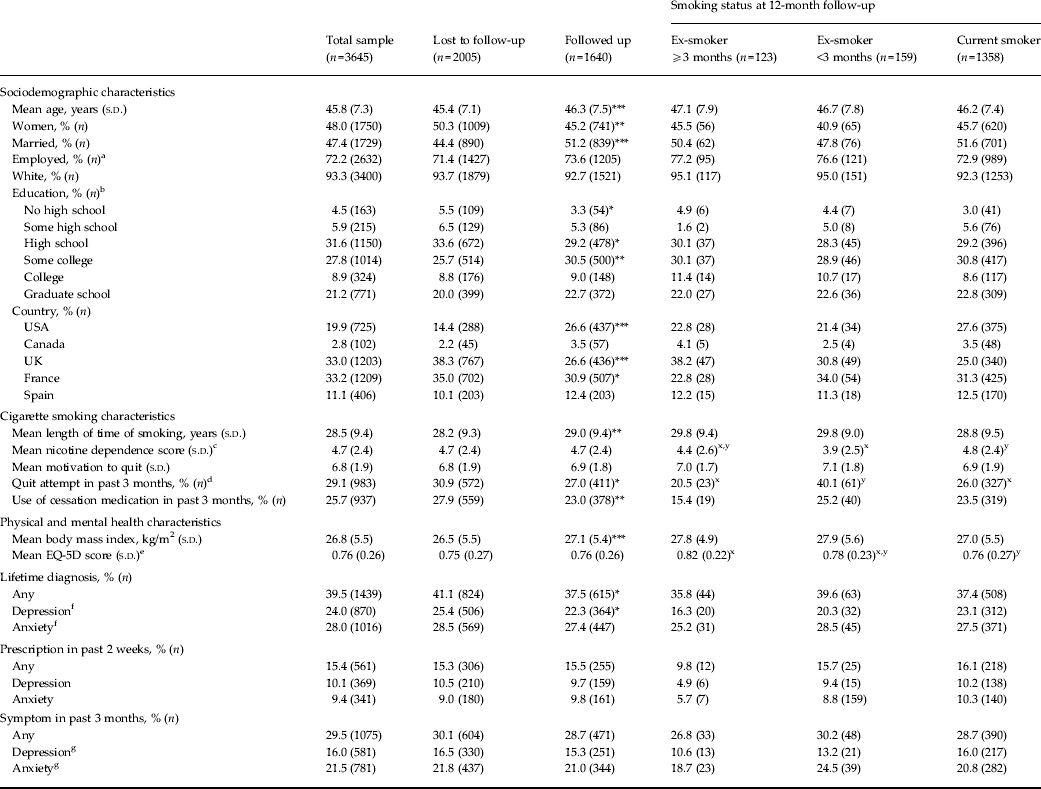
Participants were selected from the ATTEMPT cohort, a multinational prospective study examining physical and mental health outcomes in individuals as a function of their smoking status. Full details of the study methodology are provided elsewhere (West et al. Reference West, Gilsenan, Coste, Zhou, Brouard, Nonnemaker, Curry and Sullivan2006). Briefly, participants were recruited via Harris Interactive, Inc. (USA) which maintains a market research panel with several million panellists in over 125 countries. These panel members are Internet users who have registered voluntarily and have agreed to complete regular online surveys for research purposes in exchange for points that can be redeemed for merchandise. The current analysis reports on phase two of this study, set up in 2004 in the USA, Canada, the UK, France and Spain. Following email invitations sent to a random sample of panellists in these countries, those who smoked at least five cigarettes per day, intended to quit within the following 3 months and were aged 35–65 years were included. A total of 3645 respondents met eligibility criteria. At baseline participants completed a self-report questionnaire received via email, and detailed follow-up questionnaires were completed via email approximately every 3 months for up to 18 months. Only participants who provided complete and consistent responses at both baseline and the 12-month follow-up (n = 1640) were included in the current analysis (see Table 1 for sample characteristics).
Baseline sample characteristics by follow-up status and smoking status at follow-up

s.d., Standard deviation; EQ-5D, EuroQol.
a Nine missing. b Eight missing. c 80 missing. d 267 missing. e 84 missing. f 18 missing. g Six missing.
x,y Values within a row with different superscript letters are significantly different (p < 0.05).
* p < 0.05, ** p < 0.01, *** p < 0.001.
Measures
Smoking history and standard smoking characteristics, and sociodemographic characteristics including age, gender, marital and employment status, ethnicity and educational attainment were collected at baseline and follow-up surveys and standardized across countries.
At baseline, smokers were asked to indicate length of time of smoking and recent quit attempts were determined by asking: ‘During the past 3 months (90 days), have you made a serious attempt to stop smoking for good that lasted for at least a day (24 h)?’. Smokers were also asked if any cessation medications were used to support their quit attempt. Motivation to stop smoking was measured using a 10-point Likert scale: ‘In the following 10-point scale, please select the number that best describes your current motivation to quit smoking cigarettes’ (1 = not at all motivated, 10 = highly motivated). Nicotine dependence was measured using the Fagerstrom Test of Nicotine Dependence (Heatherton et al. Reference Heatherton, Kozlowski, Frecker and Fagerstrom1991), which places smokers on a 10-point scale based on six items: time to first cigarette (0 = 60+ min, 1 = 31–60 min, 2 = 6–30 min, 3 = within 5 min); daily cigarette consumption (0 = ⩽10, 1 = 11–20, 2 = 21–30, 3 = 31+); smoking when ill; more frequent smoking shortly after awakening; difficulty refraining from smoking in no-smoking areas (for all: 0 = no, 1 = yes); and the cigarette smokers hate most to give up (1 = first in the morning, 0 = any other).
Smoking status at the 12-month follow-up was assessed by asking participants: ‘Are you currently a smoker?’ and ‘Have you smoked any cigarettes today?’. Those who answered ‘yes’ to either or both questions were classified as ‘current smokers’. Participants who answered ‘no’ to both questions were further asked: ‘How many days has it been since you last smoked a cigarette?’ and a free-text response was recorded. Those who claimed to have not had a cigarette within the last 3 months were asked ‘Just to confirm, in the last 3 months (90 days) have you smoked any cigarettes (even a puff)?’ Participants who answered ‘no’ were classified as ‘ex-smokers ⩾3 months’. Participants whose response suggested that they had stopped smoking within the last 3 months were asked to confirm they had not smoked either in the last 30 days, 7 days or today. Those who answered ‘no’ to any of these options were classified as ‘ex-smokers <3 months’. Inconsistent responders (n = 40) were excluded.
Physical and mental health was assessed at both baseline and follow-up. Participants were asked to provide their height and weight in order to calculate their body mass index. Respondents also completed the EuroQol (EQ-5D), a widely used measure of health-related quality of life (Rabin & de Charro, Reference Rabin and de Charro2001). Mental health was determined by yes/no responses to single-item measures that have been found to have good congruence with structured clinical interviews (McChargue & Werth, Reference McChargue and Werth2007). Lifetime mental health diagnoses were assessed by asking: ‘Have you ever been told by a doctor or other health care professional that you had any of the following conditions? (1) Depression, (2) Anxiety’. Recent mental health status was determined by asking: ‘During the past 3 months, have you had symptoms or been bothered by any of the following conditions? (1) Depression, (2) Anxiety’. Respondents also noted their medication prescriptions, being asked: ‘During the past 2 weeks, did you take medications that require a prescription from your doctor for the following conditions? (1) Depression, (2) Anxiety’. For ease of analysis, measures of depression and anxiety were also combined into a single measure of ‘any’ mental health problem.
Analysis
Data were analysed using SPSS 20.0 (IBM, USA). In unadjusted analyses between- and within-group differences were assessed with the χ 2 test, Wilcoxon signed-rank test or analyses of variance for categorical and continuous variables, respectively. Adjusting for all other factors in the model, logistic regressions were carried out providing odds ratios (ORs) with 95% confidence intervals (CIs) in order to evaluate which, if any, of the variables were independently associated with mental health outcomes. Generalized estimating equations were used to compute mean value-adjusted levels of mental health outcomes by smoking status. Statistical significance was set at the standard level (p < 0.05) and in post-hoc analyses, the Sidak correction was applied to control for multiple comparisons.
Results
A total of 45% of participants (n = 1640) completed both baseline and follow-up online questionnaires. Those lost to follow-up differed on a number of socio-economic and smoking but on only a few physical and mental health characteristics. Those lost to follow-up were slightly more likely to report a lifetime diagnosis of any mental health problem, in particular depression [χ 2 = 4.6, degrees of freedom (df) = 1, p = 0.032], but no other differences were apparent. Lifetime prevalence of depression and anxiety in the retained sample was 22.3% (95% CI 20.2–24.2%) and 27.4% (95% CI 25.1–29.4%), respectively. Overall, a third (37.5%, 95% CI 35.2–39.8%) reported any lifetime diagnosis (Table 1).
At 12 months, 7.5% (95% CI 6.3–8.9%) of smokers had stopped for at least 3 months and 9.7% (95% CI 8.3–11.2%) for less than 3 months. There were few differences in baseline variables according to smoking status at follow-up (Table 1). Those who were smokers at the 12-month follow-up had been more nicotine dependent (F = 10.5, dfbetween = 2, dfwithin = 1610, p < 0.001) and less likely to have previously made a quit attempt at baseline (χ 2 = 16.4, df = 2, p < 0.001) than recent ex-smokers. They also scored marginally lower on the EQ-5D than longer-term ex-smokers (F = 3.4, dfbetween = 2, dfwithin = 1603, p = 0.035).
Impact of short- and longer-term smoking cessation on depression and anxiety prevalence in the general population
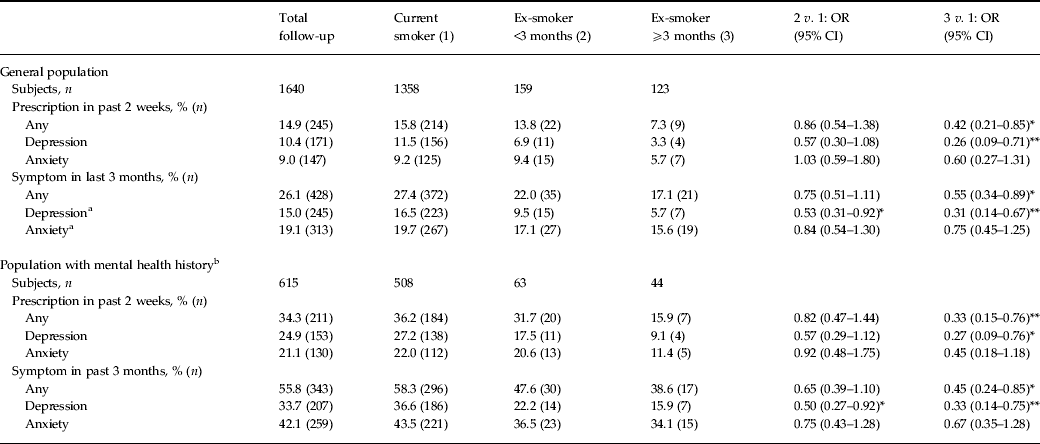
At follow-up, current smokers were more likely to have received a prescription in the last 2 weeks for ‘any’ mental health problem than longer-term (⩾3 months) ex-smokers (Table 2). More specifically, longer-term ex-smokers were less likely to report receiving a prescription for depression, but not anxiety, than current smokers (OR 0.26, 95% CI 0.09–0.71, p = 0.009). There were no differences between current smokers and recent (<3 months) ex-smokers. These results were broadly mirrored when looking at ‘any’ mental health symptoms experienced in the last 3 months (Table 2). Longer-term and recent ex-smokers were less likely to report symptoms of depression, but not anxiety, than current smokers (OR 0.31, 95% CI 0.14–0.67, p = 0.003 and OR 0.53, 95% CI 0.31–0.92, p = 0.025, respectively).
Mental health outcomes at follow-up by smoking status and mental health history

OR, Odds ratio; CI, confidence interval.
a Five missing. b With history of depression and/or anxiety.
* p < 0.05, ** p < 0.01.
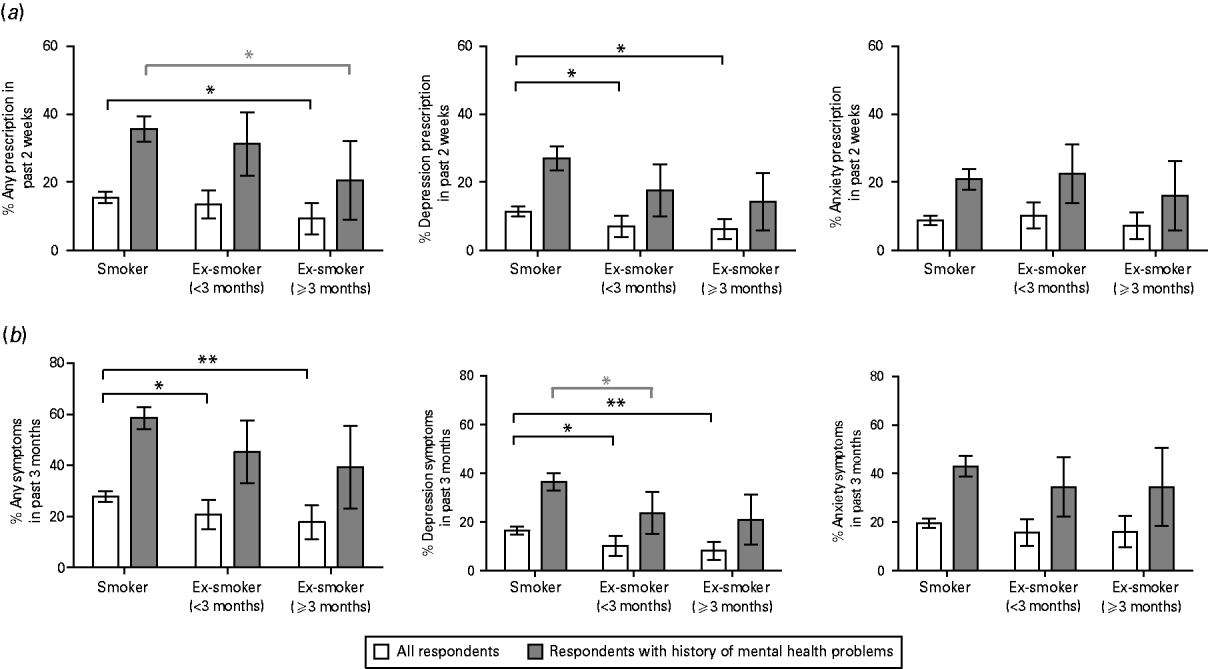
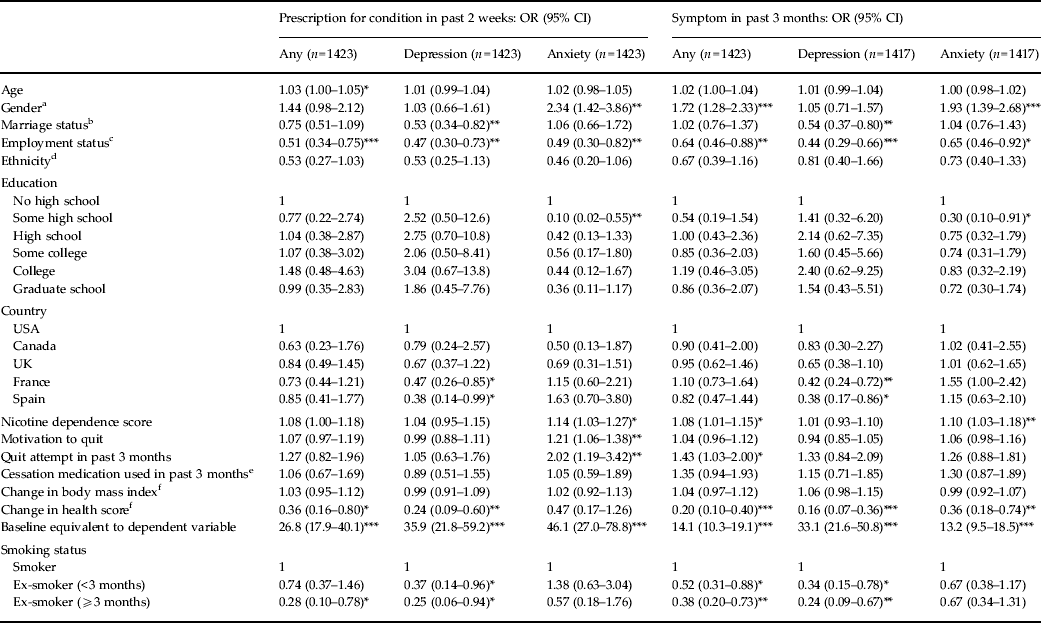
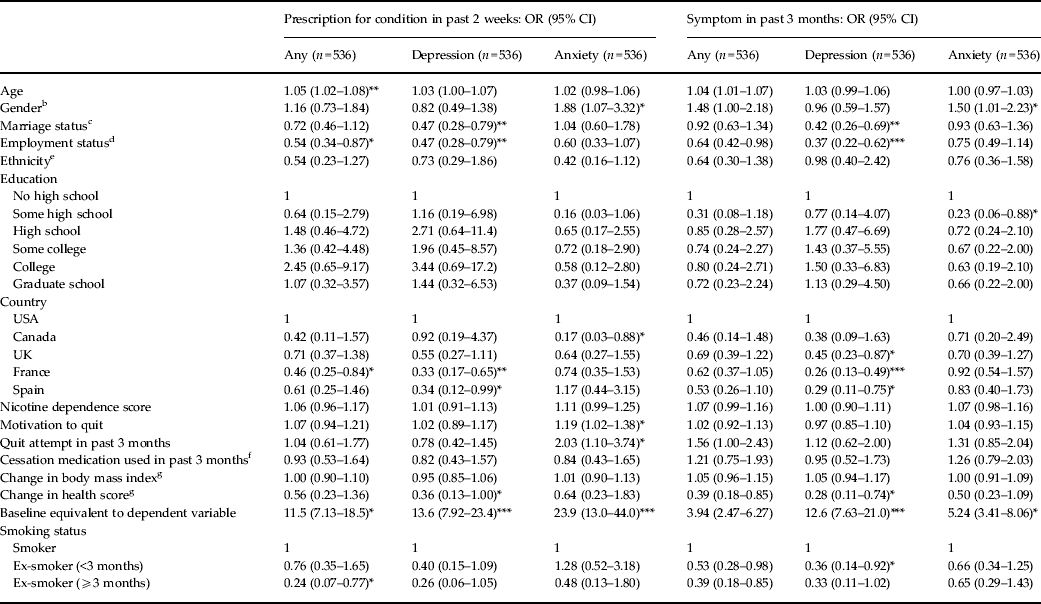
These findings were further substantiated using logistic regression models to control for potential confounders. Smoking status at follow-up did not make an impact on reported prescriptions for anxiety in the last 2 weeks or experiencing symptoms of anxiety in the last 3 months at the 12-month follow-up (Table 3). However, the prevalence of receiving a prescription for depression in the last 2 weeks at follow-up was significantly lower among recent (7.0%; OR 0.37, 95% CI 0.14–0.96, p = 0.041) and longer-term ex-smokers (6.2%; OR 0.25, 95% CI 0.06–0.94, p = 0.040) than among current smokers (11.4%, Fig. 1 a). Similarly, prevalence of reported symptoms of depression experienced within the last 3 months was significantly lower among recent (10.2%; OR 0.34, 95% CI 0.15–0.78, p = 0.011) and longer-term ex-smokers (8.1%; OR 0.24, 95% CI 0.09–0.67, p = 0.006) than among current smokers (16.5%) at the 12-month follow-up (Fig. 1 b).
Adjusted prevalence (estimated marginal means with confounders set at average values; error bars show 95% confidence intervals) of recent (a) medication prescription and (b) mental health symptoms by smoking status at 12 months follow-up in total sample and those with history of mental health illness (with history of depression and/or anxiety); * p < 0.05, ** p < 0.01.

Association of baseline characteristics and smoking status at follow-up with mental health outcomes at follow-up for total sample

OR, Odds ratio; CI, confidence interval.
a Referent: men. b Referent: not married. c Referent: unemployed. d Referent: non-white. e At follow-up. f Positive score indicates increase from baseline.
* p < 0.05, ** p < 0.01, *** p < 0.001.
As expected, baseline prescription levels and symptoms of depression or anxiety were the strongest predictors of a recent prescription and experiencing symptoms of depression or anxiety at the 12-month follow-up (Table 3). There were some country-level differences, with participants from the USA reporting highest levels of depression prescriptions and symptoms. In addition, those who were married, employed and showed an increase in their health-related quality of life from baseline were less likely to report receiving a prescription for, or experiencing, depression symptoms at follow-up. Conversely, those who were male, employed, less nicotine dependent and had improved health-related quality of life, and to a lesser degree those who were less motivated to quit and had made no recent quit attempt at baseline, were less likely to report receiving a prescription for, or experiencing, anxiety symptoms at follow-up (Table 3).
Impact of short- and longer-term smoking cessation on depression and anxiety prevalence among those with a history of mental health problems
As expected, the prevalence of indicators of recent mental health problems, depression and anxiety symptoms experienced in the last 3 months and relevant prescriptions received in the last 2 weeks was higher in this vulnerable population than in the general population (Fig. 1). Ex-smokers of at least 3 months were less likely to report receiving prescriptions for, or experiencing, ‘any’ mental health problem than current smokers in unadjusted analysis (Table 2). This was the case for prescriptions for depression (OR 0.27, 95% CI 0.09–0.76, p = 0.014) and experiencing symptoms of depression (OR 0.33, 95% CI 0.14–0.75, p = 0.008) but not anxiety. Ex-smokers of less than 3 months were also less likely to report experiencing depression symptoms in the last 3 months (OR 0.50, 95% CI 0.27–0.92, p = 0.026) than those who continued smoking (Table 2).
As Fig. 1 shows, differences between current and ex-smokers with a history of mental health problems were largely attenuated in adjusted analysis with two exceptions. First, the prevalence of having received a prescription for ‘any’ mental health problem in the last 2 weeks was significantly lower among longer-term ex-smokers (20.5%) than current smokers (35.6%; OR 0.24, 95% CI 0.07–0.77, p = 0.016). Second, the prevalence of experiencing symptoms of depression in the last 3 months was significantly lower among recent ex-smokers (23.7%) than current smokers (36.6%; OR 0.36, 95% CI 0.14–0.92, p = 0.033; Table 4). Generally, ORs were comparable with those from the general population.
Association of baseline characteristics and smoking status at follow-up with mental health outcomes at follow-up for sample with mental health history a

OR, Odds ratio; CI, confidence interval.
a With history of depression and/or anxiety. b Referent: men. c Referent: not married. d Referent: unemployed. e Referent: non-white. f At follow-up. g Positive score indicates increase from baseline.
* p < 0.05, ** p < 0.01, *** p < 0.001.
As before, baseline prescription levels and symptoms of depression or anxiety were the strongest predictors of a recent prescription and experiencing symptoms of depression or anxiety at the 12-month follow-up (Table 4). The level of depression prescription and symptoms was again higher in the USA compared with other countries. In addition, as in the general population, those who were married, employed and showed an increase in their health score from baseline were less likely to report receiving a prescription for, or experiencing, depression symptoms at follow-up. Likewise, those who were male were less likely to report receiving a prescription for, or experiencing, anxiety symptoms at follow-up and those who were more motivated to quit and had made a recent quit attempt at baseline were also more likely to report receiving a prescription for anxiety in the last 2 weeks (Table 4).
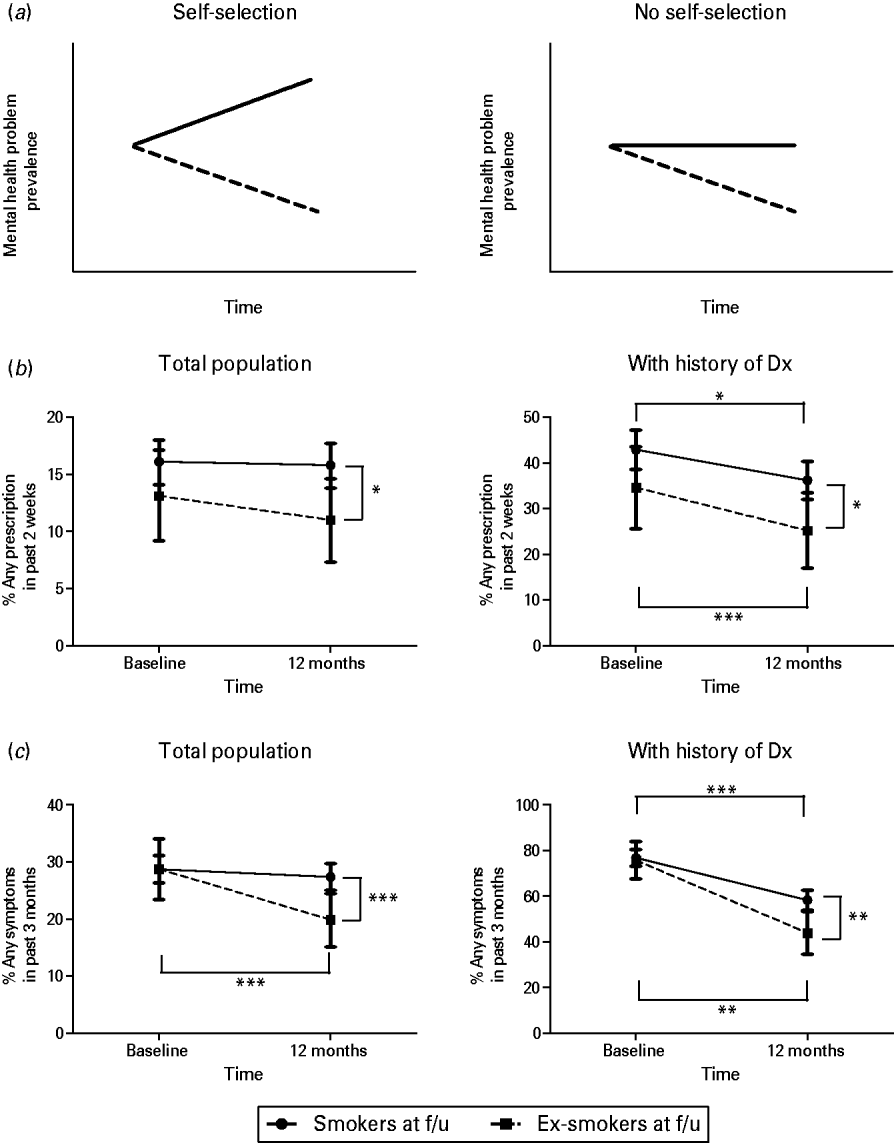
In order to delineate the causal direction of the observed association of smoking cessation with mental health, sensitivity analyses were carried out. It was reasoned that the findings might be an artefact. Self-selection could account for the results, as smokers who are more prone to become depressed upon cessation may be more likely to relapse and continue to smoke. In this scenario, there would be no change over time in the total prevalence of mental health problems in the cohort. The decrease in prevalence of mental health problems among ex-smokers – those who are less vulnerable to psychiatric morbidities and are therefore able to stop – would be offset by an increase in the prevalence of mental health problems in the remaining pool of current smokers – those who are more vulnerable to psychiatric morbidities and find it difficult to stop (Fig. 2 a). Alternatively, if smoking cessation improved mental health, one would expect that with an increase in ex-smokers in the cohort, there should be an overall decrease in the prevalence of mental health problems as there would be no change among current smokers but a decline among ex-smokers (Fig. 2 a).
Changes in indices of mental health by smoking status and history of mental health problems. (a) Postulated change scenario as function of selection; (b) change in medication prescription prevalence; (c) change in symptom prevalence. * p < 0.05, ** p < 0.01, *** p < 0.001; error bars show 95% confidence intervals. Dx, Disorder (anxiety and/or depression).

Figs. 2 b and c show a pattern of no change or a decrease in the prevalence of reported mental health outcomes among current smokers and a pronounced decrease among ex-smokers, consistent with the latter but not former interpretation. There was a non-significant overall decrease in prescriptions from 15.5% to 14.9% in the total population, no change among current smokers and a decline among ex-smokers, resulting in significant differences between ex- and current smokers at follow-up (χ 2 = 4.2, df = 1, p = 0.04) but not at baseline (Fig. 2 b). There was also a significant decrease in prescriptions among those with mental health problems from 41.5% to 34.3% (Wilcoxon Z = 3.69, p < 0.001). Whilst this was the case for both continuing smokers (Wilcoxon Z = 2.04, p = 0.041) and ex-smokers (Wilcoxon Z = 3.13, p = 0.002), possibly reflecting regression towards the mean, this decline was steeper among ex-smokers who were less likely than smokers to report receiving prescriptions for ‘any’ mental health problems in the last 2 weeks at follow-up (χ 2 = 4.7, df = 1, p = 0.03) but not baseline.
The pattern was broadly similar for mental health problems experienced in the last 3 months, reducing significantly from 28.7% to 26.1% in the overall sample (Wilcoxon Z = 2.45, p = 0.014). This decline was only present among those who had stopped smoking (Wilcoxon Z = 3.37, p < 0.001; Fig. 2 c). Among those with a history of mental health problems, there was also an overall significant decline from 76.6% to 55.8% (Wilcoxon Z = 2.45, p = 0.014). As before this may be a result of regression towards the mean, being present among both current (Wilcoxon Z = 7.09, p < 0.001) and ex-smokers (Wilcoxon Z = 2.54, p = 0.019). However, the decline was again steeper among ex-smokers since there were no differences between groups at baseline but there were at follow-up (χ 2 = 7.4, df = 1, p = 0.007).
Discussion
Depression and anxiety as assessed in this cohort of smokers were common, with one in three reporting a lifetime diagnosis of either condition, and one in four experiencing recent symptoms. These estimates are broadly similar to previous studies confirming much higher incidence and prevalence rates among smokers than non-smokers (Perez-Stable et al. Reference Perez-Stable, Marin, Marin and Katz1990; Breslau et al. Reference Breslau, Kilbey and Andreski1991; Grant et al. Reference Grant, Hasin, Chou, Stinson and Dawson2004; Lawrence et al. Reference Lawrence, Mitrou and Zubrick2009; McClave et al. Reference McClave, Dube, Strine, Kroenke, Caraballo and Mokdad2009). In agreement with previous research (West & Hajek, Reference West and Hajek1997; McClave et al. Reference McClave, Dube, Strine, Kroenke, Caraballo and Mokdad2009; Bolam et al. Reference Bolam, West and Gunnell2011), this study provides evidence that smoking cessation in the general population does not result in an increase in mental health problems and may be associated with a decrease in depression. Similar to a cross-sectional analysis, these effects appeared largely independent of the length of abstinence (Mykletun et al. Reference Mykletun, Overland, Aaro, Liabo and Stewart2008).
In contrast to some (Glassman et al. Reference Glassman, Helzer, Covey, Cottler, Stetner, Tipp and Johnson1990, Reference Glassman, Covey, Stetner and Rivelli2001; Covey et al. Reference Covey, Glassman and Stetner1997) but not other studies (Haustein et al. Reference Haustein, Haffner and Woodcock2002; Jamal et al. Reference Jamal, Van der Does, Cuijpers and Penninx2012), there was no evidence of an exacerbation of symptoms following smoking cessation among those with a history of mental health problems. This divergence may be due to a number of factors. This analysis provides a larger sample than most previous studies and includes participants from several countries. In addition, it is possible that the association of smoking cessation and deterioration in mental health may be a function of the severity of past mental health problems which was not assessed in the current study. However, even in studies reporting an increased risk of depressive episodes following cessation, rates were very low (Morrell & Cohen, Reference Morrell and Cohen2006; Ziedonis et al. Reference Ziedonis, Hitsman, Beckham, Zvolensky, Adler, Audrain-McGovern, Breslau, Brown, George, Williams, Calhoun and Riley2008), suggesting that this may be an issue for only a small proportion of smokers with a history of mental health problems.
In line with previous studies in general or patient populations, being married (Weissman et al. Reference Weissman, Bland, Canino, Faravelli, Greenwald, Hwu, Joyce, Karam, Lee, Lellouch, Lepine, Newman, Rubio-Stipec, Wells, Wickramaratne, Wittchen and Yeh1996; Frech & Williams, Reference Frech and Williams2007) or in employment (Murphy & Athanasou, Reference Murphy and Athanasou1999) was independently associated with lower rates of depression and men were less likely than women to display anxiety symptoms (West & Hajek, Reference West and Hajek1997; Lewinsohn et al. Reference Lewinsohn, Gotlib, Lewinsohn, Seeley and Allen1998; Pigott, Reference Pigott1999; McClave et al. Reference McClave, Dube, Strine, Kroenke, Caraballo and Mokdad2009). In addition, as shown previously, greater nicotine dependence was associated with anxiety (Goodwin et al. Reference Goodwin, Pagura, Spiwak, Lemeshow and Sareen2011), and improvement in general health was associated with better mental health (Wise & Taylor, Reference Wise and Taylor1990; Sherbourne et al. Reference Sherbourne, Wells, Meredith, Jackson and Camp1996; Patten, Reference Patten2001; Ruo et al. Reference Ruo, Rumsfeld, Hlatky, Liu, Browner and Whooley2003; Evans et al. Reference Evans, Charney, Lewis, Golden, Gorman, Krishnan, Nemeroff, Bremner, Carney, Coyne, Delong, Frasure-Smith, Glassman, Gold, Grant, Gwyther, Ironson, Johnson, Kanner, Katon, Kaufmann, Keefe, Ketter, Laughren, Leserman, Lyketsos, McDonald, Mcewen, Miller, Musselman, O'Connor, Petitto, Pollock, Robinson, Roose, Rowland, Sheline, Sheps, Simon, Spiegel, Stunkard, Sunderland, Tibbits and Valvo2005; Beard et al. Reference Beard, Heathcote, Brooks, Earnest and Kelly2007; Janney et al. Reference Janney, Richardson, Holleman, Glasheen, Strath, Conroy and Kriska2008; Carek et al. Reference Carek, Laibstain and Carek2011).
This study has some limitations. As data were collected online, smoking status and mental health were assessed by self-report rather than clinical assessment. However, self-report in surveys has been shown to be a valid indicator of both current smoking (Patrick et al. Reference Patrick, Cheadle, Thompson, Diehr, Koepsell and Kinne1994) and mental health status (McChargue & Werth, Reference McChargue and Werth2007). While the use of prescription as an indicator is problematic, as prescription policies and practices vary between countries of included participants, several measures of mental health were used to increase reliability, yielding similar results, and country was included as a confounder in analysis. Moreover, prevalence estimates and observed associations with a range of sociodemographic variables replicate previous findings of studies using standard measures of mental health, further corroborating this approach. Whilst numerous covariates were included in the analysis, it is possible that inclusion of other uncontrolled variables, for instance, common vulnerability factors for both mental health and smoking such as impulsivity or neuroticism (Bienvenu et al. Reference Bienvenu, Nestadt, Samuels, Costa, Howard and Eaton2001; Hooten et al. Reference Hooten, Ames, Vickers, Hays, Wolter, Hurt and Offord2005), could have altered results. In addition, self-selection cannot be excluded as an explanation for the findings. However, this problem could only be overcome using a randomized controlled design, which would be unethical, and sensitivity analysis showed that it is unlikely that self-selection alone can account for the observed associations. Lastly, given that this sample comprises Internet users, aged 35–64 years, who volunteered to participate, this may affect the generalizability of findings. However, previous analysis has shown that characteristics of this sample show high congruence with characteristics of equivalent national probability-based samples of the respective countries of participants (West et al. Reference West, Gilsenan, Coste, Zhou, Brouard, Nonnemaker, Curry and Sullivan2006). This study also had strengths. The longitudinal design allowed for an analysis of temporal associations in a large sample drawn from the general population across different countries, controlling for a multitude of confounders, which strengthens the generalizability of findings.
Our findings add substantially to a growing literature suggesting that smoking cessation may not only be beneficial for physical but also mental health in the general population and that it does not exacerbate symptoms of depression or anxiety among those with a history of these conditions. These outcomes may be explained by the adverse effects that chronic smoking has on neurophysiological substrates, being linked to changes in monoamine oxidase activity (Fowler et al. Reference Fowler, Volkow, Wang, Pappas, Logan, MacGregor, Alexoff, Shea, Schlyer, Wolf, Warner, Zezulkova and Cilento1996) and levels of brain-derived neurotrophic factor (Kim et al. Reference Kim, Kim, Lee and Kim2007) which have been implicated in the aetiology of psychopathology (Pintar & Breakefield, Reference Pintar and Breakefield1982; Sen et al. Reference Sen, Duman and Sanacora2008). It has also been postulated that the frequent unpleasant withdrawal symptoms experienced by smokers may lead to the development and maintenance of mental health problems (Parrott, Reference Parrott2006). In this context it is important to reiterate that smokers with mental health problems are just as motivated to stop smoking as those in the general population and that smoking cessation interventions are equally effective in this group of smokers (Campion et al. Reference Campion, Checinski, Nurse and McNeill2008; Ziedonis et al. Reference Ziedonis, Hitsman, Beckham, Zvolensky, Adler, Audrain-McGovern, Breslau, Brown, George, Williams, Calhoun and Riley2008). Thus smokers with and without current psychiatric co-morbidities should be encouraged to stop smoking given the great benefits that smoking cessation provides.
Acknowledgements
The present study was funded by Sanofi-Aventis Recherche et Développement (SAR&D) and the report write-up by Cancer Research UK (C1417/A14135). Data for the online assessments were collected by the Harris Interactive Inc. on behalf of RTI Health Solutions (RTI HS) and SAR&D. RTI-HS and SAR&D were responsible for the study design and questionnaire development. RTI-HS was responsible for study coordination, data entry and cleaning. SAR&D and Cancer Research UK were not responsible for data analysis and interpretation and were not involved in the preparation, review or approval of this manuscript. R.W. conceived this study and contributed to the write-up. S.A. contributed to the write-up of the manuscript. L.S. had full access to all the data in the study and takes full responsibility for the integrity of the data and the accuracy of the data analysis.
Declaration of Interest
L.S. has received an honorarium for a talk and travel expenses from a pharmaceutical company making smoking cessation products. R.W. undertakes research and consultancy for developers and manufacturers of smoking cessation treatments such as nicotine replacement products.