Introduction
The ‘normal’ pattern of retirement in Australia since the Second World War has been for men to work full-time until the age of 65 years, retire from the workforce and then receive either state or private pensions. While it is difficult to estimate the extent to which health and other factors disrupted this normative pathway in the past, in recent decades the mode and timing of exits from the workforce have become more varied (Encel Reference Encel, Borowski, Encel and Ozanne1997). On the one hand, more men have been leaving the workforce at younger ages for reasons associated with industry retrenchment and restructuring, higher unemployment, and the increased availability of veterans' and disability pensions. On the other hand, late middle-aged women have been increasing their workforce participation, compulsory retirement at 65 years-of-age has been abolished, and as unemployment rates have fallen again over the past decade, the availability of part-time and full-time work has grown. Further, the transition from the workforce may be gradual as some workers move from demanding full-time work to less demanding part-time positions.
The changing context of retirement in the world's richest countries has been reviewed in a recent Organisation for Economic Co-operation and Development (OECD) (2006) report, Live Longer, Work Longer. It shows that in Australia in 2004, among those aged 50–64 years, 72 per cent of men and 53 per cent of women were in the workforce, and that these participation rates were in the middle of the range for OECD countries and broadly similar to those in the United Kingdom (UK) and the United States (US). As in most other OECD countries, between 1970 and 2004 the labour-force participation rate in this age group declined for men (from 90 to 72%) and increased for women (from 29 to 53%). In 2004, the average ‘effective’ retirement age of 63 years for Australian men contrasted with an ‘official’ retirement age of 65 years (as indicated by the age requirements for the ‘Age Pension’). The comparable figures for older women were an effective retirement age of 61 years and an ‘official’ age of 63 years. Australian governments have recognised and facilitated these changes in older workers' labour-force participation with diverse anti-discrimination and industrial legislation that has progressively abolished compulsory retirement in most occupations (Patterson Reference Patterson2004).Footnote 1 As a result, many older men and women need to make choices about how and when to manage the transition to retirement. Should they retire early or keep working? Should they gradually phase out of the workforce or retire decisively?
This paper focuses on one aspect of retirement in this new context – mode of exit from the workforce. We distinguish between abrupt and gradual retirement transitions. Abrupt retirement occurs when the retiree retires fully on one day and remains out of the workforce, while gradual retirement takes place when workers progressively withdraw from work, or withdraw and then return part-time.Footnote 2 Research in both the United States and the United Kingdom has described the decision-making process regarding timing and mode of retirement (Feldman Reference Feldman1994; Higgs et al. Reference Higgs, Mein, Ferrie, Hyde and Nazroo2003). In Australia, recent research has shown that those who are already retired generally report that they are ‘well adjusted’ to retirement and that their overall happiness is ‘better’ since retirement (Warren Reference Warren2006); and that for both men and women, life satisfaction in retirement associates with being married, having better general and mental health, and with not having been pressured to retire. There is little research, however, on the impacts of the outcomes of the different pathways by which people retire.
This paper examines whether workers who make a gradual transition to retirement have better outcomes than those who retire abruptly. As the ways in which people retire from the workforce have diversified, it is important to investigate whether one of these pathways leads to a more satisfactory retirement than the other. We also explore the extent to which the outcomes of both gradual and abrupt retirement are linked to the decision-making process and the employee's level of control.
‘Bridge’ employment has been defined as that which takes place after an individual's retirement from full-time work but before the person's permanent withdrawal from the workforce (Kim and Feldman Reference Kim and Feldman2000). The US Health and Retirement Survey found that one-third of employed men and one-half of employed women engaged in bridge employment before completely retiring (Clark and Quinn Reference Clark and Quinn2002). Early retirees are especially likely to take bridge employment (Ruhm Reference Ruhm1990; Singh and Verma Reference Singh and Verma2003). The Australian Household, Income and Labour Dynamics Survey showed that of those who retired after the age of 50 years, one-half (52%) were gradual retirees (Millward Reference Millward2005; see also Warren Reference Warren2006).
Conventional wisdom tends to the view that a gradual transition is preferable to a sharp transition. It is widely thought that a gradual exit helps the retiree to supplement their income, to avoid the sudden loss of work-based social networks, to develop new networks before losing contact with work-mates, and to maintain continuity and routines (Goldberg Reference Goldberg2002; Kim and Moen Reference Kim and Moen2002; Kim and Feldman Reference Kim and Feldman2000; Latulippe and Turner Reference Latulippe and Turner2000; Shaw et al. Reference Scheier and Carver1998). The rationale assumes positive returns from continuity in pre- and post-retirement lives. Kim and Feldman (Reference Kim and Feldman2000) drew on ‘continuity theory’ to construct a rationale for the greater benefits of gradual retirement. They proposed that that the continuity provided by part-time and bridge employment improves wellbeing for four reasons. First, a successful transition may be best managed by maintaining the kind of daily structure experienced in formal work. Some retirees experience a sense of ‘rolelessness’, and the associated stress is heightened among those who retire abruptly. Secondly, individuals can maintain a structure in their life by increasing their level of participation in valued activities prior to retirement. Thirdly, those who identify strongly with the work role can maintain continuity through continued involvement (e.g. bridge employment, part-time work, consulting or professional associations). Fourthly, maintaining social contact after retirement at approximately the same level as before retirement is important in maintaining structure and sustaining wellbeing.
While partial retirement is increasingly advocated as an alternative to abrupt retirement, there is little evidence to suggest that it leads to better outcomes. The surprisingly sparse research has produced mixed results. Kim and Feldman (Reference Kim and Feldman2000) found that bridge employment was associated with greater post-retirement life satisfaction. Another study found that academics who took bridge employment appeared to be more satisfied than those who retired abruptly (Kim and Feldman Reference Kim and Feldman2000). While there is some evidence that post-retirement employment is linked to lower mortality and better health (Luoh and Herzog Reference Luoh and Herzog2002), it has also been found that employment after retirement has little independent effect on satisfaction (e.g. Choi Reference Choi2001). Indeed, Reitzes and Mutran (Reference Reitzes and Mutran2004) found that at six, 12 and 24 months after retirement, there was no difference between abrupt and gradual retirees in the prevalence of positive post-retirement attitudes. The lack of consistent evidence on the outcomes of abrupt and gradual retirement is not surprising. While gradual retirement might ameliorate the possible negative outcomes of an abrupt transition, other factors complicate the picture. Health is likely to be related to the way in which older workers retire (Kim and Feldman Reference Kim and Feldman2000; Parnes and Sommers Reference Parnes and Sommers1994; Singh and Verma Reference Singh and Verma2003). Since good health is linked with a good retirement, as found in Australia by Braithwaite and Gibson (Reference Braithwaite and Gibson1987), the association of retirement pathways with retirement outcomes is likely to be inconsistent.
Perhaps more importantly, the degree of choice or control associated with a retirement pathway may influence whether people have a good or poor retirement. The available evidence shows that workers who control the manner and timing of their retirement do much better in retirement (Isaksson and Johansson Reference Isaksson and Johansson2000; van Solinge and Henkens Reference van Solinge and Henkens2005). An Australian analysis of retrospective accounts indicated that those who retired abruptly were twice as likely as those who retired gradually to regard their retirement as a forced event over which they had little control (Millward Reference Millward2005). The confounding of the pathway with the level of control over the manner and timing of retirement makes it difficult to isolate the effects of the abrupt and gradual modes for post-retirement wellbeing.
Design and methods
The effects of retirement pathways have been examined using hierarchical ordinary least-squares (OLS) multivariate regression models. Seven different measures of retirement wellbeing were assessed. For each outcome, three models were evaluated: one designed to assess the impact of the pathway, the second to test the effect of retirement control, and the third to assess the effect of the interaction between pathway and control. There was prior evidence that gender, age and health are all associated with the selected pathway to retirement. Although all these factors are of interest, they were not the focus of the analysis. To remove their effects on the relationship between pathway and outcomes, they were treated as controls. Other controls were financial status, job status before retirement, and marital status.
The data
The data came from a three-year follow-up of 601 individuals recruited to the Australia Healthy Retirement Project (Wells et al. Reference Wells, Petralia, de Vaus and Kendig2003, Reference Wells, de Vaus, Kendig, Quine and Petralia2006). All participants were in paid work when recruited to the study in 1998, but left their jobs during either the second half of 1998 or the first half of 1999. Measures were taken at four time points: pre-retirement, baseline (T0 with a median of seven days prior to the last working day), and after 12 months (T12), 24 months (T24) and 36 months (T36). The pre-retirement measures were obtained using a self-completed questionnaire distributed at the workplace, while the baseline (T0) and post-retirement (T12, T24 and T36) measures were obtained mainly by telephone interviews. The current analyses were of a subset of 358 participants who were contacted at baseline and one and three years after baseline, and whose pathways to retirement could be classified as ‘abrupt’ or ‘gradual’.
The measures of retirement outcomes
Various instruments were used in the Healthy Retirement Project to measure the outcomes over the retirement transition.Footnote 3 Six of the outcome measures were based on difference scores over 12 months (T0 to T12) and 36 months (T0 to T36). For all of these outcomes, a positive difference score indicated a higher score at the later date. The outcome domains chosen for the current series of analyses were: positive and negative affect (10-item short form, Lawton et al. Reference Lawton, Kleban, Dean, Rajogopal and Parmelee1992); self-image, comprising four items from the Rosenberg (Reference Rosenberg1965) self-esteem scale, three items from Adelmann's (Reference Adelmann1994) self-efficacy scale, and four items from Scheier and Carver's (Reference Scheier and Carver1985) optimism scale Reference Scheier and Carver1985; life satisfaction (Campbell, Converse and Rodgers Reference Campbell, Converse and Rodgers1976); and marital cohesion (Spanier Reference Spanier1976). The seventh outcome domain, retirement adjustment, was adapted from a study of retired clerics (Schultz and Schultz Reference Schultz and Schultz1997); since its items were about the experience of retirement, there were no pre-retirement scores on this measure, and hence no difference scores from baseline were calculable.
The independent variables
The main independent variable of interest was retirement pathway or mode, that is, whether the participant made an abrupt or a gradual transition to retirement. All participants included in these analyses made a change to their work hours or commitment over the year between T0 and T12. The 220 participants with abrupt pathways were employed full-time (N=166) or part-time (N=54) at T0, but had no paid employment during the three-year follow-up. The 138 participants who followed a gradual pathway to retirement were more diverse. They included 50 people who retired gradually to no work, 44 who took up work in retirement after a period of no work, and 44 who decreased their work hours or commitment.Footnote 4 The other 86 participants were excluded either because they had not begun the retirement process at T12, or because they had returned to full-time work by T36.
Preliminary analyses indicated that there were no differences in marital status or age between two sub-groups that made an abrupt transition (to no work at T12 from either full-time or part-time work at T0). Women who made an abrupt transition, however, were significantly more likely than men to have given up part-time work (41.0% versus 8.8%). Similarly, blue-collar workers were significantly more likely than white-collar workers to have left part-time work (36.2% versus 15.5%). It was decided to combine those who made an abrupt transition from both full-time and part-time work into the abrupt pathway group, and to control for sex and for blue- or white-collar occupations. Among the diverse pathways included in the gradual pathway, there were no differences by sex, marital status, age and blue- or white-collar jobs.
Another important variable was the degree to which retirees had control over the timing of retirement and the way in which they retired. Five survey items measured aspects of such control:
1. How much say did you have in the timing of retiring/leaving your job? This was rated on a four-point scale from ‘1’ (complete say) to ‘4’ (no say at all).
2. How much notice did you have in retiring/leaving your job? This was rated on a four-point scale from ‘1’ (a year's notice) to ‘4’ (less than a week's notice).
3. ‘I am happy to be retiring/leaving my job.’ This was rated on a five-point scale from ‘1’ (very true) to ‘5’ (very false).
4. Would you say the timing of your retirement was [select]? The pre-codes were ‘1’ (too early) or ‘2’ (about right or too late).
5. The main reasons given for leaving employment were classified as ‘push factors’ (e.g. redundancy package, poor health, did not like the job, and pressure from employer, spouse or doctor) or ‘pull factors’ (e.g. wanted to do other things, wanted to spend more time with the family, had enough money, or was eligible for the Age Pension).
The scores from these five items were combined using a factor-based weighting method to form a single measure of control of the retirement process. Other independent variables included: female (reference category (rc) male); age groups 55–59, 60–64 or 65–73 years (rc: 50–54 years); marital status, partnered (rc: non-partnered); occupational status, white-collar, i.e. managerial, professional and para-professional (rc: blue-collar, i.e. sales, technical, trades, services and unskilled); and partner in full-time or part-time work (rc: partner had no work).
Analysis strategy
For each of the retirement wellbeing measures, regression models were run. To estimate the effect of retirement pathway, the models included the controls (see above) and then added pathway. The beta coefficients of the models indicate whether or not the pathway had a positive or negative impact on each measure of retirement wellbeing. A positive coefficient indicated that gradual retirement resulted in a better retirement outcome, while a negative coefficient meant that abrupt retirement resulted in a better retirement outcome. A similar strategy was used to assess the impact of having control over retirement type and timing. In these models, the degree of control replaced the retirement pathway. To test the possibility that the effect of the retirement pathway was contingent on the degree of control over retirement timing and exit, further models were estimated in which an interaction term for pathway and control was included. Statistically significant interaction terms mean that the effect of retirement pathway depends on the degree of control over the retirement transition.
Results
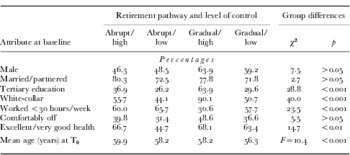
The results are presented in four stages. First, selected characteristics of the sample and retirement groups are presented, followed by the results successively for the impact of the retirement pathway on retirement outcomes, the effect of the level of control over retirement, and the effect of the interaction between pathway and control. Table 1 outlines the characteristics of the participants that experienced the four pathway-control combinations. The most notable feature of these figures is the distinctiveness of those who retired gradually and exercised a high degree of control over the withdrawal from work. This group had the highest percentages that were male, in the best health, working full-time before, educationally and occupationally advantaged, and comfortably off prior to retirement.
Characteristics of the four retirement pathway-control groups, Australia 1998/99
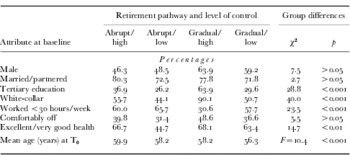
Notes: T0 is ‘at retirement’.
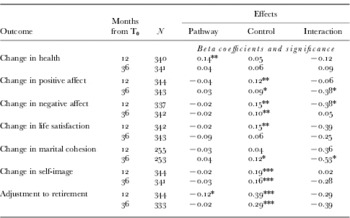
The regression results are reported in Table 2. The following discussion is in three stages. First, we examine what difference it made if workers retired abruptly or gradually. The coefficients in the middle column of Table 2 show the impact of pathway after controlling for sex, age, marital status, job status, financial status, health and scores at baseline. Positive and statistically significant coefficients indicate that those who retired gradually had better retirement outcomes than abrupt retirees. Negative and statistically significant coefficients indicate that those who retired abruptly had better retirement outcomes. Only the ‘health’ and ‘adjustment to retirement’ coefficients at T12 were significant in the pathway models, i.e. whether or not a person retired gradually or abruptly made no difference to the level of positive or negative affect, life satisfaction, self-image, or marital cohesion. The positive effect for health took into account measurable differences in health at T0. The negative coefficient for ‘adjustment to retirement’ indicated that those who retired gradually were less satisfied with their retirement at T12 than those who had retired abruptly.
Significance of beta coefficients for difference-over-time scores for outcome domains regressed on retirement pathway, level of control and the interaction term, controlling for T0 measures

Notes: The equations to which these parameters apply were as follows. For the effect of pathway: Outcome=a+b1 initial measure of outcome+(control variables: sex, age, collar, partnered, financial status and health)+bx pathway; for the effect of choice, outcome=a+b1 initial measure of outcome+control variables (sex, age, collar, partnered, financial status and health)+bx choice. For the interaction effect: Outcome=a+b1 initial measure of outcome+control variables (sex, age, collar, partnered, financial status and health)+bx pathway+by choice+bz pathway×choice. The sample size N is given for the first equation (the pathway effect) once outliers were removed.
Levels of significance: * p<0.05, ** p<0.01, *** p<0.001.
Another column of Table 2 presents the beta coefficients for degree of control over retirement. The model did not take into account whether a person retired abruptly or gradually. The many significant coefficients show that, in comparison with the pathway effects, the level of control had relatively strong effects. Positive coefficients indicate that those who exercised high choice and control had better retirement outcomes than those with little choice. Twelve months after retiring, those with greater control displayed significant increases in positive affect, decreases in negative affect, and increases in life satisfaction. They were also more likely to say that they had adjusted well to retirement. Although the positive effects of control on positive affect and life satisfaction had attenuated by 36 months after retirement, participants with high control were more likely to report increases in marital cohesion at T36.
While retirement control generally had a greater impact than retirement pathway on post-retirement outcomes, it is possible that control and pathway interacted. For example, choice and control may have a much greater effect when a person retires gradually but little effect when they retire abruptly, or the effects of an abrupt retirement pathway may have depended on how much choice participants had over their retirement. Logically, a retiree may: (1) retire gradually out of choice, (2) retire gradually with little choice, (3) retire abruptly out of choice, or (4) retire abruptly with little choice. One can examine whether these four combinations led to different outcomes by testing for interaction effects. To assist interpretation, the control measure was dichotomised into ‘low’ and ‘high’. Statistically significant interaction effects would mean that retirement outcomes were different for at least one of the combinations.
The right-hand column of Table 2 presents the beta coefficients for the interaction effects. For most of the outcome measures, the interaction between pathway and control was not significant either one year or three years after retirement. Three terms were however significant: change in positive affect at T36, change in negative affect at T12, and change in marital cohesion at T36. All four pathway-control groups experienced an average decrease in negative affect by T12, but the group that improved least (i.e. least decrease in negative affect) were those who retired abruptly with little control, while both high control groups improved most. In the case of positive affect at T36, the scores for both high control groups changed little, but the low-control, gradual-retirement group had positive change scores, and the low-control, abrupt-retirement group had negative change scores. For marital cohesion, all groups had greater marital cohesion at T36, except that the low-control, abrupt-retirement group had slightly decreased scores. In all three cases, the group that manifested the most negative or least positive change in scores (having controlled for pre-retirement measures) was the low-control, abrupt-retirement group.
It is interesting that the interaction effects for positive affect and marital cohesion were significant at T36 but not T12. It should be remembered that the measure of control derived from the participants' perceptions at the time of the first step in withdrawal from the workplace, and that those who retired gradually retained involvement in work or had returned to work by T12 and T36 – despite a perception of little choice in the matter at T0. Among the low-control, gradual-retirement group, almost one-half (48%) were in employment at T12, fewer than the proportion who retired gradually with medium or high control (57 and 71% respectively). Among these three groups, the proportions in employment at T36 were 78, 51 and 60 per cent respectively. These participants may well have gained a sense of control through exercising their capacity to return to work. By contrast, those who retired suddenly with little choice were, by definition, not able to regain work. Among this group, there was less improvement in negative affect (compared with other groups) at T12 and less increase in positive affect and marital cohesion at T36. This suggests that the low-control, abrupt-retirement group missed out on the retirement ‘honeymoon’ at T12 and failed to experience the medium-term benefits of retirement at T36.
It was not immediately apparent why the circumstances of retirement should impact on marital cohesion. It was decided to test whether the relationships between retirement pathway and control were in some measure due to changes in positive affect over the same time. When change in positive affect was added to the regression equation, the beta coefficient for the interaction effect between control and pathway was non-significant (β=0.48, p>0.05), indicating mediation (Baron and Kenny Reference Baron and Kenny1986). In other words, the predictive effect of the interaction between control and pathway on marital cohesion was because this same interaction was associated with a change in positive affect. The impacts of the interaction effects on marital cohesion were mediated through a change in positive affect.
Discussion
Until mandatory retirement was abolished in Australia during the 1990s, ceasing paid work for most men was a predictable and relatively uniform event over which they had little choice. Unless ill-health intervened, most men expected to work full-time until 65 years-of-age, when retirement was compulsory; they then experienced an abrupt transition from full-time work to no employment. For many women, by contrast, particularly those who left full-time employment when raising young children and subsequently either remained outside the paid workforce or, after an interval, returned relatively late to full-time or part-time employment, retirement was an elusive status.
In recent years, patterns of retirement in Australia have diversified and become less clearly determined by age. With the abolition of mandatory retirement, people can work beyond the age of 65 years, while the growth of self-funded retirement products and veterans' and disability pensions has meant that many people have been able to retire well before this age. Many others have been and are still forced to retire early as a result of illness or corporate and public-sector retrenchments. While it is difficult to summarise these highly variable patterns, in 2004 the average effective age at retirement in Australia was 63 years for men and 61 years for women (OECD 2006). The economic and policy context of retirement has changed radically since the 1980s, when Australia and many other highly-developed countries have experienced high levels of unemployment. The OECD (2006) report Live Longer, Work Longer noted with concern that population ageing and early retirement were producing labour shortages and increasing fiscal pressure. For example, from 1970 to 2004, the expected duration of retirement in Australia increased from 10.9 to 18.9 years for men, and from 12.4 to 21.2 years for women. The Australian Treasurer has cautioned that these trends will increase the tax burden on younger generations and slow productivity gains unless government expenditure is curbed or the birth rate increases (Australian Government 2002). The Productivity Commission (2005) put these trends in a broader context, and noted the expected rises in real incomes and the many contributions made by older people outside the paid workforce.
The Australian government has introduced several policies that will influence workforce participation in later life. People can receive a bonus on the Age Pension if they defer its inception beyond the usual age (65 years for men and 62 years for women). In mid-2007, superannuation benefits became tax-free if taken at 60 or more years-of-age, providing an incentive not to retire earlier, and transition-to-retirement arrangements provided taxation benefits for those who drew on superannuation while continuing in paid work beyond 55 years-of-age. The ages at which people can receive the Age Pension and take tax-advantaged superannuation are being revised upwards for future cohorts of older people. Deregulation of the labour market, together with further corporate re-structuring and redundancies, and variations in the take up of part-time work will increase the diversity of paths to retirement. The United Kingdom and other countries are also adopting various approaches to remove work disincentives and barriers for older workers, to enhance their employability, and to change employers' current predominantly negative attitudes towards older workers (OECD 2006).
The changing landscape of retirement means that older people need to make more decisions about the way in which they retire. They must decide the age at which they retire, and whether to retire abruptly or gradually, by reducing hours-of-work or taking transitional employment. Workers will increasingly be faced with the choice of whether to retire at a time of their choosing or to wait and see what happens. Similarly, responsible employers will increasingly need to understand the consequences of their retirement practices. The results of this study have shed light on some of these matters. It has been shown that, with the important exception of health effects, gradual retirement did not result in improved wellbeing when compared with abrupt retirement, at least once the age, sex, marital status, job status, financial status and wellbeing at retirement of the retiree were taken into account. This generally applied both 12 months and 36 months after retirement. As far as health was concerned, gradual retirees were more likely to have experienced an improvement at T12, and this effect was evident after taking into account the possibility that abrupt retirees were in poorer health when they retired.
The finding that gradual retirement was followed by a positive change in health deserves particular attention. The ability to engage in many physical and social activities following retirement is affected by one's health (Braithwaite and Gibson Reference Braithwaite and Gibson1987; Calasanti Reference Calasanti1996; Floyd et al. Reference Floyd, Haynes, Doll, Winemiller, Lemsky, Burgy, Werle and Heilman1992), and better health in retirement is associated with higher levels of life satisfaction (Warren Reference Warren2006). Consequently, the fact that gradual retirement is linked to an improvement in health will have important sequential effects. While people who retired abruptly generally reported at T12 that they were enjoying their retirement more than those who retired gradually, this difference had disappeared by T36. The erosion of the effect may reflect either the pressures on part-time employees to remain in the workforce or the fact that part-time work prevents them fully enjoying retirement.
While the pathway to retirement had only limited direct effects on wellbeing in retirement, the degree to which individuals were able to choose the way in which they retired and the timing of their retirement affected several post-retirement outcomes. While the effect on life satisfaction was evident only in the short term, choice and control appeared to have medium-term positive impacts on positive and negative affect, self-image and a satisfactory adjustment to retirement. Having control in the timing and manner of leaving work had a positive impact on psychological and social wellbeing, much of which persisted three years after retirement.
The interaction between retirement pathway and level of control had significant effects on some outcomes. Having retired suddenly with little choice significantly increased negative feelings at T12 and decreased positive feelings and marital cohesion at T36. Having a choice made more difference to those who retired abruptly. It is possible that retaining work or returning to work conferred a sense of control that countered the negative effects of being forced to leave work. Retirees who were forced out of work and did not regain employment over three years appeared to have missed out on the retirement ‘honeymoon’, and were less likely to report benefits after three years. Some previous studies have linked positive post-retirement outcomes with gradual retirement and ‘bridge’ employment, while others have been unable to demonstrate a link between pathway type and outcomes. With the exception of better health among gradual retirees, we found no evidence in favour of gradual retirement. On the other hand, those who retired abruptly were more likely than others to report that they were enjoying their retirement after 12 months.
These results have implications for the policies that many countries are introducing to promote gradual retirement, including the abolition of mandated retirement, readier access to pension and superannuation savings whilst working part-time, and the removal of other financial disincentives to partial retirement. While promoting workers' wellbeing is one motivation for encouraging gradual retirement, the primary aim of the Australian and other governments' policy changes is to increase older workers' labour-force participation rate. The findings do not imply that policies designed to enable workers to retire gradually are misguided. There is evidence that these policies are contributing to the desired labour supply effects; the former trend to early retirement is beginning to turn around (Australia Bureau of Statistics 2006). The findings indicate, however, that gradual retirement will not in itself lead to better non-financial outcomes for retirees.
This does not mean that gradual retirement should not be made available. If gradual retirement is the preferred pathway for many workers and that option is available, then the capacity to choose that option will benefit those who follow that course. The findings highlight the importance of there being retirement options and of the worker's capacity to choose. It is equally important that policies designed to make gradual retirement more widely available neither introduce punitive measures nor discourage abrupt retirement or discourage workers from continuing to work full-time. The key finding is that promoting genuine choice and control in the way workers retire is the most important modifiable influence on the outcomes. The retirement pathway matters mainly if it is the pathway that workers actively select.
Acknowledgements
The research on which this paper is based was funded by two grants from the Victorian Health Promotion Foundation. The chief investigators on these grants were Kendig and de Vaus (Healthy Retirement Project) and de Vaus and Kendig (Health and Wellbeing after Retirement). Wells managed the data collection and conducted the data analysis for these projects and this paper.