Introduction
Organized civil society has never flourished apart from active government and inclusive democratic politics. (Skocpol Reference Skocpol1996, 25)
Scholars have long argued that social capital has the capacity to transform local community and economic development (Coleman Reference Coleman1988; Putnam et al. Reference Putnam, Leonardi and Nanetti1994). Areas with high levels of social capital have been linked with a range of desirable outcomes including more civic participation (Brehm and Rahn Reference Brehm and Rahn1997; Letki Reference Letki2006), improved government performance (Coffé and Geys Reference Coffé and Geys2005; Goldfinger and Ferguson Reference Goldfinger and Ferguson2009), and increases in a variety of economic indicators (Flora et al. Reference Flora, Jeff, Cornelia and Newlon1997; Hoyman et al. Reference Hoyman, McCall, Paarlberg and Brennan2016). There is strong evidence that place has an important role in social capital variation (Tannenwald Reference Tannenwald1999). Putnam (Reference Putnam2001), for example, documented how some states like Vermont tend to have high social capital levels, while others like Mississippi are on the lower end. Hawes et al. (Reference Hawes, Rocha and Meier2013) have expanded on such findings, showing that over time trends in state-level social capital are not uniform. However, most research does not explore the nature of social capital’s place-based linkages. Why some areas are so endowed with social capital and others so bereft of it (Goetz et al. Reference Goetz, Rupasingha and Loveridge2012)?
We consider several explanations for why social capital varies by place. A core aspect of our analysis is the role of government capacity (Lowndes and Wilson Reference Lowndes and Wilson2001; Skocpol Reference Skocpol1996). Broadly speaking, research has frequently demonstrated that civil society writ large has an ongoing and symbiotic relationship with strong government institutions (Salamon Reference Salamon1987, Reference Salamon1995). Ostrom (Reference Ostrom, Dasgupta and Serageldin2000, 182), for instance, has argued that governments positively affect aggregate social capital levels when “space for self-organization is authorized outside of the realm of required government action.” The function of government institutions in this area is related to their role as facilitators in the formation of civic associations and similar groups (Skocpol et al. Reference Skocpol, Ganz and Munson2000; Wallis and Dollery Reference Wallis and Dollery2002). The connection between government institutions and social capital is important because of its relationship to community and economic development. There is some evidence that the role of social capital (operationalised as generalised trust) in fostering economic growth may change based on the strength of government institutions (Ahlerup et al. Reference Ahlerup, Olsson and Yanagizawa2009). Alongside government capacity, we also consider the relative importance of other place-based community determinants like education, household income, income inequality and racial diversity.
The analysis proceeds with a two-pronged test to assess the relationship between place-based determinants and social capital at the local level. First, we examine whether levels of social capital vary because counties differ in their level of government capacity and other community-level characteristics. Second, we consider whether differing levels of social capital can be attributed to differing productive values of each determinant across place.
Defining social capital
Scholars define social capital in many different ways (Adler and Kwon Reference Adler and Kwon2002; Coleman Reference Coleman1988; Portes Reference Portes2000). Some scholars focus on social capital as an individual construct, using measures such as trust in government or civic participation. In contrast, others conceptualise social capital at the organisational level. Putnam et al. (Reference Putnam, Leonardi and Nanetti1994, 167) define social capital as “features of social organizations, such as trust, norms, and networks that can improve the efficiency of society by facilitating coordinated actions.” Both definitions of social capital – individual and associational – are important in the context of the community-level determinants explored in this analysis.
Governments and social capital
Skocpol et al. (Reference Skocpol, Ganz and Munson2000, 542) argue “an institutional approach to civic life suggests that state, politics, and society are – for better or worse – inevitably intertwined.” At the associational level, government institutions affect social capital through enduring relationships with voluntary organisations (Skocpol Reference Skocpol1996). Concurrently, strong and high-performing public institutions also foster feelings of trust between individuals (McLaren and Baird Reference McLaren and Baird2006; Nooteboom Reference Nooteboom2007) and between individuals and the government (Wolak and Palus Reference Wolak and Palus2010). There is evidence that civically active communities (Brehm and Rahn Reference Brehm and Rahn1997) with strong local government institutions (Wallis and Dollery Reference Wallis and Dollery2002) can positively influence social capital levels.
Strong governments may foster social capital because “policy performance can be a source of trust, not just a result.” (Levi Reference Levi1996, 50). Government policy performance includes how public institutions distribute benefits, allocate costs and resolve community disputes (Ostrom Reference Ostrom, Dasgupta and Serageldin2000; Ostrom and Libecap Reference Ostrom and Libecap1994). Actions taken by governments can either encourage or discourage citizens from coming together to solve collective-action problems (Keele Reference Keele2007; Ostrom Reference Ostrom, Dasgupta and Serageldin2000; Rothstein and Stolle Reference Rothstein and Stolle2008; Wallis and Dollery Reference Wallis and Dollery2002).
Most studies on the use of policy to leverage social capital have been comparative in nature (Freitag Reference Freitag2006; Hall Reference Hall1999; Levinsen et al. Reference Levinsen, Thøgersen and Ibsen2012). These lines of inquiry have suggested governments that encourage civic participation in the policy process are associated with higher levels of social capital (Maloney, Smith, and Stoker 2000). In the United States (US), some literature suggests participants in federal-level programmes are more likely to exhibit individual-level social capital behaviours than nonparticipants (Wichowsky and Moynihan Reference Wichowsky and Moynihan2008). Research on this topic for local governments tends to involve specific policy areas. For example, research on local sustainability policies has demonstrated that success is strongly related to a government’s managerial and community network capacity building (Wang et al. Reference Wang, Hawkins, Lebredo and Berman2012). Local interventions also frequently act as social capital catalysts during periods of policy punctuation, a phenomenon that has been observed during natural disaster recovery (Chamlee-Wright and Storr Reference Chamlee-Wright and Storr2011).
In Putnam et al.’s (Reference Putnam, Leonardi and Nanetti1994) work, historically strong government institutions in Northern Italy were associated with higher civic engagement. But it is important to note that while these findings were considered groundbreaking at the time; other work has criticised this narrative on the importance of government. Tarrow (Reference Tarrow1996) and Levi (Reference Levi1996), for example, argue that Putnam’s theories were a historical narrative that did not necessarily fit the quantitative findings. Plus, some evidence hints that government institutions are often ill-equipped to act as social capital builders (Fukuyama Reference Fukuyama1995; Wacquant Reference Wacquant1998). Additionally, the nature of the relationship between government and social capital is not always clear. Solt (Reference Solt2004) finds that economic development, and not social engagement, has the most powerful association with strong democratic institutions. Others have hypothesised that social capital is an environmental resource utilised by governments (Pierce et al. Reference Pierce, Lovrich and Moon2002), but its benefits are unequal across the public sector’s diverse constituencies (Compton and Meier Reference Compton and Meier2016).
One way of measuring institutional strength is capacity, since this influences a government’s ability to act autonomously (Warner Reference Warner1999). This analysis operationalises capacity through per capita expenditures at the county government level. We theorise the increasing fiscal and policy independence of county governments (Benton Reference Benton2005; Benton and Menzel Reference Benton and Menzel1991) could make them central actors in the promotion of social capital. Once referred to as the “dark continent of American politics” (Snider Reference Snider1952), counties were historically very reliant on state/federal support and frequently managed by elected leaders with marginal administrative experience (Torrence Reference Torrence1974). But over the past few decades, policy devolution trends have caused a sea change in county governance (Gold Reference Gold1996; Kelleher and Yackee Reference Kelleher and Yackee2004). Increasing administrative and policy demands (Marando and Reeves Reference Marando and Reeves1993; Streib and Waugh Reference Streib and Waugh1991) have compelled counties to become more innovative and make better use of existing resources (Giles et al. Reference Giles, Gabris and Krane1980; Waugh and Hy Reference Waugh and Hy1988). More than ever before, counties have large and growing roles as the service delivery arms for both state and city governments (Hoene et al. Reference Hoene, Baldassare and Shires2002).
Variation by place
The importance of place is a popular narrative in political science and sociology (Goetz et al. Reference Goetz, Rupasingha and Loveridge2012). But how place is defined and operationalised varies considerably. We use a geographic lens of metropolitan status and region to better understand how government capacity and other community-level determinants may explain differences in social capital across space. Previous studies suggest both of these geographic definitions of place could influence aggregate social capital (Hofferth and Iceland Reference Hofferth and Iceland1998; Rupasingha et al. Reference Rupasingha, Goetz and Freshwater2006).Footnote 1
Metropolitan status
Some data point toward social capital being higher in less-populated communities. Compared to metropolitan areas, many non-metropolitan areas have a cultural norm of dealing with risk through collective action (Durante Reference Durante2009; Sharp and Smith Reference Sharp and Smith2003). Yet other research suggests non-metropolitan areas could have lower social capital levels. Because of geographic distance between neighbours, residents in less population-dense areas may have fewer social interactions with each other (Goudy Reference Goudy1990; Wilkinson and Pickett Reference Wilkinson and Pickett2009). High levels of geographic distance between community members can be especially detrimental to social capital formation in underserved areas (Stinner et al. Reference Stinner, Van Loon, Chung and Byun1990). Similarly, research on metropolitan areas also paints an unclear picture. Some claim social capital is higher in densely populated communities. The dense environment of metropolitan areas may increase contact between diverse individuals, leading to greater trust (Wilkinson and Pickett Reference Wilkinson and Pickett2009). However, other data show metropolitan areas have lower levels of collective action and interpersonal trust. A large number of associational contacts in metropolitan neighbourhoods can cause individuals to limit their social relationships (Goudy Reference Goudy1990) or form connections that are weaker in quality (Fallah and Partridge Reference Fallah and Partridge2007; Granovetter Reference Granovetter1973).
Region
Scholars have also noted variation across geographic regions. Putnam et al. (Reference Putnam, Leonardi and Nanetti1994) argue that region has long played a large role in social capital variation across place. Putnam (Reference Putnam2001) later observed that the American South generally has lower levels of social capital than other regions. In the South, institutionalised racial discrimination hampered the development of generalised trust and limited horizontal social networks across races (Uslaner Reference Uslaner2008). In fact, Portes and Vickstrom (Reference Portes and Vickstrom2011, 468) observe “…the North/South cleavage is so distinct in the geographic distribution of social capital that sheer average temperatures may be used as a proxy…: the lower the temperature, the higher the social capital.” Most studies generally confirm the idea that the South has lower levels of social capital. Explanations for this difference primarily rely on regional socioeconomic characteristics. For example, education and income are generally lower in the South (Goetz and Rupasingha Reference Goetz and Rupasingha2003).
Methodology
This research analyses the impact of government institutional capacity and other community-level characteristics on social capital variation across 3,141 US counties.Footnote 2 The number of counties used in this analysis is 2,959 due to the removal of 153 social capital outliers using Tukey’s (Reference Tukey1977) rule and dropping 29 counties that were missing observations.Footnote 3 The analysis has two stages. First, we explore the impact of government and other community variables through ordinary least squares (OLS) regression modelling. The purpose of the regression is to test the effect of each determinant on levels of social capital. We then use a Blinder–Oaxaca decomposition model that scholars often use to test for inequalities in health and economic outcomes (Bartolini and Sarracino Reference Bartolini and Sarracino2015; Jann Reference Jann2008). The decomposition model examines how observed differences in county social capital can be explained by both differing levels of determinants and the differing effects of those determinants across metropolitan status and region.
Counties as the unit of analysis
Lobao and Kraybill (Reference Lobao and Kraybill2005) argue that research on counties has largely been neglected, even though they are now the fastest-growing general-purpose governments. Counties are becoming “enigmatic hybrids of state and local government” (Hoene et al. Reference Hoene, Baldassare and Shires2002, 575) as they continue to increase their role in a variety of service areas. This includes expanding purviews in functions related to economic development, public health and the provision of recreational amenities (Benton Reference Benton2007; Park and Feiock Reference Park and Feiock2012). For example, county governments have long been active in community development policy because of their role in administering Medicaid and community development block grant (CDBG) programmes (Ellison et al. Reference Ellison, Stever and Stever1986). The increased scope of county government functions has made their institutional capacity more important than ever before (Lobao et al. Reference Lobao, Jeanty, Partridge and Kraybill2012).
County-level data can highlight important connections among social capital, racial diversity, income inequality, household income and education (Khatiwada Reference Khatiwada2014). This aligns with a growing body of scholarship that draws on counties as the unit of analysis in social capital research (Beyerlein and Hipp Reference Beyerlein and Hipp2005; Goetz et al. Reference Goetz, Rupasingha and Loveridge2012; Hoyman et al. Reference Hoyman, McCall, Paarlberg and Brennan2016; Rupasingha et al. Reference Rupasingha, Goetz and Freshwater2000, Reference Rupasingha, Goetz and Freshwater2002; Tolbert, Lyson, and Irwin Reference Tolbert, Lyson and Irwin1998). A wide array of multi-disciplinary research uses county-based frameworks in sociology (Portes and Vickstrom Reference Portes and Vickstrom2011; Rupasingha and Chilton Reference Rupasingha and Chilton2009), public administration (Andrews and Brewer Reference Andrews and Brewer2013; Hoyman and McCall Reference Hoyman and McCall2010; Tavits Reference Tavits2006), public health (Kim et al. Reference Kim, Subramanian, Gortmaker and Kawachi2006; McLaughlin et al. Reference McLaughlin, Stokes and Nonoyama2001; Yang et al. Reference Yang, Jensen and Haran2011) and economics (Goetz and Swaminathan Reference Goetz and Swaminathan2006; Jha and Cox Reference Jha and Cox2015; Ranjith and Rupasingha Reference Ranjith and Rupasingha2012; Rupasingha et al. Reference Rupasingha, Goetz and Freshwater2006).
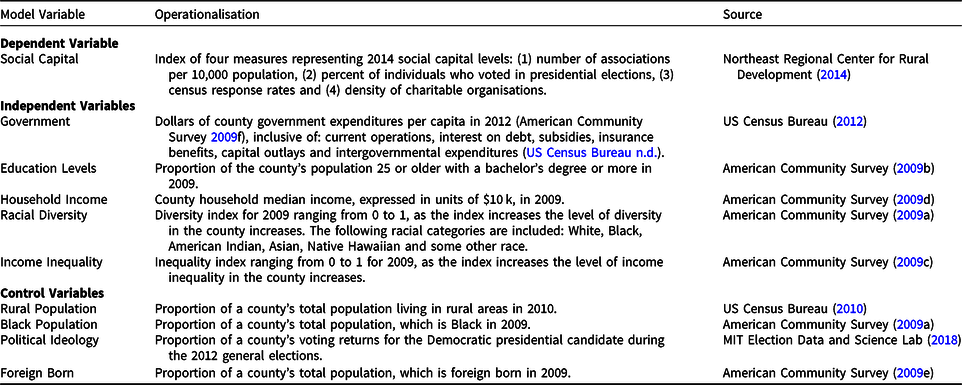
Variable operationalisation
Social capital
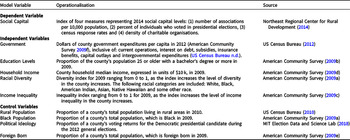
We operationalise social capital using a composite index developed by Rupasingha et al. (Reference Rupasingha, Goetz and Freshwater2006 with updates). The index is structural in nature, meaning it captures “the forms and varieties of organizations and networks that are thought to contribute to the development of social capital” (Sherrieb et al. Reference Sherrieb, Norris and Galea2010, 233). Assessments of the index by other scholars demonstrate it has content, convergent and nomological validity. Lee and Kim (Reference Lee and Kim2013) compared it against two other county-level social capital constructs operationalised as (1) the number of individuals working at voluntary organisations per capita and (2) the percent of a locality’s adults who report having a social support structure (Brown et al. Reference Brown, Scheffler, Sukyong and Reed2006; Scheffler et al. Reference Scheffler, Brown and Rice2007). They conclude there is “compelling evidence that the index is a very useful, valid tool for researchers interested in social capital processes at the US county level” (Lee and Kim Reference Lee and Kim2013, 322).
The index is comprised of four separate components that measure different aspects of associational activity and community participation. The first component aggregates the number of voluntary associations per 10,000 population.Footnote 4 This encompasses horizontal associations (that promote interactions between people of similar interests) as well as “rent-seeking” organisations (that seek financial gain for their members) (Knack and Keefer Reference Knack and Keefer1997). The second item measures the percentage of individuals who voted in presidential elections. The third variable is county-level census response rates. Voting and completing the census are forms of civic “collective action,” which serve as proxies for socially cooperative attitudes (Knack Reference Knack2002). The final construct is the density of charitable nonprofit organisations, excluding those organisations that have an international focus. The first principal component in the index explains 30% of the variation and has an eigenvalue of 1.202. The mean of the index is zero and ranges from a low of −3.183 to a high of 21.809.
Government institution capacity
Government institution capacity has been operationalised in a variety of ways (Kwon et al. Reference Kwon, Berry and Feiock2009; Lobao and Kraybill Reference Lobao and Kraybill2009). Singular measures of capacity have included the total number of government employees (Hall Reference Hall2008) and revenue per capita (Ha et al. Reference Ha, Lee and Feiock2016). Others have defined capacity more broadly with measures to include government resources, networks and leadership (Chaskin Reference Chaskin2001). Gargan (Reference Gargan1981, 656) described governing capacity as simply “the ability of a local government to do what it wants to do.” In that vein, we define capacity as county government expenditures per capita (Reese and Rosenfeld Reference Reese and Rosenfeld2001). A government’s ability to raise and spend money may be related to proxies of social capital activity, including volunteering rates (Salamon and Sokolowski Reference Salamon, Sokolowski, Dekker and Halman2003) and trust levels (Rothstein and Stolle Reference Rothstein and Stolle2008). We argue that a government’s ability to foster social capital is directly related to its expenditures of public funds. County governments that spend more on a relative basis are likely to promote higher levels of social capital.Footnote 5
Other social capital determinants
We also consider the role of social capital community determinants identified by existing studies. One of the most important predictors of social capital in the literature is the socioeconomic status of residents in a community as measured by education (Delhey and Newton Reference Delhey and Newton2005) and income (Helliwell and Putnam Reference Helliwell and Putnam2007). We measure education levels as the percentage of a county’s adults who have obtained a bachelor’s degree or higher. Income is operationalised as household median income in units of $10,000. This is based on the idea that those with more resources can engage in more social capital generating activities (Kasarda and Janowitz Reference Kasarda and Janowitz1974). Higher incomes are consistently predictive of participation in both politics and associational life (Coleman Reference Coleman1988).Footnote 6 The inclusion of socioeconomic status is important because these variables are likely to be associated with measures of government capacity (Glaeser Reference Glaeser2001; Hoyman et al. Reference Hoyman, McCall, Paarlberg and Brennan2016). Extant literature suggests both income and education will be associated with higher levels of social capital.
Beyond socioeconomic status, community racial heterogeneity may also play a large role in aggregate levels of social capital (Costa and Kahn Reference Costa and Kahn2003; Delhey and Newton Reference Delhey and Newton2005; Portes and Vickstrom Reference Portes and Vickstrom2011). We measure racial diversity using a Gini-Simpson index (Simpson Reference Simpson2004). The index is calculated as one minus the sum of the squared proportion of each type of racial group. As the index approaches one, population diversity increases with the chance of two random individuals being from the same racial group decreasing. Research on the relationship between diversity and social capital is mixed. Some data suggest diversity can be a positive factor. Tsai et al. (Reference Tsai, Laczko and Bjørnskov2011) find that diversity does not lower trust, even when controlling for a variety of socioeconomic variables.
But other research suggests social capital could be lower in diverse communities.Footnote 7 Putnam’s (Reference Putnam2007) constrict theory argues that diversity is often a challenge for social capital creation because it causes residents to “hunker down.” Empirical tests of constrict theory have mixed results (Hawes and Rocha Reference Hawes and Rocha2011; Savelkoul et al. Reference Savelkoul, Hewstone, Scheepers and Stolle2015). Hawes and McCrea (Reference Hawes and McCrea2018) contend this because social capital operates in a fundamentally different manner across diverse neighbourhoods. Other theoretical justifications include homophily that is the tendency of people who are similar to one another to interact more frequently than with people who are dissimilar (McPherson et al. Reference McPherson, Smith-Lovin and Cook2001).Footnote 8 With no clear consensus, there is an insufficient theoretical basis to hypothesise an expected relationship between diversity and social capital.
A final major community-level determinant is income inequality (Robison and Siles Reference Robison and Siles1999; Tolbert et al. Reference Tolbert, Lyson and Irwin1998). As Putnam (Reference Putnam2001, 294) notes: “Inequality and social solidarity are deeply incompatible.” Income inequality increases social disparities and class polarisation – causing a reaction that lowers generalised trust (Kawachi et al. Reference Kawachi, Kennedy, Lochner and Prothrow-Stith1997; Knack and Keefer Reference Knack and Keefer1997). There is some evidence that growing income inequality is at least partially responsible for declines in social capital across the US (Putnam Reference Putnam2001; Subramanian et al. Reference Subramanian, Lochner and Kawachi2003). Income inequality may also vary with place in ways that affect aggregate social capital. For example, income inequality could have a stronger effect in rural communities because individuals with limited social contacts are more likely to know and interact with others of radically different incomes (Fallah and Partridge Reference Fallah and Partridge2007). Income inequality is measured using the Gini index (Giorgi and Gigliarano Reference Giorgi and Gigliarano2017). As the index approaches one, a community is approaching perfect inequality. We expect that as income inequality increases, social capital levels will decline.
Control variables
We also include some control variables. First, because even metropolitan counties can include rural areas, the models incorporate the percentage of a county’s population that lives in a rural area. This is distinct from the non-metropolitan variable that we use for the split sample. Second, we include the percentage of a county’s residents who are Black to account for how large concentrations of a single minority group may affect social capital. Stolle et al. (Reference Stolle, Soroka and Johnston2008) find that individuals who are members of “visible minorities” report less generalised trust. Third, the percent of the population that has voted for the Democratic candidate in the 2012 Presidential election is included as a proxy measure for political ideology. Political attitudes may influence other key variables of interest, including both social capital (Hero Reference Hero2003a) and county government capacity (Choi et al. Reference Choi, Bae, Kwon and Feiock2010; Miller Reference Miller1991). Finally, we include the percentage of a county’s foreign-born population. There is growing evidence that social capital may operate differently in areas with large immigrant populations (Hawes and McCrea Reference Hawes and McCrea2018).
Place variation
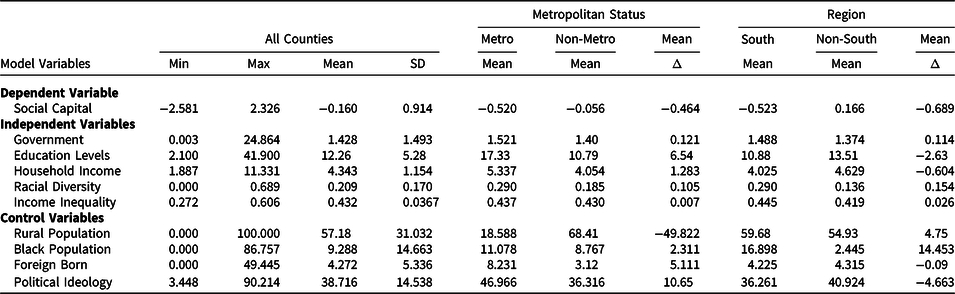
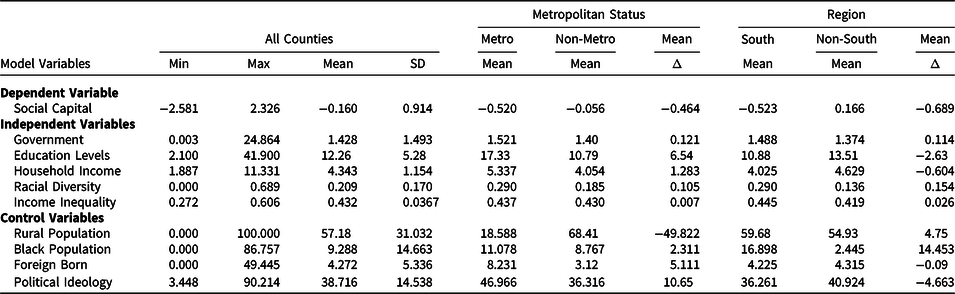
We compare the determinants of social capital listed above both across metropolitan status and region. The definition of metropolitan status includes all counties within a metropolitan statistical area, as determined by the US Census Bureau.Footnote 9 Metropolitan counties are coded as one. All other counties, including micropolitan (suburban) statistical areas and rural areas, are coded as zero.Footnote 10 Overall, 21% of counties are metropolitan, and 79% are non-metropolitan. On average, metropolitan counties have social capital scores of −0.520, while non-metropolitan counties have an average score of −0.056. We also compare variation across the South and non-South regions (Portes and Vickstrom Reference Portes and Vickstrom2011). Southern counties are those in the South Atlantic, East Central and West Central regions of the US.Footnote 11 Southern counties are coded as one, while all other regions are considered non-Southern and coded as zero. Overall, 47% of counties are Southern, and 53% are non-Southern. Social capital scores average −0.523 for Southern counties and 0.166 for non-Southern counties. We hypothesise that social capital will vary in part because of these geographic measures.Footnote 12
Research scope and limitations
Limitations of extant social capital definitions and theory
A great deal of social capital literature tends to view and test the construct across racially and economically homogeneous communities. Thus, the normative social capital theory has developed through analyses of higher income and mostly white communities. But social capital may work differently in areas with high concentrations of racial minorities (Lin Reference Lin2000), ethnic minorities (Huijts et al. Reference Huijts, Kraaykamp and Scheepers2014) and in places with higher income inequality (Hargreaves Heap et al. Reference Hargreaves Heap, Tan and Zizzo2013).Footnote 13 There is some evidence that the positive effects of social capital on outcomes like economic equity do not accrue to non-white populations at the same rate enjoyed by white populations (Hero Reference Hero2003b). The fact that social capital’s definitional contours may be different in racially or economically heterogeneous neighbourhoods is a limitation of the research.
The models try to partially account for this issue by (1) use of an index that includes congregation density within the dependent variable and (2) including the Black population percentage as a control variable. Cross-disciplinary research highlights that religiosity in general, and Black churches, in particular, may play a key role in the creation of social capital across diverse communities (Koopmans and Veit Reference Koopmans and Veit2014; Putnam and Campbell Reference Putnam and Campbell2012). Of particular note is the importance of Black churches in encouraging their congregations to be politically active, a key driver of civic participation (Calhoun-Brown Reference Calhoun-Brown1996). For example, McClerking and McDaniel (Reference McClerking and McDaniel2005) have noted that Black churches are successful in encouraging political activity from their members because they engage in a wide range of activities that create a sense of obligation to the local community.Footnote 14 Similarly, other research has shown how religious institutions that encourage heterogeneous social interactions can foster outcomes like lower income inequality (Hoyman et al. Reference Hoyman, McCall, Paarlberg and Brennan2016).
Multi-faceted nature of place
While we use a “place matters” framework for the analysis and results, the term belies the complexity of what actually defines a “place” (Lichter and Ziliak Reference Lichter and Ziliak2017). A community’s identity is much more than its physical or administrative boundaries. Drier et al. (Reference Dreier, Mollenkopf and Swanstrom2013) show that the socioeconomic characteristics of a community (in addition to its geographic contours) are important in predicting a place’s economic and social prosperity. These community-level characteristics have important implications for a variety of development inputs and outputs. Similarly, the urban politics literature has long argued that what defines a place is a constellation of variables including population density, the character of a built environment, land utilisation, the presence of political regimes and social interactions (Stone Reference Stone1993; Ward and Imbroscio Reference Ward and Imbroscio2011).Footnote 15 For this reason, our analysis divides the data into metropolitan status and region, but the models include a variety of place-related variables that go beyond geography. The analysis thus represents a starting point to consider the complexity of place.
Endogeneity and causality
There are perennial concerns about endogeneity, which are often raised in any study of social capital. For example, social capital improves the performance of government (Easterly et al. Reference Easterly, Ritzen and Woolcock2006), increases the capability of acquiring jobs through weak ties (Granovetter Reference Granovetter1973) and reduces income inequality (Ram Reference Ram2013). But all these variables represent potential determinants for aggregate levels of social capital. We have attempted to address the issue of endogeneity by lagging all independent variables of interest and the control variables. However, such concerns will always be a limitation of this kind of data analysis. As noted in many studies on the determinants of social capital, causal relationships are usually ambiguous (Bjørnskov Reference Bjørnskov2007; Delhey and Newton Reference Delhey and Newton2005).
Findings and results
Descriptive statistics
Table 1 displays summary data for each variable. Counties are divided into three categories: all counties, counties by metropolitan or non-metropolitan status and counties by South or non-South region. To determine whether there were statistically significant differences across place, we used independent-samples t-tests for all variables listed in Table 2. Social capital, education levels, household income, income inequality, racial diversity, black population and political ideology all have statistically significant differences (p < 0.01) at the regional level. The government variable for region displayed significance at the p < 0.05 level. There were no statistically significant differences for the rural and foreign-born control variables across region. All variables had statistically significant differences (p < 0.01) across metropolitan status, although differences in government expenditures were marginally significant (p < 0.10). The descriptive statistics thus hint at the importance of variance by place, although differences appear to be more pronounced at the metropolitan status level.
Model descriptive statistics
Model overview
OLS regression
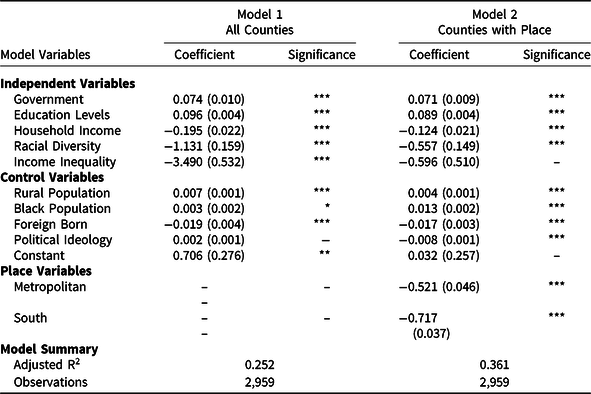
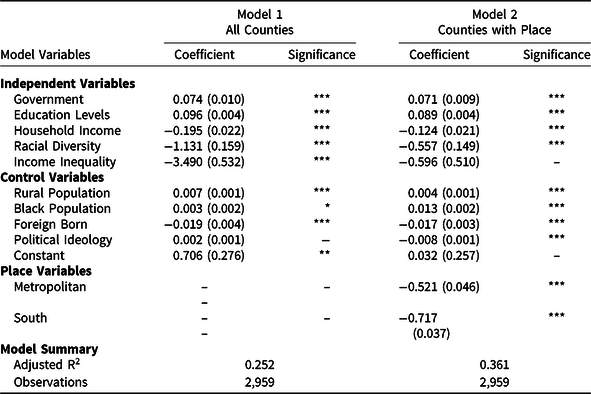
Next, we consider how the relative effects of our independent variables change when controlling for place. Table 3 includes all variables except metropolitan status and region in model 1, and then includes both geographic variables in model 2.Footnote 16 The inclusion of place variables raises the explanatory power of the models from an adjusted R2 of 0.252 to 0.361. Both being in the South and being in a metropolitan county are associated with notable declines in aggregate social capital index scores. The coefficient values for government capacity (0.074, p < 0.01 to 0.071, p < 0.01) and education (0.096, p < 0.01 to p < 0.089, p < 0.01) show little change when controlling for metropolitan status and region. Increasing county government expenditures per capita by one standard deviation (about $1,493) would be expected to increase a county’s social capital index value by 0.110. When controlling for region and metropolitan status, the expected effect of an identical increase in expenditures declines only slightly to 0.106. Increasing the level of educational attainment by one standard deviation (the equivalent of increasing the percentage of a county’s population over the age of 25 with a bachelor’s degree by 5.28%) corresponds to an expected social capital index value increase of 0.505. When controlling for region and metropolitan status, that expected effect has a small decline to 0.469.
Regression models including/excluding place variables
*** p < 0.01, ** p < 0.05, * p < 0.10. Standard errors are in parentheses.
Meanwhile, other community-level characteristic variables display more notable shifts in coefficient values. For example, the strongly negative effects of income inequality lose statistical significance when controlling for place. And while racial diversity retains a negative sign, it becomes smaller both in terms of coefficient value (from −1.131, p < 0.01 to −0.557, p < 0.01) and relative effect size when moving from model 1 to model 2.Footnote 17 Without accounting for place a single standard deviation change in racial diversity – an increase in the value of a county’s Gini-Simpson index by 0.170 – would result in a −0.193 change in social capital index scores. But the negative effect of one standard deviation change after accounting for metropolitan status and region shows a different story. With the inclusion of place variables, increasing diversity by one standard deviation only results in a social capital index change of −0.095.
Table 3 also displays some counter-intuitive results as it suggests higher incomes may lower county-level social capital. Although this effect declines somewhat after accounting for geography (−0.195, p < 0.01 in model 1 to −0.124 p < 0.01 in model 2), it remains an unexpected result.Footnote 18 Increasing the median household income in a county by one standard deviation (about $11,540) corresponds with an expected change of −0.225 in that county’s social capital index value. But after controlling for region and metropolitan status, that effect size falls to −0.143. This suggests that place could play an important role in the relationship between household income and aggregate social capital. There is some research suggesting higher incomes might depress social capital creation for a variety of reasons (Bjørnskov Reference Bjørnskov2007). Possible explanations include that higher income households are more likely to replace the community-oriented associational activity with private sector leisure (Galaskiewicz et al. Reference Galaskiewicz, Mayorova and Duckles2013). The findings are also consistent with literature showing no positive relationship between social capital and higher incomes after controlling for community-level characteristics (Bjørnskov Reference Bjørnskov2007; Rupasingha et al. Reference Rupasingha, Goetz and Freshwater2006).
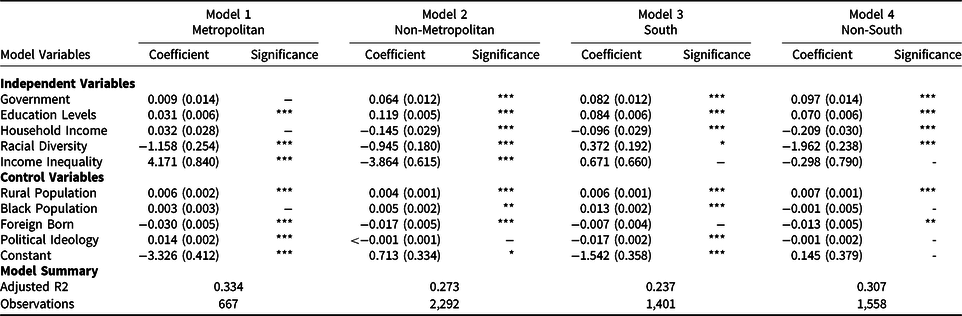
To explore how coefficients may differ across place, Table 4 contains a split sample that divides counties into metropolitan (Model 1), non-metropolitan (Model 2), South (Model 3) and non-South (Model 4). We used a Chow test to determine whether the beta coefficients are different across samples. The Chow test examines the difference in the magnitude of the beta coefficients in regression models fit on different subsets of data. For this analysis, the test considers the contribution of each independent variable when including metropolitan status and region. All beta coefficients were significantly different across metropolitan status and region (p < 0.01).
OLS regression models by metropolitan status and region
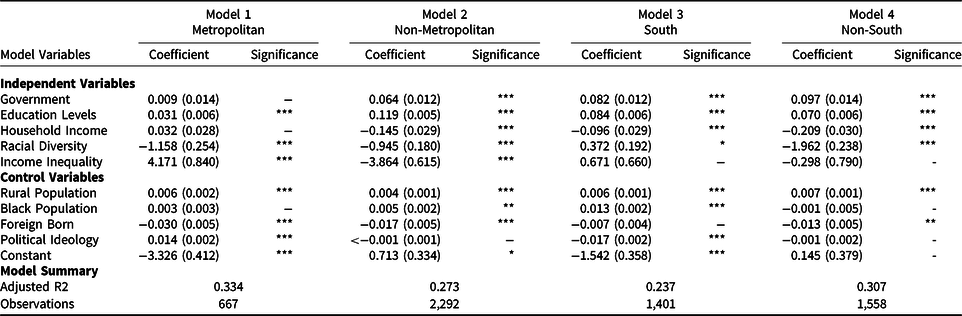
*** p < 0.01, ** p < 0.05, * p < 0.10. Standard errors are in parentheses.
Table 4’s regional models 3 and 4 show the positive influence of government capacity supports higher coefficient values in the non-South (0.097, p < 0.01) versus the South (0.082, p < 0.01). Meanwhile, models 1 and 2 show the government capacity variable loses statistical significance in metropolitan counties while retaining it in non-metropolitan counties (0.064, p < 0.01). These preliminary findings suggest that the positive effect of government institutions may vary across different facets of place. But other community determinant variables show greater variability, both in terms of coefficient value changes and sign changes. Higher-income inequality has a negative relationship (−3.864, p < 0.01) with social capital in non-metropolitan areas, but has an unexpectedly positive influence in metropolitan counties (4.171, p < 0.01).Footnote 19 To contextualise these results, a one-standard deviation increase in income inequality (moving up 0.034 on the Gini index) would be associated with an increase of 0.144 on the social capital index in metropolitan counties. But in non-metropolitan counties, a one-standard deviation increase in income inequality is associated with a −0.143 decline in the social capital index.
At the regional level, racial diversity changes from having a marginally positive coefficient in Southern counties (0.372, p < 0.1) to a negative coefficient in non-Southern counties (−1.962, p < 0.01). The relative effect size of diversity is also much higher in the non-South, where increasing the Gini-Simpson racial diversity index value by one standard deviation results in a −0.266 change in social capital in non-South counties, compared to a 0.063 increase in the index across Southern counties. Such findings offer additional support for theories that social capital may work through different mechanisms in racially diverse communities (Hawes and McCrea Reference Hawes and McCrea2018). Finally, the data yet again hint that higher income levels have a negative association with social capital in some places. But it is interesting to note the coefficient is not significant in metropolitan counties and changes are notable when moving from the non-South (−0.209, p < 0.01) to South (−0.096 p < 0.01) models.
Blinder–Oaxaca decomposition
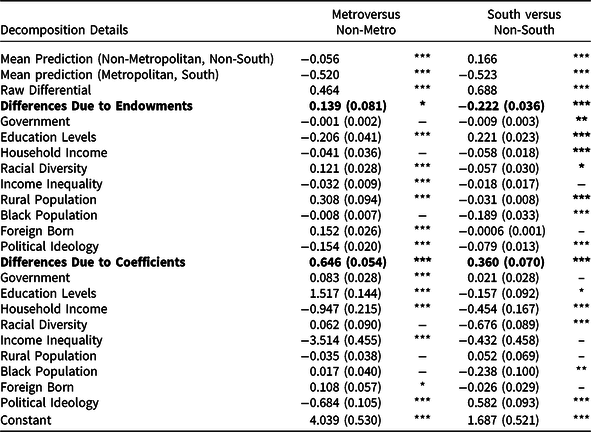
Both the descriptive statistics and regression models suggest that the level of community determinants and the effects of those determinants may vary across place. To further explore this, we estimated two Blinder–Oaxaca decompositions that measure social capital differences between (1) metropolitan and non-metropolitan counties and (2) South and non-South counties. The Blinder–Oaxaca decomposition in Table 5 decomposes the difference in mean outcomes as a gap in endowments and a gap in coefficients. For purposes of this research, we will sometimes refer to endowments as characteristics of a community determinant. The gap in characteristics measures the expected change in levels of social capital if metropolitan counties had the same characteristics as non-metropolitan counties. The second element measures the expected change in social capital if the effect of the coefficients (β) was the same across metropolitan status. We refer to the effect of coefficient decomposition as changes in productive values. A second decomposition parses the same question but compares effects across the South and non-South.
Blinder-Oaxaca decomposition by place
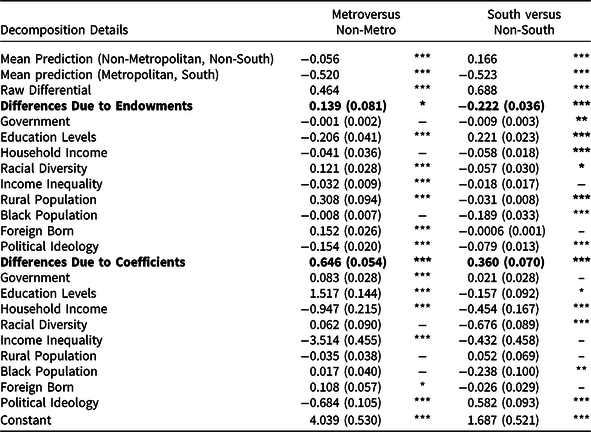
*** p < 0.01, ** p < 0.05, * p < 0.10. Standard errors are in parentheses.
Variation across metropolitan status
The mean index of social capital for metropolitan counties is −0.520, while the mean social capital index for non-metropolitan counties is −0.056, a difference of 0.464 (p < 0.01). The average social capital level is lower for metropolitan areas partially because these counties often have lower values of certain community determinants that are associated with aggregate social capital increases. Metropolitan counties would see an increase in social capital index values (0.139, p < 0.1) if they had the same levels of the model’s independent variables as non-metropolitan counties. Notably, differences in social capital across metropolitan status are not due to variance in government expenditures. If metropolitan counties had the same (lower) levels of government capacity as non-metropolitan counties, their social capital index scores would see almost no change (−0.001, not statistically significant). Similarly, differences in household income levels also have a small (−0.041) and statistically insignificant effect on mean social capital index levels across metropolitan status.
Metropolitan areas are more diverse, but this diversity, as operationalised in our models, results in lower aggregate levels of social capital. If metropolitan areas had the same (lower) levels of diversity as non-metropolitan areas, their social capital levels would increase by 0.121 (p < 0.01). There are also a few notable differences in social capital levels due to the control variables. Having a higher population density seems to be a large disadvantage for metropolitan communities. If metropolitan counties had the same (higher) level of their population living in rural places as non-metropolitan counties, aggregate social capital values would be expected to increase by 0.308 (p < 0.01) on average. Conversely, the high levels of education in metropolitan counties may give them an advantage in social capital production. If metropolitan counties had the same (lower) levels of education as non-metropolitan counties, the mean social capital index scores would change by −0.206 (p < 0.01).
If we were to apply the coefficients from non-metropolitan counties to metropolitan counties, social capital index scores in metropolitan counties would increase by an average of 0.646 (p < 0.01). This is notable because it means most of the variation in social capital across metropolitan status is attributable to changes in coefficient values. Unlike endowment levels, the productive value of government capacity is statistically significant. If the larger coefficient on government expenditures in non-metropolitan counties (0.064, p < 0.01) was applied to metropolitan counties, social capital index scores would be expected to increase by 0.083 (p < 0.01).
The largest share of across group differences in social capital levels at the metropolitan level is attributable to place-based changes in income inequality. If income inequality had the same coefficient effect in metropolitan counties as it does in non-metropolitan counties (−3.864, p < 0.01), the average social capital index value for metropolitan counties would decline by −3.514 (p < 0.01). This finding may support research that suggests income inequality has more negative effects in non-metropolitan areas because it is more visible and obvious to residents than in urban areas (Fallah and Partridge Reference Fallah and Partridge2007). Finally, the coefficient decomposition again demonstrates that education is a positive force for social capital, but its productive value effects can vary dramatically across place. If metropolitan communities had the same higher education coefficient as non-metropolitan communities (0.119, p < 0.01), their aggregate social capital index score would increase by an average of 1.517 (p < 0.01).
Variation across region
The story at the regional level is that non-South counties have higher average social capital index values (0.166) than South counties (−0.523). Raw differentials at the regional level are higher (0.688, p < 0.01) than at the metropolitan level, suggesting that, in aggregate, the influence of region plays a stronger role in explaining place-based social capital variation than metropolitan status. In aggregate, if South counties had the same levels of the tested community determinant characteristics as non-South counties, their social capital index scores would change by an average of −0.222 (p < 0.01). Differences in average government per capita expenditures across South and non-South counties have a small but statistically significant effect on social capital levels. If South counties had the same (lower) levels of government expenditures as non-South counties, average social capital would be expected to decline by 0.009 (p < 0.05). In the South, counties also have levels of household income (lower) and racial diversity (higher), which aid in the production of social capital. Among the independent variables of interest, only the South’s relatively lower level of education seems to be a disadvantage. If South counties had the same (higher) levels of education as non-South counties, their social capital index scores would increase by an average of 0.221 (p < 0.01). The model’s control variables also show a few interesting patterns. Having a higher proportion of Black residents (−0.189, p < 0.01) gives South counties a social capital advantage over non-South counties. And while South counties have lower levels of Democratic vote share than non-South counties, this appears to benefit South counties in terms of social capital production (−0.079, p < 0.01).
Like metropolitan status, differences in coefficients (or productive values) explain more of the variation in regional social capital index scores. While levels of various community determinants help South counties promote social capital, the coefficients on these variables do not give the South an aggregate advantage. If South counties had the same coefficient productive values as non-South counties, their social capital would increase by an average of 0.360 (p < 0.01). This is mostly attributable to regional differences in political ideology. If South counties had the same coefficient value for political ideology as the non-South, social capital index values would increase by a mean of 0.582 (p < 0.01). Differences in coefficients for government per capita expenditures are not statistically significant at the regional level. Most of the other independent variables of interest – racial diversity, household income and educational levels – have coefficient values that favour the South. For example, if South counties had the same negative coefficient value for diversity as the non-South (−1.962, p < 0.01), aggregate social capital index values would change by −0.676 (p < 0.01).
Discussion and conclusions
Our findings offer a first step in deconstructing the complex relationship between place and the many community-level determinants of social capital. The role of government institutions on social capital across place is particularly important. For better and for worse, social capital is often seen as an integral factor for community and economic development by policy actors (Oh et al. Reference Oh, Lee and Bush2014; Ponzetto and Troiano Reference Ponzetto and Troiano2018). Research demonstrating that localities with high levels of social capital enjoy a variety of positive socioeconomic outcomes may help drive that assumption (Engbers et al. Reference Engbers, Rubin and Aubuchon2017). However, the data show that, to some degree, “place matters” in explaining social capital variation. Only two types of community determinants – government capacity and education levels – show a consistently positive relationship with social capital. But like all variables in our models, these factors seem to shape county social capital levels differently through their endowment levels and coefficient productive values. Since endowment levels and productive values can vary greatly across metropolitan status and region, the findings hint that determinants of social capital may be more place bound than other research has suggested.
Over the past few decades, the literature has ascribed much potential to social capital theory as a public policy lever. The scholarship has posited that attempts to change or draw upon community social capital might be useful in a sundry array of areas like affordable housing (Lang and Hornburg Reference Lang and Hornburg1998), public health (Helliwell Reference Helliwell2006), disaster recovery (Joshi and Aoki Reference Joshi and Aoki2014) and economic development (Karlsson and Dahlberg Reference Karlsson and Dahlberg2003). The importance of government actors in bolstering community social capital has been hinted at in a wide variety of geographic contexts. For example, Halseth and Ryser (Reference Halseth and Ryser2016) show social cohesion is critical in non-metropolitan areas, but its effectiveness is often limited without the assistance of local government. Similarly, for metropolitan communities, there appears to be a reciprocal relationship between urban governing regimes and formalised social capital-based civic participation networks (Hays and Kogl Reference Hays and Kogl2007; Musso and Weare Reference Musso and Weare2017). Our data highlight the need for nuanced consideration of such findings, as it seems the capacity of local government to influence community social capital varies across place. As operationalised in our models, metropolitan governments tend to have higher aggregate capacity levels, but the productive value of that capacity is higher in non-metropolitan counties.
Though this research considers the role of place and social capital at the US county government level, the findings may also have applicability in a comparative context. There is evidence of a relationship between community social capital and the capacity of local government in many countries (Hooghe and Vanhoutte Reference Hooghe and Vanhoutte2011; Parés et al. Reference Parés, Martí-Costa and Blanco2014). Differences across metropolitan and non-metropolitan communities – and their implications for social capital – are certainly not unique to the US (Park et al. Reference Park, Lee, Choi and Yoon2012; Western et al. Reference Western, Stimson, Baum and Van Gellecum2005). The South and non-South distinction used in this analysis is specific to the US, but most countries have some sort of regionalism shaped by each nation’s unique social, political and institutional history (Boggs and Rantisi Reference Boggs and Rantisi2003; Crescenzi, Gagliardi, and Percoco Reference Crescenzi, Gagliardi and Percoco2013). To the extent that our findings show how social capital is shaped by place-based regional characteristics, there is a need to examine regional social capital variation in other countries. Social capital theory has long recognised the importance of region – indeed, Putnam et al. (Reference Putnam, Leonardi and Nanetti1994) original study was based on differences between Northern and Southern Italy – but more work needs to be done in terms of quantifying these effects.
The data also show a need for more research on the role of differences in endowment levels and coefficient productive values across place. The characteristics of non-metropolitan (Fallah and Partridge Reference Fallah and Partridge2007; Granovetter Reference Granovetter1973) and non-South (Portes and Vickstrom Reference Portes and Vickstrom2011; Putnam Reference Putnam2001; Rupasingha et al., Reference Rupasingha, Goetz and Freshwater2006) counties work to their advantage in generating higher mean social capital scores. But how place is defined can change the extent to which social capital variation can be explained by differences in community determinants. The decomposition models show levels of government expenditures are not related to differences in social capital levels across metropolitan status. But levels of government expenditures do vary in their ability to influence social capital index scores across region. At the same time, differences in the coefficient productive values for government expenditures seem to shape social capital at the metropolitan level, but not across region. Many of our other independent variables of interest show a similar pattern. The endowment levels and productive values of household income, racial diversity and income inequality are predictors of cross-group differences in social capital. But in many cases, their statistical significance changes across different definitions of place.
In some ways, our findings reinforce theories of place-based path dependency. Our data concur with literature suggesting a degree of social capital “lock-in” may occur in some locales. The models provide support for the idea that a community’s tendency towards path dependency may be influenced by place-based factors like regional geography (Martin and Sunley Reference Martin and Sunley2006). The data support such narratives because they hint that community determinants can vary both by characteristic endowment levels and coefficient productive values across region and metropolitan status. Thus, to some extent, a community’s social capital prosperity may be related to place luck (Reese and Ye Reference Reese and Ye2011). But while these findings are interesting, it is important to note that further research is needed to see if they hold when examining other definitions of place. Within the US, a fruitful avenue for further research is applying this type of modelling to both to smaller (e.g. cities) and larger (e.g. other definitions of region, state-level data, etc.) units of analysis. And though we believe our findings are likely generalisable to places beyond the US, there is a need to see if the findings can be replicated via decomposition modelling with comparative data.
In summary, the use of social capital has become something of a “one size fits all” prescription that seeks to cure the community and economic development ailments of localities (Lovell Reference Lovell2009). Our data show that the relationship of government capacity to place is like other community-level social capital determinants. In aggregate, higher levels of county government capacity are linked to social higher capital, but both the endowment levels and productive values of expenditures vary by some immutable qualities of place. Ultimately, our findings show policy actors must be cognizant of the role of place in determining how community-level determinants might alter the effectiveness of social capital strategies.
Acknowledgements
The authors are grateful to Mimi Clemens and James Owens for their extensive research assistance work on multiple versions of this paper.
Data Availability Statement
Replication materials are available in the Journal of Public Policy Dataverse at https://doi.org/10.7910/DVN/N3RPNR (McCall et al. Reference McCall, Bussing, Hoyman and Paarlberg2020).