Disaster preparedness is defined as the act of “enhancing the ability of social units to respond when a disaster occurs.”Reference Tierney, Lindell and Perry1 For households, this means being ready to take protective action when a disaster is imminent or being able to obtain or mobilize the necessary resources to respond to and recover from a disaster.Reference Tierney, Lindell and Perry1 How preparedness is measured at the household level varies greatly. There is no definition of preparedness widely accepted among researchers or practitioners.Reference Kohn, Eaton and Feroz2 There are several inventories and checklists, and scholars have replicated the use of some preparedness measures, but there is no standardized validated tool widely used in research studies.Reference Tierney, Lindell and Perry1,Reference Kohn, Eaton and Feroz2 A literature review published in 2012 found that 8 of 36 preparedness studies conducted between 1993 and 2010 developed new instruments to measure preparedness and the remaining studies replicated scales or tools from past research without providing information on development of the measure.Reference Kohn, Eaton and Feroz2 Agencies and organizations, including the American Red Cross (ARC) and the Federal Emergency Management Agency (FEMA), recommend that households have a basic set of preparedness supplies, a plan, and a supply of prescription medication. Messages are disseminated to households through commercials, pamphlets, billboards, and online.3,4
Despite preparedness campaign efforts in the United States by FEMA and the ARC, research shows that most people are not prepared for a disaster.Reference Basolo, Steinberg and Burby5–Reference Petkova, Schlegelmilch and Sury7 However, when evaluating socioeconomic, demographic, and health variables, differences exist among these studies regarding who is more or less likely to be prepared.Reference Uscher-Pines, Chandra and Acosta8–Reference McCormick, Pevear and Rucks12 Americans also tend to overstate their preparedness.Reference Petkova, Schlegelmilch and Sury7,Reference Ablah, Konda and Kelley11 The American Preparedness Project 2015 report on the perceptions of the American public and preparedness of American households found that 50% of households report being prepared with a kit and plan. However, when households were asked for specific information about the kit contents and plans, only 35% of households reported adequate preparedness. Household preparedness has increased since 2003 (23% prepared) by 12%. When asked about confidence in the government to respond to a disaster, 40% of Americans report they are not confident. Furthermore, 51% of Americans report that they believe a first responder will arrive within an hour of a disaster to provide assistance.Reference Petkova, Schlegelmilch and Sury7
Disaster researchers have identified many predictors of preparedness, including prior disaster experience,Reference Tierney, Lindell and Perry1,13–Reference Sattler, Kaiser and Hittner15 age,Reference Sattler, Kaiser and Hittner15 income,Reference Tierney, Lindell and Perry1,Reference Sattler, Kaiser and Hittner15 internal locus of control, perceived threat, current distress,Reference Sattler, Kaiser and Hittner15 school age children in the household, being female, and integration in community life.Reference Tierney, Lindell and Perry1 Researchers have found that certain groups are more likely to be prepared with supplies, including African Americans, Latinos, households with children, households with members born outside of the United States,Reference Eisenman, Zhou and Ong16 and households with past disaster experience.Reference Horney, Snider and Malone17,Reference Kirschenbaum18 Certain groups have also been found to be more likely to prepare with a plan, including those who are married or partnered, living in the Western United States,Reference Petkova, Schlegelmilch and Sury7 with past disaster experience,Reference Petkova, Schlegelmilch and Sury7,Reference Horney, Snider and Malone17 and with past evacuation experience.Reference Horney, Snider and Malone17
Researchers have documented that preparedness plan and supply recommendations are not based on empirical evidence. Uscher-Pines and colleagues argued in a 2012 article discussing the assumptions underlying household disaster preparedness in the United States that “the role individual Americans are being asked to play (in household preparedness) is largely based on conventional wisdom.” They provide evidence that preparedness messages are based on unverified assumptions and the content of recommended kits is largely based on expert panel guidance rather than empirical evidence.Reference Uscher-Pines, Chandra and Acosta8 Furthermore, research on whether having a disaster kit results in a reduced need for aid, better health outcomes, less property damage, or increased disaster resilience is lacking.Reference Kohn, Eaton and Feroz2,Reference Heagele19 Additionally, there has been little research on preparedness and few to no replication of the studies on preparedness that have been conducted. This gap in research limits the ability to generalize findings.Reference Tierney, Lindell and Perry1,Reference Kohn, Eaton and Feroz2 Furthermore, research has focused primarily on planning and buying behavior rather than what was used or perceived as useful for individuals coping with disaster.Reference Uscher-Pines, Chandra and Acosta8
This study aims to contribute to an empirical evidence base for preparedness by examining the relationship between disaster preparedness, having a kit and a plan, and disaster outcomes including property damage, medical or mental health impacts, and perceived recovery in a sample of households impacted by Super Storm Sandy in New York City (NYC) from October 22 to 29, 2012.Reference Blake, Kimberlain and Berg20 We hypothesize that simply having a set of supplies is not associated with better disaster outcomes but that having a plan, due to the process involved in developing a plan, is associated with better outcomes.
METHODS
Sample
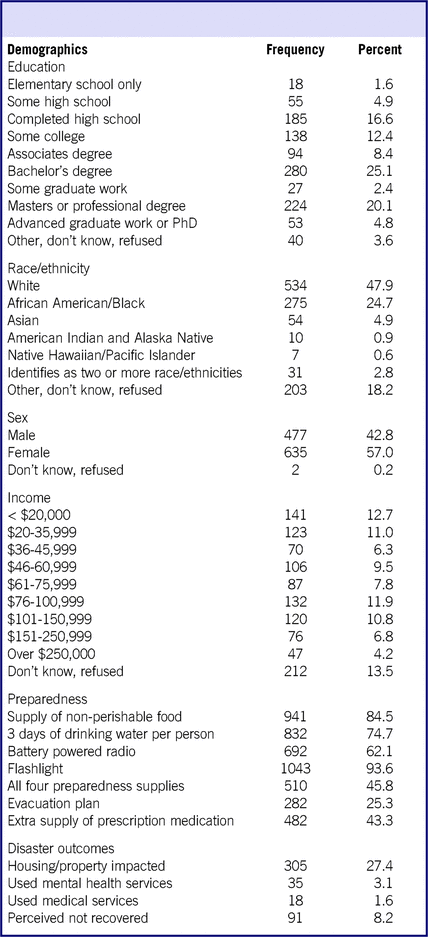
A total of 2086 households in NYC’s 5 boroughs were randomly sampled and contacted by phone (75% landline and 25% cell phone) to complete an interviewer administered computer assisted telephone interview (CATI).Reference Dixon, Singleton and Straits21 Interviewers received 10 hours of training, and each phone number in the sample received 10 call attempts at varied times of day and days of the week. Landlines in flood inundation zones were oversampled using FEMA flooding maps. A response rate of 5.6% was computed following the standard American Association for Public Opinion Research (AAPOR) methodology.22 Phone survey research has experienced declining response rates due to a number of factors, such as changing norms in phone use from making calls to text and Internet based communication, increased phone solicitation and the use of caller identification.Reference Marken23,Reference Czajka and Beyler24 In 2017, Gallup reported an average response rate of 7%, down from 28% in 1997.Reference Czajka and Beyler24 Studies of response rates and bias consistently show that low response rates are not a reliable indicator of bias.Reference Czajka and Beyler24,25 Expected sample proportions were calculated using the US Census Factfinder tool for 2014.26 Consistent with recent studies of disaster recovery,Reference Nejat, Brokopp Binder and Greer27 females and those with higher education were overrepresented in the sample. Those identifying as white were overrepresented but, curiously, so too were those identifying as American Indian/Alaska Native and Hawaiian/Pacific Islander, although the absolute numbers for these latter groups were small. Expected and observed values for those identifying as African American were nearly identical (Table 1).
Sandy Sample and NYC Population Demographic Characteristics

Respondents who reported during study screening that they lived in NYC during Super Storm Sandy (October 22-29, 2012) were interviewed 21-34 months after the storm about disaster preparedness, warning and evacuation, impacts, and physical and mental health.Reference Blake, Kimberlain and Berg20 The interview was administered in English and Spanish. The study survey was developed as part of a larger research center effort to measure and understand community resilience.Reference Links, Schwartz and Lin28 The survey specifically aimed to measure household or individual level constructs that aligned with a community level model of resilience. This model was developed based on 18 domains of community functioning.Reference Aguirre, Dynes and Kendra29 Where validated measures of concepts exist, they were utilized. Pilot testing of the survey was completed prior to CATI programming, and then the CATI survey was piloted before training interviewers. The measures utilized in the present analysis are elaborated on in the measures section to follow. Study protocols were reviewed and approved by the Institutional Review Boards at the University of Delaware and NYC Department of Health and Mental Hygiene. Complete data were obtained from 1114 households on preparedness and disaster impacts and are included in this analysis.
Measures
Disaster outcomes assessed include housing and property damage, use of medical or mental health services, and perceived recovery. Preparedness exposure measures include disaster supplies (food, water, flashlight, radio), a plan, and a supply of prescription medication, which is taken from the Behavioral Risk Factor Surveillance System (BRFSS) general preparedness module and measures a standard set of supplies commonly recommended by FEMA and the ARC.3,4
Housing and property damage was assessed by asking respondents to indicate with a yes (1) or no (0) response to the question, “Did Sandy affect your house or property in any way?”. We selected this question to capture the range of housing and property damage impacts reported by respondents including damage to foundation (9.3; n = 59), roof (36.4%; n = 111), plumbing (25.3%; n = 77), electrical (51.8%; n = 158), personal property (30.8%; n = 94), porch, patio, or balcony (26.9%; n = 82), vehicle (19.3%; n = 59), or home was unlivable (20.5%; n = 63). Physical health impacts of Sandy were assessed by asking respondents, “Did you or any member of your household require medical treatment for Hurricane Sandy related injuries?”. Mental health impacts of Sandy were assessed by asking respondents, “Did you or any member of your household get counseling because of feelings caused by Hurricane Sandy?”. Mental and physical health impacts were dichotomously coded 1 (yes) or 0 (no). Perceived recovery was assessed by asking respondents, “In general terms, how much has your household recovered from Sandy?”. Respondents indicated completely, almost, somewhat, or not at all recovered. Respondents that indicated completely or almost recovered were categorized as “recovered” and respondents that indicated somewhat or not at all were categorized as “not recovered”.
Preparedness was assessed by asking respondents if they made an evacuation plan before Sandy, had 3 days of drinking water per person, a supply of nonperishable foods, a flashlight and batteries, a battery-operated radio, and an extra supply of prescription medication. A summary measure of preparedness supplies was computed. Respondents with food, water, a flashlight, and radio were categorized as prepared with supplies. Respondents with less than all 4 supplies were categorized as unprepared with supplies. An evacuation plan (yes, no) and supply of prescription medication (yes, no) were examined as separate exposures as not everyone requires prescription medication and creating a plan is the only preparedness measure taken for the explicit purpose of disaster preparedness and it requires multiple household members to participate in its development.
Demographic variables examined in this analysis include income (< $20,000, $20-35,999, $36-45,000, $46-60,000, $61-75,999, $76-100,999, $101-150,999, $151-250,999, >$250 K), education (elementary school only, some high school, completed high school, some college, associate’s degree, bachelor’s degree, some graduate work, master’s or professional degree, Advanced graduate work or PhD, other/do not know/refused), sex (male, female, do not know/refused), and race (White, African American, Asian, American Indian/Alaska Native, Native Hawaiian/Pacific Islander, multiple races, do not know/refused). Due to small counts of respondents in the latter race categories, race was recoded as White, African American, and other race.
Data Analysis
A chi-square analysis was performed to examine the bivariate association between individual characteristics, preparedness, and disaster outcomes. A logistic regression model was fit to examine the likelihood of positive disaster outcomes given reported preparedness with a kit, plan, and medication. The models were adjusted for individual characteristics including sex, race, income, and education level where those factors were independently associated with the outcome. Change in the coefficient of the logistic regression model was examined and adjusted odds ratios (AOR) and 95% confidence intervals (CI) are reported. Statistical analyses were conducted in Stata 13.30 A power analysis indicates that we need a sample of 223 respondents that are prepared and 446 respondents that are not prepared to observe a medium effect size. In the present analysis, 510 respondents have all 4 preparedness supplies and 604 respondents do not have the full range of supplies.Reference Cohen31
RESULTS
The mean age of respondents was 50 years old, and over half of the sample reported female sex (57%; n = 635). More than half of respondents were college graduates with a bachelor’s degree or higher education (52.4%; n = 584) and nearly half reported white race (48%; n = 534) and a quarter reported African American race (24.7%; n = 275). Approximately 40% of the sample reported greater than $60,000 income (41.5%; n = 462) (Table 2).
Sample Characteristics (n = 1114)

The initial examination of Super Storm Sandy outcomes indicated that over a quarter of the sample of 1114 respondents had their housing or property affected by the storm (27.4%; n = 305) and few respondents reported accessing mental health (3.1%; n = 35) or medical services (1.6%; n = 18). Less than 10% (8.2%; n = 91) of the sample reported not being recovered 2 years after Sandy. Respondents reported a high level of preparedness with disaster supplies before Sandy, including food (84.5%; n = 941), water (74.7%; n = 832), and a flashlight (93.6%; n = 1043). More than half the sample also reported having a battery powered radio (62.1%; n = 692). However, less than half of the sample reported having all 4 preparedness supplies (45.8%; n = 510). Many fewer respondents reported having an evacuation plan (25.3%; n = 282) or an extra supply of medication (43.3%; n = 482) (Table 2).
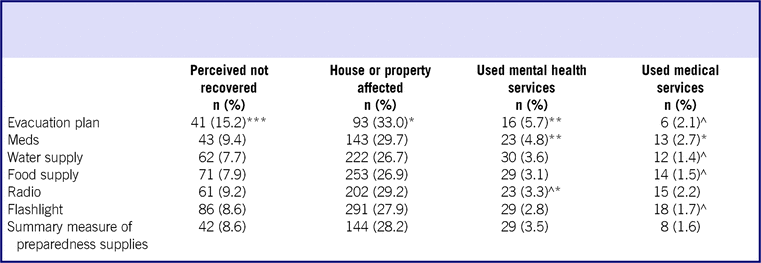
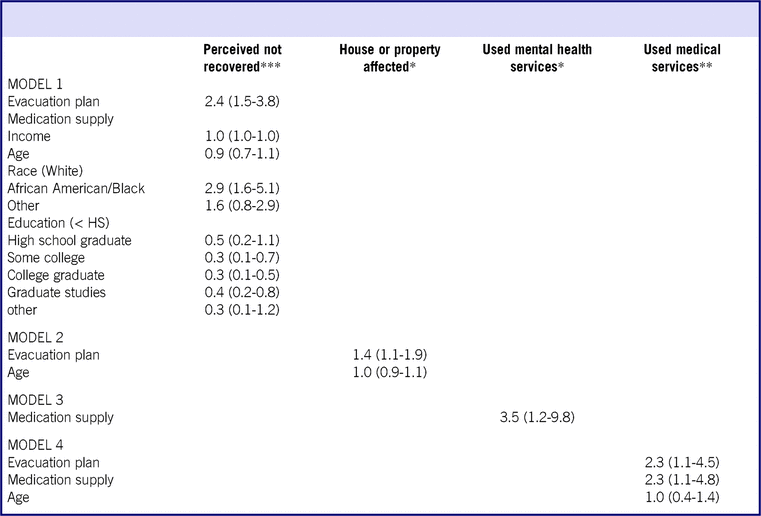
We fit 4 models, 1 for each disaster outcome: perceived recovery, housing and property damage, use of medical services, and use of mental health services. First, we examined the outcome perceived recovery. Over 90% of the sample reported being almost or completely recovered, and 8.2% (n = 91) reported being somewhat or not at all recovered (Table 2). When examining for demographic differences, age (χ2 = 12.8; P < 0.05), income (χ2 = 19.4; P < 0.05), education (χ2 = 28.2; P < 0.01), and race (χ2 = 38.0; P < 0.001) were each independently associated with perceived recovery (Table 3). A bivariate analysis of differences in perceived recovery by our outcome preparedness measures showed that having an evacuation plan (χ2 = 20.5; P < 0.001) was statistically significant (Table 3). There was no statistically significant relationship between perceived recovery and having preparedness supplies or having a supply of prescription medication. A logistic model including statistically significant demographic characteristics and preparedness measures demonstrates that those respondents having an evacuation plan (AOR = 2.4; 95% CI: 1.5-3.8) and being African American (AOR = 2.9; 95% CI: 1.6-5.1) are more likely to report poor recovery outcomes (P < 0.001; Table 4).
Bivariate Associations Between Sample Preparedness and Demographic Characteristics and Disaster Outcomes

* P < 0.05;
** P < 0.01;
*** P < 0.001.
∧ Fisher’s exact test.
Odds of a Negative Disaster Outcome [OR (95% CI)]

* P < 0.05;
** P < 0.01;
*** P < 0.001.
Next, we examined the disaster outcome of housing or property damage. Nearly 30% of respondents (n = 305; 27.4%) reported housing or property damage (Table 2). Bivariate analysis of differences in the demographic characteristics for households reporting property damage and those who did not report property damage, showed age (χ2 = 9.7; P < 0.05) was statistically significant. When examining differences in preparedness by reported property damage, having an evacuation plan was statistically significant (χ2 = 6.0; P < 0.05; Table 3). Statistically significant characteristics were examined in a logistic regression model. Households that reported having an evacuation plan were 1.4 times more likely to report property damage (AOR = 1.4; 95% CI: 1.0-1.9; P < 0.05; Table 4).
The third model examines mental health service use; about 3% of the sample (3.1%; n = 35) reported utilizing mental health services following Sandy. NY State BRFSS 2012-2013 reports that 10.1% of adults in NYC report poor mental health 14 days or more in the past month.32 When examining the bivariate associations between mental health services after Sandy by demographic characteristics of the sample and preparedness, age (χ2 = 11.3; P < 0.05), having a supply of medication (χ2 = 7.4; P < 0.01), and an evacuation plan (χ2 = 8.0; P < 0.01) were independently associated with use of mental health services after Sandy (Table 3). Households reporting having a supply of medication were 2.3 times more likely (AOR = 2.3; 95% CI: 1.1-4.8) to report using mental health services. Households reported having an evacuation plan before Sandy were greater than 2 times more likely (AOR = 2.3; 95% CI: 1.1-4.5) to report using mental health services after Sandy (Table 4).
Finally, only 18 respondents in the sample (1.6%; Table 2) reported utilization of medical services following Super Storm Sandy. There was no statistically significant difference in use of medical services after Sandy observed for any of the demographic characteristics within this sample. Bivariate examination of preparedness measures demonstrates that having a supply of medication is associated with use of medical services after Sandy (χ2 = 6.3; P < 0.05; Table 3). Households reporting having a supply of medication were almost 3.5 times more likely to report needing medical services following Sandy than households without a supply of medication (AOR = 3.5; 95% CI: 1.2-9.8; Table 4).
DISCUSSION
Overall, roughly half of study respondents (n = 1114) reported preparedness with all 4 supplies (45.8%), having a battery powered radio (62.1%), and a supply of medication (43.3%). Far fewer respondents reported an evacuation plan (25.3%). When examining preparedness as a predictor of negative disaster outcomes, we observed that an evacuation plan played the most significant role. Having an evacuation plan was a risk factor for poor perceived recovery as well as for housing and property damage and using medical services following Sandy. Having a supply of medication was a risk factor for using mental health and medical services. We also observed that greater income ($101-150,000) and greater education (some college or college graduate) were protective against poor recovery while African American race was a risk factor.
Certain findings are perhaps counterintuitive, or at least not what policy-makers and disaster planners desire. For example, respondents with a plan experienced more severe effects. Obviously, this does not tell us that a plan is meaningless, but it is possible that people who planned saw themselves (correctly) as more vulnerable to hazard effects. Similarly, having medicine on hand signals awareness of a medical condition that would point to the need for postdisaster services.
The findings point to some impediments to preparedness, but also indicate some significant challenges to public officials and others who are interested in people’s abilities to protect their safety. First, many aspects of people’s lives intervene in their capacity to take protective measures, including limited access to transportation or financial resources. Second, targeting these dimensions is often the role of different agencies and increasingly in networked systems of service delivery. And third, it may well be that aspects of education and awareness must be ratcheted to prominence. A key finding was the lack of association of preparedness supplies with any disaster outcome. One important point is that our findings, of course, are biased toward those who survived. A look at the causes and distribution of fatalities suggests possible different emphases on aspects of preparedness, which are described next.
According to the Centers for Disease Control and Prevention,33 and a detailed discussion in the New York Times34 that looked at the NYC region, most fatalities in Super Storm Sandy were from drowning (some 38%). Falling trees accounted for another 19%, and falls (often down stairs in the dark) 11%. Carbon monoxide poisoning, vehicular accidents, assorted injuries, fire, hypothermia, medical complications or failure of electric-powered medical appliances, electrocutions, and 1 unidentified cause were the remainder of causes of death. For this reason, it may be that emphasis should be not on having equipment, but on more conceptual tasks such as interpreting hazard information and relating it to the local environment: proximity to water, trees, and power lines. Evacuating would have spared all of the drowning victims, and perhaps several of the others, such as those who died from carbon monoxide poisoning, hypothermia, and fires. A flashlight may have spared those who died in falls. It is difficult to assess the deaths from trees, because several of those were well inland. Two of the drownings occurred when they failed to evacuate, reportedly for fear of looting.Reference Siff35
Potential interventions remain perplexing because no messaging or risk communication has been found to be consistently effective across all places. Of course, our data are drawn from an advanced urban area in an event that did not destroy the bulk of the city and surroundings. In such a situation, other kinds of preparedness might be needed. Similarly, the roster of dangers might be different in rural areas, where isolation may increase some burdens. And of course, preparedness and disaster-related sensemakingReference Weick36 will look entirely different in places with intersecting chronic hazards or conflict.
Preparedness should be seen as a contextual activity that comprises the natural, technical, and social system. Just as hazard is generated from the interplay of those systems,Reference Mitchell and Kirby37 the various phases of disaster management must reflect these relationships. Comprehensive preparedness from the household perspective might thus be conceptualized as an awareness of social systems (eg, network of help), technical systems (eg, condition of, or hazards threatening, a house or apartment), and natural systems (eg, prevalence of local hazards, such as trees or street flooding, which also connects with the surrounding technical systems of urban infrastructure). For the most part, household preparedness at this level appears to be rare or nonexistent.
Preparedness cannot be converted to a roster of supplies, but has to be a part of the ways of knowing, converted into the folkways of a place, whether the place is less developed or rural, suburban, or urban. While some observers have noted that urbanization has detached people from an awareness of ecological systems,Reference Mitchell38 that detachment has not been compensated by an awareness of the engineered systems in towns and cities, or by the complexities of transitional systems such as the wildland-urban interface.
It is beyond the scope of this study to outline the necessary programs that would need to be in place, but a period of education and activism leading to social change, along the lines of those seen in earlier years with regard to environmental conservation, forest fires, and household fire would appear to be warranted. These had several things in common, such as an emotional dramatic arc (eg, Smokey the Bear,39Silent Spring Reference Carson40) paired with actual things that could be done, such as proper care with fire, control of pesticides, smoke detectors, and household fire planning. A larger feature of awareness must therefore be environmental awareness, part of the local knowledge and sensemaking. This larger conceptual preparedness will require a period of education and social change, perhaps akin to the shift in environmental values that began in the 1960s with the “ecology” movement. There, stewardship of resources and care for environmental amenities became virtues, yielding actual change. Preparedness, too, must be a virtue, not a list. Achieving such social change remains a large and difficult task.
Future research focused on building an evidence base for preparedness can examine the role of a supply kit and plan on more immediate disaster experience such as the utilization of response services, including shelters or use of emergency services. Additional analyses of this sample are planned to examine if supplies beyond food, water, a flashlight, and radio were used and what supplies respondents wish they had when reflecting back on their disaster experience. This analysis will take an important step toward understanding what supplies might be useful for hurricane preparedness. Examining the utility of preparedness with a kit and plan in other hazard contexts would also enhance our understanding of preparedness.
Examining the utility of preparedness in disaster events is an important first step in working toward evidence-based disaster preparedness. Just as important as these empirical studies is developing a more comprehensive theory-driven model of household preparedness that builds on the wealth of disaster scholarship on social, technical, and natural systems.
This study has some limitations to note when considering study findings. The present study is a retrospective, observational, analytic, cross-sectional study. Data collection on this sample was designed to examine disaster resilience. Taking into account research participant time and the range of issues asked about in the survey, only a limited number of questions focused on preparedness. Using a broad survey of disaster resilience, while limiting the depth on any 1 issue, provides an opportunity to examine preparedness on a variety of outcomes and to continue to explore preparedness in a wide range of areas as new lines of inquiry develop. Much of social science research utilizes survey data collection as this is an effective and efficient method for collecting data on a range of topics for descriptive and explanatory studies. Survey research, however, carries limitations, including the challenge of obtaining sufficient and nonbiased response rates, recall bias, and interviewer bias.Reference Wright, Marsden, Marsden and Wright41 Study protocols were developed based on the Dillman protocol to reduce bias, including a re-contact protocol of 10 calls to cell phones and land-lines, detailed interviewer training, and the use of a CATI system to ensure reliability and validity of the data collected.Reference Dillman, Smyth and Christian42
CONCLUSIONS
Agency and organizational efforts focus on disseminating messages about preparedness kits annually, including FEMA, the ARC, and the American Public Health Association.3,4,43,Reference Currie44 In the absence of evidence linking a kit and a plan to improved disaster outcomes, preparedness efforts and public health funding and energy may be better-spent encouraging households in completing a household level vulnerability assessment and then providing the support to prepare appropriately for the risks present. This might include national messages calling on households to self-assess and directing residents to local risk information sources. At the local level, trusted risk communicators (or messengers) need to raise awareness about local hazards and specific preparedness measures relevant to the context.
Acknowledgments
The authors gratefully acknowledge the study participants for sharing their experiences to work towards improved disaster preparedness, response, and recovery in future events and the Disaster Research Center staff that developed the study protocol and completed data collection. The authors have complied with the ethical standards of research on human subjects and do not have any personal financial relationships with commercial interests relevant to this manuscript to disclose. The views presented here are solely those of the authors.
Funding
This research was funded by the US Department of Health and Human Services, Assistant Secretary for Preparedness and Response, grant No. HITEP130007-01-00.