

I. INTRODUCTION
In 2018, Jerome Powell, a trained lawyer who spent his career in finance and politics, was appointed chairman of the Board of Governors of the Federal Reserve System. This represents a throwback to a time when non-economists ran the “Fed.” Up until the early 1970s, most of the Board’s governors and the presidents of the Federal Reserve banks were not economists but bankers, lawyers, or businessmen; among the first nine chairmen, six were bankers (William Harding, Roy Young, Eugene Meyer, Marriner Eccles, Thomas McCabe, William Martin) and three had a background in law (Charles Hamlin, Daniel Crissinger, Eugene Black).Footnote 1 Academic credentials were much less important than practical experience in the business and banking world, either in the private sector or at the Federal Reserve System (Maisel Reference Maisel1973; Stockwell Reference Stockwell1989; Axilrod Reference Axilrod2011; Meltzer Reference Meltzer2009). A successful self-made banker with no college education, like Marriner Eccles, could become chair of the Board of Governors. Since the 1960s, however, the number of trained economists serving as governors and presidents has increased substantially, and of the last Board chairpersons—from Arthur Burns (1970–1978) to Janet Yellen (2014–2018)—only George Miller (1978–1979) had neither an MA nor a PhD in economics.
The postwar transformation of the Fed was not restricted to top decision-makers.Footnote 2 François Claveau and Jérémie Dion (Reference Claveau and Dion2018) estimate that economists at the research departments of the Board and the Federal Reserve banks today represent nearly 50% of the money and banking economists listed by the American Economic Association (p. 355); they publish a growing share of academic papers (p. 356), and these tend to have a greater impact than those published by economists outside central banks (p. 359; see also Fox Reference Fox2014; Bordo and Istrefi Reference Bordo and Istrefi2018; Ban Reference Ban2018). This closer relationship between central banks and academia has been tied by historians and sociologists to a “scientization” of central banking. This polysemic term sometimes refers to the rationalization of the decision-making process and the growing use of standardized, calculable rules by a committee rather than a single chair (see Marcussen Reference Marcussen, Dyson and Marcussen2009) or their reliance upon “cutting edge economic thinking” (Mudge and Vauchez Reference Mudge and Vauchez2016, p. 153).Footnote 3 It sometimes refers to changes in the training and career of central bankers themselves (Conti-Brown Reference Conti-Brown2016), or to the growing number of PhDs in the staff (Claveau and Dion Reference Claveau and Dion2018; Lebaron and Dogan Reference Lebaron and Dogan2016) after the PhD had become the marker of economic technical mastery in the mid-1960s (see Fourcade Reference Fourcade2009). The narratives have also pointed out the connection—sometimes disconnection—between academic macroeconomics and economic analysis at the Fed (Mankiw Reference Mankiw2006; Woodford Reference Woodford2009).
These accounts of the “scientization” of central banks, however, often rely on collective biographies and on a top-down approach that centers on the transformations of the policy-making decision process and emphasizes the visions of chairpersons and Board members. Yet any “scientization” process implies that some space was created inside the Fed for economic analysis to be developed and disseminated. What kind of space was created, where, by whom—in short, the prehistory of this trend toward scientization—however, remains a blind spot of the flourishing literature. In this paper, we thus build on data on Fed officials, oral history repositories, and hitherto underresearched personal archival sources to unpack the tortuous path toward crafting such an institutional and intellectual space for postwar developments in theoretical and empirical macroeconomics within the Board of Governors. As of 2019, it is not possible to access any internal Board archive on the development of in-house economic analysis and its use by the Board, so that our purpose is not to document its possible influence on the monetary policy decision-making process. Rather, it is to track how and why economic knowledge developed at the Board, under what set of constraints and affordances, and for which purposes.
We show that growing attention to new macroeconomic research and practices at the Board during the 1960s was the combined result of the mounting external criticisms of the Fed’s decision-making process, an internal push for quantification, and the staff’s interest in macroeconometric modeling. This transformation in the type of economic analysis produced at the Board only partially fits the oft-described process whereby mathematical and econometric modeling displaced previous forms of analysis (Morgan and Rutherford Reference Morgan and Rutherford1998). While the development of new practices at the Board’s Division of Research and Statistics (DRS) involved a break with the existing institutionalist tradition at the Board, the result was not a takeover of “old” types of empirical analysis by new ones reflective of a generational clash. Instead, macroeconometric modeling was welcomed by researchers of diverse backgrounds, and its forecasts were integrated with a long-standing tradition of judgmental analysis and scenario writing. Science did not replace art, and econometrics did not replace institutional analysis. Rather, these perspectives were initially blended into the Greenbook and the Bluebook prepared for FOMC meetings. We show that the variety in the staff’s training (in terms of the level of education, period, and university) suggests that the divide between PhD and non-PhD economists, as well as between academic and central bank researchers, is only partially relevant to understanding the shift in the type of economics practiced at the Board and the efforts to carry it to the FOMC.
II. THE FED UNDER PRESSURE
William McChesney Martin, chairman of the Board of Governors of the Federal Reserve System between 1951 and 1970, took office in April 1951. A month earlier, as assistant secretary of the Treasury, he had negotiated a landmark agreement between the Treasury and the Fed (Hetzel and Leach Reference Hetzel and Leach2012). The March 4, 1951, accord officially ended the peg on interest rates that the Fed had maintained since 1942 as part of the war effort, and Martin was therefore eager to reassess the Fed’s newfound ability to pursue independent monetary policy. Throughout his tenure Martin worked to distance the Fed from the political pressures of Washington and to make the Board of Governors the center of the Federal Reserve System—thus reclaiming the spot from the Federal Reserve Bank of New York, which Martin considered to be too close to the financial community (Meltzer Reference Meltzer2009, p. 55ff). By the end of the 1950s, however, the Fed faced mounting criticisms from governmental bodies, the financial community, congressional committees, and the press.Footnote 4 Though sometimes highly political, most of these attacks were also fueled by academic economists who essentially faulted the Fed for not relying on economic science to guide their policy-making.
Dissatisfaction with Policy Instruments and Objectives
A first line of criticisms targeted the Fed’s policy choices. James Knipe, a special consultant to the Board’s chairman, wrote a digest of “the public criticism of the Federal Reserve system” for Martin in 1962. He explained that monetary policy was lacking effectiveness in controlling expenditure on capital equipment and business inventories, yet was “too effective” in restraining residential construction, public projects, and small businesses (Knipe Reference Knipe1962, p. 20). More generally, critics considered that the Fed was “stunting national economic growth” by maintaining interest rates too high under the influence of private banking interests (Knipe Reference Knipe1962, p. 64).
The Joint Economic Committee of the Congress published a critical report in 1959 and two more in 1960, and another one was issued the next year by the Commission on Money and Credit.Footnote 5 President John F. Kennedy’s Council of Economic Advisers (CEA; comprising Minnesota tax expert Walter Heller, Yale macroeconomist James Tobin, and budget specialist Kermit Gordon) also relentlessly criticized the choice of targets. They flooded the president with memoranda explaining that “monetary policy has made no significant contribution to economic recovery.” “Short-term rates have been kept from falling to protect our gold stock,” they complained.Footnote 6 The same year, Tobin published a vocal critic of the Fed in Challenge. The essential problem was the price stability fetish at the Fed: “the heavy reliance placed on monetary restraint over the past eight years is one of the reasons that, relative to GNP, consumption has grown while investment has fallen,” he explained (Tobin Reference Tobin1961, p. 26). He also condemned the Fed’s belief that deviating from monetary restraint would result in a “collapse.” “[T]he economic logic of this prejudice [was], to say the least, obscure,” he chaffed (Tobin Reference Tobin1961, p. 26). Tobin did not fault the Fed merely for its narrow economic target but also for rejecting the idea that price stabilization could be achieved by a combination of easier monetary policy and fiscal restraint.
In a study commissioned by the House Committee on Banking and Currency, Karl Brunner and Allan Meltzer (Reference Brunner and Meltzer1964a, Reference Brunner and Meltzer1964b, Reference Brunner and Meltzer1964c) instead criticized the Fed’s use of free reserves as an indicator of the degree of liquidity of the market and of individual banks, and its failure to distinguish between individual banks and system-wide changes on free reserves. In line with future monetarist precepts, they argued that “[t]he desired growth rate of the money supply should be explicitly chosen for a 6-month or longer period and policy operations should be directed towards achieving that growth rate by explicit choice of a growth rate for the monetary base” (Brunner and Meltzer Reference Brunner and Meltzer1964c, p. 84).Footnote 7
Dissatisfaction with the Fed’s Policy Decision-Making Process
These economists also criticized how the Fed arrived at its policy decisions. Brunner and Meltzer (Reference Brunner and Meltzer1964a, p. viii) emphasized that “there is a more important series of questions that has not been asked very often: are the procedures for making monetary policy adequate? Does the Federal Reserve have adequate information in sufficient time to make appropriate decisions?” The FOMC met every three weeks, they noted, which was too often, and led them to focus too much on short-run phenomena and to rely on the “tone and feel” of the market rather than serious quantitative analysis. It was also monitoring too many variables, from yields to liquid assets, rates and required reserves, reflecting vague and contradictory definitions of concepts like “credit” and “availability.” “The very mixed nature of these criteria reveals the absence of a coherent conception,” they concluded (Brunner and Meltzer Reference Brunner and Meltzer1964a, p. 4).
“Heated” discussions took place during FOMC meetings, but they did not necessarily “contribute to the formation of rational monetary policy … [as a] variety of unsubstantiated judgments and unsupported opinions replaces analysis and evidence as the basis for policy operations,” Brunner and Meltzer (Reference Brunner and Meltzer1964c, p. 92) bemoaned. The result was indecision and a lack of direction. For instance, the open-market policy directives that the FOMC issued to the manager of the Fed’s Trading Desk—located at the New York Fed—were very loose, of the “ease of restraint” type. This left a huge discretionary power to the New York Fed, which Martin attempted to reduce. A consensus on how to draft more specific directives, however, proved difficult to reach. Brunner and Meltzer’s suggestion for reform was consequently radical: “serious consideration should be given to replacing the FOMC with a single administrative official,” they wrote (Brunner and Meltzer Reference Brunner and Meltzer1964c, p. 93).
Another line of criticism was the Fed’s lack of transparency. Both the Joint Economic Committee and the Monetary Commission complained that the lack of communication of the reasons for the Fed’s major policy decisions and actions resulted in “a tendency to seize upon even the most outlandish rumors as significant” (Knipe Reference Knipe1962, p. 40). There was, however, a more fundamental attack behind the demand for transparency. The key issue, highlighted by Tobin in his Challenge article, was how the Board had used its freedom since 1951. The independence of the Fed had become a “heated issue, a symbol of irresponsible power to some, and to others the last citadel protecting the dollar and the country from disaster,” Tobin noted (Reference Tobin1961, p. 24).
Suppressing this newfound independence was precisely the agenda of the chairman of the House Committee on Banking and Currency, Texas congressman Wright Patman. Dubbed “the populist scourge of the Fed,” he was a staunch opponent to high interest rates and to the separation of monetary and fiscal policy, which he constantly challenged after 1951 (Conti-Brown Reference Conti-Brown2016, pp. 274–276; Young Reference Young2000, chs. 7, 8). In 1964, he proposed to hold four months of hearings for the fiftieth anniversary of the 1913 Federal Reserve Act (Congress 1964), hoping that the Congress would eventually agree to get rid of the FOMC, reduce the budgetary autonomy of the Fed, and restore the primacy of the Treasury regarding the definition of monetary policy. President Lyndon Johnson’s intervention, at Martin’s request, thwarted Patman’s plans, but the criticisms outlined in the Brunner-Meltzer report, commissioned by the Committee, would have a lasting influence. Again, the report echoed the 1959 diagnosis of the Joint Economic Committee: monetary and fiscal policy should be better coordinated under the oversight of the executive or the Congress (Knipe Reference Knipe1962, p. 32). It was suggested that either the chair of the CEA or the secretary of the Treasury sit on the Board of Governors.
Dissatisfaction with the Lack of Scientific Underpinnings
Underlying these criticisms of monetary policy was the shared notion that “after 50 years the Federal Reserve ha[d] not yet provided a rational foundation for policymaking” (Brunner and Meltzer Reference Brunner and Meltzer1964a, p. ix). For those policy-oriented yet academic economists involved in monetary debates, “rational foundation” meant science-based. Brunner and Meltzer were explicit that the Fed “should develop and test a theory incorporating the essential elements of the money supply process” (Reference Brunner and Meltzer1964c, p. 83). This insistence on solid theoretical and empirical foundations echoed almost verbatim Tobin’s earlier complaint that the Fed’s decisions “rel[y] more on a general faith that virtue pays than on careful empirical and theoretical analysis” (Tobin Reference Tobin1961, p. 26; see also Maisel Reference Maisel1973, p. 168).
Monetary theories were being hotly debated at the time, with no consensus in sight.Footnote 8 Economists did not agree on the channels whereby monetary policy influenced the real economy, and hence they could not agree on the adequate instruments for policy. There was a wealth of research on the scope of lags between the Fed’s decision and the shift in the effective money supply, the changes in credit availability or in short- and long-term interest rates on the market, and the effects on production and unemployment (Knipe Reference Knipe1962, pp. 42–43). For Brunner and Meltzer (Reference Brunner and Meltzer1964a, pp. 2–3), however, the lack of consensus was not an issue. It was the competition between rival yet scientifically informed conceptions of monetary policy that would create rational policy decisions. The confrontation would be solved through discussion and empirical testing, academic economists insisted. What the Fed needed was a systematic framework for “continuous appraisal, reappraisal and comparison [of] alternative conceptions.”Footnote 9
The problem, they argued, was not that the Fed lacked in-house research facilities but that it was not doing the right kind of science. The Board had a Division for Research and Statistics (DRS) and the Federal Reserve banks were also staffing up their research departments. But these bodies were largely devoted to the collection of data on banks and credit markets, which explained the Fed’s excellent record in identifying the turning points of the business cycle—which even Brunner and Meltzer acknowledged (Reference Brunner and Meltzer1964a, p. viii). “But the relevance of this mass of data cannot be judged in the absence of a coherent conception systematically weaving this information into a meaningful pattern,” Brunner and Meltzer claimed (Reference Brunner and Meltzer1964a, p. 3). “Collection and preparation of data not guided by an explicit analytical frame often leads to a pointless accumulation of data” (p. 3).Footnote 10
Martin, the Board, and the Fed in general could not ignore this swelling tide of criticisms. Economists with opposed views of the transmission channels and monetary policy nevertheless converged in their criticism of the Fed, and their arguments were powerful ammunition for the those in Congress who constantly threatened the Fed’s independence.Footnote 11 A year after leaving the Board, former Governor Sherman Maisel clearly outlined the mid-1960s ethos: “the Fed found itself on the defensive. Specific accusations of bad judgment could no longer be countered by generalities. The system had to develop a more comprehensive theory of monetary policy and clarify its own views” (Maisel Reference Maisel1973, p. 26). Martin was acutely aware of these external pressures, yet the Fed lacked a unified vision on how to respond: Kennedy and Lyndon Johnson appointed younger Keynesian macroeconomics-trained Board members more favorable to newer empirical techniques than other members. Staff members exhibited a growing variety of approaches, no matter what their age or training was, which resulted in fragmented views of the knowledge that should be produced and presented to the FOMC.
III. INSIDE THE BOARD
Change and Resistance at the FOMC
Kennedy and Johnson were, Heller reflected after completing his term as chairman of the Council of Economic Advisers, “the first modern economists in the American presidency” (Heller Reference Heller1967, p. 37). Table 1 displays the consequences of these presidents’ inclination towards economics: four of the five governors whom they appointed were economists, and three of them had PhDs. But this did not mean that they brought a standardized view of how monetary policy should be conducted.
Appointment of Board Members after First PhD Economist in the Period

Source: Federal Reserve’s History website (www.federalreservehistory.org), the Federal Reserve Bulletin (various issues), and the lists of dissertations published by the American Economic Association in the American Economic Review (various issues).
Kennedy’s first appointment was George Mitchell (app. 1961), a tax economist with a BA from the University of Wisconsin and who at the time was the vice-president of the Federal Reserve Bank of Chicago. A handful of economists had served as governors before, but the first economics PhD had been appointed by President Dwight Eisenhower in 1954. Canby Balderston (app. 1954), aged fifty-seven at the time of his appointment, had a PhD from the University of Pennsylvania (1928) and was the dean of the Wharton School of Finance and Commerce at the time.Footnote 12 After Mitchell, who was also fifty-seven when he was appointed, Kennedy and Johnson subsequently appointed three younger economists, all of them trained at Harvard as the Keynesian revolution was being absorbed in graduate curricula: James Dewey Daane (app. 1963), who graduated in 1949 with a doctorate in public administration,Footnote 13 had previously worked at the Federal Reserve banks of Richmond and Minneapolis as well as the Treasury; Sherman Maisel (app. 1965), who also graduated in 1949, was a professor at Berkeley; and Andrew Brimmer (app. 1966), who became the first African American to serve on the Board, had graduated in 1957, then worked at the New York Fed and the US Department of Commerce.
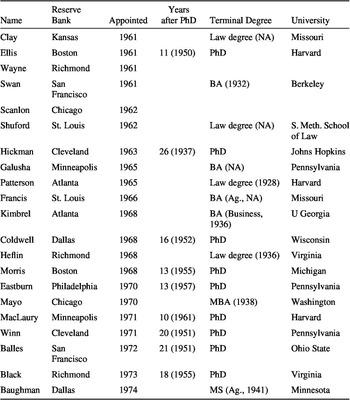
Table 2 lists information on the presidents of the Federal Reserve banks from 1950 through the mid-1970s. When Martin was appointed as chairman, there was only one president with a PhD, Alfred H. Williams (Pennsylvania, 1924). The other presidents were professional bankers who had climbed the ladder in the private sector or made a career at the Federal Reserve System. For example, New York Fed’s Allan Sproul, a widely recognized master of the art of central banking, had originally studied pomology at Berkeley and began his career at the Fed as head of the San Francisco Fed’s Division of Analysis and Research, despite knowing “little about banking and nothing about central banking” (Sproul, quoted in Ritter Reference Ritter1980, p. 4). By the time Arthur Burns was appointed chairman of the Fed in 1970, however, there were five PhDs serving as presidents of Federal Reserve banks, and by 1975 they had become a majority.
Reserve Bank Presidents Appointed between 1960 and 1975

Source: Federal Reserve’s History website (www.federalreservehistory.org), the Federal Reserve Bulletin (various issues), and the lists of dissertations published by the American Economic Association in the American Economic Review (various issues).
The fact that Martin himself—a banker and former president of the New York Stock Exchange—had no background in economics was increasingly pointed out.Footnote 14 The CEA staff often complained about his lack of economic expertise. For instance, Gardner Ackley, who replaced Heller as CEA chair, later remarked that “Martin was absolutely zero as an economist. He had no real understanding of economics” (Ackley Reference Ackley1974, p. 5; see also Maisel Reference Maisel1973, pp. 122–123). This momentum contributed to the nomination of Arthur Burns, whose work on business cycles was widely recognized, as chairman in 1970. Of him, Ackley said: “[he] is a first-rate, intelligent economist. He talks about things much in the same terms that I do; and even if we often disagree, at least there is communication at a professional level” (Ackley Reference Ackley1974, p. 11).
But PhD credentials did not fully determine chairs’ attitudes toward economic knowledge or the conduct of monetary policy. If Martin lacked academic credentials in economics, he nevertheless supported the Board’s interaction with economists. In 1964, he complained to George Leland Bach that “[t]he Board feels that … it … has not had very effective contacts with academic economists on monetary issues,” and asked him to organize an Academic Consultant Meetings series akin to what Seymour Harris had set up at the Treasury in 1960.Footnote 15 The founding director of the Carnegie School of Industrial Administration, Bach activated his wide network to invite some of the most renowned macroeconomists: Stanford’s Edward Shaw, Yale’s James Tobin, Harvard’s James Duesenberry, and Massachusetts Institute of Technology’s Franco Modigliani, among others, participated in the first meeting. Milton Friedman visited the Board a few weeks later, and he and Meltzer participated in future meetings, which became a regular event, taking place at least once a year from then on.Footnote 16
What Martin and the older bankers at the FOMC would not endorse was their younger colleagues’ push for quantification and rationalization. The shift in the FOMC’s demographics created a rift between “two bands: younger, Keynesian-laden staff vs traditionalists” (Maisel Reference Maisel1973, pp. 215–216). Maisel relentlessly fought for the inclusion of new indicators and formal forecasts in FOMC deliberations (Bremner Reference Bremner2004, p. 253). Mitchell enthusiastically pushed for the dissemination of empirical research, declaring that by 1967, “the ‘new economics’ [was] firmly in the saddle” at the Board (Bremner Reference Bremner2004, p. 230).Footnote 17 Martin countered that financial markets were characterized by uncertainty and complex psychological individual and collective phenomena, so that he had very little faith in the value of attempting to quantify Federal Reserve policy. In his opinion, measurement was dangerous, if not impossible: numbers obtained would not accurately reflect real conditions and the Fed would do best by carefully evaluating events in the financial markets (Maisel Reference Maisel1973, p. 118). The chair had to be skilled in reading the “tone and feel” of the market, and all his colleagues concurred that Martin was exceptionally gifted in the matter. Maisel (Reference Maisel1973, p. 170) again aptly summarized Martin’s paradoxical stance:
Chairman Martin led the group who felt that Federal Reserve policy had to remain an art rather than a science. However, while he opposed the introduction of any specific analytical framework, he did believe in research and knowledge. He allowed and even encouraged the staff to explore new techniques, but at the same time he adhered to his belief that real quantification was impossible, that it would downgrade judgment and intuition, and therefore would lead to greater errors on the part of the Federal Reserve.
By the mid-sixties, this blend of enthusiasm, suspicion, and external pressures was opening a space whereby new forms of economics analysis could enter the policy-making process at the Fed. Absent a clear vision about how to proceed, occupying such space was left to the Board’s staff, itself increasingly knowledgeable of the latest developments in academic macroeconomics.
The Board’s Division of Research and Statistics
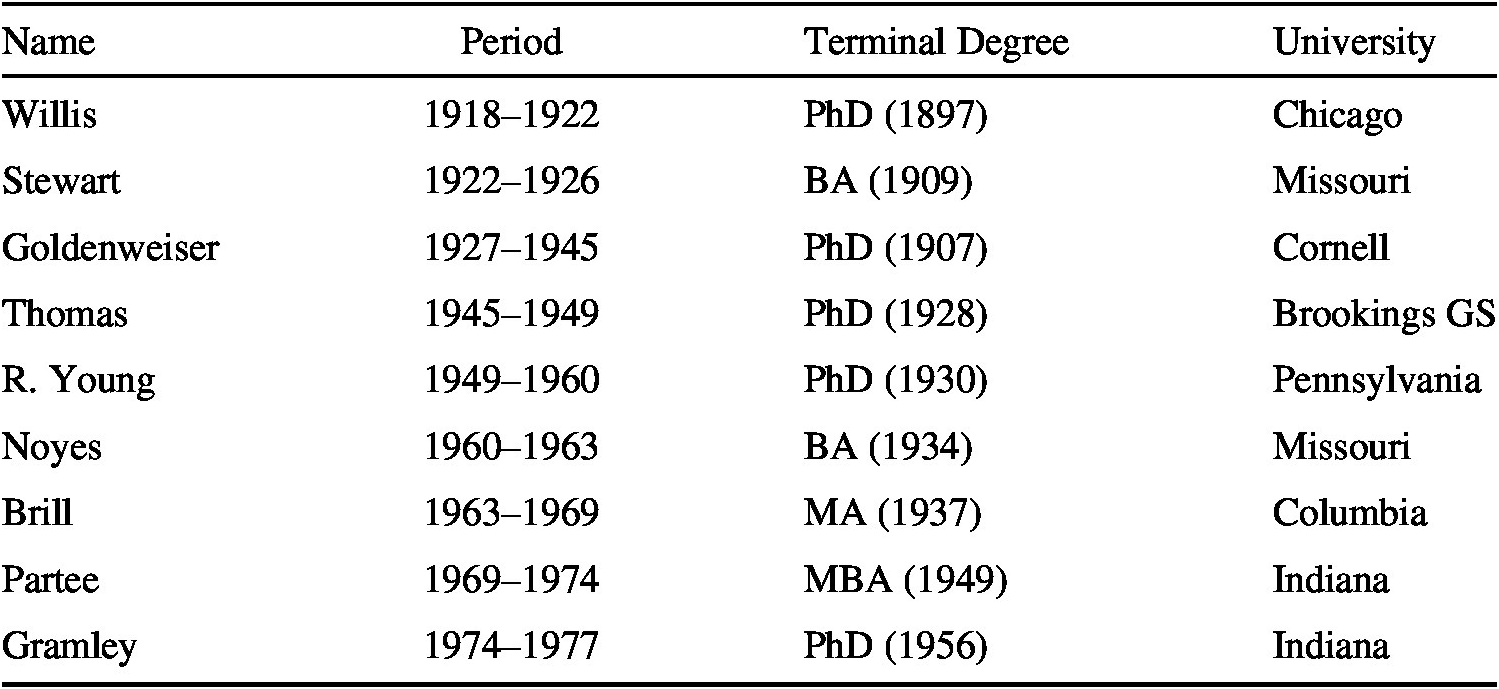
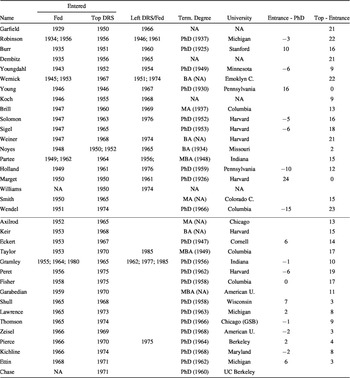
Unlike the Board of Governors and the FOMC, the Division of Research and Statistics had hired and been directed by economists since its establishment in 1918.Footnote 18 The DRS being less visible than the FOMC, systematic information was more difficult to gather. Tables 3 and 4 provide background information on DRS top advisors up to 1975.Footnote 19 They show no overwhelming trend toward an academicization of the DRS akin to what is visible within the FOMC but rather the continuation of a pre-war trend: 47% (8/17) top DRS officials who had been recruited in the pre-Martin era held a PhD, and by the end of Martin’s tenure, the number had risen to 65% (13/20). There was, however, more diversity among PhD programs than at the FOMC, which was dominated by a Harvard pipeline.
Directors of the Board’s Division of Research and Statistics, 1918–1977

Source: Federal Reserve’s History website (www.federalreservehistory.org), the Federal Reserve Bulletin (various issues), and the lists of dissertations published by the American Economic Association in the American Economic Review (various issues).
Top DRS Officials, 1950–1975

Source: Federal Reserve’s History website (www.federalreservehistory.org), the Federal Reserve Bulletin (various issues), and the lists of dissertations published by the American Economic Association in the American Economic Review (various issues).
These tables also highlight that, assuming the number of top officials is positively related to the total size of the DRS, the latter had substantially grown in size. This suggests that its role had expanded within the Fed. In the fifties, the number of top officials grew from four to eight, then stagnated in the first half of the 1960s. In the wake of external challenges to monetary policies, the DRS top hierarchy was staffed up to fourteen in 1970 and eighteen by March 1975.Footnote 20 With the exception of Ralph Young (dir. 1949–1960) and Arthur Marget, who were directly hired in top positions, and Guy Noyes (dir. 1960–1963), whose promotion was expedited, new recruits climbed the ladders within the DRS. Before 1960, reaching a top position took an average of sixteen years. For those hired after 1965, it took only 5.4 years on average, meaning that DRS top officials were considerably younger by the time Martin resigned. The data also highlight that a sizeable number of these economists obtained a PhD while working at the DRS. Table 4 shows that some of the early DRS economists completed it ten and even fifteen years after recruitment; for the later period most got their PhDs a couple of years after entering the Fed, which most likely means they were hired right after finishing their coursework. This challenges the usual separation between academic economists and practitioners (or central banking economists), and suggests that DRS economists in the postwar were knowledgeable of the latest developments in monetary theory and empirical techniques as taught in professionalized PhD programs.
As with the FOMC, however, counting PhDs does not allow grasping of the scope and nuances and the transformation that took place at the DRS during the 1960s. Oral histories and personal archives show that it was not one characterized by a generational replacement but more by a handful of key researchers slowly transitioning between different styles of economic thinking.Footnote 21 Many DRS directors had strong connections to the institutionalist movement, starting with Walter Stewart, a former professor at Amherst College who had also worked with Wesley Mitchell (Yohe Reference Yohe1990; Rutherford Reference Rutherford2011, ch. 6).Footnote 22 Woodlief Thomas had graduated from the Brookings Graduate School (Rutherford Reference Rutherford2011, ch. 7), and Ralph Young had been the director of the NBER’s Financial Research Program before entering the DRS.Footnote 23 Daniel Brill, director throughout much of the 1960s, initially entered the DRS as Morris Copeland’s main assistant in his project to build the first flow-of-funds accounts in the late 1940s.Footnote 24 Key to the DRS mission was thus the data-intensive approach several directors had inherited from their contact with the Mitchell-NBER research agenda.
And yet, it was Brill, who was trained before the war, did not have a PhD, and had a deep connection to American institutionalism, who became a pivotal figure in the DRS’s endorsement of macroeconometric modeling during the 1960s.Footnote 25 In 1960 he was asked by the recently created Committee on Economic Stability of the Social Science Research Council (SSRC) to participate in their macroeconometric model project. The purpose of the Committee was to develop a larger version of the kind of multi-equation representation of an economy initially developed by Jan Tinbergen before the war and then adapted to the US economy by Lawrence Klein in a Keynesian framework. The team of more than twenty researchers, led by Klein and Duesenberry, aimed at reaching a deeper degree of disaggregation, and entrusted various participants with writing blocks of equations meant to describe aggregate consumption, investment, the financial sector, and the housing sector, among others.Footnote 26 Brill, then an associate advisor of the DRS, had been selected as the expert in charge of the financial sector of the model, but early on, DRS economist Frank de Leeuw took over Brill’s work and wrote the published version of the financial sector for the Committee’s model (de Leeuw Reference de Leeuw, Duesenberry, Fromm, Klein and Kuh1965a).Footnote 27 Brill did not get his hands dirty with writing down equations, but throughout his tenure as DRS director he acted as an advocate of macroeconometric models and transformed the staff and its culture to allow for this type of analysis to be carried out at the Board.Footnote 28
Frank de Leeuw had joined the San Francisco Fed in 1953 as he obtained a master’s in public administration from Harvard and transferred to the DRS three years later. His initial work was on the demand for capital goods, but his work for the SSRC in the early 1960s led him to specialize in monetary economics. In 1964 he took a nine-month leave of absence to comply with the residency requirements for a doctorate at Harvard. His dissertation (de Leeuw Reference de Leeuw1965b) comprised his work for the Committee’s model (de Leeuw Reference de Leeuw, Duesenberry, Fromm, Klein and Kuh1965a) and additional simulation work he had published the year before (de Leeuw Reference de Leeuw1964). Under the “general direction of Daniel Brill” (Reference de Leeuw, Duesenberry, Fromm, Klein and Kuh1965a, p. 465n1), de Leeuw had crafted a nineteen-equation model spanning seven financial markets and five groups of agents. It was considerably larger and more disaggregated than any previous depiction of the financial sector, and allowed useful simulation experiments by including explicit parameters for actual monetary policy instruments—such as unborrowed reserves or reserve requirements on demand and time deposits. It also presented an early implementation of a portfolio choice framework of behavior for all the financial agents included in the model (Acosta and Rubin Reference Acosta and Rubin2019). The dissertation—which shared the title of his chapter for the Committee’s model, “A Model of Financial Behavior”—was defended in June 1965 and signed by Duesenberry and John Lintner, but de Leeuw also thanked his colleagues at the DRS and at the Committee model project. His work thus fully represented a synthesis between academic debates and central bank research.
While Brill was the advocate, de Leeuw was the mastermind behind the development of macroeconometric expertise at the DRS. “All the young people at the Fed then felt he walked on water,” Edward Gramlich (Reference Gramlich2004) reminisced. “In the back rooms of the research division, experimental work with the new science of econometric modeling was going on. This was mind-stretching work for Frank de Leeuw and the rest of the staff involved,” Eleanor Stockwell (Reference Stockwell1989, p. 22) likewise pointed out. The push was supported by the establishment of an empirical seminar by Martin and DRS associate director Robert Holland in 1964.Footnote 29 That the Board was equipped with a mainframe computer since at least the late 1950s also helped. A Division of Data Processing was established in 1963, and the Board developed software for multiple regression analysis and additional FORTRAN programs.Footnote 30
The work of Brill and de Leeuw was supported by the two successive directors of the DRS, Ralph Young (1949–1960)—who stayed as secretary of the FOMC afterwards—and Guy Noyes (1960–1963). This represented a significant break with prior DRS culture. Throughout the 1950s, the work of the DRS had been shackled by the vision of Winfield Riefler, the assistant to the chair and secretary of the FOMC. A graduate of the Brookings Graduate School (Rutherford Reference Rutherford2011, ch. 7), Riefler had a strong influence on Martin, Board members, and the staff, thanks to his “persuasive intellect.”Footnote 31 He had established a “Riefler rule” whereby the Federal Reserve “didn’t make or discuss forecasts” (Meltzer Reference Meltzer2009, pp. 45, 498). When Riefler retired in 1959 and was succeeded by Young, “there [was] an unleashing of staff brainpower,” Business Week journalists remarked: his retirement allowed the introduction of “methods taught in graduate schools such as econometric forecasts and economic models” (Meltzer Reference Meltzer2009, p. 498).
Institutionalists’ support for macroeconometrics can be explained by the fact that Young and Noyes may have seen in the project an opportunity to use the hitherto underused flow of funds accounts they had been building since Copeland’s 1947 to 1952 project. In an unsuccessful 1960 memorandum meant to stir the Board toward funding the SSRC model, they pointed out “that the Board’s flow of funds accounts might well provide the statistical framework for much of the analysis.Footnote 32 In 1953 already, Riefler had remarked that Brill’s attempts to use the flow of funds accounts to make projections “ha[d] been most ingenious and original in making the new [flow-of-funds] material ‘talk.’”Footnote 33 Likewise, Young and Noyes’s memo endorsed the SSRC macroeconometric model as “explor[ing] the potentialities of econometric methods of projecting the economy’s future performance and assess the utility of these methods as a supplement to other approaches to economic projection.”Footnote 34 The reasons why Noyes and Young used the “projection” rather than hitherto anathema “forecast” wording are unclear. They could have reflected a misunderstanding of the orientation of the SSRC model, or a deliberate strategy from DRS officials to stir the Board toward greater use of up-to-date econometric techniques and the systematic use of forecasts for FOMC decisions. But as more FOMC members found scientifically produced forecasts an important resource, the combination of large-scale models and judgment, of science and art, proved difficult to implement and communicate.
IV. JUDGMENT, MODELS, AND POLICY DECISIONS: A DIFFICULT CROSS-FERTILIZATION
The Development of a Macroeconometric Model
After the model of the SSRC’s Committee on Economic Stability was handed over to the Brookings Institution for further development in 1963, economists at the DRS sensed that the enhanced understanding of the transmission mechanisms whereby monetary policy decisions influence output and the systematic forecasts necessary to improve the Board’s decision-making process required yet another macroeconometric model. During a 1965 conference on investment organized at the Board, Brill reported that:
the Federal Reserve is currently pursuing a comprehensive research project on linkages between monetary policy and the general economy. Working groups in the Federal Reserve have been formed to study: (1) the entire linkage process from Federal Reserve actions to spending decisions, (2) the linkages among money market variables, such as between open market operations and member bank reserves, and (3) the linkages between money market variables and more basic financial variables, such as between bank reserves and the money supply.Footnote 35
The DRS economists, however, were not alone in believing that another model should be developed. According to University of Pennsylvania macroeconomist Albert Ando, the newly founded SSRC’s Subcommittee on Monetary Research had come to the same conclusion.Footnote 36 Ando was then involved, together with his former Carnegie colleague Modigliani, in a heated academic exchange with Friedman and his student David Meiselman over the respective influence of fiscal and monetary policy over consumption and the business cycle. Monetarist ideas were gaining traction, which called for a detailed empirical re-examination of the influence of monetary variables on the real sector, and Ando and Modigliani were eager to direct such a project from MIT and Penn.Footnote 37
Settling an academic dispute through empirical work and improving Fed decision-making were different goals, but Brill and Modigliani were aware of the complementarity of the two groups: “Because the SSRC working group … is already investigating the linkages between basic financial variables and final spending decisions, the Federal Reserve is presently concentrating most of its resources on the earlier linkages in the process,” Brill explained during a 1965 conference.Footnote 38 The two projects were officially merged in 1966, and the Board funded the joint model until December of 1970.Footnote 39 A Special Studies Section had been created at the DRS to house their econometric work, and de Leeuw, its leader, was chosen to co-direct the new model project with Ando and Modigliani. He was seconded by Edward Gramlich, who joined the Board in 1965 after completing a PhD at Yale under Tobin on the effects of fiscal policy on aggregate demand (Gramlich Reference Gramlich1997).Footnote 40
The resulting “FRB-MIT-Penn” or “FMP” model was different from the cohort of other macroeconometric models developed in the 1960s in that it “contains many more policy variables that can be used directly to represent the policy actions of the monetary and fiscal authorities of the federal government.”Footnote 41 It exhibited the usual blocks of equations (consumption, investment, financial sector, housing, etc.) but with twists that allowed for more numerous and refined transmission mechanisms than the cost-of-capital effects that previous macroeconometric models relied on. The consumption equations allowed for detailed wealth effects, and credit rationing in the mortgage market was also taken into account. The influence of interest rates on state and local public expenditures also received specific attention.Footnote 42
That several versions of the model coexisted even after the merger (Backhouse and Cherrier Reference Backhouse and Cherrier2019) speaks to the difficulty of developing a model suitable for both academic and policy purposes. Brill had indeed warned Modigliani that he wanted to “preserve the identity of our [the DRS] contribution to the project,” suggesting that it would help them to increase the staff devoted to model-building and to remain autonomous in operating their version. He also needed a distinct identity so that the Board would not be publicly associated with strange model outputs: “Obviously it would have to be made clear that these results did not necessarily reflect the views of the Board or the staff…. I can foresee the possibility of distinct embarrassment to the System from widespread publicity given to strange results of early simulation runs of an untested model,” he wrote to Modigliani.Footnote 43 At the beginning of 1969, Ando then explained that the “academic side” wanted to postpone “the work involved in putting together the model and concentrated on improvements of each equation.” On the contrary, the DRS team “must have a functioning system as soon as possible.” They had already started operating their model in November 1967, almost a year before the MIT-Penn economists.Footnote 44
In spite of diverging constraints and purposes, a shared “macroeconomics” identity nonetheless emerged, blurring the boundaries between academic and policy circles. DRS economists were painfully aware that FOMC’s skepticism toward the model’s simulation might worsen as the debate between Keynesians and Monetarists spread within the Fed. The 1960s saw the emancipation of the Reserve banks’ research departments, hitherto devoted to data collection. In the Federal Reserve Bank of St. Louis, Jerry Lee Jordan took over the practice of writing simple, single-equation models. He and Leonall Andersen wrote a single-equation model that correlated the levels and differences in money supply and expenditures with income to assess the relative importance and speed of fiscal and monetary policy. It threw macroeconomists into years of theoretical, empirical, methodological, and policy-intertwined debates. Modigliani, Ando, Brunner, Meltzer, and Gramlich participated in a controversy played out in academic journals as well as Board bulletins and Reserve banks’ reviews.
Reciprocally, academics and DRS economists alike labored to overcome the FOMC’s reservations with “mechanical” forecasts. As he presented the model to the Board in 1968, Ando emphasized the complementarity between macroeconometrics and “experts’ judgments”:
[I]t is not necessary to use the model mechanically for the purpose of forecasting … it is easy to insert into the model judgmental forecasts made by experts for housing expenditures, and rerun the model to obtain the conditional forecast of all other variables.… Thus, it is hoped that the model will perform many of the routine chores currently performed by the experts, and free them to concentrate on more crucial and difficult aspects of econ analysis.Footnote 45
The same argument was soon reprised by Gramlich: “Model forecasts can increase the mechanical advantage of judgmental forecasters … models can take care of the major economic relationships and allow judgmental forecasters to worry exclusively about specific developments,” he explained to the Committee on Banking and Credit Policy.Footnote 46 Combining formal/mechanical and judgmental forecasts was also considered so important by Brill and de Leeuw that, in 1966, the latter had asked to be transferred to the National Income Section of the DRS, which was responsible for the judgmental forecasting work. “A closer interchange between the formal model-builders and those using essentially judgmental techniques will produce a much more reasonable and useful model, enabling us to incorporate more systematically the wealth of institutional knowledge and understanding of the numbers our staff possesses,” they argued.Footnote 47
Bringing Forecasts to the FOMC: The Making of the Green and Blue Books
It was the changes in procedures resulting from the pressures to rationalize the monetary decision-making process that offered the opportunity to bring the mix of mechanical and judgmental forecasts nurtured by the DRS to the FOMC. First, Martin agreed to establish a second committee to reform the directive in the late 1960s. It was led by FOMC Secretary and future Board governor Robert Holland, Governor Maisel, and DRS’s James Pierce.Footnote 48 Second, “a formal forecasting system” was inaugurated, a development Maisel (Reference Maisel1973, p. 176) took credit for. He asked the DRS to prepare data outlining recent past and “projected” evolutions of nine series of variables, from monetary instruments and monetary and fiscal variables to real and nominal output, and prices, unemployment, and balance of payment variables.Footnote 49 Each table was accompanied with a paragraph detailing the probable sources for recent evolutions (for instance, negotiations in the steel industry explained some price changes), and the whole was assembled in a document titled “Current Economic and Financial Conditions,” sporting a green cover. This “Greenbook” was first distributed in advance of the June 10, 1964, FOMC meeting. An updated version was then circulated before every meeting, and the forecasts were more substantially updated every three months or so.
By the end of the year, Brill, now head of the DRS, seems to have asked staff economist Stephen Axilrod to transform a chart of money indicators into an outline of possible scenarios for monetary policy operation the FOMC might choose from (Axilrod Reference Axilrod2011, pp. 45–46). These would be based on carefully chosen monetary parameters (interest rates, but also reserve measures) with the purpose of “quantifying,” and thus making more specific, the instructions in the directive the FOMC transmitted to the Trading Desk manager at the New York Fed after each meeting. This “Bluebook,” originally implemented for the November 2, 1965, meeting, quickly grew in size. At the end of each discussion, “possible directive language” was presented as a set of three indicative policy alternatives (A, B, and C).Footnote 50 A “Redbook” summarizing economic conditions by district was added in 1970.
These forecasts or “projections” were initially purely judgmental. Pierce later recounted that they were provided by what econometricians called “judgmental economists” or “business economists … really expert about what was going on in their sector.… You just stare at the wall and figure out what’s going to happen—that’s how the [Greenbook] forecasts were made” (Pierce Reference Pierce1995, pp. 31–32). As they became available around 1968, forecasts resulting from the FRB model’s simulation were combined with these judgmental forecasts, in line with DRS economists’ aforementioned approach to forecasting. Maisel insisted that “policy is not based on a literal acceptance of any specific model [but] develops from … debate which allow[s] for the inclusion of judgments about the economy and the model and value judgments as to goals” (Maisel Reference Maisel1973, p. 180). To Pierce, the addition of model forecasts “forced a discipline” in that the monetary and real sector got better integrated.
The DRS’s cautious approach to the introduction of new practices was initially quite successful, though it created tensions between the econometric “technicians” and other breeds of analysts.Footnote 51 It was, however, thwarted by their failure to predict the economic consequences of the 1968 tax surcharge implemented by Johnson to curb inflation. The decrease in spending predicted by the staff, which would support a pause in the tightening of monetary policy, failed to materialize and put the Fed in the uncomfortable position of implementing a restrictive policy and potentially suffocating the economy or waiting and potentially letting inflation mount (Bremner Reference Bremner2004, pp. 252–254). Virtually all accounts by former Fed officials consistently identify this forecasting debacle as a turning point, and it likely contributed to Brill’s resignation in 1969.Footnote 52 Although Martin also leaned towards ease then, the 1968 failure contributed to his distrust of the staff’s forecasts. As inflation intensified in 1969, Martin, now pushing for restraint, criticized the staff’s confidence in their forecasts despite their previous failures. He and some Board members felt the staff and its projections had misled them, and Martin later reportedly reaffirmed that he would rather “dispense with the kind of analysis presented in the Bluebook” (Bremner Reference Bremner2004, p. 271) and added that “there is a disease called statisticalitis that could kill us” (p. 273).
The internal purchase of econometric methods did not improve with Burns’s appointment as chairman in 1970. Despite being the first chair to hold a PhD and a widely renowned academic, “[he] believed in distilling—because of his work at the NBER—huge amounts of empirical information and drawing conclusions from that," former Richmond Fed’s president Robert Black recalled (Reference Black1994, p. 7; see also Holland Reference Holland1994, p. 23). Burns, furthermore, had a completely opposite style to Martin’s: while the latter was a “consensus seeker,” Burns was an “old autocrat” who “ran those [FOMC] meetings like a graduate seminar” (Black Reference Black1994, pp. 6, 8; Parthemos Reference Parthemos1994, p. 15).Footnote 53 He understood monetary policy-making as a scientific, artistic, but also highly political endeavor.
Burns’s style led to further marginalization of macroeconometrics in the decision-making process. Pierce, who became a major antagonist to Burns in this period, explained that the prioritization of short-term judgmental forecasts allowed the chair to rely on conservative projections that vindicated his desire to tighten monetary policy in response to growing inflation. The econometrician acknowledged that these judgmental forecasts were more accurate than short-term econometric forecasts (see also Maisel Reference Maisel1973, pp. 181–182), but he believed econometricians were better able to predict if the economy might slip into recession with time (Pierce Reference Pierce1996, p. 21). Burns did not dismiss the Bluebook, as Martin had been tempted to do. Rather, he bent it to fit his own policy agenda. Pierce remembers that scenario B, the middle position, was toughly negotiated with Burns:
The one they were supposed to vote on was B. And B was the thing that Burns wanted them to do, so he’d get together with Axilrod and he’d tell Axilrod what he wanted. And then we were supposed to come up with stuff that matched that. … It was all sort of a sham. The decisions were made ahead of time.
(Pierce Reference Pierce1995, p. 22)Former DRS advisor Peter Keir likewise explained that then DRS director and Board advisor Charles Partee “would be very aggressive for, say, … typically for lowering the funds rate, which I think was alternative C in the Bluebook” (Keir Reference Keir2001, p. 17), and then Burns would go for B, which was more moderate. It was all orchestrated.Footnote 54
V. CONCLUSION
Existing accounts of the “scientization” of the Fed often rely on quantitative accounts of how newly minted PhD economists took over the FOMC and the staff. Yet, our story of how economic analysis was gradually embedded in the Fed’s decision-making process outlines a long transitional period in which the training and degrees held by protagonists mattered much less than their encounters and the vision of the importance of art, science, judgment, and quantification in the monetary policy decision-making process that they each forged in response to external pressures.
This transformation of Fed operations should not be seen as a replacement of old-style data and market intuition by sophisticated large-scale macroeconometric models. At the DRS, which had always been directed by professional economists, several styles of research cohabited, were blended, or clashed. “Judgmental” and “mechanical” economics were combined in documents carefully crafted to appeal to FOMC members with diverse backgrounds. Furthermore, the shift toward new forms of analysis was engineered by economists who either had no PhD or completed one during their career at the DRS. It was not their training that was key to their endorsement of macroeconometrics but their participation in collective endeavors (for Brill) or the external pressures they faced (for Martin and FOMC members). The use of the Green and Blue books and underlying forecasts was resisted, by non-economists as well as by PhD economists who favored institutionalist styles of analysis.
In the 1960s and early 1970s, then, the purchase of new forms of economic analysis largely hinged on the constantly changing power dynamics, personalities, and visions of FOMC members. Our story is thus not yet one of the rising influence of modern economic analysis at the Fed. It is merely one of creating some space for it, through the development of a large-scale macroeconometric models and the Green and Blue books. Ironically, it was only at the moment macroeconomics entered a state of crisis in the mid-1970s that it gained clearer traction in monetary policy decisions. The road toward scientization was a long and bumpy one.