


Introduction
The role of clinical supervision in the delivery of safe and effective therapeutic work is widely accepted. While this is recognized in our professional standards (e.g. DCP, 2005; DoH, 2008; BABCP, 2010) and by experts in the field (e.g. Butler, Reference Butler2001; Padesky, Reference Padesky2006; Scaife, Reference Scaife2008; Lewis, Reference Safran and Segal2012), the evidence base for the value of supervision and the impact of training remains scarce (Milne & Dunkerley, Reference Milne and Dunkerley2010; Milne et al. Reference Milne, Sheikh, Pattison and Wilkinson2011). It is of note that in times of increased attention to the evidence in our clinical work, the practice of supervision remains highly valued but poorly evaluated (Milne & Dunkerley, Reference Milne and Dunkerley2010).
There are numerous definitions of clinical supervision which differ in emphasis and according to therapeutic context (Turpin & Wheeler, Reference Turpin and Wheeler2011). A useful definition by Roth & Pilling (Reference Roth and Pilling2007) describes supervision as:
a formal but collaborative relationship . . . guided by some form of contract between a supervisor and supervisee. The expectation is that the supervisee offers an honest and open account of their work, and that the supervisor offers feedback and guidance which has the primary aim of facilitating the development of the supervisee's therapeutic competencies, but also ensures that they practise in a manner which conforms to ethical and professional standards (p. 4).
In their systematic reviews of the impact of supervision and supervision training, Milne, James and colleagues found a large body of literature but few empirical studies, and methodological problems with many of these. Overall, they found reason for cautious optimism, with some evidence that supervision and training can increase competence. These authors argue persuasively that the lack of rigorous evaluation in this area must be addressed if we are to remain credible healthcare professionals, and that a ‘softening’ of the notion of evidence-based practice to include both empirical evidence and professional consensus (following Parry, Reference Parry2000) may be significant in addressing some clinicians’ continued ambivalence about working to the evidence base (Milne & James, Reference Milne and James2000; Milne & Dunkerley, Reference Milne and Dunkerley2010; Milne et al. Reference Milne, Sheikh, Pattison and Wilkinson2011).
In this context, Milne & Dunkerley (Reference Milne and Dunkerley2010) developed a series of guidelines for clinical supervision drawn from the (albeit limited) evidence available. The guidelines focus on: (i) needs assessment and the learning contract; (ii) methods of facilitating learning in supervision; (iii) enhancing the supervisory relationship; and (iv) evaluation in clinical supervision.
The national Improving Access to Psychological Therapies (IAPT) programme has also influenced this debate; ‘supervision is key activity, which will determine the success of the IAPT programme’ (Turpin & Wheeler, Reference Turpin and Wheeler2011). Supervision training is identified as an essential component of the programme, and a requirement for all IAPT clinicians who supervise others. Roth & Pilling (Reference Roth and Pilling2007) have defined generic, specific, applied and meta-supervision competencies for psychological therapists, and Turpin & Wheeler (Reference Turpin and Wheeler2011) give guidance on the delivery and training of supervision in IAPT settings. These competencies and supervision training guidelines are also likely to be relevant to psychological therapists in secondary and other healthcare settings. To our knowledge, IAPT supervisor training has not been evaluated to date.
This preliminary evaluation examined the impact of a 5-day training designed for IAPT supervisors in the South of England. We aimed to improve participants’ supervisory practice based on the competencies defined by Roth & Pilling (Reference Roth and Pilling2007). In the context of limited evidence for supervisory training, and no previous studies of training designed for IAPT supervisors specifically, this is likely to be a valuable first step towards understanding the impact of these courses.
Method
Design
A within-subject, repeated-measures design was used. The training ran over 5 days consisting of three blocks – two blocks of 2 days and a final single day. The three blocks ran approximately 6 weeks apart. Competency self-assessments were completed at each of the three blocks of training. The first assessment was conducted as a baseline, at the start of the first workshop. The second and third assessments were completed at the end of the second and third blocks of training, respectively. The predictor variable was time and the dependent variable was the self-reported assessment of competencies. Ethical guidance was sought from the chair of our faculty ethics committee.
Participants
Twenty-eight people completed the 5-day IAPT supervision training for high-intensity (HI) and psychological wellbeing practitioners (PWPs). The supervisors worked across a number of NHS bases and had a wide range of supervision experience. All were new to IAPT supervision.
Training
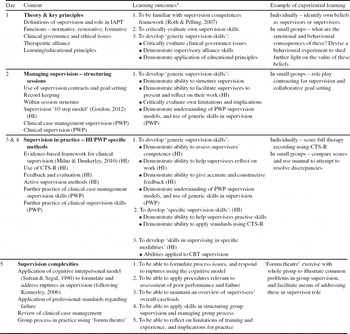
The training was commissioned by the Strategic Health Authority to support the IAPT programme locally. The 5-day course was developed following the IAPT Supervision Guidance (Turpin & Wheeler, Reference Turpin and Wheeler2011) and in line with the Supervision Competencies Framework (Roth & Pilling, Reference Roth and Pilling2007). We combined joint HI and PWP sessions on the theory and complexities of supervision, and ran separate sessions for role-specific tasks such as use of the Cognitive Therapy Scale – Revised (CTS-R; Blackburn et al. Reference Blackburn, James, Milne and Reichelt2001) for HI supervisors, and IAPT case management for PWPs. Much of the content of the training was based on the ‘Guidelines for Evidence-Based Clinical Supervision’ (Milne & Dunkerley, Reference Milne and Dunkerley2010) and the ‘Ten Step Model for Supervision’ (Gordon, Reference Gordon2012). Experiential approaches to learning were emphasized. Table 1 outlines the content and learning outcomes for each of the sessions, along with examples of experiential exercises used.
Summary of training

IAPT, Improving Access to Psychological Therapies; HI, high intensity; PWP, psychological wellbeing practitioner; CTS-R, Cognitive Therapy Scale – Revised.
* Learning outcomes apply to both HI and PWP supervisors, unless otherwise stated.
Materials
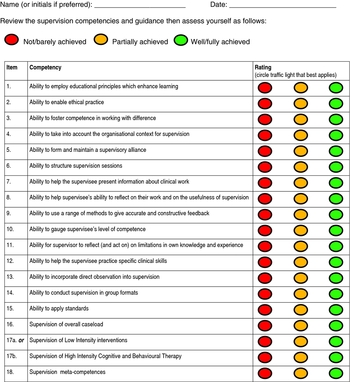
Participants completed a self-assessment of supervisory competence, developed for the purpose of the study. The measure consisted of the 18 competencies defined by Roth & Pilling (Reference Roth and Pilling2007), yielding four sub-scales (generic, specific, applied, and meta-supervision competencies) which are totalled to give an overall score. Participants rated themselves on a three-point ‘traffic light’ scale from ‘not/barely achieved’ (red), ‘partially achieved’ (amber) to ‘well/fully achieved’ (green), as shown in Figure 1.
Supervision competency self-assessment for psychological wellbeing practitioner & high-intensity CBT supervision. Based on Roth & Pilling (Reference Roth and Pilling2007). A competence framework for the supervision of psychological therapies (http://www.ucl.ac.uk/CORE/).

Procedure
The participants were verbally informed of the trainers’ intention to evaluate the course for two purposes – first, to improve the training for future cohorts, and second, for potential publication. It was made clear that submitting their self-assessments was entirely optional and that all material would be treated confidentially. Submission of the assessments was assumed to indicate consent to the use of data for the purposes stated. Participants were asked to complete the measure at each of the three blocks of training.
Results
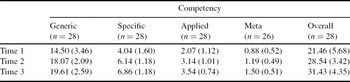
Descriptive statistics for each of the four subscales and overall competency suggested improvements over time (see Table 2). Repeated-measures ANOVAs and Bonferroni corrected post-hoc tests were then used to examine these changes in more detail. Greenhouse–Geisser corrections were used when sphericity assumptions were violated.
Descriptive statistics for supervisory competencies over time

Values given are mean (standard deviation).
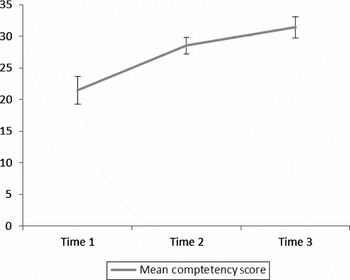
A repeated-measures ANOVA with Greenhouse–Geisser correction showed that mean generic competency differed significantly between time points (F 2,43 = 25.77, p < 0.001, ω2 = 0.38). Post-hoc tests showed significant increases between times 1 and 2 (p < 0.001), and times 1 and 3 (p < 0.001). Mean specific competency differed significantly over time (F 2,54 = 31.85, p < 0.001, ω2 = 0.44), with significant differences between times 1 and 2 (p < 0.001), and between times 1 and 3 (p < 0.001). Mean applied competency differed over time (F 2,54 = 25.17, p < 0.001, ω2 = 0.28), and post-hoc tests indicated significant changes between times 1 and 2 (p < 0.001), and times 1 and 3 (p < 0.001). Repeated-measures ANOVA with Greenhouse–Geisser correction showed that mean meta-competency differed significantly between time points (F 2,39 = 10.48, p < 0.005, ω2 = 0.20), with significant increases between times 2 and 3 (p < 0.005) and times 1 and 3 (p < 0.005). Finally, mean overall competency differed significantly between time points (F 2,54 = 36.88, p < 0.001, ω2 = 0.45), and post-hoc tests showed significant increases between times 1 and 2 (p < 0.001), times 2 and 3 (p = 0.01) and times 1 and 3 (p < 0.001). Overall competency changes are shown in Figure 2.
Mean overall competency over time. Error bars show confidence intervals.

Discussion
Self-rated supervisory competence improved over time for the people participating in the 5-day training course. Improvements were found in generic, specific, applied, and meta-supervision competencies, and reflected in overall competency.
As a preliminary and naturalistic study, there are significant limitations to the methodology. Most importantly, our design does not allow causal inferences to be drawn concerning the effect of the training on the competency ratings. The study also lacked any objective measure of supervisory skill. Although the self-assessment tool was based on best practice guidelines, it is not established as a valid and reliable measure. This is a serious weakness. The scale now requires validation with novice and established supervisors. In addition, reliance on self-ratings of competence may have resulted in inflated reports due to demand effects – it may be that participants reported improved competencies assuming that this was what was expected of them. In hindsight, it would also have been helpful to record the range of participants’ CBT supervision experience and the effect of training on novice, experienced and highly experienced supervisors. Unfortunately this information was not collected in the present study.
Within these limits, the evaluation provides interesting initial data. The findings are consistent with the possibility that the training led to improved supervision competencies, although the design means that these changes cannot be attributed to the training. The results are nevertheless relevant in the context of a very limited evidence base to date. The impact of training now needs to be examined more rigorously with methodologies that allow causality to be attributed, for example using a comparison control training.
Milne & Dunkerley (Reference Milne and Dunkerley2010) argue that the lack of an evidence base for the development of supervisory skills is a serious problem for psychological therapists. How can we claim to adopt an evidence-based approach to our work, which increasingly involves the supervision of others, and yet fail to approach this area with a rigour comparable to that expected in direct clinical work? In short, we need to extend the emphasis on evidence-based care to our supervisory practice. This study provides preliminary data contributing to what we hope will be a more robust approach to supervision in the future.
Summary of the main points
(1) Clinical supervision is essential to effective psychological work; the dearth of an evidence base in this area is a serious problem for practitioners.
(2) This preliminary evaluation examined the impact of a 5-day training course designed for IAPT supervisors.
(3) Improvements in self-rated supervision competencies over the course of the training are consistent with the possibility that the training led to these outcomes. However, our design means that these changes cannot be attributed to the training.
Acknowledgements
We thank all the supervisors who attended the training and provided the feedback that enabled us to complete this evaluation.
Declaration of Interest
None.
Learning objectives>
(1) To recognize the urgent need for an evidence base in clinical supervision training.
(2) To be familiar with a training programme (overview) designed to meet learning outcomes in line with the Supervision Competencies Framework (Roth & Pilling, 2007).
(3) To understand how initial data were gathered over the course of the 5-day training course, and the value and limitations of this information.



Comments
No Comments have been published for this article.