



1. Introduction
In the hierarchical model, galaxies are believed to form first through the accretion of material from their surroundings and, at certain points, undergo mergers. The accreted material shapes the outskirts of galaxies, forming features such as streams, shells, and stellar halos. These structures serve as valuable clues for investigating galaxy assembly histories. However, this study is challenging due to observational limitations, as these structures are intrinsically faint. Recently developed telescopes, such as Euclid, Arrakihs, and LSST, may soon improve our ability to observe these features. Additionally, low-surface brightness features are inherently difficult to distinguish. To address these challenges, we begin with simulation data from the DREAMS project, which contains thousands of simulations based on different baryonic assumptions and dark matter models. We applied Minkowski functionals to unambiguously characterize structures in these mock images and plan to utilize the extracted summary statistics to investigate how the nature of dark matter and baryonic effects shape the outskirts of galaxies.
2. Mock Images from DREAMS Simulations
The DREAMS project (DaRk mattEr with AI and siMulationS) aims to explore the nature of dark matter. It provides a variety of simulation types using different simulation codes applied to various dark matter models (Rose et al. Reference Rose, Torrey and Villaescusa-Navarro2025). In this work, we focus on Milky Way-like zoom-in galaxies based on the IllustrisTNG framework, each incorporating different baryonic physics models. To produce mock images, we use the pNbody code developed by Revaz et al. (Reference Revaz, Jablonka and Sawala2009). Since each simulated galaxy includes different baryonic physics parameters, we fix our measurements using absolute surface brightness thresholds rather than normalized luminosity.
3. Minkowski functionals
Minkowski functionals are mathematical tools used to characterize shape, geometry, and spatial structure. In 2D images, the three Minkowski functionals,
 $U_0$
,
 $U_1$
, and
 $U_2$
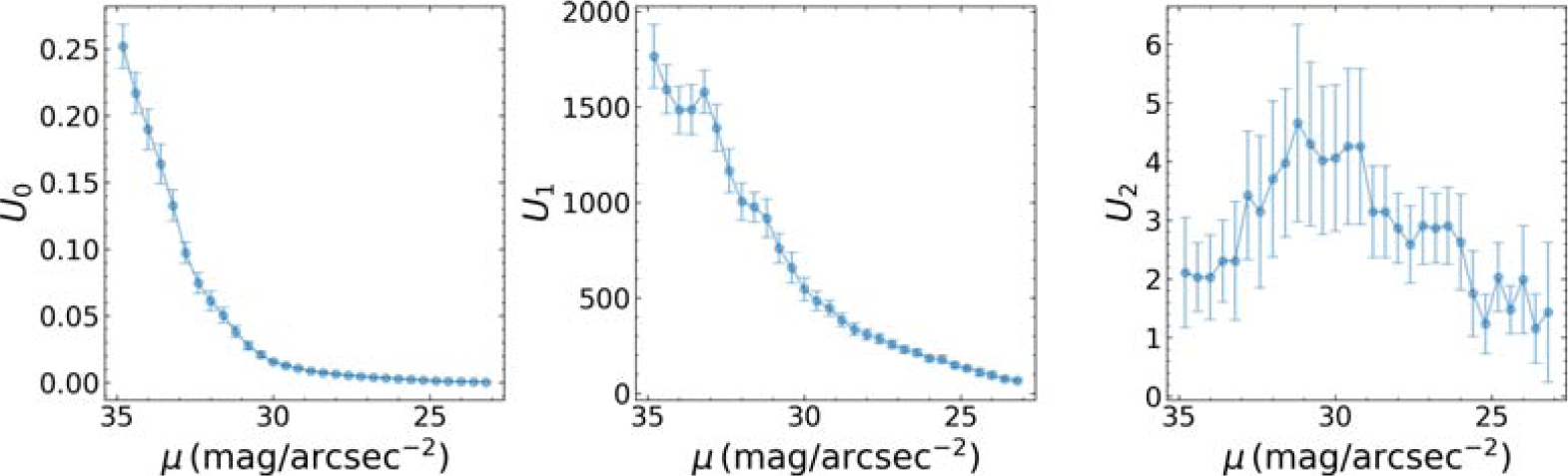
, describe the area fraction, the boundary length of structures, and the Euler characteristic, respectively. Fig. 1 is an example of Minkowski functionals applied to one of the DREAMS galaxies with different surface brightness limits. Both
 $U_0$
and
 $U_1$
increase when using fainter surface brightness limits. This demonstrates that more pixels and larger edges are detected in the Minkowski functionals.
Results of the Minkowski functionals on one of the mock images show that
 $U_0$
and
 $U_1$
increase as the surface brightness limit becomes fainter, indicating more detected pixels and edges.
 $U_2$
shows that the connectivity between patches changes with different surface brightness limits.

Figure 1 Long description
Three line graphs show the relationship between surface brightness (μ in mag/arcsec^2) and Minkowski functionals (U0, U1, U2). Panel A: The line graph for U0 shows a decreasing trend as surface brightness increases. Panel B: The line graph for U1 also shows a decreasing trend with increasing surface brightness. Panel C: The line graph for U2 shows a peak around a surface brightness of 30 mag/arcsec^2, indicating changes in connectivity between patches.
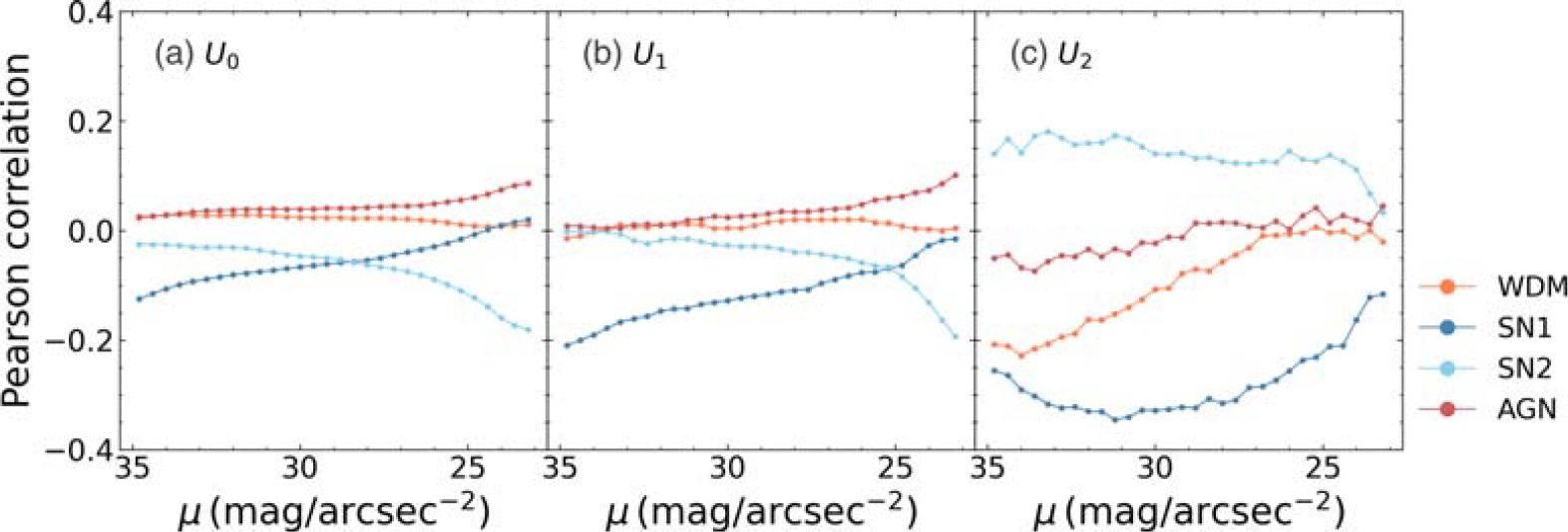
Since the galaxies in DREAMS are simulated with different baryonic physics and dark matter models, a one-to-one comparison is not straightforward. Therefore, the first step is to test whether the morphology, as measured by Minkowski functionals, varies with the baryonic parameters. Fig. 2 shows the Pearson correlation of measured
 $U_0$
,
 $U_1$
, and
 $U_2$
with the internal parameters in the DREAMS Simulations, warm dark matter mass, supernova feedback, and AGN feedback at different surface brightness limits.
Pearson correlation of
 $U_0$
,
 $U_1$
, and
 $U_2$
with the internal parameters warm dark matter mass (WDM), supernova feedback parameters (SN1, SN2), and the AGN feedback.

Although the overall correlations are weak, we find several trends that may be worth further discussion. SN1 is negatively correlated with both area and edge features in faint structures, and it also affects
 $U_2$
across a wide range of surface brightness. SN2 seems to impact area and edge primarily in the central regions and shows a positive correlation with
 $U_2$
, with its importance slightly increasing toward fainter regions. Among the four parameters, AGN shows the weakest overall correlation and appears to influence area and edge only in the brighter parts. At first glance, supernova feedback appears to influence the outer structures more strongly than AGN feedback. Additionally, the variation of correlation with surface brightness suggests that more information might be retrievable from stellar haloes.
 U0
 U1
 U2
 U0
 U1
 U2


