


INTRODUCTION
The question of what motivates political participation is central to political science. Participation is essential for holding governments to account, and for influencing incumbents to implement the policies that citizens demand. A vast literature asserts that education is a major driver of political participation, as well as many other forms of civic action (Almond and Verba Reference Almond and Verba1963). La Due Lake and Huckfeldt (Reference La Due Lake and Huckfeldt1998, 567) argue that the positive relationship between education and political participation is “one of the most reliable results in empirical social science.” Similarly, Hillygus (Reference Hillygus2005, 25) states that the idea that education is a primary driver of increased political participation is “largely uncontested,” while Putnam (Reference Putnam1995, 68) posits that education “is the best individual level predictor of participation.”
There are, however, several problems with this lawlike assertion. First, isolating the effect of education—as distinct from innate ability (Spence Reference Spence1973), socioeconomic status (Jennings and Niemi Reference Jennings and Niemi1968), or family background (Nie, Junn, and Stehlik-Barry Reference Nie, Junn and Stehlik-Barry1996)—on political participation is a formidable challenge. Debates between “education as cause” versus “education as proxy” remain far from settled (Berinsky and Lenz Reference Berinsky and Lenz2011; Kam and Palmer Reference Kam and Palmer2008). Second, with few exceptions, the existing empirical literature investigating the causal link between education and political participation has focused on a small set of rich liberal democracies (Sondheimer and Green Reference Sondheimer and Green2010). This is problematic because existing accounts of the positive effect of education on participation implicitly assume that countries have an institutional environment and a civic culture that might be absent in many developing countries.
Third, influenced by modernization theory, analyses in developing countries have primarily focused on aggregate correlations between education and the likelihood that autocratic regimes transition to democracy (Acemoglu et al. Reference Acemoglu, Johnson, Robinson and Yared2005; Murtin and Wacziarg Reference Murtin and Wacziarg2014). Here too, scholars have long assumed that education is a critical driver of political participation that, in turn, forces autocratic regimes to open up political space (Deutsch Reference Deutsch1961; Lerner Reference Lerner1958). Indeed, Huntington (Reference Huntington1991) explicitly claimed that education contributed to the “Third Wave of Democratization” in the 1970s and 1980s. It is, however, unclear whether this relationship still holds, given that the nature of dictatorial regimes has dramatically changed over the past two decades. Current day authoritarian regimes are now far more likely to combine autocratic rule with formal electoral institutions (Schedler Reference Schedler2013). Considering the dearth of individual-level analyses in this area, the nature of the relationship between education and political participation in contemporary electoral authoritarian settings remains poorly understood.
We address this gap in the literature by examining the causal relationship between education and noncontentious political participation under electoral authoritarianism. Electoral authoritarian regimes are a hybrid: while they permit some popular participation and elite contestation by holding periodic elections, they fall a long way short of genuine democracy. In such regimes, elections—while not purely pro forma—are far from fair, the government is almost assured of remaining in power, and many other forms of political action are closely monitored, and often limited, by the regime (Levitsky and Way Reference Levitsky and Way2010). What political role do more-educated citizens play in such contexts? We argue that the positive relationship between education and political participation does not necessarily apply in electoral authoritarian settings. We further argue that in electoral authoritarian regimes, education can be associated with decreased political participation, even when education—as modernization theorists have long assumed—increases socioeconomic status, interest in politics, and support for democracy.
Political participation in democratic settings can be understood as the embodiment of free will (Rousseau Reference Rousseau1997). The act of voting, in particular, has been viewed as a manifestation of political equality and individual agency (Lijphart Reference Lijphart1997). Yet in many nondemocratic settings, regimes compel political participation as a demonstration of allegiance, rather than to aggregate social preferences or genuinely enable citizen voice (Hermet Reference Hermet, Hermet, Rose and Rouquie1978; Magaloni Reference Magaloni2006). Elections in electoral authoritarian regimes seek to legitimize incumbents, appease the international community, and demonstrate the omnipresence of the regime (Levitsky and Way Reference Levitsky and Way2002). Under such conditions, political participation loses both its normative and instrumental appeals for many voters.
When participation does not provide genuine input into the political process, refraining from participation may follow from a recognition that costly political action is futile (Posner and Simon Reference Posner and Simon2002). In addition, if citizens come to believe that participation mostly serves to buttress the regime by legitimizing it, disengagement from politics can serve as a powerful form of dissent (Hermet Reference Hermet, Hermet, Rose and Rouquie1978; Karklins Reference Karklins1986). This study’s key insight is that in the context of electoral authoritarianism, better-educated citizens are more likely to exercise such deliberate political disengagement.
First, education increases the resources that citizens possess, which in turn facilitates greater knowledge and understanding of politics. Such resources could be material or ideational. With respect to material resources, education is associated with greater socioeconomic status, which increases citizens’ ability to follow politics. Educated citizens, for example, have the resources to access more critical foreign media, or may be better able to critically evaluate regime propaganda in local media outlets. As for ideational resources, education likely increases interest in politics, and thus the likelihood of following the news. A better understanding of the working of politics may, in turn, increase awareness that participation is unlikely to meaningfully affect political outcomes.
Second, education may lead to value change. Better educated citizens may place a higher premium on democratic values, such as self-expression and individual voice, than on social conformity and respect for authority (Inglehart and Welzel Reference Inglehart and Welzel2005). Such value change is expected to reduce a citizen’s interest in legitimizing the regime by participating in national and local politics.
We expect both channels—increased resources and value change—to lead to reduced support for the incumbent regime. Better-educated constituents may be more aware of the autocratic nature of politics, and better able to link politicians’ actions to policy and developmental outcomes. This, in turn, allows such voters to develop a more accurate assessment of the regime’s failings in (mis)managing the economy, or in delivering subpar social services. Thus we expect better-educated citizens to be more critical of the incumbent government. Such assessments should again reduce a citizen’s interest in legitimizing the regime via political participation.
We test our deliberate disengagement argument using the case of Zimbabwe, a paradigmatic electoral authoritarian regime ruled by President Robert Mugabe and a civilian-military junta. While elections have been held regularly since 1980, the incumbent regime has used a combination of intimidation, manipulation of legal rules, and vote rigging to maintain power. Thus, as in many electoral authoritarian regimes, elections in Zimbabwe provide some restricted opportunities for public opinion to be registered, without offering voters a genuine ability to determine the distribution of power. By contrast, the 2008 election was more competitive, resulting in a power-sharing agreement between President Mugabe and opposition leader Morgan Tsvangirai. This election thus presents a rare opportunity to compare the effects of education on participation during more and less politically competitive contexts.
Furthermore, Zimbabwe is an excellent case study because we are able to leverage a major policy reform to identify the causal relationship between education and participation. After majority rule was achieved in 1980, Zimbabwe implemented a far-reaching education reform. The reform substantially increased access to secondary education for black students and induced some students to remedially attend primary school. We exploit the timing of the reform to analyze the effects of education by comparing cohorts that were just young enough to enjoy greater access to secondary education to those that were just too old. To address noncompliance across cohorts, we also use access to secondary education to instrument for education attainment.
Our primary finding is that, in Zimbabwe, education reduces levels of political participation. Contrary to the conventional wisdom, a higher level of education reduces not only voting, but also other forms of noncontentious participation such as contacting one’s local councilor and attending community meetings. This finding is robust to various estimation approaches, different definitions of our treatment, the inclusion of a battery of pretreatment covariates, and various placebo tests and sensitivity analyses.
We follow a three-step empirical strategy to increase confidence in our interpretation of the study’s key finding—that better educated citizens deliberately chose to reduce their level of participation. First, we directly test the mechanisms that link educational attainment and low levels of participation according to our deliberate disengagement theory. Consistent with the resource mechanism, we show that educational attainment leads to greater socioeconomic status (SES), which is often seen as a key factor contributing to increased participation among the more educated in liberal democracies (Verba, Schlozman, and Brady Reference Verba, Schlozman and Brady1995). Furthermore, supporting our argument that decreased participation is an informed choice by relatively cognizant and politically aware citizens, we find that education significantly increases news consumption and interest in politics. Consistent with our value change mechanism, and findings from advanced democracies (Dee Reference Dee2004; Milligan, Moretti, and Oreopoulos Reference Milligan, Moretti and Oreopoulos2004), we further show that better educated Zimbabweans express greater support for democracy. As hypothesized, we then show that education decreases support for the ruling party, and reduces evaluations of government performance.
Second, to further increase confidence in the plausibility of a deliberate disengagement from politics, we test a key implication of our theory. Specifically, we examine whether better-educated citizens re-engage with politics when political conditions allow for more meaningful contestation. To this end, we demonstrate that the large negative relationship between education and participation weakens significantly after the relatively more competitive 2008 election.
Our third strategy rules out plausible alternative explanations for our key finding. First, we find no support for the possibility that better-educated constituents are less integrated into patronage or vote buying mobilization networks. Second, we find no evidence to suggest that better educated constituents are more likely to face violent repression intended to suppress participation. Third, we find no support for a possible “coming of age” argument, according to which students benefiting from the educational reform participate less because they were affected less by the independence movement from which Mugabe’s regime emanated. The consistency of our results across these three empirical strategies lends credibility to our interpretation that better educated citizens consciously choose to withdraw from the political sphere under electoral authoritarianism.
This article’s main contribution is to the vast literature on the relationship between education and political participation. Notwithstanding the centrality of education to political theories of democratic citizenship, much is still unknown about the nature of the relationship between educational attainment and political attitudes and behavior. If education reduces political participation in electoral authoritarian regimes, this provides an additional qualification to the literature that assumes a lawlike positive relationship.Footnote 1 We show that education increases the ability of citizens to participate in politics, and leads to greater interest in politics. However, whether citizens decide to use these capabilities, or whether they instead “deliberately disengage” from the political arena is likely to depend on the political context. In sum, this is to the best of our knowledge, the first article to argue—and causally demonstrate—that the positive relationship between education and political participation is conditional on regime type. As such, it makes an important contribution to our understanding of the determinants of political participation in the developing world.
RELATED LITERATURE
The relationship between education and political participation in mature democracies is the subject of a vast literature. Whereas early work established correlations between education and political participation, several recent studies have credibly identified a positive causal effect of education on political participation in the developed world.Footnote 2 The study of the effect of education in developing countries is somewhat less developed, and none of the recent studies that attempt to identify a causal relationship between education and participation in developing countries, briefly surveyed below, have examined this question in the context of a repressive electoral authoritarian regime.Footnote 3
Friedman et al. (Reference Friedman, Kremer, Miguel and Thornton2011) use a field experiment in Western Kenya to study the effect of an increase in education induced by a secondary school girls scholarship program. They find that secondary education made the young women in their sample more politically informed, less deferential to political authority, and more likely to reject gender-biased violence. They do not find, however, that secondary education increased community participation, political efficacy, or intention to vote. Despite its innovative design, the study measures outcomes only 4–5 years after initial enrollment and examines a non-nationally representative population.Footnote 4 Given the comprehensiveness of Zimbabwe’s education reform, we are able to identify mass public education’s long-term effects for representative samples that small-scale field experiments cannot reach.
Our findings speak most directly to two recent studies that examine the long-term effects of education. Wantchekon, Klašnja, and Novta (Reference Wantchekon, Klašnja and Novta2015) use the placement of missionary schools in Benin as a plausible source of exogenous variation in access to education. They find that the first generation of formally educated Béninois and their descendants are more likely to join and campaign for political parties. The authors do not, however, report results regarding voting and political attitudes, perhaps since their main focus is education’s effect on well-being. Larreguy and Marshall (Reference Larreguy and Marshall2014) exploit spatial variation in the intensity of Nigeria’s 1976 education reform to show that educational attainment causes more political participation in the form of voting, contacting politicians, attending community meetings, and devoting attention to political events.
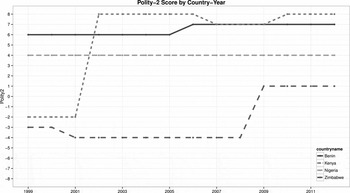
The above studies arguably identify the impact of education on political outcomes in contexts of meaningful political contestation. While Benin, Kenya, and Nigeria cannot be classified as consolidated democracies, they have experienced competitive elections and turnovers of executive power in recent years.Footnote 5 Zimbabwe, by contrast, has experienced no alternation in executive power since independence, and election rigging has been widespread since at least 1996 (the first election covered by our empirical analysis). These differences are reflected, for example, in Zimbabwe’s Polity-2 score, which is significantly lower than those of Kenya, Benin, and Nigeria during the period covered by the Afrobarometer (see Figure 1). Nevertheless, the level of contestation in Zimbabwe is not constant: the increase in the Polity score following the 2008 election reflects an important period in which genuine change appeared more likely than in the past. We leverage this change in contestation levels in testing our deliberate disengagement argument.
Polity-2 Scores by Year

POLITICS AND SECONDARY EDUCATION IN ZIMBABWE
Zimbabwe (then known as Rhodesia) was a British colony for much of the 20th century, with a small white settler elite, a large black African majority, and an apartheid-like set of institutions that ensured white dominance of political and economic life. In 1965, the white settler-led government declared independence from Britain in order to prolong its domination of the country. Armed resistance to white rule began in the mid-1960s and intensified after 1972, finally resulting in free elections and black majority rule in 1980. Robert Mugabe, Zimbabwe’s first post-independence leader, still serves as president.
After an initial phase of violent conflict between the Zimbabwe African National Union (ZANU) and its rival, the Zimbabwe African People’s Union (ZAPU), the two parties merged into “ZANU-PF” in 1987. Mugabe won 78% and 93% of the vote in the 1990 and 1996 presidential elections, respectively, while ZANU-PF won 117 out of 120 seats in the 1995 parliamentary election (Levitsky and Way Reference Levitsky and Way2010).
Opposition to Mugabe’s increasingly autocratic rule began to crystallize only in the late 1990s, when labor, religious, and civil society groups, initially mobilized to institutionalize term limits, formed the Movement for Democratic Change (MDC) opposition party. Political space opened briefly in February 2000, when the MDC defeated Mugabe’s proposal for a new constitution. But immediately following the February referendum, Mugabe and ZANU-PF ratcheted up political repression ahead of the June 2000 parliamentary elections, which were marked by widespread violence against opposition supporters (Sithole Reference Sithole2001). Rather than signifying a new openness in Zimbabwean politics, the two elections in 2000 intensified ZANU-PF domination of politics, increased the use of war veterans and youth militias to harass the opposition, and resulted in the passage of restrictive legislation such as the Public Order and Security Act to limit opposition gatherings (Bratton and Masunungure Reference Bratton and Masunungure2008).
This represented the start of an extended period of political crisis in Zimbabwe. Starting even before the June 2000 elections, President Mugabe instigated the dispossession of white farmers via land invasions and handed their farms over to ZANU-PF allies. In the 2002 presidential elections, Mugabe defeated Morgan Tsvangirai—the MDC presidential candidate—with 56% of the vote amid widespread violence and vote rigging (LeBas Reference LeBas2006). Immediately after the 2005 parliamentary elections, in which ZANU-PF won 65% of the parliamentary constituencies against an internally divided MDC (Bratton Reference Bratton2014), Mugabe launched Operation Murambatsvina (“Drive Out the Rubbish”), which displaced over 700,000 people from informal urban settlements.
The 2008 elections took place in a context of agricultural collapse and macroeconomic instability, with hyperinflation at an annual rate of 231,000,000% (Bratton Reference Bratton2014). Benefiting from (initially) lower levels of election violence than in 2002 (Levitsky and Way Reference Levitsky and Way2010), the MDC won an outright parliamentary majority. Tsvangirai beat Mugabe in the first round of the presidential election, but the electoral commission stated that he did not reach the 50% threshold required for victory. Prior to the second round, ZANU-PF and the military launched a brutal campaign of intimidation and beatings against MDC supporters and candidates, and Tsvangirai withdrew from the race. Mugabe won the uncontested election, but international pressure forced a government of national unity, with Mugabe as president and Tsvangirai as prime minister (LeBas Reference LeBas2014).
The national unity government and the end of hyperinflation allowed the economy to rebound somewhat after 2009, and political violence declined. Yet despite the facade of power sharing, ZANU-PF retained de facto control, while internal divisions weakened the MDC. The 2013 elections marked the return of ZANU-PF dominance, as Mugabe comfortably beat Tsvangirai and won 70% of parliamentary seats (LeBas Reference LeBas2014).
The Education Reform of 1980
Prior to independence, access to education for the black community was deliberately restricted. While schooling was compulsory and free for whites (until age 15), black Zimbabweans—who were not required to attend school—had to pay high school fees. In addition, black Zimbabweans were required to pass a series of increasingly difficult exams in order to continue past primary school, while continuation to the first cycle of secondary school was automatic for whites. The education budget for black Zimbabweans was tightly controlled at 2% of GDP, while out-of-pocket secondary school tuition and boarding fees cost almost two months of the average annual wage.Footnote 6 The government spent about 12 times more per capita on primary schooling for whites than for blacks (Dorsey Reference Dorsey1989). King (Reference King2013) documents that such discriminatory policies were implemented in many African colonies, which had come to associate education with greater unrest.
Starting in April 1980, the ZANU government implemented a wide-ranging set of educational reforms. Primary education was made free and compulsory for all Zimbabweans, regardless of color. While some fees were applied for secondary school, automatic progression from primary to secondary school was decreed. Furthermore, age barriers were removed for older children, allowing those who did not start school on time to attend. The government also undertook a large-scale school building campaign and reopened schools that had been closed during the independence war. Between 1980 and 1986, the number of primary schools almost doubled, from 2,401 to 4,291, while the number of secondary schools increased dramatically, from 177 to 1,276 (Bourne Reference Bourne2011).
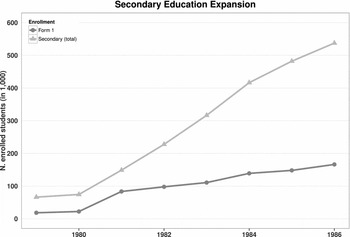
The reform had an immediate effect: overall student enrollment doubled in one year (Narman Reference Narman, Darnolf and Laakso2003). As Figure 2 illustrates, this increase was most dramatic for secondary enrollment, which rose from 66, 215 students in 1979 to 537,427 in 1986. The change is also apparent in the primary-secondary progression statistics: while in 1979 only 25% of primary school leavers continued to secondary schools, by 1986 78% did (Bourne Reference Bourne2011).
Number of Enrolled Students in Form 1 (First Year of Secondary Education) and in All Secondary Education Grades by Year, 1979–1986

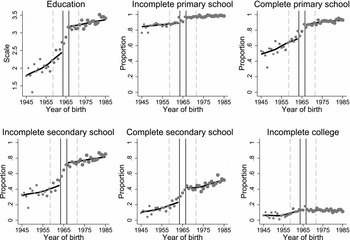
Based on the nature of Zimbabwe’s education reform, we focus on the expansion of secondary education.Footnote 7 Although primary school fees were formally banned, the reform did not substantially affect primary educational attainment. This is likely because 80% of black Zimbabweans were already enrolled in primary school even under white rule, and because some primary schools continued charging informal fees (Nhundu Reference Nhundu1992). Had the 1980 reforms significantly affected primary enrollment, we should observe a sharp increase in education among the cohorts starting primary school in 1980, i.e., those born from 1972 to 1974. However, we find no evidence of a jump around those birth years (see Figure 5 below).Footnote 8 The reform’s small effect on primary school completion principally reflects the remedial education of individuals whose education was interrupted by the war (Narman Reference Narman, Darnolf and Laakso2003).Footnote 9
Given the rapid expansion, qualified teachers could not be hired quickly enough, instructional quality often suffered, and school construction lagged behind enrollment, leading to overcrowded classrooms.Footnote 10 While some slippage in quality was perhaps inevitable given the speed of the reform, quality remained sufficiently high to deliver substantial material benefits to the reform’s beneficiaries, as we demonstrate below. Notwithstanding these challenges, Zimbabwe was widely recognized as a leader in expanding access to education in Africa during the 1980s (Dorsey Reference Dorsey1989), and provides an excellent setting in which to examine the role of education in electoral authoritarian regimes that allow some restricted political contestation.
RESEARCH DESIGN
In this section we discuss the data sources, identification strategy, and estimation approaches that we use to identify the long-term effects of Zimbabwe’s education reforms on political participation.
Data
We combine all available rounds of the Afrobarometer surveys conducted in 1999, 2004, 2005, 2009, 2010, and 2012.Footnote 11 Since the Afrobarometer questions change across survey rounds, different rounds may be used to test different outcome measures (see Online Appendix). We focus exclusively on black respondents, who comprise the overwhelming majority of Zimbabwe’s population and were the targets of the 1980 education reform.Footnote 12
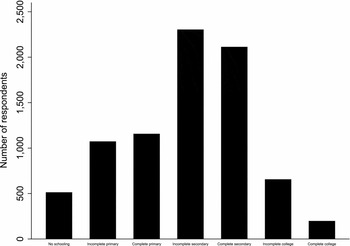
Education is our key (endogenous) explanatory variable, which is measured using the following seven-point ordinal scale: no schooling, incomplete primary, complete primary, incomplete secondary, complete secondary, incomplete college, complete college. A one-category increase in the education measure is equivalent to about 2–4 years of education, given the discrete nature of the variable. Figure 3 shows the distribution of this measure in our sample, indicating that the modal level of schooling is incomplete secondary school.
Sample Distribution of Educational Attainment (8,014 observations)

Our key dependent variable, political participation, is operationalized using four binary variables.Footnote 13 Voted indicates whether the respondent reported voting in the most recent legislative or presidential election. We also examine indicators for directly contacting one’s local government councilor (Contacted local councilor), attending a community meeting (Attended community meeting), or joining other community members in raising an issue (Raised issue at meeting) within the past 12 months.Footnote 14
In electoral authoritarian settings like Zimbabwe, political action such as voting, attending and participating in community meetings, and contacting local leaders, comprise a coherent set of behaviors encapsulating noncontentious political participation. First, these are common types of political behavior, rather than unusual forms of participation restricted to elites. Respectively, 64%, 38%, 66%, and 58% of respondents engaged in such activities.Footnote 15 The Online Appendix shows that these levels of participation broadly represent the median country in Afrobarometer surveys.
Second, mobilization of observable mass participation in public contexts such as voting and public meeting attendance is a key component of regime strategy in electoral authoritarian contexts, since they represent a signal of the regime’s strength (Magaloni and Kricheli Reference Magaloni and Kricheli2010). Marongwe (Reference Marongwe2013), for example, notes that active participation in political meetings was a key marker of regime support over the period covered in this analysis. Mass participation is a powerful signal that active resistance for any individual is pointless because opposition to the regime is only viable if many others join the struggle (Kuran Reference Kuran1991). Conversely, deliberately abstaining from such forms of participation is a meaningful political act and a genuine sign of implicit resistance in this context.
Finally, we focus on noncontentious participation because these actions are low cost and low risk forms of participation that increased education might reasonably affect. By contrast, consistent with their comparatively higher costs, only 17% and 11% of respondents report contacting their MP or attending a demonstration. Unreported results also indicate that education reduces contact with MPs and increases demonstration attendance, although neither reaches statistical significance.
We further combine the four binary participation variables, which are positively correlated with a Cronbach’s alpha of 0.65, into a simple summative rating scale (Participation scale).Footnote 16 Although we also present the results for each component separately, we place greatest weight on our scale measure because it averages over any noise contained in our individual indicators.
Variation in Access to Secondary Schooling
In order to identify the causal effect of educational attainment, we exploit cross-cohort variation in access to secondary schooling arising from Zimbabwe’s 1980 reform. Specifically, we compare black citizens from cohorts that were just young enough to be affected by the reform to black citizens from cohorts that were just too old to benefit from the educational expansion.
We define those born in 1967 or later, who were 13 or younger when the reform was implemented, as fully “treated” (
 $\mathit {Secondary \ access}=1$
). Those born in 1963 or earlier, and thus aged 17 or older in 1980, are defined as our control group that was not affected by the reform (
 $\mathit {Secondary \ access}=0$
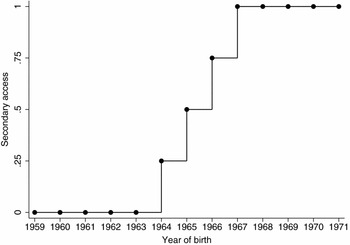
). Finally, those aged 14–16 at the time of the reform’s onset are considered “partially treated.” Such individuals are coded according to the number of additional years of schooling available to them; for example, a black Zimbabwean aged 15 in 1980 is coded as receiving a “dosage” of half treatment, while individuals aged 14 and 16 are coded as receiving one-quarter and three-quarter dosages, respectively.Footnote
17
This coding scheme, shown graphically in Figure 4, defines Secondary access, our source of exogenous variation.
Operationalization of Secondary Access, the Study’s Key Treatment Variable

Figure 5 provides preliminary evidence that the reform increased average educational attainment across cohorts. The education scale (top left) shows that cohorts fully treated by the reform exhibit substantially higher levels of education relative to cohorts born in 1963 or earlier. The increase is large and almost equivalent to moving from complete primary to incomplete secondary, or from incomplete to complete secondary education. The figure also demonstrates that the reform increased the education levels of partially treated cohorts, but by less than fully treated cohorts.
Trends in Educational Attainment by Cohort

To identify the causal effects of the reform we must assume that black Zimbabweans on both sides of the reform cutoff are identical, with the exception that only some cohorts were eligible to enjoy access to secondary education. However, independence undoubtedly brought about many important changes, and socialization processes could operate differently at different stages of life (Alwin and Krosnick Reference Alwin and Krosnick1991; Sears and Valentino Reference Sears and Valentino1997). To address such concerns, we limit our comparison to cohorts that were born just too early to be directly affected by the reform and the first cohorts to be affected by the reform. Specifically, our main analysis focuses on a bandwidth of five cohorts on either side of the reform cutoff years of birth (1963 and 1967). This is a powerful design even though it dramatically reduces our sample size: the cohorts around the reform are subject to similar economic, social and political environments, but differ in their ability to take advantage of a schooling reform that could not have been anticipated by parents more than a decade earlier.
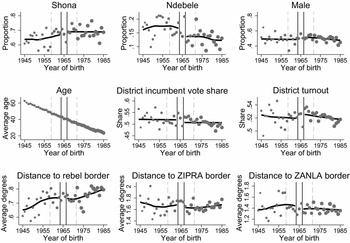
Using a subsample of five cohorts around the eligibility cutoff, there are good reasons to believe that control cohorts only differ from treated cohorts with respect to secondary schooling eligibility. First, Figure 5 indicates that trends in education are relatively flat once we focus on the five cohorts on either side of the reform’s cutoff point (inside the gray dashed lines). Below, we also document flat trends in our political outcomes. Second, by varying the size of the bandwidth, using placebo reforms, and controlling flexibly for cohort trends on either side of the reform cutoff, our robustness checks demonstrate that trends across cohorts cannot be driving our results. Third, Figure 6 indicates that cohorts on either side of the reform are balanced across treatment groups with respect to gender, age at the date of the survey, district-level political aggregates, and distance to the borders from which the rebels entered during the war of independence. Although there is a slight imbalance with respect to tribe, we show below that our findings are robust to the inclusion of pre-treatment covariates and that the effects of access to education do not vary across tribes. Moreover, previous studies indicate that cohorts affected by the reform are uncorrelated with good proxies for family income in early childhood, such as adult height (Agüero and Ramachandran Reference Agüero and Ramachandran2014).Footnote 18 Finally, the frequency of surveyed individuals by age is not affected by the treatment, suggesting that there is no differential fertility or migration across cohorts around the reform. Tellingly, the proportion of educated respondents in our surveys does not change even after hyperinflation began in the mid-2000s.
Trends in Pretreatment Variables by Cohort

Estimation Strategies
Building on our key identifying assumption that access to secondary schooling is exogenous across cohorts on either side of the reform cutoff, we utilize two main approaches to identify the long-run effects of secondary education on political participation. Our first approach includes partially treated respondents, which enables us to examine outcomes as a function of treatment intensity (i.e., differential access to secondary schooling) across cohorts that were subject to essentially identical common shocks. We first estimate the reduced form effects of increasing the availability of secondary education—which is equivalent to an “intent-to-treat” (ITT) analysis—by estimating the following regression equation using ordinary least squares (OLS):
 $$\begin{eqnarray}
Y_{icdt} = \gamma \mathit {Secondary \ access}_{c} + \eta _t + \epsilon _{icdt},
\end{eqnarray}$$
where Yicdt
is an outcome measure, and
 $\mathit {Secondary \ access}_{c}$
is our key treatment variable. We include survey fixed effects, η
t
, to account for time-varying shocks that impact respondents differently across survey rounds, and cluster standard errors by district to account for spatial correlations between respondents.Footnote
19
Access to public education, however, does not necessarily entail enrollment. Rather, the link between educational access—an opportunity that equally affects all cohort members—and educational outcomes is probabilistic. This is because not all primary students continue to secondary school, and because some older individuals returned to school after the war. To identify the effects of actual education among Zimbabweans who only received additional education because of the 1980 reform, we use access to secondary schooling to instrument for education. In our first stage, we estimate the effect of access to secondary education on a respondent’s educational attainment:
 $$\begin{eqnarray}
\mathit {Education}_{icdt} = \delta \mathit {Secondary \ access}_{c} + \eta _t + \xi _{icdt},
\end{eqnarray}$$
before estimating the following structural equation using two-stage least squares (2SLS):
 $$\begin{eqnarray}
Y_{icdt} = \beta Education_{icdt} + \eta _t + \varsigma _{icdt}.
\end{eqnarray}$$
The instrumental variable (IV) estimates thus rescale the reduced form to estimate the effect for black students who only remained in school because of the reform.
Our linear coding of education follows Marshall (Reference Marshall2014), who shows that coding an endogenous education variable as binary can significantly upwardly bias estimates if greater education at lower levels—which do not register in the first stage—also affects the outcome.Footnote 20 Since any additional education may affect political behavior, we use the seven-point education scale (described above) as our endogenous independent variable. This allows us to consistently estimate the average effect of an additional unit of education.
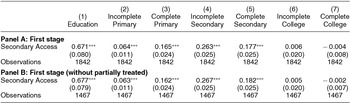
IV estimation requires several additional assumptions. First, the relationship between the instrument (secondary access) and the endogenous variable (education) must be strong. The first stage estimates in Table 1 show that the reform substantially increased education among affected cohorts, principally at the secondary level. Reinforcing the results in Figure 5, the estimate for our education scale in column (1) indicates that being fully treated by the reform increases education by two-thirds of a level on average. This entails a large first stage F statistic of 71, which far exceeds the standard critical value of 10 required to minimize weak instrument bias (Staiger and Stock Reference Staiger and Stock1997). Second, the exclusion restriction requires that our instrument only affects political outcomes through increased education. We discuss this assumption in greater detail below.Footnote 21
Estimates of Education Reform on Educational Attainment

Notes: All specifications are estimated using OLS, include survey fixed effects, and cluster standard errors by district. All specifications include five cohorts on either side of the cohorts that were fully affected or fully unaffected by the reform (panel A), or five cohorts on either side of the first cohort to receive any treatment (panel B). *p < 0.1, **p < 0.05, ***p < 0.01.
Our second approach drops all partially treated respondents, and thus compares only untreated respondents who were born in 1963 or earlier (i.e., too early to be affected by the reform) to respondents who were fully treated. This allows us to focus on a sharp change in treatment assignment, and is thus similar to regression discontinuity (RD) designs relying on the weaker assumption that potential outcomes are smooth across the discontinuity.Footnote 22 For this second approach, we again estimate Equations (1) and (3), but exclude all partially treated respondents. Finding consistent results across both approaches should increase confidence in the study’s findings.
EDUCATION AND POLITICAL PARTICIPATION IN ZIMBABWE
This section presents our main finding: that education reduces political participation in Zimbabwe, a paradigmatic electoral authoritarian regime. For each measure of participation, we provide both graphical evidence and regression estimates. Regression tables include our reduced form and IV estimates using both approaches to identification discussed above. We then demonstrate the robustness of our findings.
Main Estimates
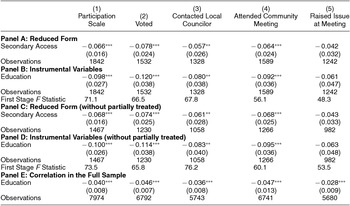
Contrary to the positive effects of education documented in advanced democracies (Sondheimer and Green Reference Sondheimer and Green2010) and democratic developing country contexts (Larreguy and Marshall Reference Larreguy and Marshall2014), we find that in Zimbabwe, education substantially and significantly reduces levels of political participation. Column (1) in Table 2 reports the estimates for our participation scale across all estimation strategies. Relative to its sample mean of 0.65, panel A shows that access to secondary education reduces participation by around 10%. Panel C shows that this estimate is barely affected by excluding partially treated respondents. The IV estimates in panels B and D reveal a similar story: regardless of whether partially treated respondents are included, a one-unit increase in education reduces participation by around 15% relative to its sample mean. Finally, we report the simple correlation between education and political participation in panel E in the sample containing all cohorts, which also shows a significant negative correlation.Footnote 23
The Effects of Education on Political Participation

Notes: All specifications in panels A, C, and E are estimated using OLS, and include survey fixed effects. All specifications in panels B and D are estimated using 2SLS, in which access to schooling is used to instrument for education, and include survey fixed effects. All specifications include five cohorts on either side of the cohorts that were fully affected or fully unaffected by the reform; panels C and D exclude partially treated cohorts born between 1964 and 1966. Standard errors are clustered by district in all specifications. *p < 0.1, **p < 0.05, ***p < 0.01.
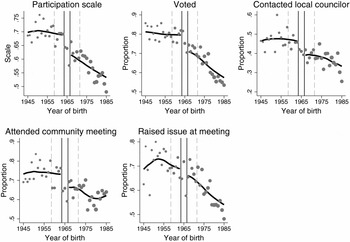
Importantly, as Table 2 and Figure 7 indicate, the negative effects of education on the participation scale are not simply due to an exceptionally large impact on one constituent variable. Rather, a one-unit increase in access to secondary schooling and a one-unit increase in education both cause substantial declines in each noncontentious form of political participation. Specifically, our estimates suggest that being fully eligible for secondary education reduces voting by 8 percentage points, contacting one’s local councilor by 6 percentage points, attending a community meeting by 6 percentage points, and raising issues with others at a meeting by 4 percentage points. Similarly, a one-unit increase in educational attainment reduces voting by 12 percentage points, contacting a local councilor by 8 percentage points, attending a community meeting by 9 percentage points, and raising an issue by 6 percentage points. Across all our specifications, only the decrease in raising an issue is not statistically significant.
Trends in Political Participation by Cohort

Robustness Checks
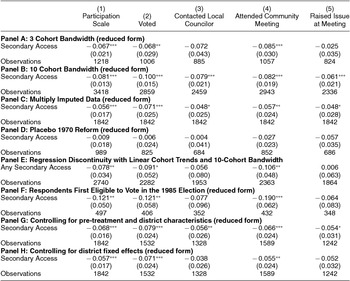
Given that these findings challenge the conventional wisdom that education increases participation, it is essential to demonstrate their robustness. In this subsection we describe several checks that more formally test our identifying assumptions and that examine whether our results hold when using alternative specifications. All robustness results are presented in Table 3.
Robustness Checks

Notes: Panels A and B include 3 and 10 cohorts, respectively, on either side of the reform. Panel C multiply imputes the outcome variables. Panel D treats cohorts born between 1957 and 1961 as treated, and compares them to cohorts born between 1952 and 1956. Panel E includes 10 cohorts on either side of the first and last cohorts on either side of the reform and includes linear birth-year polynomials on either side of the reform. Panel F includes only cohorts that turned 18 between 1981 and 1984. Panel G includes Shona, Ndebele, and male dummies as controls, as well as controls for the district incumbent vote share and district turnout at the nearest election. Panel H includes district fixed effects. Standard errors are clustered by district in all specifications. *p < 0.1, **p < 0.05, ***p < 0.01.
We first show that our results are not an artifact of specification choices or cohort trends. Panels A and B show that the reduced form estimates are similar when we include either three or ten cohorts on either side of the reform eligibility threshold. Figure 3 in the Online Appendix demonstrates that our results are similarly robust to any bandwidth choice between 1 and 10. Second, we test whether our findings could be explained by potential biases arising from missing data. Panel C shows that if anything the results are stronger when imputing the missing data across our main participation outcomes.Footnote 24
Third, to address the possibility that our findings are driven by long-term changes across cohort, we employ placebo tests and control flexibly for cohort trends. In panel D, we examine a placebo reform in which we estimate the reduced form effects of a (hypothetical) reform in 1970 and compare cohorts five years on either side of this arbitrary cutoff. Reassuringly, we do not observe any significant reduction in political participation around the placebo reform. Furthermore, we repeat this exercise and find no effects for placebo reforms in any year between 1960 and 1972.Footnote 25 Fourth, panel E implements an RD design where we redefine our treatment to include the “partially affected” citizens; i.e., all respondents born since 1964 are counted as treated. Using a 10-cohort bandwidth, and including linear cohort trends on either side of the discontinuity to account for cohort trends, our RD estimates similarly show large negative effects of access to the reform.Footnote 26
As noted above, plausible confounding explanations must relate to political differences between the cohorts immediately around the reform eligibility cutoff. First, one potential concern is a “first election” effect, such that respondents with different levels of treatment behave differently because they first voted in different elections (Meredith Reference Meredith2009). To show that this cannot explain our results, in panel F we restrict attention to respondents born between 1963 and 1966—who were first eligible to vote (at age 18) in the 1985 election—and find that the intensity of secondary access continues to significantly decrease political participation. Second, although our design minimizes differences in citizen characteristics around the reform cutoff, we also show that our results are robust to the inclusion of other potentially confounding omitted variables. Panel G, which includes the pretreatment variables described in Figure 6, yields similar results. In particular, these results suggest that participation is not being driven by compositional changes in the proportion of Shona and Ndebele respondents. Panel H demonstrates the robustness of our results to the inclusion of district fixed effects, although contacting a local councilor slightly falls outside statistical significance. Finally, while the inclusion of age fixed effects substantially decreases the precision of our estimates by removing considerable cross-cohort variation, we show in the Online Appendix that, if anything, the magnitudes of our negative estimates increase.
While our reduced form estimates do not require that the exclusion restriction holds, the IV estimates do. There are, however, good reasons to believe that the secondary education reform only affects participation through its effect on educational attainment. First, because education is highly proximate to the reform itself, most downstream behavioral responses—such as fertility, marriage, and vocation—are a function of a respondent’s education. Second, the fact that the decrease in participation levels for partially treated respondents is lower than for fully treated respondents, but higher than for untreated respondents, increases our confidence that participation is responding to changes in actual schooling. If political responses to being affected by the reform itself were driving the results via some other channel, then it is hard to see why it would have differentially affected those receiving different instrument dosages. Third, a typical concern with such reforms is the possibility of cross-cohort spillovers. However, if cohorts on either side of the reform cutoff interact with one another, spillovers are likely to reduce the effects of schooling as behavior becomes more homogeneous.
Nevertheless, we examine the sensitivity of our results to violations of the exclusion restriction by calculating the extent of the violation required to nullify our finding. Using Conley, Hansen, and Rossi (Reference Conley, Hansen and Rossi2012)’s most conservative sensitivity test, we find that 50% of the reduced form effect must operate through channels other than education for our negative estimate of education’s effect on the participation scale to become statistically insignificant.Footnote 27
ARE THE MORE EDUCATED DELIBERATELY DISENGAGING?
Why are better educated Zimbabweans, who clearly benefited from the government’s massive expansion of education, less likely to be politically active? Since it is difficult to test directly our deliberate disengagement argument—we do not have access to the thought processes of our respondents when they are deciding whether (and how) to participate—in this section we describe a three-pronged strategy to explore the plausibility of this thesis.
First we analyze the explanatory power of several mechanisms that likely mediate the relationship between education attainment and political participation. Second, we propose and examine a key observable implication of our argument: as the regime becomes less authoritarian, better-educated citizens are less likely to deliberately disengage from politics. Third, we rule out the main alternative explanations for why education might lead to decreased participation in Zimbabwe.
Mechanism
We begin by examining the mechanisms described in the introduction. First, we examine whether education increases citizens’ material resources, which allow for enhanced engagement in politics, as well as their political interest. Second, we examine the relationship between education attainment and value change, i.e., whether education has a positive effect on support for democratic institutions. Third, we assess whether voters’ increased interest and ability to participate in politics, and higher premium on democratic values, lead to a more critical assessment of the incumbent’s performance by testing whether education has a negative effect on perceptions of incumbent performance, and ultimately on the level of support for the incumbent authoritarian regime.
Resources: Socioeconomic Status and Political Interest
We first examine whether access to secondary education increases the economic welfare of the cohorts that benefited from it. Specifically we are interested in exploring the relationship between education and socioeconomic status (SES), since SES can be expected to lead to greater political participation either because some forms of participation are costly, or because higher economic status leads to greater involvement in social networks, which are entry points into such participation (Verba, Schlozman, and Brady Reference Verba, Schlozman and Brady1995). If we find that education did not increase SES, this would suggest that the economic returns to education in Zimbabwe are not as consequential as they are in mature democracies, reducing the likelihood that better educated Zimbabweans have lower participation rates due to deliberate disengagement.
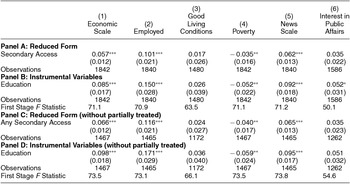
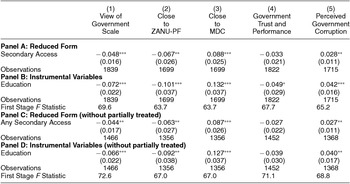
We examine the economic returns of education for black Zimbabweans in terms of employment (Employed), self-reported living conditions (Good living conditions), and a more objective poverty scale (Poverty).Footnote 28 We also combine these three measures to produce an economic outcomes scale (Economic scale). The Cronbach’s alpha for this scale is 0.41. As Table 4 shows, education improved Zimbabweans’ economic well-being. Consistent with human capital models, treated adolescents are more likely to be employed two to three decades after the reform’s onset (column 2), and they have higher income, at least as reflected in objective measures of living standards (column 4). Although not quite statistically significant, treated respondents are also likely to rate their living conditions more highly (column 3). Together, this evidence sharpens our theoretical puzzle: despite greater economic resources, which should facilitate greater participation according to the current literature, we observe lower levels of participation.
Estimates of Secondary Education on Economic Outcomes and Political Interest

Note: See Table 2.
We have also argued that education likely leads to greater interest in politics, which is important for citizen behavior. Specifically, informed citizens with greater interest in politics will have more accurate assessments of the incumbent regime, and better understanding of the limited responsiveness of the regime to the needs, preferences and interests of its constituents. Political interest is operationalized using two distinct measures. First, News scale combines indicators for whether respondents consume news from radio, television, or newspapers at least once a week. The scale has a Cronbach’s alpha of 0.74. Second, Interest in public affairs is an indicator variable for the 64% of respondents who express interest in politics and public affairs. In both cases, higher values suggest greater political interest.
Consistent with a large number of studies from Western democracies, Table 4 shows that education in Zimbabwe has a positive effect on political interest. For political interest, a one-unit increase in education raises the likelihood that an individual regularly obtains political news by around 9 percentage points, or 25% relative to the sample mean (column 5). Similarly, we find a positive, if weaker, effect of education on interest in public affairs (column 6). Our estimates thus demonstrate that reduced participation is not simply accounted for by reduced interest in politics. In fact, educated Zimbabweans are more likely to follow politics, at the same time that they are less likely to participate.
Value Change: Support for Democratic Institutions
Education is thought to also increase support for democratic institutions. Dating back to Aristotle, through Thomas Jefferson and de Tocqueville, it has been argued that education supports democratic institutions by breeding tolerance and acceptance of others’ opinions (Dewey Reference Dewey1916). By contrast, Lerner (Reference Lerner1958) highlights the impact of education on self-assessment and self-confidence. In Lerner’s model, educated people in modernizing societies start developing opinions about public issues, which leads them to believe that they have the ability, and thus should have the right, to provide input on matters of importance that affect their welfare. This psychological change, Lerner (Reference Lerner1958) argues, translates into growing support for inclusive political institutions. We therefore test whether education increases support for democratic institutions.
We argue that respondents who support democratic institutions would be less interested in legitimizing the autocratic regime with their participation. A null finding on education’s effect on support for democratic institutions would therefore be at odds with our “deliberate disengagement” argument. We measure support for democracy in two ways. First, we examine the relationship between education and Support democracy, an indicator for the 72% of respondents claiming to support or strongly support democracy. Importantly, this question is not asking respondents whether they approve of democracy as practiced in Zimbabwe, but rather democracy in the abstract. Second, to better capture support for specific liberal institutions associated with democracy, we group the following nine indicators into a scale: do you agree that parties are needed, do you reject one-party government, do you reject one-man government, are you against government banning civil society organizations, are you against government closing news stations, are you against presidential discretion, are you in favor of parliament making the laws, do you agree that the president should obey the laws, and do you support term limits. The variables that make up this Support liberal institutions index are positively correlated with a Cronbach’s alpha of 0.74. Again, larger values suggest greater support for democratic institutions.
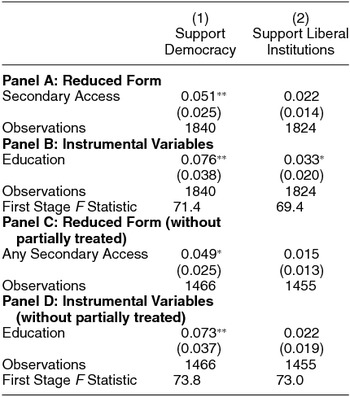
Belying an explanation rooted in limited demand for democracy, we find that education increases support for democracy. An additional unit of education significantly increases the likelihood that an individual professes support for democracy by 8 percentage points (Table 5, column 1). The positive, albeit not always quite statistically significant, effect on support for liberal institutions similarly suggests that voters possess a genuine understanding of the building blocks required to support liberal democracy (column 2). In sum, these results suggest that, consistent with our deliberate disengagement argument, support for democracy increases with education.

Lower Support of the Incumbent Regime
We have argued above that to the extent that education increases interest in politics and support for democratic institutions, we should expect that education reduces support for the incumbent autocratic regime. If true, this should in turn reduce participation in noncontentious political action among citizens that do not wish to legitimize the regime by actively participating.
To explicitly test this mechanism, we assess support for the government using four measures. Our first and second measures, Close to ZANU-PF and Close to MDC, indicate whether respondents report feeling close or very close to the ruling party and the main opposition party; 27% and 24% of respondents in our sample reported being close to ZANU-PF or the MDC, respectively. Third, we create a variable Incumbent trust and performance, which is a summative rating scale combining three indicators for trusting the president, the ruling party, and its MPs, and three indicators for whether the respondent believes that the president, MPs, and the local government are performing well in office (alpha of 0.84). Fourth, Perceived government corruption is a summative rating scale (alpha of 0.80) that combines four indicator variables asking whether the respondent believes the president, MPs, local councilors, and government officials are corrupt. Finally, we combine these four variables to produce our View of government scale (alpha of 0.62).
The results in Table 6 support our theoretical argument: across all specifications in column (1), access to secondary education has a negative effect on the view of government scale. Furthermore, columns (2) and (3) show a significant decrease in support for ZANU-PF and a significant increase in support for the MDC. Trust in government also broadly decreases with education (column 4). Consistent with the idea that political interest might decrease support for the regime, perceptions of corruption significantly increase with education. These findings suggest that better-educated citizens are more critical of Mugabe’s regime and cognizant of its problems, and consequently less likely to support it.

Testable Implication: Participation and Election Competitiveness
We now move to examine a central implication of our theoretical argument. Specifically, we test whether the relationship between education and participation varies as the nature of elections in Zimbabwe has changed over time.
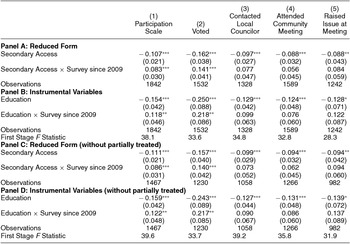
Zimbabwean elections during the study period (1996, 2002, 2005, and 2008) varied significantly in their competitiveness. Notably, the first round of the 2008 election allowed a higher level of contestation than previous elections.Footnote 29 Despite the intense violence preceding the second round of voting, the ultimate result of the 2008 election was that the MDC (together with its splinter group, MDC-M) gained a majority in the House of Assembly, a majority of municipal councils, and some level of executive power through the internationally brokered unity government. This contrasts sharply with the 2002 and 2005 elections, which were marked by severe repression and in 2005 an initial opposition boycott (Frankel Reference Frankel2010), which left ZANU-PF in complete control of government.Footnote 30 Thus, if better educated voters are more likely to disengage when they feel that participation is futile, merely serving to legitimize the government, or when boycotts have been called specifically to highlight the illegitimacy of the regime, we should also expect such voters to re-engage when elections are able to more meaningfully reflect political preferences. We thus compare the effects of education on political participation for respondents who were surveyed before and after 2009 (the first survey since the 2008 election).Footnote 31
The results, reported in Table 7, show that education had different effects before and after 2008. Consistent with our theoretical argument, the effect of education is negative and very large during the uncompetitive period before 2008. As demonstrated by the positive interaction term for post-2009 survey responses, the effect of education is essentially zero when elections meaningfully affected the distribution of executive power. In no case is access to secondary education statistically significant for respondents surveyed since 2009, while the difference in coefficients is statistically significant for voting. These results are also important because they cannot be easily reconciled with alternative explanations grounded in relatively stable characteristics such as income or early-life socialization.
The Effects of Education on Political Participation, Before and After 2008

Note: See Table 2.
It is possible that the differences between the pre- and post-2008 period could reflect changes in the characteristics required for deliberate disengagement, such as support for democracy and disapproval of the regime. We find, however, that none of the potential mechanisms of deliberate disengagement—which are relatively long-term processes that should not substantially fluctuate across elections—changed across the pre- and post-2009 periods (see Online Appendix). While other factors may have differentiated the 2008 election from earlier elections in Zimbabwe, it is not obvious how these interact with education. Though not conclusive, these findings are suggestive of the possibility that meaningful political contestation can reverse the negative effects of education on participation.
Alternative Explanations
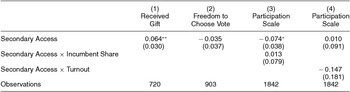
Finally, we eliminate three alternative interpretations of our deliberate disengagement argument. First, we test whether less educated voters are disproportionately the targets of turnout mobilization drives, because vote-buying efforts either target the poor or the regime’s core supporters (Stokes et al. Reference Stokes, Dunning, Nazareno and Brusco2013). Better educated voters seem a priori to be less likely to be included in clientelistic networks. However, as shown in columns (1) and (2) of Table 8, greater education does not decrease the likelihood that voters receive a gift from a political party before the most recent elections,Footnote 32 or perceive their vote not to be free. In fact, better-educated voters are more likely to report receiving a gift. Furthermore, if mobilization were driving our results, we might expect the negative effect of education to be largest in locations dominated by ZANU-PF or where turnout is high. However, we find no significant negative coefficient on the interaction of access to secondary school for either the district-level ZANU-PF vote share or the turnout rate at the most recent election (columns (3) and (4)). We conclude that even if better-educated voters are less likely to be mobilized—and we find no such evidence in our data—this cannot be driving the key results reported herein.
Mobilization Explanations

Notes: All specifications are estimated using OLS, include survey fixed effects, and cluster standard errors by district. Specifications include five cohorts either side of the cohorts that were fully affected or fully unaffected by the reform. *p < 0.1, **p < 0.05, ***p < 0.01.
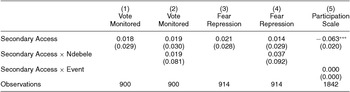
A second alternative explanation is that better educated citizens are simply more likely to be repressed by the regime. This channel seems plausible given that in both the 2002 and 2008 elections the regime targeted significant violent repression at suspected MDC supporters. Similarly, educated citizens may preemptively disengage to avoid facing violence by signaling that they are not troublemakers. However, columns (1) and (3) in Table 9 show that education does not affect a respondent’s fear of repression nor their belief that voting is monitored. More so, given that President Mugabe has historically regarded the Ndebele as the opposition, if education induces greater fear then we should expect this to be greatest among the Ndebele. Interacting access to secondary education with an indicator for Ndebele respondents, columns (2) and (4) do not support this possibility. Finally, we show that in districts with more instances of violence against civilians by ZANU-PF—as measured by the Armed Conflict Location and Event Data Project—educated voters are no less likely to participate in politics (column 5). Together, these findings suggest that targeted repression is not the main driver of our key results.
Repression Explanations

Notes: All specifications are estimated using OLS, include survey fixed effects, and cluster standard errors by district. Specifications include five cohorts either side of the cohorts that were fully affected or fully unaffected by the reform. Event is district number of instances of violence against civilians by ZANU-PF as measured by the Armed Conflict Location and Event Data Project. *p < 0.1, **p < 0.05, ***p < 0.01.
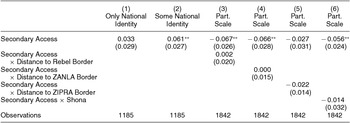
Last, a subtle “coming of age” alternative explanation is that older students may have been more cognizant of the independence movement, and their more intense support for Mugabe’s regime could be manifested in greater participation that has persisted until today. However, we find little support for the key predictions of this argument. First, columns (1) and (2) of Table 10 show that, contrary to the idea that engagement in the war cultivated nationalist sentiments among relatively older cohorts of young teenagers, expression of national identity is instead positively (and insignificantly) associated with secondary access. Second, columns (3)–(5) similarly show that respondents living closer to the borders where the ZANLA and ZIPRA independence groups entered the country—and are thus likely to have been most exposed to the armed independence movements or directly exposed to conflict—are no less likely to disengage upon receiving access to education.Footnote 33 Third, members of the Shona tribe—the group most strongly associated with the victorious ZANLA group that ultimately took power—who had access to secondary education are similarly no less likely to disengage. Finally, persistent differences in support for Mugabe’s regime across cohorts cannot convincingly explain the differential change in the participation of younger (better-educated) cohorts following the more competitive 2008 election.

DISCUSSION
The key implication of our study’s findings is that the impact of education on noncontentious forms of participation is conditional on a country’s level of political contestation. This result has important implications beyond the study of the determinants of political participation. For example, our study directly speaks to a growing cross-country literature that seeks to isolate the impact of education on democracy. Scholars such as Barro (Reference Barro1999) and Przeworski et al. (Reference Przeworski, Cheibub, Limongi and Alvarez2000) have argued that differences in access to education are a major causal factor explaining differences in levels of democracy.Footnote 34 Our study suggests a more complex interaction between education and degree of political contestation. By discussing why educated cohorts, seen by modernization theorists as “agents of change,” may withdraw from politics, this article also suggests one reason why—contrary to the expectation of the democratic transition literature—many countries that took initial steps towards liberalization got “stuck” in electoral authoritarian equilibria (Carothers Reference Carothers2002).
Specifically, our findings suggest that limited liberalization processes, commonly adopted in the early 1990s by a host of nondemocratic developing countries, can powerfully neutralize better-educated citizens. The formal adoption of electoral institutions allows the regime to claim democratic credentials, leaving citizens critical of the regime with two suboptimal options: play the “democratic” game in which they are assured to lose while legitimizing the regime, or withdraw from politics altogether. Our theoretical argument and empirical findings thus contribute to our understanding of regime stability and change theories.
Naturally, the findings reported in this study raise concerns regarding external validity. To provide a suggestive step in this direction, we pool the Afrobarometer surveys for all available countries and test whether the relationship between education and voting depends on regime type. Encouragingly, we find a significant negative correlation for closed anocracies (Burkina Faso, Tanzania, Uganda, and Zimbabwe, where Polity scores are between − 4 and 0), and weak insignificant correlations for open anocracies (where Polity scores are between 1 and 5). While these correlations suggest that our findings likely apply beyond Zimbabwe, more work is needed to qualify the conditions under which educated citizens choose to withdraw from the political sphere.
Another point of note is that this study investigates the negative effects of education on nonviolent forms of participation. A fruitful avenue for future research would be to explore the conditions under which education leads individuals to instead support political violence, as Friedman et al. (Reference Friedman, Kremer, Miguel and Thornton2011) find in Western Kenya, or to personally adopt violent means of opposing an autocrat, as seems to be the case in Burundi (Samii and West Reference Samii and West2014). We suspect—but cannot test in this study—that the choice between disengagement and armed rebellion is closely related to the interaction between a country’s levels of repression and grievance, and to whether those excluded from power belong to a minority or a majority group.
CONCLUSION
Reflecting on the positive association between education and political participation, Phillip Converse famously wrote that “education is everywhere the universal solvent, and the relationship is always in the same direction” (Converse Reference Converse, Campbell and Converse1972, 324). In this article we qualify “Converse’s law” by examining the relationship between education and participation in electoral authoritarian settings. We develop and test a theory of “deliberate disengagement,” according to which better-educated citizens may decide to disengage from politics when initial political liberalization efforts prove to be futile. Nonparticipation, we further argue, serves as a nonviolent form of protest designed to deprive the autocratic regime from enjoying a semblance of legitimacy. We substantiate this argument using the case of Zimbabwe, a paradigmatic electoral authoritarian regime.
We also provide considerable evidence to support our claim that better-educated voters exhibit lower levels of political participation due to deliberate disengagement rather than other possible channels. Consistent with our theoretical argument, we find that education causes citizens to experience higher living standards that increase voters’ capacity to participate in politics, greater interest in politics and support for democracy, and ultimately, induce voters to become more critical incumbent autocrat’s performance information and less supportive of the regime. We further find that these results are unlikely to be driven by alternative explanations such as limited membership in clientelistic networks or political repression, though we acknowledge that these may be effective strategies for depressing turnout among opposition supporters.
In short, our results strongly suggest that “Converse’s law” should indeed be qualified. Using Zimbabwe’s major education reforms in 1980 as a plausible source of exogenous variation, we find that, in Zimbabwe, education reduces various forms of noncontentious political action. This finding is robust to various estimation approaches, to the inclusion and exclusion of “partially treated” respondents, to the inclusion of a battery of pre-treatment covariates, to various placebo tests, and to varying the length of the bandwidth around the cohort-eligibility cutoff point. Mechanistic understandings of the processes of modernization, whereby education translates directly into increased participation—and more vibrant democracy—appear to be overly optimistic. The institutional environment and the nature of the existing regime condition the effect of education in important ways.
SUPPLEMENTARY MATERIAL
To view supplementary material for this article, please visit http://dx.doi.org/10.1017/S0003055416000253.






Comments
No Comments have been published for this article.