Introduction
The intentional deposition of objects has long been a subject of interest and debate amongst scholars. It has already been more than a century since the first paper concerning intentional deposition was published (see Thomsen Reference Tomsen1845; Worsaae Reference Worsaae1866). The primary question which has long been asked was whether groups of finds should be categorized as either traders’ hoards, hidden wealth or votive hoards. In recent years it has become evident that these are mainly modern categories and not prehistoric ones (see Brück Reference Brück1999; Fontijn Reference Fontijn2002; Bradley Reference Bradley2005).
This paper will explore the meaning and significance of Neolithic flint axe depositions. Based on an in-depth empirical study, it will be argued that deposition was selective, highly structured and consequently of great importance. Through the act of production, skilled craftsmen produced axes with special powers that were exchanged over great distances. By looking at patterns of wear and residue, parts of their use-lives have been reconstructed, which shows that these axes were treated in a very special manner. The objects played an important role in the cosmologies of the Neolithic communities responsible for their production, circulation and deposition. As such they contrast with the axes retrieved from the megalithic tombs. It will be argued that the axes from depositions and the axes from graves had a completely different cultural biography. The megalithic graves and wetland depositions represent exclusive categories in Middle Neolithic Funnel Beaker Culture (Trichterbecher Kultur – TRB) cosmology and identity.
Research area and topic
The current study focuses on the depositions of flint axes associated with the TRB in the northern Netherlands, which is dated between 3400 and 2750 cal. B.C. (Lanting and Van der Plicht Reference Lanting and Van Der Plicht2000, 68). During this period, axes were deposited in waterlogged places, either as single objects or as part of multiple-object hoards (Achterop Reference Achterop1960; Ter Wal Reference Ter Wal1996). The latter often contained flint nodules and axes in different stages of production (rough-outs, blanks, finished pieces). The TRB sites are predominantly located on the Drenthe Plateau, a till plateau in the Dutch province of Drenthe, which is more or less surrounded by extensive bogs. The most obvious traces of the TRB can be found in the form of megalithic tombs, mostly passage graves. Unfortunately, due to preservational conditions, settlements are largely lacking from the archaeological record (J.A. Bakker Reference Bakker1979).
Methods and results
If we want to understand ‘why’ people were doing things in the past, we should start by looking at ‘what’ they were doing in the first place. By empirically studying our data and subsequently analysing the patterns that emerge, we can come to an understanding of how deposition was structured. When we find that people were repeatedly doing things in a particular way, we can start to think about the reasons behind this.
A variety of techniques were used to study the flint axes in order to learn as much as possible about their production, use-lives and deposition. These included metrical, spatial and functional analyses. The metrical analysis focused on the physical appearance of the axes, such as typology and size. GIS analysis was used to investigate spatial patterns both in relation to the natural landscape and in relation to other contemporary sites such as the megalithic tombs. Using high-power microscopy (magnifications between ×100 and ×500), a functional analysis was performed which focused on the presence of both use-wear and residue (for methods used see Van Gijn Reference Van Gijn1990). The study comprised axes both from depositions and from megalithic tombs.
The results of the analyses will be only briefly presented, as the focus of this paper lies in the interpretation of the data. For a more detailed description of the data, patterns and techniques used the reader is referred to the original publication (Wentink Reference Wentink2006; also see Wentink and Van Gijn Reference Wentink, van Gijn, Hamon and Benedicte2008).
Different axes from different contexts
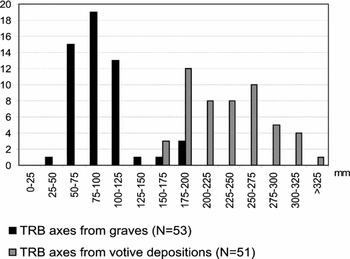
During the TRB period axes were placed both in graves (mostly megaliths) and as votive depositions in peat bogs. Both types of find illustrate the fact that the axe was seen as an important object and not merely as a ‘mundane’ tool. However, when we look at the size of the axes from both contexts we can see a very clear pattern (see figure 1). The smallest axes all appear to come from graves whereas the largest ones were all found in waterlogged places. As I hope to show in this paper, the axes from graves and those from hoards represent two different types of object, each with their own life history and, most importantly, each with their own meaning.
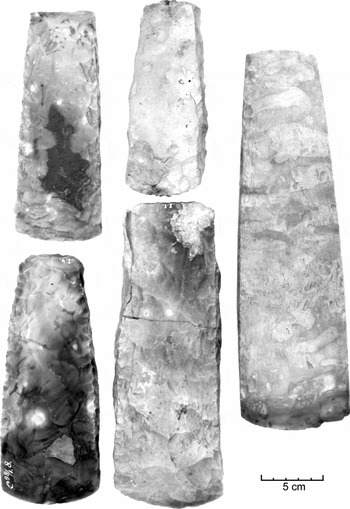
TRB hoard of Een, found in 1898. Collection of the National Museum of Antiquities, Leiden (photo: Q. Bourgeois).

Axes from graves: practical tools from life as gifts to the dead
Although organic remains were not preserved, many finds were revealed in the megalithic passage tombs in Drenthe. These included vast quantities of pottery, stone and flint tools, amber and jet ornaments and even some early copper objects. A distinct and frequently occurring type of tool is the flint axe.
The axes found in graves are all relatively small and appear to be worn down. Most of them show extensive traces of hafting in the form of friction polish on the butt. Moreover, use-wear analysis revealed that these axes had indeed been heavily used, probably for a multitude of tasks, mostly involving woodworking. Interestingly, it appeared that many of the axes had been resharpened, as if to prepare them for use before placing them in the tombs.
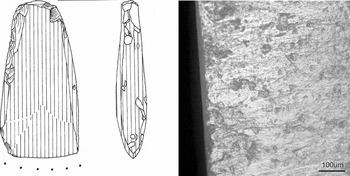
Many of the small axes were rather coarsely shaped and were most likely locally produced (figure 2). Apart from such locally produced axes, however, the tombs also contained worn-down, imported axes both from northern Europe (with a rectangular cross-section) and from southern sources, produced in the Atlantic tradition (with an oval cross-section).
Representative axe from tomb D19 at Drouwen (drawing: R. Timmermans, scale 1:2) with wear traces (magnification × 100) typical of a used axe: rounded edge, edge damage, polish overlapping the grinding traces.

These axes could very well have represented some of the personal possessions of the deceased, thus being intimately linked to the person who owned them. They would have been used during the clearing of fields and the construction of houses. It is therefore not improbable that axes like these were the possessions of specific people for many years. As these tools were employed in many important activities during a person's (or a group's) life, the axe potentially formed a powerful symbol of that person or group and of the activities it was involved in. The axes represented the tools that were used for transforming a natural landscape into an agrarian landscape. Although they may have had local or distant origins, it was ultimately their (practical) use-lives that determined their suitability as grave gifts.
Axes from bogs: did size matter?
It is already widely known that hoards of axes were predominantly found in waterlogged places. An earlier study by Ter Wal (Reference Ter Wal1996), moreover, revealed that the Dutch axes from waterlogged places were significantly larger than axes from other contexts. The TRB axes found in waterlogged places, whether singly or as part of a multiple-object hoard, mostly comprise large specimens in mint (often even ‘unfinished’) condition. They were all imported from northern sources in northern Germany and Denmark. The absence both of good-quality local flint and of production waste moreover indicates that the axes arrived in the Netherlands as finished products (Beuker Reference Beuker, Louwe Kooijmans, van den Broeke, Fokkens and van Gijn2005, 277).
Although some medium-sized axes (150–200 millimetres) occur in depositions, the majority of finds concern extremely large specimens (200–325 millimetres) (see figure 3). The latter are of particular interest, as it appears that the majority was too large to be used. For flint axes in particular, the risk of breakage (due to end-shock) is increased when the axe blade is longer. It has therefore already been proposed by other researchers that these largest axes could not have been used for everyday tasks (Bradley Reference Bradley1990; Bradley and Edmonds Reference Bradley and Edmonds1993; Tilley Reference Tilley1996). This assumption can be substantiated by the fact that the functional analysis revealed that no axe larger than 218 millimetres had been used for ‘functional’ activities. Indeed, none of the axes found in TRB hoards showed any traces of hafting or use, including the medium-sized specimens.
Length distribution of TRB axes from graves and from votive depositions.

We may assume that the people manufacturing these axes were intimately familiar with their physical properties and limits. Their extreme size, their often ‘unfinished’ appearance and the general lack of use-wear related to functional tasks therefore suggest that the axe-makers were producing axes that were not meant to be used and in many cases could not have been used.
Manipulation of size
The production of tools of extreme sizes meant for non-functional purposes is a phenomenon that is also encountered in ethnographical context. In the Kimberley region of north-western Australia, so-called Kimberley points were manufactured. Some points were especially produced for exchange purposes. These points could be recognized as such by their being much larger than the normal, functional points (Akerman, Fullagar and Van Gijn Reference Akerman, Fullagar and van Gijn2002, 18). Another example comes from Malinowski (Reference Malinowski1961, 88) who reports the following concerning arm-shells associated with the Kula exchange:
by far the greater number of the arm-shells, easily ninety per cent, are of too small a size to be worn even by young boys and girls. A few are so big and valuable that they would not be worn at all, except once in a decade by a very important man on a very festive day.
Manipulation of size can thus be regarded as a powerful strategy to emphasize the special status of an object, and by doing so it is placed apart from conventional, everyday tools. The ‘non-functional’ character of these axes is also emphasized by the fact that many of them were unpolished or only partially polished. Interestingly, with the partially polished axes it is the cutting edge which is often left untouched. I would therefore like to argue that a specific group of axes was produced for ‘ceremonial’ rather than ‘functional’ purposes. These axes were of an extreme length or circulated in ‘unfinished’ form. They were exchanged over great distances (up to 400 kilometres) and all seem to have finished their lives in waterlogged places, being deposited either as a single object or as part of a hoard.
The use-life of ceremonial axes
The physical appearance of these ‘ceremonial’ axes was not the only thing that set them apart from the practical tools. The functional analysis revealed that despite the complete absence of ‘functional’ traces of use, these ‘ceremonial’ axes did display other wear traces. This included a specific type of wear found on all protruding edges. These traces were particularly visible on the unpolished or partially polished specimens. The fact that all protruding ridges showed this type of wear indicates that the contact material causing the traces had surrounded the axe. The wear traces did not display any features, such as striations, that indicated a specific motion. It was therefore considered highly unlikely that the wear was caused by an activity that entailed a clear repetitive motion such as rubbing or polishing. It has been postulated that the wear was rather caused either by wrapping the axe in a protective material during transport, or by repeatedly wrapping and unwrapping the axe in a specific material. Wrapping the axe during transport for protective reasons is plausible as they were transported up to 400 kilometres from their source. Moreover, the wrapping and unwrapping of ceremonial objects is well documented in many ethnographic contexts worldwide, e.g. the Dani of New Guinea (Hampton Reference Hampton1999), Australian Aboriginals (Akerman, Fullagar and Van Gijn Reference Akerman, Fullagar and van Gijn2002; Paton Reference Paton1994; Weiner Reference Weiner1992), or the Baruya of New Guinea (Godelier 1990; Reference Godelier1999). In these cases wrapping is often related to secrecy and the creation of insiders and outsiders. An object with special powers is wrapped to protect it from uninitiated persons and, at the same time, to protect them from its special powers.
Several experiments were conducted, including wrapping pieces of flint in several materials and carrying them around in a backpack for five weeks in order to simulate transport (Wentink Reference Wentink2006, 62). In addition, pieces of flint were repeatedly wrapped and unwrapped (up to 250 times per artefact) in a variety of different materials. It appeared that carrying a wrapped object around did not cause any wear to develop. This can be explained by the fact that wear traces are primarily caused by friction, which is exactly the thing that is prevented in this case. The wrapping and unwrapping, however, caused traces to develop that were very similar to the traces seen on the archaeological finds. As the traces on the flint axes were very well developed, it was concluded not only that they were wrapped and unwrapped in a specific material, but that this process must have been repeated at least hundreds of times. Further experiments are required to determine exactly what type of material was used for wrapping these axes.
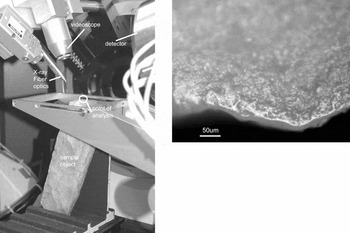
Besides traces of wrapping, most ceremonial axes also bore traces of red ochre. During previous research, Annelou van Gijn found traces of ochre on some of these axes, but it was not until an extensive survey was performed, by Annelou van Gijn and the author, that we could confirm that indeed most of the axes showed traces of ochre. That we were indeed dealing with red ochre was confirmed in cooperation with the Delft University of Technology by using a polarized light microscope and by means of X-ray powder diffraction (figure 4). The ochre was mainly located on the cutting edge of the axes and was especially well preserved on the unpolished axes. The residue was not accompanied by use-traces, which would have been the case if these axes had been involved in some sort of contact with unprocessed ochre. It can thus be concluded that the ochre was most probably applied as a pigment paste. It was not possible to determine during which stage in the life of the axe the ochre was applied.
Ochre on an axe from the hoard of Een being tested with X-ray diffraction (photo: J. Dik), with wear traces typical of wrapping: slightly rounded edges, smooth and bright polish.

Spatial patterns
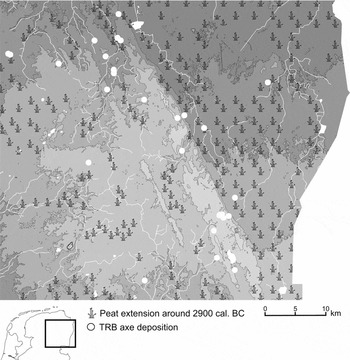
Spatially these ceremonial axes were confined to specific places in the landscape. During the Neolithic, the Drenthe Plateau was surrounded by large raised bogs and intersected by many small streams. The stream valleys themselves were largely filled in with peat and flooded during winter. The higher sandy grounds, used for habitation and burial, were still densely forested in the Neolithic (Spek Reference Spek2004, 209; J.A. Bakker, Reference Bakker1982, 114; R. Bakker, Reference Bakker2003). It was from the stream valleys at the edge of the peat that most depositions were retrieved (figure 5). Although the plateau was surrounded by some of the largest bogs of north-western Europe, no axes were deposited there. It appeared that depositions were only placed in the peat near running water. Many of the depositions were located within a distance of between 500 and 1,500 metres from a megalithic tomb, something that has also been observed in Denmark (Midgely Reference Midgley1992, 282; Tilley Reference Tilley1996, 61; Ebbesen Reference Ebbesen and Thrane1982, 61). Although burial and deposition each occurred in a specific environmental setting, these locations were generally not further apart than a 15-minute walk. This seems to illustrate that each local group, apart from having their own places to bury the dead, also had their own places to deposit axes, probably all located within a relatively short distance from the settlement. Fontijn (Reference Fontijn2002, 262) found similar patterns with respect to Bronze Age depositions. Also in this period, bronze axes, spears and sickles were deposited in marshes and streams just outside the areas that were used for habitation, food production and burial.
Distribution of TRB votive axe depositions on the Drenthe Plateau.

As these stream valleys intersected the Drenthe Plateau, they would have been perceived as natural boundaries between social groups. At the same time these peat-filled places, located at the edge of the habitable grounds, could very well have been seen as boundaries between people and supernatural entities. Apart from separating people on a social level these boundaries would also have been used for connecting people on a physical level. Since the higher grounds were still densely forested in the Neolithic, the many stream valleys would therefore have played an important role in (water) transport. As such the stream valleys formed networks through the landscape, which were also used for contact, transport and exchange. These places may therefore have been perceived as representing clear-cut divisions between the higher habitable grounds and the ‘natural’ stream valleys. On a social level these places can be perceived both as boundaries separating social groups and at the same time as places binding social groups, as they facilitated transport, contact and exchange (see Fontijn Reference Fontijn2002, chapter 14).
Craftsmanship
It has been argued above that the axes from hoards were specially produced for ceremonial activities. Although they may have acquired an additional level of meaning during their lives, they were explicitly produced as special objects. This implies that their significance originates, at least in part, from the production process. This can be corroborated by empirical evidence, which indicates that the notion of craftsmanship itself played an important role.
When working on Scandinavian axes, Rudebeck (Reference Rudebeck, Edmonds and Richards1998) noted that about 70 per cent of them had a small piece of cortex on the butt. This phenomenon was also observed on the axes found in Dutch depositions. If desired, these small pieces of cortex could have easily been removed. Since, in general, much attention was paid to detail while making these axes, Rudebeck argued that we must interpret the presence of these small pieces of cortex as the result of intentional choice.
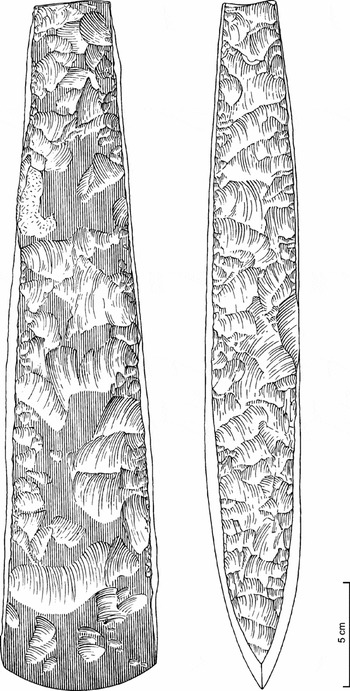
A good example of this is the axe found at Zuidbarge on the southern edge of the Drenthe Plateau (figure 6). Measuring 325 millimetres, this is the largest TRB flint axe found in the Netherlands. Only the main faces were polished, leaving the sides unpolished. On the butt, a small piece of cortex was left. As the sides are unpolished, one can see the skill with which flakes have been removed. Flaked surfaces are usually somewhat irregular; in this particular case the flakes were so thin that in fact a very smooth, regular surface was created.
The axe of Zuidbarge. Collection of the Drents Museum, Assen (drawing: H.R. Roelink).

Although the sides of the axe were not polished, a tiny spot of about one square centimetre was identified by microscope as having been polished. In fact at this precise spot there had been a hinge fracture. This had left a small protruding ridge in a position that could not have been removed by flaking. Although this would have been a ridge of just one or two millimetres, it apparently bothered the axe-maker, who subsequently removed this ridge by grinding this tiny spot. This observation illustrates that the axe-maker had an exceptional eye for detail. As the cortex on the butt of the axe could easily have been removed with a single blow, it is safe to assume that it was indeed left there intentionally.
Rudebeck (Reference Rudebeck, Edmonds and Richards1998, 322) argued that cortex and flint properties contain information about the raw materials used, in the sense both of source identification and of the quality of the flint. Thus flint sources would be identifiable through the presence of cortex. Although this might be true, this is not the only explanation. An alternative or additional explanation has been proposed by John Whittaker. Being an expert flint-knapper himself, he has suggested that by leaving a bit of cortex on the butt of the axe it is indicated that the axe could not have been any bigger, the limiting factor thus being the size of the flint nodule and not the skills of the flint-knapper (Whittaker, personal communication 2006) – the craftsperson had made optimal use of the available resources.
Apparently, crafting skills appear to be particularly important with regard to these ceremonial axes. This is also illustrated by the grinding away of the small ridge on the Zuidbarge axe. Not only was a small mistake erased, but the explicit choice of only polishing this small spot, leaving the remainder of the flaked surface untouched, was also revealed. The flaked surfaces of the sides of this axe were so smooth that it would have required a great deal of knapping skill. If the entire surface had subsequently been polished all traces of that skill would have been erased.
Exchanged axes, shared knowledge
Taken together, these patterns indicate the existence of a well-defined ritual. The depositions occur over the entire Drenthe Plateau, indicating that this ritual was widely adopted and performed by the TRB people. We are thus dealing with a highly structured phenomenon of selective deposition. The fact that people repeatedly performed depositions in such a way indicates that both the act of deposition and the axes themselves were considered important and meaningful.
Thus there must have been a corpus of knowledge both describing how to treat these axes and explaining why they should be treated as such. The clear patterns in our data indicate that this knowledge was present and accepted by all persons handling these axes. As these objects were not locally produced, but exchanged over vast distances, this has some interesting consequences with respect to their exchange.
If specific rules were to be followed in the treatment of these axes, the implication is that they could only be exchanged if both exchange partners were familiar with the rules. The fact that we have uniform patterns in our data indicates that this was indeed the case, at least in the Netherlands. Exchange partners had to have a certain body of knowledge concerning these objects and their required treatment. Axes could thus only have been exchanged between knowledgeable agents.
In addition to the exchange partners, the persons producing these axes also had to be familiar with this knowledge. It has already been argued that these objects were specially produced for ceremonial activities. This means that even during the initial production stages a sort of mental template existed as to what kind of role the axes were going to play in society. As early as production, these axes were attributed a specific significance or meaning. It was this significance that was recognized and appreciated by people far and wide as the axes were exchanged and eventually deposited. By transforming nodules of flint into ‘ceremonial’ axes, the craftspersons produced objects with a special meaning, with special powers.
Craftsmanship and the making of sacred objects
It has become clear that the axes found in depositions represented a very special category of objects. The fact that specific stone sources can carry special meanings is a well-documented phenomenon (e.g. Great Langdale – Bradley and Edmonds Reference Bradley and Edmonds1993; Bradley Reference Bradley2000). Also, materials themselves can carry a specific meaning or significance (for some recent publications see Ingold Reference Ingold2007; Harvey Reference Harvey2006; Tilley Reference Tilley2004). It is often overlooked, however, that particular crafting skills can also contribute to the meaning and special status of an object. It has been argued that at least part of the significance of TRB ceremonial axes should be connected with the skills and craftsmanship with which they were produced. In order to interpret the meaning of these axes, we must therefore explore some theoretical aspects concerning craftsmanship.
Ultimately, craftsmanship has to do with the knowledge and skills needed for production. From a western point of view, this has primarily to do with the theoretical and practical knowledge, or know-how, required for actually making things. In many non-western societies, however, craftsmanship also includes what I would classify as ‘cosmological knowledge’. The term ‘cosmological knowledge’, as used in this paper, entails all sorts of knowledge connected with a group's cosmology. It refers to all elements connected with myths, ancestors, spirits and all other things that lie beyond the everyday world. Cosmological knowledge is commonly perceived to originate outside human society. This is generally indicated by the inclusion of elements either from geographically distant places or from the mythical past (Helms Reference Helms1988, 49).
But how is cosmological knowledge, which mainly deals with the metaphysical domain, related to craftsmanship? A good example of this connection can be found in the adze-makers of Langda, New Guinea (Stout Reference Stout2002). The craft of adze-making is highly structured and part of a kinship-based learning process. Adzes can only be manufactured under the supervision of the head adze-maker, and only particular individuals are allowed to learn the craft. The apprenticeship can last five years or more, but the skills needed to produce the largest adzes can take over ten years to develop. Besides practical knowledge and know-how, a great deal of cosmological knowledge is required for adze-makers to produce adzes.
During the knapping process the craftsmen praise Aim-Ey, a reference to the mythical figure Alim Yongnum, who is revered as the provider of the tool-stone found in the Ey River. This mythical woman is said ‘to give birth’ to these stones and thus control their availability. The stones themselves are seen as living entities. If stones fall or do not break as planned, the knappers will speak of the stones being angry. They soothe the stones by calling out to them using their ‘secret names’ as they search for them at the quarry sites along the river. After ‘birth’ the boulders are, moreover, believed to grow and age as people do, thus ‘old stone’ is darker and stronger than ‘young stone’. Throughout the production process the stones are treated as living entities. There are particular rules as to how to place the stones on the ground in a proper orientation (they should lie parallel, with the cutting edge facing away from the craftsman). By observing these rules the craftsmen avoid angering the stones. Although cosmological knowledge may sometimes seem trivial to westerners, it is considered highly important to the Langda adzemakers.
Cosmological knowledge and craft performance
There are some general elements that are often found with regard to cosmological knowledge and craftsmanship. The ability to perform a certain craft that is not controlled by other individuals in a group is, for example, often considered to be a form of magic. Magical powers are believed to be required to perform a certain technique, consequently the successful practising of a craft is often taken to indicate the craftsman's possession of magical powers (Helms Reference Helms1988, 111).
Furthermore, the physical act of retrieving raw material and the manufacturing of products often took place beyond the boundaries of a social group's daily domestic sphere. Craftsmen ventured out to see unfamiliar places and meet strange people (Helms Reference Helms1988, 112). According to Helms (ibid., 114), craftsmen are intimately involved in the acquisition or preparation of foreign goods. These places, the raw material involved and the objects produced can represent cosmologically charged elements. There thus appears to be a link between the actual workings of craftsmen and the nature of cosmological knowledge. Both seem to involve places outside the everyday domain. Moreover, the origins of both cosmological knowledge and crafting skills are often connected with otherworldly domains.
Cosmological knowledge and the origins of craftsmanship
The most common link between craftsmanship and cosmological knowledge can be found in the attribution of the origin of the craft itself as well as in the objects produced. Both the knowledge involved in production and the objects produced are often considered gifts from mythical ancestors or spirits. This can be illustrated by various ethnographic examples. The production of Kimberley points in Australia has already been mentioned – some were too big for use and were solely produced for exchange purposes. The manufacturing of these points is associated with mythical ancestors who invented the craft:
Wodoi made the first stone-tipped spears – light reedshafted darts that could be propelled great distances with the new spear-thrower . . . The new weaponry was far superior to the old, hand-thrown spears. Wodoi and Tjungkun bequeathed the art of making such weapons to the ancestors of the Wororra, Wunambal and Ngarimjin people of the north Kimberley (Akerman, Fullagar and Van Gijn Reference Akerman, Fullagar and van Gijn2002, 16).
Further, the localities where objects were produced were often those places where spirit ancestors introduced them or their method of manufacture (Helms Reference Helms1988, 116).
As was mentioned above, adze production among the Langda is also closely related to spirits and ancestors (Stout Reference Stout2002). A vast corpus of terminology and cosmological knowledge is involved in the adze-making process and there is a strong connection with the ancestors who invented the craft:
The first thing, entirely unsolicited, that adze makers generally wanted to relate during interviews was a list of their ancestors who had handed down the craft through the years. For the dominant Balyo clan, the list begins with Menminy Malyoman Balyo, who is said to have originated the technology (ibid., 704).
Burton (Reference Burton1984, 240) reports a similar case for the Tungei axe-makers of New Guinea. The stone used for axe production is controlled by specific spirits. Ritual purity and ‘axe-magic’ were therefore of key importance when it came to the successful procurement of stone and the production of axes.
A similar connection between spirits and a specific craft can be found among the Baruya of New Guinea (Godelier Reference Godelier1990, 144; Reference Godelier1999, 113). The Baruya use a musical instrument called a bull-roarer. These instruments are played during ceremonies and are made from black-palm, to which a bark string is attached. As they are whirled around they make a strange sound, which is said to be the voice of the spirits. According to Godelier (Reference Godelier1999, 113), ‘the bull-roarers are manufactured by the men and passed on as treasures to their sons. But in the beginning, the Baruya say, they were given to the men by the Yimaka, the forest spirits.’
Craftsmanship is thus often connected with supernatural entities such as spirits or ancestors. They were the entities from which the craft originated; they either gave mankind the objects directly or the knowledge required for their production. Helms (Reference Helms1988, 116) argues that the association of crafting skills with extraordinary power can be found either directly stated or implied in ethnographies worldwide. Gell (Reference Gell, Coote and Shelton1992, 59; Reference Gell1998, 23) argues, with respect to art objects, that they are often not attributed to human artists, but are thought either to be of divine origin, to be manufactured using magic or to have mysteriously made themselves. Also, in ancient mythology we find the attribution of specific knowledge to supernatural beings. The ancient Egyptians, for example, ascribed the invention of writing to the Ibis god Thoth, who gave this knowledge to the Pharaoh (Ray Reference Ray1986). In Greek mythology it is said the knowledge of making fire was a gift from the titan Prometheus (Graf Reference Graf1993).
Practising a craft, therefore, is not solely a practical, functional enterprise. It often involves interaction with supernatural entities or magic. Thus ‘crafting skills in particular may represent human intelligence and understanding which . . . in traditional societies . . . ultimately refers to understanding of the meaning and operation of the cosmos and its dynamic and animating powers’ (Helms Reference Helms1988, 116).
TRB axes and the legitimization of meaning
Is it possible that similar principles also apply to the ceremonial TRB axes? Is it possible that through production they became animated with supernatural powers? In this respect the following statement by Godelier (Reference Godelier1999, 124), referring to sacred objects, is of interest:
In order for a phenomenon to be reproduced by all members of a society, social realities must appear, if not to everyone at least to the majority, as legitimate, as the only ones possible, and this certainty is not wholly self-evident unless the origin of these relations seems to lie outside the human world, in some sacred, changeless order, and changeless because it is sacred.
The patterning in the archaeological record indicates that the deposited TRB axes all had to a large degree an identical cultural biography. They were produced, treated and deposited according to a strict set of rules. Following Godelier (Reference Godelier1999), this can only be explained if motivations to do so originated outside the human world. An object is thus only considered sacred if the source of its power is sacred. This also applies to many elements seen in modern religions. Many holy texts, for example, cannot be questioned, for they contain the word of God. Although the texts themselves can be copied and exchanged, this does not diminish their power as they were not written by men. Only if the authentication of the axes came from a domain outside the present could these objects circulate while keeping their special meaning. The element that made these axes special thus had to originate outside the human domain, in the sphere of myths, spirits or ancestors. Only if these objects had spiritual or ancestral connotations would their standardized treatment be perceived as legitimate, as the only one possible.
Although it may still seem strange to us that craftsmen are able actively to produce objects that are subsequently associated with a mythical origin, it has been argued above that in many non-western societies the special character of a craft should not merely be attributed to the craftsperson, but rather to the origin of the craft itself. The corpus of knowledge associated with a particular craft is often handed down by a group of (initiated) individuals. The source of the craft is moreover attributed to a mythical ancestor, spirit or culture hero.
The introduction of either a specific object, or the knowledge required for its production, is attributable to supernatural entities such as spirits or ancestors. As such, the craft can literally be seen as a gift from those entities to the people. The objects produced are thus highly commensurable with these entities. Mauss (2002, 16) argued that ‘to make a gift of something to someone is to make a present of some part of oneself’. These objects, however, cannot only be considered commensurable with, but even manifest part of, these entities. Godelier stated (Reference Godelier1999, 137) in this respect that sacred objects
can be presented as having been made either directly by gods or spirits, or by men following instructions provided by the former, but in any case, the powers present in these objects were not made by man. These objects are gifts from the gods or the ancestors, gifts of powers henceforth residing in the object.
Often such objects do not merely symbolize supernatural entities, but are seen as supernatural entities themselves, by the people producing and using them. The Baruya, for example, consider their sacred possessions as actual spirits (ibid., 179).
As the ceremonial TRB axes travelled great distances, we may assume that this was at least in part related with exchange. Inalienable sacred objects, however, are usually kept and treasured and cannot be exchanged as they are deeply embedded in a group's identity and cosmology. There are, however, situations in which such objects can be exchanged. In these cases it was not the object itself that was a gift from spirits or ancestors, it was the knowledge required for its production. In such a scenario the archetype of these items is carefully preserved, if only in people's minds, while copies may circulate (ibid., 138).
Axes as animated objects
The ‘ceremonial’ axes appear to have played a very important role within TRB society. They were not just axes, they were objects that were animated with some sort of supernatural power. In order to control this power, the axes could only be handled by, and exchanged between, persons who possessed intimate knowledge about TRB cosmology. As is the case with the Dreaming of the Australian Aboriginals, such knowledge itself is highly treasured. Connecting people with mythical times, events and localities places them in a wider cosmic setting (Weiner Reference Weiner1992, 101). As such, knowledge about these axes can itself be seen as an inalienable possession as it constituted the TRB world view and TRB identity. The axes themselves served as material references to this knowledge. The axes’ ancestral origins legitimized cosmological knowledge, which in turn authenticated their formidable powers. Cosmological knowledge and the ceremonial axes were intimately intertwined elements of the same continuum. They served to define each other and legitimize each other.
Nodules in hoards
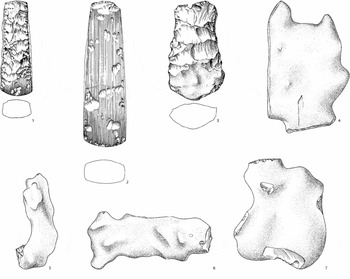
As was argued above, the flint axes became animated with special powers through the act of production. Some of the hoards, however, also contained flint nodules. Apart from a few test flakes these had not been modified and of course did not display any signs of outstanding crafting skills. Unfortunately, only five nodules coming from two hoards survive. It is recorded that some other hoards had also contained flint nodules, but at the time of their discovery these were not seen as important and were subsequently not included in museum collections. The hoard of Eenerveld (figure 1), for example, was found in 1898 and contains five axes. Originally, however, the hoard also contained a nodule 50 centimetres long and an axe rough-out. Unfortunately, these were not seen as interesting at the time and were left in the field.
Interestingly, the nodules that did survive all have very irregular forms, making them completely unsuitable for axe production. They are twisted, strangely shaped and often have internal flaws. The nodules thus contrasted with the ceremonial axes not only in that they were largely unmodified, but also in that it was impossible to make axes out of them. Physically they thus seem to form exact opposites of the ceremonial axes: everything the axe is, the nodule is not, nor can ever be. The fact that they were deposited together, however, indicates that there must have been a link between them.
What is particularly remarkable about these nodules is that they, too, are imported objects. They could not have been found locally and must thus have travelled great distances, as was the case with the ceremonial axes. It has been posited that axe production involved the work of (ritual) specialists. In such a context it is likely that access to sources of raw materials was restricted and controlled by these craftspersons. This would mean that the selection of impractical nodules was a deliberate choice. So apparently impractical nodules were chosen to accompany impractical axes.
Apart from their exotic origin there is also a commonality in the treatment that axes and nodules alike received. As was the case with the axes, the nodules also bore remains of a red ochre paste. At least four of the five nodules examined showed clear traces of red ochre. Although it is possible that the nodules were completely painted red, it is perhaps more plausible that they were painted with particular decorative motifs, perhaps associated with different spheres of identity.
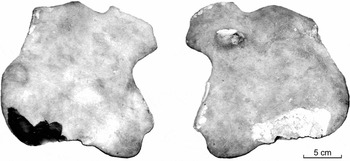
Interestingly, three of the five nodules were tested: a few flakes were removed in order to assess their quality. We know from the ethnographic record that selection of raw material is often very important and subject to much discussion amongst axe-makers (e.g. Stout Reference Stout2002). In this respect the nodules from the hoard of Een are of particular interest. What is fascinating is that although a few of these test-flake negatives appear to be unpatined (as are the axes from the same hoard), other flake negatives on the same nodules are heavily white-patinated (figure 8). This suggests that there were at least two phases of flake removal. Although white patina cannot be used directly as a means of dating, it does suggest that these flakes were removed several millennia before the TRB knappers picked them up. It is therefore possible that these TRB knappers in fact selected Mesolithic, or perhaps even Palaeolithic, tested nodules. Although it is possible that these scars were actually removed by natural causes, what is important is that they look very much like the result of human flake removals. It is clear that the TRB knappers picked up nodules that appeared to have been flaked a very long time ago.
The hoard of Eenerveld found in 1940, collection of the Drents Museum, Assen (Beuker Reference Beuker, Louwe Kooijmans, van den Broeke, Fokkens and van Gijn2005, 279).

Fresh and patinated flake-scars on one of the nodules of the Eenerveld hoard (see figure 7). Note how the patinated flakes on one side were used as a platform to remove the fresh flakes from the other side (photo by the author).

It has often been postulated that the objects found in these depositions seem to represent the different stages of the production process. Instead I would rather argue that the flint nodules and the flint axes found in depositions actually represent opposite poles. These opposing elements might, however, be interpreted as parts of the same narrative. It was argued that the significance of the axes lay in the fact that they were produced with knowledge received from mythical entities such as spirits or ancestors. The opposition between these impractical nodules and skilfully crafted axes could be used to signify the supernatural qualities that were needed for axe production. As it would be physically impossible to make axes out of these nodules, magic or supernatural powers would be required to do so. In this respect the objects from a hoard might be seen as physical elements illustrating different parts of a narrative or myth – the myth of how, with the aid of spirits or ancestors, things can be created that would normally be impossible for human beings.
Weiner (Reference Weiner1985, 224) suggests that ‘with inalienable wealth, we also find “visual substitutes” for history, ancestors, and the immortality of human life’. Perhaps the combination of the nodules and axes was used to legitimize their ancestral origin. They formed the material reference of knowledge only known in abstract form. The abstract notions, the contents of a myth, by creating physical elements, became more real, tangible and permanent.
This is supported by the observation that three of the four nodules of the hoard of Een showed traces of working that pre-dated the TRB. As the TRB axe-makers were excellent flint-knappers, they no doubt recognized the older traces of knapping. Also, the fact that the negatives were white-patinated must have indicated to the TRB knappers that these traces of working were indeed very ancient. The TRB knappers either removed a few more flakes located next to the existing ones, or they used the existing scars as a platform to remove flakes from the other side of the nodule in a bifacial manner. Perhaps they chose to do so in order to show the antiquity of the piece by revealing the true colour of the flint, or perhaps it was to claim relatedness to those who had worked these nodules before them. Either way they clearly selected nodules that, as far as the TRB knappers were concerned, had been truly worked by their ‘ancestors’.
In this respect the axes and nodules actually do represent different stages in the manufacturing process – a process, however, that could not be controlled by man, a process that was dependent on supernatural intervention to shape the unshapable, to control the uncontrollable, to do the impossible. We have already seen that the axes must have been embedded in a social context – a context of cosmological knowledge describing their role in society, the rules one should observe while handling them and, most importantly of course, their meaning, purpose and significance. The fact that this corpus of knowledge appears to have been present at least throughout the northern Netherlands suggests that it was part of the cosmology of these people. It did not travel together with the axes as a sort of ‘manual’, instead it was part of the identity of these people, both over a large area and during a long time. The axes themselves thus served as material references, mnemonics, of this knowledge, cosmology and identity. They legitimized this knowledge by making it tangible, by making it real:
The object acts as a vehicle for bringing past time into the present, so that the histories of ancestors, titles, or mythological events become an intimate part of a person's present identity. To lose this claim to the past is to lose part of who one is in the present (Weiner Reference Weiner1985, 210).
Physical objects are used to connect past and present, myth and reality. The past becomes incorporated in the present and myth becomes reality.
Axes in their cultural context
It is at this point that one might recall the apparent separation of graves and hoards. Graves contain functional tools and hoards contain ceremonial items. Both were axes but they were not at all the same. Graves and hoards thus appear to represent two exclusive categories which could not be combined. This separation can be explained if we analyse the roles these two categories played within TRB cosmology.
Tombs were places that had been built to last: they formed permanent locations where human remains were accumulated and objects were deposited. These were places that could be visited time and again. During each visit objects and human remains could be added while the artefacts and human remains deposited on earlier occasions could be rearranged. The more objects and human remains were added, the more ceremonies were performed at the tombs, the more commensurable they became with deceased people and past events. Through time they became the material reference of a local group's history, lineages, ancestors and past events. The tombs became inscribed with the history of the local community that built and used them. As is the case with objects and knowledge, locations in the landscape such as monuments can also become inalienable possessions. Through each act that took place at these monuments, they became more inalienable.
The megaliths thus not only became meaningful as places to bury the dead, they were transformed to become one of a community's most treasured inalienable possessions. As such they materialized the history, lineages, past events and ancestors of that local community. In this respect the megaliths form a distinct contrast with the ceremonial axes. The latter were already highly inalienable when they were acquired by a local community. They did not represent the historical past of the local community as the tombs did. They rather represented a mythical past described in myths of origin, an origin that was shared with other TRB groups throughout the Netherlands and throughout northern Europe. The powers associated with these objects originated in long-gone times and faraway places. These objects represented powers related to TRB cosmology that could not be permanently controlled by a small local group. Therefore such objects could not be placed in a tomb as a local community's permanent possession. Such objects should be placed outside the sphere of a group's everyday domestic activities, in a place that symbolized a larger social universe. It is commonly observed that boundaries are associated with distant places both in space and time (Helms Reference Helms1988, 42). By depositing these axes at the boundaries of a local community's sphere of everyday activity, the objects were placed in the context of a larger whole. Such a place potentially represented not only the local community, but also a larger social and cosmic universe, a TRB universe.
Conclusion
What I hope to have shown is that although theoretical frameworks are indispensable when it comes to interpreting past behaviour (and this case study is no exception to that rule), at the core of each interpretation should be a body of thoroughly invested empirical data. Patterns in our data have indicated that axe depositions in waterlogged places in the landscape played a very special role within TRB cosmology. Using the work of Godelier, Weiner and Helms, it has been argued that the knowledge required for production was considered a gift from spirits or ancestors. Through the act of production axes became animated with supernatural powers. As they were subsequently exchanged over great distances they were treated in a highly ritualized manner. Analysis of residue and traces of wear indicated that this treatment involved the application of red ochre and the repeated wrapping and unwrapping of these axes, probably for display purposes. The values these axes represented thus became very different from the values associated with the axes retrieved from megalithic tombs. As a result the ceremonial axes and the axes from the tombs were kept strictly separated. It remains a question whether the patterns observed can also be found in datasets from Germany and Scandinavia, a question that can hopefully be answered by future research.
Acknowledgements
This paper is based on the author's MA research (Wentink Reference Wentink2006), with the incorporation of more recent research results. This study was performed as part of The Meaning of Flint for Prehistoric Societies research project (Van Gijn, in preparation).
First of all I would like to thank Annelou van Gijn, with whom I performed the functional analysis, who gave me access to unpublished data and who commented on an earlier version of this paper. David Fontijn, Quentin Bourgeois and Alice Samson read and commented upon earlier drafts and helped greatly in improving it. I would also like to thank all the museum curators who provided access to all the axes; Dr Vincent van Vilsteren (Drents Museum) especially has been a great help. I also wish to thank the Archaeological dialogues editorial board, as well as two anonymous referees for their useful comments and suggestions.