1. Introduction
Alluvial fans and megafans occupy vast areas in the northern and central parts of the Ganga Plain (Geddes, Reference Geddes1960; Singh, Reference Singh1996). The megafans are dominantly sandy in nature, extend up to the central part of the Ganga Plain, and have a large spatial extent (more than a thousand square kilometres) and low gradient (generally < 0.5°) (Geddes, Reference Geddes1960; Gohain & Parkash, Reference Gohain, Parkash, Rachoki and Church1990; Shukla et al. Reference Shukla, Singh, Sharma and Sharma2001; Chakraborty et al. Reference Chakraborty, Kar, Ghosh and Basu2010). On the other hand, the alluvial fans are dominantly gravelly in nature, restricted to the piedmont zone of the Ganga Plain, and have small areas (not more than a few hundred square kilometres) and a steeper gradient (up to 3°) (Shukla & Bora, Reference Shukla and Bora2003; Shukla, Reference Shukla2009; Goswami, Pant & Pandey, Reference Goswami, Pant and Pandey2009; Goswami & Yhokha, Reference Goswami and Yhokha2010).
The morphological and sedimentological aspects of the megafans of the Ganga Plain have been studied in detail by many workers (see Gohain & Parkash, Reference Gohain, Parkash, Rachoki and Church1990; Shukla et al. Reference Shukla, Singh, Sharma and Sharma2001; Chakraborty et al. Reference Chakraborty, Kar, Ghosh and Basu2010 and references therein). But, the alluvial fans of the piedmont zone have not gained much attention from the workers, most likely because of the dense forest cover and limited accessibility over a large part and intense human activities in the remaining part. Detailed geomorphological and morphotectonic studies of a few alluvial fans of the western Ganga Plain have been carried out in recent years (Shukla & Bora, Reference Shukla and Bora2003; Goswami, Pant & Pandey, Reference Goswami, Pant and Pandey2009; Goswami & Yhokha, Reference Goswami and Yhokha2010). However, the detailed sedimentology of only one fan, the Gola (also called Gaula) Fan, has been determined so far (Shukla, Reference Shukla2009).
The present study has been carried out to fill the gap-in-knowledge regarding the geomorphology and sedimentology of alluvial fans of the western Ganga Plain. This area is located in the subtropical region and has a humid climate influenced by summer and winter monsoons, and it may be pointed out here that there is still a limited literature available on the geomorphology and sedimentology of alluvial fans within the humid climatic settings of the subtropical–tropical regions (e.g. Kochel & Johnson, Reference Kochel, Johnson, Koster and Steel1984; Kochel, Reference Kochel, Rachocki and Church1990; Evans, Reference Evans1991; Silva et al. Reference Silva, Harvey, Zazo and Goy1992; Harvey, Reference Harvey2002; Hashimoto et al. Reference Hashimoto, Oguchi, Hayakawa, Lin, Saito and Wasklewicz2008; Shukla, Reference Shukla2009; Goswami, Pant & Pandey, Reference Goswami, Pant and Pandey2009).
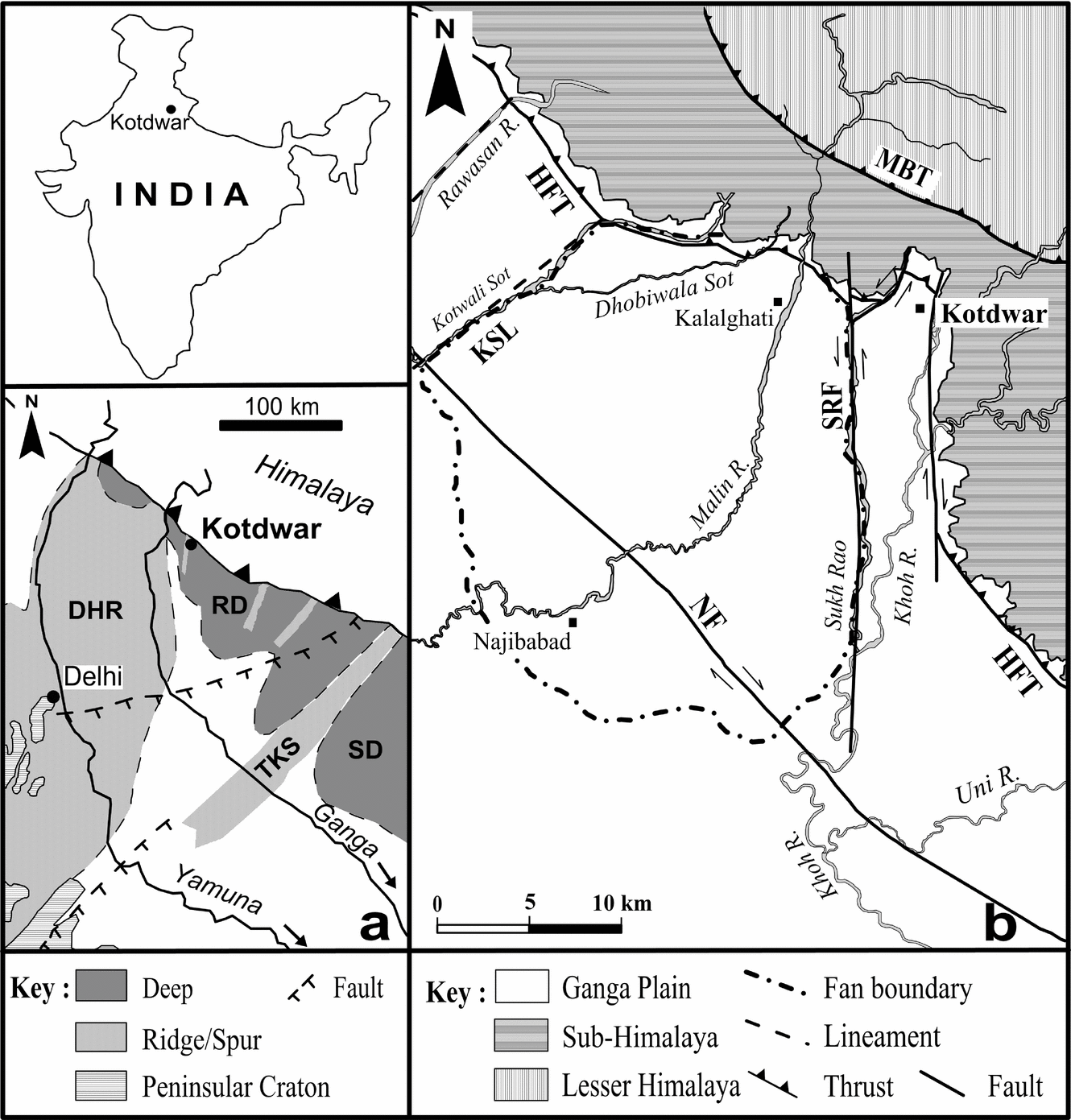
We have mapped the morphotectonic features and carried out detailed facies analysis of the alluvial fan of the Malin River, which is a tributary of the Ganga River. This fan, hereafter called the Malin Fan, is located to the west of Kotdwar town (78°31′25″E 29°45′N) in the Uttarakhand state of India (Fig. 1a, b). The main objective of the study is to understand the climatic and tectonic controls on alluvial fan evolution in the tectonically active piedmont zone of the Ganga Plain (Nakata, Reference Nakata1972; Yeats & Thakur, Reference Yeats and Thakur2008; Goswami, Pant & Pandey, Reference Goswami, Pant and Pandey2009). We have carried out detailed facies analysis to establish a conceptual depositional model of the fan and understand the role of palaeoclimate and neotectonics on the fan evolution. We hope that this data will be helpful in understanding the sedimentary processes of alluvial fan evolution in the piedmont zone of the Ganga Plain and similar climatic and geotectonic settings in other parts of the world. This can also be helpful in interpreting ancient alluvial fan deposits.
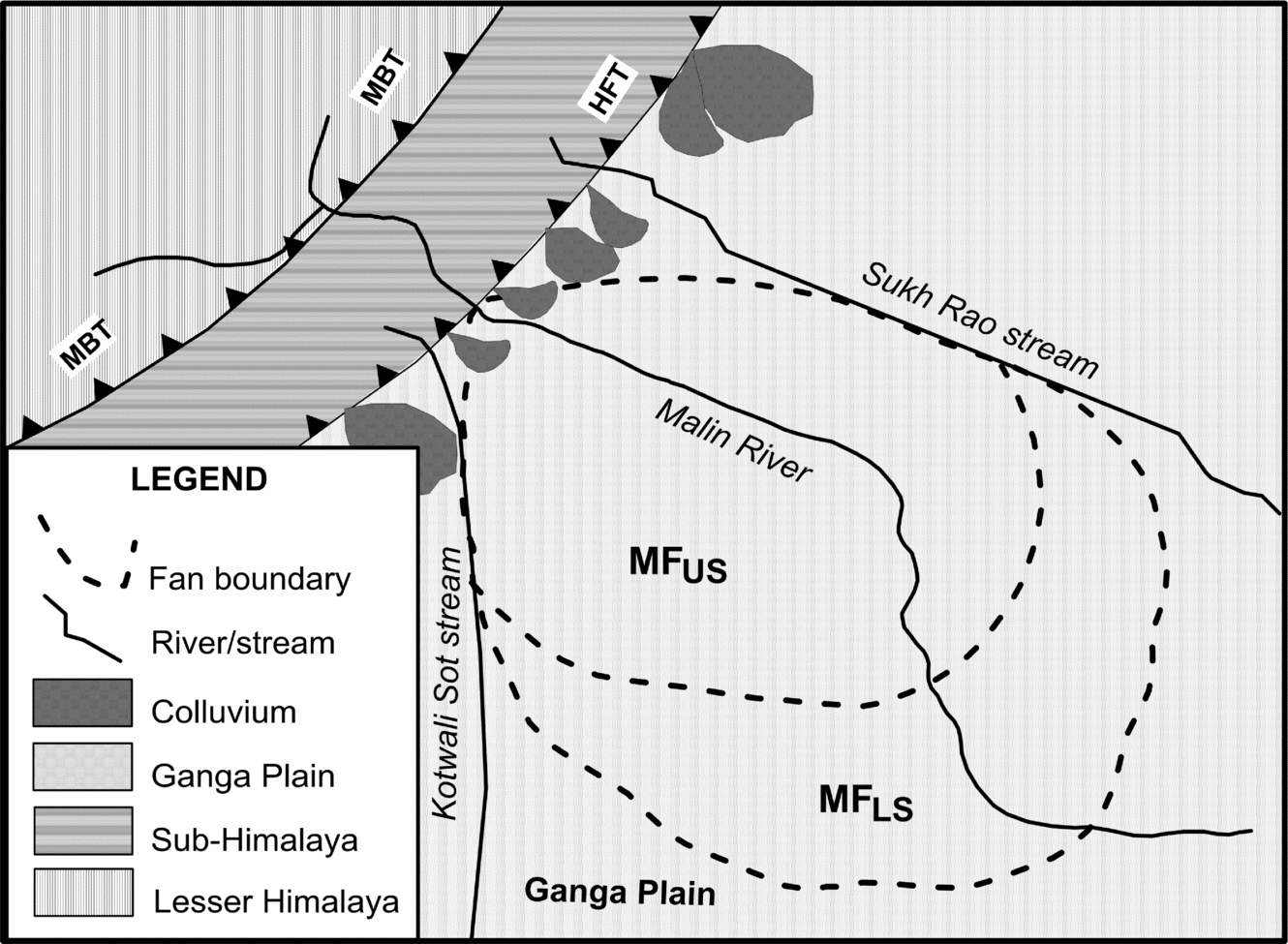
(a) Schematic map showing subsurface structures of the western part of the Ganga Plain (compiled from Karunakaran & Ranga Rao, Reference Karunakaran and Ranga Rao1979 and Raiverman, Kunte & Mukherjea, Reference Raiverman, Kunte and Mukherjea1983). DHR – Delhi Haridwar Ridge, TKS – Tanakpur Kasganj Spur, RD – Ramganga Deep, SD – Sarda Deep. (b) Geological map showing major lithotectonic units and faults/thrusts of the area. The boundary of the Malin Fan is marked with a dashed line. MBT – Main Boundary Thrust, HFT – Himalayan Frontal Thrust, SRF – Sukh Rao Fault, NF – Najibabad Fault, KSL – Kotwali Sot Lineament, R. – River. Rao and Sot mean stream in the local dialect.

2. Geological setting of the study area
The Ganga Plain is the central part of the alluvium-filled Indo-Gangetic foreland basin system formed on the Indian Plate lithosphere, which was flexed downwards in response to the over-riding of the Himalaya following collision of the Indian and Asian plates (Dewey & Bird, Reference Dewey and Bird1970; Lyon-Caen & Molnar, Reference Lyon-Caen and Molnar1985). The sedimentary fill of the basin is of Tertiary (Siwalik Group) and Quaternary ages (Alluvium), which rests unconformably over the Precambrian basement that has a number of ridges/spurs, deeps and faults (Rao, Reference Rao1973; Raiverman, Kunte & Mukherjea, Reference Raiverman, Kunte and Mukherjea1983). The thickness of the sedimentary fill in the basin is highly variable and controlled by the topography of the basement, being a maximum of ~4.5 km in the piedmont zone and decreasing gradually towards the south (Rao, Reference Rao1973; Raiverman, Kunte & Mukherjea, Reference Raiverman, Kunte and Mukherjea1983). The study area corresponds to the western part of the Ramganga frontal deep. There is a nearly N–S-trending spur in the basement of the area (Fig. 1a) (Raiverman, Kunte & Mukherjea, Reference Raiverman, Kunte and Mukherjea1983).
The sediments of the study area are derived from the Lesser Himalayan and Sub-Himalayan terranes in the north (Fig. 1b). The Lesser Himalayan terrane is composed of low- and medium-grade metamorphic rocks, granitic quartz-porphyry, sandstones, mudstones and a dolomite-dominated suite of calcareous rocks of Precambrian – Early Cambrian age (Heim & Gansser, Reference Heim and Gansser1939; Valdiya, Reference Valdiya1995). It is thrust southwards over the Sub-Himalaya along the Main Boundary Thrust (MBT) (Auden, Reference Auden1934). The Sub-Himalayan range comprises mudstones of the Subathu Formation of Late Paleocene to Eocene age, and mudstones, shales, siltstone and sandstone of the Lower and Middle Siwalik subgroups of Miocene age (Raiverman, Reference Raiverman1979; Tandon, Reference Tandon, Tandon, Pant and Casshyap1991; Thakur & Rawat, Reference Thakur and Rawat1992). The Sub-Himalaya is then thrust southwards over the Ganga Plain alluvium along the Himalaya Frontal Thrust (HFT). The Himalayan rock succession is extensively folded, faulted, fractured and sheared. There are a number of incidences of mass wasting in the Himalaya, most of which are triggered during rains.
3. Morphotectonics of the Malin Fan
The frontal Sub-Himalayan mountain range, adjoining the Malin Fan, rises up to 1056 m amsl (above mean sea level). It has generally planar slope facets. The streams exhibit sub-dendritic, sub-parallel, sub-trellis or semi-rectangular patterns in different parts and debouch into the adjoining piedmont zone through narrow, V-shaped valleys along mountain-front embayments. There are a number of landslides, triangular facets and cliffs developed along different segments of the Siwalik mountain-front. The morphotectonic features of the Malin Fan and surrounding area have been delineated with the help of multispectral imagery from the Indian Remote Sensing satellite, Geographical Information System (GIS) based Digital Terrain Models (DTMs) and field data. The boundaries of the fan were demarcated on the basis of morphological characteristics as proposed by Blair & McPherson (Reference Blair and McPherson1994). The morphological characters of the fan, like shape, slope angle, slope aspect, longitudinal and transverse profiles, and drainage pattern were examined through DTMs. The measurements of all morphological parameters, like area, length, width, slope angle, etc. were calculated in the GIS. The tectonic features have been demarcated on the basis of their geomorphic expressions, like surface deformations and drainage anomalies.
The Malin Fan and its drainage basin are located in the subtropical region. The mean annual average temperature is around 23°C, with a maximum of ~40°C during daytime in summers and a minimum of ~7°C during winter nights. The rainfall in the area is influenced by the southwest monsoon, the Indian Summer Monsoon, with a maximum rainfall during July and August. Westerlies contribute ~5 to 8% to the annual rainfall during the months of December to February. During about the last century, the region has been receiving an average of ~1750 mm rainfall during the summer monsoon and an average of ~170 mm precipitation by the westerlies (data source: Indian Institute of Tropical Meteorology, Pune).
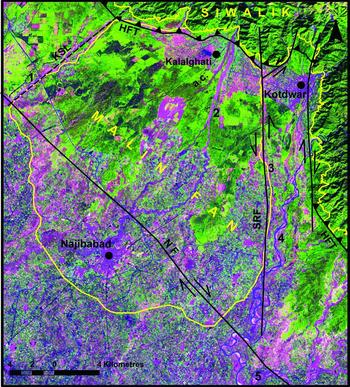
The Malin Fan has an area of ~480 km2 and a radial length of ~27.5 km. It has developed on the footwall of the HFT, but some of its proximal part rests on the hanging wall of the HFT (Figs 1b, 2). The 2-D profiles drawn in the GIS show that the fan is concave-up in longitudinal profile and convex-up in transverse profile. The average radial slope of the fan is ~1.4° in SE to SW directions in the proximal part and ~0.16° in SE to WSW directions in the distal part. The altitudes of the apex and toe of the fan are 518 and 260 m amsl, respectively, and the flow expansion angle beyond the mountain-front embayment is ~114°. The eastern boundary of the fan is defined by the Sukh Rao stream, which flows along the N–S-trending Sukh Rao Fault (SRF) (Fig. 2) (Goswami & Mishra, Reference Goswami and Mishra2012). The western boundary of the fan is defined by the Kotwali Sot stream, which flows along a distinct NE–SW-trending lineament, hereafter called the Kotwali Sot Lineament (KSL) (Fig. 2). Presently, there is only one prominent channel across the fan that becomes active during the rainy season. It is incised up to ~20 m in the proximal-fan area, with two levels of paired strath terraces developed along its banks. The elevation differences between successive terraces, i.e. river bed (T0) to first level terrace (T1) and T1 to second level terrace (T2), are ~2 to 4 m and ~9 to 20 m along the right bank and ~2 to 4.5 m and ~9 to 9.5 m along the left bank. However, the elevation difference between successive terraces gradually decreases downstream, and ultimately the terraces terminate at a distance of ~3.4 km downstream of the fan-apex. The channel incision also decreases in the downfan direction to ~5 m in the middle-fan region. In the distal-fan region the channel has a ~2.5 km wide active flood plain. The presence of a major abandoned channel in the west indicates that the stream flow has diverted eastwards into the present-day channel sometime in the Holocene, most likely as a result of the block-tilting caused by the HFT and SRF (Fig. 2).
RESOURCESAT-1 LISS III False Colour Composite (Band 3, 4, 5 in Blue, Green, Red channels, respectively) of November 2007 showing the Malin Fan and various tectonic features. 1 – Kotwali Sot stream; 2 – Malin River; 3 – Sukh Rao stream; 4 – Khoh River; 5 – Uni River; a.c. – abandoned channel; KSL – Kotwali Sot Lineament; SRF – Sukh Rao Fault; HFT – Himalayan Frontal Thrust; NF – Najibabad Fault.

In the western middle-fan area, and further to the west, a ~7–9 km wide badland zone with up to ~7 m deep gullies is developed almost parallel to the Himalayan trend. This zone represents an upwrap related to the active blind Najibabad Fault trending almost parallel to the Himalayan strike (Parkash et al. Reference Parkash, Kumar, Someshwar Rao, Giri, Suresh Kumar, Gupta and Srivastava2000; Yeats & Thakur, Reference Yeats and Thakur2008; Goswami & Mishra, Reference Goswami and Mishra2012). In the east, there are sharp knee-bend turns along the courses of the Khoh and Uni rivers where they cross this fault (Figs 1b, 2).
The Malin Fan receives the bulk of the sediments from the drainage basin of the Malin River, and a subsidiary amount from the drainage basin of the Dhobiwala Sot stream. The drainage basin of the Malin River has an area of ~84 km2 in the Sub-Himalayan and Lesser Himalayan terranes, whereas the drainage basin of the Dhobiwala Sot stream has an area of ~4 km2 in the Sub-Himalaya. The Malin River is a mainly rain-fed river with its drainage basin extending to a maximum altitude of 1803 m amsl. The river valley is lined with uplifted paired and unpaired terraces, landslides and talus cones in the mountains.
4. Facies analysis
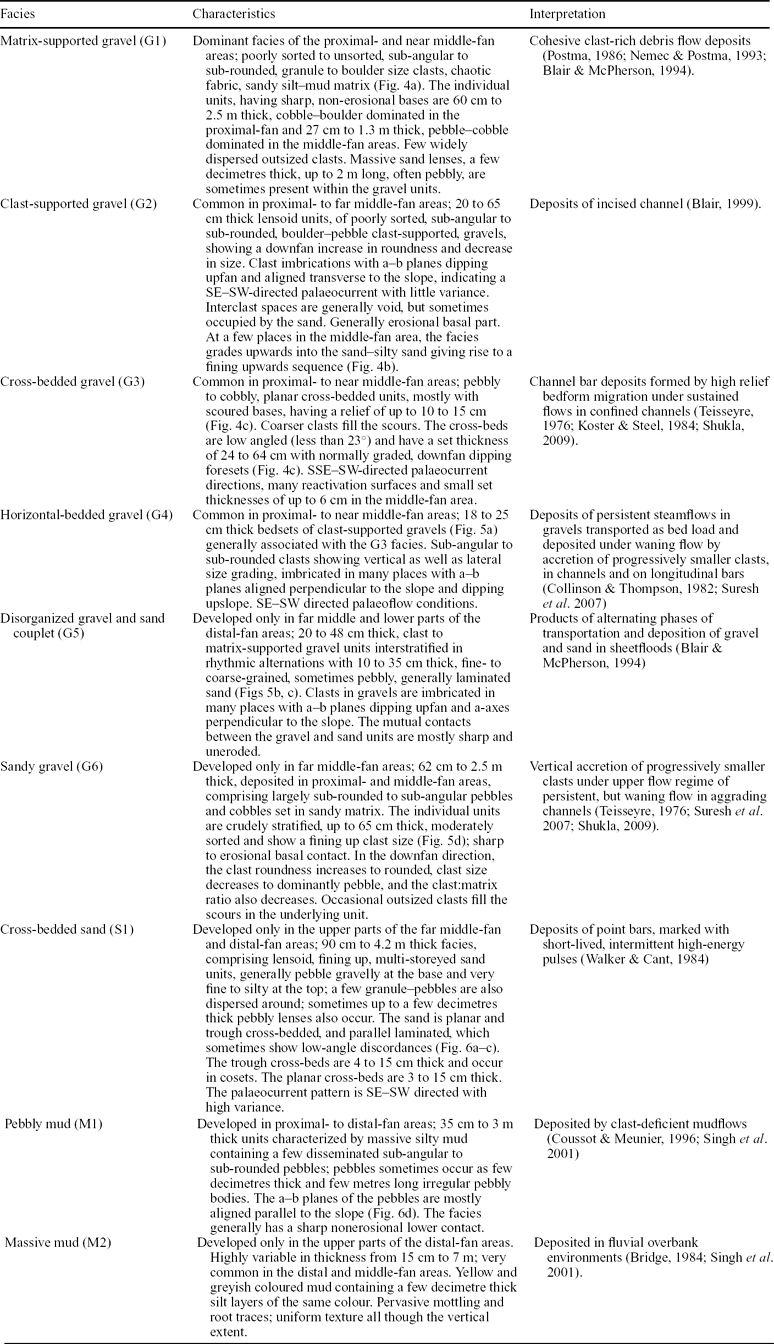
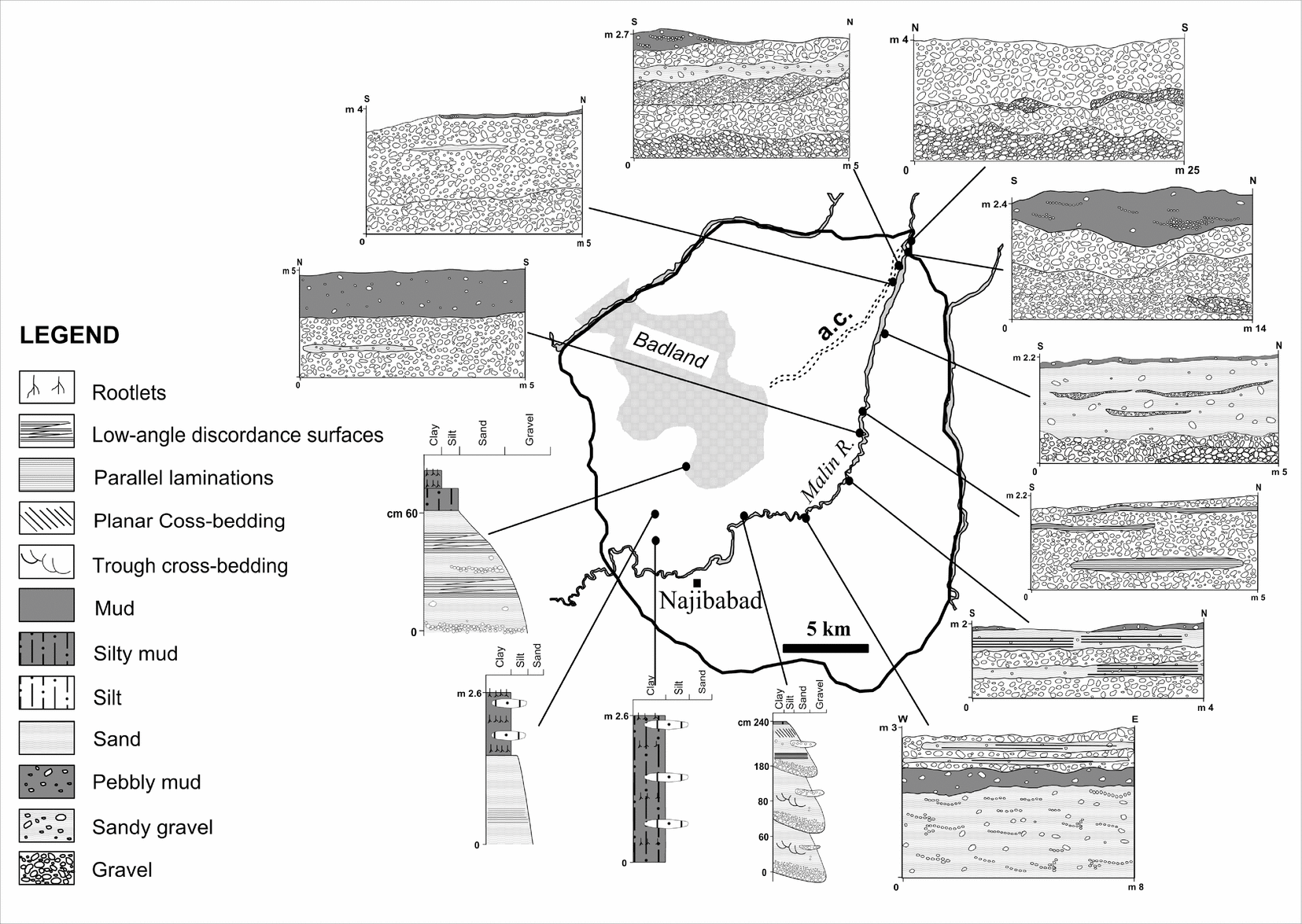
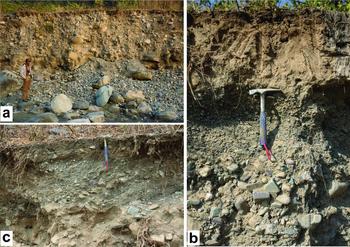
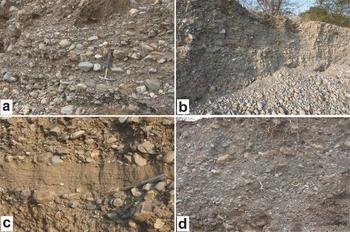
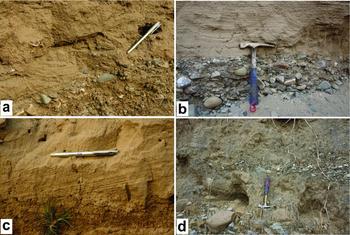
The present facies analysis is based on sedimentological data collected from selected stratigraphic cuts along the complete radial transect of the fan. These cuts are exposed along the banks of the Malin River. Two-dimensional sedimentological profiles/vertical logs were measured and drawn at these stratigraphic cuts. Most of the high stratigraphic cuts in the proximal- and middle-fan regions have collapsed because of the large-scale gravel and sand mining. The collapsed material forms a steep surface along the foot of the cuts and, as such, hinders the sedimentological measurements. Thus, profiles and logs could be drawn only along the stratigraphic cuts of relatively short heights (up to 4 m high). However, sedimentological attributes have been noted at many other cuts as well. Thirteen representative 2-D profiles and logs of the fan are shown in Figure 3. The individual lithofacies have been identified on the basis of bed morphology, mutual contacts with bounding units, clast size, sorting and fabric, and sedimentary structures. In all, nine major facies could be identified from the proximal to distal parts of the fan: six gravel facies, one sand facies and two mud facies. Each of these lithofacies has distinct sedimentological attributes pointing to specific processes of deposition (Table 1; Figs 4–6).
Description and interpretation of the lithofacies of the Malin Fan

Sedimentological 2-D sections and logs from different parts of the Malin Fan. The badland zone developed in the western part of the fan and an abandoned channel (a.c.) on the fan surface are also shown in the figure.

(a) Matrix-supported gravel (G1 facies) in the proximal part of the fan. Height of the person is 182 cm. (b) Clast-supported gravel (G2 facies) grading upwards into the sand in the middle-fan area. At the top is soil. Length of the hammer is 26 cm. (c) Planar cross-bedded gravel (G3 facies) with basal scour into the underlying matrix-supported gravel (G1) in the middle-fan area. On the top is a sandy gravel unit (G6 facies).

(a) Horizontal-bedded gravel (G4 facies) in the proximal part of the fan. Length of the hammer is 26 cm. (b) Disorganized gravel and sand couplets (G5 facies) in the middle-fan area. (c) Close-up of the sand unit of the G5 facies. The granule–pebble-bearing coarse sand is parallel laminated. Length of the pen is 14.5 cm. (d) Crudely bedded sandy gravel (G6 facies) developed in the middle-fan area.

(a) Trough cross-bedding in cosets overlying the pebble gravels (facies S1) in the middle-fan area. Length of the pen is 14.5 cm. (b) Parallel laminated sand (S1 facies) overlying the clast-supported pebble gravel (G2 facies) in the middle-fan area. (c) Planar cross-bedding in the sand (facies S1) in the distal-fan area. Length of the hammer is 26 cm. (d) Pebbly mud (M1 facies) in the proximal part of the fan.

5. Facies associations and distribution
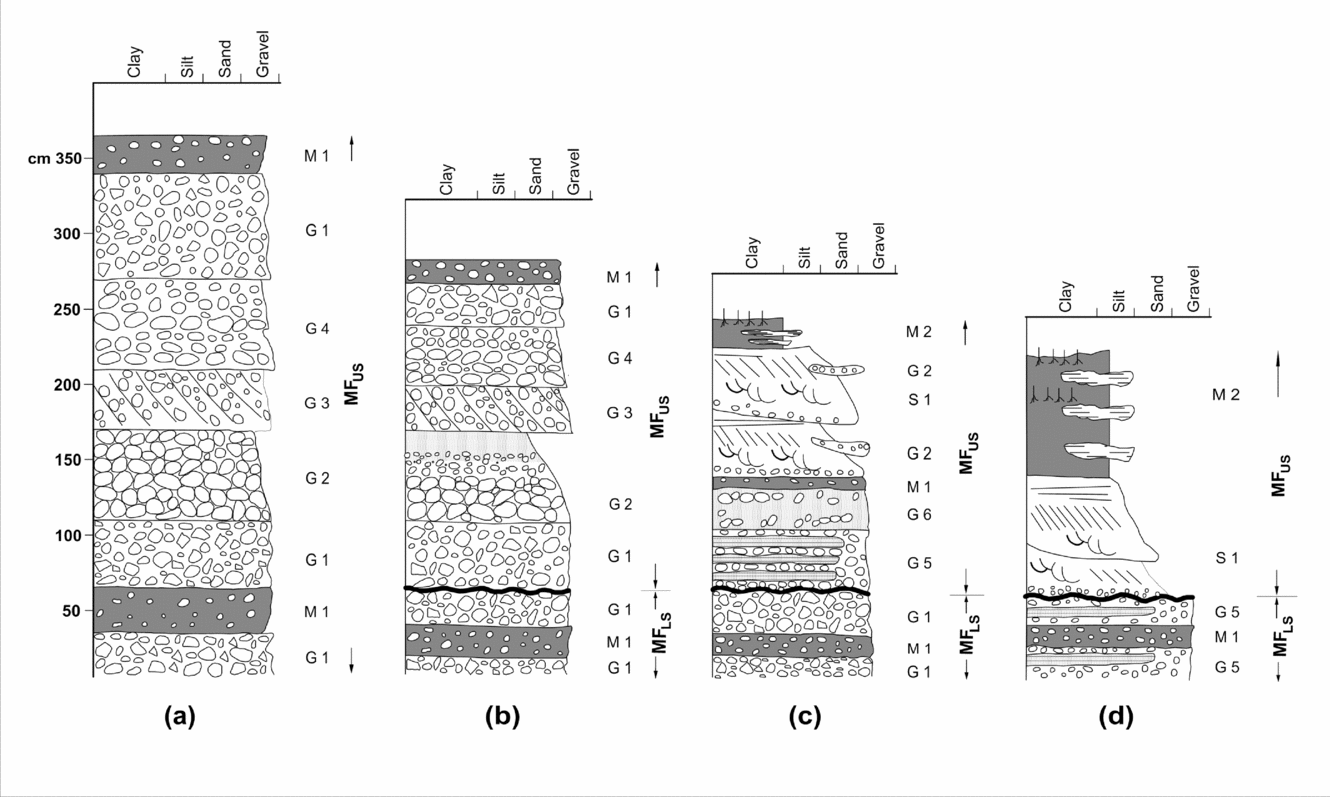
Two distinct stratigraphic packages have been indentified in the sedimentary succession of the Malin Fan, hereafter referred to as the lower stratigraphic package (MFLS) and upper stratigraphic package (MFUS), respectively. The contact between these two packages is sharp to erosional having undulations of low relief (a few decimetres to ~1 m) and large wavelength (a few metres to a few tens of metres). At a few places along this contact there are intervening, discontinuous, up to a few decimetres thick, fine sand and silty mud layers with some rootlets and faint pedogenesis, and some discontinuous, few millimetre thick ferruginized layers. The vertical and lateral distribution of lithofacies in both the packages shows distinct characters. The unit facies cycles as well as the facies associations are fining upwards (Figs 3, 7). The individual units show a decrease in thickness and clast size and an increase in clast roundness in the downfan direction. In the proximal-fan the MFLS constitutes the tread of the upper level strath terrace. Here the MFLS and MFUS do not occur in contact. But, in the far middle-fan and near distal-fan regions both the MFLS and MFUS are exposed in normal stratigraphic order. The middle-fan area consists of only gravel facies in the MFLS and dominantly gravel and sand facies in the MFUS. The distal-fan area consists of only gravel facies in the MFLS and dominantly sand and mud facies in the MFUS surface. At many places in the proximal- and middle-fan areas, the fan surface is covered with an up to a few decimetres thick pedogenic soil. The facies associations observed in different parts of the Malin Fan are shown in Figure 7 and given below:
Sedimentological logs showing generalized facies associations in the (a) proximal part of the fan, which is dominated by the matrix-supported gravel (G1) facies, (b) near the middle-fan area, in which the dominance of the matrix-supported gravel (G1) facies decreases in the MFUS unit as compared with the MFLS unit, (c) far middle-fan area, in which the matrix-supported gravel (G1) facies is deposited only in the MFLS unit and the disorganized gravel and sand couplet (G5) facies and sandy gravel (S1) facies dominate the MFUS, and (d) distal-fan area, in which the MFLS unit is dominated by the disorganized gravel and sand couplet (G5) facies and the MFUS unit is exclusively sandy and muddy with no gravels. Legend is the same as in Figure 3.

(1) Matrix-supported gravel (G1), clast-supported gravel (G2), cross-bedded gravel (G3), horizontal-bedded gravel (G4) and pebbly mud (M1) in the proximal part. The G1 facies dominates the succession by constituting ~65% of the stratigraphic cuts followed by a ~25% share taken up by the G2, G3 and G4 facies.
(2) Matrix-supported gravel (G1) and pebbly mud (M1) in the MFLS of the middle part with the G1 facies constituting ~80% of the stratigraphic cuts.
(3) Matrix-supported gravel (G1), clast-supported gravel (G2), cross-bedded gravel (G3), horizontal-bedded gravel (G4) and pebbly mud (M1) in the MFUS of the near middle-fan area. The G1, G4 and G3 facies together constitute ~70% of the stratigraphic cuts.
(4) Disorganized gravel and sand couplet (G5), sandy gravel (G6), cross-bedded sand (S1), clast-supported gravel (G2), pebbly mud (M1) and massive to laminated mud (M2) in the MFUS of the far middle-fan area. The G5 facies dominates the succession by constituting ~40% of the stratigraphic cuts, followed by the S1 facies with a ~30% share.
(5) Disorganized gravel and sand couplet (G5) and pebbly mud (M1) in the MFLS of the distal-fan, with the G5 facies constituting ~80% of the stratigraphic cuts.
(6) Cross-bedded sand (S1) and massive to laminated mud (M2) in the MFUS of the distal-fan with variable proportions at different locations.
6. Depositional model
In the piedmont zone of the western Ganga Plain, between Yamuna River in the west and Sarda River in the east, the Malin Fan is the second largest alluvial fan, next to the Gola Fan, which formed ~120 km southeast of the Malin Fan (cf. Goswami, Pant & Pandey, Reference Goswami, Pant and Pandey2009, Goswami & Yhokha, Reference Goswami and Yhokha2010).
The facies associations and distribution indicate that the MFLS and MFUS are related to two distinct, most recent cycles of the Malin Fan evolution, the MFLS representing the older and MFUS representing the younger evolutionary cycle. These cycles are separated by a time gap, during which there was insignificant sediment supply to the basin and occasional sheet flows redistributed the sediments of the MFLS unit to deposit a veneer of fine sediments in shallow depressions on the fan surface. The absence of any mature soil profile in between the MFLS and MFUS units indicates that this time gap was of a short duration. Interestingly, Shukla (Reference Shukla2009) also identified two distinct evolutionary cycles, separated by a hiatus, in the exposed fill of the Gola Fan. The older evolutionary cycle of the Gola Fan is characterized by fluvial processes in continuously changing channel patterns, from gravelly braided in the proximal part to sandy braided in the middle part and meandering in the distal part of the fan, whereas the younger cycle is characterized by multiple debris flow events (Shukla, Reference Shukla2009).
In contrast to the Gola Fan, the older evolutionary cycle of the Malin Fan is characterized by sediment gravity flows in the upper reaches and sheetfloods in the lower reaches of the fan, whereas the younger cycle is dominated by sediment gravity flows and channel processes in the proximal-fan, sheetfloods and fluvial processes in the middle-fan, and fluvial processes in the distal-fan regions.
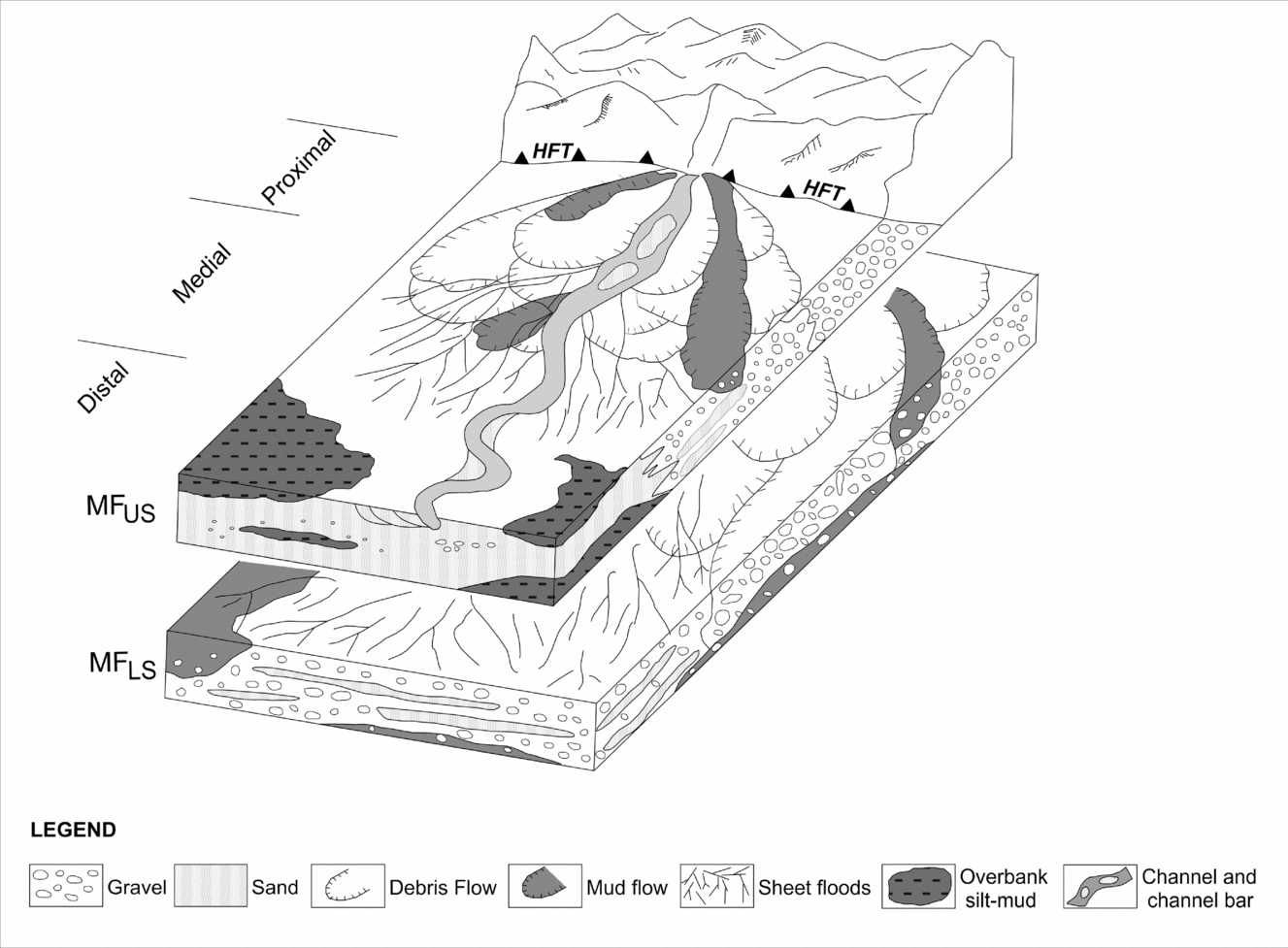
The fan building activities of the MFLS cycle were intense, capable of transporting gravelly sediments down to long distances from the mountain-front (Fig. 8). During this period, a high volume of water flushed out a huge quantity of sediments from the source to the basin, under steeper regional gradients. The sediments were emplaced as sheetfloods caused by flash floods during catastrophic events and as sediment gravity flows during non-catastrophic events (Fig. 9). The sheetfloods deposited gravel–sand couplets of the G5 facies, whereas the debris flows and mud flows deposited matrix-supported gravels of the G1 facies and pebbly mud of the M1 facies, respectively (cf. Blair & McPherson, Reference Blair and McPherson1994).
Diagrammatic sketch showing spatial extent of the latest two evolutionary cycles of the Malin Fan. MFLS represents the older cycle and MFUS represents the younger evolutionary cycle.

Schematic depositional model of the Malin Fan. During the older MFLS cycle, debris flows, mud flows and sheetfloods deposited gravels at long distances from the mountain-front. During the younger MFUS cycle, sediment gravity flows deposited sediments up to the near middle-fan area and sheetfloods deposited sediments in the distal-fan area. Sediments have also been deposited in shallow channel hollows and channel bars in the proximal part of the fan and near middle-fan areas. Down in the far middle-fan and distal-fan areas sediments have been deposited in point bars and overbank areas.

The fan building activities during the MFUS cycle were reduced, during which gravelly sediments could not be transported far from the source (Fig. 8). During this cycle, the fan aggraded through deposition in the channels as well as on the fan surface (Fig. 9). In the proximal-fan and near middle-fan areas, sediment gravity flows deposited G1 and M1 facies, whereas under high water-to-sediment ratio conditions sediments of the G2 facies were deposited in the shallow depressions of the channels, and sediments of the G3 facies formed channel bars (cf. Teisseyre, Reference Teisseyre1976; Blair & McPherson, Reference Blair and McPherson1994; Blair, Reference Blair1999; Shukla, Reference Shukla2009). The gravels of the G4 facies were deposited as channel lags or on longitudinal bars under persistent flows of waning floods (cf. Collinson & Thompson, Reference Collinson and Thompson1982; Suresh et al. Reference Suresh, Bagati, Kumar and Thakur2007). During the flash flooding events, sheetfloods were generated which deposited gravels up to the lower reaches of the middle-fan region. The gravel–sand couplets of the G5 facies were deposited on the fan surface, and sandy gravels of the G6 facies were deposited in shallow channels during waning flood conditions (cf. Blair & McPherson, Reference Blair and McPherson1994; Teisseyre, Reference Teisseyre1976). The downfan region was formed by the fluvial processes of smaller sandy channels, which developed due to effective grain-size sorting by consistent flow conditions for a considerable period of time (cf. Brozovic & Burbank, Reference Brozovic and Burbank2000) under a high water-to-sediment ratio and a gentler channel gradient. In this region, sand of the S1 facies deposited in point bars and mud–silt of the M1 facies deposited in overbank areas following floods (cf. Bridge, Reference Bridge1984; Walker & Cant, Reference Walker, Cant and Walker1984). The infrequent pulses of high water discharge caused scouring and deposition of pebbles in the channels.
7. Discussion and conclusion
The sedimentation in the piedmont zone of the Ganga Plain started at about 25 ka bp and continued until as late as 3 ka bp (Singh, Reference Singh1996; Srivastava et al. Reference Srivastava, Singh, Sharma and Singhvi2003). During this period of time the Ganga Plain and adjoining Himalaya of this region witnessed distinct climatic oscillations (e.g. Barnard et al. Reference Barnard, Owen, Sharma and Finkel2004; Kotlia et al. Reference Kotlia, Sanwal, Phartiyal, Joshi, Trivedi and Sharma2010; Ray & Srivastava, Reference Ray and Srivastava2010). Furthermore, there have been distinct phases of monsoon intensification and weakening during late Pleistocene–Holocene times (see Kale, Reference Kale2007 and references therein). The Quaternary period was also the time of intense tectonic activities in the region (Nakata, Reference Nakata1989; Valdiya, Reference Valdiya2001). In conceptual models, these climatic and tectonic phenomena are considered to be the primary variables of alluvial fan evolution (Ritter et al. Reference Ritter, Miller, Enzel and Wells1995; Calvache, Viseras & Fernandez, Reference Calvache, Viseras and Fernandez1997; Harvey, Reference Harvey, Alsharhan, Wood, Goudie, Fowler and Abdellatif2003; Viseras et al. Reference Viseras, Calvache, Soria and Fernandez2003; Harvey, Mather & Stokes, Reference Harvey, Mather, Stokes, Harvey, Mather and Stokes2005). The alluvial fans developed ~100 to 150 km southeast of the present area conform to such models: the morphologies of the Nihal, Gola, Nandhaur and Kalonia fans are tectonically controlled (Goswami, Pant & Pandey, Reference Goswami, Pant and Pandey2009), whereas the sedimentary processes of the Gola Fan have been climatically controlled (Shukla, Reference Shukla2009).
The evolution of the Malin Fan is also tectonically and climatically controlled. The transverse expansion of the fan is tectonically controlled by the SRF in the east and KSL in the west (Fig. 2). The SRF is related to a basement spur that actively pushes and indents the mountain-front (Fig. 1b) (Goswami & Mishra, Reference Goswami and Mishra2012). Moreover, in the north the HFT has controlled and deflected the streams southwestwards or southeastwards, preventing them from forming their own fans or contributing sediments to the Malin Fan, e.g. the Kotwali Sot stream (Fig. 2). Movements along the HFT have also facilitated further incision of the channel in the proximal-fan and thus controlled the sedimentary processes by confining the flows within the channel itself.
Shukla (Reference Shukla2009) identified five mesocycles of gravel emplacement in the Gola Fan: three in the borehole data and two in the exposed sections. The lower four of these cycles deposited gravels up to the distal-fan area, whereas the youngest one deposited gravels only up to the middle-fan area. Similarly, the MFLS and MFUS cycles of the Malin Fan deposited gravels up to the distal- and middle-fan areas, respectively. These observations clearly indicate that the fan building activities in the piedmont zone have reduced with time (Figs 8, 9). This reduction could be a result of (i) a decrease in the sediment supply from the source, (ii) a decrease in the water-to-sediment ratio, and (iii) a decrease in the regional gradient, or (iv) a combination of any two, or all, of these climate and tectonics related factors.
Supply of a large amount of coarse clasts from a distant source through a river channel requires a high water budget. In the case of the rivers in the study area, the variations in water budget are directly related to variations in the rainfall because these have been mainly rain-fed rivers. The high rainfall not only flushes out the already generated sediment from the basin but also generates a huge sediment quantity by triggering mass wasting (cf. Bookhagen, Thiede & Strecker, Reference Bookhagen, Thiede and Strecker2005), although the role of tectonic activities in triggering mass wasting and generating sediments in the basin should not be underestimated (e.g. Keefer, Reference Keefer1994). The MFLS cycle of the Malin Fan indicates deposition in a wetter climatic phase of strengthened monsoon when powerful sediment gravity flows and sheetfloods carried coarser clasts down to long radial distances, under steeper regional gradients. This was followed by dry climatic conditions of a weak monsoon, during which occasional sheet flows only redistributed the sediment on the fan surface. The fan building activities were renewed during the MFUS cycle due to strengthening of the monsoon, which was, however, not as powerful as had been during the MFLS cycle. Consequently, the fan building activities were comparatively less powerful and generally unable to transport gravelly sediments beyond the middle-fan area. This cycle of the Malin Fan evolution shows clear clast size grading from gravels in the proximal part to gravel–sand in the middle part and sand–silt–mud in the distal part. Such downfan clast size grading has been noticed in most of the fans deposited by fluid gravity processes (e.g. Boothroyd & Nummedal, Reference Boothroyd, Nummedal and Miall1978; Harvey, Reference Harvey, Koster and Steel1984).
Presently, the Malin River is deeply incised to the north of the Najibabad Fault, in the proximal- and middle-fan regions, and the sediments are deposited within the channel only. Here, the fan surface is only very slowly accreting in some areas by sheet flows, mainly through redistribution of the small colluvial slides. But, to the south of the Najibabad Fault, the distal-fan areas are flooded during heavy monsoonal rains and accrete through overbank sedimentation. In this part of the fan, point bars are also developed along the Malin River. It has been observed in laboratory experiments that the channel entrenchment and terrace formation in the fanhead area, and channel avulsion and migration in the distal-fan area, are commonly associated with the late stages of fan evolution due to intrinsic factors (Hooke, Reference Hooke1968; Clarke, Quine & Nicholas, Reference Clarke, Quine and Nicholas2010). Nevertheless, keeping in view the tectonic setting of the region, the role of activities along the Najibabad Fault, HFT and SRF cannot be completely ruled out in influencing the channel entrenchment on the fan. Anthropogenic activities in the form of extensive gravel and sand mining from the river bed and channel walls are also playing their role in affecting the channel processes, whether to a little or large extent.
Acknowledgements
We are thankful to Prof. Charu C. Pant, Head, Department of Geology, KU, Nainital, for encouragement, frequent fruitful discussions and providing working facilities. We have been greatly benefited through discussions with Dr B. S. Kotlia, Nainital. Jay is thankful to DST and UGC, New Delhi for awarding research fellowships. We thankfully acknowledge the encouraging and constructive comments of two anonymous reviewers.