Introduction
Beauveria bassiana (Balsamo) Vuillemin (Cordycipitaceae), a fungus long known for its entomopathogenic properties, causes an insect disease known as white muscardine. Although B. bassiana initially was considered only an insect pathogen, it recently has been reported as an endophyte (Jaber and Ownley Reference Jaber and Ownley2018; Vega Reference Vega2018). An “endophyte” is an organism that lives inside a plant without causing any apparent symptoms during the plant growth cycle (Wilson Reference Wilson1995; Akello and Sikora Reference Akello and Sikora2012).
Although the efficiency of entomopathogenic fungi is influenced by environmental factors such as ultraviolet radiation, low moisture, and temperature (Lacey et al. Reference Lacey, Grzywacz, Shapiro-Ilan, Frutos, Brownbridge and Goettel2015; Jaronski and Mascarin Reference Jaronski, Mascarin and Lacey2017), using Beauveria as an endophytic has solved those barriers and demonstrates more cost-efficient strategies to host plants. The reason mainly is that by establishing inside plants, the fungi are protected from environmental abiotic stresses, and this is accompanied by longer persistence and less inoculum needed to colonise the host (Mascarin and Jaronski Reference Mascarin and Jaronski2016).
Among the entomopathogenic fungi that naturally colonise plants, B. bassiana has been reported as an endophyte from a broad range of plants (Vega Reference Vega2008; Dara Reference Dara2019). Beauveria bassiana has been established as an endophyte in citrus (Rutaceae) (Bamisile et al. Reference Bamisile, Akutse, Dash, Qasim, Carlos and Aguila2020), coconut seedling (Arecaceae) (Posada and Vega Reference Posada and Vega2005; Gaviria et al. Reference Gaviria, Parra and Gonzales2020), artichoke (Asteraceae) (Guesmi-Jouini et al. Reference Guesmi-Jouini, Garrido-Jurado, López-Díaz, Ben Halima-Kamel and Quesada-Moraga2014), banana (Musaceae) (Akello et al. Reference Akello, Dubois, Coyne and Kyamanywa2008a, Reference Akello, Dubois, Coyne and Kyamanywa2008b), corn (Poaceae) (Wagner and Lewis Reference Wagner and Lewis2000), sorghum (Poaceae) (Reddy et al. Reference Reddy, Khan, Devi, Sharma and Reineke2009; Tefera and Vidal Reference Tefera and Vidal2009; Mantzoukas et al. Reference Mantzoukas, Chondrogiannis and Grammatikopoulos2015), and tomato (Solanaceae) (Klieber and Reineke Reference Klieber and Reineke2015). The endophytic activity of different isolates of B. bassiana and their effects on plant growth, height, and tissue nutrient content, the composition of induced plant defensive compounds, and plant volatiles have been previously reported (Tefera and Vidal Reference Tefera and Vidal2009; Mantzoukas et al. Reference Mantzoukas, Chondrogiannis and Grammatikopoulos2015; Shrivastava et al. Reference Shrivastava, Ownley, Augé, Toler, Dee and Vu2015; Jaber and Enkerli Reference Jaber and Enkerli2016; Renuka et al. Reference Renuka, Ramanujam and Poornesha2016; Jaber and Ownley Reference Jaber and Ownley2018; Sánchez-Rodríguez et al. Reference Sánchez-Rodríguez, Raya-Cíaz, María, García-Mina, Carmen and Quesada-Moraga2018; Tall and Meyling Reference Tall and Meyling2018; Vega Reference Vega2018; Moloinyane and Nchu Reference Moloinyane and Nchu2019; Bamisile et al. Reference Bamisile, Akutse, Dash, Qasim, Carlos and Aguila2020).
The presence of endophytic B. bassiana in treated host plants has been effective in controlling pests under lab conditions (Bing and Lewis Reference Bing and Lewis1991; Cherry et al. Reference Cherry, Banito, Djegui and Lomer2004; Vega et al. Reference Vega, Goettel, Blackwell, Chandler, Jackson and Keller2009; Lopez and Sword Reference Lopez and Sword2015). Several studies have reported the impact of endophytic fungi on survival, fitness, development, and fecundity of sap-sucking herbivores (Gurulingappa et al. Reference Gurulingappa, Sword, Murdoch and McGee2010; Akello and Sikora Reference Akello and Sikora2012; Lopez et al. Reference Lopez, Zhu-Salzman, Ek-Ramos and Sword2014; Muvea et al. Reference Muvea, Meyhöfer, Subramanian, Poehling, Ekesi and Maniania2014; Jaber et al. Reference Jaber, Araj and Qasem2018). These studies suggest that the application of endophytic fungi can be integrated with other pest management strategies to provide effective insect pest control. Endophytic fungi also can colonise the rhizosphere and confer protection to the host plant (Ownley and Gwinn Reference Ownley and Gwinn2010; Greenfield et al. Reference Greenfield, Gómez-Jiménez, Ortiz, Vega, Kramer and Parsa2016; Jaber and Ownley Reference Jaber and Ownley2018) against plant pathogens such as Rhizoctonia solani (Ceratobasidiaceae), Pythium myriotylum (Pythiaceae) (Ownley et al. Reference Ownley, Griffin, Klingeman, Gwinn, Moulton and Pereira2008), Plasmopara viticola (Peronosporaceae) (Rondot and Reineke Reference Rondot and Reineke2019), Pythium ultimum (Pythiaceae), Sphaerotheca fuliginea (Erysiphaceae), Fusarium solani (Nectriaceae) (Jaber and Ownley Reference Jaber and Ownley2018), and Magnaporthe grisea (Magnaporthaceae) (Atugala and Deshappriya Reference Atugala and Deshappriya2015).
Wheat (Poaceae) production in the Near and Middle East, Eastern Europe, and North Africa is affected by the Sunn pest, Eurygaster integriceps (Hemiptera: Scutelleridae) (Critchley Reference Critchley1998; Hosseininaveh et al. Reference Hosseininaveh, Bandani and Hosseininaveh2009; Talaei-Hassanloui et al. Reference Talaei-Hassanloui, Kharazi-Pakdel and Hedjaroude2009; Davari and Parker Reference Davari and Parker2018) and the plant pathogen Fusarium culmorum (Nectriaceae) (Motallebi et al. Reference Motallebi, Alkadri, Pisi, Nipoti, Tonti and Niknam2015). Nymphs and adults of E. integriceps feed on leaves, stems, and grains (Critchley Reference Critchley1998; Hosseininaveh et al. Reference Hosseininaveh, Bandani and Hosseininaveh2009), reducing crop yield. Insects feeding on developing kernels inject salivary hydrolytic enzymes that break down gluten to reduce bread quality (Hosseininaveh et al. Reference Hosseininaveh, Bandani and Hosseininaveh2009; Koksel et al. Reference Koksel, Ozderen, Olanca and Ozay2009). Fungal diseases – namely root and crown rot caused by F. culmorum – threaten wheat production in different areas of the world (Grosu et al. Reference Grosu, Sicuia, Dobre, Voaideş and Cornea2015; Meyer-Wolfarth et al. Reference Meyer-Wolfarth, Schrader, Oldenburg, Weinert and Brunotte2017). Fusarium culmorum symptoms appear as brown necrotic discolouration, root browning, and necrosis, resulting in stand loss, reduced yield, and decreased grain quality. It can also spread throughout a plant’s crown and infect the stems (Beccari et al. Reference Beccari, Covarelli and Nicholson2011).
In the present study, we assessed the potential for a native B. bassiana isolate for use as an endophyte in wheat to enhance plant growth and confer protection against Sunn pest and F. culmorum. We first examined methods to optimise endophytic establishment of the isolate in host plants. We then assessed the direct effect of the endophyte on plant growth. In greenhouse and field studies, we subsequently tested the effect of inoculations on the egg hatch of Sunn pest and the incidence of root and crown disease.
Materials and methods
Fungal isolates and inoculum
Beauveria bassiana TV, isolated from soil in Karaj County, Alborz, Iran in 2017 (Seyedtalebi et al. Reference Seyedtalebi, Safavi, Talaei-Hassanloui and Bandani2017, Reference Seyedtalebi, Safavi, Talaei-Hassanloui and Bandani2020), was obtained from the collection of entomopathogenic fungi at the Biological Control Laboratory, College of Agriculture and Natural Resources, University of Tehran, Karaj, Iran. The fungus was cultured on Sabouraud dextrose agar (dextrose (40 g), peptone (10 g), agar (15 g), and distilled water (1 L)) with 1% yeast extract in Petri plates and kept in the dark at 25 ± 1 °C and 65 ± 10% relative humidity for 14 days. Conidia were harvested by scraping the surface of each culture with a sterile spatula and were transferred into a sterilised 100-mL glass beaker containing 50 mL of 0.01% Tween 80 (Merck, Darmstadt, Germany; Gurulingappa et al. Reference Gurulingappa, Sword, Murdoch and McGee2010). The conidial suspension was stirred, filtered, and adjusted to 1 × 10⁷ conidia mL–1, which was used to inoculate the plants and soil, as described below. The viability of conidia was assessed following the method described by Parsa et al. (Reference Parsa, Ortiz and Vega2013).
Fusarium culmorum isolated from wheat in Varamin County, Iran, in 2003 was obtained from the Iranian Research Institute of Plant Protection, Tehran, Iran, cultivated on potato dextrose agar, and kept at 25 ± 1 °C and 65 ± 10% relative humidity in darkness for seven days. The F. culmorum inoculum for infecting the test plants was prepared as described by Chekali et al. (Reference Chekali, Gargouri, Paulitz, Nicol and Rezgui2011).
Greenhouse experiments
Fungal treatments
Seeds of the wheat cultivar “Pishtaz” were obtained from the Gene Bank, Department of Agronomy and Plant Breeding, University of Tehran, Karaj, Iran. In order to study the possible establishment of B. bassiana isolates in wheat, different inoculation methods – soil drench, foliar spray, seed soaking in conidial suspension, and seed treatment in conidial powder – in two sterile versus nonsterile conditions were applied. The soil drench and foliar spray treatments were carried out according to Parsa et al. (Reference Parsa, Ortiz and Vega2013), with slight modification. Briefly, 15 mL of fungal suspension at a concentration of 1 × 10⁷ conidia mL–1 were used to drench the soil, and 10 mL of the same were used to spray the leaves (foliar spray). The wheat foliage was sprayed using a manual atomiser at 14 days after planting. For the foliar and soil sterile treatments and control, the seeds were surface sterilised before fungal inoculation by immersion in sodium hypochlorite (2% v/v) for two minutes followed by one wash with sterile distilled water, immersion in ethanol (70% v/v) for two minutes, and then three rinses with sterile distilled water. The sterilised seeds then were placed on sterile filter paper to dry, and 20 seeds were planted in each polyvinyl chloride pot (8 and 10 cm in diameter and height, respectively) in sterile soil (400 g per pot). In the nonsterile treatments, the wheat seeds were planted in polyvinyl chloride pots without sterilisation of seeds, soil, and water. In general, eight pots were considered for each treatment, with four pots for sterile treatments and four pots for nonsterile treatments.
For seed inoculation, wheat seeds (approximately 160 seeds) were treated either by soaking in the B. bassiana conidial suspension for 12 and 24 hours, depending on the seed-soaking-in-conidial-suspension treatment, or by inoculating the seeds with fungal conidial powder (6 mg, equivalent to 3.1 × 10⁷ conidia/mL). For conidial powder inoculation of seeds, 0.1 g of fungal conidia powder was obtained by scraping the surface of each culture with a sterile spatula and was stirred with 160 seeds for two minutes in a microtube, and then the seeds were planted in eight pots. In the seed-soaking treatment, the inoculated seeds were transferred to an incubator at 25 °C ± 1 °C and 65% ± 5% relative humidity in darkness, dried on sterile tissue paper for 30 minutes under the laminar hood, and then planted in eight pots, as described below.
Re-isolation of Beauveria bassiana from tested plants
The presence of B. bassiana within the treated wheat plants was verified through fungal isolation from different parts of the plant and plant extract and through detection of B. bassiana DNA.
Following Parsa et al. (Reference Parsa, Ortiz and Vega2013), 15 days after inoculation, four wheat plants were removed from each pot (each treatment consisted of eight pots, with four pots for sterile treatments and four pots for nonsterile treatments) and washed with running tap water for one minute. For each plant, two parts of the leaf (sampled randomly from the first true leaf), two parts of the root (sampled from the middle of the root and near the root tip), and two parts of the stem (3-cm-long samples taken from the middle of the stem length) were excised, surface sterilised in sodium hypochlorite (2% v/v) and ethanol (70% v/v), and washed three times with sterile distilled water. The six samples of plant material obtained from each plant were then plated together on a 90-mm Petri dish with Sabouraud dextrose agar medium supplemented with the antibiotics tetracycline and penicillin at 2 mg/L each. Plates were sealed with parafilm and incubated in the dark at 25 °C. Every 2–3 days for 2 weeks, fungal outgrowth was recorded and verified as B. bassiana morphologically, as described by Humber (Reference Humber and Lacey1997). To ensure efficacy of the disinfection process, water samples of the last disinfection step were spread onto Sabouraud dextrose agar medium and incubated for 10 days at 25 °C. No fungal growth was observed in any of the last-rinse water from the surface-sterilisation procedure. Ultimate estimation of the presence of endophytic B. bassiana was recorded after 14 days and was calculated as colonisation percentage, per the formula:
 $$Colonization\;percentage{\rm{\;}} = {{{\rm}Number{\rm{\;}}of{\rm{\;}}plant{\rm{\;}}samples{\rm{\;}}exhibiting{\rm{\;}}fungal{\rm{\;}}growth} \over {Total{\rm{\;}}number{\rm{\;}}of{\rm{\;}}plated\;plant\;samples}}{\rm{\;}} \times 100$$
The intensity of endophytic establishment of B. bassiana TV applied through the different treatments was evaluated following Abdel-Hafez et al. (Reference Abdel-Hafez, Abo-Elyousr and Abdel-Rahim2015), with some modifications. Fifteen days after the inoculations, three pots were selected, and 10 plants were uprooted from each pot, with tissues separated into aerial (leaf and stem) and ground (root) parts. Ground parts (1 g) and the aerial parts (3 g) were surface sterilised, as described above, and added to sterilised distilled water (10 and 30 mL, respectively). The extract of the plant was prepared by blending the plant material in distilled water (1 mL) with a Waring® blender (Waring Commercial Products, McConnellsburg, Pennsylvania, United States of America) until the solution became homogeneous. The plant extract obtained from each pot was cultured on a Sabouraud dextrose agar medium supplemented with penicillin and tetracycline (2 mg/L each). The numbers of B. bassiana colonies were counted and recorded every 2–3 days for 2 weeks.
Detection of Beauveria bassiana by two-step nested polymerase chain reaction
To document the presence of infections in wheat plants inoculated with B. bassiana, plant tissues were further analysed with polymerase chain reaction. The fungal DNA and genomic plant DNA from aerial parts (leaf and stem) and roots were separately extracted by the cetyltrimethylammonium bromide method provided by Saghai-Maroof et al. (Reference Saghai-Maroof, Soliman, Jorgensen and Allard1984). Quantity and quality of DNA were determined by the spectrophotometric method, using Thermo Nanodrop (Thermo Fisher Scientific, Waltham, Massachusetts, United States of America) and agarose gel electrophoresis (1%). The amplification process of the first polymerase chain reaction was carried out in a reaction mixture (50 µL) containing universal primers ITS1-F (1 µM; Gardes and Bruns Reference Gardes and Bruns1993) and ITS4 (1 µM; White et al. Reference White, Bruns, Lee and Taylor1990), Taq DNA polymerase (1.0 unit), Taq polymerase buffer (1×), deoxynucleoside triphosphate (dNTP; 50 µM), and DNA template (100 ng/µL). The reaction was performed in a C1000 thermocycler (Bio-Rad, Hercules, California, United States of America). The first polymerase chain reaction products were used in two-step nested polymerase chain reaction protocols by designing B. bassiana–specific primers BB.fw (5´–GAACCTACCTATCGTTGCTTC–3´) and BB.rv (5´–ATTCGAGGTCAACGTTCAG–3´), as described by Landa et al. (Reference Landa, López-Díaz, Jiménez-Fernández, Montes-Borrego and Muñoz-Ledesma2013). The nested polymerase chain reactions were conducted in 25-µL solutions of primers (1.0 µM each), reaction buffer (10×), dNTP (50 µM), DNA polymerase (1.5 units), magnesium chloride (1.5 mM), and the template DNA (1 µL of 20 ng/µL). Polymerase chain reaction was performed with the following cycling profile: 2 minutes of initial denaturation at 95 °C, followed by 35 cycles of amplification with 1 minute denaturation at 94 °C, 1 minute annealing at 65 °C, 1 minute extension at 72 °C, and an extra extension step of 5 minutes at 72 °C.
Analysis of plant growth index
To measure the growth index, at 15 days after inoculation of each treatment, wheat plants were removed from each of eight pots per treatment, washed with running tap water, and then dried. The height of the wheat plant from the base to the apical meristem was recorded. The wet weight and the dry weight of the whole plant after drying at 70 °C for 48 hours were also measured.
Sunn pest bioassay
The pathogenicity of the endophyte B. bassiana TV isolate was assessed against E. integriceps. Based on the results of the endophytic activity of B. bassiana, the best wheat plant inoculation method was used in the bioassay experiments. When the wheat plants began the heading stage, the inoculated plants were kept in a cylindrical steel cage (50 cm diameter × 23 cm height), with one opening on top and three openings on the sides covered with fine mesh for ventilation. In each cage, six females and four males of E. integriceps were placed on a pot of wheat plants for four days to mate and lay eggs. The insects were then removed, and the numbers of hatched and nonhatched eggs were counted to calculate the percentage of egg hatching. The numbers of nymphs were recorded. This process continued until adult eclosion.
Effect of endophytic Beauveria bassiana on Fusarium plant pathogen
Fourteen days after planting the Beauveria-inoculated seeds, soil from the crown of each plant was removed, and 4–5 seeds contaminated with F. culmorum were placed next to the crown. For controls, five oat (Poaceae) seeds without Fusarium inoculation were placed alongside the wheat plants. After two weeks, the emergence of Fusarium disease was assessed in the wheat plants that had been treated with B. bassiana and in controls, following Yuan et al. (Reference Yuan, Feng, Wang, Li, Shi and Zhao2017). Briefly, a scale of 0–4 (0 = healthy plant or plant without symptoms; 1 = 1 – 33% of the plant affected; 2 = 34 – 66% of the plant affected; 3 = 67 – 99% of the plant affected; 4 = dead plant) was used to rank plants according to the percentage of plant tissue affected by chlorosis, leaf necrosis, or defoliation. Disease incidence was then calculated.
Field trial
Field experiments were conducted at the Agricultural Science and Education Farm, University of Tehran, Karaj, Iran during the 2018 and 2019 crop years. An area of approximately 500 m2 was selected, and operations such as ploughing, tilling, levelling, and irrigation were carried out in the selected area each year before planting. The wheat seeds were cultivated in four blocks, or replicates, in a randomised complete block design. Each block had four plots of 12-m2 area each. Six rows of wheat were sown in each plot. Distance between rows was 20 cm, and seed spacing in each row was 3 cm. The seeds were treated with B. bassiana conidia for treatment plots before planting, as described above, and a similar number of seeds without inoculation were planted in control plots.
The endophytic effect of B. bassiana on E. integriceps was studied under field conditions. Within each replicate, two plots (a control and a treatment plot) were used to introduce E. integriceps at the heading stage of the wheat plants. In each plot, three points were randomly selected, and a steel cage-like net-covered frame was placed over wheat plants. Twelve female and eight male E. integriceps were placed in each cage for mating. The field experiments continued, as is described in the Greenhouse experiment section above.
Another plot was used to determine the endophytic effect of B. bassiana on F. culmorum. After reaching the tillage stage, 4–5 seeds inoculated with F. culmorum conidia were planted at the foot of each plant. For control plants, the same number of seeds without Fusarium inoculation was placed next to the crown. After the plants reached the heading stage, the rate of disease incidence was assessed in the same way as is described in the greenhouse bioassay above.
Statistical analysis
Analysis of variance for each variable was used for data analysis. The endophyte-confirmation test of wheat by B. bassiana under greenhouse conditions consigned to a factorial design with three replicates and other greenhouse tests was conducted, based on a completely randomised design with three replicates. Field data for two years were based on a randomised complete block design. A two-sample t-test was used to compare the differences between the Sunn pest parameters on control and treated plants. Post analysis of variance means comparisons was done using Tukey’s test. SAS version 9.0 software (SAS Institute Inc., Cary, North Carolina, United States of America; https://www.sas.com/en_us/software/iml-sas9.html) was used for statistical analysis.
Results
Re-isolation of Beauveria bassiana from plants
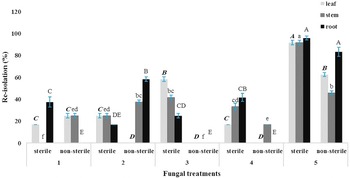
The presence of B. bassiana as an endophyte in wheat plants was confirmed in all of the tested treatments after 14 days of initial inoculation, and none of the control plants were found to be colonised by the fungus. The recovery of B. bassiana as an endophyte from different plant organs – leaf (F 9,30 = 88.58, P < 0.001), stem (F 9,30 = 40.04, P < 0.001), and root (F 9,30 = 35.54, P < 0.001) – differed significantly among the different inoculation methods. The highest percentage of B. bassiana re-isolation was obtained in the conidial powder seed inoculation under both sterile and nonsterile conditions from the leaf (91.7% and 62.5%, respectively) and the stem (91.7% and 45.8%, respectively; Fig. 1). In the case of root inoculation, both the conidial powder–inoculated seed treatment (95.8% and 83.3% for sterile and nonsterile conditions, respectively) and foliar spray treatment under nonsterile conditions (58.3%) showed the highest rate of fungal recovery (Fig. 1). Beauveria bassiana was not recovered in any of the plant tissues in the conidial suspension–soaked seed treatment after 12 hours under nonsterile conditions. Also, no fungal growth was observed for the foliar spray and seed soaking in conidial suspension 24-hour treatments under nonsterile conditions among leaf samples (Fig. 1). Sterile and nonsterile soil drench, sterile foliar spray, and sterile seed soaking in conidial suspension 24-hour treatments showed the lowest percentages of stem endophytism. As shown in Figure 1, the sterile and nonsterile seeds soaking in conidial suspension 12-hour, sterile foliar spray, nonsterile soil drench, and nonsterile seed soaking in conidial suspension 24-hour treatments showed the lowest endophytic root growth compared to other treatments.
Mean (± standard error) colonisation percentages of Beauveria bassiana TV in different wheat plant parts (leaf, stem, and root) with different inoculation methods under sterile and nonsterile conditions in the greenhouse (1, SD; 2, FS; 3, SSS 12 hours; 4, SSS 24 hours; and 5, SCP treatments). No Beauveria bassiana was present in control leaves. SD, soil drench; FS, foliar spray; SCP, inoculation of seed with conidia powder; SSS, seeds soaking in fungal suspension; SSS 12 hours, seeds soaking in fungal suspension for 12 hours; SSS 24 hours, seeds soaking in fungal suspension for 24 hours.

Due to the absence of endophytism in the seed soaking in conidial suspension treatment after six hours and severe fungal contamination in the seed soaking in conidial suspension at 48 hours, these two treatments were excluded from the tests. The root endophyte intensity differed significantly according to the amount of inoculum (F 3,12 = 18.73; P < 0.001). According to the colony-forming unit value, the best endophyte was achieved by inoculation of 0.1 g conidia powder with the wheat seeds (equivalent to 3.1 × 10⁷ conidia/mL per seed; data not shown).
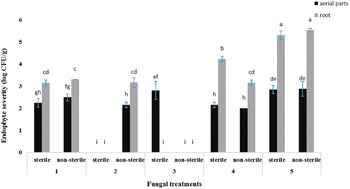
In the next step, the intensity of endophytic presence in plant extracts was investigated by counting colony-forming units. An interaction was observed between all three variables, treatment (F 4,21 = 567.8, P < 0.001), plant tissues (F 4,21 = 259.6, P < 0.001), and experimental conditions (F 1,21 = 14.4, P < 0.0005) on the intensity of B. bassiana endophyte in wheat plants (Fig. 2). The highest percentage of fungal recovery was obtained in roots after the seed inoculation in conidial powder under sterile and nonsterile conditions. The lowest-intensity endophytic presence was found in the aerial parts in the seed soaking in conidial suspension 12-hour treatment under both sterile and nonsterile conditions. Moreover, a significant difference occurred between the endophytic intensity in aerial tissues (stem and leaf) and root (F 1,21 = 259.6; P < 0.001). Significant differences were also observed among the different fungal treatments. The highest and lowest values for fungal endophytic intensity were observed in the seed inoculation in conidial powder and seed soaking in conidial suspension 12-hour treatments, respectively (F 4,21 = 567.8; P < 0.001).
The effect of endophyte inoculation of Beauveria bassiana TV (1, SD; 2, FS; 3, SSS 12 hours; 4, SSS 24 hours; and 5, SCP treatments) on the intensity of fungal colonisation in aerial (leaf and stem) and root tissues of wheat variety Pishtaz under sterile and nonsterile conditions in the greenhouse. SD, soil drench; FS, foliar spray; SCP, inoculation of seed with conidia powder; SSS, seeds soaking in fungal suspension; SSS 12 hours, seeds soaking in fungal suspension for 12 hours; SSS 24 hours, seeds soaking in fungal suspension for 24 hours; CFU, colony-forming units

Endophytic intensity in aerial parts and root of wheat plants was affected by inoculation method: the highest amount in roots was obtained by treating seeds in conidial powder, and the lowest value was recorded in the seed soaking in conidial suspension 12-hour treatment (F 4, 21 = 164.9; P < 0.001).
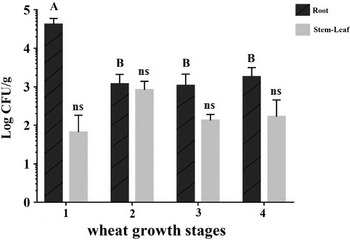
In the field trials, significant differences were observed in root endophytic intensity among the different growth stages (F 4,21 = 201.6, P < 0.0001), but in the aerial plant parts, endophytic intensity was not affected by growth stages (Fig. 3). Endophytic fungus was recovered from all vegetative organs, but its re-isolation from seed was not successful.
The effect of inoculation of seed with conidia powder treatment on the intensity of Beauveria bassiana TV colonisation in aerial (leaf and stem) and root tissues of wheat variety Pishtaz under different stages of growth (1, shooting; 2, tilling; 3, stem elongation; and 4, head emergence) in the field. CFU, colony-forming units

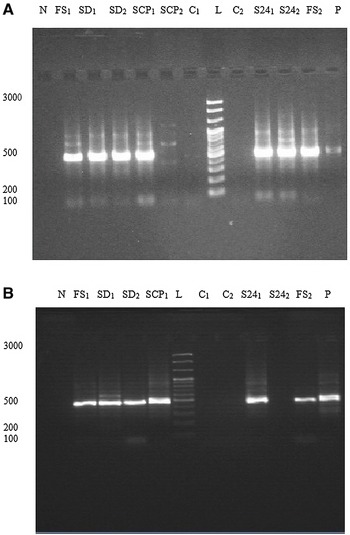
The presence of B. bassiana in wheat plants was also confirmed by performing polymerase chain reaction and amplifying the ITS1-5.8S-ITS2 sequences. Accordingly, in all treatments, an amplicon with the expected size was observed, but the target sequence was not amplified in the control plants (Fig. 4).
Detection of Beauveria bassiana TV with two-step nested polymerase chain reaction in A, wheat variety Pishtaz aerial parts and B, in the root. (N = negative control; FS1 and FS2 = FS R1 and R2; SD1 and SD2 = SD R1 and R2; SCP1 and SCP2 = SCP R1and R2; C1 and C2 = control R1 and R2; L = ladder; S24; and S242 = SSS 24 hours R1 and R2; and P = positive control). SD, soil drench; FS, foliar spray; SCP, inoculation of seed with conidia powder; SSS, seeds soaking in fungal suspension; SSS 12 hours, seeds soaking in fungal suspension for 12 hours; SSS 24 hours, seeds soaking in fungal suspension for 24 hours.

Growth index
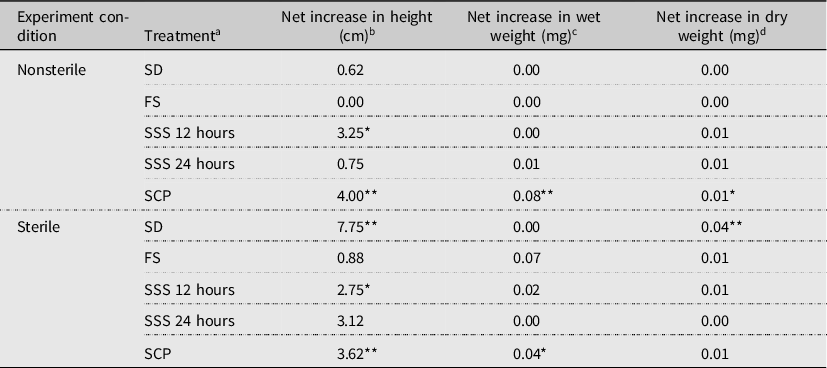
The effect of endophytic B. bassiana on growth promotion of wheat plants under different inoculation methods in comparison with control plants was analysed under both sterile and nonsterile conditions (Table 1). Height and wet and dry weights differed significantly in the inoculated plants compared to the controls. The most significant differences from the control plants in three parameters were recorded in the seeds treated with conidial powder under nonsterile conditions. The seed treatment in conidial powder under sterile conditions showed a significant difference in height and wet weight. Soil inoculation, or soil drench, led to increased height and dry weight under sterile conditions. Only the wheat plants’ height increased in the seed soaking in conidial suspension 12-hour treatment in both sterile and nonsterile conditions.
The effect of endophytic Beauveria bassiana TV on growth promotion of wheat variety Pishtaz plants with different inoculation methods in comparison with control plants under sterile and nonsterile conditions in the greenhouse.

aSD = soil drench; FS = foliar spray; SCP = inoculation of seed with conidia powder; SSS = seeds soaking in fungal suspension; SSS 12 hours = seeds soaking in fungal suspension for 12 hours; SSS 24 hours = seeds soaking in fungal suspension for 24 hours.
b, c, dThe data show the difference between absolute values of the growth parameter for fungus-treated and control plants.
* The significant difference, P < 0.05.
** The significant difference, P < 0.01.
In contrast to the greenhouse results, no significant differences were observed in the growth factors of inoculated plants compared to that of control plants in the field study.
Bioassay
The endophytic effect of B. bassiana was determined on life parameters of Sunn pest (Table 2). The egg-hatch percentages (t = 3.02, df = 6, P < 0.05) and nymph mortality rates (t = 5.23, df = 6, P < 0.01) were affected significantly by endophytism under greenhouse conditions: 60.9% of the eggs laid by the adults that were fed on the endophyte-treated plants hatched, whereas the hatchability percentage in the controls was an estimated 89.4%. In the treatment under greenhouse conditions, nymphs were unable to complete their life cycle and enter the adult stage.
Mean (± standard error) percentages of Sunn pest egg hatching and adult emergence after feeding on endophyte-treated and control plants in greenhouse and field. Percentage values are based on the recovery of eggs from four cages per treatment as follows: greenhouse (endophyte-treated plants: average 46 eggs/cage; control plants: average 43 eggs/cage); field (endophyte-treated plants: average 33 eggs/cage; control plants: average 35 eggs/cage).

Interestingly, pooled data from the field trials showed the same results as in greenhouse studies for egg hatching. The mean hatching percentage for adults in control plants was higher than that for adults reared on inoculated plants (t = 6.49, df = 6, P < 0.0001). The percentage of adult emergence from control plants was higher than that from inoculated plants (t = 5.45, df = 6, P = 0.001; Table 2).
Endophytic effect of Beauveria bassiana on plant disease
Significant differences between disease incidence in inoculated and control plants were noted (t = 5.149, df = 8, P < 0.001). Disease incidence in inoculated plants was significantly lower (36% ± 4.58%) than that in control plant (63.5% ± 2.55%). Presence of B. bassiana as an endophyte in wheat plants decreased 42% of the root and crown rot disease caused by F. culmorum in the greenhouse experiment.
Discussion
The wheat variety “Pishtaz” released in 2002 for temperate regions of Iran has good baking properties, shows resistance to yellow rust and wart, and is tolerant to brown rust. Different insect pests, particularly E. integriceps, which is the most destructive pest, threaten Iran’s wheat production. Another critical agent reducing the production of Pishtaz-variety wheat is Fusarium spp. The nonchemical control of these pests sensu lato is of particular importance. Taking advantage of the pathogenic potential of naturally occurring B. bassiana against insects and its recent discovery for endophytic effects against pests and plant diseases is worth consideration.
The endophytic potential of the B. bassiana isolate TV was investigated in wheat plants under greenhouse and field conditions. Of the different inoculation methods tested, the seed treatment in conidial powder showed the highest percentage of B. bassiana recovery in all three plant tissues (leaf, stem, and root). Admittedly, soaking seeds in conidial suspension (for 24 hours) and the foliar spray treatment (in all the tested time intervals) showed the lowest percentage of fungal recovery. Achieving the highest recovery rate of B. bassiana after inoculation in particular host plants is affected by the fungal inoculation method (Donga et al. Reference Donga, Vega and Klingen2018; Jaber and Ownley Reference Jaber and Ownley2018). Direct injection of inoculant into coffee (Rubiaceae) (Posada et al. Reference Posada, Aime, Peterson and Rehner2007) and corn leaves (Wagner and Lewis Reference Wagner and Lewis2000), stem injection (Bing and Lewis Reference Bing and Lewis1991), tomato seed coating (Ownley et al. Reference Ownley, Griffin, Klingeman, Gwinn, Moulton and Pereira2008), banana plant immersion (Akello et al. Reference Akello, Dubois, Coyne and Kyamanywa2008b), seed inoculation in other plants (Griffin Reference Griffin2007; Ownley et al. Reference Ownley, Griffin, Klingeman, Gwinn, Moulton and Pereira2008), and poppy (Papaveraceae) leaf or seed coating (Quesada-Moraga et al. Reference Quesada-Moraga, Landa, Muñoz-Ledesma, Jiménez-Diáz and Santiago-Alvarez2006) resulted in high recovery rates of B. bassiana after inoculation. According to Sánchez-Rodríguez et al. (Reference Sánchez-Rodríguez, Raya-Cíaz, María, García-Mina, Carmen and Quesada-Moraga2018), soil inoculation and seed coating were the most effective inoculation methods for B. bassiana endophytic establishment in wheat plants, and the foliar spray treatment rarely resulted in fungal recovery from plant tissue. Also, Posada et al. (Reference Posada, Aime, Peterson and Rehner2007) reported that leaves are a poor route for fungal colonisation in the plants. It should be considered that those authors referred to coffee plants, which have stomata within only one surface of their leaves, whereas wheat and other grasses have stomata within both surfaces of leaves. However, we found that the fungus could establish in all parts of wheat by inoculation of seed treatment, soil drench, and foliar spray. Beauveria bassiana could successfully be recovered from parts of the plant that were not directly treated with the fungus. This ability may depend on the capacity of B. bassiana to reach the plant’s xylem and to spread from there throughout the plant (Wagner and Lewis Reference Wagner and Lewis2000).
The presence of B. bassiana in the treated plants was also confirmed using specific primers and two-step nested polymerase chain reaction. Using a combination of different detection methods for the re-isolation of B. bassiana leads to accurate detection of endophytic fungus in the plant (Rondot and Reineke Reference Rondot and Reineke2018). We were able to recover endophytic fungus from all vegetative organs, but we were unsuccessful in re-isolating B. bassiana from seed. However, the presence of an endophyte in a specific tissue does not necessarily elicit a measurable effect (Lopez et al. Reference Lopez, Zhu-Salzman, Ek-Ramos and Sword2014).
We demonstrated that B. bassiana has potential to improve plant growth parameters such as height and wet and dry weights, and that a relation exists between the inoculation method and plant growth. Plant-associated endophytes can promote plant growth directly through the production of plant hormones or indirectly through antimicrobial activity, ammonia production, and synthesis of deteriorating enzymes that inhibit pathogens (Hassan Reference Hassan2017). Our results support earlier investigations that showed improved wheat growth following inoculation with B. bassiana (Gurulingappa et al. Reference Gurulingappa, McGee and Sword2011; Sánchez-Rodríguez et al. Reference Sánchez-Rodríguez, Raya-Cíaz, María, García-Mina, Carmen and Quesada-Moraga2018). In contrast, Mantzoukas et al. (Reference Mantzoukas, Chondrogiannis and Grammatikopoulos2015) found that growth of sorghum was not influenced by the endophytic treatment with B. bassiana and Metarhizium robertsii (Clavicipitaceae).
In addition to their ability to promote plant growth, entomopathogenic fungal species’ insecticidal activity is of special importance. Endophytic B. bassiana establishment in wheat is shown to negatively affect mortality and egg hatching of Sunn pest. This effect on insect pests can be attributed to the chemical mechanisms B. bassiana induces in the plant (Lopez et al. Reference Lopez, Zhu-Salzman, Ek-Ramos and Sword2014); for example, the destructive effects of endophytic fungi were observed to affect growth and fertility of Acyrthosiphon pisum and Aphis fabae (both Hemiptera: Aphididae) nymphs. The numbers of nymphs reared on the treated plants were significantly lower than those fed on the control for two continuous generations (Akello and Sikora Reference Akello and Sikora2012), which is consistent with our results showing a significant reduction in egg hatching of Sunn pest fed on B. bassiana–inoculated plants.
No sign of fungal infection was detected in dead adults and nymphs in the current study, similar to previous studies (Cherry et al. Reference Cherry, Banito, Djegui and Lomer2004; Lopez and Sword Reference Lopez and Sword2015). This suggests that the insect-killing mechanism may be due to feeding inhibition, antibiosis, or alteration in host-plant metabolites. Therefore, host-plant quality, not the fungus itself, affects the insects (Quesada-Moraga et al. Reference Quesada-Moraga, Munoz-Ledesma and Santiago-Alvarez2009; Akutse et al. Reference Akutse, Maniania, Fiaboe, van den Berg and Ekesi2013; Lopez et al. Reference Lopez, Zhu-Salzman, Ek-Ramos and Sword2014; Reddy et al. Reference Reddy, Zhao and Humber2014; Mantzoukas et al. Reference Mantzoukas, Chondrogiannis and Grammatikopoulos2015; Yan et al. Reference Yan, Broughton, Yang and Gange2015; Jaber and Ownley Reference Jaber and Ownley2018; Rondot and Reineke Reference Rondot and Reineke2018). Reduction in insect populations or damage caused by insect pests such as Cosmopolites sordidus (Coleoptera: Curculionidae) (Akello et al. Reference Akello, Dubois, Coyne and Kyamanywa2008a), Iraella luteipes (Hymenoptera: Cynipidae) (Quesada-Moraga et al. Reference Quesada-Moraga, Munoz-Ledesma and Santiago-Alvarez2009), Ostrinia nubilalis (Lepidoptera: Crambidae) (Bing and Lewis Reference Bing and Lewis1991), and Sesamia calamistis (Lepidoptera: Noctuidae) (Cherry et al. Reference Cherry, Banito, Djegui and Lomer2004) has been attributed to the toxicity of endophytic metabolites of B. bassiana for the mentioned insects.
In addition to biocontrol of Sunn pest, endophytic B. bassiana was able to reduce F. culmorum infection by up to 42%. Similar results have been previously reported: for example, Jaber and Ownley (Reference Jaber and Ownley2018) reported that endophytic colonisation of wheat with B. bassiana (NATURALIS) resulted in a significant reduction in percentage disease incidence of F. culmorum, with up to 51.5% of B. bassiana–colonised plants having no visible symptoms of disease, whereas all Fusarium-infected noncolonised plants (control) showed visible disease symptoms after 24 days. The interaction between endophytic fungi and plant pathogens could be through fungal parasitism, competition for ecological and nutritional niches, or the production of secondary metabolites (Jaber and Ownley Reference Jaber and Ownley2018). After seed treatment, the initial endophytic colonisation may induce a defence mechanism in the plant by producing lignin or cell wall, leading to the reduction of pathogen contamination or prevention of the disease occurrence (Jaber and Ownley Reference Jaber and Ownley2018).
In conclusion, our results demonstrate the potential endophytic activity of an entomopathogenic isolate of B. bassiana for promoting growth of wheat and contributing to control of E. integriceps and Fusarium pathogen. Beauveria bassiana can be commercially produced and used in wheat cultivation, along with other elements to successfully control E. integriceps and Fusarium-caused diseases and to promote wheat growth and performance.
Acknowledgements
The authors acknowledge the financial support by the University of Tehran, project No. 73132800.6.25 and technical help by Dr. Kh. Fotowhifar, Farzaneh Zamani, and Nasim Khalifeh from the College of Agriculture and Natural Resources, University of Tehran, Karaj, Iran. James White, Rutgers University, New Brunswick–Piscataway, New Jersey, United States of America, provided valuable tips that helped to improve the manuscript. The authors used the online tool BioRender (BioRender.com) to create the graphical abstract (Publication License Agreement Number DS22YF9HI3).
Competing and conflicting interests
The authors declare they have no competing interests and no conflicts of interest. The authors confirm that the research was conducted in the absence of any commercial or financial relationships that could be construed as potential conflicts of interest.