Introduction
As the centenary approaches of the arrival of Robert Falcon Scott and his companions at the South Pole and their death on the return trip, there is growing interest in Scott related history.
Above the main altar in the Edge Anglican church (until recently St Alban's) in the northern Hobart suburb of Claremont is a three-panel or triptych stained glass window, dedicated on 17 October 1915, to commemorate Scott's life. It may seem strange that such a monument exists in Hobart but there were strong links between the Scott family and Tasmania.
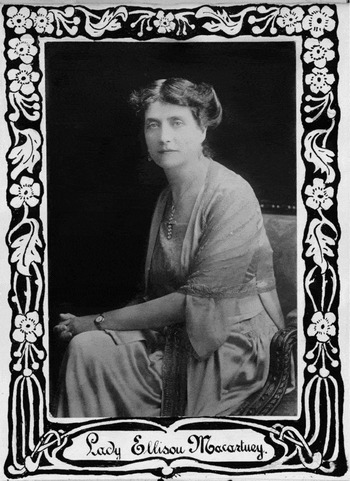
The foundation stone of the original St Alban's was laid on 5 July 1913. The foundation laying ceremony was attended by Ettie, Lady Ellison-Macartney (Fig. 1), the wife of Sir William Ellison-Macartney, governor of Tasmania (and later, of Western Australia). Lady Ellison-Macartney was Scott's sister. Also at the ceremony was Mrs Edith Knight of Windermere Park whose husband was a local lawyer and landowner. A young Clarence Knight presented Lady Ellison-Macartney with a posy. It is likely that this was the occasion when Edith Knight met Lady Ellison-Macartney and offered to have made, and installed, a stained glass window as a memorial to Scott.
Ettie, Lady Ellison-Macartney late in 1917. Courtesy of the State Library of South Australia.

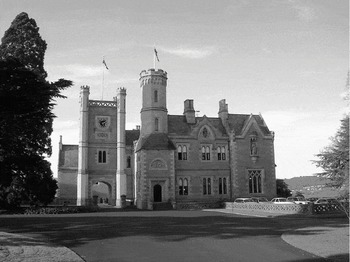
The timing was significant. Scott's death was confirmed on 12 November 1912 but not made known to the world until 12 February 1913, and the Scott family was still in mourning at the time of the laying of the foundation stone. In addition to Lady Ellison-Macartney, Scott's mother, sister, Rose Campbell, and niece Erica Campbell who had accompanied the Governor's family to Hobart were all resident at Government House at the time (Fig. 2). Tasmanians were very aware of the work and fate of a British national hero. This was in spite of the fact that Scott had not set foot on Tasmania other than for an afternoon on Macquarie Island on 22 November 1901.
Government House, Hobart, home of Lady Ellison-Macartney, Robert Falcon Scott's sister.

Claremont at this time was a small country parish with some 41 householders, chiefly farmers and orchardists, and families of private means, but the population was growing.
The church
The church was completed by 18 April 1914 when it was formally dedicated. It had seating for 130 and had cost £391 to build. The entire cost was paid off within two years.
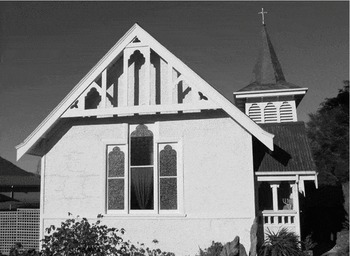
Unfortunately the St Alban's parish records of the time have been lost. During World War I, St Albans was incorporated into the much larger Glenorchy (St Paul's) parish and few references to St Alban's exist in the Glenorchy weekly parish news. The Church year book for 1914 notes (Church year book of the Church of England in Tasmania 1914: 31) that the church ‘will be dedicated in a week or two by the Bishop’. The record for 1916 (Church year book of the Church of England in Tasmania 1916: 37) refers to ‘the Claremont church in which a painted window has been put by Mr J.C.E. Knight in commemoration of the brave Antarctic explorer, Captain Scott, R.N.’ The original St Alban's church (Fig. 3) was deconsecrated in December 1980 and sold; it is now a private home. The window was incorporated into a modern church that was consecrated in 1981.
Original St Alban's church Claremont showing the rear wall where the stained glass window was originally installed.

In the original church, the windows were in the wall and lit by natural light; in the new building, they are not visible externally but are well backlit by artificial light.
The window
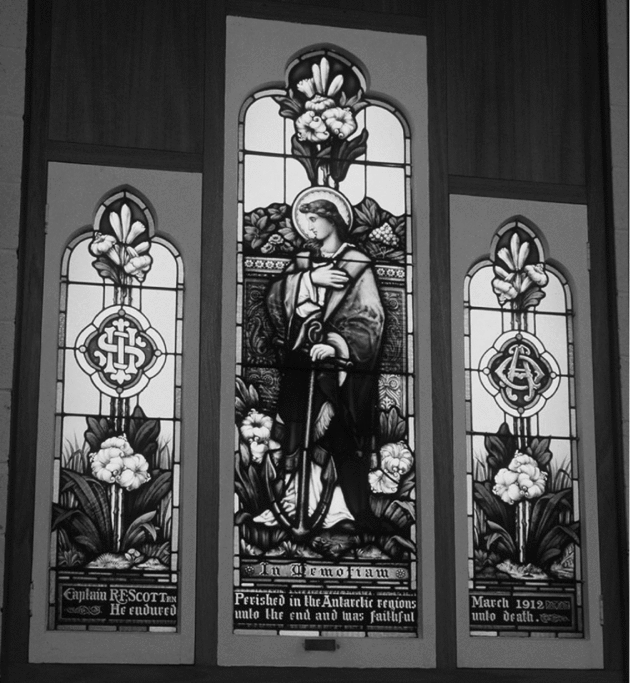
Winter (Reference Winter1996) summarised what was known of the window at the time. The window (Fig. 4) consists of three tall panels and was described in the Church News (Church news for the Archdiocese of Tasmania 1915: 11) as being of ‘chaste design’. The Tasmanian Mail of 14 October described it as ‘a very beautiful one, and the colouring exquisite’ (Tasmanian Mail (Hobart) 14 October 1915).
The stained glass window.
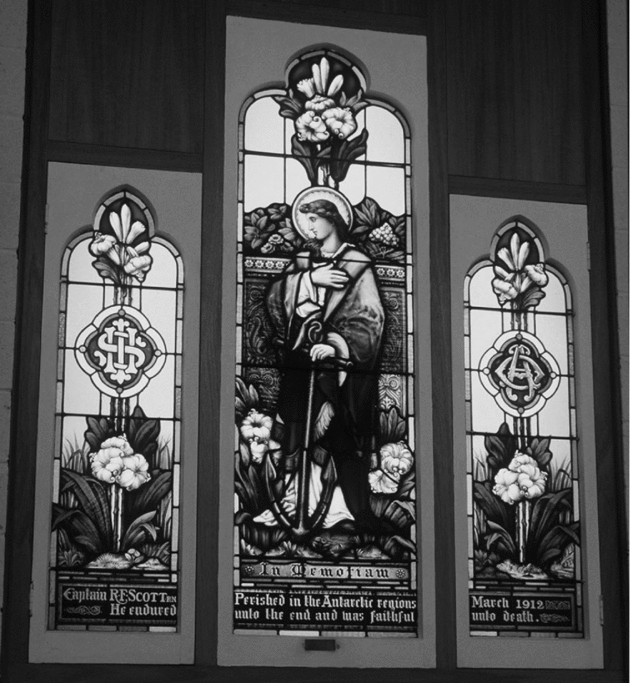
Left hand and right panels are very similar with lilies below and above. Slightly above centre height in both is a monogram, that in the left hand panel a representation of the Latin IHS (In hoc signo [vinces] – In this sign [you shall conquer]) and on the right is the A and Ω (Revelations 22:13). Otherwise, they differ little. The centre panel shows Jesus (or sometimes referred to as Hope – see below) with scalloped halo and right hand on his/her breast, looking to the right with left hand resting on an anchor, the symbol of the sailor. Again, lilies are dominant. This panel also contains the dedication ‘In memoriam’. Across the base of the three panels is the statement ‘Captain R.F. Scott RN. Perished in the Antarctic regions March 1912. He endured unto the end and was faithful unto death’.
The dedication
Winter noted that the windows were dedicated on Sunday 17 October 1915. The Weekly Courier of Thursday 21 October, 1915 carries the following comment under ‘Vice-Regal’ ‘His Excellency and Lady Ellison-Macartney, and Miss Esther Ellison-Macartney, went to St. Albans Church, Claremont, on Sunday morning, when a memorial window to the late Captain Scott was dedicated.’ Under ‘General Notes’ of the same edition is the following (Weekly Courier 1925: 28–29):
Although the weather was wintry on Sunday, there was a large congregation at St. Albans, the little Anglican Church at Claremont, where there was a dedication service in conjunction with a memorial window to the late Captain Scott. His Excellency the Governor, Lady Ellison-Macartney and Miss Esther Ellison-Macartney, attended by Colonel Evans, attended the service which was conducted by the Rev. J. Dodson. The window which was given by a parishioner, has in the centre the figure of Hope, with an anchor, and the side panels are lilies.
Design and manufacture
Since Winter's (Reference Winter1996) paper, considerable effort has been expended in finding out more information about the window but tantalisingly little information seems to exist and questions still remained. Where were the windows made? Who designed them and how much did they cost? Possible answers to these questions have been obtained.
Winter (Reference Winter1996) stated that ‘The maker of the stained glass windows is unknown’ but surmised that the design may have originated with Alan Cameron Walker, the architect for the church.
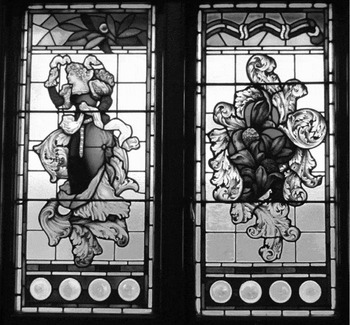
It now seems very likely that the window was designed and manufactured by Auguste Fischer of Melbourne perhaps with design assistance from Walker. According to Dr Bronwyn Hughes, a stained glass historian, Fischer (sometimes misspelled as Fisher) was a close friend and associate of Alan Cameron Walker (McNeill and Ratcliff Reference McNeill, Ratcliff and Alexander2005), a notable Hobart architect who designed the church at Claremont and whose home ‘Huonden’ in Hobart (Fig. 5) contains a set of Fischer's stained glass work. Fischer's work is quite widespread in Tasmania, for example ‘Crucifixion’ at St James’ Anglican church (now deconsecrated) at Jericho, southern Tasmania, and ‘The Annunciation’ in Holy Trinity church, Hobart (now Greek Orthodox).
Stained glass windows in ‘Huonden’ Hobart, home of the Alan Cameron Walker, architect of the original St Alban's church.

In the opinion of Hughes, a hallmark of Fischer's work is that ‘He often floated his figures or heraldic devices against a leadlight background, as seen at ‘Huonden’. . .’. This feature is evident in the Huonden windows (Fig. 5) and in all three panels of the Edge window, particularly those on the left and right. Hughes (B. Hughes, personal communication, 29 June 2010) is quite certain that Auguste Fischer was the designer/maker.
Fischer was born on 5 September 1860, the son of Peter Joseph and Ellen Fischer of Grosvenor Square, London. He came to Australia about 1884, after an early career training in stained glass techniques, and travelled widely in the late 19th century, keeping up with developing techniques. He worked predominantly on religious themes, especially for domestic settings.
Until 1911, his address in Melbourne was given as 184 Little Flinders St. but then changed to 12 Watson Place. It was apparently a successful business because it survived the 1890 depression. After his death on 26 June 1916, his studio, its goodwill and contents were sold to William Wheildon of Brooks, Robinson and Co. The name Fischer was still used until 1918 when, in advertising, it was changed to Fisher because of anti-German prejudice even though his parents were English, and that name remained in use until 1927. The Walker/Fischer link makes it likely that the window was made in Melbourne.
Walker was more than simply an architect but was also a craftsman in silverware. Another of his buildings with close Antarctic associations is the Hobart General Post Office, from the steps of which Roald Amundsen announced he had been the first man to reach the South Pole.
Footnote
Scott's last Antarctic expedition was the amalgamation of two proposals, one by Scott and another by Lieutenant E.R.G.R. Evans. When Sir Clements Markham became aware that two were being planned, he suggested a combination with Scott as leader and Evans as his second in command. Evans’ concept was of a Welsh group and he had been very successful in obtaining support in Wales. In consequence, the expedition sailed from, and returned to, Cardiff. On Saturday 29 March 1930, Evans (now Rear Admiral) gave an illustrated address to The Royal Society of Tasmania on the topic ‘Scott's last Antarctic expedition’. He was unaware that a memorial existed in Tasmania and received a photographic copy of the window (Hobart Mercury 31 March 1930).
Acknowledgements
We are very grateful to Dr Bronwyn Hughes of Hughes Hughes Associates, Melbourne for making her expertise available and her advice concerning the design and manufacture of the window. Brian Andrews made the important link with Dr Hughes. Bob Reeves, then photographer at the Australian Antarctic Division, took the initial photographs of the windows and these were made available through the intervention of Mr J. Davis. Mrs Anne Parker, Official Secretary, Government House Hobart, supplied the image of Government House. The Australian Institute of Architects gave advice on possible sources of information on the original architectural drawings of St Alban's. Crawford, Padas and Shurman (successors to A.C. Walker's firm) searched the company files, and Ms E. Wishart and Mr I. Terry, historians at the Tasmanian Museum and Art Gallery, searched the TMAG records, on our behalf but without success. Mr J. Kelleher (Huonden), Mrs S. Burbury (Jericho) and Fr T. Evangelinidis (Holy Trinity) helped examination of other known Fischer stained glass windows.