

The term ‘school connectedness’ (SC) is used to describe a student's relationship to school. SC is an ecological concept consisting of affective, behavioural, and cognitive dimensions, placing the individual in relationship with others. The transactional pathways of these relationships are multidirectional and shape and influence the individual's and others’ experience of SC. With school being a compulsory feature of most young people's lives, the nature of their relationship with this institution can be highly influential in terms of the quality of their overall school experience. Young people with low connectedness to school are more likely to withdraw from school (Finn, Reference Finn1989) and experience the parlous outcomes that may follow (Bloom, Reference Bloom2010; Lessard et al., Reference Lessard, Butler-Kisber, Fortin, Marcotte, Potvin and Royer2008; Sum, Khatiwada, McLaughlin, & Palma, Reference Sum, Khatiwada, McLaughlin and Palma2009).
The relationship between young people and school is the foundation on which the educational enterprise rests; therefore, this relationship is seen as highly influential in terms of outcomes for students, including its impact on academic performance and health (Mouton, Hawkins, McPherson, & Copley, Reference Mouton, Hawkins, McPherson and Copley1996; Prince & Hadwin, Reference Prince and Hadwin2013; Samdal, Nutbeam, Wold, & Kannas, Reference Samdal, Nutbeam, Wold and Kannas1998). The list of terms used to describe this relationship is lengthy, including ‘engagement’, ‘bonding’, ‘belonging’, and ‘attachment’, and the proliferation of terms has itself become a focus of comment and discussion (Allen & Bowles, Reference Allen and Bowles2012; Jimerson, Campos, & Greif, Reference Jimerson, Campos and Greif2003; Libbey, Reference Libbey2004; O'Farrell & Morrison, Reference O'Farrell and Morrison2003). Many researchers in this field preface their work with an acknowledgment of the variety of terms and lack of consistency in application and measurement (Faulkner, Adlaf, Irving, Allison, & Dwyer, Reference Faulkner, Adlaf, Irving, Allison and Dwyer2009; Frydenberg, Care, Freeman, & Chan, Reference Frydenberg, Care, Freeman and Chan2009).
A Historical Overview of School Connectedness
Described as a basic human need to belong and to experience relational mutuality (Baumeister & Leary, Reference Baumeister and Leary1995), connectedness, or social connectedness as it is frequently called, occurs in the exchanges between individuals and their social ecologies, which are broadly identified as family, school, and community or neighbourhood (Barber & Olsen, Reference Barber and Olsen1997; Shin & Yu, Reference Shin and Yu2012).
SC has drawn increasing scholarly interest as a specific domain of social connectedness (Ripperger-Suhler & Loukas, Reference Ripperger-Suhler, Loukas and Levesque2012), first gaining a conceptual profile in 1993 when Resnick, Harris, and Blum named it as a key protective factor for boys and girls against acting-out behaviours. Drawing on data from the National Longitudinal Study on Adolescent Health, Resnick et al.’s Reference Resnick, Bearman, Blum, Bauman, Harris, Jones and Udry1997 study identified SC as protective against a range of health-compromising behaviours and in the process firmly established its place in the field of adolescent health research. Newmann (Reference Newmann1981) had referred to connectedness more than a decade earlier when discussing ways to reduce student alienation in schools. Although the term was used with no conceptual specificity at that time, Newmann's impassioned case for schools to be places of ‘integration, engagement and connectedness’ (p. 549) offered a blueprint for school reform that contained elements such as student voice, increased opportunities for extra-curricular involvement, and improved student-teacher relationships that continue to feature strongly in SC research. Newmann's Reference Newmann1981 vision appears remarkably prescient when read from a vantage point three decades later. Since Resnick et al. conducted their 1993 and 1997 studies, SC has consolidated its presence in both education and health research as a key protective factor for young people, although its burgeoning profile has not produced greater conceptual clarity (Barber & Schluterman, Reference Barber and Schluterman2008; Chung-Do, Goebert, Chang, & Hamagani, Reference Chung-Do, Goebert, Chang and Hamagani2015; Millings, Buck, Montgomery, Spears, & Stallard, Reference Millings, Buck, Montgomery, Spears and Stallard2012).
The ambiguity surrounding SC can be partly explained by its location in the large set of constructs used to describe a student's relationship with school, including belonging and bonding. Whitlock, Wyman, and Moore (Reference Whitlock, Wyman and Moore2014), in discussing connectedness and suicide prevention in adolescents, identify nine conceptual frameworks that have shaped the definition of connectedness, including attachment theory, social support theory, resilience frameworks, and the bio-ecological model of human development. Additions to this list could comfortably include social control theory (Hirschi, Reference Hirschi1969), motivation theory (Maslow, Reference Maslow1962), self-determination theory (Deci & Ryan, Reference Deci and Ryan2000; Ryan & Deci, Reference Ryan and Deci2000), and human relatedness theory (Hagerty, Lynch-Sauer, Patusky, & Bouwsema, Reference Hagerty, Lynch-Sauer, Patusky and Bouwsema1993).
The definitions of SC that emerge from these theories range from Libbey's (Reference Libbey2004) pragmatic definition of SC as ‘the study of a student's relationship to school’ (p. 274) to more complex understandings viewing SC as multidimensional (Tighezza, Reference Tighezza2014) and generated by interactions among all members of a school's ecology (Rowe & Stewart, Reference Rowe and Stewart2011; Waters et al., Reference Waters, Cross and Runions2009). Clearly, an ecological understanding of connectedness, the overarching construct from which SC developed, is integral to its definition; yet SC research has been slow to embrace its conceptual origins (Barber & Schluterman, Reference Barber and Schluterman2008).
An ecological perspective has, however, grown over the last decade. Blum (Reference Blum2005) noted that SC was influenced by the interplay between individuals, environment, and culture, while Whitlock's (Reference Whitlock2006) definition marked a clear departure from earlier understandings, introducing the idea of SC as both given and received. Rowe and Stewart (Reference Rowe and Stewart2009, Reference Rowe and Stewart2010, Reference Rowe and Stewart2011) used a whole-school approach, informed by the Health Promoting School Model, to identify ways in which SC could be enhanced and firmly located SC in the multiple ecologies of the school. Similarly, Waters et al. (Reference Waters, Cross and Runions2009) describe SC as a function of the dynamic interactions between individuals and their social and ecological environments.
While the definition of SC continues to evolve, a small number of early studies have continued to be highly influential in how it is understood. In 2004, the Wingspread Declaration on School Connections served as a clarion call for an increased focus on the relational dimension of young people's school experience, singling out students’ relationships with adults, feelings of safety, and supportive environments, coupled with high expectations for learning as the core elements of connectedness, and defined SC as students’ belief that adults in the school care about them and their learning. In 2009, the Centers for Disease Control and Prevention (2009) co-opted this definition of SC and included peers as key relational influences.
Since Resnick et al. (Reference Resnick, Bearman, Blum, Bauman, Harris, Jones and Udry1997) reported that SC was protective for young people against pregnancy, substance use, emotional distress, and involvement in violence, research into SC has accelerated and evidence of the reach of its protective qualities has accumulated. One reason for the positive reception of Resnick et al.’s findings may be that it reinforced previous research into the link between a student's relationship with school and health-risk behaviours. Wilson (Reference Wilson2004) rightly observed that research into social bonding, described as ‘closely akin to connectedness’ (p. 298) had already established that the quality of social bonds can lower delinquency rates. This research and associated studies into school bonding and delinquency (Hawkins, Guo, Hill, Battin-Pearson, & Abbott, Reference Hawkins, Guo, Hill, Battin-Pearson and Abbott2001; Herrenkohl et al., Reference Herrenkohl, Hill, Chung, Guo, Abbott and Hawkins2003; Jenkins, Reference Jenkins1995) provided a firm foundation on which research into the links between SC and various adolescent problem behaviours has developed.
More recently, SC has been studied in relation to internet use (Yen, Ko, Yen, Chang, & Cheng, Reference Yen, Ko, Yen, Chang and Cheng2009), suicide prevention (Whitlock, Wyman, & Moore, Reference Whitlock, Wyman and Moore2014), depression (Joyce & Early, Reference Joyce and Early2014; Shochet & Smith, Reference Shochet and Smith2014), and transport risk-taking behaviours (Chapman, Buckley, Sheehan, Shochet, & Romaniuk, Reference Chapman, Buckley, Sheehan, Shochet and Romaniuk2011). The consistent findings from the research continue to be optimistic, situating SC as protective in young people's lives against a range of health risk behaviours.
Despite the bourgeoning research interest in SC, there continues to be little consensus on how it is defined (Loukas & Pasch, Reference Loukas and Pasch2013), and the present study sought to address this gap by exploring the meanings of SC from both student and school staff perspectives. A small number of studies has begun to emerge in which teachers’ views of connectedness are explored using qualitative approaches (Biag, Reference Biag2016; Bower, van Kraayenoord, & Carroll, Reference Bower, van Kraayenoord and Carroll2015; Chapman, Buckley, Sheehan, & Shochet, Reference Chapman, Buckley, Sheehan and Shochet2013); however, student voices are largely absent. Notable exceptions in the Australian context are Rowe and Stewart's (Reference Rowe and Stewart2009) study exploring the influence of a whole-school approach to SC via a case study design in which both students and staff were represented and Thompson and Bell's (Reference Thompson and Bell2005) use of focus groups to explore student, teacher, and parent perspectives on disconnection to school. More recently, a New Zealand study by Neely, Walton, and Stephens (Reference Neely, Walton and Stephens2015) used an ethnographic methodology involving students and teachers to explore the impact of shared school lunches on SC. Whitlock's (Reference Whitlock2006) study using surveys and student focus groups to explore contextual correlates of SC is also noteworthy, as is the study by Yuen et al. (Reference Yuen, Lau, Lee, Gysbers, Chan, Fong and Shea2012) exploring Chinese adolescents’ views on factors that shape SC. Such qualitative approaches, however, remain the exception, and SC research continues to reside largely in the empirical domain, with student surveys the default data source of most studies (Chapman et al., Reference Chapman, Buckley, Sheehan and Shochet2013).
The Current Study
In order to enhance the current understanding of SC, this study employed a mixed methods approach to answer the following research questions and test the following hypotheses:
1. What are the meanings of being connected to school?
2. What influences students’ connectedness to school? The hypotheses related to this research question are:
• A student's prior knowledge of Woodlands College, through having parents or siblings attend the College, would influence SC;
• A student's involvement in the decision to attend Woodlands College would influence SC;
• Starting secondary school with peers from primary school would influence SC;
• The distance a student lived from school would influence SC.
3. How is students’ connectedness to school nurtured?
Method
Design
This was a mixed methods study utilising both qualitative and quantitative data collection methods within a concurrent triangulation design (Cresswell, Plano Clark, Gutmann, & Hanson, Reference Cresswell, Plano Clark, Gutmann, Hanson, Tashakkori and Teddlie2003). This approach best suited the exploratory and confirmatory questions posed by this study and allowed both generation and verification of theory, which is considered a notable advantage of this approach (Teddlie & Tashakkori, Reference Teddlie and Tashakkori2006). The qualitative data were collected via student and staff focus groups, student diaries, and a student questionnaire with a series of open-ended questions and opportunities for additional comments, while the quantitative data were captured through single and multiple-choice items within the student questionnaire. The qualitative data enabled the exploration of meanings of SC as offered by students and staff, while the quantitative data through identifying the factors associated with SC allowed a profile of connectedness to be generated. Results from both data sources were triangulated.
Participants
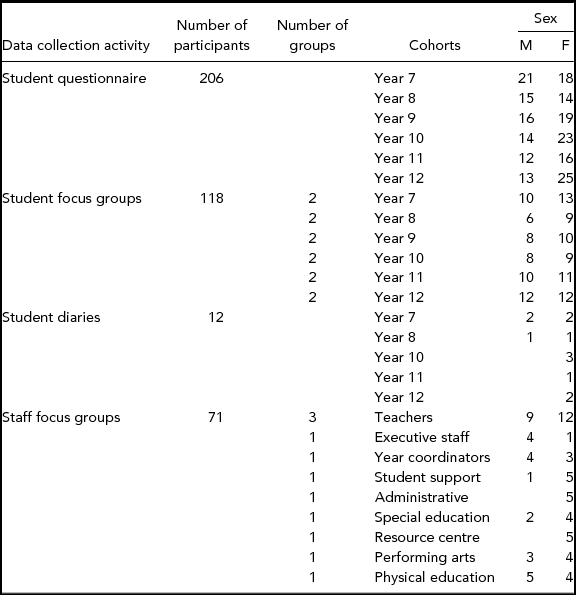
The study was conducted in a coeducational secondary school, Woodlands College (a pseudonym), located in metropolitan Melbourne, Victoria, Australia. At the time the study was conducted, Woodlands had an enrolment of 1,590 students and employed 167 teachers (68 males, 99 females). Participants ranged in age from 12 to 18 (M = 15.09, SD = 1.67). Indigenous students and students with a background other than English comprised less than 1% of the total enrolment. A total of 336 students (187 female, 149 male) participated in the study. In terms of living arrangements, most of the participating students lived with their immediate family, consisting of parents and siblings (194, 94.2%), with the remainder living with extended family or friends (12, 5.8%). Seventy-one staff (43 females, 28 males) participated in focus groups. See Table 1 for participants by method of data collection.
Study Participants by Method of Data Collection

Note: M = male, F = female.
For the quantitative aspect of this mixed methods study, the researcher determined the required sample size based on the results of a power analysis conducted using G*Power v. 3.0.1. When conducting the a priori power analysis procedures, the researcher took into account the desired medium effect size, the error probability, the desired power of the test, and the type of statistical analysis procedures that were planned (Faul, Erdfelder, Buchner, & Lang, Reference Faul, Erdfelder, Buchner and Lang2009). The results of the power analysis procedures are summarised in Table 2. Based on the results of the power analysis, a minimum sample size of 200 students was targeted for recruitment. A total of 206 students completed the questionnaire, which means that the minimum number of required samples was met.
Results of a Priori Power Analysis for Sample Size

Measures
Data were collected by multiple methods, including a student questionnaire, student focus groups, student diaries, and staff focus groups. The student questionnaire constructed for this study drew on comprehensive SC research and consisted of 109 items in eight sections, containing 64 single response items, 23 multiple response items, and 21 open questions. The School Connectedness Scale (Resnick et al., Reference Resnick, Bearman, Blum, Bauman, Harris, Jones and Udry1997) has been widely used to measure SC, although considerable variations exist in how it has been applied (Furlong, O'Brennan, & You, Reference Furlong, O'Brennan and You2011). While the original scale contained six items, other studies have used between three (Kaminski et al., Reference Kaminski, Puddy, Hall, Cashman, Crosby and Ortega2010) and seven (Svavarsdottir, Reference Svavarsdottir2008). In this study, four items from the School Connectedness Scale were included in the questionnaire. These questions pertained to whether the participant feels close to people at school, feels like a part of their school, feels safe at school, and whether the students at school are treated fairly. The 109-item questionnaire was piloted with five young people who had completed their final year of secondary education at Woodlands College in the year prior to data collection.
The first section of the questionnaire contained questions related to students’ age, gender, year level, educational history, family structure, parental attendance at parent-teacher interviews, and level of enjoyment in attending Woodlands College. Section 2 contained four open questions about what students do and don't enjoy about being a student at Woodlands, two questions about opportunities for students to express their opinions about school matters, and eight questions about school disciplinary policy and the student's history of truancy, and receiving detentions or suspensions. Section 3 asked questions about students’ awareness and understanding of the school's policy regarding student safety, and students’ views regarding bullying and their sense of safety at Woodlands. Section 4 contained 11 questions about the student's use of school spaces for different purposes and their preferred lunchtime activities. Section 5 asked students about their enjoyment of schoolwork, their academic progress across their subjects, their teachers’ engagement with them around their learning, and their intentions regarding completing their secondary education. Section 6 contained items regarding the student's access to supportive adults and peers at school, utilisation of nursing, counselling and educational support services, and health status. Section 7 posed questions about the student's relationships with school staff, what facilitates supportive relationships with particular staff, and what makes talking to teachers difficult. Section 8, ‘Activities/Things You Like Doing’, asked questions about the student's involvement in school-based activities, part-time employment, and use of cigarettes. Ten questions targeted students in different year levels, asking about their knowledge of, or their intention to participate in, key events for their cohort. The questionnaire concluded with an invitation for students to describe Woodlands to someone who was considering attending the College.
Item 26 in the questionnaire was a visual analogue scale (VAS), asking students to indicate their level of connectedness on a horizontal line, with the anchor points being not connected at all and very connected. The VAS has been used extensively in health research to measure subjective experiences such as pain intensity, fatigue (Crichton, Reference Crichton2001), and patient quality of life (de Boer et al., Reference de Boer, van Lanschot, Stalmeier, van Sandick, Hulscher, de Haes and Sprangers2004) and demonstrates reliability, validity, and sensitivity within health settings (Gift, Reference Gift1989).
The student focus groups were organised according to year level and included males and females, with the size of groups ranging from 6 to 13. The lead researcher facilitated all groups using a developed set of questions, which explored the participants’ general experiences of being a student at Woodlands through to more specific questions around availability of support, student-teacher relationships, school rules, involvement in extra-curricular and co-curricular activities, and safety. To ensure the content validity of the questions a pretest with four Year 12 students was conducted. Staff focus groups drew participants from the different operational areas of staffing and teaching faculties with group size ranging from five to eight. Questions addressed how staff recognise connectedness in students, student-staff relationships, and how schools influence SC. The student and staff focus groups were developed and run according to protocols as described by Stewart and Shamdasani (Reference Stewart and Shamdasani1990). All focus groups were audio-recorded and transcribed by a professional transcription service.
Student diaries were used as another form of qualitative data collection. Diaries are regarded as an effective way to explore an individual's emotional and relational experiences and are popular in mixed methods approaches (Snowden, Reference Snowden2015). Students who volunteered for this activity were asked to record their daily experiences of school life both within and outside the classroom over a 3-week period. Given the intimacy of the act of diary keeping (Hayman, Wilkes, & Jackson, Reference Hayman, Wilkes and Jackson2012) and the possibility of participant distress as a result, the researcher met weekly with young people to monitor their wellbeing and address any concerns that arose.
Procedure
Ethics approval was obtained from The University of Melbourne Human Research Ethics Committee, and the principal at Woodlands College gave permission for the study to be conducted. Participant and parental consent were obtained and students were recruited from randomly selected classes at each year level. Students were then randomly assigned to complete a questionnaire or participate in a focus group, while students who kept a diary volunteered for this task. Engaging with both male and female students across year levels 7 to 12 and staff from different areas of school operations was considered important. As indicated in Table 1, the numbers of participants involved in each data collection method varied considerably, but overall the goal of representation of different groups within the College was achieved. All data collection occurred in Term 4 of the school year (early October to mid-December) in order to allow all students, but particularly the Year 7 cohort who were in their first year at the College, to have experienced three terms of school life.
Data Analysis
Questionnaire data were examined using both descriptive and inferential statistical analyses. SC provided the dependent variable in the study and was derived from two sources. Each participant's connectedness response on the VAS was converted into a rating from very low (0–2) to very high (9–10) and this rating was cross-tabulated against the independent variables in the questionnaire to identify significant associations.
SC was also derived by summing up the scores attributed by the participants to four questions in the questionnaire from the School Connectedness Scale (Resnick et al., Reference Resnick, Bearman, Blum, Bauman, Harris, Jones and Udry1997). Each of the items was scored on a scale of 1 to 5, resulting in scores for the SC variable ranging from 5 to 25. This measure of connectedness enabled inferential statistical analysis to be applied. A Pearson's correlation analysis was conducted to determine any significant relationships between the continuous variables of the study. The results of this analysis were also used as the basis to quantify the type and strength of relationship between the study variables, based on the r coefficient. For the categorical variables, an analysis of variance (ANOVA) was conducted to determine whether the participants’ characteristics were associated with differences in their school connectedness scores. A linear regression analysis was conducted to determine which study variables were significant predictors of school connectedness. In the linear regression analysis, the study variables identified to be significantly correlated with SC were used as the independent variables, while SC was used as the dependent variable. For all analysis procedures, statistical significance was set at p = .05. Excel 14.6.2 and SPSS v.22.0 were used to facilitate data analysis.
The qualitative data, drawn from open items in the questionnaire, focus groups, and diaries were thematically analysed, allowing broad patterns to be identified. Thematic analysis is inductive, where the themes emerge from the data and are not predetermined by the researcher (Carroll, Booth, & Lloyd-Jones, Reference Carroll, Booth and Lloyd-Jones2012). In this study, the researcher conducted the thematic analysis in accordance with the six steps identified by Braun and Clarke (Reference Braun and Clarke2006). To facilitate the qualitative data analysis, NVivo v.8.0 was used. Both qualitative and quantitative data sets were analysed separately and results from each set were integrated during the analysis phase to identify areas of convergence or divergence (Terrell, Reference Terrell2012).
Results
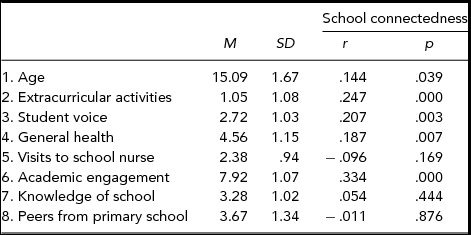
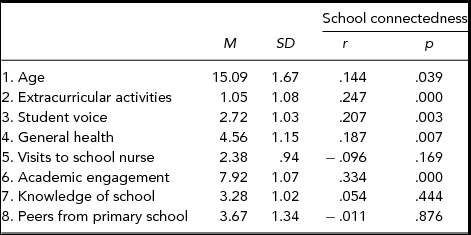
The means, standard deviations, and correlations of the study variables are presented in Table 3. The correlations show that age (r = .144, p = .039), extracurricular activities (r = .247, p < .001), student voice (r = .207, p = .003), general health (r = .187, p = .007), and academic engagement (r = .334, p < .001) are significantly positively correlated with SC. For SC, the dependent variable in the study, scores ranged from 5 to 24 (M = 14.45, SD = 3.90).
Means, Standard Deviations, and Correlations for Independent Variables
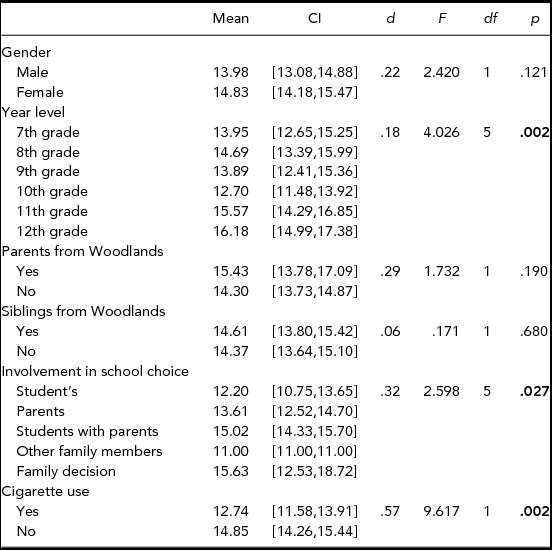
The categorical variables of the study were also analysed to determine whether these independent grouping variables were associated with differences in the SC scores of the participants. Based on the results of the ANOVA shown in Table 4, year level (F (5) = 4.026, p = .002), involvement in the decision to go to Woodlands College (F (5) = 2.598, p = .027), and cigarette use (F (1) = 9.617, p = .002) were significantly associated with differences in the SC scores of the participants. Students from the higher year levels had higher mean scores of SC compared to those from lower year levels. Similarly, students who made the decision to attend Woodlands with their parents had higher scores for SC. Students who reported cigarette smoking also had significantly lower SC scores than students who did not smoke cigarettes.
Results of ANOVA
Note: p < .05.
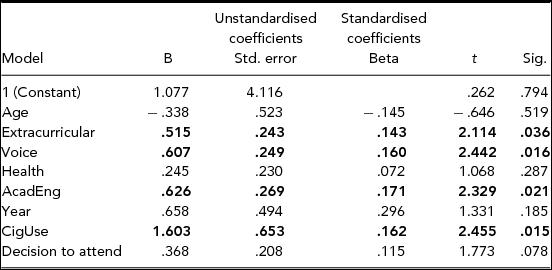
A linear regression analysis using SC scores as the dependent variable and the variables found to be significantly associated with SC as the independent variables was conducted. The results of the analysis, as shown in Table 5, indicate the proposed model is a significant predictor of SC, F(8) = 6.837, p < .001, accounting for 21.8% of the variance in the dependent variable (R 2 = .218). Among the predictors included in the model, extracurricular activities (β = .515, p = .036), student voice (β = .607, p = .016), academic engagement (β = .626, p = .021), and cigarette use (β = 1.603, p = .015) were found to be significant predictors of SC.
Results of Linear Regression Analysis
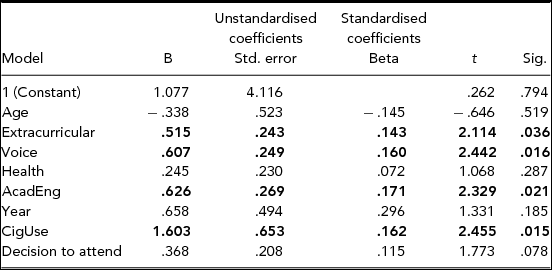
Note: a. Dependent variable: School connectedness b. Model = F(8) = 6.837, p < .001, R 2 = .218.
Using the students’ self-ratings of connectedness, significant associations were found with enjoyment in being a member of the school community (p = .001), the number of subjects a student liked (p = .001), the number of subjects the student was passing (p = .037), availability of an adult to talk to if the student was upset (p = .003), truancy for a whole school day (p = .004), and distance lived from school (p = 008). Smaller distance from school was associated with greater connectedness.
In addressing the research question about the meanings of SC, thematic analysis of the qualitative data from the student questionnaire, focus groups and diaries provided a surprising result, with a single meta-theme, opportunities, distinctly emerging from each data source. Four subthemes sat beneath the meta-theme: peer friendships, relationships with teachers and other school staff, activities, and learning. Among these subthemes, opportunities to experience peer friendships, frequently referred to as ‘socialising’, was the most frequently named across all the qualitative data sources. The theme and subthemes sat within a temporal and spatial domain so that opportunities occurred within particular places in the school (classrooms, school grounds, ovals) and within named timeframes (a period, a lunchtime, a term, a year). Students in the focus groups and diaries consistently told a narrative that presented school as a journey with multiple episodes located across time and in a variety of spaces. These aspects are captured in a comment from a Year 11 male student who observed that ‘Everyday I'm creating history here with my mates’.
School was seen as presenting opportunities to do things (extracurricular activities, sport, music, drama, camps); to make, grow, and dismantle friendships with peers; to form and resist relationships with teachers, and to learn and resist learning. A Year 10 female student commented that ‘there's lots of opportunities, lots of things to do, there's things for everybody, things you're interested in, people to meet, so a good school for opportunities and a job’. While few students used the term ‘school connectedness’, most students understood their connection to school through the opportunities it presented (or did not). The meanings of SC that emerged from the thematic analysis of the staff focus group data revealed five themes: enjoyment of school, engagement with teachers, part of a peer group, valuing learning, and involvement in school life. Like students, teachers also considered peer relationships as pivotal in connecting a young person to school, although more as a protective factor against disconnection than as a promotive factor for connection. In this regard, teachers and students viewed peer relationships in markedly different ways.
In relation to the research question concerning how schools can nurture SC, a single theme from the staff focus groups was provision of an enabling school environment that contained three subthemes: opportunities for teacher-student relationships to form, participatory pedagogy, and ensuring every student finds a niche in which they are recognised, can experience success, and relational connections are formed. Student responses to this research question fell into five themes: being treated fairly, being listened to by school staff on issues of concern, good teaching, the school's academic and behavioural expectations, and variety and number of relational and learning opportunities. Both students and staff regarded the relational experiences offered by school as key to enhancing SC.
Discussion
This study aimed to clarify the meanings of SC through a mixed methods approach. The study confirmed previously reported associations between SC and cigarette use, health status, extracurricular activities (Bonny, Britto, Klostermann, Hornung, & Slap, Reference Bonny, Britto, Klostermann, Hornung and Slap2000; Brown & Evans, Reference Brown and Evans2005), academic engagement, and student voice (Libbey, Reference Libbey2004). The study also identified new associations. Two of the hypothesised associations between SC were supported: joint decision making with parents about the choice of school and distance of residence from school were both associated with SC. Joint decision making may lead to greater student investment in the decision and may also be an indication of parental involvement and interest in their child's educational experiences, which has benefits for a young person's development (Davis-Alldritt, Reference Davis-Alldritt2012). Closer residence to school may facilitate participation in extracurricular activities and increase familiarity with and access to school facilities and spaces, which in turn may promote incidental contact with other students (not necessarily in the same age group or year level).
A key finding from this study concerns the way in which students understood their connection to school. For many students this connection was experienced through the opportunities given to them by the school. Opportunities existed in relational (peers and staff), activity-based (extra- and co-curricular), and academic (learning) domains, with considerable overlap between each. Staff also understood SC in terms of a young person's relational and academic experiences, as well as involvement in school life. Student and staff suggestions for ways to facilitate SC also fell into these domains.
The lead relational experience for students in this study was the peer relationship. Although relationships with teachers were important, they did not have the intensity, endurance, or influence of peer relationships. This differs from much previous research, which has focused heavily on the teacher-student relationship and its influence on a student's experience of school. In the present study, the teacher-student relationship emerged as more transitory and less influential than students’ relationships with peers, which were repeatedly characterised as central to life at school. The narratives students told about school were biographical accounts in which they and their friends and peers were lead characters, with teachers frequently appearing but occupying less prominent roles.
Students and staff provided similar advice regarding ways to enhance the relationships between teachers and students. Subjects such as sport, art, drama, and music were singled out as participatory learning experiences that created relational spaces in which students and teachers could encounter each other in novel and engaging ways. Camps, retreats, and excursions provided similar relational opportunities in which staff-student relationships and peer-peer relationships could develop.
Limitations
Students and staff who participated in this study were drawn from a single school and therefore are not representative of all students or staff or the multiple school sectors within the education system in Victoria. The purposive sampling strategy may have excluded some participants whose experience of connectedness differed from those selected to participate. The voluntary nature of teacher participation in focus groups also means that not all teacher perspectives were represented. The self-reported data from the questionnaire, focus groups, and student diaries cannot be independently verified; however, the congruence between the qualitative and quantitative data suggests that this was not a major limitation. It is worth noting that due to its definitional ambiguity, some claims regarding SC are based on studies of different constructs. Engagement and belonging appear to be most frequently used as surrogates, and this situation necessarily attenuates the strength of some claims regarding SC within this field of research in general.
Implications
SC emerges from this study as a process rather than a state, fluctuating across time within the relational, experiential, and physical spaces of school life. Reconceptualising SC as connecting (and disconnecting) to school requires responses that are both planned and spontaneous. Students are constantly building and dismantling their own and others’ connection to school as they negotiate their educational pathways. These changes can be minor and transient, or catastrophic, as when a young person drops out of school. The malleability of a number of the factors associated with SC provides clear direction for schools to focus their efforts and is a cause for optimism and energetic engagement with the task. Further studies are required to more clearly delineate SC from other constructs and bring much-needed definitional and conceptual clarity. SC research that seeks young people's accounts of their relationship to school is also needed so that a key constituency in this field is given a greater voice. This study has shown that they have important stories to tell about connecting and disconnecting to school.
Acknowledgments
None.
Financial Support
This research received no specific grant from any funding agency, commercial, or not-for-profit sectors.
Conflicts of Interest
None.
Ethical Standards
The authors assert that all procedures contributing to this work comply with the ethical standards of the relevant national and institutional committees on human experimentation and with the Helsinki Declaration of 1975, as revised in 2008.