Paediatric heart failure is an increasingly recognised consequence of childhood cardiac disease. Heart transplantation is a therapeutic option for those with end-stage heart failure. Since Kantrowitz performed the first paediatric heart transplant in 1967, enormous strides have been made in surgical approach, organ preservation, and immune management;Reference Bailey 1 , Reference Dipchand, Edwards and Kucheryavaya 2 yet, limitations to heart transplantation remain. Recent research highlighted in this study focusses on reducing wait-list mortality and re-assessing historical risk factors to heart transplantation that may not confer the same mortality risk in the present era.
There has also been a major frameshift in paediatric heart failure care with the introduction of more durable mechanical circulatory support for children. Several important studies regarding mechanical circulatory support use in children have been published in the past 3 years and will be summarised in this review.
Heart failure in children
Despite a growing number of children with heart failure, there are a few studies to guide paediatric heart failure management. An important publication in 2014 addressing this population is the ISHLT Guidelines for the Management of Pediatric Heart Failure.Reference Kirk, Dipchand and Rosenthal 3 This is the most comprehensive summary to date regarding end-stage heart disease in children. Most of the recommendations discussed are based on consensus (level of evidence C) due to the limited number of heart failure trials in children. Nevertheless, the guidelines are an important step to guiding uniform practice and highlighting gaps in the literature that need to be addressed by future studies.
Other notable studies within the past 3 years have examined the scope of paediatric heart failure through the use of national public databases.Reference Rossano, Kim and Decker 4 – Reference Rodriguez, Moodie and Parekh 6 Rossano et alReference Rossano, Kim and Decker 4 analysed the Kids’ Inpatient Database and the Nationwide Inpatient Sample to compare outcomes and charges for paediatric versus adult heart failure-related hospitalisations. They found longer duration of hospitalisation, higher mortality, and greater charges for paediatric heart failure-related admissions compared with adult hospitalisations. These findings shed light on the prevalence of paediatric heart failure, the burden on the healthcare system, and the need to improve value in terms of outcome and cost.
Cardiomyopathies in children
Key publications in 2013 from large registry-based, multicentre studies addressed risk stratification and outcomes of paediatric dilated cardiomyopathy.
Dilated cardiomyopathy
A follow-up study from the National Australian Childhood Cardiomyopathy Study indicated that 26% of patients with newly diagnosed dilated cardiomyopathy will proceed to death or transplantation within 15 years.Reference Alexander, Daubeney and Nugent 7 Familial cardiomyopathy and lower fractional shortening identify those at increased risk. Importantly, 69% of transplant-free survivors – 33% of the entire cohort – had recovery of systolic function. This remarkable rate of recovery is similar to that described by Everitt et alReference Everitt, Sleeper and Lu 8 from the Pediatric Cardiomyopathy Registry where they reviewed the findings in 741 patients with dilated cardiomyopathy. The authors found that 22% of the children had cardiac recovery by echocardiographic measures within 2 years following diagnosis. Interestingly, 9% of the patients with normalisation later experienced death or transplantation, indicating the need for lifelong follow-up and the potential for late deterioration.
The Pediatric Heart Network investigators sought to identify key clinical characteristics that predict disease progression in children with chronic, stable dilated cardiomyopathy.Reference Molina, Shrader and Colan 9 A combination of left ventricular end-diastolic dimension, ejection fraction, age, and diastolic function predicted progression of disease defined as hospitalisation, increased listing status, transplant, or death.
Collectively, these three publications from multicentre and national studies add significantly to our present understanding of paediatric dilated cardiomyopathy. These studies demonstrate the potential for recovery in children with acute heart failure, and the predictors of deterioration in the chronic, stable patient with dilated cardiomyopathy.
Heart transplantation
Despite breakthroughs in donor organ utilisation, such as ABO-incompatible heart transplant for infants, technological advances and expanded use of circulatory support devices, as well as better outcomes for many patients in the present era of heart transplant, wait-list mortality and post-transplant mortality remain unacceptably high for certain groups.Reference Almond, Gauvreau and Thiagarajan 10 – Reference Savla, Lin and Lefkowitz 17 Publications within the last 3 years have considered this disparity in wait-list mortality and have spurred paediatric heart allocation policy change in the United States that goes into effect in 2016.Reference Almond, Gauvreau and Thiagarajan 10 , Reference Singh, Almond, Piercey and Gauvreau 14 There have also been a number of recent publications challenging historical risk factors for paediatric heart transplant outcome.
Wait list and heart transplant outcomes
In one provocative study by Singh et al,Reference Singh, Almond, Piercey and Gauvreau 14 UNOS data were utilised to determine the benefit of transplant for patients stratified by disease severity at listing. By ranking the patients in disease-severity deciles, the authors evaluated how each group fared over time with respect to wait-list, peri-transplant, and post-transplant mortality. Risk of death or removal from the transplant list increased uniformly across the ranked groups of disease severity.
The analysis showed that heart transplant listing was beneficial in all groups except for the sickest.Reference Singh, Almond, Piercey and Gauvreau 14 Those ranked as having the greatest severity of disease at listing, the upper-most 5%, experienced a post-transplant mortality of 52%. For children on the other end of the spectrum who were least ill, there was a 5–10% survival benefit, which was relatively minimal compared with children in higher-severity deciles. This study revealed that 55% of children in the United States were listed at the highest priority level (status 1A) with the previously mentioned disparity in mortality and transplant benefit despite similar urgency listing. Results suggest that fine-tuning of the current listing process may improve overall transplant benefit and utility.
A similar rate of death or de-listing for deterioration was reported in a single-centre, retrospective analysis from Toronto.Reference Jeewa, Manlhiot, Kantor, Mital, McCrindle and Dipchand 15 In this study, 19% of children listed for heart transplant died or were de-listed because of deterioration within 6 months of listing. Mechanical support by ventricular assist device or extracorporeal membrane oxygenation, CHD, and younger age were associated with higher likelihood of death or de-listing. The finding of higher wait-list mortality or de-listing among those receiving mechanical circulatory support is of particular interest but may not represent the risk of associated mortality accurately as it pertains to extracorporeal membrane oxygenation versus ventricular assist devices due to the analysis of these circulatory support means together rather than separate. Other recent studies focussing on wait-list mortality and post-transplant outcomes in patients supported by ventricular assist devices have shown improved wait-list and transplant outcomes compared with extracorporeal membrane oxygenation.
Effect of heart failure aetiology and age on medication adherence and heart transplant survival
There is much attention given to improving medical adherence in children with chronic disease; two recent studies examined the associations of diagnosis as a surrogate for illness chronicity and of age with medication adherence and survival in paediatric heart transplant recipients.
Important age-related findings were identified by Savla et al and Oliva et alReference Oliva, Singh, Gauvreau, Vanderpluym, Bastardi and Almond 16 , Reference Savla, Lin and Lefkowitz 17 using data from the United Network for Organ Sharing/Organ Procurement and Transplantation Network. First, Oliva et alReference Oliva, Singh, Gauvreau, Vanderpluym, Bastardi and Almond 16 found adolescence to be an independent predictor of non-adherence, and found non-adherence to be associated with a high mortality rate – 33% mortality at 2 years in this cohort. Further examining adolescence and transplant outcome, Savla et alReference Savla, Lin and Lefkowitz 17 evaluated how heart failure aetiology as a surrogate for disease chronicity affects age-related differences in transplant survival. Children and adolescents who underwent heart transplantation due to myocarditis, presumably an acute illness in an otherwise healthy child, were compared with those with CHD – a marker for longer duration of illness and previous need for medical care. The analysis showed that adolescents with new-onset heart disease (myocarditis) had worse overall transplant survival than other age groups with myocarditis and that adolescence was a significant risk factor for mortality in multivariable analysis of myocarditis patients. In contradistinction, adolescents with chronic heart disease had better transplant survival than adolescents with myocarditis, and there was no difference in transplant outcome based on age when only those with previous CHD were analysed.Reference Savla, Lin and Lefkowitz 17 Taken together, these data suggest that adolescents have more issues with post-transplant management, particularly non-adherence, and that adolescents with new-onset heart failure in comparison with those with a pre-existing chronic condition may be especially vulnerable to worse transplant survival. Further studies into the effects of age and disease chronicity at the time of heart transplant on post-transplant medical adherence and survival are needed.
Re-transplantation
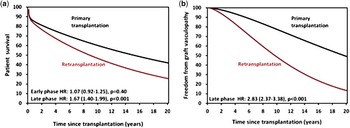
The number of re-transplants is increasing worldwide. An analysis of the International Society for Heart and Lung Transplantation database by Conway et alReference Conway, Manlhiot, Kirk, Edwards, McCrindle and Dipchand 18 found that paediatric recipients of a second cardiac graft had higher rates of renal dysfunction, infections, hypertension, and hyperlipidaemia, but a lower level of support at listing compared with the primary transplant cohort. The 1-year graft survival was similar between the groups, but mid-term outcomes were worse after re-transplantation, with median survival of only 8 years compared with 15 years after primary transplantation (Fig 1a). Rates of cardiac allograft vasculopathy in the second graft, late rejection, and late renal dysfunction were significantly higher in the re-transplanted patients (Fig 1b–d).
( a and b ) Patient survival ( a ) and freedom from graft vasculopathy ( b ). Re-printed from the study by Conway et al.Reference Conway, Manlhiot, Kirk, Edwards, McCrindle and Dipchand 18 Copyright (2014), with permission from Elsevier.

An analysis of patient outcomes after undergoing a third heart transplant was published in 2014 by Friedland-Little.Reference Friedland-Little, Gajarski, Yu, Donohue, Zamberlan and Schumacher 19 In total, 27 recipients <21 years of age at the time of the first transplantation were identified in the UNOS database who received a third heart transplant between 1985 and 2011. Survival, late rejection, and development of cardiac allograft vasculopathy were not different between those with second versus third cardiac allograft, although limited follow-up and the small number of patients somewhat limited the analysis.
Pulmonary vascular resistance
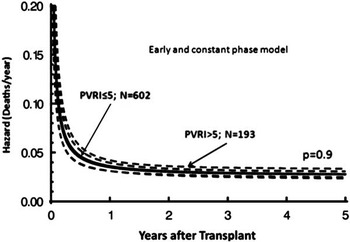
Pediatric Heart Transplant Study investigators challenged the notion that significantly elevated pulmonary vascular resistance is a contraindication to heart transplantation in the present era.Reference Richmond, Law and Das 20 In this analysis of 795 children with cardiomyopathy, significantly elevated pulmonary vascular resistance was defined as an indexed pulmonary vascular resistance >5 Woods Units×m2 – the highest quartile for the cohort. There was no increased risk for 90-day or late graft failure in the significantly elevated pulmonary vascular resistance indexed group (Fig 2). An era effect was seen with improved outcomes following 2009, possibly due to changes in postoperative management of pulmonary hypertension or right heart failure. Although the results show favourable outcomes for children with elevated pulmonary vascular resistance who undergo heart transplantation, it is important to recognise that this patient cohort was a select group of children. Specifically, the children in this cohort were determined by their listing centre to be suitable for heart transplantation and were not all-comers with pulmonary hypertension referred for heart transplant evaluation.
Multiphase hazard analysis of elevated PVRI. Re-printed from the study by Richmond et al.Reference Richmond, Law and Das 20 Copyright (2015), with permission from Elsevier. PVRI=pulmonary vascular resistance index.

Transplant for palliated CHD
Heart transplantation following Fontan palliation has been regarded as high risk because of the increased early mortality previously reported. Bernstein et alReference Bernstein, Naftel and Chin 21 published data from the Pediatric Heart Transplant Study spanning outcomes from 1993 to 2001. Lamour et alReference Lamour, Kanter and Naftel 22 analysed data from the same time period (1990–2002) by combining the Pediatric Heart Transplant Study registry and the Cardiac Transplant Registry. These authors reported an early mortality of ~25% in Fontan patients who underwent heart transplant, significantly worse compared with those without CHD.
Recently, two studies have shown that these patients remain at risk for early mortality but longer-term outcomes are favourable. Michielon et al described results from a single-centre review of 44 Fontan patients and 17 Glenn patients.Reference Backer, Russell and Pahl 23 Survival conditional to 1 year was similar to non-single-ventricle controls. Backer et al reported an early mortality of 23% in a series of 22 transplants after failing Fontan palliation.Reference Michielon, van Melle and Wolff 24 Remarkable is that seven (32%) had undergone Fontan conversion before the heart transplantation and that previous conversion was not a risk factor for post-transplant mortality. In both series, all transplant survivors with protein-losing enteropathy and plastic bronchitis had resolution of their pathological conditions following transplant.Reference Backer, Russell and Pahl 23 , Reference Michielon, van Melle and Wolff 24 Improved results for Fontan patients in the present era of heart transplant as reported in these recent studies may reflect earlier referral for heart transplantation before co-morbid conditions are severe and/or long-standing, more selective listing of candidates deemed to be at lower mortality risk, or improved pre- and post-transplant management.
Furthermore, one of the increasingly recognised complications of the Fontan palliation is liver disease.Reference Ghaferi and Hutchins 25 – Reference Wallihan and Podberesky 29 Often discussed is the indication for heart only versus combined heart–liver transplantation; two single-centre studies described excellent results with divergent approaches to this clinical dilemma. Simpson et alReference Simpson, Esmaeeli and Khanna 30 reported their experience with heart transplantation in Fontan patients with liver abnormalities diagnosed by CT. Among 20 Fontan patients who received a heart transplant, there were 12 with liver abnormalities (seven with cirrhosis). The 1-year survival was equivalent in patients with and without liver abnormalities (86 versus 77%). There was no progression of liver disease on serial follow-up. In contrast, Hollander et alReference Hollander, Reinhartz, Maeda, Hurwitz, N Rosenthal and Bernstein 31 reported their initial single-centre experience with heart–liver transplant in three patients with CHD and end-stage liver disease. All three underwent successful heart–liver transplant. Although outcomes with both transplant strategies appear similar, a goal of organ transplantation is to be judicious in the use of organs. Thus, determining patients who will benefit from heart alone transplantation without the need for simultaneous liver transplant will dually serve both the heart transplant recipient and those awaiting liver transplant.
These recent studies emphasise the continued efforts to improve perioperative results in Fontan patients. The resolution of the pathological processes afterwards supports the utility of heart transplantation to treat protein-losing enteropathy, plastic bronchitis, and hepatic cirrhosis.
Mechanical circulatory support
Until the last two decades, mechanical circulatory support in children has been almost exclusively provided through the use of extracorporeal membrane oxygenation. Since the first pulsatile paracorporeal ventricular assist device implanted in an 8-year-old boy in 1990, use of the Berlin Heart EXCOR device has grown steadily throughout Europe, North America, and the international community.Reference Warnecke, Berdjis and Hennig 32 Other temporary support devices such as paracorporeal centrifugal pumps are being used for ventricular support on both the left and the right sides of the heart in children and adolescents instead of traditional extracorporeal membrane oxygenation systems. In addition, fully implantable continuous flow devices are being used increasingly in older children and adolescents.
Outcomes of ventricular assist device use in children
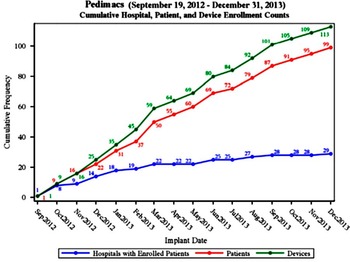
The Sixth Annual Interagency Registry for Mechanically Assisted Circulatory Support (INTERMACS) report published in The Journal of Heart and Lung Transplantation in June, 2014 was the first to report separate paediatric data specifically collected through submissions to the paediatric arm of the registry – PEDIMACS;Reference Kirklin, Naftel and Pagani 33 29 centres provided data on 99 patients <18 years of age from 2012 to 2013 (Fig 3). The caveat for this report is that the information contained in the registry is restricted to Food and Drug Administration-approved devices; however, the paediatric data do include both durable and temporary support devices. Among device implants reported in the PEDIMACS registry, the Berlin Heart EXCOR was utilised in nearly half of paediatric device implantations and was the only device reported in this registry to support children <5 years of age. Continuous flow support was preferentially used in larger children, including 50% of implants in children aged 6–10 years and 81% of implants in children aged 11–18 years.Reference Kirklin, Naftel and Pagani 33
Hospital, patient, and device enrolment in Pediatric Mechanically Assisted Circulatory Support, the paediatric arm of Interagency Registry for Mechanically Assisted Circulatory Support. The number in green indicates the total number of devices at any time point; the number on the red line indicates the total number of patients; and the numbers on the blue line indicate total number of hospitals with enrolled patients. Re-printed from the study by Kirklin et al.Reference Kirklin, Naftel and Pagani 33 Copyright (2014), with permission from Elsevier.

Key data from the Berlin Heart EXCOR regulatory database were published by Almond et alReference Almond, Morales and Blackstone 34 in 2013. This report focussed on outcomes from 204 children implanted with the EXCOR device in the United States and Canada from 2007 to 2010. The median duration of support was 40 days (with a range from 1 to 435). Survival at 12 months after implantation was 75%: 64% bridged to transplant, 6% explanted for recovery, and 5% alive on continued support. The primary cause of death was neurological insult. Multivariate analysis revealed lower weight, biventricular support, and elevated bilirubin as markers for early mortality. Notably, the mortality rate for infants weighing <5 kg was 64% (21/33). Lower weight infants with CHDs fared the worst with 13 of 14 (93%) dying after implantation.
Eghtesady et alReference Eghtesady, Almond and Tjossem 35 used data from the United Network for Organ Sharing/Organ Procurement and Transplantation Network to examine the 1-year transplant outcomes for children bridged to transplant with the EXCOR. They compared 106 children supported by the EXCOR before transplantation with a cohort of similar age that was not on ventricular assist device support at the time of transplant. There was no difference in the 1-year transplant survival between groups. There was a clear post-transplant survival benefit seen in those children supported by the EXCOR compared with those on extracorporeal membrane oxygenation. Rejection as a more frequent cause of 1-year post-transplant mortality among those supported by the EXCOR requires further study as does the higher rate of death after transplant for EXCOR patients with CHD versus those with cardiomyopathy (26 versus 7%).
In the United Kingdom, the Berlin Heart EXCOR has been used steadily for nearly a decade. Cassidy et alReference Cassidy, Dominguez and Haynes 13 reported the United Kingdom experience with the device in 2013. The patient cohort spanned the years 2004–2011 and included 102 patients with a total of 5247 days of support. In total, 86 patients (84%) survived to transplant (74) or explant for improvement (12). Similar to the experience in North America, CHD was a significant risk factor for death after implant; however, three of five single-ventricle patients supported by the EXCOR for a short period of time (3–7 days) survived to transplant. Haemorrhagic and thromboembolic events accounted for most of the mortality and morbidity in this cohort as well. The authors noted that over the course of the study they had increased utilisation of the EXCOR and fewer complications. Although this extended survival time on the wait list for their patients, there was no increase in the overall transplant rate because the number of donors remained stagnant.
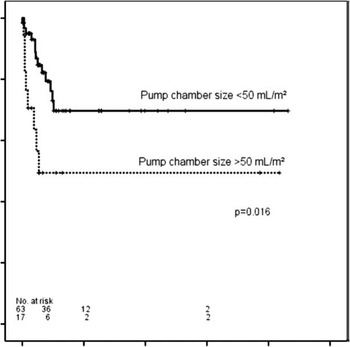
Furthermore, two additional studies published related to the EXCOR experience and thromboembolic events are worth noting. The first was a single-centre study by Byrnes et al,Reference Byrnes, Prodhan and Williams 36 which showed decreased rates of stroke with increased centre experience. The second study was from Germany by Meira et al.Reference Miera, Schmitt, Delmo-Walter, Ovroutski, Hetzer and Berger 37 The primary aim of this retrospective study was to evaluate whether pump size in relation to body surface impacted clinical outcome. The primary end points of mortality, myocardial recovery, and transplantation were not related to age, body surface area, or pump size; however, large pump size in relation to body surface area was an independent risk factor for thromboembolic events. Figure 4 shows the significant difference in survival without a thromboembolic event based on pump size per patient body surface area.
Thromboembolic events during ventricular assist device support. Comparison between children supported with pump chamber sizes <50 ml/m2 (solid line) and children with pump chamber >50 ml/m2 (dotted line). Re-printed from the study by Miera et al.Reference Miera, Schmitt, Delmo-Walter, Ovroutski, Hetzer and Berger 37 Copyright (2014), with permission from Elsevier.

Continuous flow mechanical circulatory support
There has been continued interest in utilising smaller continuous flow devices to support larger children and adolescents. Cabrera et alReference Cabrera, Sundareswaran and Samayoa 38 reviewed the present United States use of the HeartMate II in patients <18 years of age captured in the INTERMACS registry. In total, 28 patients between the ages of 11 and 18 years underwent HeartMate II implantation from 2008 to 2011. Survival at 6 months after implantation was 96% with 10 having undergone heart transplantation, three explanted for improvement, and 15 still alive on support. The 6-month survival rate and the complications reported were similar between the children (<18 years) and the adult patients (⩾18 years) supported by HeartMate II during the same time period. Placement of HeartMate II was shown to be effective down to a BSA of 1.1–1.2 m2.
The use of other continuous flow pumps is also being described successfully in children and in those with CHD. Several recent case reports within the past 3 years highlight the ever-growing array of applications for miniaturised continuous flow pumps in pre-adolescent children, as a transition from extracorporeal membrane oxygenation, as a means to reverse pulmonary vascular resistance elevation, or to recover the systemic ventricle before complex CHD.Reference Crews, Kaiser, Walczak, Jaquiss and Lodge 39 – Reference Yilmaz, Zuckerman and Lee 42 Sparks et al published the St. Louis Children’s Hospital data from 2012 to 2014, which included six adolescents with dilated cardiomyopathy and INTERMACS profile-1 or 2 supported for over 1000 total patient-days with the HVAD HeartWare.Reference Irving, Crossland, Haynes, Griselli, Hasan and Kirk 43 Ferra et al reported the Children’s Medical Center of Dallas’ experience (2013–2015) of eight children (age 9–17 years) with cardiomyopathy (n=7) and complex single-ventricle heart disease (n=1).Reference Sparks, Epstein and Baltagi 44 Among the 13 children with cardiomyopathy in these two series, survival was excellent with 12 bridged to heart transplant and one still supported by the device at >100 days after implant. The one patient with single-ventricle physiology died perioperatively in the Dallas series, and this group of patients with single-ventricle anatomy remains a challenge for mechanical circulatory support. Adverse events were not rare, occurring at a rate of one event per 170 days on the device in the St. Louis series. Most events were bleeding, infection, and renal failure with only one neurological event reported in these two series.Reference Irving, Crossland, Haynes, Griselli, Hasan and Kirk 43 , Reference Sparks, Epstein and Baltagi 44
Outcomes in children supported by mechanical circulatory support other than death and transplant
Although much of the early study of mechanical circulatory support in children has focussed on establishing the benefit of these devices to reduce wait-list mortality and achieve successful transplant, there are emerging reports on myocardial recovery. Irving et al reported on a series of patients in whom a structured protocol was used to assess readiness for EXCOR explantation.Reference Ferro, Murthy, Williams, Sebastian, Forbess and Guleserian 45 Patients were formally tested after 2–4 weeks of support to find out whether there was evidence of at least near-normalisation of systolic function. Testing included echocardiographic, invasive pressure, and blood gas monitoring with and without pharmacological stress over a 90- to 120-minute period; 11 explants occurred in 10 patients. There was one early cardiac failure and three late events of recurrent cardiac failure in two patients that required implantation of another device. All three patients who had recurrent failure and were implanted with another device went on to have successful transplantation; five of the other seven patients were alive with stable systolic function at the time of report.
Furthermore, two small single-centre studies examined quality of life and neurodevelopmental outcomes after ventricular assist device use.Reference Stein, Bruno, Konopacki, Kesler, Reinhartz and Rosenthal 46 , Reference Ezon, Khan and Adachi 47 Stein et al,Reference Stein, Bruno, Konopacki, Kesler, Reinhartz and Rosenthal 46 compared the neurocognitive outcomes in 11 children supported by ventricular assist device as a bridge to transplant versus paediatric transplant recipients without previous mechanical circulatory support and healthy controls. Overall, the ventricular assist device group performed in the normal range, although on aggregate lower than the healthy controls. The heart transplant recipients with previous ventricular assist device performed better than the transplant recipients without previous mechanical circulatory support with regard to working memory, processing speed, and perceptual reasoning. Although the number of patients is small, the findings are reassuring that acceptable neurocognitive outcomes can be attained in children supported by ventricular assist devices, despite the aforementioned neurological complications associated with their use. Ezon et alReference Ezon, Khan and Adachi 47 compared quality-of-life scores in 21 children who required long-term ventricular assist device support and 42 children without ventricular assist device support before transplant. This study showed similar quality-of-life scores among children with and without ventricular assist device use.
These studies pertaining to ventricular assist device use in children show promising results. These include increased access to and utilisation of ventricular assist device support in children, a reduction in morbidity related to institutional experience, and encouraging neurocognitive and psychosocial outcomes for children after ventricular assist device support.
Future directions
In the almost five decades since the first paediatric heart transplant was performed, there have been striking advances in the care for children with end-stage heart disease. There is a growing awareness of the need for heart-failure therapies, mechanical circulatory support, and life-saving heart transplantation to treat children with advanced heart failure. This need is reflected by much of the literature summarised from studies in the past 3 years. Many of these recent studies have reported better wait-list survival, reduced pre-transplant morbidity, and improved heart transplant survival despite challenging risk factors in the recipient. As always, new data must be interpreted in the context of previous publications. Although improved outcomes in contemporary studies may lead to the interpretation that certain risk factors no longer impact outcome in the present management era, this is not necessarily a correct inference. In fact, these improved outcomes may be the direct result of careful assessment and recognition of these risk factors, the cautious selection of suitable candidates, and the expectant management of these risk factors. The past few years mark a pivot point in the treatment of paediatric heart failure. The future directions of paediatric heart failure care hinge on building on previous research and harnessing the power of multicentre and international collaborations and the ingenuity that has been a constant driver of progress.
Acknowledgements
The authors acknowledge Cynthia Schmidt from the University of Nebraska, McGoogan Library, for her help with the preliminary literature search.
Financial Support
This research received no specific grant from any funding agency, commercial, or not-for-profit sectors.
Conflicts of Interest
None.
Ethical Standards
The authors assert that all procedures contributing to this work comply with the ethical standards of the relevant national guidelines on human experimentation and with the Helsinki Declaration of 1975, as revised in 2008, and has been approved by the institutional committees.