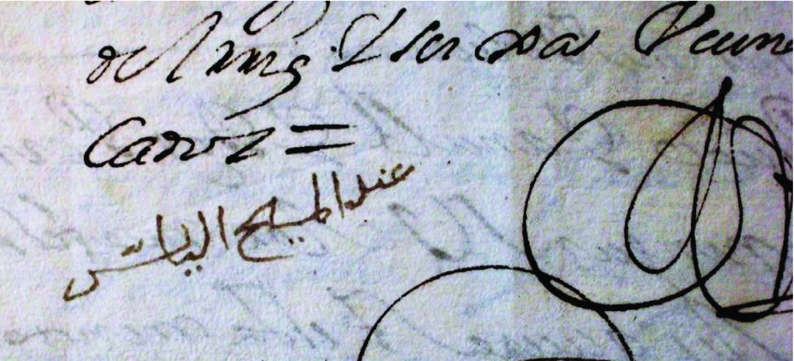
Let me begin with three signatures that do not belong. The signature in Figure 1 comes from the will and testament of a man described in Spanish as ‘Manuel de Elías the Greek (de nacion griego)’. Originally from Aleppo, Manuel had travelled to Iberia at some point, where he started a new life for himself in Cádiz. At any rate, he had been in Spain long enough to marry, have children and accumulate a sizeable array of possessions. In February 1679, presumably during the last days of his life and after so many years spent away from home, Manuel still decided to sign his will in the language of his parents. When faced with this document, anyone who reads Arabic might be forgiven for imagining that Manuel actually had forgotten how to write his name in Arabic: the ligatures joining the Arabic letters seem malformed and, at the very least, he could not remember where to place the diacritics.Footnote 1
Manuel de Elías, or ʿAbd al-Masīh Ilyās, Cádiz 1679. Reproduced with permission from the Archivo Histórico Provincial de Cádiz, Cádiz, Spain.
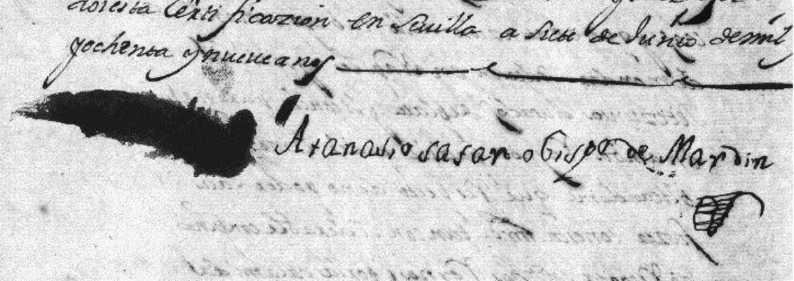
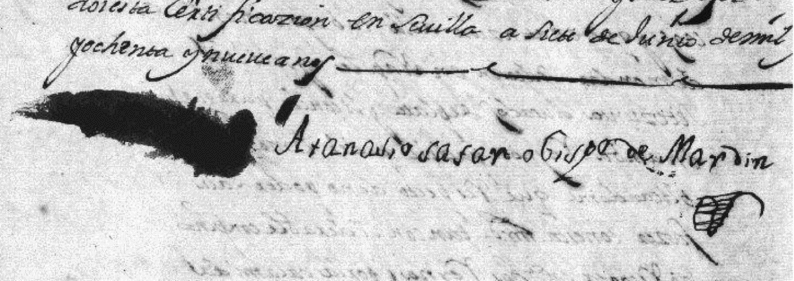
The second signature is that of Athanasius Safar, a bishop from Mardin in today's south-eastern Turkey. In the 1680s, Athanasius began to cultivate links with the Catholic church, which culminated in his visiting Rome and then Spain in 1689 where he secured permission to travel to the New World to collect alms. As he and his servant boarded a ship bound for Mexico, Athanasius signed a document at the Casa de Contratación, or Board of Trade, which is presented here in Figure 2. What are we to make of the pronounced right-to-left smudge to the left of his signature? He may well have started instinctively to sign his name in Arabic only to suddenly stop, blot out the signature and rewrite it again – this time in the Latin alphabet as ‘Atanasio Safar, bishop of Mardin’.Footnote 2
Athanasius Safar, bishop of Mardin, Seville 1689. Reproduced with permission from the Archivo General de Indias, Seville, Spain.
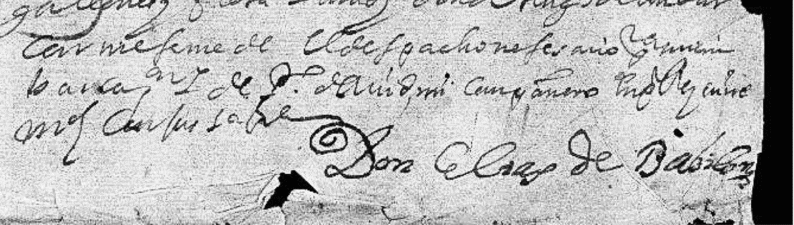
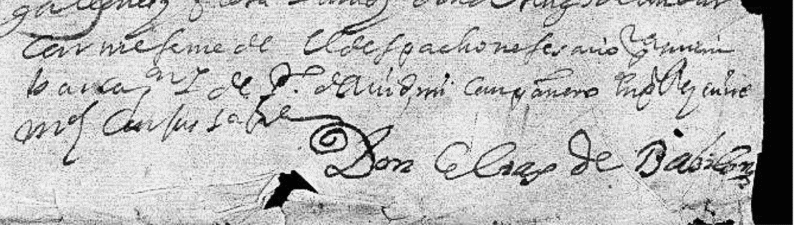
Perhaps my favourite signature is that in Figure 3 belonging to Ilyās ibn Ḥanna al-Mawsilī, or Elías de Babilonia, a priest from Mosul who travelled across Europe and as far as Peru in the late seventeenth century. Note, here, the fantastic curl in the first letter of ‘Don’, a testament to the great concentration with which Elias signed his name in the Latin script. And yet, in this instance, he seems to have made a crucial miscalculation: he ran out of space at the end of the line. The reason for this is not surprising: for a man accustomed to signing his name from right to left in Arabic, even the simple act of signing in the Latin script risked becoming a moment of cognitive dissonance in the everyday life of an individual living in a new society.Footnote 3
Don Elías de Babilonia, Seville 1675. Reproduced with permission from the Archivo General de Indias, Seville, Spain.
If we are persuaded by what some historians have been telling us for decades about the importance of small details, then we might imagine that these signatures offer clues into the everyday experience of circulation and mobility in the early modern world.Footnote 4 Indeed, we could develop at least three different interpretations of migration as reflected here in these signatures. There is Manuel de Elías who in the last days of his life was persuaded (by nostalgia?) to sign his name in Arabic as ʿAbd al-Masīh Ilyās even though he may have forgotten how to do so properly; Athanasius Safar whose hand seemed instinctively to sign in Arabic, only for his mind immediately to correct this impulse a moment later; and finally Elias of Babylon whose determined curls in the first letter of his signature appear contrived, perhaps even artificial, on the page.
Of course, there are countless ways of interpreting these signatures (assuming we accept that they can even be interpreted). I begin in this way, therefore, not out of some amateur fascination with graphology or psychoanalysis, but rather because this paper is about how we make sense of the diverse historical record that survives about Eastern Christians and their experiences of life in early modern Europe. Fortunately, we need not rely only on signatures because there exist today a wide variety of sources, documents and witnesses to this type of movement by Ottoman Christians. For when we cast our eyes across the horizons of early modern Europe, we find Christian subjects of the sultan lurking in all sorts of places: urban centres and port cities, to be sure, but also small towns and villages further afield. Drawing on their unique linguistic skills, some of these individuals created new lives for themselves as copyists, translators and librarians, leaving marginalia, colophons and autobiographical notes scattered across the manuscripts they encountered. Still others struggled to eke out a living for themselves as itinerant alms-collectors, merchants and purveyors of luxuries and marvels. In a few cases, a considerable amount of evidence can be drawn together to tell the story of the life of a single person. But more often than not, these wayfarers left nothing behind apart from a thin paper trail in the archives of the countries through which they walked. Or even less: in the case of a man from Mount Lebanon who travelled through Germany in 1727, all that remains today are a few vague printed news reports and some of his personal effects – a pair of slippers and the gown that he left behind for the cabinet of curiosities of his host, the duke of Saxe-Gotha – which can still be visited today in the Schlossmuseum of the Friedenstein Castle in Gotha.
Signatures, scraps of paper, slippers: all like shiny objects to a magpie. Yet one might reasonably wonder whether it is even possible to construct a wider history of early modern circulation based on such trinkets? Perhaps we would feel that we were standing on firmer ground if we focused our attention instead on the growing collection of first-hand narratives that have become the subject of sustained interest by specialists working in oriental and Eastern Christian studies. Consider, for example, a couplet of poetry that appears in a letter written in May 1642 by one Niqūlāwus ibn Butrus, a copyist from Aleppo who was persuaded to come to Europe by Christian Ravius, a German orientalist who had been travelling in the Ottoman Empire. Soon after his arrival in England, Niqūlāwus was disappointed by the scheming ways of his new patron. In a remarkable set of his letters recently given new life by Hilary Kilpatrick and Gerald Toomer, this was how Niqūlāwus summed up his experiences in a letter to a friend:
So much for everyday life in the Republic of Letters. But if we consider the context of this letter, then we must ask ourselves whether in fact first-hand narratives such as these are any more useful as sources than the signatures with which I opened this paper. The letter was in fact written to the Dutch orientalist, Jacob Golius, who Niqūlāwus hoped would be able to help him secure a new patron, a new job, a new life. It comes as no surprise then that the strategy adopted in his letter recalls those of others in need, for example letters requesting poor relief or petitions submitted to municipal authorities. We struggle to hear the perspectives of dislocated souls, cast adrift in the early modern world, whose voices have been drowned out by their poignant attempts to endear themselves to their host societies. Put simply, working with the very sources that appear to give us the most direct access to this category of migrants can sometimes feel like falling down a rabbit hole.
In recent years, the movement of people has become a subject of particular interest among early modern historians. In part, this is a reflection of contemporary developments and the politics of migration flows today, but it is also the expression of a genuine sense among historians that movement really mattered when it comes to making sense of the key transformations of the early modern period. From an ‘alternative history of the Reformation’ that focuses on religious exiles to the growing body of work by social and economic historians interested in migration, diasporas and trade networks, movement is on the historical agenda today in a real and substantive way.Footnote 6 Even so, we still have a long way to go in terms of developing a critical approach to the study of movement, circulation and migration. One particular issue concerns me here, what we might think of as a problem of perspective. When historians write about migration, what they often seem to be referring to is physical movement, that is, the purposeful movement of individuals, families or entire communities from one geographic place to another. In most cases, this work has focused on certain forms of movement that, on the surface at least, appear to be permanent, unidirectional and intentional. And yet, migration probably looks much different in retrospect than it did to contemporaries. It is only when studied from afar that the day-to-day itinerary of a seasonal worker, for example, adopts for itself the trappings of a clear pattern or structure of labour. As a subject of historical study, therefore, movement seems to lose any lingering sense of ambiguity with the passage of time. When placed under the historian's microscope, a particular pattern of movement may become a victim to our own overriding interests in issues of causation, agency and even intentionality. The risk here is that in making movement a subject of historical analysis in this way, we will view the movement of individuals as little more than blips moving across a radar screen. In this context, we may feel more confident than we should about our ability to explain movement and its meaning in the lives of the people we study. Unlike anthropologists or sociologists, when we study movement, we are at the mercy of the distorting mirror of time.
One way to address this challenge is to think more about how we incorporate contemporary ideas about movement into our own analysis of it. Individuals did not travel across maps, but rather over land, through fields, on rivers, onto ships and off of them and into and out of gates and walls that carried them into diverse towns, cities and societies. While doing so, they travelled through different contexts – often straddling multiple contexts simultaneously – and these contexts helped them to explain, represent and make sense of their movement as much to themselves as to the worlds around them. For this reason, we must explore movement and migration from within and from without. This paper is intended as an experiment in how we might study movement in this way with reference to the case of Christians under Ottoman rule and their circulation in early modern Europe. In the case of Eastern Christians, I argue, we have to pay as much attention to how they themselves understood their circulation in Europe as to how this experience of migration was imagined by the European societies they encountered.
This paper considers two contemporary ideas about movement and how they intersected with each other. On the one hand, there was a European tradition, rooted in the anxieties and suspicions of state bureaucrats, doctrinally obsessed clerics and theologians and officials entrusted with poor relief. Such people worried unceasingly about Eastern Christians in Europe. The testament to this comes in European sources, archives and even literature, where the stereotype of the wandering Eastern Christian – usually fleeing Muslim persecution – had crystallised by this period into a stock character. ‘Princes of Lebanon’, ‘knights of Jerusalem’, ‘priests of Babylon’: all language coming straight from the documents and witnesses to how Europeans imagined Eastern Christians in their midst. But alongside this, there was a second story of movement that was reflected in Eastern Christian sources. Based on correspondence, first-person narratives, travelogues and manuscript colophons, this tradition offers us a glimpse of how Eastern Christians understood their own circulation in the early modern world.
These two contemporary perspectives about migration intersected with each other: they drew from one another, reinforcing and feeding on each other in powerful, mutually constitutive ways. Of course, neither of these perspectives were more ‘true’, ‘genuine’ or ‘real’, but rather they informed one another in a reciprocal manner with Eastern Christians increasingly representing their movement in Europe in ways that satisfied the expectations of Europeans. In as much as we seek to access the experience of Eastern Christians, we can do so only by setting our sights squarely on the interaction between these two traditions. In what follows, I will begin by presenting some aspects of European ideas of Eastern Christian migration. Next, I will give a sense of the phenomenon as viewed from within the Eastern Christian tradition with a particular focus on the Arabic- and Syriac-speaking churches of the Ottoman world.Footnote 7 As this paper is intended for a general audience, I will not be able to address here specific, philological questions raised by the sources although I have engaged with these problems elsewhere in my research. In the last section, I will briefly explore some aspects of what life was like for Eastern Christians in early modern Europe. These concluding remarks are intended only to signal some avenues for further research. Although I do not have the space here to treat the subject adequately, I do at least want to end this paper by suggesting some ways in which we might begin to hear the voices of these people through the white noise of the historical record.
I Migration viewed from without
Was there really a ‘phenomenon’ of Eastern Christian circulation to Europe in the early modern period – that is, a pattern of migration perceived by contemporaries as something more than a mere handful of exceptional cases of individual movement? To be sure, the late nineteenth and early twentieth centuries witnessed important changes in the movement of people from the Middle East to Europe, Asia and the Americas, all of which we understand better today thanks to several important works by such scholars as William Clarence-Smith, Andrew Arsan and Akram Khater.Footnote 8 These works have brought to life in vivid ways the practices, motivations and strategies that carried Ottoman Christians and Muslims to new lives and careers in places as different from each other as New York, Manila, Brazil and West Africa. Where an older generation of scholarship saw such migration as a reaction to the sectarian tensions of the late Ottoman Empire, these recent approaches have emphasised instead how these migrants were in fact drawn towards new opportunities in the worlds around them. There is even a new journal, Mashriq & Mahjar, dedicated exclusively to the study of migration in the Middle East, a testament to the energy and interest of modernists working in this field.
In light of such work, however, we must be careful not to project such migration flows uncritically back to the early modern period, a period when both the scale and structure of migration was rather different. Unlike modern historians, early modernists do not have anything approaching the requisite sources needed to speak in a meaningful way about the actual size of the phenomenon. Even so, it is useful at least to try to consider just how many people we are actually talking about. To give an idea, consider one estimate based on some of the finest work on the subject written by Bernard Heyberger. In a detailed study of the Vatican archives, Heyberger identified no fewer than 178 Eastern Christians in Rome whose presence was noted by the authorities of the Propaganda Fide during the period of 1690 to 1779.Footnote 9 This estimate is especially revealing if we consider that it is based only on a single archive, and that it includes only those individuals who addressed themselves specifically to Catholic officials in Rome. A full survey would require a more extensive study of other types of evidence, for example European correspondence, diplomatic and financial archives, registers of poor relief, and even the catalogues and accounts of oriental manuscript libraries in Europe, all of which would suggest we could easily build upon Heyberger's initial research to arrive at a more general estimate of numbers of Eastern Christians across Europe. Be that as it may, there is still little to suggest that the movement of Eastern Christians approaches anything like the sort of mass migration that scholars have identified for other groups of religious refugees in this period. Even if we were being generous, we might hazard an estimate of, say, only 1,000 or 2,000 separate individuals that can be identified in specific documents over the course of the sixteenth to the eighteenth centuries. For all that a quantitative history of circulation promises to offer, the truth is that we simply do not know how many Eastern Christians migrated to early modern Europe, at least not yet.
We must look for other barometers to assess the significance of Eastern Christians, and their movements, in the eyes of Europeans. Law provides one such measure. Consider, for example, the anxieties of Spanish imperial officials who clearly worried that Eastern Christians roamed wildly across the early modern world. This is at least the impression given by the Book of the Laws of the Indies, a four-volume codification of Spanish laws related to the Indies printed in Madrid in 1681. Among the regulations laying out everything from the proper administration of jails to the bureaucratic permissions required by pearl-divers, we find a curious law in book 1, chapter 21, sandwiched between several laws on ‘questores y limosnas’, or alms-collectors. Migration to the New World was strictly regulated by Spanish officials, and the Atlantic crossing required an individual to have obtained a special licence to travel. Even so, this bureaucratic regime, imposing as it was, could not prevent a trickle of people without papers across the Atlantic. And in the Laws of the Indies, among the undesirables who were explicitly not to be permitted to travel to the Americas, special mention was made in fact of a specific category of Ottoman subjects, namely ‘Greeks, Armenians’ and ‘monks of Mount Sinai’.Footnote 10
The law had been issued in 1634 by Philip IV, and the logic behind it is interesting. As it explained, Christian subjects of the sultan had in the past managed to obtain licences to travel to the New World for the purpose of collecting alms (‘para pedir limosnas en nuestros Reynos’), ostensibly for the holy sites in Jerusalem but also for the protection of their communities from Muslim persecution in the Ottoman Empire. The law expressed a concern about the ‘ill-treatment (malos modos)’ of Christians by Muslims in the Ottoman Empire. There was also a risk that money collected by such wayfarers might ultimately be confiscated by the Ottoman authorities upon their return to the Ottoman Empire. In this way, alms given by faithful Christians could potentially end up in the hands of the Ottoman sultan. In hopes of putting an end to these problems, Philip IV ordered that ‘such licences are not to be given to Greeks, Armenians, or monks of Sinai, of whatever quality they may be, or under any other pretended titles’. To the viceroys of Peru and New Spain, he instructed ‘if any such people are known to be present in your domains, they are to be apprehended’ and sent back to Spain. While the law may reflect competition between Eastern Christian and local, probably Franciscan, attempts to monopolise the collection of alms, it is nonetheless an important testament to the growing circulation and presence of Eastern Christians in the New World.Footnote 11
That this was more than imperial paranoia is suggested from the intensity of efforts carried out by those entrusted with the task of monitoring the movements of such people in everyday life. In 1694, for example, among the survivors who made it safely to land after a shipwreck near Buenos Aires, there was a Greek man who called himself Joseph Georgirenes and claimed to be the archbishop of Samos. In his company were two priests – one English, one Portuguese – two servants from Naples, and two African slaves. This motley crew found themselves at the mercy of local, suspicious bureaucrats, setting off a flurry of paperwork between imperial officials anxious to figure out who this man was, how he got there and what was his story. The result was an inquiry that lasted over a decade and involved dozens of interviews with people who had encountered Georgirenes in South America. The case book runs today to some 500 folios, and the archbishop of Samos would also be tried by the Inquisition.Footnote 12
Such anxieties were not only the reflection of bureaucratic concerns within the Spanish empire, but rather they were rooted more generally in the religious and confessional divides that tore Europe apart in this period. The Reformation unleashed a renewed interest in Eastern Christianity, not least because the practices and beliefs of the Eastern churches could prove useful and instrumental in polemics between Protestants and Catholics.Footnote 13 The consequence was that where some officials spurned the wayward circulation of Eastern Christians, others were more interested in interrogating them about the practices and beliefs of their communities. This was the case for one itinerant Chaldean priest in Paris who we know only as ‘Dom Hissa’ (ʿIsa?) who celebrated mass in 1673 in the chapel of Saint-Germain-en-Laye. Afterwards, he gave his hosts a Syriac manuscript of the liturgy, which was subsequently translated into French and published as a testament to the conformity of the ancient Eastern churches with Roman practices.Footnote 14 The importance of the confessional context here cannot be understated: time and time again, Catholic concerns about the movement of Eastern Christians are directly connected to the worry that if left to their own devices, they might cross over into Protestant countries and convert. That this was certainly plausible is clear from the handful of cases of Eastern Christians who did exactly this. Already in 1643, one Josephus Adjutus, originally from Mosul, had publicly declared his renunciation of the Catholic church, which resonated with the occasional presence of Eastern clergy in Protestant centres of learning.Footnote 15 There was also the example of more notable figures like Cyril Lukaris, the patriarch of Constantinople who had allegedly flirted with Calvinism in the 1630s.Footnote 16
Looking beyond law and religion, popular literature also offers an indicator of the importance of the figure of the Eastern Christian in the European imagination. News reports and travel literature, for example, were full of stories of Eastern Christians who had travelled to Europe, often in search of a safe haven far away from their Muslim neighbours in the Ottoman Empire. The Histoire du Prince Junès is typical in this respect.Footnote 17 It tells the story of a Christian notable, the Maronite prince Junès, who had earned the scorn of the local Muslim governor. Hoping for a more peaceful life, his brother, Yusuf, travelled to France where, the author claimed, he had secured a patron in none other than Louis XIV himself. Such tales circulated across a wide variety of scribal and print media from travel literature to missionary correspondence and even in private letters. They were so effective in constructing an ideal type of the Christian vagabond from the East that we even have evidence of a few cases where European charlatans impersonated Eastern Christians in an attempt to secure posts or collect alms. In the early twentieth century, some scholars continued to debate whether Carolus Dadichi – a man who would occupy several posts including interpreter for oriental languages in Britain – was really from Aleppo, as he claimed, or rather if he was a fraud from the south of France.Footnote 18
By a later period, these whispered stories of Ottoman Christians in Europe's midst accumulated one on top of another, crystallising into the stock character of the wandering Eastern Christian. The nineteenth century, for example, witnessed the emergence of a vibrant tradition of fictional writing based around such characters. J. F. Coakley has described how from the 1840s, British publishers released a series of novels about Assyrian Christians and their adventures in the world. Likewise, the short stories of the nineteenth-century Peruvian novelist Ricardo Palma included the tales of a prince of Lebanon (‘el prícipe del Líbano’) who lived in Lima in the eighteenth century. Similarly, in a collection of fantastic tales, the fanciful writer Manuel Mujica Láinez described a sorcerer called the ‘archbishop of Samos’ who found himself imprisoned in a jail in seventeenth-century Buenos Aires. The prisoner uses Eastern magic to transform himself into an owl that travels great distances to torment the servants who have abandoned him to his fate. Such works presented truth in the guise of storytelling.Footnote 19
Perhaps the most salient characteristic of this stereotype of the Eastern Christian was the idea that he (rarely she) was fleeing persecution and, more often than not, forced conversion to Islam. These claims reflected details that were drawn directly from the very letters of recommendation that Eastern Christians brought with them to Europe. This was the case, for example, in 1727 when Solomon Negri, a Damascene in London, died and left behind a trunk full of old correspondence. When his friends sifted through the papers, they found certificates and letters of recommendation from the head of the Franciscans in Jerusalem explaining how ‘Solomon Negri in or about the month of April 1688 being under fear of being forced to turn Turk and renounce Christianity fled from Damascus and went to Rome [and] from thence to France and proceeded to Holland and afterwards to England.’Footnote 20 In fact, this story conflicts with another story that Negri had told some friends during his life, namely that he had been dispatched to Europe by the Jesuits in Damascus who admired his scholarly talents. Although a great deal of work remains to be done on the subject of conversion in the Ottoman world, we have learned enough from Ottoman historians to know to be suspicious about such claims that seem a world away from Ottoman realities. Nonetheless, the theme of persecution by Muslims found a sympathetic audience among Europeans, and for this reason it crops up again and again in the language used to describe donations given to Eastern Christians. In Mexico in 1682, for example, a donation given to Elias of Babylon was recorded as being made ‘to relieve the 20,000 Christians living under the cruel oppression of the Muslim barbarians’.Footnote 21 This is perhaps one of the clearest examples of how European discourses about Eastern Christian migration had the potential to shape the actual practices and strategies used by specific Eastern Christians who presented their own life-stories in such a way as to conform with European expectations. This was a sort of wishful thinking on the part of Europeans, which Eastern Christians accommodated and used in order to achieve their own goals.
II Migration viewed from within
What does this sort of circulation look like from within, that is, from the perspective of the people who were actually in motion? Unlike the migrations of the late nineteenth century, the movement of Ottoman Christians to early modern Europe did not always involve an active decision to leave the Ottoman Empire in search of a particular type of economic opportunity. Instead, movement to Europe in this period unfolded outwards from localised, internal practices of circulation within the Ottoman Empire. Indeed, we should be careful not to over-exaggerate the importance of Europe as a destination within a much wider landscape of sites scattered across the Ottoman world and indeed beyond its frontiers. That this connectedness within Eastern Christianity has been forgotten owes something to the ways in which the field of Eastern Christian Studies has developed historically. First, scholars have tended to restrict themselves to local and nationally oriented studies of particular Eastern Christian communities such as the Copts of Egypt, the Maronites of Lebanon or the Chaldeans of Iraq. Such an approach risks ignoring the interactions that took place between specific communities within Eastern Christianity. Moreover, this approach over-emphasises the doctrinal differences that separated particular Eastern Christian churches from each other – Christological and theological debates that go back to late antiquity – while ignoring the fact that many of these communities shared a common vernacular in the language of Arabic (e.g. the Maronites, Melkites and Orthodox of Lebanon and Syria; the Copts of Egypt; and the West and East Syrians of Iraq) and, for some, the historical and liturgical use of Syriac (e.g. the Maronites, West Syrians and East Syrians).Footnote 22
Seen in this way, Eastern Christianity looks too much like a world of islands, a Christian archipelago isolated in a sea of Islam. Instead, it is more accurate to imagine a Christian population spread across a wide geography but connected linguistically by the use of Arabic, Greek and Syriac and, socially, through intermarriage, the shared use of religious spaces, and popular devotional practices, and imaginatively through a set of shared traditions, stories and literatures. Nor did the boundaries of Eastern Christianity stop at the frontiers of the Ottoman Empire. To take one example, the church of the East – referred to, incorrectly, as the ‘Nestorian’ church by Europeans in the period – had its origins in the Christian community established beyond the boundaries of the Roman Empire in Persia.Footnote 23 The church had played an important role in the spread of Christianity, having sent its own missionaries to Central Asia and China in the seventh century. Not only was the memory of these missions still alive in the seventeenth century, but evidence from sermons reveals that the church of the East might have imagined itself to be in direct competition with the Catholic church for the ‘hearts and minds’ of Indian communities.Footnote 24 By the late eighteenth century, the result would be renewed interests in closer relations with India on the part of patriarchs based in Aleppo and Mosul. Like Europeans in this period, therefore, some Eastern Christian churches saw the world as a theatre for missionary outreach.
The literary production of Eastern Christianity bears witness to this worldview. We know, for example, that the Christians of Mosul would gather together in the evening to hear tales about India from merchants and pilgrims who had travelled there.Footnote 25 If we look across other sources – local chronicles, ecclesiastical histories, even sermons – they all speak to the intricate ways in which the experience of Eastern Christianity ‘at home’ was intimately bound up with the fortunes and misfortunes of Eastern Christians abroad, and vice versa. Not surprisingly, therefore, the global horizons of Eastern Christianity made for a world in which of two priests who left Baghdad together in 1668, one would end up spending a decade in Peru trying to ‘convert the barbarians’, as Elias of Babylon had put it, while another, Simon of Ada, would spend the last thirty years of his life in Pondicherry. We only know that the latter even existed because his death was reported in Jesuit correspondence in August 1720 after the poor man reportedly fell down a flight of stairs and died.Footnote 26
In terms of practices of movement and the genres used to document such practices, migration to Europe developed outwards from localised forms of internal movement in the Ottoman Empire. Two revealing examples relate to the act of pilgrimage to Jerusalem and the act of alms-collecting. The pilgrimage account represents an important genre for documenting movement in the Eastern Christian tradition. It is striking, therefore, that nearly every account of travel to Europe by an Eastern Christian begins with the expression of a desire to travel to Jerusalem. As in the Christian West, the act of pilgrimage to Jerusalem was part of a wider landscape of sacred destinations that included local shrines, tombs and holy sites. A fourteenth-century copy of a guide to pilgrimage included some seventy sites to visit in the Holy Land.Footnote 27 Christians who had travelled there were marked out by the appellation maqdīsī, which was used much like the term hajjī for Muslims who had travelled to Mecca. An Ottoman report on tax collected from pilgrims to Jerusalem in 1582 reflects the overwhelming presence of Eastern Christians: of some 1,359 pilgrims recorded by the authorities, the lion's share – over 1,000 of them – were Christian subjects of the sultan.Footnote 28 Yet as a practice, pilgrimage was not simply a form of internal movement within the Ottoman Empire. Rather, it was necessarily an outward-looking practice, which also gazed towards sites in the Mediterranean world like the tombs of Lazarus, Mary and Martha in Cyprus as well as to pilgrimage sites further afield in Europe. Rome may have been of particular importance given its grand churches, descriptions of which feature in several Arabic accounts written by Eastern Christians in this period. But among those communities that professed loyalty to Rome, such as the Maronites, pilgrimage also extended to Catholic sites of devotion and piety such as the Madonna di Montenero in Livorno, described in one account written by a Maronite who visited there in 1709.Footnote 29
A second, important expression of local practices of movement related to alms-collecting. Like the pilgrimage narrative, alms-collecting left behind a particular type of source in the form of notebooks and cashbooks carried by alms-collectors. We know something of the way alms-collecting was carried out in this period from a description of the practice in Mount Athos written in the 1670s.Footnote 30 Every year, a handful of monks were chosen to raise funds. They travelled together, normally in groups of two or three, and they were dispatched to a particular region where they were expected to work for a period of a few years. They were sent off by their leaders and given permission to celebrate mass and hear confessions: any funds collected in this way were to be handed back to the institution. Armed with letters of recommendation, these collectors travelled ostensibly to visit members of their own community living abroad but their missions quickly expanded also to include a search for European patrons and donors. In Heyberger's aforementioned study of the Propaganda Fide, alms-collecting was identified as the main reason invoked for their presence in Europe by a third of the Eastern Christians under study. Be that as it may, we should not assume that alms-collecting was a type of movement that invariably led to Europe. In the same period that alms-collectors like Elias of Babylon set their sights on the Catholic world, Macarius ibn al-Zaʿīm, the Orthodox patriarch of Antioch, travelled in 1656 – and again, a decade later – to Moscow in hopes of raising funds from the tsar.Footnote 31 In this way, Eastern Christian movement across the early modern world stretched from the Americas in the west to Russia and India in the east.
By the nineteenth century, it appears that alms-collecting had become institutionalised, so to speak, almost as a form of ‘seasonal’ work carried out by particular communities of Christians in the Ottoman Empire. For a later period, Andrew MacDonald has described brilliantly the global movement of the so-called ‘thieves of the cross’, a network of alms-collectors who all came from the village of Jīlū in today's south-eastern Turkey.Footnote 32 As MacDonald describes it, the men of Jīlū set out across the world in search of alms. The fact that their movements were reported in detail in local newspapers enabled MacDonald to recover a sense of practices that may go back to earlier patterns of alms-collecting that are less easily identified in early modern sources. At any rate, scholars in several fields have increasingly acknowledged the importance of a thriving, global industry of alms-collectors in this period, one in which Eastern Christians appear to be just one of several groups operating.Footnote 33 Historians of migration in the early modern period need to think more about the significance of such forms of seasonal, temporary or back-and-forth migration, which may in fact represent a more common type of movement in the early modern world than we have appreciated. Not all migrants were exiles.
Interestingly, when we do have evidence of what we might think of as deliberate movement to Europe by Eastern Christians, the Eastern Christian sources tend to tell a rather different story from those that crop up in European archives. I have written elsewhere, for example, about how Eastern Christians were lured to Europe by Europeans they encountered in the Ottoman Empire.Footnote 34 Evidence from Arabic sources also suggests that some Eastern Christians did seek to escape persecution in the Ottoman Empire, importantly not from Muslims but rather from their own Christian brothers and sisters. Ottoman Christian communities sometimes experienced divisions when it came, for example, to disagreement over the appointment of bishops or the succession of patriarchs. The possibility of schism was reinforced in the seventeenth century by the extension of Catholic missions into the Ottoman Empire, which contributed to the development of internal rivalries within Eastern Christian communities between pro-Catholic factions and those less persuaded by the missionaries in their midst. These disputes could turn violent, and it was not uncommon for one group of Christians to call on the support of a local Ottoman (Muslim) official to help rid them of their Christian enemies. This was the fate of a priest and schoolteacher in Mosul named Khiḍr bin Hormizd as he described it in his journal (about which, see below). In 1719, the Vatican sent an agent to Mosul in search of Arabic and Syriac manuscripts, and Khiḍr hosted the agent and helped him obtain manuscripts. Rumours began to circulate about his ‘Catholic’ sympathies, which were of particular concern because Khiḍr was also the tutor to the patriarch's own nephews. When news circulated that Khiḍr might be elevated to the rank of archbishop, he became the target of violent attacks from lay members of his community. The tension lasted for over a year before Khiḍr finally decided to travel to Rome with the help of the Capuchins in Aleppo. Because the letters of recommendation that Khiḍr carried with him have not survived, we cannot know what stories Khiḍr carried with him from the Capuchins. At any rate, his example is a telling reminder of how far from reality were European tropes about the Eastern Christian refugee escaping Islam in the Ottoman Empire.
III Stories of migration
What, if anything, therefore can we know about the actual experience of the types of people whose signatures opened this paper? I have already suggested that European expectations conditioned and shaped the production of Arabic sources in particularly significant ways. In addition, we face a certain asymmetry in the sources in as much as the general paucity of first-hand narratives by Eastern Christians makes it difficult to say anything in a general way about the lives of these individuals. Even so, we can benefit from a handful of sources that were written by Eastern Christians explicitly for an Eastern Christian audience. These include not only first-hand accounts of travel but also journals or diaries and a small, but growing collection of correspondence, which has become the focus of recent attention by a community of scholars working today in Arabic and Syriac studies. Drawing on such sources, I want to end this paper by attempting to give at least a sense of a few aspects of life for Ottoman Christians in early modern Europe.
First, there is a distinct sense of simultaneity between East and West that betrays something of how these migrants preserved their ties to the worlds they left behind. Khiḍr of Mosul's journal is a case in point. On the one hand, we find in it moving lamentations in Arabic and Syriac written on the occasion of the death of new friends he had made in Rome, mostly Catholic priests. But at the same time, in one of his entries, we find a testament to the emotional ties that kept Khiḍr remembering home, namely a list of every student he had ever taught in Mosul and a list of all the books he was forced to leave behind when he fled to Rome.Footnote 35 (Even today, this makes for especially poignant reading for any scholar or teacher.) In the case of another priest from Mosul named Behnam, who was one of Khiḍr's companions in Rome, parts of his notebook have survived. In it, Behnam kept a detailed record of the names of those individuals whose memory he celebrated at mass each day: many of these names appear to be friends and family from his home in Mosul.Footnote 36 Wayfarers they may have been, but even so they continued to inhabit the worlds they had left behind.
This simultaneity in their interior lives was reinforced by the connectedness that they saw in the world around them. While historiography too often emphasises the great cultural and religious distance between Europe and the Ottoman world, scholars like Jocelyne Dakhlia and Wolfgang Kaiser have encouraged us to look for the continuities and practices that linked both sides of the Mediterranean.Footnote 37 A single family might stretch across the Mediterranean world, connecting the western and eastern shores of the great sea in personal and intimate ways. Immediately upon his arrival in Marseille, for example, the Maronite Hanna Diyab encountered the brother of a merchant whose family he had known well in Aleppo. Later, he learned that the chief secretary to the archbishop of Paris was the brother of the head of the Franciscans in Jerusalem, a man that Hanna had seen only a few months before his arrival in France.Footnote 38 In this way, families, commerce and friendship all underpinned a set of connections that made the arrival to Europe less disorienting than might have otherwise been the case.
When we do find feelings of strangeness or foreignness expressed by individuals in the sources, it tends to come at moments of acute illness or physical discomfort. The fear of travel on the seas, for example, is a recurring theme in these sources. As Elias of Babylon began his journey across the Atlantic to Peru, he wrote that he wished he had someone ‘from among his own people’ with him.Footnote 39 More basic, perhaps, was the daily rhythm of ordinary life: eating, washing and defecation. Hanna Diyab, for example, tells an amusing yet revealing story about an unnerving experience he had in a small inn called ‘Le Petit Paris’ in the south of France. One day, he went to the innkeeper explaining that he needed to relieve himself, to which the innkeeper responded, ‘You can find what you need in your room under your bed.’ Returning to his room, Hanna found what he called a ‘large pot’, presumably a chamber pot. Confused, he returned to the innkeeper who instructed him again to return to his room. It took Hanna a few moments before he finally realised what he was being asked to do, at which point he quickly left the inn and went out to the fields on the outskirts of town to relieve himself. The next day, he discussed the matter with another man from Aleppo who instructed him next time simply to throw the contents of his chamber pot out the window in the evenings. This, it seemed, is what the locals did.Footnote 40 An anecdote perhaps, but still an important reminder that for many migrants the experience of foreignness was not only or even primarily expressed in cultural terms but rather it was rooted in the physicality of everyday life.
Amid all of this, there was nonetheless in the Eastern Christian imagination a belief in the possibility for resurrection in exile. We have already seen something of this in the life of Manuel de Elías, the Aleppan in Cádiz whose signature opened this paper. In many ways, Manuel's life resonates with one last story told by Hanna Diyab about a close friendship he developed with a man called Stephen. After arriving in Paris – the circumstances of which are never mentioned – Stephen lived for some time as a beggar, mainly travelling from one saint's festival to another and collecting alms. Before long, though, he had collected enough money to do what one of his friends (another Eastern Christian?) suggested to him, namely to purchase two kettles, a few glasses, and whatever else he needed to make and sell coffee at the fairs. Stephen quickly established a successful trade for himself with a few coffee shops in Paris. His reputation spread far and wide, and he even managed to set up one of his agents in Versailles – or so he claimed.Footnote 41 It was a tale that told at least of the possibility for permanence and the potential for success to be had by newcomers from the Ottoman Empire. One must wonder what those listening to Hanna's story in Aleppo would have imagined about the world that beckoned to them from across the Mediterranean.
IV Conclusion
Making sense of the movement of Eastern Christians to Europe requires us to start by focusing on localised, internal practices of movement that began in the Ottoman Empire. The idea that Christians under Muslim rule longed to migrate to Europe was clearly a powerful and compelling idea in the early modern period, but it reveals more about how Europeans imagined the Ottoman world than about the reality of everyday life for Ottoman Christians on the move. Amid the cacophony of the sources, the voices of Eastern Christians are sometimes the hardest to hear. In part, this is because we have so little by way of first-hand accounts about their experiences but also, as I have tried to suggest, because of the way in which European expectations of Eastern Christians had an immensely strong influence on the production of sources. European expectations had the effect of inciting certain types of stories from certain types of people. In this way, the documentary record that speaks to the experiences of these migrants is one in which Europeans and Eastern Christians were complicit.
At any rate, the lives of these individuals remind us of the emotional and lived experience of migration and mobility in the early modern Mediterranean. Making sense of these lives requires us to hold them in our hand and examine them closely, in multiple contexts simultaneously, turning them around and around in our hands like a pair of dice so that we can carefully view them from different perspectives. When we do so, we find that the smallest of details – even the signature of a man running out of space – really do matter. They help us recover something of the lost worlds through which these people travelled, and the dreams, motivations and stories that kept them moving onwards.