I. INTRODUCTION
A remarkable effort has been made on developing electronic devices utilizing nanowires and nanorods since they promise to have novel properties and be a substitute for devices made of conventional and bulk semiconducting materials. With its wide and direct band gap (3.37 eV) and large exciton binding energy (60 meV), zinc oxide (ZnO) is a promising material for various applications. ZnO nanorods and nanowires have been a subject of intense studies in recent years for their implementation in ultraviolet (UV) lasers,Reference Huang, Mao, Feick, Yan, Wu, Kind, Weber, Russo and Yang1 field emission devices,Reference Li, Zhang, Mann, Hiralal, Unalan, Lei, Wang, Chu, Pribat, Amaratunga and Milne2, Reference Zhu, Zhang, Sun, Feng, Xu, Zhao, Xiang, Wang and Yu3 sensors,Reference Santra, Guha, Ali, Hiralal, Unalan, Covington, Amaratunga, Milne, Gardner and Udrea4, Reference Wang, Summers and Wang5 transistors,Reference Li, Hsieh, Dalal, Newton, Stott, Hiralal, Nathan, Warburton, Unalan, Beecher, Flewitt, Robinson, Amaratunga and Milne6 solar cells,Reference Law, Greene, Johnson, Saykally and Yang7–Reference Unalan, Hiralal, Kuo, Parekh, Amaratunga and Chhowalla9 piezo-nanogenerators,Reference Wangand and Song10, Reference Lu, Song, Lu, Chen, Gao, Chen and Wang11 light-emitting diodes.Reference Könenkamp, Word and Godinez12–Reference Chen, Lu, Wu, Song, Lee, Lu, Chang, Chou, Wang and Chen15 Several methods have been utilized for the synthesis of ZnO nanowires. Vapor phase transport,Reference Wu, Wen, Tseng and Liu16, Reference Lyu, Zhang, Lee, Ruh and Lee17 metal organic chemical vapor deposition,Reference Yuan and Zhang18, Reference Ye, Huang, Xu, Zhou and Wang19 and hydrothermal synthesisReference Elias, Tena-Zaera and Lévy-Clément20–Reference Akgun, Kalay and Unalan33 are among these methods. Hydrothermal method has its distinctive advantages such as cost-effectiveness and straightforward implementation compared to other alternatives. Researchers use different zinc salts such as zinc nitrate hexahydrate, zinc chloride, and zinc acetate dihydrate for the synthesis of ZnO nanowires within hydrothermal method. They also use additives like capping agentsReference Xu, Adiga, Ba, Dasgupta, Wu and Wang21 or strong basesReference Lee, Sounart, Liu, Spoerke, McKenzie, Hsu and Voigt22 to synthesize ZnO nanowires with high aspect ratio.
Zinc nitrate hexahydrate salt is commonly preferred for the growth of ZnO nanowires via hydrothermal route.Reference Vayssieres23 Zinc chloride, on the other hand, is usually utilized for electrodeposition.Reference Elias, Tena-Zaera and Lévy-Clément20 Zinc acetate dihydrate, although extensively used for seeding the nanowire growth,Reference Greene, Law, Tan, Montano, Goldberger, Somorjai and Yang24 is rarely used for the growth of ZnO nanowires.
In this work, we try to clarify the effect of the use of different zinc salts as zinc sources for growing ZnO nanowires via hydrothermal method. Zinc nitrate hexahydrate, zinc chloride, and zinc acetate dihydrate were used as zinc sources using conventional heating. To have a better understanding, pH, temperature, and light transmittance of the growth solutions were monitored. In addition, the effect of microwave heating to growth solutions containing different zinc salts was also investigated for demonstrating the effect of different heating methods.
II. EXPERIMENTAL DETAILS
In this work, ZnO nanowires were grown on p-type silicon (Si) (001) substrates in aqueous solutions containing each of 0.02 M zinc acetate dihydrate [Zn(O2CCH3)2(H2O)2, 99.0%], 0.02 M zinc chloride (ZnCl2, 98.0%), and 0.02 M zinc nitrate hexahydrate [Zn(NO3)2(H2O)6, 98.0%] mixed with 0.02 M hexamethylenetetramine (HMTA) [(CH2)6N4, 99.0 %]. All chemicals were purchased from Sigma-Aldrich (Steinheim, Germany) and used without further purification. Si substrates were first ultrasonically cleaned in consecutive acetone (99.8%), isopropanol (99.8%), and deionized water baths (18.3 MΩ) for 10 min. Then, the substrates were dried with nitrogen gas. Before the application of hydrothermal growth process, Si substrates were seeded through spin coating of a 5 mM solution of zinc acetate dihydrate in 1-propanol. Spin coating was applied for three times at 2000 rpm. Right after spin coating, substrates were annealed at 350 °C for 20 min before nanowire growth to orient ZnO seeds with their (0001) planes parallel to the substrate surface to obtain aligned ZnO nanowires. Then, seeded substrates were dipped into aqueous solutions for ZnO nanowire growth, and these solutions were set at a growth temperature of 85 °C using an oil bath setup, which will be further referred as conventional heating. The change in temperature and pH of each of the hydrothermal growth solutions was investigated with an in situ probe within the growth solution. UV–Vis measurements were performed on samples from each growth solution taken periodically during the growth process. The transmittance of the solutions at 550 nm was then determined. The crystal structure of the nanowires was investigated by x-ray diffraction (XRD) using a vertical goniometer axis Rigaku Cu Kα x-ray diffractometer (Rigaku Corporation, Tokyo, Japan) with the Bragg–Brentano focusing geometry. The effect of microwave heating on growth of ZnO nanowires was also investigated. For this, a commercially available microwave oven (2.45 GHz) was used. Two sets of substrates were prepared for the nanowire growth through microwave heating. First set of substrates were annealed as described earlier, while the second set of substrates were directly used for growth following seeding. Microwave oven was operated at 700 W. The hot growth solution was refreshed after a minute of growth. This process was repeated for three times giving a total growth of 3 min. The substrates were then rinsed with deionized water.
III. RESULTS AND DISCUSSION
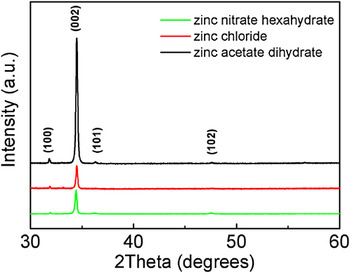
XRD spectrum of ZnO nanowires grown at 85 °C for 2 h at an equimolar zinc acetate dihydrate, zinc nitrate hexahydrate, zinc chloride, and HTMA concentration of 0.02 M is shown in Fig. 1. A strong peak at 34.8° corresponding to (0002) spacing of the wurtzite structure (JCPDS Card No: 36–1451) revealed the preferential alignment of the nanowires on the substrate in their c-axis direction. Overwhelming intensity of the ZnO nanowires within this direction for the zinc acetate dihydrate salt could be attributed to the nearly perfect alignment of the nanowires. As will be explained throughout the paper, zinc acetate dihydrate allows the synthesis of nanowires with highest aspect ratio and longest length. Alignment is better pronounced for long nanowires, where steric hindrance effect dominates. This increases the unit volume for diffraction and results in the increase in peak intensity.
XRD spectrum of ZnO nanowires grown on Si substrates in solutions containing equimolar concentration of 0.02 M of zinc salt and HMTA at 85 °C.

ZnO nanowires grown on Si substrates were analyzed without any conductive coating for scanning electron microscope (SEM; FEI Quanta 400F, FEI, Eindhoven, Netherlands) analyses. Cross-sectional SEM analyses were conducted from the cleaved surfaces of the specimens. Length and diameter of more than 100 nanowires were measured using ImageJ software and reported with their standard deviations. Optical absorption measurements (UV–Vis) were made using a Varian Cary 100 Bio UV–Visible Spectrometer (Agilent Technologies Pty Ltd., Mulgrave, VIC, Australia) in normal incidence mode. Solutions containing each of three salts in quartz sample cuvettes were used for measurements. Deionized water in quartz cuvettes was used as the background and subtracted from the spectra of the sample.
A. Zinc acetate dihydrate as zinc source
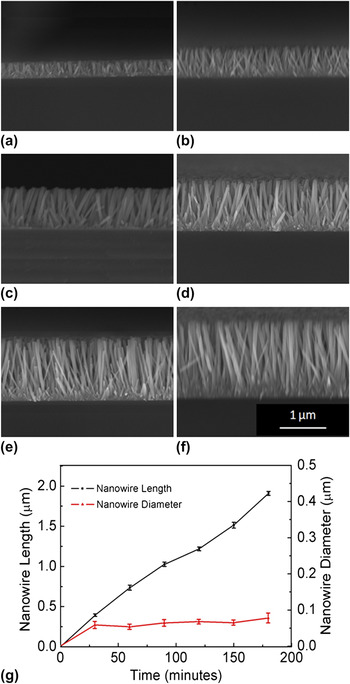
Cross-sectional SEM images of ZnO nanowires grown with zinc acetate dihydrate salt for 30, 60, 90, 120, 150, and 180 min are given in Figs. 2(a)–2(f), respectively. From the figures, it can be clearly seen that ZnO nanowires were grown at each time interval and their length almost increased with a steady rate, as shown in the plot given in Fig. 2(g). Their diameters seemed to be almost constant within the growth duration investigated in this work.
Cross-sectional SEM images of ZnO nanowires that are grown for (a) 30 min, (b) 60 min, (c) 90 min, (d) 120 min, (e) 150 min, and (f) 180 min with zinc acetate dihyrate salt. All scales are the same. (g) Variation of nanowire diameter and length with time. Lines are for visual aid.

B. Zinc nitrate hexahydrate as zinc source
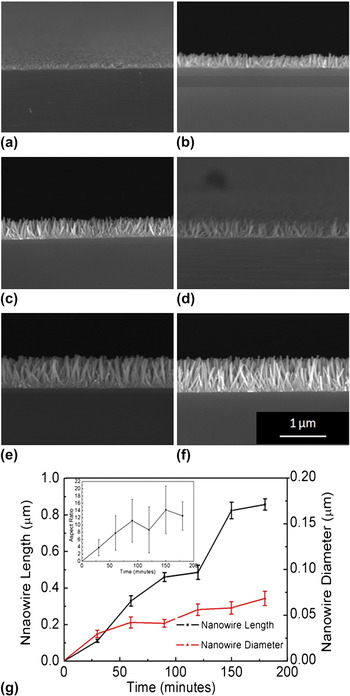
Cross-sectional SEM images of ZnO nanowires grown with zinc nitrate hexahydrate salt for 30, 60, 90, 120, 150, and 180 min are given in Figs. 3(a)–3(f), respectively. Both length and diameter of the ZnO nanowires were found to increase with time, as shown in the plot in Fig. 3(g). At each time interval, the formation of nanowires can be clearly observed on the substrates.
Cross-sectional SEM images of ZnO nanowires that are grown for (a) 30 min, (b) 60 min, (c) 90 min, (d) 120 min, (e) 150 min, and (f) 180 min with zinc nitrate hexahydrate salt. All scales are the same. (g) Variation of nanowire diameter and length with time. Inset shows the aspect ratio of the samples. Lines are for visual aid.

C. Zinc chloride as zinc source
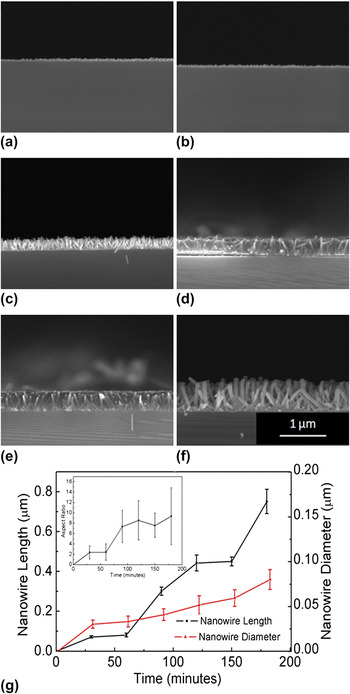
Cross-sectional SEM images of ZnO nanowires grown with zinc chloride salt for 30, 60, 90, 120, 150, and 180 min are given in Figs. 4(a)–4(f), respectively. Both length and diameter of the ZnO nanowires were found to increase with time, as shown in the plot in Fig. 4(g). At each time interval, similar to the growth with other zinc salts, the nanowire morphology can be clearly observed on the substrates.
Cross-sectional SEM images of ZnO nanowires that are grown for (a) 30 min, (b) 60 min, (c) 90 min, (d) 120 min, (e) 150 min, and (f) 180 min with zinc chloride salt. All scales are the same. (g) Variation of nanowire diameter and length with time. Inset shows the aspect ratio of the samples. Lines are for visual aid.

D. Comparison of zinc sources used in conventional heating
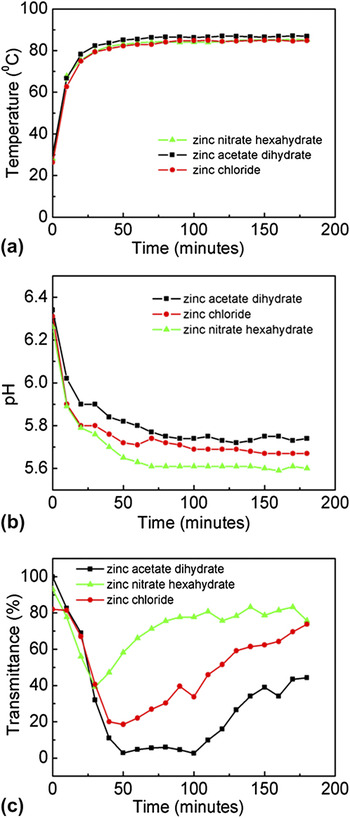
Various results have been obtained from the different zinc salts used in the experiments. It is evident that counterion of zinc salts has a profound effect on ZnO nanowire morphology and growth rate. The temperature and pH of each growth solution were monitored for understanding why these different characteristics emerge. Plot in Fig. 5(a) shows the change in temperature of each growth solution with time. It is seen that solutions warm up with an identical rate (±1 °C), showing the uniformity of the growth setup used.
Variation of (a) the growth solution temperature, (b) pH, and (c) transmittance with time.

The plot in Fig. 5(b) shows the change in pH of each growth solution with time. Each growth solution has a different pH level at room temperature. Furthermore, the decrease rate of the pH values is almost identical and fixed pH values at a further time period within each solution is also different. The growth solution containing zinc acetate dihydrate has a pH value of 6.34, which is closest to neutral among the other salts upon preparing the solutions. A fixed pH value of 5.74 was obtained during the growth for zinc acetate dihydrate salt, which is also the closest to neutral. The high pH value may give a hint why zinc acetate dihydrate salt allows for the synthesis of nanowires with the highest growth rate. pH values of growth solutions containing zinc chloride and zinc nitrate hexahydrate were measured to be 6.31 and 6.26 right after preparing the solutions, respectively. During the nanowire growth period, zinc chloride solution has a fixed pH value of 5.67, whereas pH of zinc nitrate hexahydrate solution is 5.61. Although there are less OH− ions in zinc nitrate hexahydrate solution compared to zinc chloride, the aspect ratio of ZnO nanowires grown in zinc nitrate hexahydrate solution is higher compared to those in zinc chloride solution at the end of growth period. It seems that higher ionization rate of Zn+2 in zinc nitrate hexahydrate solution compared to the one with zinc chloride leads to earlier precipitation of ZnO, which in turn decreases the amount of Zn+2 in zinc nitrate hexahydrate solution faster than zinc chloride solution. This condition is also indicated in the plot in the Fig. 5(c), which shows the transmittance of each solution at 550 nm with different salts. According to the plot at any time, the solution with zinc acetate dihydrate has the lowest transmittance corresponding to the slowest ZnO precipitation rate throughout the whole growth period. In fact, solution is totally opaque for more than an hour. As a result, Zn+2/OH− ratio has the lowest value at any time during the reaction for acetate salt. This should also lead to the formation of high aspect ratio ZnO nanowires. Besides, capping effect of acetic ions has been also known to contribute to this condition.Reference Greene, Law, Tan, Montano, Goldberger, Somorjai and Yang24 The presence of acetic ions suppresses the growth of the ZnO nanowires along <10-10> planes, increasing the length of ZnO nanowires.
Solubilities of zinc chloride (432 g/100 mL) and zinc nitrate hexahydrate (184.3 g/100 mL) in water are excessive compared to zinc acetate dihydrate (43 g/100 mL). However, what is more important is the ionization of zinc in these solutions, which is influenced by their counterions. Chloride and nitrate ions both form comparably strong acidic solutions compared to acetate ions, which form a weakly acidic solution. As a result, zinc highly ionizes in solutions prepared with zinc chloride and zinc nitrate hexahydrate, whereas ionization of zinc is less in zinc acetate dihydrate solution. Thus, Zn+2/OH− ratio in solutions containing zinc chloride and zinc nitrate hexahydrate is higher.
E. Microwave heating with annealed substrates
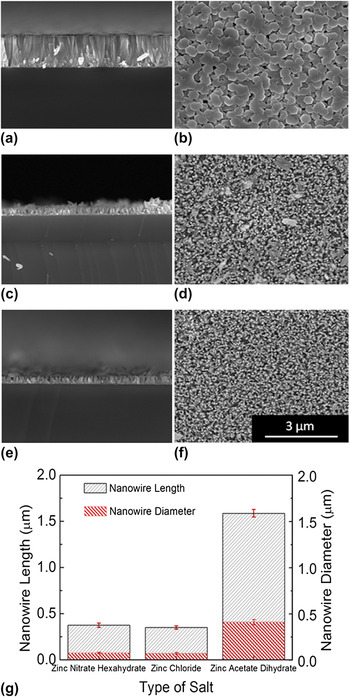
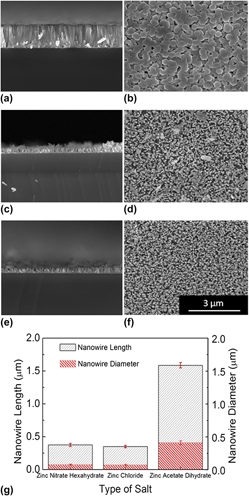
Figures 6(a)–6(f) shows cross-sectional and top view SEM images of ZnO nanowires grown on the substrates that are annealed at 350 °C for 20 min after seeding. These nanowires have been synthesized using three different salts under investigation and growth solution was heated through a microwave oven. Zinc acetate dihydrate salt again leads to the formation of longest ZnO nanowires among the ones obtained with other salts, as shown in Fig. 6(g). Top view SEM images revealed that ZnO nanowires grown with zinc acetate dihydrate salt have flat tips. In addition, nanowire nucleation density seems to be high compared to the ones obtained with other salts since the nanowire diameters are very large. Similar to conventional heating, ZnO nanowires grown in zinc nitrate hexahydrate solution have slightly longer length and larger diameter values compared to the ones grown in zinc chloride solution. Cross-sectional SEM images show that ZnO nanowires grown in zinc chloride and zinc nitrate hexahydrate solutions have tapered tips. It was reported by Sun et al.Reference Sun, Riley and Ashfold29 that ZnO nanowires with tapered tips tend to form when overall reduction of Zn+2/OH− ratio occurs with time during the growth of ZnO nanowires. In our case, same growth time was investigated for different zinc salts. The very fast formation of ZnO in zinc chloride and zinc nitrate hexahydrate solutions could lead to sudden decrease in Zn+2/OH− ratio compared to zinc acetate dihydrate solution, close to the end of each 1 min long microwave heating period.
Cross-sectional SEM images of the annealed samples grown with (a) zinc acetate dihydrate salt, (c) zinc chloride salt, (e) zinc nitrate hexahydrate salt using microwave heating. Top view SEM images of the samples grown with (b) zinc acetate dihydrate, (d) zinc chloride, and (f) zinc nitrate hexahydrate salt. All scales are the same. (g) Variation of length and diameter of ZnO nanowires on annealed substrates grown with different salts.

F. Microwave heating with nonannealed substrates
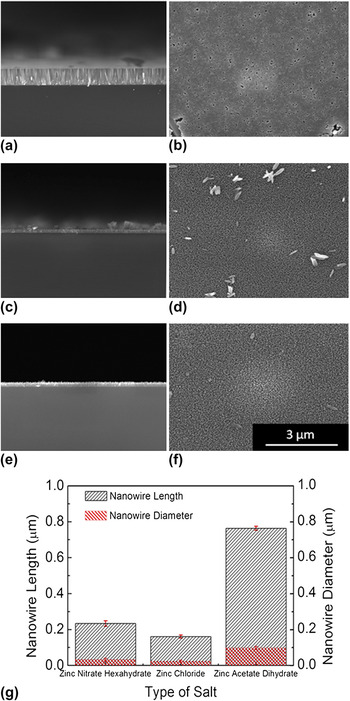
Figures 7(a)–7(f) shows cross-sectional and top view SEM images of ZnO nanowires grown on the substrates, which are not annealed following seeding. These nanowires have been synthesized through microwave heating. Similar to annealed substrates, ZnO nanowires grown with zinc acetate dihydrate salt have flat tips, as shown in the top view SEM images. Similar to the use of annealed substrates, ZnO nanowires grown with zinc nitrate hexahydrate have slightly longer length and almost the same diameter with the ones grown with zinc chloride salt, as shown in Fig. 7(g). Cross-sectional SEM images revealed that ZnO nanowires grown on unannealed substrates using zinc chloride and zinc nitrate hexahydrate salts have tapered tips.
Cross-sectional SEM images of the nonannealed samples grown with (a) zinc acetate dihydrate, (c) zinc chloride, and (e) zinc nitrate hexahydrate salt. Top view SEM images of the samples grown with (b) zinc acetate dihydrate, (d) zinc chloride, and (f) zinc nitrate hexahydrate salt. All scales are the same. (g) Variation of length and diameter of ZnO nanowires on nonannealed substrates grown with different salts.

G. Comparison of microwave heating with conventional heating
Microwave heating has some advantages compared to conventional heating. Hydrothermal synthesis of ZnO nanowires can be carried out with microwave heating only within a few minutes compared to conventional heating of the growth solutions, which takes place for hours.Reference Unalan, Hiralal, Rupesinghe, Dalal, Milne and Amaratunga28 As in the case of conventional heating, nanowires grown by microwave heating using zinc acetate dihydrate salt have the highest growth rate. Similar to conventional heating, ZnO nanowires grown with zinc nitrate hexahydrate have higher aspect ratios compared to the ones grown with zinc chloride on both annealed and nonannealed substrates.
IV. CONCLUSIONS
To conclude, we have investigated the effect of different salts, namely, zinc acetate dihydrate, zinc nitrate hexahydrate, and zinc chloride for the hydrothermal growth of ZnO nanowires. Two alternative heating methods such as conventional heating and microwave heating were examined. Temperature, pH, and transmittance of solution to visible light were monitored for detailed analysis. The results revealed that ZnO nanowires with highest aspect ratio can be synthesized using zinc acetate dihydrate salt. It was also evident that earlier precipitation of ZnO in zinc nitrate hexahydrate solution compared to zinc chloride containing one leaded to the formation of ZnO nanowires with higher aspect ratio. This was due to the earlier decrease in Zn+2/OH− ratio for zinc nitrate hexahydrate solution. In addition, microwave heating revealed similar results in terms of the effect of zinc salt and shortened the reaction time compared to the conventional heating. The results obtained herein provide a road map and allow the basis for hydrothermal growth of ZnO nanowires using various salts.
ACKNOWLEDGMENTS
This work was supported by the Scientific and Technological Research Council of Turkey (TUBITAK) under Grant Nos. 109M084 and 109M487 and the Distinguished Young Scientist Award of the Turkish Academy of Sciences (TUBA).