




1. Introduction
Scientific knowledge has become a powerful force in global sustainability politics, shaping discourses, legitimising solutions, and informing decision-making. Particularly for the poorest countries in the Global South, which are often disproportionately vulnerable to Earth system change and lack the adaptive capacity to cope with the impacts, scientific information is crucial. Yet the role of these countries in sustainability science remains insufficiently examined. In particular, what role do scientists based in these countries play in the production and dissemination of knowledge on sustainability? This article seeks to shed light on this crucial question.
We focus on the ‘least developed countries’, a country classification introduced by the United Nations in 1971 to better channel funding and support to combat poverty in these countries. While acknowledging critiques that portray this category as reinforcing the stereotypes and hiding histories of oppression and continued exploitation (e.g., Alam, Reference Alam2008), this clear-cut country category enables us to engage in meaningful empirical research with a focus on the most vulnerable and poorest countries in the Global South. In 2025, 44 countries were classified as least developed countries, with a total population of 1.2 billion (World Bank, n.d.). While least developed countries account for only 14.5% of the global population, they host more than 50% of the world’s extremely poor, i.e. living with less than 3 dollars per day according to the United Nations definition (UN-OHRLLS, 2024). In contrast, only four countries outside of the ‘least developed country’ category have a poverty rate above 40% (World Bank, n.d.). Additionally, the number of extremely poor in least developed countries has increased in recent years by 15 million, at a rate higher than in other country categories (UNCTAD, 2023). Least developed countries are also disproportionately vulnerable to Earth system change due to high exposure and poor resilience (WMO, 2023). In contrast with the least developed country category, which is strictly defined by the United Nations, the Global South is a geopolitical, economic, socio-cultural, and epistemic construct serving not only as a geographical categorisation but also – and mostly – as a marker of power shifts and as a site of contestation (Jayaram et al., Reference Jayaram, Yumie Aoki Inoue, Kotzé, Barros-Platiau, Korber Gonçalves, Triyanti and Balag’Kutu2025). Because the Global South is home to the majority of the world’s population and is rich in diversity and legitimacy, our data also provide insights into the role of scientists based in this broader set of countries.
To document the role and relevance of the least developed countries in sustainability science, we study how scholars from these countries are quantitatively represented in knowledge production and the management of major journals and scholarly networks. In particular, we assess the representation of scientists with affiliations in least developed countries – as well as in the Global South more generally – in the publications of five major sustainability-related academic journals and in the editorial boards of these outlets. Furthermore, we examine the procedures of scientific publishing, and whether and how they affect scientists from least developed countries. Third, we assess how scientists from least developed countries are represented in the dissemination of knowledge in three major sustainability science networks, focusing on participation in their conferences.
The underlying assumption of this study is that a scholar’s country of affiliation matters in the highly politicised context of sustainability science. Research on sustainability is inherently social and as much about economics, values, politics, and power as about natural processes. Sustainability science is at its core about people, and in the study of people, it matters whether scientific research is conducted by scholars who are based in only one country, or by research institutions that draw on inputs from all corners of the world. We assume, in other words, that credible, legitimate, and usable sustainability science requires fair involvement of scholars who are based in the Global South, including the least developed countries: this is what we call epistemic justice. Epistemic justice is important not only for its normative value but also for its instrumental value, as it facilitates the contribution of new perspectives, strategies, and solutions, from hitherto marginalised ontologies and epistemologies, for addressing Earth system changes. This assumption is supported by much recent writing in science and technology studies (e.g., Meyer & Chang, Reference Meyer and Chang2020; Turnhout, Reference Turnhout2024) and in the literature on just sustainability transitions (e.g., Álvarez & Coolsaet, Reference Álvarez and Coolsaet2018; Avelino et al., Reference Avelino, Wijsman, Van Steenbergen, Jhagroe, Wittmayer, Akerboom and Kalfagianni2024; Sievers-Glotzbach & Tschersich, Reference Sievers-Glotzbach and Tschersich2019). In addition, it is fully acknowledged by global science institutions that operate under United Nations auspices, such as the Intergovernmental Panel on Climate Change, and is essential in realising the aspiration of ‘leaving no-one behind’ set out in the 2030 Agenda for Sustainable Development.
Scholarly interest in the epistemic marginalisation of the Global South has grown in line with increasing critiques of power dynamics in academia and aspirations to foster the inclusiveness of knowledge production on sustainability (e.g., De la Rosa et al., Reference De la Rosa, Ludwig, Nieves and El-Hani2025; Demeter, Reference Demeter2020; Trisos et al., Reference Trisos, Auerbach and Katti2021; Turnhout, Reference Turnhout2024). Political scientists have exposed the marginalisation of scholars and knowledge from the Global South in knowledge production on a variety of sustainability issues ranging from climate change (e.g., Biermann, Reference Biermann2000, Reference Biermann, Mitchell, Clark, Cash and Dickson2006; Corbera et al., Reference Corbera, Calvet-Mir, Hughes and Paterson2016; Ho-Lem et al., Reference Ho-Lem, Zerriffi and Kandlikar2011), biodiversity (e.g., Díaz-Reviriego et al., Reference Díaz-Reviriego, Turnhout and Beck2019), and solar geoengineering (Reference Biermann and Möller2019; Conca, Reference Conca2018). Yet, few empirical studies have systematically analysed the representation of the voices of the least developed countries in major academic journals and research communities on sustainability along with the processes that drive imbalances in representation.
The article proceeds as follows. Section 2 introduces the research design. The subsequent empirical section (Section 3) analyses the extent to which least developed countries are represented in scientific knowledge production and dissemination, delving successively into authorship in major scientific journals, membership in the governance structures of these journals, and participation in leading scientific networks on global sustainability. Then, in Section 4, we discuss both the theoretical contribution and political implications of our empirical findings. In Section 5, we conclude the article by sketching several reform avenues towards a more inclusive and pluriversal sustainability science.
2. Research design
We assess the role of scientists based in least developed countries, and in the Global South more broadly, in four areas of sustainability science. First, we analyse the authorship of scientists with a main affiliation in a least developed country in five major academic journals on global sustainability. Then, we analyse the dynamics of inclusion and exclusion of the voices of the Global South in these scientific journals by assessing the extent to which scientists based in least developed countries, and in the Global South more broadly, are represented in their governance structures, assessed through membership in their editorial boards. Third, we study how procedural rules shape the representation of scientists from least developed countries in scientific knowledge production and dissemination. Finally, we study the representation of least developed countries at the scientific conferences of three main academic networks.
Dozens of academic journals and interdisciplinary scientific communities cover issues of sustainability. We limit this analysis to five academic journals, strongly anchored at the crossroads between environmental and social sciences, studied over the period 2015–2024: Earth System Governance, Global Environmental Change, Global Sustainability, Global Environmental Politics, and Environmental Politics. This time frame corresponds to the halfway point in the implementation of the 2030 Agenda and the Sustainable Development Goals (SDGs), which aspire to ‘leave no-one behind’ and include specific targets that aim to enhance scientific collaboration and knowledge sharing between the North and South (see, for instance, SDG 17.6; United Nations, 2015).
We selected these five journals based on (i) their scope – they all seek to document Earth system changes, with a strong focus on policy and governance dimensions; (ii) their ranking – they were all located in the highest quartile in the Scopus CiteScore categories of ‘Social Sciences – Miscellaneous’ or ‘Environmental Science – Global and Planetary Change’ in 2024; and (iii) the additional consideration of diversity in publishing models – with two journals (Earth System Governance and Global Sustainability) being fully open access, and the other three being traditional subscription journals. Open access implies that authors of manuscripts have to pay article processing charges, which may influence publishing opportunities across the Global North and Global South. In addition, we excluded from our sample journals that (i) exclusively publish reviews or opinions instead of original research (e.g., Current Opinion in Environmental Sustainability or Annual Reviews of Environment and Resources), (ii) were launched after the data collection period (e.g., Cell Reports Sustainability), (iii) obtained their first CiteScore after the data collection period (e.g., Sustainable Horizons), and (iv) focus on a sectoral sustainability issue (e.g., Climate Policy). Finally, we also excluded top sustainability journals such as Nature Sustainability from our sample, as these have been the focus of recent bibliometric research focusing on the contribution of Global South authors (e.g., Dangles et al., Reference Dangles, Struelens, Ba, Bonzi-Coulibaly, Charvis, Emmanuel and Vidal2022). As a result of applying these inclusion and exclusion criteria, our sample was limited to the five above-mentioned English-language journals.
To document authorship, we analysed the representation of authors from least developed countries and from the Global South more broadly in all the publications of these five academic journals, based on data on the affiliation of authors manually retrieved from their websites and coded into Excel according to the country of the first listed affiliation, which we assumed to be the main affiliation where the research was conducted. While including multiple affiliations listed by one author could have revealed interesting trends in terms of collaborations with Global South institutions, restricting the analysis to the first listed affiliation (or “straight counting”) simplified institutional tracking in our database. In addition, we assume that using all listed affiliations would not have yielded substantially different results, as a recent study finds that the co-affiliation host countries listed by authors are generally based in the Global North (e.g., Hottenrott et al., Reference Hottenrott, Rose and Lawson2021). Data were disaggregated by country of affiliation and by authorship position (first author versus contributing authors) on a sample of 2227 publications, including 8988 authors over the period 2015 to 2024 (see Figure S1 and Table S2 in the Supplementary material). To document board membership, we collected quantitative data on the country of affiliation of the editorial board members of the five selected academic journals, at three different points in time to assess the evolution of representation. Based on available information on the websites of the journals, we collected data for (i) 243 editorial board members in 2015 (or the first year of operation of the journal in case of Earth System Governance and Global Sustainability, both of which were launched in 2018); (ii) 242 editorial board members in 2020; and (iii) 276 editorial board members in 2025.
To examine the impact of procedural rules in journal publishing, we collected qualitative data from 11 researchers affiliated with a university in the Global South as well as seven editors of academic journals or book series in the field of Earth system change during a workshop that we organised at the annual conference of the Earth System Governance Project in Nijmegen, the Netherlands, in October 2023. The workshop aimed to take stock of Global South scholars’ experiences with academic publishing and identify rules and procedures in academic publishing that act as explicit and implicit barriers, thus preventing inclusiveness of diverse perspectives and voices in sustainability science (see Tables S5 and S6 in the Supplementary material). Two 45-minute sessions, entitled ‘Taking stock: Your experience with Western-centred academic publishing’ and ‘Moving forward: Formulating principles to increase diversity in academic publishing’, allowed participants to share their insights on a digital whiteboard based on a series of guiding questions (see Table S7 in the Supplementary material). We then qualitatively analysed the data contained in the responses using an inductive approach, deriving thematic clusters from our data, around which we classified barriers to inclusiveness in academic publishing. Both Global South scholars and journal editors were selected among the participants in the annual conference of the Earth System Governance Project; among the journal editors, three represented two of the journals sampled for our previous authorship analysis. However, data are presented at a generic level, so that the shared insights cannot be attributed to any Global South scholar or journal editor.
Additionally, we studied participation in academic conferences hosted by three major scientific networks: the Earth System Governance Project, the International Sustainable Development Research Society, and the International Association for the Study of the Commons. The Earth System Governance Project, launched in 2009, aims to explore political solutions and novel, more effective governance systems to cope with Earth system change by stimulating and facilitating research collaborations between scholars from different countries and disciplines in the social sciences and humanities. Over the years, the project has grown into the largest social science research network in the area of governance and Earth system change (Earth System Governance Project, n.d.). The International Sustainable Development Research Society exists since 2006; it seeks to link researchers in academia and implementation practice from all continents with the overall objective of exchanging knowledge, experiences, and best practices worldwide on sustainable development to achieve a fair, clean, and sustainable society (International Sustainable Development Research Society, n.d.). The International Association for the Study of the Commons, created in 1989, is devoted to bringing together researchers, practitioners, and policymakers for the purpose of improving governance and management, advancing understanding, and creating sustainable solutions for commons and common-pool resources (International Association for the Study of the Commons, n.d.).
We selected these networks based on three criteria. First, all three networks are interdisciplinary and seek to advance knowledge at the interface between Earth system change and governance, and they all aim to foster and disseminate knowledge on innovative (governance) solutions that tackle Earth system change. Second, the main activity of these networks is the organisation of academic conferences, held either annually or biennially, that aims to bring the community together. Additionally, we looked for networks in which the organisation of conferences rotates between Global North and Global South countries. Third, the list of presenters in these academic conferences was consistently available on the website of the networks, along with presenters’ associated country of affiliation. To document conference participation, we analysed the representation of presenters from least developed countries in the annual conferences of the three scientific networks under scrutiny, based on the information publicly available on the websites of the scientific networks. We collected data on the country of affiliation of the 4249 presenters at in-person academic conferences of the selected scientific networks, exclusively focusing on the pre-COVID-19 pandemic period when hybrid settings were not yet widely used (2015–2019).
We classified countries in this article as follows: (1) least developed countries (following the 2018 classification of the United Nations); (2) Brazil, China (including Hong Kong and Taiwan), India, and South Africa; (3) other developing countries (classified as such by the United Nations and not covered by categories 1 and 2); (4) countries with economies in transition (including the Russian Federation, Ukraine, Belarus, Central Asia, and the Caucasus region); (5) European countries (excluding the Ukraine, Belarus, Russia and Turkey but including the Balkan countries); (6) Canada and the United States of America; (7) all other OECD countries (including Australia, Israel, New Zealand, Japan, South Korea, and Turkey, but excluding Chile and Mexico). While the Global South includes country categories 1–3, the Global North consists of categories 4–7. We use the aforementioned seven-fold country categories or the aggregated categories of ‘Global North’ and ‘Global South’ to present this data (see Table S3 in the Supplementary material for the detailed list of countries classified according to our seven-fold categories).
Methodologically, the approach of focusing on scholars ‘based in a least developed country’ or ‘based in the Global South’ is likely to under-represent the role of scholars born in least developed countries or more broadly in the Global South by not accounting for academic migration and counting Global South scientists who live and work in OECD countries as scholars from the Global North. Admittedly, focusing on country affiliation as a proxy tends to invisibilise scholars who have been trained in the Global South at high school, undergraduate, or graduate levels – when language skills are sharpened and methodological skills develop, or who have collaborated with or been hosted by Global South institutions during their careers – when ontological affiliations further develop. This is a key limitation of our analysis. This problem, however, cannot be circumvented in data-driven research given that data on the nationality or origin of scientists are not provided in the author affiliation tables of scholarly journals and global scientific conferences. The alternative would be to conduct in-depth biographical analyses of authors, which are impossible in the larger descriptive datasets that we are analysing here.
The following section presents a detailed assessment of imbalances in the representation of the Global South in sustainability science.
3. Results
3.1. Authorship in academic journals
How are least developed countries and, more generally, Global South countries represented in the production and dissemination of sustainability science? We now study this question in more detail, focusing first on scientific production in academic journals. From the 2227 articles published in the five selected journals from 2015 to 2024, we found that most of the 8988 authors were affiliated with a Global North university. Such overrepresentation of authors from the Global North is a common trend across sustainability science journals, though with slight variations (see Figure 1). In contrast, only 99 of the 8988 authors who published an article in sustainability science journals were affiliated with a university in a least developed country.
Authorship according to country of affiliation in sustainability science journals, 2015–2024.

1 Long description
A pie chart titled, Global Environmental Change. The pie slices correspond to the legend categories as follows: Developed countries 88 percent; Other developing countries 7 percent; BICS, Brazil, India, China and South Africa 3 percent; Least developed countries 2 percent. The image B showing a pie chart titled, Environmental Politics. The pie slices correspond to the legend categories as follows: Developed countries 94 percent; Other developing countries 3 percent; BICS, Brazil, India, China and South Africa 3 percent; Least developed countries 0 percent. The image C showing a pie chart titled, Earth System Governance. The pie slices correspond to the legend categories as follows: Developed countries 94 percent; Other developing countries 3 percent; BICS, Brazil, India, China and South Africa 2 percent; Least developed countries 1 percent. The image D showing a pie chart titled, Global Environmental Politics. The pie slices correspond to the legend categories as follows: Developed countries 93 percent; Other developing countries 4 percent; BICS, Brazil, India, China and South Africa 2 percent; Least developed countries 1 percent. The image E showing a pie chart titled, Global Sustainability. The pie slices correspond to the legend categories as follows: Developed countries 74 percent; Other developing countries 14 percent; BICS, Brazil, India, China and South Africa 10 percent; Least developed countries 2 percent. A legend lists four categories: Other developing countries; BICS, Brazil, India, China and South Africa; Least developed countries; Developed countries. The five pie charts use slice shading that matches the legend categories. Across all five pie charts, the Developed countries slice is the largest in each chart and Global Sustainability shows the smallest Developed countries share at 74 percent and the largest combined share of the other three categories at 26 percent.
Even in some well-established journals with several decades of operation such as Environmental Politics, no authors based in least developed countries published between 2015 and 2024. In other journals, including Earth System Governance and Global Environmental Politics, less than 10% of all authors who published an article between 2015 and 2024 were based in the Global South, and many of these were based in a major Global South economy such as Brazil, India, China or South Africa.
Global Environmental Change and Global Sustainability had a slightly more balanced representation. Specifically, Global Sustainability, launched in 2018, includes authors from the Global South the most – 27% of all authors who published an article within the time frame of operation of the journal were affiliated with an institution in a Global South country. Even authors based in least developed countries were represented to some extent: 3% of authors who published an article in Global Sustainability between 2018 and 2024 were affiliated with a least developed country. However, overall, these authors remain overwhelmingly under-represented in scientific publications on sustainability compared to the share of these countries in the world population. In addition, whenever scholars from least developed countries published in these journals, they rarely appeared as the first author. From the 2227 articles that we analysed, only five were led by an author based in a least developed country. These five articles were published in Global Environmental Change (n = 4) and in Global Environmental Politics (n = 1).
In contrast, countries of the Global North were overrepresented in authorship within the five sustainability science journals we studied. Between 74% (Global Sustainability) and 94% (Earth System Governance and Environmental Politics) of all authors who published an article between 2015 and 2024 had their main affiliation in the Global North. Overall, 87% of authors who published an article in these five selected journals were affiliated with an institution in the Global North, while 13% were based in the Global South. Such representation is the exact reverse trend of what the Global South and the Global North represent in the world population. Our data, however, seem to indicate a slight evolution towards more inclusion of authors from the Global South in latest years (see Figure 2).
Affiliation of authors in sustainability science journals per year from 2015 to 2024.

Figure 2 Long description
A stacked bar graph with four categories in a legend: Developed countries, Other developing countries, BICS (Brazil, India, China and South Africa) and Least developed countries. The horizontal axis shows years 2015, 2016, 2017, 2018, 2019, 2020, 2021, 2022, 2023, 2024. The vertical axis unit shows the number of authors. A table under the graph lists values for each year. Developed countries: 2015 equals 67, 2016 equals 77, 2017 equals 64, 2018 equals 64, 2019 equals 71, 2020 equals 84, 2021 equals 95, 2022 equals 104, 2023 equals 77, 2024 equals 79. Other developing countries: 2015 equals 41, 2016 equals 67, 2017 equals 43, 2018 equals 38, 2019 equals 28, 2020 equals 49, 2021 equals 60, 2022 equals 44, 2023 equals 71, 2024 equals 79. BICS (Brazil, India, China and South Africa) : 2015 equals 26, 2016 equals 49, 2017 equals 21, 2018 equals 44, 2019 equals 33, 2020 equals 24, 2021 equals 47, 2022 equals 110, 2023 equals 77, 2024 equals 142. Least developed countries: 2015 equals 0, 2016 equals 9, 2017 equals 8, 2018 equals 8, 2019 equals 13, 2020 equals 16, 2021 equals 5, 2022 equals 8, 2023 equals 22, 2024 equals 10.
Such imbalances in the distribution of authorship within sustainability science journals reflect a stark injustice not only because the Global South is largely missing in knowledge production, but also because they seldom lead author teams in publications. In addition, while three special issues focusing either thematically or geographically on the Global South were published by Environmental Politics (2023), Global Environmental Change (2024), and Global Environmental Politics (2021) during our study period, indicating some editorial attention to Global South regions and topics, these did not systematically coincide with a stark increase in authorship by scholars affiliated with institutions in least developed countries or the Global South more broadly (see Table S4 in the Supplementary material). One would expect that such imbalances are also reflected in the governance structures of these scientific journals. Next, we assess the membership of editorial boards of the scientific journals selected for this study.
3.2. Representation in editorial boards of academic journals
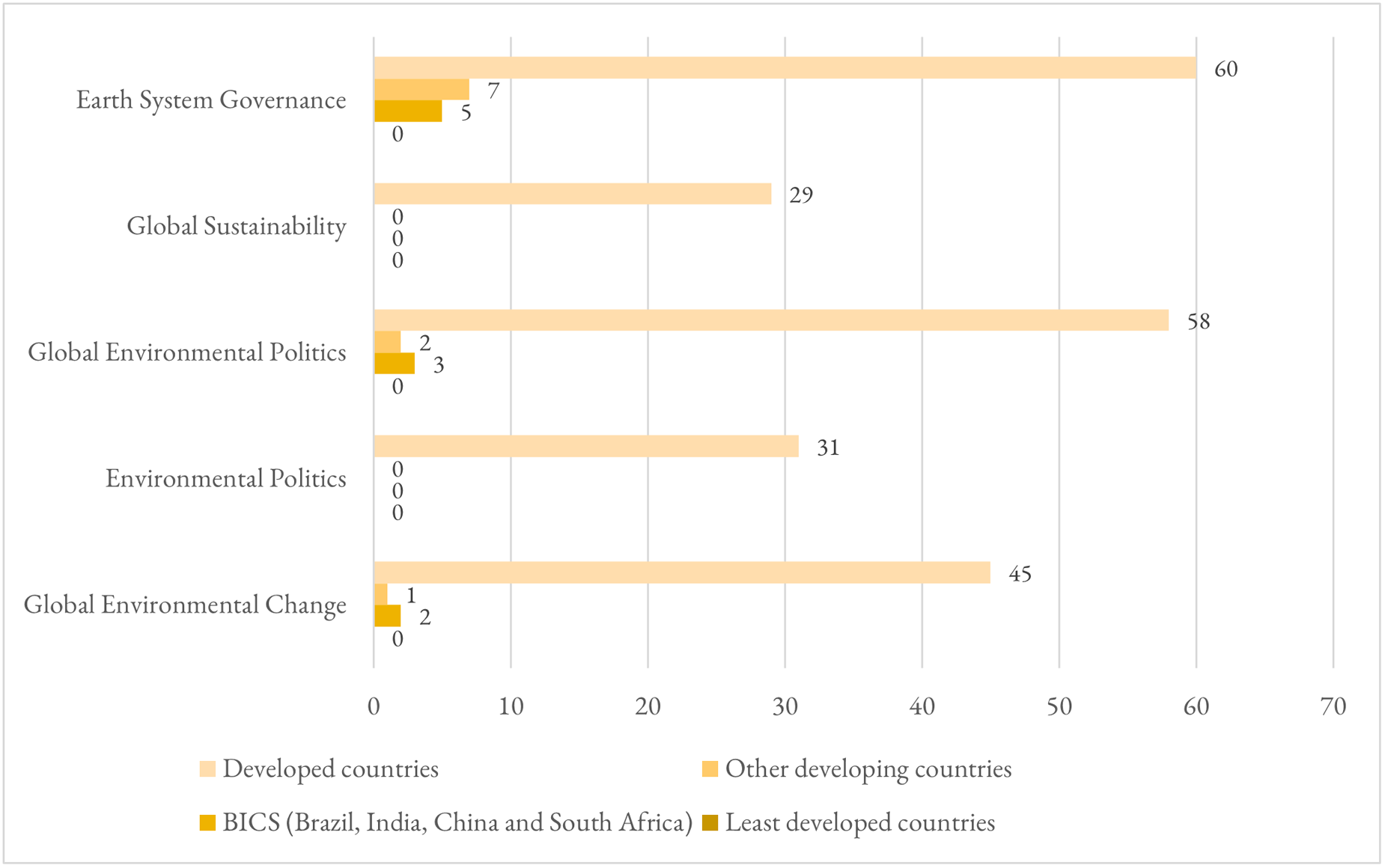
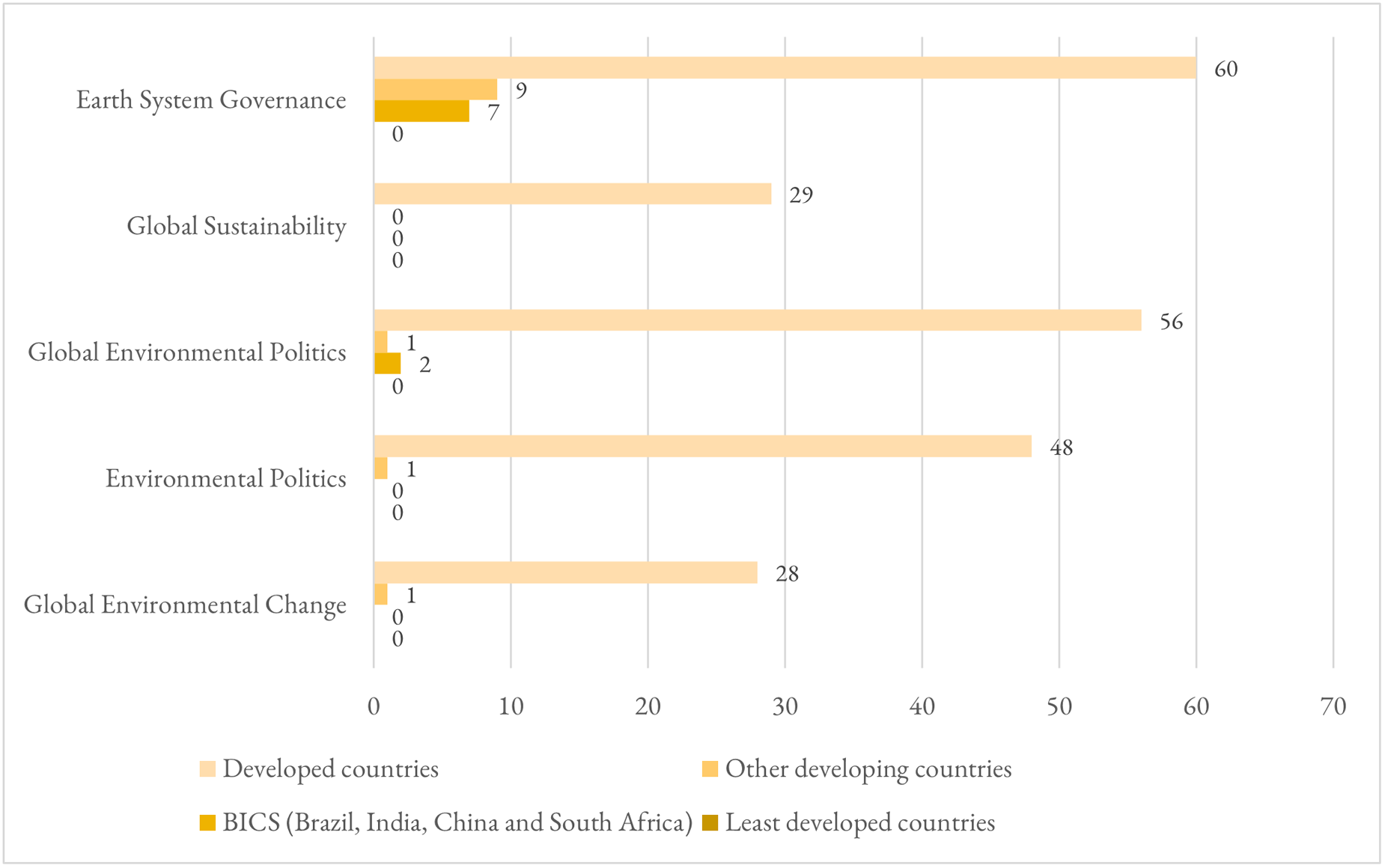
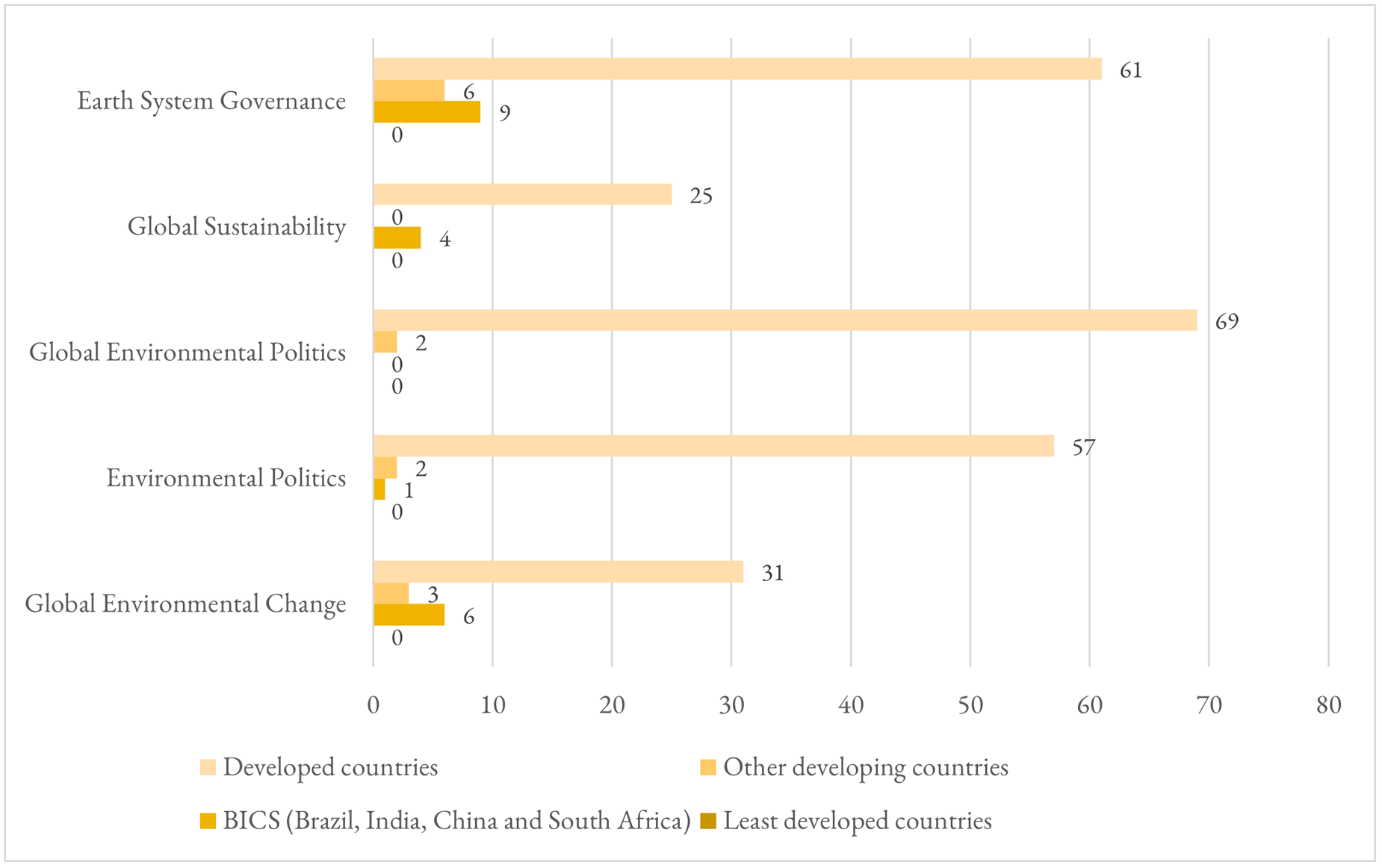
To assess representation of Global South scholars in the governance structure of mainstream academic journals, we examined editorial board membership in the five journals selected for this study. Over the time frame 2015–2025, we found that none of the editorial board members of these five academic journals came from an institution in a least developed country (see Figures 3–5). In other words, scholars working in least developed countries were not represented in any of the editorial boards of the major academic journals in the field of sustainability. When looking at the Global South more broadly, the Western-centric governance of academic journals is evident as well. Scholars affiliated with a Global South institution were not represented at all in the editorial board of Global Sustainability in 2015 or 2020, and they represented merely 8% or less of the editorial board members of Global Environmental Change, Environmental Politics or Global Environmental Politics in the same period. In turn, 20% of the editorial board members of Earth System Governance were affiliated with a university in the Global South over the same period (see Figures 3–5). In the most recent years (2020–2025), the share of editorial board members from the Global South rose across almost all journals, with the steepest increase attributed to Global Environmental Change and Global Sustainability (see Figure 6). Such representation, however, is still low compared to the share of Global South countries in the world’s population, which accounts for nearly 80%.
Editorial membership in sustainability science journals in 2015 (or in the first year of operation of the journal).

Editorial membership in sustainability science journals in 2020.

Editorial membership in sustainability science journals in 2025.

Global South representation in editorial board members of sustainability journals between 2015 and 2025.

Comparatively, scholars affiliated with a Global North institution dominate the editorial boards of major academic journals in the field of sustainability science (see Figures 3–5). Over the period 2015–2025, 80–90% of editorial board members of the five studied journals were affiliated with an institution in OECD countries (excluding Chile and Mexico). In the case of Global Sustainability, the board was exclusively composed of Global North scholars in the journal’s first few years of operation (2018–2020). Within the Global North, scholars from European countries, the United States, and Canada dominate the editorial boards compared to scientists from OECD countries in Oceania and Asia. Moreover, 60–80% of editorial board members are either European or North American.
Finally, in terms of the diversity of countries represented in editorial boards, we observed a high degree of concentration towards a few English-speaking countries, including the United States, the United Kingdom, Australia, and Canada, as well as in other European countries, such as the Netherlands, Germany, and Sweden, which are also well integrated into the structures of global academic publishing.
In sum, data on editorial board membership reveal persistent dynamics of marginalisation in sustainability science. Global South scholars – not to mention scholars affiliated with scientific institutions in least developed countries – are either excluded or sharply under-represented in the decision-making process related to editing and publishing in major academic journals in sustainability science. In the next section, we delve into identifying potential barriers that may further explain this observed imbalance.
3.3. Barriers to publishing in academic journals
The way science is valued and validated eventually shapes knowledge production on sustainability. Such a validation system relies on numerous implicit and explicit rules and procedures that act as barriers that further marginalise researchers from the Global South and reinforce existing imbalances in the production and dissemination of sustainability science. Here, we report on Global South scholars’ experiences with academic publishing as well as journal editors’ reflections shared in the collaborative workshop that we organised, and we further embed these in the existing literature. Following an inductive approach, we categorise explicit and implicit barriers into three types: epistemological, linguistic, and financial. We elaborate on each below.
First, a number of epistemological barriers implicitly marginalise Global South scientists in academic publishing. Academic publishing relies on the institution of academic ‘top journals’ and their access procedures, notably the widely used mechanism of peer review. The journal editors present at our workshop described that they send the manuscripts they receive to other scientists in the field, often scholars who have published in the same or similar journals on similar topics. Ideally, reviewers have a certain standing in the field, as measured by a long list of publications on the topic and many citations. The editors, associate editors, and members of the editorial board – often renowned scientists at top universities – thus serve as additional gatekeepers.
Given the authorship and composition of editorial boards in the top journals that we just sketched, a paper submission from a scholar from the Global South will most likely face a phalanx of reviewers who all work at well-known universities in the North and have published extensively in that field. While this system is less problematic for purely natural-science research, it is likely to have a much stronger impact in the social sciences. Journal editors and reviewers of the leading journals of sustainability science, including those included in our analysis, expect explicit recognition of ‘the state of the art’ and comprehensive knowledge in the field from submitted papers. They also require solid methods and theoretical approaches that are informed by the leading texts taught at the top schools in OECD countries, often in the United States or the United Kingdom, where most English-language textbooks are published. Theoretical approaches, methods, and implicitly general political convictions all form an underlying discourse of scientific validity that materialises in journal-acceptance decisions. Such discourse of scientific validity is, in addition, deeply ingrained in a specific worldview grounded in post-Enlightenment rationality, whereby culture and nature are separated. Such a worldview, however, ignores the fact that nature is relational in many other cultures, which bear knowledges that are often critical in shaping and moving towards sustainable futures (Adelman, Reference Adelman, French and Kotzé2017; Hope, Reference Hope2020; Vasquez-Fernandez & Ahenakew, Reference Vasquez-Fernandez and Ahenakew2020). As a result, implicit epistemological barriers tend to marginalise empirical research experiences from regions located in the Global South in academic publishing, while research informed by European or North American standards is becoming the mainstream that gets published.
Second, linguistic barriers make Global South scholars invisible in the knowledge that is produced within leading academic journals such as those included in our study. While knowledge on Earth system change is mainly communicated in English, it is practised at the local level in many tongues other than English. Many scholars in the Global South work in non-English discourse communities, be it in Spanish, French, Arabic, or Mandarin. Research in such languages is generally not known in English-speaking communities, and assessments of ‘the state of the art’ in a certain field of sustainability science are quickly biased in favour of those journals that publish in English. While leading scientists in non-English-speaking countries in the OECD, such as France or Spain, also publish their work in English, this step is much harder for their colleagues in the Global South. Both Global South scholars and journal editorial board members who participated in our workshop indeed observed that academic English language skills oftentimes motivate rejection decisions in leading journals in sustainability science. Scholars located in the Global South often lack resources to translate their work into English at a publishable level and cannot afford to ‘brush up’ their academic English language skills by conducting parts of their education at a leading institution in the United States, Canada, the United Kingdom, or Australia (as it is common for non-English-speaking researchers from the OECD). Existing research also found that non-native English speakers need up to twice as much time to write papers in English, which are 2.5 times more likely to be rejected and 12.5 times more likely to receive a request for revision, simply due to their written English (Amano et al., Reference Amano, Ramírez-Castañeda, Berdejo-Espinola, Borokini, Chowdhury, Golivets and Veríssimo2023). Language dominance, hence, works to the further exclusion of Global South science, of course, apart from those Global South countries that use English as their national academic language.
Finally, financial barriers further restrict opportunities for Global South scholars to publish their research. This is especially true as open access is spreading as a model in the publishing market. Open access is defined as a publishing model for scholarly communication that makes research information available to readers at no cost, as opposed to the traditional subscription model in which readers have access to scholarly information by paying for a subscription. It is described by academic publishing companies as a way to “share the learning of the rich with the poor and the poor with the rich” (Taylor and Francis, n.d.), making knowledge a public good. Yet, in practice, the experiences shared by Global South scholars during this workshop are far from reflecting the noble aim that publishing companies strive to achieve with open access – freely available knowledge for all. This is mainly because open access involves high publication costs, known as ‘article processing charges’, for authors (or their institutions) who submit their research to open access journals. Here again, the country of affiliation of researchers affects the opportunities available for authors to publish their research. Opening up access is often available only in one part of the world and may be equal to closing it at the other end, due to funding restrictions in the Global South. In the end, what is being published mostly comes from that part of the world that can afford to pay the publication costs. Echoing the experiences shared by Global South scholars and journal editors in our workshop, Sengupta describes the injustices scholars located in a Global South institution face in terms of publishing opportunities:
[A]uthors and academics from the developed powerful countries hav[e] better access to funding and institutional support due to their location and have better chances to get their works published. In contrast, authors writing on similar topics belonging to the Global South, lacking financial support end-up either not publishing their work or getting them published in ‘sub-standard’ journals, which are not indexed in Scopus etc. This keeps perpetuating and generating a new-form of academic colonialism. (Sengupta, Reference Sengupta2021: 204)
In sum, sustainability science relies on the careful review of publications in leading English-language journals published by prestigious publishing houses and academic presses in North America or Europe. By and large, however, it is the science that universities in a few wealthy OECD countries have produced. Numerous explicit and implicit rules and procedures in academic publishing, including epistemological biases, financial constraints, and linguistic domination, play out in marginalising scientists from the Global South. In the final section of our empirical analysis, we study the representation of least developed countries at scientific conferences of three main academic networks.
3.4. Representation in global scientific networks
In analysing the representation of researchers from the Global South at the annual conferences of the three selected scientific networks between 2015 and 2019, we found that researchers from the Global North, and specifically from European countries, were overrepresented in all three networks. Conversely, participants from the Global South, and specifically from the least developed countries, were largely missing.
For instance, participants from Europe and North America together made up 70.8% of the 1328 presenters at the conferences of the Earth System Governance Project over this period, while only 0.2% of presenters were from a least developed country. Similarly, in conferences of the International Sustainable Development Research Society over the same period, only 1.1% of participants had a professional affiliation in a least developed country, while 53.5% of the 1474 participants were from Europe. In the conferences of the International Association for the Study of the Commons, participants from least developed countries accounted for only 1.7% of all 1444 participants, with European researchers making up 44.8% of attendees.
The conferences of the latter two networks had a slightly better representation from Global South countries (i.e., beyond least developed countries). While conferences of the Earth System Governance Project included only 13.9% of participants affiliated with a Global South country, this figure accounts for 27.5% for the conferences of the International Association for the Study of the Commons and up to a third of all participants in conferences of the International Sustainable Development Research Society.
Several factors might have influenced the representation of different country categories among participants. One factor is the conference location. Despite some rotation between Global North and Global South countries, nearly two-thirds of the conferences of the three networks that we studied were organised in the Global North, thus facilitating the participation of researchers from European or North American universities. Conference location alone, however, does not fully explain variation in the representation of Global South researchers in academic conferences. While both the Earth System Governance Project and the International Sustainable Development Research Society organised two of their annual conferences in the Global South over the same period, the representation of Global South participants in Earth System Governance conferences is still lower than in conferences of the International Sustainable Development Research Society. Other factors, including registration and membership fees, the financial resources of the conference hosts, and outreach and communication strategies, might also influence participation and deserve further research.
In sum, even though the scientific community is devoting increasing attention to its diversity, the imbalance between the Global North and Global South within leading academic networks on sustainability remains sharp, with researchers from the least developed countries being strikingly absent from these communities. In the next section, we discuss the potential implications of such marginalisation on the legitimation of specific scientific discourses and policy solutions to limit Earth system change.
4. Discussion and future research
This study contributes to the literature on critical perspectives around justice. In particular, the empirical data add new insights to existing debates on the interactions between different justice dimensions articulated by the work of Nancy Fraser (Reference Fraser1995, Reference Fraser2009). Fraser categorises justice into distributional, recognitional, and procedural dimensions. Distributional justice refers to how resources, costs, and benefits are allocated or shared amongst people and groups; it also refers to how scientifically-informed policies are shaped to influence such allocation or reallocation. Recognitional justice refers to the acknowledgement and respect that is given, or withheld, for the identities, ontologies, values, and rights of communities, and to their visibility in general. Specifically, recognitional justice emphasises epistemic, ontological, cultural, and political domination as forms of injustice (Leach et al., Reference Leach, Reyers, Bai, Brondizio, Cook, Díaz, Espindola, Scobie, Stafford-Smith and Subramanian2018). Finally, Fraser conceptualises a third, procedural justice dimension, which refers to the extent to which different people and groups are able to influence how decisions are made or have their perspectives represented or incorporated. Here, more recent studies emphasise how knowledge injustices are a crucial aspect of procedural justice, considering that “groups can be included or excluded from decisions based on what they know, or based on the extent to which their knowledge and perspectives are deemed valid or legitimate” (Leach et al., Reference Leach, Reyers, Bai, Brondizio, Cook, Díaz, Espindola, Scobie, Stafford-Smith and Subramanian2018: 4, Reference Leach, Scoones and Wynne2005). Others, still, have emphasised the role of ontological (in)justice in shaping procedural justice and the representation of marginalised voices in science and policy (Ludwig et al., Reference Ludwig, Banuoku, Boogaard, El-Hani, Guri, Kramm, Renck, Robles-Piñeros and Turska2024). This reflects that knowledge and its production are an outcome of power relations as well as a means that contributes to maintaining power dynamics – and epistemic imbalances – unchanged (Foucault, Reference Foucault1975). With this three-tier categorisation in mind, this study shows how procedural justice within sustainability science – in this case, the procedural rules that govern academic publishing and the extent to which scholars with an affiliation in the Global South participate in how decisions are made – drives recognitional injustice, understood within the scope of this article as the (in)visibility and lack of acknowledgement of Global South scholars in knowledge production and dissemination on sustainability. Additionally, while this fell outside the scope of this study, we hypothesise that both procedural and recognitional injustices further drive distributional injustice. In other words, the marginalisation of least developed countries in scientific production and dissemination on sustainability issues may shape the scientific discourse in such a way that it invisibilises and excludes their interests. As sustainability policies are increasingly informed by and based on scientific knowledge, the epistemic marginalisation which we thoroughly documented in this article may have significant political implications for distributional justice, in shaping how the resources, costs, and benefits of sustainability policies are distributed among countries.
Existing literature already documented the misleading universalism of specific academic concepts which, as they are gradually accepted as mainstream in sustainability science and become politically authoritative, silence awareness of differentiation and misrecognise, or worse make invisible, the interests of the least developed countries. One prominent example is the Planetary Boundaries framework. Advanced in 2009 by a group of 29 scholars from the Global North to define nine planetary boundaries that ‘humanity’ must not cross at its own peril (Rockström et al., Reference Rockström, Steffen, Noone, Persson, Chapin and Foley2009), this concept has been influential in shaping research projects and policy recommendations worldwide. And yet, the extent to which these boundaries are universally shared is questionable from a Global South perspective. One important line of critique from the development studies community and scholars from the Global South is that in its original definition by a group exclusively composed of Global North scientists, the Planetary Boundaries framework did not account for the regional distribution of causes and consequences of Earth system change (Biermann & Kim, Reference Biermann and Kim2020: 502). The boundaries were seen as planetary, setting limits for humanity as a whole, with no concern for global equity. While the 2015 updated version of the boundaries was still silent on the “deeper issues of equity and causation” (Steffen et al., Reference Steffen, Richardson, Rockström, Cornell, Fetzer, Bennett and Sörlin2015: 8), the 2023 revised proposition included just thresholds along with safe limits (see Rockström et al., Reference Rockström, Gupta, Qin, Lade, Abrams, Andersen and Zhang2023). Even though the integration of a justice component within the framework constitutes a step towards answering previous critiques related to the lack of differentiation of the original framework, it remains unclear what the political consequences will be of the quantifications of safe and just boundaries for global equity and redistribution, and especially for least developed countries. For instance, some scholars argue that while the authors posit the need for policies that account for distributive justice, they stop short of articulating what these policies might be (Humphreys, Reference Humphreys2023). Future research should investigate whether the local and regional application of the revised version of the Planetary Boundaries, combined with elements of other scientific frameworks (e.g., the Doughnut’s social foundations; Raworth, Reference Raworth2012), addresses this inadequacy.
While the updated planetary boundaries framework calls for further research to investigate whether just thresholds are aligned with the perspectives of those groups and communities on behalf of which the team of scientists speaks, this example suggests that the overwhelming dominance of Global North scholars in knowledge production and dissemination may eventually determine what is accepted as universal and authoritative knowledge on sustainability. While framed as universal, such knowledge on sustainability may in fact serve partial interests as well as contribute to legitimising specific policies and governance instruments to address Earth system change, with implications in terms of distribution of costs and benefits that are detrimental to the interests of the Global South. These implications have been widely documented and assessed in existing literature, including policies and governance instruments related to afforestation (Bond et al., Reference Bond, Stevens, Midgley and Lehmann2019), nature-protected areas (Blanc, Reference Blanc2022; Geisler, Reference Geisler2003), and climate engineering techniques such as bio-energy with carbon capture and storage (Yengoh & Armah, Reference Yengoh and Armah2015) or solar radiation management (Carr & Preston, Reference Carr and Preston2017; Mbeva et al., Reference Mbeva, Okereke and Makomere2025; Okereke, Reference Okereke2023; Stephens et al., Reference Stephens, Kashwan, McLaren and Surprise2023).
Reflecting on the example of the mainstream and universally-framed scientific concept of Planetary Boundaries, we argue that procedural and recognitional injustices may further aggravate distributional injustices through the legitimation of policies informed by scientific knowledge formulated exclusively by scholars in the Global North. Yet, to move beyond speculations, we invite future research to shed light on how epistemic imbalances play out at the science-policy interface. In particular, studies could further investigate the political implications of the marginalisation of Global South scholars in knowledge production and dissemination on sustainability on the dominance of specific scientific concepts and governance instruments to address Earth system change.
Future research could build on the present study in several ways to address some of its limitations and deepen our understanding of the marginalisation of the Global South in the structures and practices of sustainability science. First, with regards to authorship, expanding the sample to include a broader range of sustainability journals, particularly those published in languages other than English, would provide a more comprehensive and globally representative picture of authorship patterns. Future studies could also distinguish between the representation of Global South scholars in submitted and published manuscripts to assess whether disparities arise during the editorial and peer review process rather than solely in publication outcomes. Considering that the use of institutional affiliation as a proxy for researchers’ geographical backgrounds is one major limitation of this study, future research could complement quantitative analyses of authorship patterns with in-depth qualitative interviews with scholars trained in the Global South but affiliated with institutions in the Global North to provide valuable insights into their ontological and epistemological trajectories. Further work should also investigate the prevalence of ‘helicopter research’ – defined as a practice where researchers from the Global North collect samples or data from lower-income countries with little or no involvement from local scientists or communities (Tackling Helicopter Research, 2022) – in publications co-authored by Global South scientists. In particular, surveys could assess whether studies involving Global South scientists employ genuinely participatory and inclusive research methodologies or whether their contributions are primarily limited to data collection and logistical support. Finally, a broader comparative analysis of research ecosystems across the Global South and the Global North – including indicators such as the number of sustainability researchers per capita, national investment in sustainability research, the availability of higher education programmes, and the research standing of relevant institutions – could help contextualise observed publication patterns.
Second, regarding editorial board membership and barriers to publishing, future studies could examine differences in journal governance structures, editorial policies, and procedural rules to further explain how different institutional practices shape authorship and publication outcomes. Similarly, future research could explore whether particular research centres, universities, or professional networks are disproportionately represented on journal editorial and governance boards, and whether these networks influence authorship patterns.
Third, investigating the accessibility of conferences – including the availability of online or hybrid participation, registration costs, scheduling across time zones, membership requirements, and digital connectivity barriers – would provide a more holistic understanding of participation patterns.
Finally, beyond the four areas that form the scope of this study (authorship, editorial board membership, barriers in publishing, and participation in academic conferences), the increasing international mobility of researchers and the growing importance of South–South collaborations, driven in part by evolving geopolitical dynamics, present important opportunities for examining how emerging research partnerships may reshape scientific collaboration, knowledge production, and publication ecosystems over time.
5. Conclusion
Taken together, this analysis systematically revealed the marginalisation of the Global South in sustainability science. Scholars who are based in least developed countries and in the Global South more broadly, are hardly present in sustainability research networks, and their contributions to the mainstream academic outlets are small. Various procedural elements of global knowledge production – from the governance of academic journals to the functioning of the peer review system as well as plain financial constraints – further limit the involvement of scholars from the Global South, and, more specifically, from least developed countries in sustainability science. As a consequence, key issues from the perspective of least developed countries are likely to be misrecognised at best, or erased at worst, in the output of sustainability science. Such a bias is problematic from a policy-oriented perspective, as emerging policy responses to Earth system change are more likely to be framed around worldviews or interest constellations that are aligned with the Global North.
This final assessment might be overly pessimistic. Many scholars from the Global South are, in fact, involved in sustainability science but do so while based at Northern research institutions. For methodological reasons, as we laid out above, we could not account for these colleagues. Also, much research from Northern institutions, regardless of their authors, is focusing on ameliorating the situation of the least developed countries and seeks to improve their livelihoods by academic research. Many Northern universities are prominent in, or are leading, for example, global debates on climate justice, pro-South global governance reforms, or decolonial development discourses. And yet: sustainability science remains fully and squarely dominated by a global academic community that is financed by and based in the Global North.
Acknowledging such marginalisation and its political implications, social science scholars have, in recent years, increasingly advocated for decolonising sustainability science. This endeavour entails changing mindsets, practices, and policies at various levels. First, we need change operating at a normative level, with evolving norms and values about what counts as knowledge and what is considered good science, and evolving practices in conducting science with reflexivity, relationality, empathy, and openness towards different epistemological approaches and ontological affiliations. Second, it requires procedural changes (e.g., in rules) within academic publishing institutions. Authors, reviewers, and editors in the sustainability field all have a role to play in their individual capacity in catalysing change within scientific self-organisation. Third, change also ought to occur beyond academia, at the political level, by redesigning funding structures and research programmes and policies towards a better inclusion of Global South interests and priorities. At present, only a tiny share of global research funding goes to the least developed countries, and this is where global support programmes should help.
While critical to the emergence of replicable, resilient, and sustainable solutions to global wicked problems, the pursuit of an inclusive and pluriversal sustainability science is far from easy. It implies reformulating research practices so as to reject extractive knowledge and integrate other perspectives that better reflect the diversity and richness of the academic community we belong to, and of the world we live in. Additionally, it requires us to engage in a reflexive, self-critique exercise as well as it entails disrupting systemic injustices and current power structures within and beyond the academic world. By documenting the injustices experienced by scholars in the least developed countries, we hope this article acts as a first step towards such an endeavour.
Supplementary material
The supplementary material for this article can be found at https://doi.org/10.1017/sus.2026.10088.
Acknowledgements
We thank two anonymous reviewers for their detailed and insightful comments that substantially improved this manuscript.
Author contributions
C.S. and F.B. led the conceptualisation, methodology, investigation, and writing of the original manuscript. C.S. led the review and editing of the manuscript. B.S.N., C.B., G.D., and H.D.G. supported the investigation, led the data collection and quantitative analysis, and supported the review and editing of the manuscript.
Data availability statement
The data that support the findings of this study are available from the corresponding author upon reasonable request.
Funding statement
This work was supported by Utrecht University Institutions for Open Societies (C.S., seed money grant 17th round) and by the European Research Council (F.B., Advanced Grant number 788001, GlobalGoals Project).
Competing interests
Authors declare none.




 Open access

