Introduction
There is a growing literature on the history of mental health services in Ireland. As is the case elsewhere (Shorter, Reference Simmons1997), the historiography of Irish mental health care demonstrates a strong focus on the history of institutions, echoing the emphasis governments traditionally placed on institutional provision as a key element in resolving the social problems presented by individuals with apparent mental disorder or intellectual disability (Finnane, Reference Finnane1981; Walsh & Daly, Reference Walsh2004; Brennan, Reference Brennan2014). In Ireland, there has been particular engagement with the histories of earlier, larger institutions such as the St Brendan’s Hospital, Dublin (Reynolds, 1992), St Patrick’s Hospital, Dublin (Malcolm, Reference Malcolm1989; Clare, Reference Clare1998), St Vincent’s Hospital, Fairview (Collins, Reference Collins2007), Our Lady’s Hospital, Cork (Henry, Reference Henry1989) and Holywell Hospital, Belfast (Mulholland, Reference Mulholland1998), among others. There is also growing literature relating to the Central Criminal Lunatic Asylum (later Central Mental Hospital) in Dundrum, Dublin (Kelly, Reference Kelly2007a, Reference Kelly2008a, Reference Kelly2008b, Reference Kelly2009a, Reference Kelly2009b; Prior, Reference Reuber2008).
In addition to its focus on institutions, the historiography of Irish psychiatry also shows a strong focus on mental health legislation. This is attributable to both the existence of laws permitting criminal and civil detention on the grounds of mental disorder (McAuley, Reference McAuley1993; Cooney & O’Neill, Reference Cooney and O’Neill1996; Gibbons et al. Reference Gibbons, Mulryan and O’Connor1997; Prior, Reference Prior2004; Kelly, Reference Kelly2008c) and the fact that the development of Ireland’s psychiatric institutions throughout the 1800s and 1900s (Finnane, Reference Finnane1981; Reuber, Reference Reuber1996, Reference Reynolds1999) was rooted in multiple revisions of legislation, including committal laws, over this period (Prior, Reference Prior2003; Kelly, Reference Kelly2008d, Reference Kelly2008e, Reference Kelly2008f).
Throughout the 19th century, these developments were largely shaped by a strong belief that rates of mental illness were increasing rapidly in Ireland (Hallaran, Reference Hallaran1810, Reference Hallaran1818), especially towards the end of the 1800s (Anonymous, 1861; Inspectors of Lunatics, 1894; Tuke, Reference Walsh1894). The subsequent expansion of the Irish asylum system was a complex socio-medical phenomenon (Williamson, Reference Williamson1992; Walsh, Reference Williamson2004), which resulted in the institutionalisation of large numbers of individuals diagnosed with mental illness or intellectual disability: in 1851 there were 3234 individuals in Irish asylums, and by 1891 this had increased to 11 265 [Inspector of Lunatics (Ireland), 1893; Walsh & Daly, Reference Walsh2004]. This trend continued well into the 20th century: in 1961, one in every 70 Irish people above the age of 24 was in a psychiatric hospital (Lyons, Reference Lyons1985).
Ireland was not alone in experiencing this problem, as there were increases in committal rates in many countries including France, England and the United States (Shorter, Reference Simmons1997; Stone, Reference Torrey and Miller1998). Ireland’s rates were, however, especially high at their peak and slow to decline (Shorter, Reference Simmons1997; Torrey & Miller, Reference Tuke2001; Brennan, Reference Brennan2014). This explains, at least in part, the tendency for the historiography of Irish psychiatry to focus on both the asylums and their legal underpinnings.
Recent years have, however, seen some signs of broadening of historical research interest to include, for example, the fate of the mentally ill in the Irish workhouse system (Kelly, Reference Kelly2004, Reference Kelly2007b; Walsh, Reference Walsh and Daly2010). There is still, however, a dearth of historical information about individuals with mental disorder who were not in asylums, workhouses or other institutions in Ireland at the start of the 20th century. This paper aims to provide a systematic picture of this group by using data from the census performed in Ireland in 1901.
Methods
On 31 March 1901, the government carried out a national census throughout the United Kingdom of Great Britain and Ireland. Census returns were arranged by townland (the smallest division of land) or, in urban areas, by street. The 1901 census listed, for each member of each household, the individual’s name, age, sex, marital status, relationship to head of the household, religion, occupation, ability to read or write and ability to speak the Irish language.
In addition, the 1901 census included a question about whether the individual was ‘deaf and dumb’, ‘dumb only’, ‘blind’, an ‘imbecile’, an ‘idiot’ or a ‘lunatic’. The terms ‘imbecile’, ‘idiot’ and ‘lunatic’ were used in inconsistent ways in Irish censuses throughout the 1800s and early 1900s; however, for census purposes, ‘imbeciles’ were officially defined as ‘persons who have fallen in later life into a state of chronic dementia’; ‘idiots’ were ‘those who suffer from congenital mental deficiency’; and a ‘lunatic’ was ‘a mentally ill person with periods of lucidity’. Further measures governing the 1901 census were outlined in the Census (Ireland) Act, 1900.
The 1901 census form containing all of this information was filled in and signed by the head of each household on census night (31 March 1901). If the head of the household could not write, his or her mark (usually an X) was recorded and witnessed by the census enumerator. In December 2007, as part of a digitisation project, a census website was launched under the auspices of the National Archives of Ireland, along with various partners, and the website now provides census data from 1901 for all 32 counties on the island of Ireland. These data are freely available to the public in a fully searchable, electronic format (www.census.nationalarchives.ie).
For this study, we examined the census records of all individuals who were described as ‘lunatics’ on the island of Ireland on 31 March 1901 and were not resident in psychiatric hospitals, workhouses or other institutions on census night. We used the transcriptions of scans for our analysis. In some instances, the enumerator appears to have inserted the word ‘lunatic’ and in other instances the word ‘lunatic’ was entered on the form but then scored out, likely by the enumerator who did not agree with the entry by the head of household; we did not include these individuals as ‘lunatics’ in this analysis.
We used IBM SPSS statistics (version 20) for data entry and analysis. We used the Student’s t-test and Pearson χ 2 tests for the analysis. This project used only information that was already in the public domain.
Throughout this paper, original language and terminology from the 19th and early 20th centuries have been maintained. This represents an attempt to optimise fidelity to historical sources and does not represent an endorsement of the broader use of such terminology in contemporary settings
Results
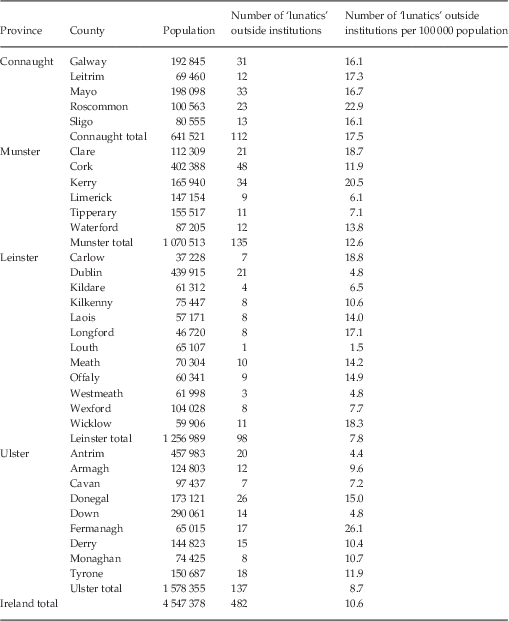
On 31 March 1901, there were 4 547 378 individuals recorded as living on the island of Ireland, of whom 482 were described as ‘lunatics’ and not resident in psychiatric hospitals, workhouses or other institutions on census night. That yields a point prevalence of 10.6 per 100 000 population. Geographical distribution was uneven: the lowest prevalence (7.8 per 100 000 population) was in Leinster and the highest in Connaught (17.5) (t=5.270, p=0.013) (Table 1).
Geographical distribution of individuals described as ‘lunatics’ and not resident in psychiatric hospitals, workhouses or other institutions on census night (31 March) in 1901

Data relate to the island of Ireland and are derived from the 1901 census of the United Kingdom of Great Britain and Ireland, conducted on 31 March 1901. Data are freely available on the 1901 and 1911 census website launched under the auspices of the National Archives of Ireland, along with various partners (www.census.nationalarchives.ie).
A majority (60.4%) were women. Mean age was 45.7 years (s.d. 16.0); mean age of women was higher than that of men (47.0 years, s.d. 15.8; and 43.8, s.d. 16.1, respectively; t=2.167, p=0.031). A majority were single (i.e. never married) (63.7%); 25.7% were married; 10.2% were widowed; and marital data were not recorded for 0.4%. Marital status differed between women and men, with 33.3% of women being married, compared with 14.1% of men, and 12.0% of women widowed, compared with 7.3% of men (Pearson χ 2 31.275, p<0.001).
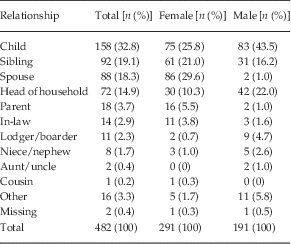
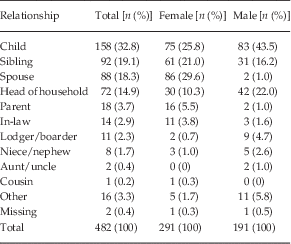
The most common relationship that the mentally ill individual had to the head of the household was that of child (32.8%) (Table 2). The next most common relationships were sibling (19.1%), spouse (18.3%) and head of household (14.9%). The distribution of these relationships differed between genders: 43.5% of males were children of the head of household, compared with 25.8% of females; 22.0% of men were the head of household, compared with 10.3% of women; and 1.0% of men were spouses of the head of household, compared with 29.6% of women (Pearson χ 2 101.663, p<0.001). It is notable that some of the ‘boarders’ were unrelated to the ‘head of household’; the possibility that these households represented ‘boarding out’ initiatives is discussed below.
Relationship to the head of household of individuals described as ‘lunatics’ and not resident in psychiatric hospitals, workhouses or other institutions on census night (31 March) in 1901
Data relate to the island of Ireland and are derived from the 1901 census of the United Kingdom of Great Britain and Ireland, conducted on 31 March 1901. Data are freely available on the 1901 and 1911 census website launched under the auspices of the National Archives of Ireland, along with various partners (www.census.nationalarchives.ie).
A majority were Roman Catholic (82.0%). The other religions represented were Church of Ireland (7.9%), Presbyterian (7.7%), Methodist (0.6%), Church of England (0.6%), Episcopalian (0.4%), Baptist (0.2%), Society of Friends/Quaker (0.2%), Unitarian (0.2%) and no recorded religion (0.2%). There was no gender difference in religion (Pearson χ 2 9.002, p=0.437).
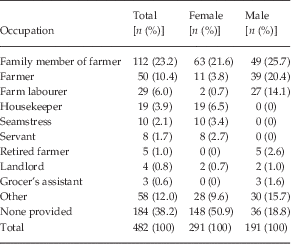
No occupation was recorded for 38.2% of individuals (Table 3). Farming was the most common occupation recorded, with 40.6% involved in some way: 23.2% were family members of farmers; 10.4% farmers; 6.0% farm labourers; and 1.0% retired farmers. The next most common occupation was housekeeper (3.9%). Occupation differed between genders (Pearson χ 2 137.392, p<0.001), with 20.4% of men described as farmers, compared with 3.8% of women, and all housekeepers (n=19), seamstresses (n=10) and servants (n=8) were women.
Occupations of individuals described as ‘lunatics’ and not resident in psychiatric hospitals, workhouses or other institutions on census night (31 March) in 1901
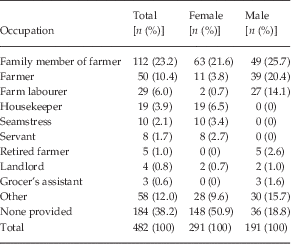
Data relate to the island of Ireland and are derived from the 1901 census of the United Kingdom of Great Britain and Ireland, conducted on 31 March 1901. Data are freely available on the 1901 and 1911 census website launched under the auspices of the National Archives of Ireland, along with various partners (www.census.nationalarchives.ie).
A majority could ‘read and write’ (64.5%); 6.0% could read only; 28.4% could not read or write; and data were not recorded for 1.0%. For a majority (63.5%), the ability to speak the Irish language was not recorded. Among those for whom this information was recorded (n=176), 74.4% spoke both Irish and English, 21.0% could speak English only and 4.5% could speak Irish only. There was no gender difference in literacy (Pearson χ 2 1.671, p=0.643) or the ability to speak Irish (Pearson χ 2 0.769, p=0.857).
Discussion
Main findings
Overall, the 1901 census describes 482 individuals as ‘lunatics’ who were not resident in psychiatric hospitals, workhouses or other institutions on 31 March 1901. This yields a point prevalence of 10.6 per 100 000 population, with the lowest prevalence in Leinster (7.8) and the highest in Connaught (17.5). A majority were women (60.4%). Mean age was 45.7 years; mean age of women (47.0 years) was higher than that of men (43.8 years). A majority were single (i.e. never married) (63.7%), although 33.3% of women were married, compared with 14.1% of men. The most common relationship to the head of the household was child (32.8%). Farming was the most common occupation (40.6%), although 38.2% had no occupation recorded. The majority were Roman Catholic (82.0%) and could ‘read and write’ (64.5%). Among those for whom the ability to speak Irish language was recorded, 74.4% spoke both Irish and English.
Strengths and limitations
This study has several strengths. Most importantly, this study focuses on individuals described as ‘lunatics’ who were not resident in asylums, workhouses or other institutions in 1901. This is a historically important population, which has been relatively neglected owing to the historiography’s strong focus on psychiatric institutions and mental health legislation.
In addition, our study includes data on many relevant and interesting variables, such as level of education, which can help shed light on specific aspects of this population. Our study also helps shed light on important topics in the history of psychiatry, such as the possible early emergence of care for the mentally ill outside the institutions, a potential forerunner of later models of community care (see below).
Our study also focuses on an important time in the evolution of mental health services in Ireland. As the 20th century commenced, there was unprecedented professional and public concern about the destitute mentally ill: in 1903, for example, a Conference of the Irish Asylums Committee was convened at the Richmond Asylum in Dublin to consider the inexorable rise in demand for asylum beds (Healy, Reference Healy1996). Subsequent decades saw no fewer than three commissions of enquiry into the mentally ill, including the ‘Commission on the Relief of the Sick and Destitute Poor including the Insane Poor’ (1927), which called for auxiliary mental hospitals to be established in old workhouses and the introduction of a voluntary admission status, as well as outpatient clinics (O’Neill, Reference Prior2005).
Notwithstanding these strengths, the present study has several limitations. In the first instance, this study is based on census data from 1901. Census data can include inaccuracies for several possible reasons, including incorrect recording of data in the first place, compounded by the possibility that certain Irish households may have deliberately misled census enumerators. There may also have been incomplete enumeration in certain households or partial coverage of certain geographical areas of the country. This is supported by the fact that the prevalence of mental disorder among individuals outside asylums, workhouses and other institutions identified in this study seems low, especially for certain counties (see below for further discussion and suggestions for future research).
In addition, the design of the 1901 census form imposes certain limitations including the fact that any individual described as a ‘lunatic’ could not also be described an ‘imbecile’ or an ‘idiot’ (Kelly, Reference Kelly2010); this is regrettable, owing to evidence that certain mental disorders (e.g. schizophrenia) appear to be more common among individuals with intellectual disability compared with the general population (Deb et al. Reference Deb, Thomas and Bright2001). Finally, we used the online transcriptions of scans for our analysis rather than scans of the original forms; there are likely to be certain differences between the two, as well as occasional differences of opinion between enumerators and the heads of households filling out the forms.
The definitions used in Irish censuses are important to consider here, as the terms ‘imbecile’, ‘idiot’ and ‘lunatic’ were used in inconsistent ways, although definitions were provided – for example, a ‘lunatic’ was ‘a mentally ill person with periods of lucidity’. This is similar but not identical to the definition of a person of ‘unsound mind’ used in the Fourth Census of Canada 1901, which stated that ‘it is not necessary that the degree of infirmity should be absolute or total, but that it should be so sufficiently marked in any one of the classes as to have reached the stage of incapacity’ (Fisher, Reference Fisher1902). The Irish definition is somewhat similar, at least to the extent that it defines lunacy as involving a lesser degree of impairment than ‘imbecile’ and ‘idiot’.
It is difficult, if not impossible, to clarify just how conscientiously these definitions were used by various enumerators in 1901. It seems likely that, at the very least, the terms ‘imbecile’ and ‘idiot’ tended to be used interchangeably. The Mental Deficiency Act of 1913 later defined an ‘imbecile’ as an individual unable to take care of himself or herself, and defined an ‘idiot’ as a person unable to protect himself or herself from common dangers (Simmons, Reference Stone1978). The 1901 census, however, preceded the Mental Deficiency Act of 1913 by more than a decade, and the 1913 Act was, in any case, never applied in Ireland. As a result, the terms ‘imbecile’ and ‘idiot’ were likely used interchangeably in the 1901 census. In this context, it also appears likely that the low prevalence of ‘lunatics’ in the census is explained by the ‘lunatic’ definition for the enumerator and the ways in which such a definition was used.
Comparison with asylums and workhouses
Our study identified 482 individuals described as ‘lunatics’ and not resident in asylums, workhouses or other institutions on 31 March 1901. A majority of them (60.4%) were women, and the mean age of women (47.0 years) was higher than that of men (43.8 years). By way of comparison, there were, on 1 January 1901, 21 169 inpatients in Irish asylums, of whom 48.0% were women (Brennan, Reference Brennan2014). This slight difference in gender distribution may reflect increased likelihood of women, especially slightly older women, remaining at home, despite showing signs of mental disorder. This is consistent with the fact that women generally tended to be admitted to asylums at a later stage in their illness than men, and were more likely to be discharged (Walsh, Reference Williamson2004).
In our study, the most common relationship to the head of the household was child (32.8%), suggesting that children with mental disorder may have remained at home in order to be cared for by their families, or, alternatively, to care for their parents, attend to household tasks or work on farms. Consistent with this, we found that a majority were single (i.e. never married) (63.7%), although marriage was more common among women (33.3%) than men (14.1%).
At the county level, it is interesting that our study shows that certain counties with large asylums (e.g. Kerry) had relatively high prevalences of individuals with mental disorder outside the asylums and workhouses. This may reflect the fact that many Irish asylums demonstrated significant rates of both admission and discharge (Walsh, Reference Williamson2004), possibly resulting in relatively larger numbers of individuals diagnosed with mental disorder living in counties with asylums. On the other hand, the prevalence in Dublin was relatively low, despite Dublin’s large number of asylums, suggesting that this explanation was not universal, or that other factors may have been at play, especially in Dublin.
It is known, for example, that Dublin’s workhouses accommodated large numbers of mentally ill individuals in the early 1900s (Kelly, Reference Kelly2007b). On 31 January 1907, the Chairman of the Joint Committee at the Richmond Asylum (later St Brendan’s Hospital, Grangegorman) made this very clear to his Committee:
A large number of our admissions come here direct from workhouses. I have looked up the exact numbers and find they average about 30% of total admissions. During the last four financial years 709 patients came from workhouses. I do not think I would be very much in error in estimating that 50% of these 709 admissions would come under the head of Chronic and Harmless Lunatics, and probably at the present time there are not far short of 700 or 800 cases in the whole institution who could be so classified (Richmond Asylum Joint Committee, 1907: 92–93).
This issue was again brought to the attention of the Richmond Asylum Joint Committee on 15 August 1907, when they received correspondence from the guardians of the North Dublin Union Workhouse, enclosing a report from Dr Courtenay, Inspector of Lunatics, in which he states that ‘the lunacy wards of the workhouse are overcrowded and the condition of the insane there deplorable’ (Richmond Asylum Joint Committee, 1907: 408). From 1907 onwards, the Committee at the Richmond made concerted efforts to address this problem (Kelly, Reference Kelly2007b); however, in 1901, it remained the case that many of the ‘Chronic and Harmless Lunatics’ housed in the North Dublin Union Workhouse or the Richmond Asylum might, had they lived in other counties, have been living outside the workhouse or asylum systems.
Overall, it is probable that the demographic and geographical differences between East and West, provincial and urban areas observed in the present study are related, at least in part, to ease of access to the asylums and availability of alternative institutions (e.g. workhouses). These patterns could be elucidated significantly by further epidemiological and geo-spatial analysis of the geographical distribution of ‘lunatics’ outside institutions described in this paper. Such an analysis is beyond the scope of the present paper, but would involve examining the density of ‘lunatics’ living outside institutional settings in the counties served by each individual public asylum; the overall population density in the counties served by the asylum; and the size and occupancy rate of the local asylum, as well as the availability of alternative private asylum beds, workhouse places and other kinds of provision within the same counties.
Such an analysis, although complex, could also help clarify the extent to which the data analysed here provide early indicators of the provision of care for the mentally ill outside asylums and other institutional settings. More specifically, it is notable that some of the ‘lunatics’ who were ‘boarders’ (Table 2) were unrelated to the ‘head of household’, suggesting the possibility that these households may have represented ‘boarding out’ initiatives. There was significant interest in such schemes at this time, with Dr John Conolly Norman (1853–1908), resident medical superintendent of the Richmond Asylum, Grangegorman (1886–1908), being an especially strong proponent of ‘domestic treatment’ (Norman, Reference Norman1896) and ‘family care of the insane’ (Norman, Reference O’Neill1905). Analysing the distribution of such arrangements, as part of a geo-spatial analysis of the general distribution of ‘lunatics’ in relation to population density and asylum location, might help clarify the precise extent to which such arrangements were in place in 1901, and their relationships to the asylums themselves.
Finally, although no occupation was provided for 38.2% of individuals in our study, farming was the most common occupation recorded (40.6%). In addition, consistent with the broader population, majorities were Roman Catholic (82.0%); could ‘read and write’ (64.5%); and among those for whom the ability to speak Irish was recorded 74.4% spoke both Irish and English. This, too, is consistent with broader trends in Ireland, as illiteracy had fallen rapidly in preceding decades from 53% in 1841 to 18% in 1891 (Hill et al. Reference Hill, Lynch and Maguire2013).
Conclusions
There were 482 individuals described as ‘lunatics’ and not resident in psychiatric hospitals, workhouses or other institutions on 31 March 1901, yielding a point prevalence of 10.6 per 100 000 population. This is likely to be an underestimate, but this is a difficult population to study systematically, and thus more accurate figures will be difficult to establish with any greater confidence. There were significant geographical differences: the highest prevalence was in Connaught (17.5) and the lowest in Leinster (7.8). These differences are likely attributable to different levels of provision or use of workhouses and asylums, but this requires further study. A similar analysis of the 1911 census, which is also available online, might assist in contextualising these findings further.
There were significant gender differences within the population in our study, with 33.3% of women recorded as married, compared with 14.1% of men, and the mean age of women (47.0) was slightly but significantly higher than that of men (43.8). These differences likely reflect different social factors governing the admission of women to asylums and workhouses, compared with men, but this, too, requires further research before firm conclusions can be drawn. Qualitative methodologies will be as important as quantitative ones in elucidating the dynamics underpinning these trends.
Apart from the differences outlined above, this population resembled the broader Irish population in several important respects, with a majority recorded as Roman Catholic (82.0%) and farming being the most common occupation (40.6%). In addition, a majority were able to ‘read and write’ (64.5%), and among those for whom the ability to speak Irish was recorded a majority (74.4%) spoke both Irish and English.
These similarities, along with the significant geographical and gender differences identified in our study, clearly indicate that this is a group that merits further research in order to deepen our understanding of the fate of individuals with apparent mental disorder outside the institutions in the early 20th-century Ireland. Particular attention could be usefully devoted to the geo-spatial distribution of such individuals in relation to local asylums and the extent to which these individual were cared for in communities, possibly prefiguring later models of community care. Greater understanding of these patterns would assist not only with understanding the early trajectory of community care in Ireland but also the social histories of districts served by each local asylum.
Acknowledgements
The authors are very grateful to the peer reviewers for their helpful comments and suggestions.