CHDs are the most common birth defect in the newborn, occurring in approximately 1% of births per year in the USA.Reference Reller, Strickland, Riehle-Colarusso, Mahle and Correa1 Prenatal diagnosis has been shown to reduce the risk of death prior to planned cardiac surgery of neonates with certain defects, such as hypoplastic left heart syndrome and transposition of the great arteries.Reference Holland, Myers and Woods2 This conclusion, however, is not without controversy. Some data suggest that prenatal diagnosis of CHD does not improve risk of mortality.Reference Khoshnood, Lelong and Houyel3,Reference Khoshnood, Lelong and Houyel4 Other studies show a decrease in preoperative mortality but a paucity of data showing post-operative mortality benefit. This limitation is likely due to the limited power of these studies to assess a true mortality advantage, as the number of deaths attributed to a major CHD is small, owing to improved medical and surgical management.Reference Mahle, Clancy, McGaurn, Goin and Clark5,Reference Kumar, Newburger, Gauvreau, Kamenir and Hornberger6
Given the continued advancement of perinatal detection, obstetricians are increasingly faced with managing pregnancies complicated by fetal CHD. Unfortunately, there is no consensus on the optimal timing or route of delivery. It is well established that preterm (less than 37 and 0/7 weeks of gestation) and early-term (37 0/7–38 6/7 weeks) delivery is associated with increased neonatal morbidity and mortality.7 Multiple studies reveal, however, that despite improved outcomes with term delivery, those pregnancies complicated by CHD are often delivered at an earlier gestational age. A retrospective cohort study by Costello et al. found that median gestational age at birth in neonates with CHD was 38 weeks when a prenatal diagnosis was made compared to 39 weeks in those without a prenatal diagnosis in their study population.Reference Costello, Pasquali and Jacobs8
The decision to proceed with an early-term delivery may be multifactorial. A prospective cohort study by Bartlett et al. of infants born with transposition of the great arteries noted that a delay in diagnosis and treatment is associated with perioperative cerebral ischaemia and reperfusion injury.Reference Bartlett, Wypij and Bellinger9 Reperfusion injury was hypothesised to be the etiology for the observed decreased Psychomotor Development Index scores on the Bayley Scales of Infant Development at 1 year of age. Additionally, co-occurring maternal conditions, such as poorly controlled pre-gestational diabetes or pre-eclampsia, may be an indication for late-preterm or early-term delivery.10 The presence of CHD itself is another risk factor for early spontaneous onset of labour. Finally, physician and maternal anxiety regarding onset of labour and potential delivery at a non-tertiary care center as well as availability of subspecialists may also be contributing factors in the decision-making process.Reference Costello, Pasquali and Jacobs8,Reference Bartlett, Wypij and Bellinger9 Despite an increased interest and ability to prenatally diagnose CHDs, as described above, it is unclear if prenatal diagnosis confers a postnatal survival advantage. Additionally, the optimal timing and mode of delivery remain unclear in those pregnancies complicated by CHD.
We sought to evaluate delivery outcomes in fetuses prenatally diagnosed with congenital cardiac defects and compare these outcomes with the general population at a tertiary care center.
Materials and methods
We conducted a retrospective case–control study using data from the Johns Hopkins School of Medicine QS database. This searchable obstetrical database was queried for all singleton cases of neonates with CHD confirmed by ultrasound, with non-cardiac anomalies, and controls without anomalies from July 2013 to July 2016. The analysis was limited to those neonates with Apgar scores greater than or equal to 1 at the time of birth. Intrauterine fetal demise and genetic terminations were excluded from the data set. Cardiac anomalies included are as follows: atrioventricular canal defect, clinically significant atrial septal defect or ventricular septal defect, coarctation of the aorta, complete heart block or heart failure leading to non-immune hydrops, double-outlet right ventricle, hypoplastic aortic arch, mesocardia, heterotaxy, pulmonary atresia, tetralogy of Fallot, dextro-transposition of the great arteries, hypoplastic right heart (tricuspid atresia, pulmonary atresia, Ebstein anomaly), and hypoplastic left heart syndrome (aortic atresia, mitral atresia). Cases with sonographic evidence of hydrops were excluded unless thought to be secondary to a major cardiac anomaly. Fetuses with multiple congenital anomalies that included a major cardiac defect were included in the CHD group. Non-cardiac anomalies included clinically significant genitourinary anomalies (absent bladder on anatomy ultrasound and follow-up ultrasound, bladder exstrophy, renal agenesis, polycystic kidney disease), gastrointestinal anomalies (congenital diaphragmatic hernia, gastroschisis, omphalocele, absent stomach), neurological anomalies (agenesis of the corpus collosum, caudal regression, ventriculomegaly, spina bifida spectrum, sacrococcygeal teratoma), congenital pulmonary airway malformation, or other masses that may obstruct fetal descent. The control group consisted of all singleton deliveries in the same period of time of women living in the same region (selected by postal code) as the cases.
Primary cesarean section indications were limited to arrest of descent, arrest of dilation, malpresentation, fetal anomaly precluding vaginal delivery (such as severe ventriculomegaly), non-reassuring fetal heart tracing, pre-eclampsia with severe features and eclampsia, and elective, which includes placenta accreta, history of shoulder dystocia or severe perineal laceration in prior pregnancy, macrosomia, herpes simplex virus, human immunodeficiency virus with a viral load >1000, or worsening maternal clinical status.
The co-primary outcomes of the study included the incidence of preterm delivery, early-term delivery, full term, and primary cesarean section versus vaginal delivery. Delivery timing was classified according to Spong et al.’s definition of term pregnancies.Reference Spong11 Preterm delivery is defined as delivery before a gestational age of 37 weeks. Preterm delivery is further sub-classified into preterm, delivery prior to a gestational age of 34 weeks, and late preterm, delivery between 34 weeks and 36 weeks and 6 day. Early term is defined as 37 to 38 weeks and 6 days. Full term is defined as a gestational age over 39 weeks. Secondary outcomes that were investigated included birth weight in grams, incidence of meconium-stained amniotic fluid, Apgar score at 1 minute and 5 minutes, and incidence of spontaneous labour versus induction of labour.
Data were collected and analysed using odds ratios with p-values and confidence intervals. Birth weight percentiles were obtained using a standardised birth weight chart for all neonates at a given gestational age. Generalised estimating equations regression models were used to analyse the association between median gestational age at delivery, birth weight, placenta weight, maternal estimated blood loss at delivery, incidence of meconium-stained amniotic fluid, Apgar score at 1 minute and 5 minutes, incidence of spontaneous labour and induction of labour, and incidence of cesarean section in pregnancies with a prenatal diagnosis of CHD as compared to those complicated by non-cardiac anomalies and without fetal anomalies. Multiple imputation was used to impute plausible values for missing data, thus reducing selection bias and increasing statistical power. In the multivariate analyses performed, multiple imputation was used to impute 10 imputed data sets using observed associations in the data. Using multiple imputation, results from generalised estimating equations are valid under the less strict assumption of missing at random, i.e., rates of missing data may depend on the observed data, but do not depend on the missing data values.
Results
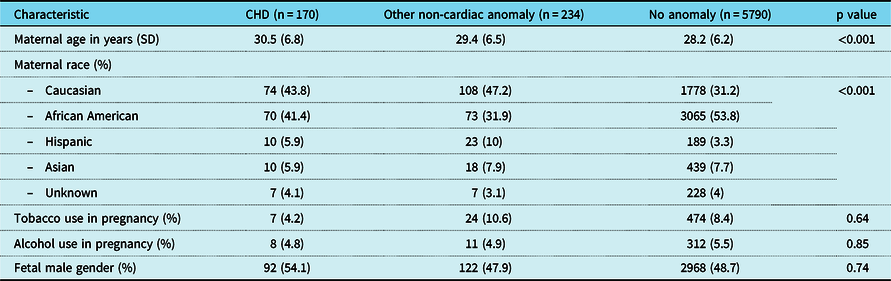
From July 2013 to July 2016, there were a total of 6,194 live births included in the study. In total, 170 live births affected by a fetal diagnosis of CHD and 234 births with a prenatal diagnosis of non-cardiac anomaly were included. The study cohort’s baseline characteristics and demographics are shown in Table 1. In pregnancies complicated by cardiac or other anomalies, the maternal age was slightly higher (30.5 and 29.4 versus 28.2 years, respectively, p < 0.001). There were no differences in the rate of tobacco or alcohol exposure (p = 0.079 and 0.851) and no difference in neonatal gender (p = 0.742) across the groups.
Demographic data and baseline characteristics of study cohort.

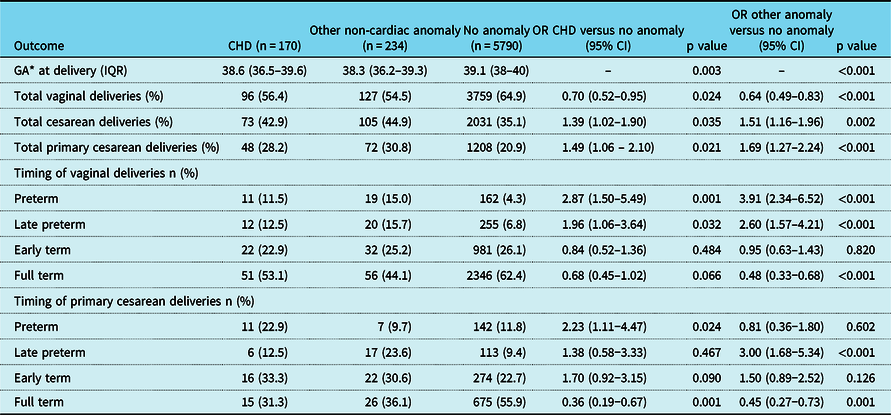
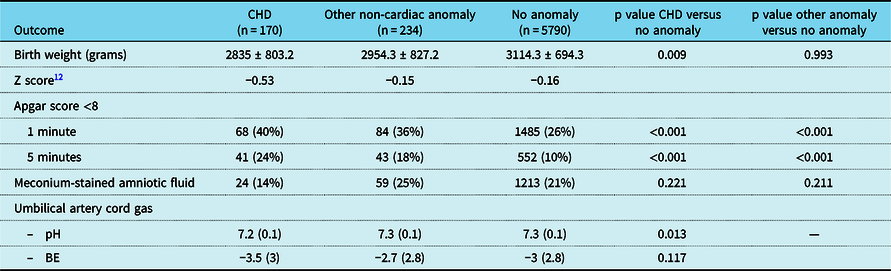
In the study population, the median gestational age at delivery was significantly lower between those neonates with either a cardiac or non-cardiac anomaly (38.6 and 38.3 weeks, respectively) and those without a known fetal anomaly at 39.1 weeks (Table 2). Further, when comparing vaginal deliveries of those prenatally diagnosed with CHD, there is an approximately threefold increased risk of delivery at less than 34 weeks and approximately twofold increased risk of delivery in the late-preterm period compared to the control group, with an odds ratio of 2.87 (p = 0.001) and 1.96 (p = 0.032), respectively (Table 2). The rate of preterm delivery in pregnancies with prenatally diagnosed CHD was significantly increased regardless of mode of delivery in comparison to the control group, with an odds ratio of 2.87 for vaginal delivery and 2.23 for primary cesarean delivery. It is therefore not surprising that newborns with prenatally diagnosed CHD were found to have a significantly lower birth weight as compared to those with other anomalies (2835 g versus 2954 g, z scores of –0.53 and –0.15, respectively) and compared to those fetuses without anomalies (3114 g, z score of –0.16, p < 0.001) (Table 4).Reference Talge, Mudd, Sikorskii and Basso12
Mode of delivery outcomes

* GA: median gestational age in weeks (interquartile range).
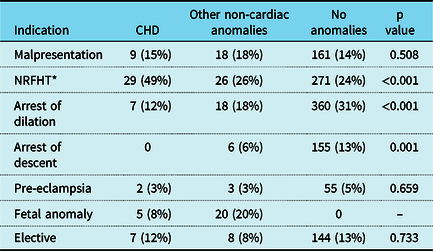
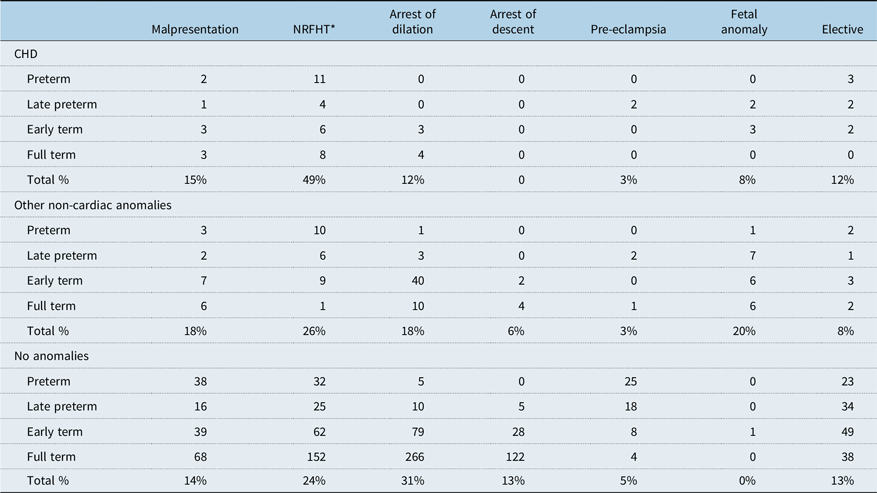
The data in Table 2 demonstrate that the rate of cesarean delivery was 42.9% for those complicated by CHD, 44.9% for all other anomalies, and 35.1% for the control cohort. There is, however, an approximately 1.5-fold increase in the rate of primary cesarean sections-associated prenatally diagnosed CHD with an odds ratio of 1.49 (95% CI 1.06–2.10) and in those pregnancies complicated by non-cardiac anomalies with an odds ratio of 1.69 (95% CI 1.27–2.24). The most commonly cited indication for primary cesarean delivery was non-reassuring fetal heart tracing for fetuses with prenatally diagnosed CHD and other anomalies, whereas arrest of descent was the most commonly cited indication for non-anomalous fetuses (Table 3).
Indications for primary cesarean delivery

* NRFHT: non-reassuring fetal heart tracing.
Delivery outcomes

With regard to perinatal outcomes, Apgar scores differed significantly when comparing fetuses with anomalies to non-anomalous fetuses. The data in Table 4 show that significantly more fetuses in both the CHD and other anomaly cohorts demonstrated lower 1- and 5-minute Apgar scores of less than 8 than compared to fetuses without anomalies. About 40% of the CHD cohort and 36% of the non-cardiac anomaly group had 1-minute Apgar scores of <8 compared to 26% in the non-anomalous group (p < 0.001). Five-minute Apgar scores of <8 were similarly resulted, with 24% of CHD, 18% of other anomalies, and 10% of the control group (p < 0.001). CHD was also associated with lower umbilical artery cord pH (7.2 versus 7.3 p = 0.013). There was no significant difference between base excess (–3.5 versus –3 p = 0.117), however. Further, incidence of meconium-stained fluid was analysed as a marker of fetal distress in utero. While not meeting statistical significance, 14.1% of fetuses with CHD were noted to have meconium-stained amniotic fluid, which was less than in non-anomalous pregnancies at 20.9% (p = 0.221).
Discussion
The results of this study demonstrate that neonates with prenatally diagnosed CHDs are born at an earlier gestational age than those without a CHD, lower birth weights, and more often by cesarean delivery. These findings verify those of prior studies, which are discussed further in the following paragraphs. Furthermore, a novel finding of this study is that the indications for primary cesarean delivery differed between the CHD neonates and the controls.
Our data indicate that there is twofold increased risk of delivery at less than 39 weeks and further that there is up to a threefold increased rate of delivery at less than 34 weeks gestational age in those pregnancies complicated by CHD as compared to unaffected pregnancies. Further, the average birth weight of those fetuses with a prenatally diagnosed CHD was lower than those without an anomaly, 2835 g ± 803.2 g versus 3114.3 g ± 694.3 g (z score of –0.53 and –0.16, respectively).Reference Talge, Mudd, Sikorskii and Basso12 These results are particularly significant as numerous studies have shown a survival benefit for neonates born near term and in those with a higher birth weight.Reference Best, Tennant and Rankin13 It is important to note, however, that our study is limited by a lack of accounting for maternal obstetric conditions that may have been indications for late-preterm or early-term delivery, such as gestational hypertension, pre-eclampsia, or poorly controlled diabetes. These confounders are also known to influence fetal growth and could potentially confound determination of the etiology of the observed birth weight discrepancy. Despite this limitation, the findings of this study corroborate with those of Peyvandi et al., who noted that neonates prenatally diagnosed with CHD were born earlier with lower birth weights, as compared to their postnatally diagnosed counterparts, despite having a similar severity of defect.Reference Peyvandi, Nguyen and Almeida-Jones14 In light of multiple studies showing that a lower birth weight is associated with poorer surgical outcomes in those neonates with critical CHD necessitating early intervention,Reference Costello, Pasquali and Jacobs8 these data underscore the importance of monitoring fetal growth via serial growth assessments in planning the timing of delivery and interventions after birth, which may follow a less predictable trajectory.Reference Wallenstein, Harper and Odibo15
Our data are also in line with the findings of other studies that have shown that prenatally diagnosed CHD is associated with an increased risk of delivery by primary cesarean section.Reference Peyvandi, Nguyen and Almeida-Jones14 Specifically, for those pregnancies complicated by CHD, there is an approximately 1.5 times increased risk of primary cesarean delivery as compared to unaffected pregnancies. Analysis of the data also shows that the indication for primary cesarean section was most commonly for non-reassuring fetal heart tracings in those pregnancies affected by a prenatal diagnosis of CHD, whereas in unaffected pregnancies, the indication was most commonly for arrest of descent. Fetal heart rate tracing interpretation has poor inter-observer reliability. In The American College of Obstetricians and Gynecologists Practice Bulletin on intrapartum fetal surveillance, it is noted that when the same obstetrician who looked at the same tracing two months after first interpreting it, 21% interpreted it differently.16 Further, there is poor inter-observer reliability in fetal heart rate interpretation. Therefore, this finding could be due to implicit bias of the physician interpreting the tracing at that moment in time. Just as electronic fetal monitoring increases the risk of cesarean delivery in the general population, thought to be due to high false-positive rates, the same conclusion could be applied to the CHD population. In addition, some of the CHD population could have associated placental abnormalities such as lower placental weight, which has been shown to impact fetal growth.Reference Matthiesen, Henriksen and Agergaard17 Pregnancies complicated by hypoplastic left heart syndrome have been found to be associated with placentas with abnormal parenchymal morphology.Reference Jones, Olbrych and Smith18 The increased rate of cesarean delivery has significant implications on maternal and neonatal outcomes, with the strongest evidence for an increased risk of maternal haemorrhage, longer hospital stay, and increased rates of neonatal respiratory distress.10 Further, there are implications in future pregnancies, with an increased risk of uterine rupture and abnormal placentation in those individuals with a history of cesarean delivery.
One of the strengths of this study is the large number of deliveries, over 5000, during the study period. Despite the large number of total deliveries, there were only 170 deliveries affected by a clinically significant CHD that met study criteria. Further, this study was conducted at a single academic institution. While large population-based studies have shown no significant difference in the rate of cesarean delivery between academic and community hospitals, there are certainly differences in maternal demographics. The Johns Hopkins Hospital is a major tertiary care center, with a level four neonatal ICU, that receives high-acuity patient transfers from throughout the mid-Atlantic region. The indication for transfer may be either for maternal or fetal comorbidities. This higher prevalence of maternal comorbidities in our patient population is a likely explanation for the lower observed median gestational ages at delivery. Unfortunately, however, we were unable to determine the indication for all these early-term deliveries, either due to lack of access of prenatal records or incomplete documentation at the time of delivery.
In summary, the data presented provide additional evidence that the prenatal diagnosis of CHD is associated with a lower birth weight, preterm delivery, and with an increased risk of delivery by primary cesarean section. Further study may be needed regarding the interpretation of fetal heart rate tracings and placental factors in pregnancies with CHD. Despite the limitations of this study, the results presented further emphasize the importance of thoughtful delivery management of those with pregnancies complicated by CHDs.
Acknowledgements
We would like to acknowledge support for the statistical analysis from the Johns Hopkins Biostatistics Center.
Financial support
Angie Jelin is funded by a Johns Hopkins Women’s Health Scholarship. Grant IO# 90072576 was funded by the Saudi Arabian Cultural Mission for support of a research fellow.
Conflicts of interest
None.
Supplemental table displaying indications for primary cesarean section at a particular gestational age