FOCUS POINTS
• Pathological gambling (PG) and obsessive-compulsive disorder (OCD) have been considered related because of the peculiar intrusive ideas and the compulsive behaviors associated with specific themes, which are socially and occupationally dysfunctional to the individual. However, some argue against such a relationship.
• The only neurocognitive deficit common to both PG and OCD groups is increased fragmentation error on the Rey–Osterrieth Complex Figure test. No neurocognitive function is decreased in either clinical group, including in the areas of executive function, verbal and visual memory, and visual organization, except for the fragmentation error.
• Caution should be exercised in concluding that PG is a part of the OCD spectrum because neurocognitive evidence demonstrating the overlap between PG and OCD is currently insufficient.
Introduction
Pathological gambling (PG) is defined as a severe form of problem gambling that negatively affects interpersonal, occupational, and financial functioning.Reference Potenza, Kosten and Rounsaville1 Pathological gamblers show persistent and recurrent maladaptive gambling behavior, such as loss of control over gambling despite its adverse consequences. Therefore, PG is considered a problem related to impulse control in the Diagnostic and Statistical Manual of Mental Disorders, 4th Edition (DSM-IV)2 and the International Classification of Disorders, 10th Revision (ICD-10).Reference Potenza3
Some previous studies have suggested a similarity between PG and obsessive-compulsive disorder (OCD) because, like OCD, PG includes intrusive thoughts focusing on specific themes and repetitive behavior that generates distress.Reference Riggs and Foa4 Unlike clinicians, who have used PG to describe severe problem gambling, Gamblers Anonymous (GA) members have more often used the term “compulsive gambling.”Reference Raylu and Oei5, Reference Lesieur6 Although GA members misuse the term “compulsive” as it is defined by medical terminology, their intuition seems to be correct, considering the link between features of PG and OCD.Reference Lesieur6 Black and MoyerReference Black and Moyer7 found that the most common personality disorder in PG patients was OCD. Hollander and WongReference Hollander and Wong8 also suggested that PG can be viewed as an impulsive subtype of the obsessive-compulsive (OC) spectrum. Many researchers have studied PG patients’ obsessive preoccupation with gambling and have examined the relationship between the PG and the OC spectrum by focusing on clinical features and behavioral patterns.Reference Durdle, Gorey and Stewart9–Reference Kim and Grant11 Whether the two disorders are related is still under debate.Reference Kim and Grant11–Reference Blanco, Moreyra, Nunes, Saiz-Ruiz and Ibanez13
Given that the link between the PG and the OCD spectrum is unclear, neurocognitive studies could be a strategic alternative to identify the similarities and differences between these clinical groups. Indeed, many studies have identified the unique neurocognitive profiles of various disorders.Reference Rhinewine, Lencz and Thaden14, Reference Ferrier and Thompson15 However, no study has compared neurocognitive functions in PG and OCD patients. Furthermore, because contradictory evidence has been reported with respect to neurocognitive functions, such as executive function or attention, even among studies on PG,Reference Rugle and Melamed16–Reference Brand, Kalbe and Labudda18 it is also necessary to identify the neurocognitive functions that are linked with emotional regulation and social, cognitive, and behavioral performance.Reference Greenberg, Kusché and Riggs19 Further, two studies have used the same neurocognitive test and yet shown different behavioral data. For example, one research group reported differences between PG patients and controls on the Wisconsin Card Sorting Test (WCST),Reference Marazziti, Catena Dell'Osso and Conversano20, Reference Heaton, Chelune, Talley, Kay and Curtiss21 whereas another failed to find differences compared to healthy controls.Reference Cavedini, Riboldi, Keller, D'Annucci and Bellodi22
In the present study, we investigated the neurocognitive profiles of PG and OCD groups. If the two disorders belong to the same psychopathological spectrum, the neurocognitive profile should show common patterns. We hypothesized that differing profiles between the two clinical groups would provide evidence for differentiating between PG and OCD.
Methods
Participants
Sixteen male outpatients who met the DSM-IV criteria for PG2 and achieved a score of ≥5 on the South Oaks Gambling Screen (SOGS; mean ± SD, 15.79 ± 1.53)Reference Lesieur and Blume23 were recruited from a psychiatric clinic in one university hospital in Seoul, Korea. We also recruited OCD patients who were drug naïve; this measure was taken to exclude the effects of drugs on neuropsychological performance,Reference Mataix-Cols, Alonso, Pifarré, Menchón and Vallejo24 because the PG patients had never been medicated. Thirty-six patients with OCD were screened from the OCD clinic at Seoul National University Hospital. Of these, 31 (23 males and 8 females) signed consent forms, underwent a Structured Clinical Interview for DSM-IV (SCID), and met the inclusion criteria. Diagnoses and comorbidity were established by experienced psychiatrists using the SCID-Axis I.
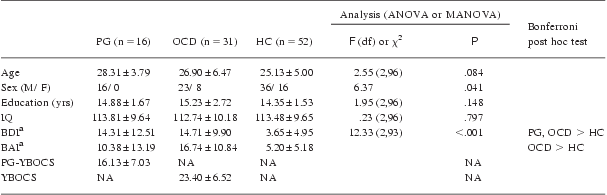
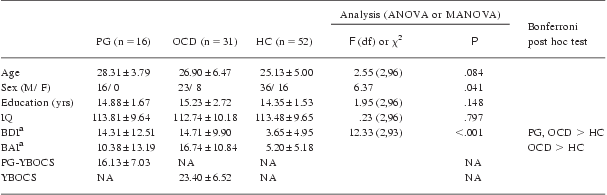
Fifty-two healthy controls over 19 years of age (HC; 36 males, 16 females) were recruited through Internet advertisements. HC subjects were also administered the nonpatient form of the SCID (SCID-NP) for Axis I or Axis II disorders. The groups were well matched for age, education, and intelligence. Table 1 provides demographic data. Exclusion criteria for all groups were (i) head injury, medical and neurological disorders, and alcohol or drug abuse; (ii) IQ <80; or (iii) age <19 years. The participants were paid $50 each for their time. Written informed consent was obtained from all participants after they had been completely informed of the study protocols. This study was conducted in accordance with the guidelines provided by the Institutional Review Board at Seoul National University Hospital.
Demographic and clinical characteristics of pathological gambling, obsessive-compulsive disorder, and healthy control groups
PG, subject with pathological gambling; OCD, subject with obsessive-compulsive disorder; HC, healthy controls.
BDI, Beck Depression Inventory; BAI; Beck Anxiety Inventory; PG-YBOCS, Yale–Brown Obsessive Compulsive Scale adapted for Pathological Gambling; YBOCS, Yale–Brown Obsessive Compulsive Scale.
NA, not applicable.
aMANOVA analysis for BDI and BAI.
Clinical assessments
The Yale–Brown Obsessive-Compulsive Scale adapted for Pathological Gambling (PG-YBOCS), which was developed to measure the severity of PG symptoms,Reference Pallanti, DeCaria, Grant, Urpe and Hollander25, Reference Spitzer, Gibbon and Williams26 and the Yale–Brown Obsessive-Compulsive Scale (YBOCS)Reference Goodman, Price and Rasmussen27 were used to assess symptoms in the PG and OCD groups, respectively. The severity of depression and anxiety was assessed with the Beck Depression Inventory (BDI)Reference Beck and Steer28 and the Beck Anxiety Inventory (BAI)Reference Beck, Epstein, Brown and Steer29 because the both clinical groups might suffer mental health problems.
Neuropsychological assessments
First, the Vocabulary, Arithmetic, Block Design, and Picture Arrangement subtests of the Korean version of the Wechsler Adult Intelligence Scale (K-WAIS) were administered to provide an IQ estimate.Reference Kim and Lee30 Then, a neurocognitive test battery was administered to assess three main cognitive functions: executive function, verbal learning and memory, and visual organization and memory.
To evaluate executive function, we used the (i) Trail-Making Tests (TMTs),Reference Reitan31 (ii) Controlled Oral Word Association Test (COWA),Reference Benton32 (iii) Category Fluency Test (supermarket and animal),Reference Mattis33, Reference Kertesz34 (iv) Stroop task,Reference Trenerry, Crosson, DeBoe and Leber35 and (v) manual version of the Wisconsin Card Sorting Test (WCST).Reference Heaton, Chelune, Talley, Kay and Curtiss21 These tests require various cognitive functions such as controlled attention, set-shifting ability, abstract concepts, and problem solving.Reference Lezak36
We also administered the Korean version of the California Verbal Learning Test (K-CVLT)Reference Kang and Kim37, Reference Delis, Kramer, Kaplan and Ober38 to assess verbal learning and memory. This test yields recall for 16 target nouns, recall for 16 intervening nouns, immediate and delayed recall of 16 nouns learned verbally, and word recognition.
The Rey–Osterrieth Complex Figure Test (ROCF)Reference Shin, Park, Park, Seol and Kwon39 was used to test for visual organization and memory, together with the Boston Qualitative Scoring System (BQSS).Reference Stern, Singer and Duke40 The BQSS includes measures of copying and immediate and delayed recall, as well as a series of subscales such as planning (the order in which the elements are drawn), fragmentation (whether the elements are drawn as entities or as pieces), and organization (sum of planning and fragmentation scores).
The above neuropsychological tests took 1.5 hours to complete, and they were administered during a single day.
Statistical analysis
One-way analysis of variance (ANOVA) or χ2 tests were performed on demographic and clinical variables. Multivariate analysis of variance (MANOVA) with Bonferroni's post hoc tests were conducted on the neuropsychological variables due to the possibility of correlations among the variables. The relationship between the performance on the neuropsychological tests and clinical symptoms among the PG and OCD subjects was explored by Spearman rank correlation and Pearson's correlation, respectively. In the statistical analyses, P < .05 was considered significant.
Results
Demographic data
The mean age of the PG subjects was 28.31 ± 3.79 years, and the mean duration of illness since the onset of symptoms was 2.19 years (SD = 1.24). The mean age of the OCD patients was 26.90 ± 6.47 years, and the mean duration of illness since the onset of symptoms was 8.51 years (SD = 7.24). The mean age of the HCs was 25.13 ± 5.0 years. We found no differences among the PG, OCD, and HC groups in age (F[2,96] = 2.55, P = .084), education (F[2,96] = 1.95, P = .148), and IQ (F[2,96] = 0.23, P = .797); a difference in sex distribution was found (χ2[2] = 6.37, P = .041) (Table 1).
Clinical assessments
The mean score on the PG-YBOCS was 16.13 ± 7.03 in PG subjects. The mean score on the YBOCS was 23.40 ± 6.52 in OCD subjects. The MANOVA for BDI and BAI revealed significant group differences (Wilks’ λ = .62; F[2,93] = 12.33; P < .001; for three HCs, clinical evaluation was not available). The OCD subjects were found to be more depressed and more anxious compared with the HC group (both P < .001), whereas the PGs showed only greater depression compared with the HC subjects (P < .001) (Table 1).
Neurocognitive assessments
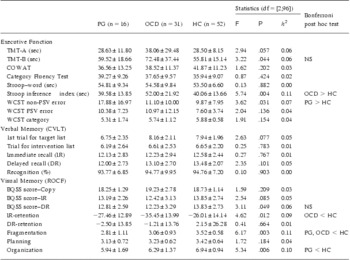
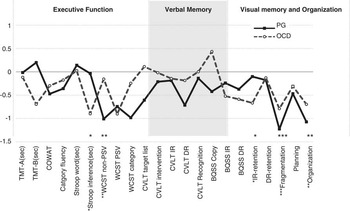
MANOVA showed significant group differences in some assessments of executive function (Wilks’ λ = .62; F[2,96] = 1.92; P = .017; WCST nonperseverative errors, P = .031 Stroop inference index, P = .004). The Bonferroni's post hoc test revealed that PG subjects demonstrated more nonperseverative error on the WCST than HCs did (P = .026), whereas OCD patients had poorer performance on the Stroop inference index (measured as the time for the color–word condition minus that for the word condition) compared with that in the HC group (P = .005) (Table 2, Figure 1).
Mean scores and standard deviation of neurocognitive test in pathological gambling, obsessive-compulsive disorder, and healthy control groups

PG, subject with pathological gambling; OCD, subject with obsessive-compulsive disorder; HC, healthy controls.
TMT, Trail Making Test; COWAT, Controlled Oral Word Association Test; WCST, Wisconsin Card Sorting Test; PSV, Perseverative; WCST category, WCST category completed; CVLT, California Verbal Learning Test; IR, Immediate recall; DR, Delayed recall; ROCF, Rey–Osterrieth Complex Figure Test; RT, response time; BQSS, Boston Qualitative Scoring System for ROCF.
Z-scores of the differences between the OCD and PG group on neurocognitive performances. PG, subject with pathological gambling; OCD, subject with obsessive-compulsive disorder; HC, healthy controls. The z-scores were calculated based on the mean ± SD of the HC group. Plus/minus signs of some of variables were reversed to adjust the severity profile in the graph. Abbreviations as in Table 2. *OCD < HC, **PG < HC, ***OCD = PG < HC.

There was no significant group difference in any index of verbal learning and memory as assessed by CVLT (Wilks’ λ = .86; F[2,96] = 1.49; P = .146, Table 2). However, the BQSS scores on the ROCF suggested statistical differences among groups (Wilks’ λ = .76; F[2,96] = 1.90; P = .029; immediate retention P = .012; fragmentation P = .003; organization P = .006; Table 2). The Bonferroni's post hoc test revealed that the OCD subjects showed weaker retention in immediate recall and more fragmentation than did HCs (P = .011 and P = .041, respectively). With the same analyses, more fragmentation and less organization were found in the PG subjects compared with the HCs (P = .008 and P = .015, respectively).
Although group differences emerged in the response time on the TMT-B (P = .044) and in the BQSS delayed recall on the ROCF (P = .049), post hoc adjustments for multiple comparisons using Bonferroni's test resulted in no statistically significant differences.
There was a group difference in sex (P = .041); however, MANOVA for the OCD and HC groups and for all the subjects (N = 99) showed no evidence that neurocognitive functioning differed according to sex (all P > .05).
Discussion
We evaluated the neurocognitive functioning of PG and OCD subjects. The only common neurocognitive deficit shared by PG and OCD was the fragmentation error in the ROCF copying subtest. The PG subjects showed more nonperseverative errors on the WCST and less organization in construction on the ROCF compared with the HC group, whereas the OCD subjects performed worse on the Stroop inference test and in retention and immediate recall on the ROCF compared with the HC subjects. In short, the main findings showed differences in neurocognitive patterns between the PG and OCD groups, which could be evidence against the hypothesis that the two clinical entities represent positions on the same spectrum.
In the present study, the PG subjects committed more nonperseverative errors on the WCST. A previous review that analyzed 59 schizophrenia studies suggested that nonperseverative errors were a sign of impairment in set-shifting or inhibitory functions.Reference Li41 Another study also indicated that nonperseverative errors on the WCST had clinical implications for prefrontal impairment, as did perseverative response tendencies.Reference Barceló and Knight42 Thus nonperseverative errors appear to be related to inhibition, working memory, reasoning, strategy selection, monitoring, and task management,Reference Burgess and Shallice43–Reference Smith and Jonides45 revealing ineffective cognitive processes among the PG group. These deficits in strategy selection, the irrational approach to a series of problems, and reduced monitoring and episodic memory might make the PG subjects persist in their damaging behavior.Reference Potenza, Kosten and Rounsaville1
Meanwhile, the OCD subjects showed similar levels of WCST performance to those of the HC subjects, which was consistent with previous studies reporting unimpaired WCST performance in OCD patients.Reference Kim, Park, Shin and Kwon46–Reference Olley, Malhi and Sachdev49 The OCD group revealed inhibition deficits on the Stroop task in our study that correspond to findings in previous studies,Reference Rao, Reddy, Kumar, Kandavel and Chandrashekar50, Reference Bannon, Gonsalvez, Croft and Boyce51 but they did not show deficits in strategic reasoning, which were seen in the PG group.
We found that PG subjects showed more fragmentation and less organization compared with the HCs, whereas OCD subjects showed only increased fragmentation and retention impairment on the ROCF. In line with Seidman etal.'sReference Seidman, Stone, Jones, Harrison and Mirsky52 suggestion that the copying process is associated with visual memory performance, both poor organization and weak recall performance were shown together in the OCD group. Meanwhile, the PG subjects did not reveal any dysfunction in recall and recognition on the ROCF. Even though the PG subjects showed no deficit in the quantitative ROCF scores, they seemed not to use the organizational strategy or gestalt image to solve the problem when it was copied or recalled.Reference Shin, Park, Park, Seol and Kwon39 Although the PG subjects’ performance on the visual memory test seems to have been compensated for by their high average intelligence, their approach to the complex visual–spatial stimuli was poor compared with that of the HC subjects, and the deficits were broader than those in the OCD group.
Less efficient problem solving or organizational strategies have been also reported in patients with alcohol dependence, which is the most common substance-related disorder.Reference Sullivan, Mathalon, Ha, Zipursky and Pfefferbaum53 The poor organization of ROCF shown in the PG subjects was especially revealed in the patients with alcohol dependence.Reference Dawson and Grant54 The common trait between PG and alcohol dependence groups may be plausible, because the DSM-V work group has reclassified PG as a substance-related disorder that will be renamed “addiction and related disorders—substance use disorder.”55
We tried to investigate the relationship between clinical symptoms and impaired neurocognitive functions in the PG and OCD subjects. However, clinical measures including BDI, BAI, YBOCS, and PG-YBOCS did not show any significant relationship to cognitive measures (all P > .05). That is, the neurocognitive profile of each group was not related to the severity of clinical symptoms, but occurrence of critical symptoms itself could be a crucial factor for the neurocognitive pattern in each group.
One major limitation should be considered when interpreting our results. In Korea, the rate of PG among men is much higher than that in women (9:1); therefore, it was difficult to include female pathological gamblers.Reference Shin, Lim, Choi, Kim and Grant56 This selection bias may have limited generalization of the results, even though no gender effect on neurocognitive functions was found in the OCD and HC groups. Further research should assess both men and women with a large number of cases to confirm the present results.
Conclusion
To the best of our knowledge, this is the first comparison of neurocognitive profiles in PG and OCD groups. The only common deficit shared by the PG and the OCD groups was increased fragmentation on the ROCF. OCD was associated with deficits in inhibition and visual memory, whereas the deficits in the PG group were more concentrated in strategy selection, reasoning, and task management. Considering these differences, we should be cautious before assuming a link between the PG and the OCD spectrum. A challenge for future research is to further understand these disorders and to develop new interventions.