Introduction
Various neuropsychiatric disorders are characterized by impairments in the ability of the central nervous system to inhibit or gate meaningless or intrusive extero- and interoceptive stimuli (Swerdlow et al., Reference Swerdlow, Caine, Braff and Geyer1992; Braff et al., Reference Braff, Geyer and Swerdlow2001; Geyer, Reference Geyer2006). These deficits are especially apparent in patients with schizophrenia (SZ), who, indeed, often report having difficulties in filtering out irrelevant information (McGhie and Chapman, Reference McGhie and Chapman1961; Swerdlow et al., Reference Swerdlow, Caine, Braff and Geyer1992).
Prepulse inhibition of the startle reflex (PPI) is regarded as an operational measure of sensorimotor gating and has been studied in patients with SZ for four decades (Braff et al., Reference Braff, Stone, Callaway, Geyer, Glick and Bali1978, Reference Braff, Geyer and Swerdlow2001; Aggernaes et al., Reference Aggernaes, Glenthoj, Ebdrup, Rasmussen, Lublin and Oranje2010). PPI is typically assessed in an auditory paradigm based on the electromyographic (EMG) amplitude of the blink reflex: this reflex can be triggered by a loud noise and is usually reduced in magnitude whenever the loud noise is preceded by a less intense noise (the prepulse) within a period of 30–500 ms (Graham, Reference Graham1975; Braff et al., Reference Braff, Geyer and Swerdlow2001). The process of sensorimotor gating is believed to be a centrally evoked inhibitory mechanism which protects the processing of the first stimulus, i.e. the prepulse (Graham, Reference Graham1975; Postma et al., Reference Postma, Kumari, Hines and Gray2001). PPI is regulated through a cortico-striatal-pallido-thalamic network that exerts influence on the startle reflex which in turn runs via the brainstem (Fendt et al., Reference Fendt, Li and Yeomans2001; Kumari et al., Reference Kumari, Antonova, Zachariah, Galea, Aasen, Ettinger, Mitterschiffthaler and Sharma2005; Hammer et al., Reference Hammer, Oranje, Skimminge, Aggernæs, Ebdrup, Glenthøj and Baaré2013) and various major neurotransmitter systems appear to be involved in PPI (Braff et al., Reference Braff, Geyer and Swerdlow2001; Jensen et al., Reference Jensen, Oranje, Wienberg and Glenthoj2007; Oranje and Glenthoj, Reference Oranje and Glenthoj2013).
A large number of studies have reported deficient sensorimotor gating in patients with early (Mackeprang et al., Reference Mackeprang, Kristiansen and Glenthoj2002; Ludewig et al., Reference Ludewig, Geyer and Vollenweider2003) or late (Kumari et al., Reference Kumari, Soni, Mathew and Sharma2000; Parwani et al., Reference Parwani, Duncan, Bartlett, Madonick, Efferen, Rajan, Sanfilipo, Chappell, Chakravorty, Gonzenbach, Ko and Rotrosen2000; Swerdlow et al., Reference Swerdlow, Light, Cadenhead, Sprock, Hsieh and Braff2006) stages of SZ, patients with schizotypal disorder (Cadenhead et al., Reference Cadenhead, Swerdlow, Shafer, Diaz and Braff2000), individuals at risk of psychosis (Quednow et al., Reference Quednow, Frommann, Berning, Kuhn, Maier and Wagner2008; Ziermans et al., Reference Ziermans, Schothorst, Sprong, Magnee, van and Kemner2012) and in first degree relatives of SZ patients (Cadenhead et al., Reference Cadenhead, Swerdlow, Shafer, Diaz and Braff2000). Based on these findings PPI has been suggested as an endophenotypic marker for SZ-related disorders. Most of these studies have assessed adults while few studies have investigated PPI in early-onset psychosis (onset before the age of 18 years). Among these, Ziermans et al. (Reference Ziermans, Schothorst, Magnee, van and Kemner2011, Reference Ziermans, Schothorst, Sprong, Magnee, van and Kemner2012) reported reduced PPI in 12–18 year olds with ultra-high-risk for psychosis compared with healthy adolescents (Ziermans et al. Reference Ziermans, Schothorst, Magnee, van and Kemner2011, Reference Ziermans, Schothorst, Sprong, Magnee, van and Kemner2012). Other studies have merely described PPI deficits in mixed groups of adults and adolescents with psychosis, where age groups were not reported separately (Cadenhead, Reference Cadenhead2011). Research shows that a substantial number of patients with early-onset psychosis will eventually develop SZ over time (Ballageer et al., Reference Ballageer, Malla, Manchanda, Takhar and Haricharan2005; Schimmelmann et al., Reference Schimmelmann, Conus, Cotton, McGorry and Lambert2007). Early-onset psychosis and early-onset SZ (onset before the age of 18 years) are therefore closely related and neurobiological findings in early-onset SZ may extend to the broader defined early-onset psychosis. Compared with adult-onset SZ, children and adolescents with this disorder show a more severe and a more rare form of the disorder (Vyas et al., Reference Vyas, Patel and Puri2011), often characterized by a more insidious onset of symptoms (Joa et al., Reference Joa, Johannessen, Langeveld, Friis, Melle, Opjordsmoen, Simonsen, Vaglum, McGlashan and Larsen2009), a longer duration of untreated psychosis (Ballageer et al., Reference Ballageer, Malla, Manchanda, Takhar and Haricharan2005; Schimmelmann et al., Reference Schimmelmann, Conus, Cotton, McGorry and Lambert2007) and a poorer prognosis (Hollis, Reference Hollis2000). Since long duration of untreated psychosis has been associated with a worse outcome (Perkins et al., Reference Perkins, Gu, Boteva and Lieberman2005), early identification and intervention is important in young patients with psychosis. The assessment of a (candidate) endophenotypic marker such as PPI may potentially be helpful in evaluating the nature of non-SZ and non-affective psychotic disorders in children and adolescents. It is therefore relevant to investigate whether PPI extends as a specific candidate endophenotypic marker for SZ to a more general marker of psychotic disorders, including the early phases of early-onset psychosis.
An important objective in this investigation is to clarify whether sensorimotor gating deficits are also present in other dopaminergic dysregulated disorders with inhibitory impairments. Attention deficit/hyperactivity disorder (ADHD) is a highly prevalent neuropsychiatric disorder that has its onset in early childhood and is characterized by symptoms of inattention and/or hyperactive-impulsivity (APA, 2013). Moreover is ADHD associated with impairments in response inhibition and control processes of the cognitive system (Kuntsi et al., Reference Kuntsi, McLoughlin and Asherson2006). Even though ADHD and SZ are phenotypically different they not only seem to be affected by overlapping genetic and (early) environmental risk factors (Cannon et al., Reference Cannon, Jones and Murray2002; Owen et al., Reference Owen, O'Donovan, Thapar and Craddock2011; Silva et al., Reference Silva, Colvin, Hagemann and Bower2014) but also share cognitive deficits (Groom et al., Reference Groom, Jackson, Calton, Andrews, Bates, Liddle and Hollis2008; Brodsky et al., Reference Brodsky, Willcutt, Davalos and Ross2014), and in both disorders there appears to be a hypo-dopaminergic activity in the prefrontal cortex (Arnsten, Reference Arnsten2009; Howes and Kapur, Reference Howes and Kapur2009). In addition, a disproportionally high ratio of children with ADHD will develop SZ later in life (Kim-Cohen et al., Reference Kim-Cohen, Caspi, Moffitt, Harrington, Milne and Poulton2003; Dalsgaard et al., Reference Dalsgaard, Mortensen, Frydenberg, Maibing, Nordentoft and Thomsen2014) while comorbidity between ADHD and early-onset SZ is highly prevalent in children and adolescents (Ross et al., Reference Ross, Heinlein and Tregellas2006). These commonalities between psychosis, respectively, SZ and ADHD warrant a direct comparison of sensorimotor gating characteristics in these disorders.
A number of studies have investigated sensorimotor gating in ADHD. Most of these reported no PPI deficits, neither in children (Ornitz et al., Reference Ornitz, Hanna and de1992, Reference Ornitz, Russell, Hanna, Gabikian, Gehricke, Song and Guthrie1999; Castellanos et al., Reference Castellanos, Fine, Kaysen, Marsh, Rapoport and Hallett1996; Hawk et al., Reference Hawk, Yartz, Pelham and Lock2003) nor in adults (Feifel et al., Reference Feifel, Minassian and Perry2009; Hanlon et al., Reference Hanlon, Karayanidis and Schall2009; Conzelmann et al., Reference Conzelmann, Pauli, Mucha, Jacob, Gerdes, Romanos, Bahne, Heine, Boreatti-Hummer, Alpers, Fallgatter, Warnke, Lesch and Weyers2010; Holstein et al., Reference Holstein, Vollenweider, Geyer, Csomor, Belser and Eich2013). Although the majority of these studies included unmedicated patients, recently medicated patients (within days or weeks) were also frequently included. The results from one study, however, indicated that PPI of those ADHD subjects with below median levels of PPI improved with methylphenidate treatment which suggests deficient sensorimotor gating in at least some patients with ADHD (Schulz-Juergensen et al., Reference Schulz-Juergensen, Thiemann, Gebhardt, Baumgarten-Walczak and Eggert2014). Similarly, in preclinical studies amphetamine (psychostimulant) normalized sensorimotor gating deficits in an ADHD model in mice (Tanaka et al., Reference Tanaka, Shintani, Hashimoto, Kawagishi, Ago, Matsuda, Hashimoto, Kunugi, Yamamoto, Kawaguchi, Shimada and Baba2006) while atomoxetine (noradrenaline reuptake inhibitor) enhanced PPI in C57BL/6 mice (strain that reliably demonstrates PPI) (Gould et al., Reference Gould, Rukstalis and Lewis2005). The above, in combination with indications of delayed structural brain maturation in young patients with ADHD (Rubia, Reference Rubia2007) motivates further research on sensorimotor gating in adolescents with ADHD that have never been treated with psychostimulants before.
To the best of our knowledge no studies have yet directly compared sensorimotor gating between adolescents with psychosis and adolescents with ADHD. In a previous paper, we reported deficient mismatch negativity in young adolescents with a first-episode non-affective psychosis (FEP), but not in adolescents with ADHD compared with age and gender matched healthy individuals (Rydkjaer et al., Reference Rydkjaer, Mollegaard Jepsen, Pagsberg, Fagerlund, Glenthoj and Oranje2017). In the context of the same experiment we additionally reported increased reflection impulsivity in adolescents with ADHD but not in adolescents with FEP (Jepsen et al., Reference Jepsen, Rydkjaer, Fagerlund, Pagsberg, Jespersen, Glenthøj and Oranje2018). The aim of the current study was to compare sensorimotor gating in this same sample of subjects. Based on the literature, we theorized that the young adolescents with FEP would demonstrate decreased levels of PPI, whereas the adolescents with ADHD would not.
Materials and methods
Participants
The study was approved by the Ethical Committee of the Capital Region of Denmark (H-C-2008-076) and informed consent was obtained from legal holders of custody and participants. Twenty-five adolescents with first-episode psychosis (FEP) (13 with SZ, five with schizoaffective disorder, seven with psychotic disorder not otherwise specified), 28 adolescents with a diagnosis of attention deficits/hyperactivity disorder (ADHD) (24 with combined type, four with inattentive type) and 44 healthy controls (HC) were included in the study. Eight patients (FEP: 5; ADHD: 3) and one HC were also recruited for the study but not included in the analyses for various reasons (see below). All participants were aged 12–17 years at the time of inclusion and were recruited from in- and outpatient units at the Child and Adolescent Mental Health Center in the Capital Region of Denmark (Copenhagen). Twelve FEP and one ADHD patients were hospitalized, while 13 FEP and 27 ADHD patients were outpatients. Healthy adolescents were recruited from the local community of Copenhagen. Diagnoses were assessed according to the criteria of Diagnostic and Statistical Manual of Mental Disorders (DSM)-IV-TR and ICD-10 by means of the Danish version of the Kiddie-Schedule for Affective Disorders and Schizophrenia, Present and Lifetime Version (K-SADS-PL) (Kaufman et al., Reference Kaufman, Birmaher, Brent, Rao, Flynn, Moreci, Williamson and Ryan1997), supplemented with information from medical records if needed. The same interview was used to screen HC for psychopathology. Adolescents and parents were interviewed separately. A maximum of 12 months of cumulative treatment with psychopharmacological compounds in patients with psychosis was permitted. Sixteen patients with psychosis were treated with atypical antipsychotics, three were not presently medicated with antipsychotics but had been treated with these compounds within the last month (⩾14 days) before the assessments, six were antipsychotic-naïve, nine were treated with antidepressants (SSRIs) and five were psychotropic medication-naïve. Among the ADHD patients 25 were never treated with psychostimulants, while three were at an earlier point, however not within 5 months prior to the tests. Symptoms of psychotic patients were rated using the Positive and Negative Syndrome Scale (PANSS) (Kay et al., Reference Kay, Fiszbein and Opler1987) with a minimal required inclusion score of 3 on two or 4 on one of the following items: delusions (P1), conceptual disorganization (P2), hallucinations (P3), grandiosity (P5), suspiciousness/persecution (P6) and unusual thought content (G9). Parents were asked to fill out the Danish version of the ADHD-Rating Scale (ADHD-RS) (DuPaul et al., Reference DuPaul, Anastopoulos, Power, Reid, Ikeda and McGoey1998), which includes scores on symptoms of inattention, hyperactivity and impulsivity in the previous 6 months. Children's Global Assessment Scale (CGAS) (Shaffer et al., Reference Shaffer, Gould, Brasic, Ambrosini, Fisher, Bird and Aluwahlia1983) were assessed in all participants. To characterize group differences between patients and HC all three groups were assessed in the psychopathological interviews mentioned above. Furthermore, participants were physically examined to exclude somatic differential diagnosis. Any individual with a history of neurological disorders (except for migraine and febrile seizures) or head injury followed by more than 5 min of unconsciousness or a disorder of alcohol or substance dependence according to the DSM-IV-TR was excluded. Use of alcohol and other psychoactive substances were assessed in detail while recent use of addictive drugs was screened (urine sample). Duration of illness and duration of untreated psychosis were defined as the time from the estimated beginning of psychotic illness to the first day of testing in the current study, respectively the first day of antipsychotic treatment. All diagnostic and psychopathological assessments were performed by a child and adolescent psychiatrist (JR) or a child-neuropsychologist (JRMJ) and were based on consensus ratings.
In terms of the individuals not included in the analyses, three dropped out before the assessments were initiated, four were unable to complete the PPI test, one was a startle non-responder (average response to pulse alone stimuli <10 µV), while in one case the signals appeared not registered due to hardware failure. In addition, one HC showed a disproportionately high response to pulse alone stimuli (>6 s.d. above average) and was therefore excluded from the analyses of startle magnitude while one patient with FEP was not able to complete the second block of habituation stimuli and was subsequently excluded from the analyses of startle magnitude (although not associations) and habituation.
Experimental design
PPI, sensitization and habituation were assessed as the first paradigm in the Copenhagen Psychophysiological Test battery (Jensen et al., Reference Jensen, Oranje, Wienberg and Glenthoj2007; Oranje and Glenthoj, Reference Oranje and Glenthoj2013) which further included assessment of P50 suppression, Mismatch Negativity and Selective Attention presented in this fixed order. Only data on PPI, sensitization and habituation are included in this report; the other data of the experiment will be, or already have been (Rydkjaer et al., Reference Rydkjaer, Mollegaard Jepsen, Pagsberg, Fagerlund, Glenthoj and Oranje2017; Jepsen et al., Reference Jepsen, Rydkjaer, Fagerlund, Pagsberg, Jespersen, Glenthøj and Oranje2018), published elsewhere. To reduce unnecessary noise in the data participants were requested not to smoke or drink caffeinated beverages one respectively 2 h prior to the EEG assessments. In order to reduce potential acute effects of pharmacological treatment, FEP patients under current medical treatment were requested to pause intake of medication from 24:00 a.m. the night before until after the assessments.
Assessment of PPI, sensitization and habituation
The paradigm and assessment procedures have been previously described (Jensen et al., Reference Jensen, Oranje, Wienberg and Glenthoj2007; Oranje and Glenthoj, Reference Oranje and Glenthoj2013). In short, the test was carried out with the participants seated in a comfortable armchair in a sound insulated (<40 dB) cabin where the auditory stimuli of the paradigm were presented binaurally. The assessment started with 5 min of acclimation to a continuous background noise (70 dB white noise) after which three blocks of stimuli were superimposed. Blocks 1 and 3 were identical and were used to assess habituation and sensitization of the acoustic startle reflex. These two blocks consisted of eight pulse-alone trials of white noise (115 dB, 20 ms), instant rise and fall. Block 2 consisted of 50 trials presented in a pseudorandomized order and were used to assess PPI: two intensities prepulse stimuli were used (6 and 15 dB above the 70 dB background, both with 20 ms duration), while also two stimulus onset asynchronies (SOA) of 60 and 120 ms were used in the trials. The session consisted of 10 pulse alone and 10 of each prepulse–pulse combination (76 dB/60 ms, 76 dB/120 ms, 85 dB/60 ms, 85 dB/120 ms) which were presented in a pseudo-randomized order (never two of the same trial types were directly following each other). Intertrial intervals in all blocks were randomized between 10 and 20 s. All auditory stimuli were presented using a computer running Presentation software (soundcard: Creative soundblaster 5.1) and were presented through stereo insert earphones (Eartone ABR). The software and hardware settings were calibrated by means of an artificial ear (Brüel and Kjær, type 2133). The complete paradigm took ~25 min. Following offline filtering of the data between 25 and 250 Hz, startle magnitude was scored as the highest absolute amplitude within a window between 20 and 120 ms following the startle eliciting pulse, whereas PPI was expressed as [(1 − (PP/PA)) × 100%]; with PP = the average startle amplitude to prepulse–pulse trials, and PA = the average startle amplitude to pulse alone trials in block 2. Sensitization was defined as the percent increment in startle amplitude from the second to the fourth pulse-alone trial in block 1. Habituation was defined as the percent decrement in the average response amplitude of trials 4–8 in block 1 to the average response amplitude of trials 4–8 in block 3.
Signal recording and processing
The eye-blink component of the acoustic startle response was measured by recording EMG activity from the right m. orbicularis oculi. The recordings were performed with two electrodes placed under the right eye, one aligned with the pupil, the other positioned just laterally. EMG was assessed using BioSemi hardware (Biosemi, Amsterdam, Netherlands). Sampling started before the experimental block and lasted to the end of it. All signals were digitized online by computer at a rate of 2048 Hz. Processing of data was done using BESA software (version 5.3, MEGIS Software GmbH, Gräfelfing, Germany).
Statistical analyses
SPSS version 20.0 (SPSS. Inc., USA) was used for all statistical analyses. The distribution of raw startle amplitude, PPI, sensitization and habituation were analyzed with a Kolmogorov–Smirnov test. Whenever data were not normally distributed they were analyzed non-parametrically, except when no suitable nonparametric test was available. Normally distributed data were analyzed with repeated measures ANOVA/ANCOVA, (M)ANOVA or (M)ANCOVA. Sex, age and smoking were included as covariates in between group analyses of the variables of interest but only retained in the model if their effects were statistically significant. Associations between the startle measures (magnitude, PPI, sensitization and habituation) and clinical measures (e.g. severity of symptoms) were investigated in patients using Spearman's or Pearson's correlation tests.
Results
General
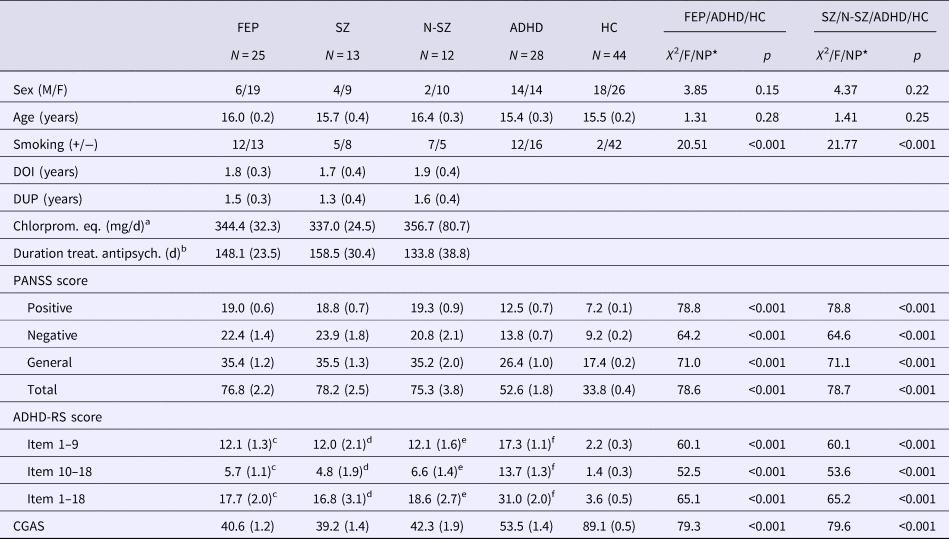
Reflecting our matching efforts, the three groups (FEP, ADHD, HC) did neither differ significantly in age nor sex composition. As logically expected, the ratings of psychopathology were significantly different between groups (p < 0.004), although no significant differences in severity of psychopathology were found between the two subgroups of EOP (patients with (SZ) and without SZ (N-SZ), p > 0.18). The demographics, psychopathology ratings, duration of illness, duration of untreated psychosis, and information on use of medication (according to the standards as specified in Gardner et al. (Reference Gardner, Murphy, O'Donnell, Centorrino and Baldessarini2010)) are listed in Table 1. Recent use of cannabis was indicated in seven subjects, either through a positive urine screening or by oral information of the participants themselves (FEP: 3, ADHD: 3, HC: 1). In addition, three female participants refused to deliver a urine sample.
Demographic and psychopathological data

FEP, patients with first episode psychosis; ADHD, patients with ADHD; HC, healthy controls; SZ, patients with schizophrenia; N-SZ, patients with non-schizophrenia psychosis; DOI, duration of illness (psychosis); DUP, duration of untreated psychosis; PANSS, Positive and Negative Syndrome Scale; ADHD-RS, Attention Deficit/Hyperactivity Disorder Rating Scale; CGAS, Children's Global Assessment Scale.
Sex and smoking are given in numbers; statistics χ2. Other values are mean (s.e.m.); statistics ANOVA (age) or *NP = non-parametric test (psychopathological and functional scores)
All pairwise comparisons of psychopathological and functional scores between FEP, ADHD and HC; p < 0.004
a N = 16 patients currently treated with antipsychotics, chlorpromazine equivalents calculated according to Gardner et al. (Reference Gardner, Murphy, O'Donnell, Centorrino and Baldessarini2010).
b N = 19 patients ever treated with antipsychotics.
c Information on 22 patients.
d Information on 11 patients.
e Information on 11 patients.
f Information on 27 patients.
The inclusion of covariates did not change p-values substantially in any of the analyses.
PPI
Analyses of the raw startle amplitudes of block 2 (PPI block) did not show a main effect of group (F (2,94) = 0.59) but did show an effect of trials (F (4,91) = 32.88, p < 0.001), indicating that similar amplitude reductions occurred across groups as a result of prepulses.
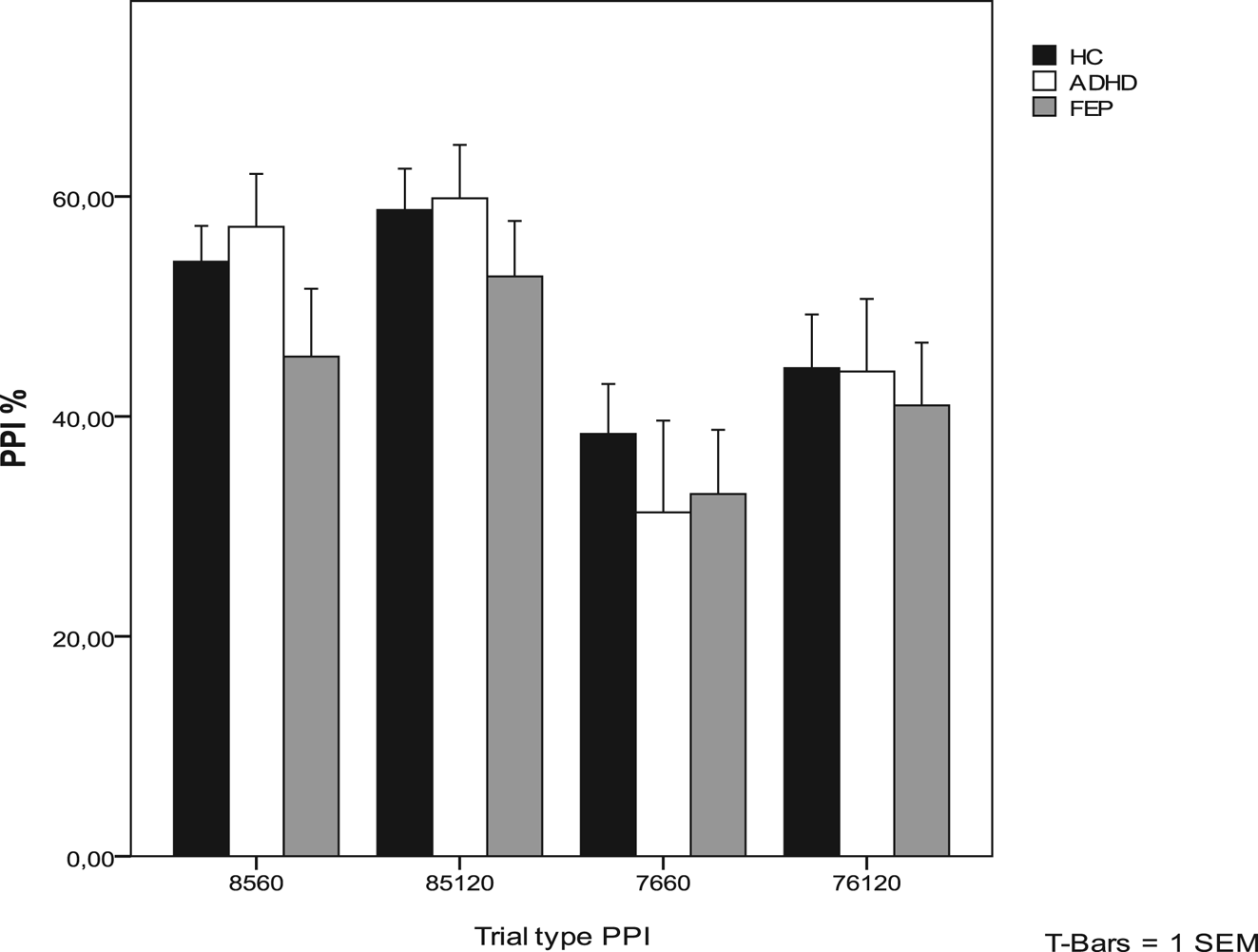
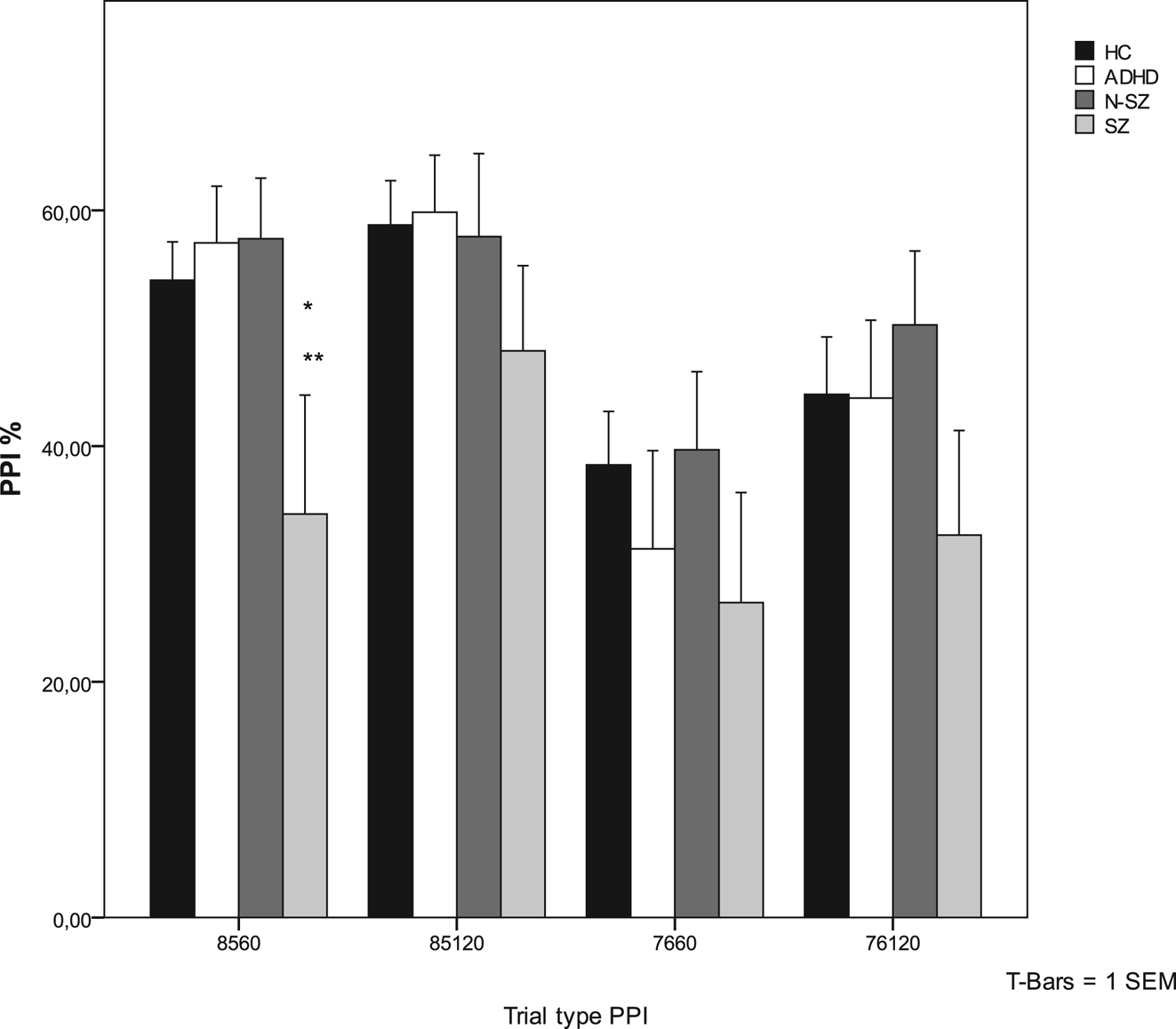
Similarly as in the raw analyses, no significant group effects were found in the main analysis on percentage PPI, i.e. with intensity and SOA as within factors and group as between factor (F (2,94) = 0.46). However, several previous studies from our laboratory (Mackeprang et al., Reference Mackeprang, Kristiansen and Glenthoj2002; Hammer et al., Reference Hammer, Oranje, Fagerlund, Bro and Glenthoj2011; During et al., Reference During, Glenthoj, Andersen and Oranje2014) as well as from other research groups (Kumari et al., Reference Kumari, Soni, Mathew and Sharma2000; Parwani et al., Reference Parwani, Duncan, Bartlett, Madonick, Efferen, Rajan, Sanfilipo, Chappell, Chakravorty, Gonzenbach, Ko and Rotrosen2000; Swerdlow et al., Reference Swerdlow, Light, Cadenhead, Sprock, Hsieh and Braff2006) have demonstrated PPI deficits in SZ patients, especially with the 85/60 trial type. Therefore, in post-hoc analyses we split the group of FEP into two subgroups of patients with and without SZ and compared all four groups (SZ, N-SZ, ADHD and HC) on percentage PPI in the 85/60 trials. A significant main effect of group was found in this analysis (F (3,93) = 2.92, p = 0.038). Further pairwise comparisons revealed significant differences between SZ and ADHD (F (1,39) = 5.47, p = 0.025, Cohen's d = 0.73), between SZ and HC (F (1,55) = 6.04, p = 0.017, Cohen's d = 0.66) and a trend level difference between SZ and N-SZ (F (1,23) = 4.04, p = 0.056, Cohen's d = 0.82). No significant differences were found in the pairwise comparisons between N-SZ, ADHD and HC (p > 0.57). These significant PPI effects were neither based on group differences in amplitudes to pulse alone nor on prepulse–pulse trials (p > 0.20). Explorative analyses on the other three trial types revealed no significant group differences (p > 0.53). Figures 1 and 2 present the PPI data.
Percentage PPI in the three diagnostic groups, showing no significant differences among the groups. FEP, patients with first episode psychosis; ADHD, patients with ADHD; HC, healthy controls.

Percentage PPI in the two subgroups of FEP; SZ and N-SZ, and in ADHD and HC. Significantly less PPI was found in SZ than in ADHD (*p = 0.025) and HC (**p = 0.017) in trial type 85 dB/60 ms. SZ, patients with schizophrenia; N-SZ, patients with non-schizophrenia psychosis; ADHD, patients with ADHD; HC, healthy controls.

Startle magnitude
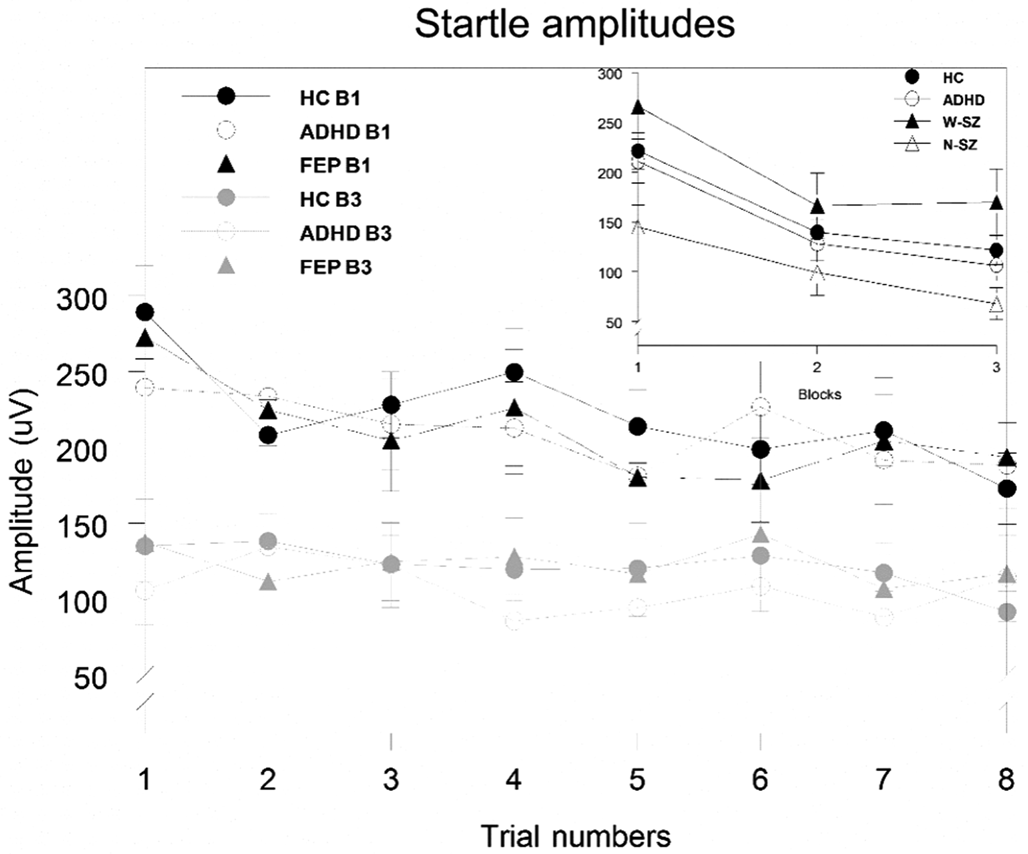
No group effects were found on startle magnitude if controlled for the three blocks (F (2,92) = 0.14). However, after splitting the FEP into the two subgroups of FEP (SZ and N-SZ) post-hoc comparisons with ADHD and HC revealed a trend level main group effect (F (3,91) = 2.32, p = 0.081), pointing toward a possible group difference in startle magnitude of block 3 (F (3,91) = 2.74, p = 0.048): both N-SZ patients (F (1,22) = 6.76, p = 0.016, Cohen's d = 1.10) and patients with ADHD (F (1,39) = 4.04, p = 0.051, Cohen's d = 0.62) (trend level of significance) showed lower startle magnitude than SZ, while no significant differences were seen in pairwise comparisons between each of the patient groups and HC or between N-SZ and ADHD (p > 0.073). Figure 3 presents the data of startle amplitudes.
Startle magnitude in FEP, ADHD and HC and in SZ, N-SZ, ADHD and HC showing habituation effects in all groups and subgroups. The inlay shows the average startle magnitude across the three experimental blocks, indicating no significant groups differences in habituation. Patients with N-SZ showed significantly less startle amplitude than SZ in block 3 (p = 0.016). FEP, patients with first episode psychosis; ADHD, patients with ADHD; HC, healthy controls; SZ, patients with SZ; N-SZ, patients with non-SZ psychosis; B1, block 1; B3, block 3.

Sensitization and habituation
Except for the HC (p = 0.033), none of the patient groups, including the SZ and N-SZ subgroups, reached a level of sensitization that was significantly different from zero. In contrast, all groups and subgroups showed significant levels of habituation (p < 0.018). However, no significant group or subgroup differences were found in either sensitization (p > 0.21) or habituation (p > 0.48).
Associations
Percentage PPI of 85/60 trials correlated positively with PANSS total (r s = 0.58, p = 0.037) in SZ while percentage PPI of 76/60 trials correlated negatively with PANSS general (r s = −0.60, p = 0.041) in N-SZ. Percentage PPI of 76/120 correlated positively with chlorpromazine equivalents (r p = 0.90, p = 0.014) in N-SZ.
Startle magnitude of block 1 correlated positively with PANSS total in SZ (r s = 0.61, p = 0.026), PANSS positive in N-SZ (r s = 0.65, p = 0.021), and chlorpromazine equivalents in N-SZ (r p = 0.89, p = 0.017). Startle magnitude of block 2 correlated positively with the total score on the ADHD rating scale (ADHD-RS 1–18) in ADHD (r s = 0.47, p = 0.013), yet specifically on symptoms of inattention (ADHD-RS 1–9) in ADHD (r s = 0.55, p = 0.003), and with chlorpromazine equivalents in N-SZ (r p = 0.82, p = 0.045).
We found no other significant correlations between startle magnitude or PPI with PANSS, ADHD-RS or global function (−0.45 < r s < 0.55, p > 0.052) or with duration of illness, duration of untreated psychosis, chlorpromazine equivalents or duration of antipsychotic treatment (−0.55 < r p < 0.76, p > 0.060) and also no significant correlations between sensitization or habituation with any of the clinical measures (−0.47 < r s < 0.40, p > 0.10) (−0.53 < r p < 0.45, p > 0.60).
No significant correlations were found between startle magnitude and scores of anxiety on PANSS (G2) in FEP, N-SZ or SZ (−0.12 < r s < 0.25, p > 0.23).
Medication
No significant differences in levels of PPI, startle magnitude, habituation, or sensitization were found between those FEP patients who were currently treated with antipsychotics (N = 16) and those who were antipsychotic-naïve (N = 6) (p > 0.19) nor between those FEP patients currently treated (N = 9) and those not treated with antidepressants (N = 16) (p > 0.30).
Discussion
We observed no significant differences in scores of sensorimotor gating, startle magnitude, sensitization, or habituation between young adolescents with first-episode psychosis, adolescents with ADHD and HC. Splitting the psychosis group into patients with (SZ) and without SZ (N-SZ) in an exploratory manner revealed that SZ patients exhibited significantly less PPI than both HC and patients with ADHD in the 85 dB/60 ms trials. The N-SZ patients had similar levels of PPI as patients with ADHD and HC while differing at trend level of significance from patients with SZ. Furthermore, N-SZ and ADHD patients had less startle magnitude in the final stages of habituation assessment than SZ, although the difference only reached trend level of statistical significance for the ADHD v. SZ comparison. HC had levels of startle magnitude intermediate to those of the two psychosis groups and not significantly different from any of the patient groups. Although not statistically significant, the psychosis group and subgroups were characterized by a higher proportion of females than the other two groups. Inclusion of sex as a covariate did however not change p-values substantially and support that group differences were not attributable to different sex ratios.
Our finding of deficient PPI in young adolescents with SZ are in line with the many reports on PPI reductions in adults with SZ, including those from our own laboratory (Kumari et al., Reference Kumari, Soni, Mathew and Sharma2000; Hammer et al., Reference Hammer, Oranje, Fagerlund, Bro and Glenthoj2011; During et al., Reference During, Glenthoj, Andersen and Oranje2014; Swerdlow et al., Reference Swerdlow, Light, Sprock, Calkins, Green, Greenwood, Gur, Gur, Lazzeroni, Nuechterlein, Radant, Ray, Seidman, Siever, Silverman, Stone, Sugar, Tsuang, Tsuang, Turetsky and Braff2014). Among the four trial types of prepulse intensity and SOA that were investigated a statistical difference was only detected in the trials with 85 dB/60 ms. This is consistent with a number of studies suggesting that this specific trial type is the most reliable to detect PPI deficits in SZ (Leumann et al., Reference Leumann, Feldon, Vollenweider and Ludewig2002; Ludewig et al., Reference Ludewig, Geyer and Vollenweider2003; Aggernaes et al., Reference Aggernaes, Glenthoj, Ebdrup, Rasmussen, Lublin and Oranje2010; Swerdlow et al., Reference Swerdlow, Light, Sprock, Calkins, Green, Greenwood, Gur, Gur, Lazzeroni, Nuechterlein, Radant, Ray, Seidman, Siever, Silverman, Stone, Sugar, Tsuang, Tsuang, Turetsky and Braff2014). Nevertheless, some studies have indicated more general PPI deficits in these patients, across several trial types (Parwani et al., Reference Parwani, Duncan, Bartlett, Madonick, Efferen, Rajan, Sanfilipo, Chappell, Chakravorty, Gonzenbach, Ko and Rotrosen2000; During et al., Reference During, Glenthoj, Andersen and Oranje2014). A possible reason for our current, more confined, finding may be that many of our patients with psychosis were treated with atypical antipsychotics. In several studies (Oranje et al., Reference Oranje, Van Oel, Gispen-De Wied, Verbaten and Kahn2002; Wynn et al., Reference Wynn, Green, Sprock, Light, Widmark, Reist, Erhart, Marder, Mintz and Braff2007; Aggernaes et al., Reference Aggernaes, Glenthoj, Ebdrup, Rasmussen, Lublin and Oranje2010), although not all (Mackeprang et al., Reference Mackeprang, Kristiansen and Glenthoj2002; During et al., Reference During, Glenthoj, Andersen and Oranje2014), atypical antipsychotics were found to normalize PPI, likely based on their specific pharmacokinetic properties. In this context, the deficits in our SZ group may reflect a more treatment resistant and pronounced sensorimotor gating deficit with the 85 dB/60 ms trial type than with the other trial types.
Unexpectedly, N-SZ patients exhibited healthy levels of PPI which in theory may reflect an effect of atypical antipsychotics. However, only half of the N-SZ patients (6/12) were presently treated with antipsychotics, while additionally these treated N-SZ patients showed similar levels of PPI as those N-SZ patients who were not treated with antipsychotics (p = 0.87). It is therefore conceivable that the N-SZ patients had healthy levels of PPI even before they were treated with antipsychotics. Alternatively, it may be that those N-SZ patients who were in treatment with antipsychotics were also the ones with more severe PPI deficits, while this treatment successfully reduced both their symptoms and their PPI deficits (Quednow et al., Reference Quednow, Frommann, Berning, Kuhn, Maier and Wagner2008; Ziermans et al., Reference Ziermans, Schothorst, Sprong, Magnee, van and Kemner2012)
Interestingly, N-SZ patients had lower startle magnitude in block 3 than SZ patients. This did not appear to be an effect of antipsychotic treatment because the startle magnitude did not differ between patients who were and those who were not presently medicated with antipsychotics. It is possible that the apparent difference in startle magnitude is due to a variation in habituation rather than a true difference in startle reactivity. However, no significant subgroup differences were found in habituation. The difference in startle magnitude may therefore either reflect fundamental group differences or correspond to different stages in the course of psychosis.
We found no sensorimotor-related deficits in our group of ADHD patients. In fact, none of our measures differed significantly between HC and ADHD patients. Thus, our data contribute to the growing number of studies reporting healthy levels of PPI in patients with ADHD (Feifel et al., Reference Feifel, Minassian and Perry2009; Hanlon et al., Reference Hanlon, Karayanidis and Schall2009; Conzelmann et al., Reference Conzelmann, Pauli, Mucha, Jacob, Gerdes, Romanos, Bahne, Heine, Boreatti-Hummer, Alpers, Fallgatter, Warnke, Lesch and Weyers2010; Holstein et al., Reference Holstein, Vollenweider, Geyer, Csomor, Belser and Eich2013) and add that this is even the case in patients that have never been treated with psychostimulants. Furthermore, our data could indicate that the levels of PPI in ADHD are significantly higher than those of young adolescents with first-episode SZ. In other words, our data suggest that even though ADHD and SZ share a number of features, including the above-mentioned prefrontal neurochemical and attentional and inhibitory impairments, they do not share impaired PPI. Our data therefore contribute to the theory that PPI deficits are endophenotypic for SZ, but not for ADHD. However, there are studies reporting deficits in patients with ADHD in so-called ‘active’ (attention-based) PPI paradigms (Ashare et al., Reference Ashare, Hawk, Shiels, Rhodes, Pelham and Waxmonsky2010; Conzelmann et al., Reference Conzelmann, Pauli, Mucha, Jacob, Gerdes, Romanos, Bahne, Heine, Boreatti-Hummer, Alpers, Fallgatter, Warnke, Lesch and Weyers2010), which indicates that this theory does not extend to more conscious, attentional processing.
Although the negative correlation between PPI (76 dB/60 ms) and PANSS general in N-SZ are in line with earlier reports on associations between PPI and positive and negative symptoms (Braff et al., Reference Braff, Swerdlow and Geyer1999; Meincke et al., Reference Meincke, Morth, Voss, Thelen, Geyer and Gouzoulis-Mayfrank2004) it is difficult to interpret the positive correlation between PPI (85 dB/60 ms) and psychopathological symptoms (PANSS total score) in SZ. However, it is possible that there is no clear and uniform association between PPI and psychopathology in young patients with psychosis. We also found correlations between startle magnitude and the severity of psychopathology and chlorpromazine equivalents, all of which pointing toward a positive association between startle magnitude and more severe symptoms (PANSS scores in FEP, ADHD-RS scores in ADHD) and higher medication dose (N-SZ). The latter parallels a previous report on greater startle reactivity in medicated patients with early psychosis (Cadenhead, Reference Cadenhead2011).
One of the major strengths of the current study was its design, in which sensorimotor gating in FEP patients was compared with two control groups, i.e. HC and ADHD patients. This design has made it possible to detect the diagnostic specificity at a group level of sensorimotor gating deficits in a subgroup of our FEP patients. Moreover our FEP population had a reasonable size considering that these patients are not only scarce, but that they also take considerable time and effort to recruit. Furthermore, all of our ADHD patients were either psychostimulant-naive or -free at least 5 months prior to testing. However, a substantial number of our FEP patients were treated with antipsychotics which may be a limitation: as mentioned above, it may have normalized sensorimotor gating in some of them, most likely in those of the N-SZ group, because these patients were less ill than the SZ patients. It was an important limitation that the group differences were detected only in the post-hoc analyses and therefore only future studies, ideally preregistered, will prove if our current findings can be replicated.
In conclusion, our study points toward that only those adolescents with early-onset psychosis who already have a diagnosis of SZ have similar sensorimotor gating deficits as adult patients suffering from this disorder. Moreover, we found higher startle magnitude in our young first-episode psychosis adolescents with SZ compared with those without SZ. No deficits were found in our currently assessed variables in adolescents with ADHD. Our findings point toward differences in basic information processing between SZ and ADHD, although the disorders share phenomenological characteristics and a hypo-dopaminergic activity in the prefrontal cortex. The detected differences in sensorimotor gating may potentially help distinguish between early phases of SZ and ADHD. Future studies are warranted to elucidate whether sensorimotor gating deficits can also be detected in, prodromal, phases of early-onset SZ and whether these impairments can be used as discriminative vulnerability markers in young psychiatric patients, with or without psychosis, who are at risk of SZ.
Author ORCIDs
Jacob Rydkjaer, 0000-0002-1903-0619; Jens Richardt Moellegaard Jepsen, 0000-0002-5849-5996
Acknowledgements
The authors would like to thank research assistants Gitte Saltoft Andersen (CRN), Mikkel Erlang Sørensen (MSc) and Katharina Alfsen (CRN) and students Rókur av Fløtum Jespersen and Nanna Pagsberg from the Center for Neuropsychiatric Schizophrenia Research (CNSR) for assisting in psychophysiological assessments and registration of data.
Financial support
The study was sponsored by a Ph.D. scholarship from the Research Foundation of Mental Health Services in the Capital Region of Denmark, The Lundbeck Foundation Center for Clinical Intervention and Neuropsychiatric Research (CINS) (R25-A2701), Læge Gerhard Linds legat, Fru C. Hermansens legat, Slagtermester Wörzners og Hustru Inger Wörzners mindelegat and Psykiatrisk Forskningsfond af 1967.
Conflict of interest
Glenthoej is the leader of a Lundbeck Foundation Centre of Excellence for Clinical Intervention and Neuropsychiatric Schizophrenia Research (CINS), which is partially financed by an independent grant from the Lundbeck Foundation based on international review and partially financed by the Mental Health Services in the Capital Region of Denmark, the University of Copenhagen, and other foundations. Her group has also received a research grant from Lundbeck A/S for another independent investigator initiated study. All grants are the property of the Mental Health Services in the Capital Region of Denmark and administrated by them. She and the rest of the authors have no other conflicts to disclose.
Ethical standards
The authors assert that all procedures contributing to this work comply with the ethical standards of the relevant national and institutional committees on human experimentation and with the Helsinki Declaration of 1975, as revised in 2008.