


1. Introduction
The Tyrrhenian Sea (Fig. 1) developed as a back-arc basin through and after Tortonian time during subduction of the Ionian oceanic crust towards the northwest, beneath the Calabria Terrane (Malinverno & Ryan, Reference Malinverno and Ryan1986; Gueguen, Doglioni & Fernandez, Reference Gueguen, Doglioni and Fernandez1998). Southeastward rollback of the subduction zone was responsible for synchronous extension in the Tyrrhenian domain and contraction in the Southern Apennines–Maghrebide chain. The progressive southeastward motion of the Calabria Terrane, forced by subduction rollback, produced an arcuate shape in the chain. As a result of this process, two branches formed, connected by the Calabria Terrane: the NW-trending Apennine and the E-trending Maghrebide chains (Fig. 1).
(a) Sketch map of the Southern Apennines and Southern Tyrrhenian Sea. Marine geology is taken from Argnani & Savelli (Reference Argnani and Savelli1999). (b) Geological section across the Southern Apennines, from the Tyrrhenian Sea to the Bradanic trough.
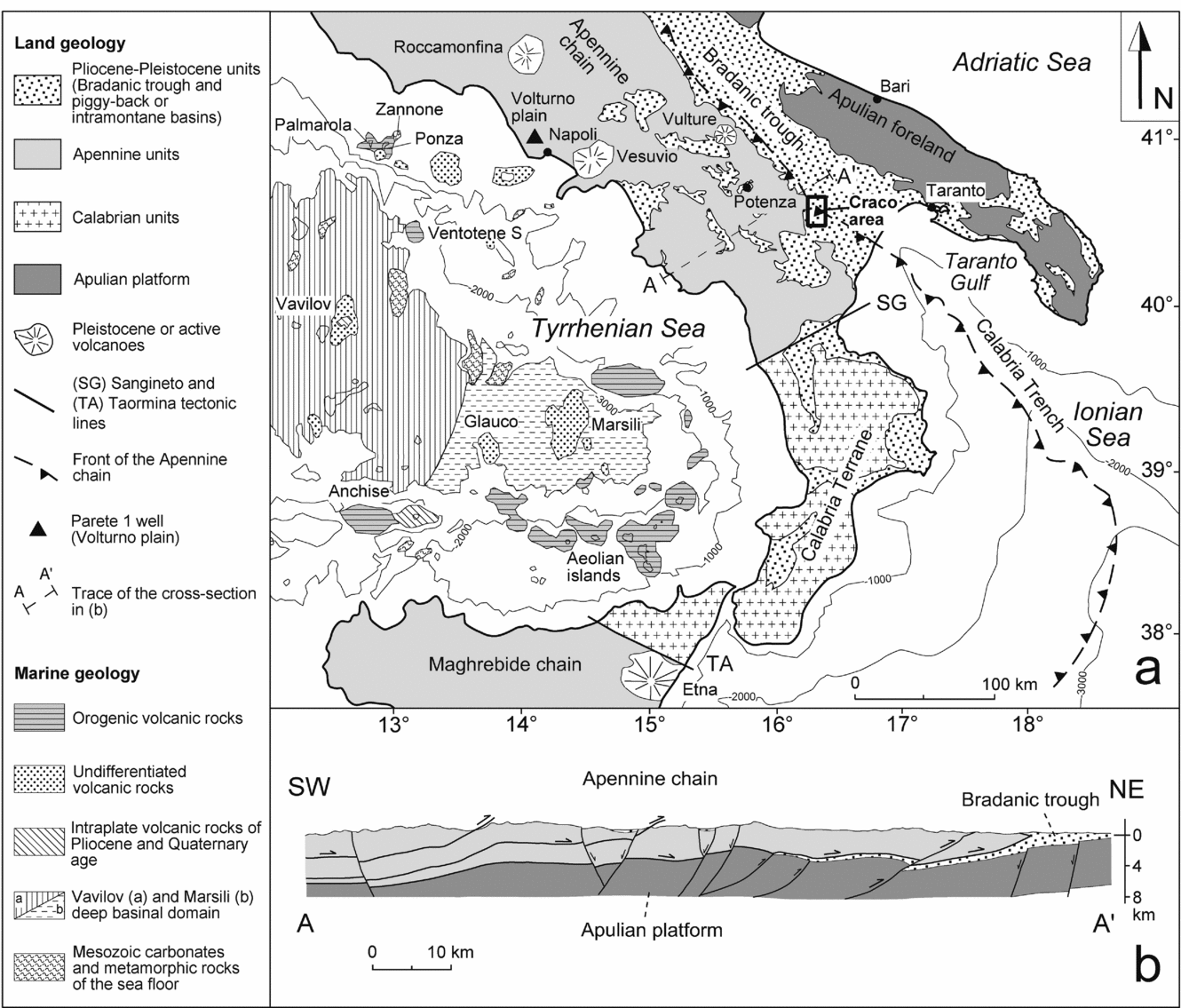
Subduction and back-arc extension were accompanied by intense magmatic activity that progressively shifted with time from Tuscany and Sardinia southeastwards, up to the Aeolian arc (Peccerillo, Reference Peccerillo2005). Here, high-K calc-alkaline magmatic activity is still taking place and is connected to active subduction of the Ionian lithosphere. Due to the progressive migration and steepening of the slab, calc-alkaline products were followed by within-plate volcanism in the western and central sectors of the Tyrrhenian Sea (Argnani & Savelli, Reference Argnani and Savelli1999). Local emplacement of MOR-type basalts took place in the Vavilov and Marsili basins (Fig. 1) during Late Miocene and Late Pliocene–Pleistocene times, respectively (Savelli, Reference Savelli2005). Marine tephra, collected from the Tyrrhenian and Ionian basins, record volcanic activity of Pliocene–Pleistocene age (Cornette et al. Reference Cornette, Gillot, Barrier and Jehenne1987; Calanchi, Gasparotto & Romagnoli, Reference Calanchi, Gasparotto and Romagnoli1994; Clift & Blusztajn, Reference Clift and Blusztajn1999; Bogaard, Mocek & Stavesand, Reference Bogaard, Mocek, Stavesand, Zahn, Comas and Klaus1999).
Volcaniclastic deposits of Neogene and Quaternary age are also intercalated in sedimentary clastic successions cropping out in southern Italy (for a review, see Guerrera & Veneri, Reference Guerrera and Veneri1989). In particular, some of the most significant deposits have been described and analysed in the Bradanic trough (Fig. 1), in the detailed petrographic research of Spadea (Reference Spadea1986). Apart from a few cases (Cello et al. Reference Cello, Spadea, Tortorici and Turco1983; Spadea, Reference Spadea1986; Massari et al. Reference Massari, Rio, Sgavetti, Prosser, D'alessandro, Asioli, Capraro, Fornaciari and Tateo2002), composition and depositional mechanisms of these deposits are poorly known and in general, previous authors gave only vague indications of the volcanic sources. However, a connection with the Tyrrhenian magmatism seems likely for some products, since they show similar age and magmatic affinity. Considering that volcaniclastic products intercalated in Neogene deposits from southern Italy are often well preserved, they can be used to recognize activity of volcanic centres that have now disappeared under water.
For this reason, study of the volcaniclastic levels increases the amount of significant data on the time-space evolution of the Tyrrhenian Sea and the adjoining magmatic arcs and, in a larger geodynamic framework, allows gathering of additional information on the evolution of the Mediterranean and the Apennine–Maghrebide chain (e.g. Argnani & Savelli, Reference Argnani and Savelli1999).
In this paper, we analyse in detail thick volcaniclastic levels of Pliocene age cropping out in the Southern Apennines within the Craco area (Fig. 1). The compositional features of these products will be discussed, along with evidence concerning the possible depositional mechanism. The age of the volcaniclastic levels will be defined by 40Ar–39Ar geochronology. These data will be used to discuss the provenance of the volcaniclastic products and their correlation with the Tyrrhenian magmatism.
2. Geological setting
Volcaniclastic rocks are interlayered in Pliocene clays located in the frontal part of the Southern Apennines (Fig. 1a). This fold-and-thrust belt (Fig. 1b) was built between Late Oligocene–Early Miocene and Middle Pleistocene times (Dewey et al. Reference Dewey, Helman, Turco, Hutton, Knott, Coward, Dietrich and Park1989; Menardi Noguera & Rea, Reference Menardi Noguera and Rea2000), following the closure of the Mesozoic Alpine Tethys Ocean (Stampfli et al. Reference Stampfli, Borel, Marchant, Mosar, Rosenbaum and Lister2002). The chain mainly consists of carbonate platform and deep-sea sedimentary units derived from the former passive southern margin of the Alpine Tethys. The frontal part of the chain is essentially made up of strongly deformed clayey units of Late Cretaceous–Early Miocene age, interpreted as a tectonic mélange (‘Argille varicolori’; Fig. 2). They overthrust the clastic deposits of the Bradanic trough; the latter represents the Pliocene–Middle Pleistocene foredeep basin of the Southern Apennines (Fig. 1b; Balduzzi et al. Reference Balduzzi, Casnedi, Crescenti and Tonna1982; Patacca & Scandone, Reference Patacca, Scandone, Vai and Martini2001). In turn, the clastic deposits of the foredeep overlie the Mesozoic carbonates of the Apulian platform, widely exposed in the foreland of the Southern Apennines.
Geological map of the Craco area, partly redrawn after Lazzari & Lentini (Reference Lazzari and Lentini1980) and Bentivenga et al. (Reference Bentivenga, Foresi, Prestera, Prosser and Sabia2005), showing the location of the volcaniclastic layers. The dashed rectangles enclose the two investigated areas.
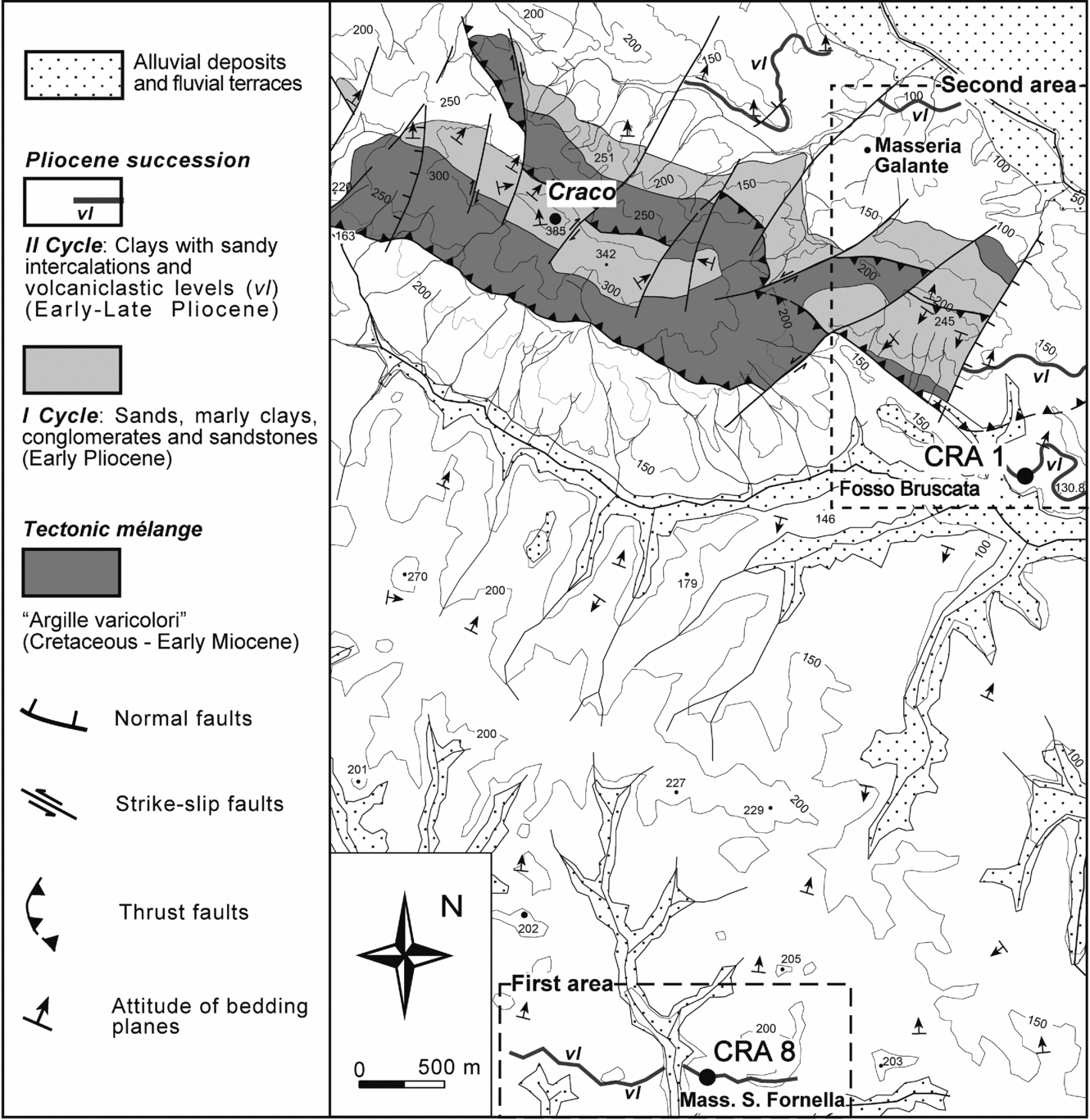
In the Craco area, the ‘Argille varicolori’ mélange is unconformably overlain by Pliocene conglomerates, sands and clays (Fig. 2). These clastic units represent the infill of thrust-sheet top basins that developed near the front of the Apennine chain (Patacca & Scandone, Reference Patacca, Scandone, Vai and Martini2001). Pliocene deposits are organized into two distinct cycles separated by an unconformity of Early Pliocene age. Sedimentation of Pliocene deposits took place during folding of the substratum, as shown by evident dip variations of the bedding planes across the Early Pliocene unconformity (Bentivenga et al. Reference Bentivenga, Foresi, Prestera, Prosser and Sabia2005). Contractional deformation in this area was active up to recent times (Pleistocene), as indicated by the presence of Late Pliocene deposits in the footwall of a backthrust located southwest of Craco village (Fig. 2).
Two volcaniclastic successions, showing different compositional and sedimentological characteristics, are intercalated within clays of the second Pliocene cycle. The successions crop out in two different areas located in the southwestern and northeastern parts of the studied zone (Fig. 2). The most significant outcrops were found at Masseria S. Fornella (first area) and at Fosso Bruscata and Masseria Galante (second area). The relative age of the two successions has not been directly detected in the field because of discontinuous outcrops and intense folding of the second cycle clays. However, preliminary biostratigraphic analyses favour a younger age for the volcaniclastic succession cropping out in the second area.
In the first area, up to seven NNW-dipping volcaniclastic layers were recognized. They display a grey colour and are weakly to moderately cohesive. Thin silty clay layers are interbedded within the volcaniclastics, with a cumulative thickness of the succession amounting to about 6–7 m. The analysed sample (CRA 8; Fig. 2), dealt with in Section 4, comes from the uppermost layer.
The volcaniclastic succession rests on silty clays, with isolated sandy layers. Clays have been referred to Middle Pliocene time on the basis of preliminary biostratigraphic analyses. In the lower part of the succession a cohesive volcaniclastic bed displays planar lamination and groove marks. The other layers are mainly massive and only locally show inclined or convolute laminations.
In the second area the most continuous volcaniclastic succession is exposed near Fosso Bruscata. It consists of two amalgamated beds with a cumulative thickness of 4.7 m (Fig. 3a). They are quite loose and display a light grey colour. A closer observation reveals the presence of mafic minerals standing out within the bright glassy matrix. The whole volcaniclastic succession, dipping 35° towards the NNE, is intercalated in silty clays of Pliocene age. According to Bentivenga et al. (Reference Bentivenga, Foresi, Prestera, Prosser and Sabia2005), similar clays, exposed about 2 km east of the Fosso Bruscata outcrop, yield a Late Pliocene age (Globorotalia inflata zone). The base of the lower bed is very typical, with a reddish colour in the first 3 cm, the presence of millimetre-sized accretionary lapilli and the larger grain size. Sample CRA 1 (Fig. 2), dealt with in Section 4, comes from this stratigraphic interval. Upwards, an interval with cross-lamination is observed for about 10 cm (Fig. 3b), followed by weak planar lamination (~80 cm) and convolute lamination (~60 cm). The lower bed ends with very fine-grained volcaniclastics showing dispersed pumice clasts.
Stratigraphic and sedimentological characteristics of the Craco volcaniclastic deposits in the Fosso Bruscata locality. (a) Stratigraphic column of the volcaniclastic succession and grain-size distribution histograms for different levels. The histograms were determined using a COULTER Multisizer particle analyser. Black squares indicate the location of samples used for grain size analyses. (b) Cross-laminations at the base of the volcaniclastic succession (width of the spade is 10 cm). (c) Convolute laminations in the intermediate part of the upper bed.

The upper volcaniclastic bed starts with a coarse-grained interval, about 6 cm thick, characterized by cross-lamination. Fine-grained deposits, characterized by planar and convolute laminations (Fig. 3c), appear further up. The top portion of the layer is less well exposed and a faint convolute and/or planar lamination can be observed in some cases.
In the second area the volcaniclastic layers are offset by several faults (Fig. 2). Northwards, at Masseria Galante, the total thickness of the volcaniclastic deposits reduces to a minimum of 1.1 m, and consists of a single bed resting upon massive clays of Middle–Late Pliocene age (G. aemiliana zone, according to Bentivenga et al. Reference Bentivenga, Foresi, Prestera, Prosser and Sabia2005). The bed shows planar laminations, frequently deformed by syndepositional gravitational processes at the base, and convolute laminations at the top. Massive volcaniclastics appear only in the intermediate portion of the bed. Variations in thickness and sedimentary structures in different outcrops are probably related to irregular palaeomorphology of the sea bottom during Late Pliocene time.
3. Sedimentological features
The grain size has been measured in the best exposed volcaniclastic succession of the second area (Fosso Bruscata). Analysis has been carried out in five different levels of the volcaniclastic deposits, as well as in the underlying silty clays (Fig. 3a). The latter are characterized by a grain size spanning 3.5 to 8.5 φ (0.088–0.003 mm) and a median of 5.3 (0.025 mm) in a bimodal distribution. Volcaniclastic deposits show a distinctly coarser grain size ranging from 1.5 to 6.5 φ (0.354–0.011 mm). Grain size distributions are unimodal, even though they can be both gaussian and with negative skewness. The median size ranges between 3.77 and 4.50 φ (0.073–0.044 mm), with the coarser value measured at the base of the lower bed. Sorting, as calculated by Inman (Reference Inman1952) coefficient, ranges between 0.98 and 1.30, corresponding to moderately sorted sediments. The grain size and textural features are typical of pyroclastic fall deposits related to an explosive eruption with consequent upward projection of the fragmented material through a Plinian column. Figure 4 shows the typical morphologies of volcanic glass particles as photographed with the SEM. In particular, Figure 4a shows a shard fragment bounded by the walls of spherical gas bubbles, whereas Figure 4b represents a pumice clast with tubular vesicles.
SEM (secondary electrons) images of vesiculated glass particles. (a) Shard particle formed at the junction of three bubbles. (b) Pumice fragment.

The overall sedimentological characteristics of the volcaniclastic deposits at Fosso Bruscata can be summarized in the following points (Fig. 3): (1) a fining-upwards gradation can be observed in both beds; (2) the base consists of tractive deposits characterized by cross-lamination that grades to planar lamination; (3) convolute laminations, related to gravitational instability of thick and water saturated sediments, are widespread, especially in the finer portions of the levels; (4) the topmost portion of the two beds is made up of very fine-grained massive volcaniclastic material settled by decantation.
All these features are typical of material deposited by aggradation of stratified density currents during the passage of a waning flow. In particular, they are similar to the upper part of a Bouma sequence (units c to e), produced in a sub-critical hydrodynamic regime. This suggests a low-velocity turbidity current, as confirmed also by the fine grain size of the deposits.
Summing up, the volcaniclastic products, after projection in a plinian column reaching stratospheric height, fell in a marine environment. Here they deposited on the slope of Pliocene basins in the frontal sector of the Southern Apennine chain. Finally, they were mobilized as volcaniclastic density currents towards a deeper environment.
4. Petrology
Two samples were selected for petrological studies as representative of the first (CRA 8) and the second (CRA 1) areas (Fig. 2). Both samples contain glass and crystals of plagioclase, orthopyroxene, clinopyroxene, amphibole, rare biotite and accessory apatite (Fig. 5a–f). These components in most cases are very fresh. Rare hexagonal quartz of magmatic origin is present in the CRA 1 sample, whereas rounded quartz may be of detrital origin. A very small amount of supergenic calcite is present.
Micrographs of samples CRA1 and CRA8. (a) Y-shaped glass shards in the CRA 1 sample (plane polarized light). (b) Pumice fragment in the CRA 1 sample. Plagioclases in synneusis relation can be observed in the lower left corner (plane polarized light). (c) Pale brown glass fragment containing abundant plagioclase microlites in the CRA 8 sample (plane polarized light). (d) Crystal fragment of zoned plagioclase in the CRA 1 sample (crossed polars). (e) Euhedral orthopyroxene in the CRA 1 sample (plane polarized light). (f) Crystal fragment of green hornblende in the CRA 1 sample (plane polarized light).

Proportions and nature of the volcanic components change from sample CRA 8 to sample CRA 1. In the latter, glass is more abundant and represented by shards and pumice (Fig. 5a, b). In CRA 8, non-vesiculated brown glass fragments are found together with groundmass fragments with vitrophyric texture containing plagioclase and rare clinopyroxene microlites (Fig. 5c). Other differences are major proportions of green amphibole and orthopyroxene in the CRA 1 sample.
Glass and crystal compositions were first investigated by SEM/EDS analyses. Electron microprobe analyses were then performed on glass fragments to obtain more reliable results. Selected compositions are presented in Tables 1 to 3. Details of the adopted analytical conditions are provided in the table notes.
Glass composition in samples CRA 1 and CRA 8
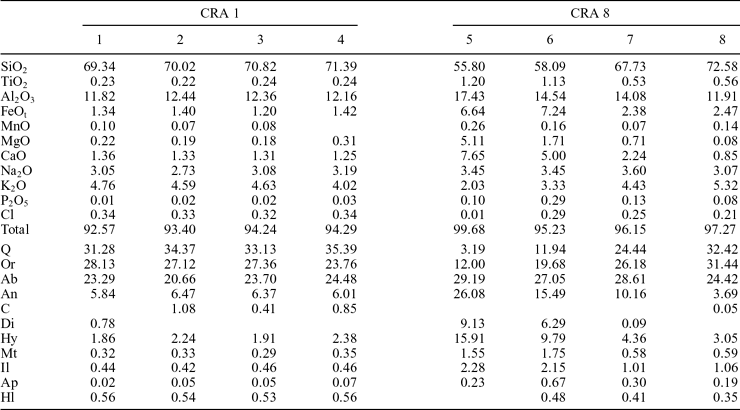
1, 2 – rhyolitic glass shards; 3, 4 – rhyolitic pumices; 5 – dark glass of basaltic andesite composition in fragment with vitrophyric texture; 6, 7 – non-vesiculted brown glass particles of trachyandesite (6) and trachydacite (7) composition; 8 – mild brown rhyolitic glass in fragment with vitrophyric texture. To calculate weight norm, Fe2O3 and FeO were estimated assuming FeO/FeOt = 0.85.
Major and minor oxides analyses of fresh glass were performed in Padova at laboratories of IGG CNR by a four WDS spectrometers CAMECA SX 50 electron microprobe.
Operating conditions were: accelerating voltage of 15 kV and a beam current of 5 nA for major oxides. For minor elements a higher beam current (up to 40 nA) was adopted. The conditions used to measure sodium concentration were: raster analyses over an area of 20 μm2; counting times of 6 s and 3 s for peak and background, respectively. The following natural and synthetic standards were adopted for standardization: albite for Na, olivine for Mg, Al2O3 for Al, orthoclase for K, wollastonite for Si and Ca, vanadinite for Cl, MnTiO3 for Mn and Ti, Fe2O3 for Fe and apatite for P. Comparison with glass analyses obtained by SEM-EDS showed a very good match.
Abbreviations: Q – quartz; Or – orthoclase; Ab – albite; An – anorthite; C – corundum; Di – diopside; Hy – hypersthene; Mt – magnetite; Il – ilmenite; Ap – apatite; Hl – halite.
Selected mineral analyses in sample CRA1 from the second area
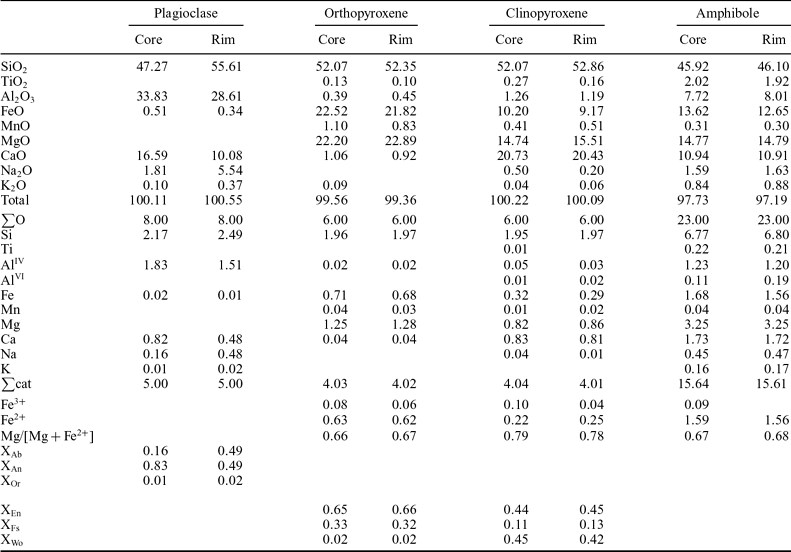
Estimates of Fe3+ and Fe2+ are based on adjustment of ∑cat to 4 in pyroxenes and to 15 except Na and K in amphiboles (15eNK method). Analyses were performed at Dipartimento Geomineralogico (University of Bari) with a Cambridge S360 SEM equipped with a LINK AN 10000 ED detector. Operating conditions were: 15 kV accelerating potential, 1 nA probe current, counting time of 100 s, 25 mm working distance, standards by Microanalysis Consultants Ltd.
Selected mineral analyses in sample CRA 8 from the first area
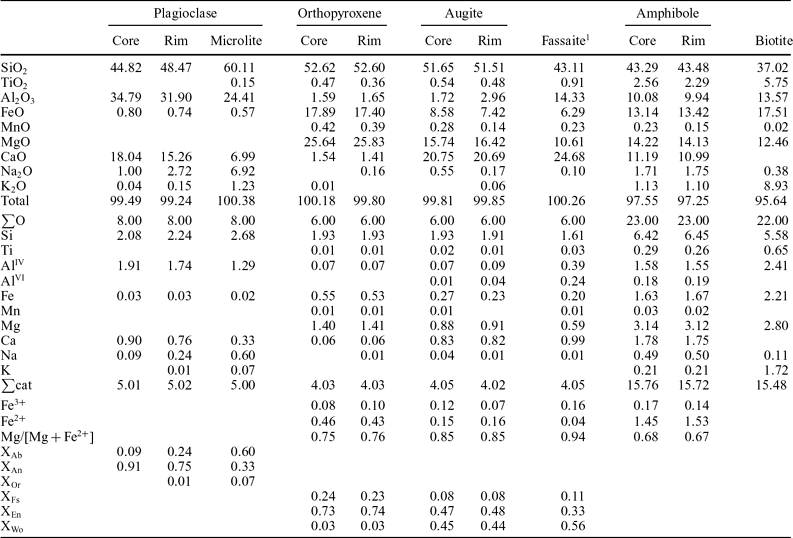
1Fassaite is the former name, now abandoned, for subsilicic aluminian ferrian diopside (Morimoto, Reference Morimoto1988). Analytical methods as in Table 2.
To illustrate glass compositional features, the more homogeneous sample, CRA 1, from the second area is first examined. The TAS diagram (Le Bas, Le Maitre & Zanettin, Reference Le Bas, Le Maitre and Zanettin1986) indicates that composition is invariably rhyolitic (Fig. 6a), without significant differences between shards and pumice fragments.
Glass composition in the volcaniclastic deposits of the Craco area. (a) TAS classification for glass analyses in the CRA 1 and CRA 8 samples (Le Bas, Le Maitre & Zanettin, Reference Le Bas, Le Maitre and Zanettin1986). (b) K2O–SiO2 classification diagram modified after Peccerillo & Taylor (Reference Peccerillo and Taylor1976). (c) Representation of average glass composition from the CRA 1 sample in the Qtz–Ab–Or phase diagram. Boundary curves, thermal minima and eutectic points according to Ebadi & Johannes (Reference Ebadi and Johannes1991).
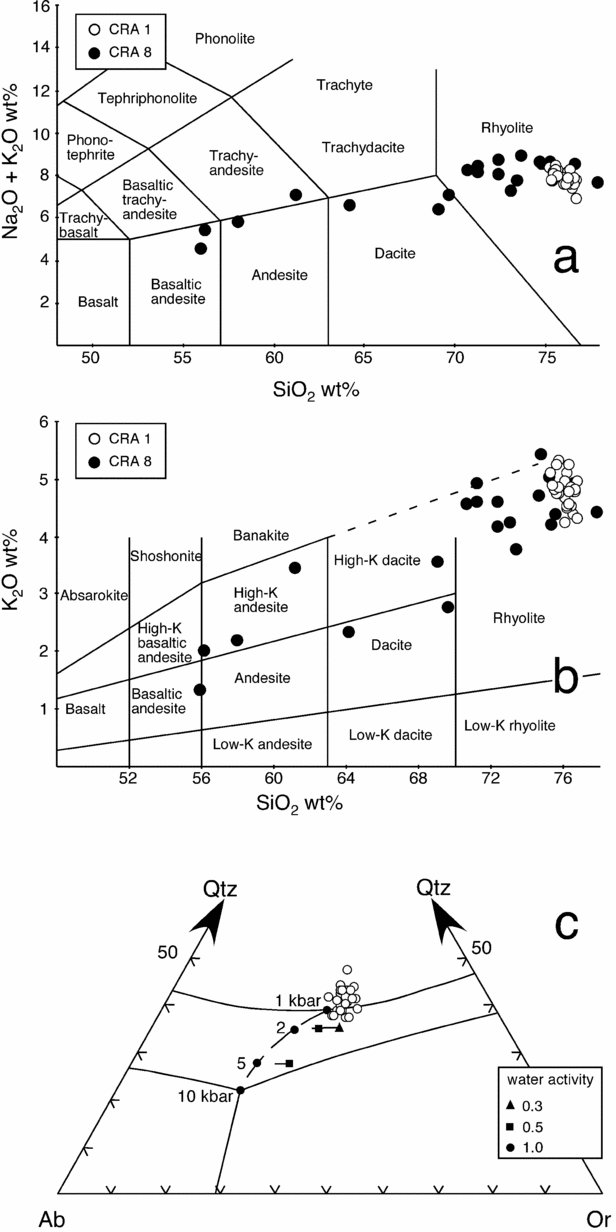
When considering the K2O/Na2O ratio, a value greater than 1 is always obtained and the average is 1.56±0.14. In the K2O–SiO2 diagram (modified after Peccerillo & Taylor, Reference Peccerillo and Taylor1976), data points plot in the rhyolite field near the dashed extension of the line dividing the high-K from the shoshonitic series (Fig. 6b). Representation of these rhyolitic compositions in the normative Q–Ab–Or diagram by Ebadi & Johannes (Reference Ebadi and Johannes1991) indicates that they mostly plot near the 1 kbar quartz–alkali feldspar cotectic line slightly to the right of the minimum melt, owing to a weak enrichment in the Or component (Fig. 6c). This suggests melt equilibrium at low pressure under moderate water activity.
In sample CRA 8, glass has a brown colour with a tonality varying from mild to dark. Microanalyses on non-vesiculated glass particles and on fragments with vitrophyric texture revealed a wide compositional span from basaltic andesite to rhyolite, across the trachyandesite, trachydacite and dacite fields (Fig. 6a). The higher closure of the analyses (Table 1) reveals a low volatile content in glasses in comparison with sample CRA 1. In the K2O–SiO2 diagram (Peccerillo & Taylor, Reference Peccerillo and Taylor1976), intermediate compositions mostly plot in the high-K calc-alkaline series fields (Fig. 6b). As for sample CRA 1, rhyolitic compositions plot close to the extension of the line dividing the high-K from the shoshonitic series.
EDS mineral analyses are presented in Table 2 (CRA 1) and in Table 3 (CRA 8). Plagioclase shows normal zoning: in the CRA 1 sample it has a typical compositional range from labradorite to andesine with some bytownite cores; in the CRA 8 sample, composition changes from anorthite to labradorite, except for microlites in the fragments with vitrophyric texture for which EDS analyses indicated a lower anorthite component (Table 3).
Pyroxenes, according to Morimoto's (1988) classification, are mostly represented by augite and enstatite. In sample CRA 8, the rare occurrence of an unusual Al–Fe3+-rich clinopyroxene was detected. Following Morimoto (Reference Morimoto1988), it can be classified as subsilicic aluminian ferrian diopside, corresponding to the former name of fassaite. Zoning in pyroxene is usually weak in both enstatite and augite. In particular, a slight increase of the enstatite component from core to rim has been detected in the orthopyroxene from sample CRA 1. A lower Mg/(Mg + Fe2+) ratio can be observed in both ortho- and clinopyroxene of sample CRA 1: the average values are 0.68 and 0.78 (CRA 1) versus values of 0.74 and 0.82 (CRA 8), for ortho- and clinopyroxene, respectively. Amphiboles, according to Leake's (Reference Leake1978) classification, are mostly represented by Mg hornblende and in some cases by titanian Mg hornblende, tschermakitic hornblende and hastingsitic hornblende. In sample CRA 1, the Mg/(Mg + Fe2+) ratio is 0.66 on average. Larger crystals show a weak reverse zoning with rims slightly richer in Mg with respect to cores. In sample CRA 8, amphibole is less abundant than pyroxenes and has a Mg/(Mg + Fe2+) ratio ranging from 0.67 to 0.71. Biotite is present in still lower amounts and is characterized by a high Ti content (0.58 atoms pfu).
The comparison of the glass composition from the CRA 1 sample with that of the associated crystals highlights an unlikely equilibrium of the rhyolitic melt with the analysed pyroxenes, hornblende and labradoritic plagioclase. This suggests that the volcaniclastic level of the second area includes the residual melt and the solid settled in a previous fractionation episode.
5. Geochronology
Age determinations were performed using the 40Ar–39Ar step-heating method on amphibole. To this end, we selected sample CRA 1 for the higher amount of amphibole, the coarser crystal size and the absent or weak weathering effects. A detailed description of the analytical method is given in the Appendix. The supposed age, the grain-size and the K content do not allow performing a single crystal step-heating on CRA 1 amphibole. Three step-heating experiments were done on small aliquots of amphibole, and the obtained results are summarized in Table 4.
Summary of 40Ar–39Ar step-heating data of three amphibole aliquots from sample CRA 1

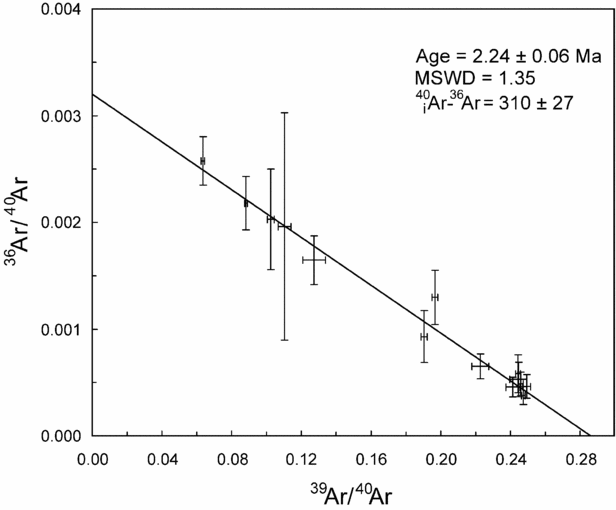
All uncertainties in ages comprise a 0.4 % conservative error in the neutron flux parameter J. The plateau age represents the weighted mean of consecutive steps whose ages do not differ at the 2σ level, that totally represent at least 50 % of the overall 39Ar released from the sample. The weighting factor is the inverse analytical variance of each step. The isochron age is obtained from a least-square fit line to an isotope correlation diagram in which 36Ar/40Ar is plotted against 39Ar/40Ar after corrections for nuclear interferences and instrumental isotopic fractionation. The integrated age is obtained from the sum of K-derived 39Ar and radiogenic 40Ar of all steps.
Mineral analyses do not show consistent variations of Ca and K content in the core and rim of the amphibole (Table 2). The Ca-derived 37Ar, the Cl-derived 38Ar and the K-derived 39Ar allow monitoring of the K/Ca and K/Cl variations during the step-heating analysis. Low temperature (low laser power) steps have higher K/Cl and K/Ca ratios, likely related to tiny inclusions in amphiboles. However, percentages of 39Ar released in these steps are limited and in all the other steps the K/Ca and K/Cl ratios do not show remarkable variations. In analysis Pav-55#12–2 (Table A1 in the Appendix), the sample was pre-heated, rastering the laser beam above the crystals at low power; in this case the spread in K/Ca and K/Cl ratios is restricted in comparison to the other two step-heating analyses, but the result of the total sample does not change. It is also worth noting that all the intermediate and high temperature steps of the three measurements are characterized by high radiogenic 40Ar yields.
The data in Table 4 clearly show that analyses are reproducible. In fact, the ages calculated with the plateau and isochron approaches do not differ significantly among themselves and in comparison to the integrated ages, suggesting an undisturbed sample. The averages of the plateau, isochron and integrated ages are between 2.20 and 2.27 Ma, well within their standard deviations. The major spread observed in the isochron ages is due to the small number of points used for the regression lines. The steps used to calculate the plateau ages of Table 4 have been plotted together in an inverse isochron diagram of 36Ar/40Ar v. 39Ar/40Ar. The resulting age is 2.24±0.06 Ma, with an initial 40Ar/36Ar ratio of 310±27, slightly high but atmospheric (40Ar/36Ar = 295.5) within the 2σ error (Fig. 7). This is the best estimate of the age of CRA 1 amphibole.
Inverse isochron plot of amphibole in the CRA 1 sample. All displayed points, representing the plateau steps of the three performed measures, were used in the least-square fit. Error bars represent ± 2σ.
6. Correlations with Tyrrhenian magmatism
Arc volcanism of calc-alkaline affinity took place during the evolution of the Southern Tyrrhenian basin (Argnani & Savelli, Reference Argnani and Savelli1999). The older products originated during the Oligo-Miocene (32–13 Ma) in Sardinia (Fig. 1), whereas the younger products are present in the Aeolian Islands (1–0 Ma). It was proposed that volcanic arc activity migrated progressively from Sardinia and Tuscany southeastwards to the present position in the Aeolian Islands. In an intermediate stage of this time-space evolution, a volcanic arc of Pliocene age (5–2 Ma) crossed the central part of the Southern Tyrrhenian basin, passing by the ridge between the Vavilov and Marsili sub-basins (Kastens et al. Reference Kastens1988; Argnani & Savelli, Reference Argnani and Savelli1999). Volcanic edifices were located in the terminations of this central arc. The southern and northern ends were represented by the Anchise seamount and by the Western Pontine (Ponza and Palmarola) Islands, respectively (Fig. 1). Further to the north, Late Pliocene products are represented by the Roccastrada rhyolites of Tuscany province (Pinarelli, Poli & Santo, Reference Pinarelli, Poli and Santo1989). According to Argnani & Savelli (Reference Argnani and Savelli1999), other products related to the activity of the central volcanic arc are basalts and andesites recovered in deep drillings from the Volturno river plain, near the Campania coast, and possibly the Glauco and Ventotene-south seamounts, in the Tyrrhenian Sea.
For the purpose of the present research the critical point is to ascertain the activity of the arc during Late Pliocene time. In the Southern Tyrrhenian domain, several datings point to this stage (Savelli, Reference Savelli2002, and references therein), but they are subject to discussion, as demonstrated by the examples given below. Calc-alkaline basic to intermediate lavas of the Volturno river plain recovered in the Parete 2 well provided a K/Ar age of 2±0.4 Ma (Barbieri et al. Reference Barbieri, Di Girolamo, Locardi, Lombardi and Stanzione1979). However, a more recent attempt to date plagioclase from the deepest segment of the well gave a disturbed 40Ar–39Ar age spectrum that did not provide more accurate chronological information (D. Brocchini, unpub. Ph. D. thesis, Univ. Pisa, 1999).
The second example concerns the Western Pontine Islands, characterized by the emission of high-K rhyolitic products in the time span 1.5–4.5 Ma (Barberi et al. Reference Barberi, Borsi, Ferrara and Innocenti1967; Savelli, Reference Savelli1987; Conte & Dolfi, Reference Conte and Dolfi2002; Cadoux et al. Reference Cadoux, Pinti, Aznar, Chiesa and Gillot2005). More specifically, the first datings of the Western Pontine volcanic rocks were performed by Barberi et al. (Reference Barberi, Borsi, Ferrara and Innocenti1967) and indicate possible magmatic activity during Late Pliocene time (1.9 and <2.5 Ma), supported by biostratigraphic evidence provided by Carrara, Conato & Dai Pra (Reference Carrara, Conato and Dai Pra1986). On the other hand, it should be considered that K/Ar dating of submarine volcanic rocks may be influenced by significant aqueous alteration, as already indicated for the products of Ponza Island (Scutter et al. Reference Scutter, Cas, Moore and De Rita1998; Altaner et al. Reference Altaner, Ylagan, Savin, Aronson, Belkin and Pozzuoli2003). More recently, Cadoux et al. (Reference Cadoux, Pinti, Aznar, Chiesa and Gillot2005), after selecting fresh samples, performed new K/Ar datings that question the previous results and show a substantial hiatus in magmatic activity between 2.9 and 1.64 Ma. Even though the age estimated for the Craco volcaniclastics falls within this time interval, a correlation with the Tyrrhenian magmatism cannot be ruled out, considering that most of the volcanic products presently occur under water. In this respect, it is relevant that volcaniclastic ash layers have been recovered from ODP site 974, drilled in the central Tyrrhenian basin about 80 km at SW of Ponza (Bogaard, Mocek & Stavesand, Reference Bogaard, Mocek, Stavesand, Zahn, Comas and Klaus1999). In particular, biostratigraphic ages document volcanic activity here between 2.95 and 1.25 Ma.
In light of these arguments, a comparison of some volcanic products from the Tyrrhenian area with the Craco volcaniclastics is legitimate and worthwhile to ascertain compositional affinities.
Data in Table 5 illustrate average chemical characteristics of these products in comparison to the Craco volcaniclastics. In any case, the comparative analysis performed here should be considered as a first attempt, preliminary to more specific geochemical research on this subject. In fact, examined data derive from rock and glass analyses performed with different methods (EMP, SEM/EDS, XRF, ICP/AES, ICP/MS). In comparing EMP or SEM/EDS glass analyses with rock analyses, some differences may derive from the variable phenocryst distribution in rock and from local concentration gradients produced in melt by fast crystal growth. In principle, the lower porphyritic index makes rhyolites less prone to these effects. The wider spread observed in the intermediate compositions is consistent with this hypothesis. For this reason the comparison performed below is limited to the rhyolites.
Average composition of rhyolitic glasses from the Tyrrhenian area and from Craco (sample CRA 1)
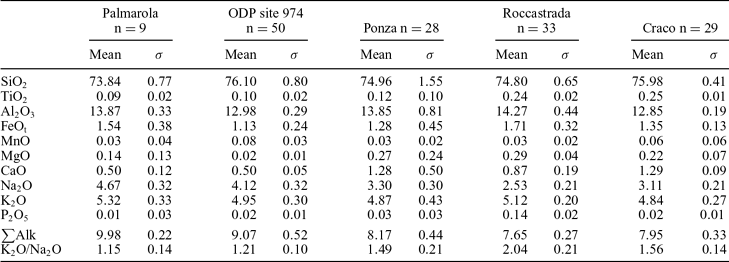
Major and minor oxides were recalculated to 100 %. Data sources: Barberi et al. (Reference Barberi, Borsi, Ferrara and Innocenti1967) and Cadoux et al. (Reference Cadoux, Pinti, Aznar, Chiesa and Gillot2005) for Palmarola; Bogaard, Mocek & Stavesand (Reference Bogaard, Mocek, Stavesand, Zahn, Comas and Klaus1999) for ODP site 974, core 9H; Barberi et al. (Reference Barberi, Borsi, Ferrara and Innocenti1967), Conte & Dolfi (Reference Conte and Dolfi2002) and Cadoux et al. (Reference Cadoux, Pinti, Aznar, Chiesa and Gillot2005) for Ponza; Pinarelli, Poli & Santo (Reference Pinarelli, Poli and Santo1989) for Roccastrada. Peccerillo (Reference Peccerillo2005) for a compilation of the published chemical analyses.
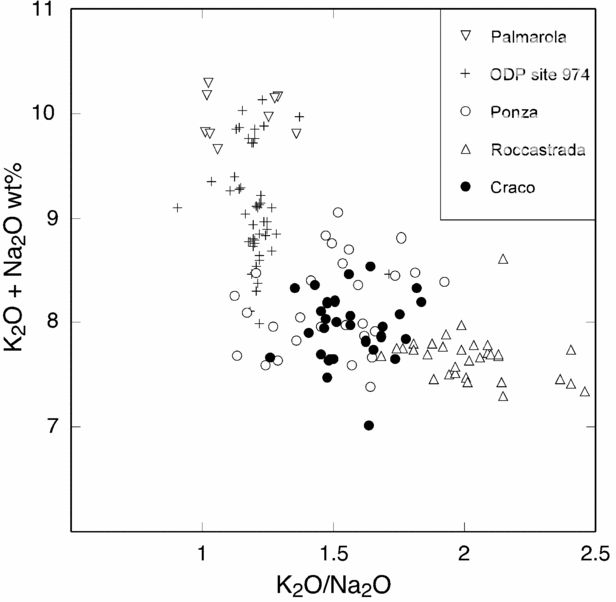
The diagram in Figure 8 considers Pliocene to Early Pleistocene rhyolitic rocks from the Tyrrhenian area in terms of alkali contents, following the approach used by Calanchi, Gasparotto & Romagnoli (Reference Calanchi, Gasparotto and Romagnoli1994) and Pinti et al. (Reference Pinti, Quidelleur, Lahitte, Aznar, Chiesa and Gillot2003). Datapoints derive from analyses of the Palmarola, ODP site 974, Ponza and Roccastrada rhyolites. A coarse distribution of the points along a concave-upward trend with negative covariation of ∑Alk and K2O/Na2O can be observed. The rhyolites of different provenance can be easily identified, since they occupy, with limited overlap, distinct areas of the diagram. In particular, the Palmarola rhyolites have the highest ∑Alk content and the lowest K2O/Na2O ratio. On the other hand, the Roccastrada rhyolites, with a marked signature by the continental crust, have the lowest ∑Alk and the highest K2O/Na2O. ODP site 974 and Ponza datapoints occupy an intermediate position, being closer to the Palmarola and Roccastrada areas, respectively. The Craco glass analyses from sample CRA 1 fall in the intermediate area, mostly overlapping with the Ponza rhyolites.
∑Alk–K2O/Na2O diagram for some Pliocene–Early Pleistocene rhyolitic products from the Southern Tyrrhenian area and the Tuscany province. Data sources as in Table 5.
The occurrence of fassaite in sample CRA 8 allows further consideration of the source area. The origin of this pyroxene may indicate magma contamination with carbonatic rocks that represent the substratum for most of the Roman–Campanian volcanoes, including some of the Western Pontine Islands (De Rita et al. Reference De Rita, Funiciello, Pantosti, Salvini, Sposato and Velonà1986).
In summary, rhyolitic glass composition of the Craco volcaniclastic deposits is compatible with an origin from volcanoes of the Southern Tyrrhenian domain. The Ponza rhyolites show closer similarities in composition, but, according to Cadoux et al. (Reference Cadoux, Pinti, Aznar, Chiesa and Gillot2005), they are older than the Craco products. Nonetheless, considering that volcanoes characterized by plinian activity are easily destroyed by explosive eruptions, it cannot be excluded that a source close to Ponza is not preserved above sea level and remnants are now under water.
To clarify the possible linkage of the Craco deposits to the Southern Tyrrhenian volcanic activity, some consideration of the transport mechanisms may be useful. The eruption that generated the volcanic material is linked to an explosive activity, characterized by intense magma fragmentation. This produced pumiceous ash clasts expelled through the vent together with a few crystals. The eruption formed a plinian column (Cas & Wright, Reference Cas and Wright1987) that reached a stratospheric height (more than 20 km a.s.l). Deflection of the plinian column occurred in response to dominant stratospheric wind that in the northern hemisphere blows westerly. This, together with the grain size of the volcaniclastic material in the range of fine ash, is compatible with a provenance of the Craco products from the Tyrrhenian domain.
The noticeable thickness of the Craco deposits suggests the connection with an important volcanic episode that should be recognized on a regional scale in sedimentary rocks of Late Pliocene age cropping out in Southern Italy.
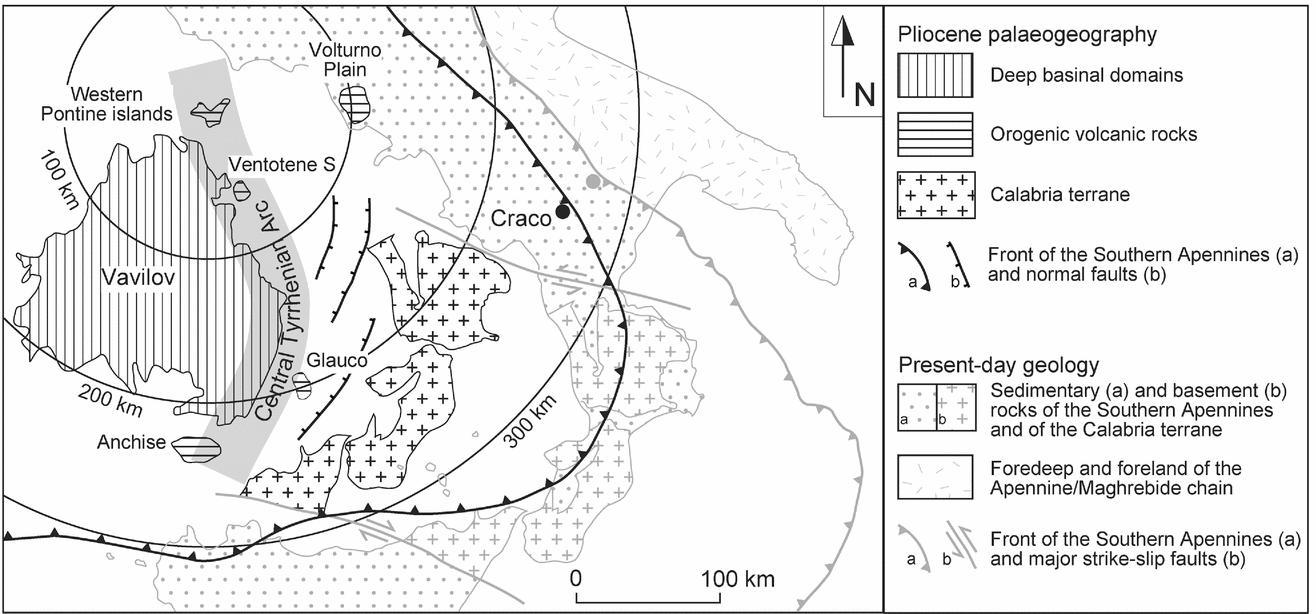
On this basis, Figure 9 depicts the possible palaeogeography in which the eruption responsible for the formation of the studied deposits took place. In Pliocene time, the Southern Tyrrhenian basin was still opening and the front of the Apennine chain occupied a westernmost position. Therefore, the Craco area was closer to the hypothetical source of the volcaniclastic material, represented by the subaerial volcanic edifices located at the northern end of the central Tyrrhenian arc. After eruption and formation of the plinian column, the fragmental volcanic material erupted by these edifices was transported eastwards by the winds to go beyond the still uplifting Apennine chain. The pyroclasts were settled by fallout over the sea and deposited under water. From here they promoted the formation of volcaniclastic density currents. The sedimentation mechanisms, as reconstructed from the sedimentary structures of the deposits and the physical features of pumice particles, suggest the progressive aggradation of multiple currents by turbulent sediment-laden flows with low shear velocity. If we compare the volcaniclastic sequence in Figure 3 with the standard Bouma sequence of turbiditic currents, structural affinities emerge. This suggests that, in comparable hydrodynamic regimes, pyroclastic material and arenites respond similarly to the transportation and sedimentation processes.
Pliocene palaeogeography of the southern Apennines and the Tyrrhenian Sea. The Pliocene positions of the Calabria Terrane and the front of the Southern Apennines have been deduced from Gueguen, Doglioni & Fernandez (Reference Gueguen, Doglioni and Fernandez1998).
7. Conclusions
The integrated approach adopted in this study emphasizes the importance of volcaniclastic layers intercalated in a sedimentary succession to help reconstruct the palaeogeography and the geodynamic evolution of the Tyrrhenian and Apennine domains. In particular, the thick volcaniclastic deposits of the Craco area indicate an important volcanic episode of Late Pliocene age (2.24±0.06) occurring during the final development stages of the Apennine chain. The volcaniclastic deposits show tractive structures and are fine-grained with moderate sorting. They were derived from mechanical fragmentation of high-K calc-alkaline magmas of intermediate and acidic composition and are essentially made up of abundant glass, plagioclase, two pyroxenes and amphibole. In the neighbourhood of the Craco area, volcanic centres responsible for the eruption of such deposits are lacking. Products with similar compositional characteristics were erupted in the southern Tyrrhenian domain, where a volcanic arc was active until Late Pliocene time. The eruptive centres were likely located at the northern termination of the arc and also gave origin to the Pontine islands. Other neighbouring volcanic centres were located on land in the Volturno plain. Eruption projected the fragmented material to form a plinian column reaching the stratosphere. Here the dominant westerly winds transported the volcanic material to the marginal part of a thrust-sheet top basin located on the evolving Apennine chain. Remobilization of the deposits from the slope of the basin activated turbidity currents that determined the final sedimentation in a deeper environment.
Additional information on the geodynamic evolution of the Tyrrhenian and Apennine domains can be obtained if general compositional features of all the volcaniclastic layers intercalated in Neogene deposits of the Apennines and Calabria domains are considered (e.g. Cello et al. Reference Cello, Spadea, Tortorici and Turco1983; Spadea, Reference Spadea1986; Guerrera & Venneri, Reference Guerrera and Veneri1989; Caggianelli, Dellino & Sabato, Reference Caggianelli, Dellino and Sabato1992; Massari et al. Reference Massari, Rio, Sgavetti, Prosser, D'alessandro, Asioli, Capraro, Fornaciari and Tateo2002). Deposits of Miocene and Quaternary age document a progressive shift from calc-alkaline to alkaline affinity, through the Pliocene high-K calc-alkaline series (Spadea, Reference Spadea1986). These data are coherent with the progressive southeastward retreat of the Ionian subduction zone.
In summary, this paper confirms that the study of tephra, often well preserved in the sedimentary successions, represents a powerful tool to recognize and date important eruptions undetectable by studying only the exposed volcanic centres (see Pyle, Reference Pyle, van Andel, Paschos and Bogaard1998). In particular, the study of the Apennines and Calabria volcaniclastics represents a very useful way to collect the missing pieces of information on volcanism in the southern Tyrrhenian domain, in some cases related to sources that have disappeared under water.
Acknowledgements
The authors express their gratitude to David Pyle and an anonymous referee for suggestions and constructive criticism that helped to improve the paper significantly. Expertise and assistance by Raul Carampin were of great help in performing microprobe glass analyses in the Padova laboratories of IGG CNR. Financial support came from PRIN 2005 funds (F. Boenzi).
Appendix. Sample treatment for the geochronological analyses
Sample CRA 1 was crushed and sieved, and coarse-grained amphiboles (>500 μm) were separated with conventional magnetic and gravimetric methods. The selected minerals were checked under a binocular microscope and the altered grains were removed. Amphiboles were treated with an ultrasonic bath at 50°C with HCl 3.5 N (1 hr), and with HNO3 1N (1 hr). The amphibole was then thoroughly rinsed with deionized water in an ultrasonic bath. The sample was packed and irradiated for 4 hours in the core of a 250 kW TRIGA reactor, together with FCT#3 biotite as age monitor (27.95 Ma: Baksi, Archibald & Farrar, Reference Baksi, Archibald and Farrar1996).
After the irradiation, the package was opened and the amphibole grains were placed into 4–5 mm diameter holes inside a copper disk. Three replicate splits of about 7–10 mg of samples were used to perform the 40Ar–39Ar analyses. Samples were step-heated at progressively higher power levels of a defocused infrared (IR) laser beam. In this arrangement, the laser beam is passed through an integrator lens to produce a uniform energy profile; as the beam area was smaller than the size of the sample placed in the hole, the beam was slowly moved over the sample to produce a uniform heating. Each step lasted 20 minutes, with a first 5 minute heating phase followed by a 15 minute cleaning phase performed by two AP 10 SAES getters, held at about 200 and 400°C respectively. Blanks were run every two or three steps, and were about 8 × 10⁻¹⁹ moles 36Ar and about 2 × 10⁻¹⁶ moles for 40Ar. Table A1 reports the 40Ar–39Ar analytical data.
40Ar–39Ar analytical data for the Craco volcaniclastics

Isotopes are in moles. Asterisks indicate steps used in the plateau and isochron calculations. Errors on the ages of individual steps do not include the uncertainty in J value, included in the calculations of plateau and isochron ages. All isotopes are corrected for blanks, nuclear interference reactions and 37Ar decay. The correction factors are: 39Ar/37Ar(Ca) = 0.00075 (± 0.00006), 36Ar/37Ar(Ca) = 0.00024 (± 0.00002), 40Ar/39Ar(K) = 0.0083 (± 0.0017).



