MĀORI MANAGEMENT IN AOTEAROA NEW ZEALAND
In Aotearoa New Zealand, management theory and practice tends to be dominated by American and European legends of management thought, notably Taylor, Fayol, Weber, Follet, McGregor, Maslow, Mintzberg, Porter and Drucker among others (Robbins, Bergman, Stagg, & Coulter, Reference Robbins, Bergman, Stagg and Coulter2009). They appear as legends because their theories and deeds are re-told year-on-year at universities throughout New Zealand; whereas non-Western alternatives are less readily presented (O'Sullivan & Mika, Reference O'Sullivan and Mika2012). Although undoubtedly deserving of their place in the annals of management history, none are indigenous to Aotearoa New Zealand. Some scholars have, however, recently sought to contextualise management theory to the local environment (see, e.g., Geare, Cambell-Hunt, Ruwhiu, & Bull, Reference Geare, Cambell-Hunt, Ruwhiu and Bull2005; Aotahi Ltd, 2008; Jones, Reference Jones2011). We contend, however, that Western management theory may not adequately explain the Aotearoa New Zealand experience, and in particular the experience of the Māori people, that is, the indigenous people of Aotearoa New Zealand. We are prompted to ask where are the management scholars for whom indigeneity is a dominant paradigm because of their ethnicity as an indigenous person or because their cultural orientation and interest lends itself to indigenous scholarship, theories and practice? What are their theories on Māori management? Further, what relevance and bearing might an indigenous perspective have on management theory and the performance of organisations – Māori and non-Māori alike – in Aotearoa New Zealand; or indeed management theory and practice in other parts of the world?
What is written about Māori organisations tends to concentrate on governance, structure and leadership rather than on management per se (see, e.g., Dyall, Reference Dyall1985; Douglas & Robertson-Shaw, Reference Douglas and Robertson-Shaw1999; Modlik, Reference Modlik2004; Durie, Reference Durie2005; Mika, Reference Mika2005; Law Commission, 2006; Spencer & Broughton, Reference Spencer and Broughton2008; New Zealand Law Society, 2009). However, the topic of Māori management featured in academic writing as early as 1992 (Love, Reference Love1992; Mika, Reference Mika1994; Moon, Reference Moon1995). Indeed, Māori scholars such as Warriner (Reference Warriner1999), Puketapu (Reference Puketapu2000), Henry and Pene (Reference Henry and Pene2001), Durie (Reference Durie2002), Knox (Reference Knox2005), Panoho (Reference Panoho2006), Ruwhiu (Reference Ruwhiu2009), Tinirau and Gillies (Reference Tinirau and Gillies2010), Spiller (Reference Spiller2011) and Henare (Reference Henare2011) are creating a body of literature on how Māori values, beliefs and customs affect the way in which Māori organisations are managed. For their part, non-Māori, or non-indigenous scholars, are also making a positive contribution to the literature on Māori management. Some examples include Pio (e.g., Spiller, Erakovic, Henare, & Pio, Reference Spiller, Erakovic, Henare and Pio2010), Woods (e.g., Kawharu, Tapsell, & Woods, Reference Kawharu, Tapsell and Woods2012) and Moon (Reference Moon1993, Reference Moon1995, Reference Moon1998, Reference Moon2010). No doubt there are others, as refreshing and critical perspectives on Māori management are emerging often from collaborations between Māori and non-Māori management scholars.
In this article, we hope to bring to the surface some of the literature on Māori management and to renew interest in the field among researchers, policy makers and practitioners. We attempt to define Māori management and discuss its relevance for today's organisations. Māori management, we argue, gives the concept of management an identity, a character, a face, a place, a time and an alternative source of management principles. We examine differences and similarities between Western and Māori management in terms of the four functions of management adapted from principles first proposed by Fayol (Reference Fayol1949). We propose a theoretical model of Māori management and discuss the implications of Māori management for management research, policy and practice.
THEORETICAL POSITIONING
Post-colonialism, critical management studies and kaupapa Māori
Post-colonial discourse offers a theoretical framework in which to understand management within the context of Aotearoa New Zealand's colonial past and the continuing effects of European imperialism (Ashcroft, Griffiths, & Tiffin, Reference Ashcroft, Griffiths and Tiffin2000). During (Reference During2000: 391) defines post-colonialism as ‘the pursuit of an uncompromised tradition and autonomy by colonized peoples after official decolonization’. This view was informed by his observation during the 1980s and 1990s of ‘Māori reassertion of rangatiratanga [chiefly authority] and mana, [power and authority]… by viture of their place as tangata whenua [people of the land]’ (emphasis in original). According to During (Reference During2000: 387) ‘[a]s a paradigm… postcolonialism lasted about a decade—from about 1985 to, say 1994’ and was characterised by ‘progressive interactions between colonized and colonizer’. It was ultimately displaced, along with its ‘twin, post-modernism’ by globalisation. Globalisation, and more particularly the global economy (the international flows of ‘[m]oney, transport and information’), is forcing individuals and collectives as cultural agents to re-think and re-make themselves in order to participate in this process on their own terms, Māori included (During, Reference During2000: 388).
Although our article is located within post-colonial discourse (Smith, Reference Smith1999; Jack & Westwood, Reference Jack and Westwood2009) and critical management studies (Panoho & Stablein, Reference Panoho and Stablein2005; Alvesson, Bridgman, & Willmott, Reference Alvesson, Bridgman and Willmott2009), its principal theme of the synthesis of traditional and contemporary Māori management within a burgeoning Māori economy, which is subject to globalisation, shifts the boundaries of the debate to something new. That is, how do Māori management and Māori organisations discard the cloak of colonial conquest and replace this with an economic system designed by their own hand without replicating the institutions and effects of the ‘hegemonic project’ upon their own people (Jack & Westwood, Reference Jack and Westwood2009: 8)? In other words, how do Māori management and Māori organisations integrate Western management theory and practice without the unpleasant side-effects?
In Aotearoa New Zealand, the response to this challenge is expressed in the desire for tino rangatiratanga (self-determination) (Durie, Reference Durie1995) and is manifest most visibly in Māori forms of political activism, education and health provision (Love, Reference Love1977; Durie, Reference Durie1998a, Reference Durie1998b; Hook, Reference Hook2006) and post-treaty settlement organisational developments (Law Commission, 2002; Dodd & Joseph, Reference Dodd and Joseph2003; Gardiner, Reference Gardiner2010; Paora, Tuiono, Flavell, Hawksley, & Howson, Reference Paora, Tuiono, Flavell, Hawksley and Howson2011). Allied to this, Māori are articulating, refining and evolving a philosophical theory and practice based on traditional Māori knowledge called kaupapa Māori (Māori philosophy), substantially in health and education, but increasingly in management research, theory and practice (Henry & Pene, 2001; Smith, Reference Smith1999; Tinirau & Gillies, Reference Tinirau and Gillies2010). Several important qualities of kaupapa Māori theory are: first, being Māori and living as Māori is accepted as valid and legitimate; second, it is reasonably resistant to misappropriation and misrepresentation; third, it is accepted as public policy; and fourth, it is adaptive to other disciplines (e.g., environmental science, biotechnology) (Smith, Reference Smith1997, Reference Smith1999; Hohepa, Cram, & Tocker, Reference Hohepa, Cram and Tocker2000; Powick, Reference Powick2003; Ruwhiu & Wolfgramm, Reference Ruwhiu and Wolfgramm2006). Although kaupapa Māori theory has been applied as an emancipatory device to establish a degree of Māori autonomy within the academy, its potential as a conceptual basis for ethical management and economic development is only just emerging (e.g., Harmsworth, Reference Harmsworth2009; Spiller et al., Reference Spiller, Erakovic, Henare and Pio2010; Henare, Reference Henare2011; Henry, Reference Henry2011). This moves Māori beyond decolonisation – the ‘process of revealing and dismantling colonialist power in all its forms’ (Ashcroft, Griffiths, & Tiffin, Reference Ashcroft, Griffiths and Tiffin2000: 63, as cited in Jack & Westwood, Reference Jack and Westwood2009: 12) – towards what Smith (Reference Smith1999: 107) calls the ‘indigenous peoples’ project’. That is, a global movement of indigenous peoples to re-align and re-focus their collective efforts on a transformational agenda as self-determining peoples. What new forms of Māori management and Māori organisation might emerge under these conditions will be fascinating to observe.
Defining management
We draw on the texts by Schermerhorn, Davidson, Poole, Simon, Woods, and Chau (Reference Schermerhorn, Davidson, Poole, Simon, Woods and Chau2011) and Robbins et al. (Reference Robbins, Bergman, Stagg and Coulter2009) to help define management as these texts are commonly used as prescribed or supplementary reading in undergraduate management courses at New Zealand universities (O'Sullivan & Mika, Reference O'Sullivan and Mika2012). Moreover, our reference to them illustrates that functionalism remains the dominant discourse in management education in Aotearoa New Zealand and most likely in other Western countries (Gonzalez, Castro, Bueno, & Gonzalez, Reference Gonzalez, Castro, Bueno and Gonzalez2001), yet, functionalism also serves as a basis upon which to discuss Māori management.
Schermerhorn et al. (Reference Schermerhorn, Davidson, Poole, Simon, Woods and Chau2011: 19) define management as ‘the process of planning, organising, leading and controlling the use of resources to accomplish performance goals’. Robbins et al. (Reference Robbins, Bergman, Stagg and Coulter2009: 10) define management slightly differently as ‘the process of coordinating and overseeing the work activities of others so that their activities are completed efficiently and effectively’. Thus, the modern understanding of management is that it is a systematic action-oriented activity, which can be grouped into functions, for the purpose of regulating and guiding the deployment of resources, including people, towards some specific object, which has meaning for all involved, the manager, the workers and others. One of the reasons managers exist is the organisation. Robbins et al. (Reference Robbins, Bergman, Stagg and Coulter2009: 7) define organisation as a ‘deliberate arrangement of people to accomplish some specific purpose’. From these definitions it is not difficult to imagine that the combination of management and organisation could be regarded as the fundamental building block for economic and social activitiy within any developed or developing society.
Management and organisation defined in this way appear to be ahistorical, apolitical, acultural and atemporal. In other words, management and organisations are universal constructs free to inhabit the ‘borderless world’ (Ohmae, Reference Ohmae1990: 6; Fang, Reference Fang2012: 5) that we have created for the uniform good of humankind. Moreover, management and organisational theory are assumed to adequately explain human relations within organised groups in any society at any time in their past, present or future. However, we contend that this is far from reality, however we might define what is real. Organisations, and by implication management, are built on a foundation of ‘power’ (Clegg, Kornberger, & Pitsis, Reference Clegg, Kornberger and Pitsis2008: 256) and operate in an environment of cultural diversity because of the unprecedented mobility of people across the globe and the ubiquity of information and communications technology (Schermerhorn et al., Reference Schermerhorn, Davidson, Poole, Simon, Woods and Chau2011). Māori management, we argue, is locked into a post-colonial struggle to correct the imbalances of ‘unequal systems of economic exchange’ and the remnants of ‘cultural imperalism’ (Jack & Westwood, Reference Jack and Westwood2009: 8). Māori are attempting to do this by imposing a ‘blueprint’ for management based on Māori values and aspirations, articulated as expressions of tino rangatiratanga and kaupapa Māori theory and practice.
A functional approach to management
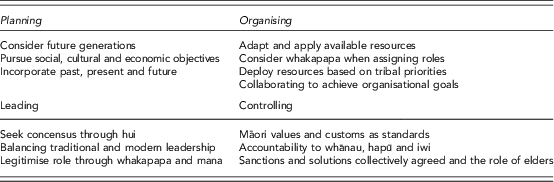
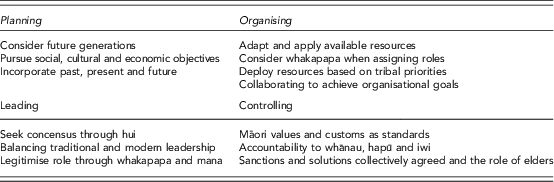
A functional approach to understanding the role of the manager has remained the most popular approach to management education (Carroll & Gillen, Reference Carroll and Gillen1987) with most management texts drawing on the work of Fayol (Reference Fayol1949) to organise this material (Dyck & Kleysen, Reference Dyck and Kleysen2001). Fayol's (Reference Fayol1949) original principles have been reduced to four: planning, organising, leading and controlling (see Figure 1). Taking Fayol's (Reference Fayol1949) functions of management as a framework for examining what it is that Māori managers do, we suggest that there is a distinctively Māori approach to management with respect to planning, organsing, leading and controlling (see Table 1 for examples). We suspect that Māori management tends to integrate Māori and Western management theories and practices to achieve Māori-defined purposes within Māori and non-Māori organisational settings. Table 2 illustrates some similarities and differences between contemporary Māori and Western organisations. The binary distinctions are somewhat artificial to the extent that contemporary Māori organisations are essentially ‘structures built from European blueprints’ (Salmond, Reference Salmond1987: 2), but, nonetheless, are operated by Māori according to Māori-defined purposes and values. That is to say, a form of ‘hybridity’ in which Māori identity, agency and autonomy are vigorously pursued within post-colonial institutional settings (Meredith, Reference Meredith2000; Drichel, Reference Drichel2008).
Functions of management Source. Adapted from Schermerhorn et al. (Reference Schermerhorn, Davidson, Poole, Simon, Woods and Chau2011: 20)

Selected functions of Māori management
Source. Authors.
Characteristics of Māori and Western organisations
Source. Adapted with permission from Massey University (2012).
THE ORIGINS OF THE MĀORI OF AOTEAROA NEW ZEALAND
Māori, the indigenous people of Aotearoa New Zealand
Māori management begins with the migration of Polynesian settlers to Aotearoa New Zealand, with most evidence, including genetic and archealological studies, suggesting that this occurred sometime around 1350ad (King, Reference King2003). They travelled from their homelands, most likely the islands of East Polynesia (the Society, Marquesas, Astral and Cook groups) in ocean-going waka (canoes) in a series of migratory voyages (King, Reference King2003). Māori tradition talks of earlier ancestral explorers discovering Aotearoa, namely Kupe, then Toi followed by the ‘great migration’ of waka from Hawaiki (the Māori name for distant homelands) (Buck, Reference Blake, Mouton, Barnes and Greiner1987: 9–37; King, Reference King2003: 38). Among the most well known of these ancestral canoes are the ‘Tainui, Te Arawa, Mataatua, Kurahaupo, Tokomaru, Aotea, Takitimu… Horouta [and] Nukutere’, though others are remembered by other tribes (Buck, Reference Blake, Mouton, Barnes and Greiner1987: 40).
These early settlers brought with them sufficient knowledge, capability and resources, including plants, animals, weapons and tools, to ensure their survival and to establish permanent life in their new environment (Buck, Reference Blake, Mouton, Barnes and Greiner1987). As the indigenous settlers began life in Aotearoa, aspects of their Polynesian cultural heritage were supplanted with the emergence of a new culture and identity, that of the New Zealand Māori. By the time Europeans first sighted Aotearoa on ‘13 December 1642’ (King, Reference King2003: 93), Māori had explored and settled every part of the land. Through the naming of geographic features and defending their territories, Māori had laid claim to the country's natural resources and established whakapapa (genealogical) connections to the land (Dyall, Reference Dyall1985).
In the challenging natural environment that Aotearoa presented, membership of a social group was vital for survival. Pre-contact Māori defined themselves in terms of the kinship groups to which they belonged (Reilly, Reference Reilly2004; O'Sullivan & Dana, Reference O'Sullivan and Dana2008). The dominant form of social organisation and primary economic unit of pre-contact Māori society was the whānau (family) (O'Sullivan & Dana, Reference O'Sullivan and Dana2008). This consisted of the extended family, typically mother, father, their children, grandparents, and sometimes aunties, uncles and their families (Reilly, Reference Reilly2004). Whānau were connected with other whānau by their descent from a common ancestor and generally lived in close proximity to each other in kāinga (villages) or fortified villages called pā (Buck, Reference Blake, Mouton, Barnes and Greiner1987), undertaking ‘many industrial pursuits together’ (Firth, Reference Firth1973: 111). Groups of whānau are called hapū (sub-tribe), which united under common ancestry for ‘active operations and defence’ (Buck, Reference Blake, Mouton, Barnes and Greiner1987: 331–333; Reilly, Reference Reilly2004: 63). Further, groups of related hapū are called iwi (tribes), who in turn trace their heritage to a common ancestor after whom tribes are often named (Firth, Reference Firth1973). Iwi were more a political unit than an economic one, as resources were generally owned and managed by hapū (O'Regan, Reference O'Regan2001; O'Sullivan & Dana, Reference O'Sullivan and Dana2008).
According to traditional Māori cosmology, social, economic and cultural activities occurred within a strong sense of their obligation to spiritual and celestial beings from whom humanity descends (Waa & Love, Reference Waa and Love1997b; Royal, Reference Royal2005; Warren, Reference Warren2009). The keepers of Māori cosmological knowledge – tohunga (experts) and kaumātua (elders) – would ensure proper observation of the spiritual element (or wairua) with which all objects, animate and inanimate, are imbued, to keep whānau, hapū and iwi safe from the will of ātua (Māori gods) (Barlow, Reference Barlow1993; Durie, Reference Durie2001; Best, [1924] Reference Best2005; Awatere, Reference Awatere2008). Karakia (incantations) were used to convey human desires to ātua at the start and end of events such as hui (gatherings), plantings, harvests and any venture that might involve an element of danger, harm and risk to people and their environments (Waa & Love, Reference Waa and Love1997b; Raerino, Reference Raerino1999).
Traditional Māori management
Reflecting on traditional Māori management is important in understanding how the values, customs and institutions of Māori society inform contemporary Māori management. We define traditional Māori management as the way in which Māori managed their social, cultural, spiritual and economic activities within the tribal institutions of whānau, hapū and iwi. Thus, traditional Māori management relied on the application of tikanga (Māori values, beliefs and customs), kawa (protocols) and reo (language), to regulate social, economic, cultural and spiritual relationships between themselves and their environments. In the Māori world view, the concept of the self is quite non-individualistic, defined in the context of kinship (O'Sullivan & Dana, Reference O'Sullivan and Dana2008). Whakapapa (genealogy) and whānaungatanga (family relationships) defined an individual's obligations to the collective, the processes by which decisions were made, how conflict was resolved and what work was to be done, how and by whom.
The purpose of traditional Māori management was the survival of whānau, hapū and iwi. Whānau leaders were generally the pakeke (parents) and kaumātua (elders, or grandparents). Hapū leaders were rangatira or chiefs whose responsibility extended to several whānau over a defined settlement. Iwi leaders were āriki or paramount chiefs. Traditionally, leadership was decided by virtue of being the first-born male from chiefly lines of descent from the founding ancestor of the tribe or commander of the ancestral canoe. In some cases, women of high rank would assume leadership roles by virtue of their whakapapa and their actions (Mahuika, Reference Mahuika1992). Leadership roles could, however, be acquired through ‘force of character’ (Firth, Reference Firth1973: 108), proven talent or the unwillingness or inability of one to assume their inherited status (Mahuika, Reference Mahuika1992). Moreover, leaders who failed to perform would be by-passed or removed from their position (O'Sullivan & Dana, Reference O'Sullivan and Dana2008).
Some leadership and management roles were performed by those with the demonstrated skill, knowledge, talent and expertise. These included healers and craftsmen called tohunga, who were experts in various areas of tribal lore and the role of military leader or kaingārahu, whose responsibility extended to those alongside whom they trained, worked and fought (Walker, Reference Walker1990). Tohunga often travelled widely, sharing cultural traditions with other hapū and iwi, creating a cultural practice of accepting knowledge generated outside the kinship group (O'Sullivan & Dana, Reference O'Sullivan and Dana2008).
Rangatira exercised authority with the support of their people who would assemble to debate any major course of action. These assemblies or hui provide a forum in which all views are heard and a consensus decision is reached (Salmond, Reference Salmond1987; O'Sullivan & Mill, Reference O'Sullivan and Mills2009). The importance of gaining support for a course of action through speeches created the tradition of oratory, which is still present in Māori society (Rewi, Reference Rewi2010). At the time the Treaty of Waitangi was signed in 1840 between Māori and representatives of the British Crown, it was signed by 540 rangatira of hapū and iwi, although several important āriki refused (Walker, Reference Walker1990). Despite the ingenious and sometimes insidious methods used during colonisation to unseat the Māori way of life (see, e.g., Walker, Reference Walker1990; Waitangi Tribunal, 1991, 2009), the principle of tribal organisation remained an irresistible force in Māori society (Ngata, Reference Ngata1940). This was rejuvenated as a result of protest movements and Māori political and economic struggles of the 1960s and 1970s (Walker, Reference Walker1990).
WHAT IS A MĀORI ORGANISATION?
There is no agreed definition of what is a Māori organisation. Research and public policy whose inquiries have been about Māori organisations have tended to avoid defining them, preferring instead to shift this responsibility on to others (e.g., Policy Advice Division, 2001). In another example, the Zapalska, Perry, and Dabb's (Reference Zapalska, Perry and Dabb2003) study of Māori exporters relied on Trade New Zealand (now New Zealand Trade and Enterprise) to identify Māori commercial organisations for their study, which were effectively the ones on the agency's list of Māori organisations.
The prevailing approach to defining Māori organisation favours self-identification. But how does one adjudge what is a Māori organisation? What general features distinguish a Māori organisation from others and how does one get on the various lists of Māori organisations that exist (e.g., Tumahai, Reference Tumahai1999; Tamanui, Reference Tamanui2001)? In our view, the most important criteria for defining Māori organisation are identity, values and ownership. In Māori terms, these might be described as whakapapa (genealogical and cultural identity), tikanga (culture and values) and mana (power and authority).
Identity as a Māori person – being Māori – is defined in terms of one's whakapapa as a blood descendant of a Māori family and tribe. One's whakapapa as a Māori person qualifies one for membership of tribal organisations of whānau, hapū and iwi, but also of non-tribal Māori organisations such as Māori service providers, Māori enterprises, and Māori political and voluntary organisations (Puketapu, Reference Puketapu2000). The values, beliefs, customs, symbols and language that come with being Māori – tikanga Māori or Māori culture – are what primarily distinguishes Māori organisations from others. Māori values and ideals will often permeate the governance, management and operations of Māori organisations.
Ownership implies a measure of power to control the direction, operation and existence of an organisation according to the identity, values and preferences of its members. Māori might describe ownership in terms of mana. Mana is a complex concept that has esoteric and pragmatic qualities (Barlow, Reference Barlow1993; Mead, Reference Mead2003). Essentially, mana refers to power and authority conferred upon leaders through their whakapapa connection to noble ancestors including ātua (gods) enabling them to decide and influence actions of a group, subject to agreement of the group's members. Mana imposes responsibility upon leaders for the well-being of the organisation's members and in turn upon members to uphold the mana of the organisation through their participation and contributions.
By Māori organisation, we therefore mean an organisation where the identity, values and ownership of an organisation are predominantly Māori, and whose activities produce benefits for the organisation's members and others. Although Māori organisations may have adopted many of the techniques of modern management, we argue that Māori do approach these tasks from a cultural lens peculiar to them, informed by cultural imperatives, stakeholder expectations, resource availability, and their particular needs and circumstances (e.g., Mika, Reference Mika1994; Puketapu, Reference Puketapu2000; Mulligan, Mulligan, & Kimberley-Ward, Reference Mulligan, Mulligan and Kimberley-Ward2004; Knox, Reference Knox2005; Te Au Rangahau, 2006; Warriner, Reference Warriner2007; Tinirau & Mika, Reference Tinirau and Mika2012). There is also the ever-present obligation to mediate between Māori custom and Pākehā laws; a point illustrated by Hiko Hohepa, an esteemed kaumātua (elder) of the Te Arawa tribe, who said:
Traditionally, the marae [traditional meeting place and complex] could be managed without consultation of any higher authority than those who belonged to it through ancestral and kinship links. The marae was a law unto themselves and decided what was best for them. Now there seems to be a mana above the marae dictating how the people are to treat their land and that is the government through its laws and regulations (Mika, Reference Mika1994: 9–10).
In our view, Māori organisations operate and exist as they determine is best for them, according to the identity (whakapapa), values (tikanga) and ownership (mana) interests of their members, whether constituted under traditional tribal institutions or more recent instituional arrangements.
WHAT IS MĀORI MANAGEMENT?
Being a Māori manager and practising Māori management are two separate but related phenomena. On the one hand, we define a Māori manager as someone who self-identifies as a Māori person and who may or may not apply a Māori approach to management; that is to say, Māori management practices. Fundamentally, our definition suggests that whakapapa (a genealogical connection to and identity as Māori) is necessary for someone to be described as or ascribe to being a Māori manager. On the other hand, we define Māori management as the systematic action-oriented deployment of resources by Māori and potentially non-Māori managers within a Māori world view (āronga Māori), to achieve purposes that are meaningful and of benefit to whānau (family), hapū (sub-tribe), iwi (tribe), Māori communities and others, in terms of both the means and ends, and which may be conducted within both Māori and non-Māori organisational contexts. This conception of it does not preclude the adaptation of Māori management practices by non-Māori managers and non-Māori organisations. On the contrary, non-Māori managers who adopt a Māori approach to management, whether working in Māori or non-Māori organisations, have the potential to make vital contributions to improving the performance of Māori organisations, Māori assets, Māori social and economic outcomes and the responsiveness of ‘mainstream’ organisations to Māori needs. Moreover, aspects of Māori management may yet reveal principles and practices with universal appeal and application to management both within and beyond Aotearoa New Zealand.
Although located within a collectivist tradition, Māori management is not devoid of personal ambition and satisfaction on the part of the manager (Mead, Reference Mead1995). However, when Māori measures of well-being are applied, which typically encompass spiritual, physiological, psychological, social and environmental dimensions (Durie, Reference Durie1998b; Spiller et al., Reference Spiller, Erakovic, Henare and Pio2010; Henare, Reference Henare2011), the success of Māori management may more appropriately be measured in terms of benefits accruing to the group rather than the individual.
Although the term ‘āronga’ is used to denote ‘world view’, it is not commonly used, with the term kaupapa Māori (Māori philosophy) being more prevalent in Māori cultural discourse (Smith, Reference Smith1999). Āronga Māori (Māori world view) was used by Royal (Reference Royal2005: 234, 240) in his conceptualisation of the relationship between kaupapa Māori (Māori principles), tikanga Māori (Māori customs), kawa (Māori protocols) and whakahaere (Māori methods). Figure 2 provides a précis of elements of the Māori world view, based on the work of Reedy (Reference Reedy2003), as cited in Mika (Reference Mika2006). This implies that Māori management involves the adoption of kaupapa Māori (Māori philosophy), mātauranga Māori (traditional Māori knowledge), tikanga Māori (Māori customs) and whakahaere Māori (Māori management practices).
Elements of the Māori world view Source. Adapted with permission from Reedy (Reference Reedy2003)
Māori management is contextual. That is, there is unlikely to be merely one approach to Māori management; there will be many. Differences in approach may be influenced by several factors, including tribal differences, the purposes of the organisation, the nature of the assets under management, the locality and the strata of Māori social organisation (e.g., whānau, hapū, iwi, pan-tribal). Although some form of management is universally implied within the make-up of Māori organisations, the precise style (principles, process and outcomes) will vary. We next discuss some of these ‘variations’ of Māori management using Fayol's (Reference Fayol1949) functional approach to management, in the order of planning, organising, leading and controlling.
A MĀORI APPROACH TO PLANNING
When Māori managers engage in planning, some of the imperatives that influence the process include: the needs of future generations (i.e., a sustainability ethic), the pursuit of multiple objectives (e.g., social, cultural and economic), and the invocation of ancestral legacies, identities and values in daily activity (i.e., spirituality). Some of the most oft-quoted examples of a Māori approach to planning include the migration of Māori ancestors to Aotearoa New Zealand over 700 years ago from Eastern Polynesia (King, Reference King1975; Buck, Reference Blake, Mouton, Barnes and Greiner1987; Walker, Reference Walker1990), Ngāti Raukawa's Whakatupuranga Rua Mano strategy (Waitangi Tribunal, 1999; Te Wānanga o Raukawa, 2012) and Ngāi Tahu's 2025 Strategic Plan (Te Rūnanga o Ngāi Tahu, 2005).
The Waitangi Tribunal (1999: 12) succinctly describes the Raukawa example:
The Raukawa trustees, a body representing the tribal confederation of Te Ati Awa, Ngāti Toa Rangatira, and Ngāti Raukawa (the ART confederation)… began a tribal planning experiment entitled Whakatupuranga Rua Mano, or Generation 2000. The purpose of this experiment was to prepare the ART confederation for the twenty-first century. The programme called for the establishment of a new TEI [Tertiary Education Institution], a trustee for the Māori language, and an academy of Māori arts. The entire Whakatupuranga Rua Mano programme was underpinned by four key principles: (a) the principle that the Māori language is a taonga [treasure]; (b) the principle that people are our greatest resource; (c) the principle that the marae is the principal home of the iwi; and (d) the principle of rangatiratanga [chiefly authority].
Ngāi Tahu adopted a similar time horizon (25 years, roughly equivalent to one generation) in developing their vision and strategies for a post-settlement future for their tribe. Ngāi Tahu's traditional homelands encompass much of the South Island (Te Wai Pounamu), with an iwi population of around 50,000 after the 2006 Census (Statistics New Zealand, 2007). Ngāi Tahu's vision is ‘Tino Rangatiratanga – Mō tātou, ā, mō kā uri ā muri ake nei (Tino Rangatiratanga – for us and our children after us)’ (Te Rūnanga o Ngāi Tahu, 2005: 4). Te Rūnanga o Ngāi Tahu (2005: 5) regard their strategy as having a profound effect on the tribe:
It is our tribal map that in the year 2025 will have carried us to the place where we are empowered as individuals, whānau, hapū, Papatipu Rūnanga [tribal councils] and iwi to realise and achieve our dreams. Our whakapapa is our identity. It makes us unique and binds us through the plait of the generations – from the ātua [gods] to the whenua [lands] of Te Waipounamu [the South Island].
The expectation that Māori organisations will pursue multiple (seemingly conflicting) objectives is a common challenge for Māori organisations (Morgan & Mulligan, Reference Morgan and Mulligan2006) and is often perceived as a disadvantage by non-Māori (Dickson, Reference Dickson2010). Although Māori organisations, particularly Māori land-based enterprises, might prefer to simply focus on productivity, shareholders and beneficial owners and will expect these enterprises to contribute to the collective and individual needs of their members (e.g., donations to charitable causes, education grants and environmental projects). Māori organisations have attempted to ameliorate the challenge of multiple objectives by forming related legal entities to separately pursue social and economic objectives. This is illustrated within Te Rūnanga o Ngāi Tahu, whose organisation is deliberately arranged to separate commercial from social endeavours (Harmsworth, Reference Harmsworth2009). Such formal separation between social and commercial activities is now a feature of most other iwi through administration of fisheries settlement assets that requires it (see Māori Fisheries Act, 2004). In Māori fisheries, the parent body, called a mandated iwi organisation, is constituted as a charity that must establish a subsidiary company to operate iwi commercial fisheries activities (Te Ohu Kai Moana, 2003).
Māori managers and organisations often apply principles and practices associated with spirituality (or wairuatanga) in planning (Mulligan et al., Reference Mulligan, Mulligan and Kimberley-Ward2004; Warren, Reference Warren2009; Yates, Reference Yates2009). One of these is the pertinent use of whakatauāki (proverbs) derived from tribal legend and ancestral deeds (Reed, Reference Reed1999). For example, ‘Tūtara Kauika e! Kawea au ki uta ra’, is a karakia in the form of a proverb that relates the tale of a marooned tohunga being rescued by a friendly whale. This proverb is used as a metaphor to express a commitment to sustainable fisheries within the Tūhoe tribe (Tūhoe Fisheries Charitable Trust, 2011: 1). Another method is the use of appropriate karakia (prayer) to open discussions and confer spiritual safety upon those who bear responsibility for specific projects (Barlow, Reference Barlow1993). The Māori spiritual dimension also enters managerial practice through ‘rituals of encounter’ (Salmond, Reference Salmond1987: 115). The way in which Māori greet one another and welcome others is a spiritual process, transforming participants from a state of tapū (a sacred and cautionary state) to one of noa (cleansed of inhibition and distance from ones hosts) (Tauroa & Tauroa, Reference Tauroa and Tauroa1986; Karetu, Reference Karetu1992; Mead, Reference Mead2003).
A MĀORI APPROACH TO ORGANISING
Features of organising within Māori management include: adapting available resources (including Māori and non-Māori tangible and intangible assets), considering whakapapa (genealogical kinship) when assigning jobs, allocating resources on the basis of tribal priorities and needs and collaborating with others to achieve organisational goals.
Māori have proven adept at modifying and applying Western technology, knowledge and practices to achieve Māori purposes. In early colonial settings, many tribes readily adopted the musket, Western agricultural impliments and methods, purchased and operated mills for flour production and ships for inter-regional and trans-Tasman trade (Sinclair, Reference Sinclair1959; Waa & Love, Reference Waa and Love1997a; Hawkins, Reference Hawkins1999). Māori management continues to display a desire for innovation by adapting new technologies and contemporary human resource, investment and financial management practices in response to institutional and market pressures (Knox, Reference Knox2011; Nana, Reference Nana2011). Such commitment to innovation is necessary for Māori organisations to meet the changing needs, priorities and aspirations of whānau, hapū, iwi and Māori communities in ways they determine are best for them.
Whakapapa (genealogy) can be a consideration in determining governing and managerial appointments in Māori organisations, especially in communally based Māori entities such as Māori trust boards, Māori land trusts and incorporations, rūnanga, and companies and trusts that own and control Māori assets (Henry, Reference Henry1997). However, the appointment of chief executives in Māori organisations presents another level of complexity. Although Māori organisations, particularly tribal organisations, may aspire to have members of their iwi assume executive positions, Māori organisations will generally seek the best person for the job from within and outside the tribe. In part, this may be because managerial talent within the tribe is constrained, or such tribal members are already fully engaged elsewhere. Ngāi Tahu offers an insight into their approach:
Early on, the decision was made to hire the best person for the job, regardless of ethnicity, so a big part of the Ngāi Tahu (Petrie, Reference Petrie2002) story is the non-Ngāi Tahu people in the organisation. He [Anake Goodall, a former Ngāi Tahu CEO] points to a figure such as Sid Ashton, who has been corporate secretary and Tront's [Te Rūnanga o Ngāi Tahu] chief executive. ‘Ashton is so fundamental to who we are today and he is not of us.’ Currently, the Ngāi Tahu and non-Ngāi Tahu mix is slightly under 50-50, with iwi members as the minority (Fairfax NZ News, 2008: 1).
Tūhoe, a central North Island tribe, published its post-settlement management plan called the ‘The Blueprint, A New Generation Tūhoe Authority’ as part of its progress towards settlement (Tūhoe Establishment Trust, 2011). The Blueprint arranges work within the proposed post-settlement governance entity according to tribal priorities and tribal definitions of the scope and intent of each function. These include the following categories: whenua (land), rawa (assets), anamata (futures), iwi (people) and whai mahi (subsidiaries) (Tūhoe Establishment Trust, 2011). Although the tribe organises its activities in traditional ways, integrated within this are best practice management systems for land-use, investment, service delivery and human resource development (Mika, Reference Mika2010).
The impetus for Māori to collaborate with others in business seems more pressing, as Māori aspire to move beyond being ‘resource holders’, particularly in the primary industries of farming, forestry and fishing to controlling the marketing and distributing of their goods and services to local and international markets (Te Puni Kōkiri, 2007a; Māori Economic Taskforce, 2010). Māori recognise that aggregating their resources and capacities through various forms of collaboration is essential if they are to achieve the scale and sophistication needed to compete globally (Henare, Reference Henare1998; Love, Reference Love1998; Allen, Reference Allen2011; Nana, Stokes, & Molano, Reference Nana, Stokes and Molano2011; Mika, Reference Mika2012). However, this calls on Māori to defy their natural tendency towards tribalism in favour of the collective good of all tribes involved in a particular venture.
Two examples of where Māori are collaborating in different ways to good effect in business are Miraka and Sealord. Miraka is a central North Island dairy company, 80 percent owned by several large Māori land-based organisations, which together established a $90 million milk processing factory in 2011 (Smale, Reference Smale2013). One of the factory's unique features is that it is powered by a geothermal electricity plant owned by one of Miraka's major shareholders – Tuaropaki Trust (Smale, Reference Smale2013). Miraka's success is prompting other iwi to consider similar arrangements (Radford & Cairns, Reference Radford and Cairns2013). Sealord is a global fishing company jointly owned by Māori through Aotearoa Fisheries Limited (AFL) and Japanese company Nippon Suisan Kaisha Limited (Nissui) (AFL, 2009). In addition to doing business together, AFL and Nissui, with the support of Te Ohu Kaimoana (the Māori Fisheries Trust), provide opportunities for Māori to learn the global business of fishing through scholarships to study and work with Nissui in Japan (Moore, Reference Moore2012).
As Māori organisations are increasingly operating globally Māori managers and Māori management practices will need to adapt to the international business environment. There is anecdotal evidence that Māori culture and the way Māori do business appeals to and is compatible with other international cultures, particularly the Japanese. However, the evidence on whether cultural compatibility with Māori is pivotal in international business relations is not strong, more is needed (Allen, Reference Allen2011).
A MĀORI APPROACH TO LEADING
Much attention has been given to Māori leadership and leading (Mahuika, Reference Mahuika1992; Mead, Reference Mead1994; Ka'ai & Reilly, Reference Ka'ai and Reilly2004; McNally, Reference McNally2009; Katene, Reference Katene2010) and we draw on this literature to discuss leading as a function of Māori management.Three common aspects of leading in Māori management include: the preference for and practice of consensus decision making; the dual competency ideal, where Māori managers are expected to be commensurately versed in Pākehā and Māori cultures; and the roles of whakapapa and mana in leadership efficacy.
Mead (Reference Mead1995: 10) argues that ‘the role of the leader or chief is to listen [emphasis in original] to the discussion, summarise the main points and indicate, if not already apparent, where the consensus view lies’. Before 1840, the preference among Māori was for consensus decision making where ‘[d]ebate was encouraged in formal situations… meetings were open and non-exclusive and decisions were based on appeasement to the community’ (Gallagher, Reference Gallagher2012: 12). Consensus decision making occurred within hui (meetings) often on marae (village courtyard) (Salmond, Reference Salmond1987) where issues would be introduced, followed by more ‘concentrated’ discussion inside the meeting house (Mead, Reference Mead1995: 10). The method of discussion followed a ‘set, clockwise pattern where every speaker is given an opportunity to speak… without interruption or heckling’ (Mead, Reference Mead1995: 10). In these settings, ‘the leaders had to be persuasive and convincing’, particularly where decisions affected the survival and lives of the group's members (Mead, Reference Mead1995: 9). Decisions by majority vote are viewed as a last resort, or necessary because of some administrative imperative (e.g., mandating for treaty claims) or because an organisation's constitution requires it. Where consensus cannot be achieved because of entrenched views, the matter is usually carried over to subsequent meetings (Mulligan et al., Reference Mulligan, Mulligan and Kimberley-Ward2004: 25) or discussion continues over several hours or days until resolved (Mead, Reference Mead1995).
Māori managers, particularly in Māori organisations, may be expected to be competent in both Māori and Pākehā cultures (Dickson, Reference Dickson2010). For instance, the modern Māori chief executive should not only be a fluent speaker of te reo Māori (the Māori language) and conversant in tikanga Māori (Māori customs), but equally adept in managing people, finance and projects in complex, dynamic and ambiguous circumstances (e.g., Te Karere Ipurangi, 2012). This dual competency ideal presents a challenging proposition for aspiring Māori managers, especially when one considers that only 25% of Māori people speak the Māori language fluently (Ministry of Social Development, 2010; Statistics New Zealand, 2010). Nonetheless, tertiary educated Māori professionals are emerging as ‘latter-day tohunga [experts]’ because they are able to convey ‘the benefits of Māori values to Pākehā and conversely, they translate to Māori the Pākehā ways’ (Katene, Reference Katene2010: 8).
A further characteristic of leading relates to legitimising Māori management through whakapapa (genealogy) and mana (prestige, power and authority). This means that leading in Māori management depends on the extent to which the manager possesses whakapapa that connects him or her to the members of the organisation. Leading also depends on the manager's mana, acquired by virtue of one's whakapapa, proven ability and talent, and contribution to the wider aims and objectives of the collective (Mahuika, Reference Mahuika1992), as well as the postional power and authority that comes with being a manager (Clegg, Kornberger, & Pitsis, Reference Clegg, Kornberger and Pitsis2008). However, having the right whakapapa or positional authority as the managerial leader of a Māori organisation, especially a tribal one, does not assure Māori managers of success or immune them from tribal vitriol when things go badly. Whakapapa and mana are, nevertheless, relevant considerations of leadership as a function of Māori management.
A MĀORI APPROACH TO CONTROLLING
Three characteristics of controlling in Māori management include: the use of Māori values and customs as standards for ethical organisational behaviour; accountability to whānau, hapū and iwi; and an emphasis on collectively agreed rather than individually determined sanctions and solutions to organisational problems and the role of elders in this.
Māori values and customs are increasingly important to Māori (Terry & Wilson, Reference Terry and Wilson2007), as well as non-Māori (Kalafatelis, Fryer, & Walkman, Reference Kalafatelis, Fryer and Walkman2003). Māori organisations are explicitly adopting Māori values and customs as ethical principles for the conduct of boards of directors, management and employees (Harmsworth, Reference Harmsworth2005; Tinirau & Gillies, Reference Tinirau and Gillies2010), and in the design and delivery of health, education and business services (Durie, Reference Durie1998, Reference Durie2002; Hudson, Reference Hudson2004; Knox, Reference Knox2005; Mika, Reference Mika2009). Although the trend towards codification of traditional Māori values in organisational documents will not eliminate the risk of misdeeds or guarantee successful outcomes, this does form part of an evolving contempoary Māori organisational culture, which in our view warrants further investigation.
Knox (Reference Knox2005) identifies 11 core Māori values, which are important to and common among Māori organisations he has worked with throughout his career, and more particularly during his doctoral research (see Table 3). The operationalising of these and other Māori values in Māori organisations is predicated upon some degree of cultural competency (Office of the Auditor General, 1998). Such competency is in turn reliant on access to kaumātua (elders) and tohunga (experts) who are willing and able to help interpret and support application of Māori values in a given context (Mika, Reference Mika2008). One organisation that actively embodies the kinds of values, Knox (Reference Knox2005) identifies, is Te Wānanga o Raukawa. This is a tribally based tertiary education organisation in the lower North Island, which was an outcome of the Whakatupuranga Rua Mano strategy referred to earlier under Māori approaches to planning.
Te Wānanga o Raukawa was founded upon tikanga Māori (Māori values and customs), in which ‘mātauranga Māori [Māori knowledge] informs and guides… its policy development and decision-making’ (Te Wānanga o Raukawa, 2012: 1). The wānanga operates according to a conceptual framework that sets out 10 kaupapa (philosophies) and their associated tikanga (values and customs), which are similar to those identified by Knox (Reference Knox2005). These values may be applied as standards against which to correct errant conduct as it occurs or evaluate whether an organisation's overall performance is holding to its ambitions. Other Māori organisations appear to have replicated the Te Wānanga o Raukawa values framework (e.g., the Māori Party) and work continues on illuminating wider application of Māori values within Māori and non-Māori commercial activities (Warriner, Reference Warriner1999; Harmsworth, Reference Harmsworth2005; Tinirau & Gillies, Reference Tinirau and Gillies2010; Best & Love, Reference Best and Love2011).
Owners, shareholders and beneficaries of Māori organisations expect their managers to openly account for past performance or present major proposals for discussion (Mulligan et al., Reference Mulligan, Mulligan and Kimberley-Ward2004; Morgan & Mulligan, Reference Morgan and Mulligan2006). Hui may also be used to discuss and collectively resolve sanctions for organisational performance. In this context, Māori organisations value the guidance, wisdom and advice of tribal elders or kaumātua and provide for this in different ways (Davies, Reference Davies2008). Some Māori organisations seek to keep elders engaged in the business of the organisation without the burden of governing (e.g., Te Pūtahi o Ngā Ara Trust; Cairns, Reference Buck2013). Others genuinely perceive kaumātua as offering an additional form of accountability for governing bodies (e.g., Te Rūnanganui a Iwi o Ngāpuhi; Gifford, Reference Gifford2008). When important decisions are at stake, convincing kaumātua of the merits of major transactions can prove decisive in Māori organisations as the voices of approving kaumātua may help dispell shareholder unease (Cairns, Reference Buck2013).
A MODEL OF MĀORI MANAGEMENT: TE WHAKAHAERENGA MāORI
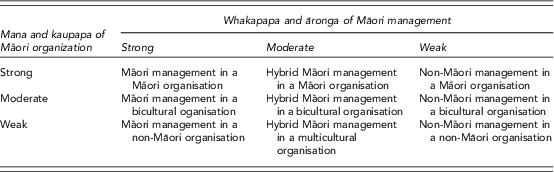
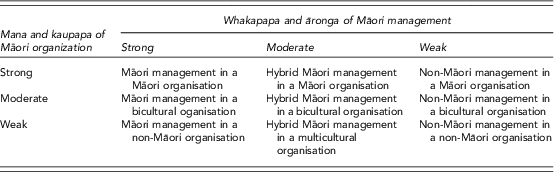
In an attempt to synthesise traditional and contempory elements of Māori management, we propose a two-dimensional model of Māori management called Te Whakahaerenga Māori. Whakahaere means to manage and whakahaerenga, management (Moorfield, Reference Moorfield2011). Our model draws inspiration from Durie's theoretical models of bicultural management (Durie, Reference Durie1993) and Māori-centred business (Durie, Reference Durie2002), and behavioural leadership models such as Blake and Mouton's ‘managerial grid’ (Blake, Mouton, Barnes, & Greiner, 1964, as cited in Robbins et al., 2009: 650). The two dimensions of Te Whakahaerenga Māori (see Table 4) are Māori management along the horizontal axis and Māori organisation on the vertical axis. Māori management is defined by two core variables: whakapapa (identity) and āronga (world view). Māori organisation is explained by two other variables: mana (Māori authority, power and control) and kaupapa (Māori-defined purposes). The model produces nine possible combinations of Māori management depending on the presence and strength of the underlying elements. As with any model a few assumptions are worth noting. First, there are no absolutes within the model, only degrees to which the variables are either present or not present, and if present, how strong? Second, variables other than the ones we have chosen may better explain the relationship between Māori organisations and Māori management. However, empirical research will be necessary to test our model.
Model of Māori management
Source. Authors.
Māori management is at its peak when the manager has direct whakapapa (blood ties) to the members of the organisation and demonstrates a high degree of self-efficacy with respect to a Māori world view. Remembering that a Māori world view is underpinned by mātauranga Māori (Māori knowledge), kaupapa Māori (Māori philosophies), tikanga Māori (Māori customs), kawa (Māori protocols) and whakahaere (Māori methods), which will vary according to the tribe, location and other conditions. Māori organisation is at its strongest when Māori have recognised mana over a particular domain and associated activity (e.g., mana whenua or authority over land) and the kaupapa of the organisation is primarily derived from a Māori-defined ideology and philosophy (e.g., kōhanga reo or Māori language pre-school movement).
When Māori management and Māori organisational variables are concurrently moderate, Māori management may be described as being of a ‘hybrid’ kind. That is, Māori and Pākehā managers operating according to a mix of Māori and Western world views with respect to management theory and practice. In this scenario, organisational mana and kaupapa are neither exclusively Māori, nor completely diverse or ‘multicultural’ in outlook. Thus, the organisational condition may be described as being ‘bicultural’. Biculturalism refers to the beneficial co-existence and mutual support of two cultures within one nation, institution or organisation (Ihi Management Consultants, 1987). Biculturalism is uniquely informed in Aotearoa New Zealand by the relationship between Māori and the Crown in the Treaty of Waitangi of 1840 (Geare et al., Reference Geare, Cambell-Hunt, Ruwhiu and Bull2005). Bicultural organisational goals and structural arrangements may vary from simple cognisance of Māori culture and socio-economic conditions to recognising independent Māori institutions and working with them to address Māori needs (Durie, Reference Durie1993).
In situations when Māori organisation and Māori management variables are simultaneously ‘weak’, our model suggests that we are likely to observe non-Māori management in a non-Māori organisation. By ‘weak’ we are not implying that non-Māori management and non-Māori organisations are inferior; simply that in respect of our model the presence of variables associated with Māori management and Māori organisations are not evident. In other words, an organisational context in which a predominantely Pākehā management may be applying a Western world view to management practice, in which power and control (mana) and organisational purposes (kaupapa) are defined by non-Māori for purposes that are neither directly beneficial nor harmful to Māori – a state of indifference.
Although a broad framework is evident in Te Whakahaerenga Māori, further research will be necessary to more adequately describe the relationship between the dimensions and their mediating variables. This will help us to locate actual organisations and management within the model with some confidence. Such research may also yeild insights about the predictive value of the model and its capacity to assess the performance of organisations in modifying their goals, structures and strategies to more readily pursue Māori development aims (Durie, Reference Durie1993). The model also gives credence to the proposition that there is no one form of Māori management, there are many; nor does there appear to be an ‘ideal type’ of Māori management. Māori management will vary depending on the organisational settings of mana and kaupapa.
IMPLICATIONS FOR RESEARCH, POLICY AND PRACTICE
Is Māori management necessary to exercise mana and fulfil kaupapa of benefit and meaning to Māori? In other words, are Māori management and Māori organisations inter-dependant and essential in combination for Māori development? And is a Māori organisation the only place in which Māori management can exist and survive? Whatever the answers to these searching questions, we argue that Aotearoa New Zealand can ill-afford Māori managerial talent to be under-developed, under-utilised and disengaged from the productive economy given the potential economic benefits (Nana, Reference Nana2011) and social costs (Te Puni Kōkiri, 2000). Māori management is needed to maximise gains from treaty settlements (Sapere Research Group, 2011), develop and transform Māori social service organisations (Cram et al., Reference Cram, Pipi, Keefe-Ormsby and Small2002), boost the productivity of Māori land trusts and incorporations (PriceWaterhouse Coopers, 2013), assume senior management roles in emerging Māori corporations (Mead, Stevens, Third, Jackson, & Pfeifer, Reference Mead, Stevens, Third, Jackson and Pfeifer2006) and grow the performance of Māori small and medium enterprises (New Zealand Institute of Economic Research, 2003; Love & Love, Reference Love and Love2005; Māori Economic Development Panel, 2012). These are some not insignificant expectations.
Furthermore, we agree with others (Harmsworth, Reference Harmsworth2005; Te Puni Kōkiri, 2007b) that Māori management has a place in New Zealand's non-Māori organisations and enterprises, particularly those seeking to position themselves as distinctive internationally (Te Puni Kōkiri, 2007b) and those wanting to do business with Māori (Davies, Reference Davies2011). Is there something non-Māori can learn from Māori organisations and Māori management? We believe so. The relationship is possibly already more symbiotic than we know; another possible avenue for future research.
We have identified what we believe to be grounds for renewed interest in Māori management within the academy, not least for its contribution to indigenous organisational theory, research and practice. Possible research themes include a more detailed examination of the functions of Māori management, the definition of Māori management and comparative analysis between Māori and Western management and organisation theory, practice and institutions. We believe Māori and non-Māori management scholars through collaborative efforts are best placed to lead this work. This article and the proposed research have implications for Māori management in the public sector as well as policies aimed at building the capacity of Māori organisations (e.g., Te Puni Kōkiri, 2009). For practitioners, this research may further develop theories of Māori management and legitimise a different approach to being a manager in Aotearoa New Zealand
Acknowledgement
We are especially grateful for the generous support, encouragement and valuable comments on the draft manuscript provided by Professor Annemarie Gillies of Te Whare Wānanga o Awanuiārangi and Doctor Joanne Bensemann of Massey University's School of Management. We thank Amsterdam Reedy, esteemed kaumātua of the East Coast tribe of Ngāti Porou, among others, for permission to include his work on the Māori world view. We thank Tāmati Cairns, esteemed kaumātua of the Tūhoe, Ngāti Raukawa and Ngāti Kahungunu tribes for his advice on the role of kaumātua in management and enterprise. We thank the Australian and New Zealand Academy of Management for their permission to use our conference paper, which formed the basis for the article. We thank Massey University's Head of School of Management, Professor Sarah Leberman, for permission to include material on Māori management.