Introduction
The independent performance of daily activities is one of the most relevant outcomes for people with dementia. Family carers have claimed that dementia research should focus more on the outcome of daily functioning than on cognition (Georges et al., Reference Georges, Jansen, Jackson, Meyrieux, Sadowska and Selmes2008). International guidelines demand the assessment of activities of daily living (ADL) in dementia research (National Collaborating Centre for Mental Health, 2007; Work Group on Alzheimer's Disease and Other Dementias, 2007; European Medicines Agency, 2008; Institute for Quality and Efficiency in Health Care, 2009). A recent synopsis of four Health Technology Assessments reporting the results of 27 pharmacological and 13 psychosocial intervention randomized controlled trials (RCTs) looking at daily functioning revealed that very heterogeneous ADL scales were used (Voigt-Radloff and Hüll, Reference Voigt-Radloff and Hüll2011). For harmonization, the INTERDEM group sought a consensus on appropriate outcome measures (Moniz-Cook et al., Reference Moniz-Cook2008). Although the group stated that an adequate dementia-specific measure for the endpoint ADL is not available at present, they considered the Interview for Deterioration in Daily Living Activities in Dementia (IDDD; Teunisse and Derix, Reference Teunisse and Derix1997) among several other scales to be appropriate when metric properties are confirmed through further validation studies.
The IDDD consists of two scales recording the carers’ rating of patients’ initiative and performance of daily living activities. The Initiative Scale measures the initiative for (1) washing oneself, (2) making tea or coffee, (3) dressing, (4) combing one's hair and brushing one's teeth, (5) shopping, (6) using the phone, (7) preparing a meal, (8) cleaning the house or doing minor repair work and (9) handling finances. The Performance Scale records the need for assistance in the performance of the same nine activities plus eating and using the toilet. Both domains of the IDDD are constructed as five-point Likert scales with the ratings never = 0, seldom = 1, sometimes = 2, often = 3, always = 4. Scores of the Initiative Scale range from 0 to 36, with higher scores indicating higher initiative. The Performance Score ranges from 0 to 44, with higher scores indicating higher need for assistance. In a sample of 451 persons, the IDDD demonstrated great internal consistency (Cronbach's α = 0.99), reproducibility (intraclass correlation coefficient (ICC) = 0.94) and significant differences between groups of patients with mild cognitive impairment and patients with dementia (Böhm et al., Reference Böhm, Peña-Casanova, Aguilar, Hernández, Sol and Blesa1998). In a sample of 25 primary and secondary carer pairs, the IDDD interrater reliability was high (ICC 0.85 for the Initiative Scale and 0.74 for the Performance Scale; Teunisse and Derix, Reference Teunisse and Derix1997). In an RCT on psychosocial intervention, the Performance Scale demonstrated high responsiveness by indicating clinically relevant improvement in 78% of cases in the intervention group and 12% of cases in the control group six weeks after baseline and 82% and 10% respective after 12 weeks (Graff et al., Reference Graff, Vernooij-Dassen, Thijssen, Dekker, Hoefnagels and Rikkert2006).
While these results provide evidence for the reproducibility, interrater reliability and responsiveness of the IDDD, studies on its construct and concurrent validity are missing. Therefore the purpose of the present validation study was to translate the IDDD into German and to evaluate the internal consistency, construct validity and correlation with corresponding scales of this translated version in two samples of people with mild to moderate dementia.
Methods
Design
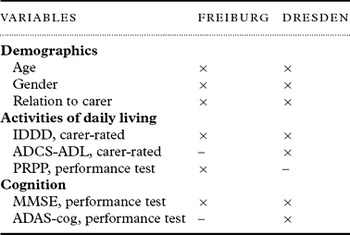
Two independent RCTs funded by the Federal German Health Ministry set the frame for data collection. These multi-site randomized trials evaluated the effectiveness of community occupational therapy on daily functioning of people with mild to moderate dementia. Table 1 shows the measurements used in the collection of data from the two samples in Freiburg and Dresden.
Freiburg and Dresden samples: measurements

IDDD = Interview for Deterioration in Daily Living Activities in Dementia; ADCS-ADL = Alzheimer's Disease Cooperative Study Activities of Daily Living inventory; PRPP = Perceive, Recall, Plan and Perform System of Task Analysis; MMSE = Mini-Mental State Examination; ADAS-cog = Alzheimer's Disease Assessment Scale – cognitive.
The WHEDA trial from Freiburg included seven study sites and 141 participants. Inclusion criteria were a diagnosis of Alzheimer's disease (AD) or mixed type dementia and a Mini-Mental State Examination (MMSE) score between 14 and 24. Patients had to be living in the community and a carer had to be available twice a week. Participants with major depression and severe behavioral disturbances were excluded.
The ERGODEM trial from Dresden comprised three sites and 160 patients. The eligibility criteria for participation in the study were the same as for the WHEDA trial with two exceptions: patients with vascular dementia according to DSM-IV were also included and the range of the MMSE score was broader (12–26).
Measurement instruments
Two assessment instruments on ADLs and two measurements of cognition were applied assuming a possible association with the IDDD.
The WHEDA trial used the Perceive, Recall, Plan and Perform System of Task Analysis (PRPP) to evaluate a patient's usual daily activity (Chapparo and Ranka, Reference Chapparo and Ranka2006). In this assessment, a trained rater defines single steps of a performed activity to be analyzed and identifies any activity step in which errors of accuracy, omission, repetition or timing occur. The number of activity steps rated as incorrectly performed is divided by the total number of activity steps, resulting in an independence score indicated in percent (100% = all steps are error-free). Content validity was shown in a comparative analysis of the same activities of daily living of 25 healthy adults and 20 persons with brain injury. Variations of performance but no errors occurred within the healthy sample. Clearly observable errors within the sample with brain injury could be catalogued in the four main categories of accuracy, omission, repetition and timing. Interrater reliability of three raters in a sample of 15 adults with schizophrenia was moderate (ICC 0.77; Chapparo and Ranka, Reference Chapparo and Ranka2006). Nott et al. (Reference Nott, Chapparo and Heard2008) found fair test-retest reliability and high internal consistency (ICC > 0.8).
The informant-based Alzheimer's Disease Cooperative Study Activities of Daily Living Inventory (ADCS-ADL) was applied in the ERGODEM trial. It assesses 17 instrumental and 6 basic ADLs. The scoring categories differ between 0 to 3 and 0 to 5 depending on the item. The total score of the ADCS-ADL ranges from 0 (positive, highly independent) to 78 (negative, highly dependent). In a sample of community-dwelling older people with mild to moderate AD, each of the 27 items was tested for correlation with the MMSE (Spearman R: 0.28–0.70) and for test-retest-reliability after one and two months (κ: 0.40–0.73; Galasko et al., Reference Galasko1997).
The MMSE and the Alzheimer's Disease Assessment Scale – cognitive (ADAS-cog) are established tests of cognitive performance (Demers et al., Reference Demers, Oremus, Perrault, Champoux and Wolfson2000).
Procedures
Our procedures followed the latest guideline on cross-cultural translation and validation (Sousa and Rojjanasrirat, Reference Sousa and Rojjanasrirat2011). We used Dutch as the source language and German as the target language. English was the common language in all phases to explore the meaning of terms in the source and target languages and to resolve inconsistencies by using descriptions of intended meanings.
Forward translations: Two native German speakers, excellent in Dutch and fluent in English, independently translated the instructions, items and response format. One of them lives in the Netherlands and works in Germany. The second translator lives in Germany but studied psychology in the Netherlands for five years.
Synthesis of forward translations: The project manager of the WHEDA-study compared the forward-translated versions and achieved an agreement with the translators by discussing ambiguities and discrepancies in a synthesized version.
Backward translations: Two native Dutch speakers, excellent in German and fluent in English, independently translated the preliminary German version back into Dutch. One of the translators has published on language issues in qualitative research (van Nes et al., Reference van Nes, Abma, Jonsson and Deeg2011).
Synthesis of backward translations: The Dutch translators compared the two backward-translated Dutch versions and transferred the Dutch discrepancies to the German version and explained it with English comments using single Dutch words where necessary. The project manager moderated the discussion of all four translators about the synthesized version considering all highlighted ambiguities and discrepancies of the forward and backward versions. Agreement on the final version was achieved by discussion.
Pilot-testing: The assessors involved in the WHEDA trial attended a seminar on the IDDD application and applied it to carers of patients with mild to moderate dementia. The assessors listed aspects facilitating or hindering the IDDD application within a written cognitive debriefing on the response process (Cook and Beckman, Reference Cook and Beckman2006; Frost et al., Reference Frost, Reeve, Liepa, Stauffer and Hays2007). The assessors involved in the ERGODEM trial attended a training session involving detailed instructions for the application of the instrument.
Full psychometric testing: Patients with mild to moderate dementia were informed about the study during a routine visit to the participating centers or via an invitation letter. The study physician informed both patient and carer and received written informed consent and full agreement with the contents and procedures of the study from both patient and primary carer. The primary carer had to be a family member or friend living together with or providing informal care for the patient at least twice a week. Trained physicians, psychologists or study nurses collected MMSE and ADAS-cog data at the study site. The assessors handed over the IDDD and the sociodemographic questionnaires to the primary carer, received it back and clarified questions and unclear answers with the carer within the same session. In the Dresden trial, the primary carers completed the ADCS-ADL at the same time as the other questionnaires. In the Freiburg trial, the assessors videotaped the patient's performance of a selected ADL, which was rated by external raters using the PRPP. The patient, the carer and the assessor jointly selected one out of 20 defined everyday activities bearing in mind that the task must be meaningful for this patient and that he/she must not be able to demonstrate an effective and fully independent task performance so that there is room for improvement. At the coordinating study centers, questionnaires were checked for completeness and plausibility, typed in, checked again for typing errors and analyzed.
Statistical analysis
Descriptive statistics: IDDD scales were reported with means, standard deviation, and frequency of best and worst possible values (ceiling and bottom effects).
Construct validity and internal consistency: We applied confirmatory factor analyses in order to evaluate whether the scale structure of the IDDD can be replicated in other samples. Internal consistency was indicated by Cronbach's α.
Concurrent validity: Pearson correlation coefficients were calculated for both IDDD scales and scores of the PRPP, ADCS-ADL, MMSE, and ADAS-cog.
Results
Translation
There was a discussion on how to refer to the patient when the carer is being addressed in the questionnaire: your relative vs patient vs the ill person vs person with dementia. We decided on the ill person because this term in German is a single word and has the connotation of someone who is cared for, but not just in a medical sense. The use of the term your relative would have excluded non-family carers.
Two misinterpretations were prevented through the comparison of the forward and backward translations: (1) the item using the toilet without soiling was not meant as without soiling oneself, but without soiling the toilet; (2) the forward translation of the item doing tasks in and around the house such as cleaning, repairing something or gardening could be misleading, because the carer might associate this with bigger tasks such as renovating and caring for the whole garden. To avoid such misinterpretation we agreed on the amendment doing minor tasks.
Pilot-testing
Fourteen assessors provided data on 21 IDDD questionnaires. All carers were able to complete the IDDD, except one who felt that he did not know the patient well enough. No item response was missing in the resulting 20 questionnaires. Of 400 possible response items, 7 (<2%) were answered with “do not know” and 28 (7%) with “activity was never done” indicating that the carers could rate most of the daily activities and that these activities were relevant to the patients. The assessors observed that motivation, sufficient cognitive ability and diligence of the carer all helped to facilitate the completion of the IDDD. Furthermore, the fact that the carer was asked to mark any ambiguity or open questions directly on the form was well received, as well as the assessor's check of each response as soon as the completed questionnaire was returned. We concluded that a change in the wording was not necessary and that the data collection will be optimized when trained assessors ask the carer to note unclear points and directly check the responses for completeness and plausibility.
Descriptive results
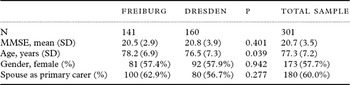
We pooled the data from both samples: Freiburg (N = 141) and Dresden (N = 160). Baseline characteristics were similar and differed only in age, which, however, was still in a typical range for people with mild to moderate dementia (Table 2). Descriptive data indicate that, on average, patients only sometimes showed the initiative to perform ADLs but seldom needed assistance (Table 3). Minimal bottom effects were found in the performance scale (4.3% with best scale values).
Baseline characteristics
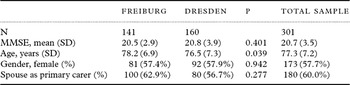
MMSE = Mini-Mental State Examination.
IDDD descriptive data (Freiburg and Dresden sample, N = 301)

a Range: positive to negative; b Number of cases with worst/best scale values
IDDD = Interview for Deterioration in Daily Living Activities in Dementia.
Construct validity
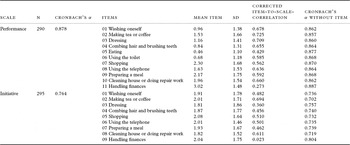
The IDDD scales demonstrated good internal consistency with Cronbach's α = 0.878 for the performance scale and α = 0.764 for the initiative scale (Table 4). Only for the item handling finances did we find low corrected item-to-scale-correlations in both scales.
IDDD internal consistency

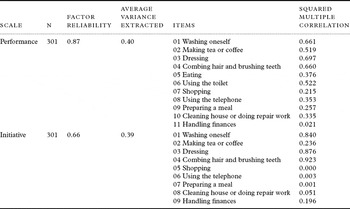
However, the factor analysis of the IDDD model revealed a significant chi-square (χ2 = 1396, df = 169, χ2/df = 8.261, p < 0.001) indicating a difference between empirical and estimated data and a bad fit for the model. Further indices (Kline, Reference Kline1998) confirmed an insufficient model fit (Root Mean Square Error of Approximation (RMSEA) = 0.156 (good fit: <0.08); Tucker-Lewis Index (TLI) = 0.574; (good fit: >0.9) Comparative Fit Index (CFI = 0.657) (good fit: >0.95). The initiative scale showed low factor reliability (r = 0.66; Table 5). In particular, items of instrumental activities of daily living (shopping, using telephone, preparing a meal, cleaning house or doing repair work and handling finances) demonstrated very low correlations (r < 0.2; Table 5). Considering this, we developed a four factor model based on the clinically relevant distinction between basic and instrumental activities of daily living. The new model demonstrated an acceptable fit according to the indices recommended by Kline (Reference Kline1998; χ2 = 431, df = 160, χ2/df = 2.696, p < 0.01; RMSEA = 0.075; TLI = 0.911; CFI = 0.925) and an excellent internal consistency with Cronbach's α as follows:

IDDD confirmatory factor analysis

Concurrent validity
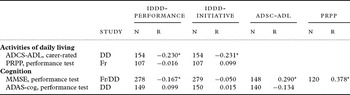
We found no correlations between the IDDD scales and cognition performance scores (r < 0.17 for MMSE and ADAS-cog; Table 6). Furthermore, the IDDD performance and initiative scale both correlated very weakly with the carer-rated ADCS-ADL score (r < 0.24) and were not associated with the PRPP performance test of a daily activity (r < 0.1). In addition, we found no association between the ADCS-ADL and the ADAS-cog. Correlations of the MMSE were moderate with the PRPP and weak with the ADCS-ADL (Table 6).
Correlations between ADL scales and related scores (Pearson coefficient)

* p < 0.01.
IDDD = Interview for Deterioration in Daily Living Activities in Dementia; ADCS-ADL = Alzheimer's Disease Cooperative Study Activities of Daily Living inventory; PRPP = Perceive, Recall, Plan and Perform System of Task Analysis; MMSE = Mini-Mental State Examination; ADAS-cog = Alzheimer's Disease Assessment Scale cognitive; DD = Dresden; Fr = Freiburg.
Discussion
Following standardized procedures of translation, we could provide a German IDDD version equivalent to the Dutch instrument. Piloting revealed that carers did understand the questions well and that data collection can be optimized by checking the responses directly after administration.
Descriptive IDDD data indicated a moderate initiative to perform activities of daily living and a minor need of assistance in a pooled sample of 301 community dwelling people with mild to moderate dementia from two multi-centre trials including ten study-sites in total. For both IDDD scales, initiative and performance, bottom and ceiling effects were very low (< 5%) and internal consistency was good (α > 0.7).
Based on our findings on the construct validity of the IDDD, we advocate for a four factor solution, because even though each of the four new scales consisted of fewer items, the Cronbach's α values were excellent. The indices for a better fit of the four factor model as well as the excellent internal consistency suggest that the clinically established differentiation between instrumental and basic ADL is confirmed by our factor analysis.
Cognition as measured with the MMSE or ADAS-cog did not correlate with the IDDD scales (r < 0.17). These findings are in contrast to former studies. The first version of the IDDD correlated highly with the Cambridge Cognitive Examination (Roth et al., Reference Roth1986) in a sample of 30 community-dwelling persons with mild to moderate dementia (r = ˗0.77, p < 0.01; Teunisse et al., Reference Teunisse, Derix and van Crevel1991). However, this former IDDD version included additional items of cognitive and communicational functions such as finding one's way inside and outside the house, finding objects, reading, writing, verbal expression and starting a conversation. Bouwens and colleagues (Reference Bouwens, van Heugten and Verhey2009) found in a sample of 442 persons with AD (MMSE: 19) a moderate correlation (r = ˗0.60; p < 0.01) between the MMSE and the Blessed Dementia Scale (BDS; Erkinjuntti et al., Reference Erkinjuntti, Hokkanen, Sulkava and Palo1988). The BDS comprises only four ADL items (eating, dressing, continence and household tasks) and seven items of cognitive functioning in everyday life (coping with small sums of money, remembering short list of items, finding way indoors and in familiar neighborhood, interpreting surroundings, recalling recent events and tendency to dwell in the past). These results suggest that ADL constructs are heterogeneous. A precise definition is needed for a thorough evaluation of the association between cognition and daily functioning in AD.
The low correlations between the IDDD performance scale and the PRPP may have two explanations. First, the PRPP measured the number of mistakes made in the performance of instrumental and not of basic ADLs. This was because patients never chose activities like dressing or bathing to demonstrate during video-taping, while the original 11-item IDDD performance scale covered also these basic activities. However, the assumption that the PRPP would significantly correlate with the IDDD performance subscale limited to instrumental ADL could not be confirmed (r = 0.008; p = 0.932). Secondly, the comparison of the IDDD and the PRPP performance scales included the contrast of a carer's estimation of the patient's need for assistance and an assessor's rating of a concrete task performance. The first can be influenced by the carer's mood, attitude, knowledge or memory. The second might be biased by the patient's mental capacity, which may change day by day, or by special motivation when being video-taped. So the fact that the carer's rating of the need for assistance in everyday functioning for the last seven days is different to a patient's short-term performance of an everyday task when being video-taped seemed to be the main reason for the low correlations between the IDDD and the PRPP.
The IDDD scales demonstrated low correlations with the ADCS-ADL score (r < 0.24), although both instruments are carer-rated. A reason for this might be that the ADCS-ADL did not cover the IDDD item handling finances but additionally records items on communication (reading, writing, making conversation, discussing current events), on social interaction (watching TV, playing games or doing hobbies, keeping appointments, can be left alone, travelling outside home) and on two further items (walking and finding belongings). To test this assumption we selected the basic ADL items and the household ADL items of the ADCS-ADL and correlated these two new ADCS-subscales with the two new IDDD performance subscales. We found highly significant correlations between the ADCS-basic-ADL and IDDD-performance-basic-ADL scores (r = 0.549; p < 0.001) and between ADCS-household-ADL and IDDD-performance-instrumental-ADL scores (r = 0.646; p < 0.001).
Our findings are in line with reviews on assessment instruments in dementia research stating that ADL instruments are heterogeneous on item level and in their correlations with measures of cognition. Furthermore, ADL measurements differ in their responsiveness to drugs and psychosocial interventions depending on the state of dementia (Desai et al., Reference Desai, Grossberg and Sheth2004; Sikkes et al., Reference Sikkes, de Lange-de Klerk, Pijnenburg, Scheltens and Uitdehaag2009; Bouwens et al., Reference Bouwens, van Heugten and Verhey2009; Gauthier et al., Reference Gauthier2010; Voigt-Radloff and Hüll, Reference Voigt-Radloff and Hüll2011). Low correlations of cognition not only with the IDDD but also with the other ADL measurements (PRPP; ADCS-ADL; Table 6) emphasize the conceptual differences between these constructs. Cognitive decline can result in a reduced performance of cognitively challenging daily activities but may not directly lead to the deterioration of routine activities of daily living such as basic ADL and familiar household chores. On the other hand, a decline in initiative may drastically reduce ADLs in patients with good cognitive test results. We therefore advocate more precise ADL measurement in AD. The IDDD has been shown to be able to measure the impact of non-pharmacological treatment aiming at the stabilization of familiar routine activities. The presented empirical data of the German IDDD support a four factor model distinguishing initiative and performance as well as basic and household activities of daily living. Separate analyses of these subscales seem to be appropriate in further trials of non-pharmacological interventions. A further broadening of the IDDD will be necessary to cover the full range of daily functioning.
Conflict of interest
None.
Description of authors' roles
All authors contributed to the study conception or data collection. SVR and RL performed the statistical analysis. SVR drafted the paper. All authors revised the draft critically for important intellectual content and approved the final paper.
Acknowledgments
We thank all participants and interventionists for their contribution. We acknowledge Gieneke Jonker-Welvaadt, Sofia Joosten and Jana Ploch for their involvement in the independent translation procedures.