




No CrossRef data available.
Article contents
The prognostic value of balloon occlusion in candidates for the various types of cavo-pulmonary anastomosis
Published online by Cambridge University Press: 24 May 2005
Abstract
The purpose of our paper is to assess the prognostic value of balloon occlusion as a test for patients with various types of functionally single ventricle after different palliative surgical procedures who were candidates for further modifications of a cavo-pulmonary operation. In all patients, there were at least two sources of pulmonary arterial supply.
Our hypothesis was that, using balloon occlusion temporarily to produce changes in the haemodynamic situation, we could simulate the potential state subsequent to surgical palliation. We used balloon occlusion in 19 patients during diagnostic catheterisation, followed by interventional and or surgical procedures as considered necessary. This test was applied for temporary closure of the pulmonary valve in 8 patients, and a Blalock-Taussig anastomosis in 11 patients.
Information
- Type
- Original Article
- Information
- Copyright
- © 2003 Cambridge University Press
Patients with functionally univentricular physiology often require several surgical interventions until final palliation is achieved. It is not rare, therefore, to find dual supply of blood to the pulmonary arteries before the final surgical procedure. The result of the procedure will then depend on the clinical state of the patient, and the results obtained by non-invasive and invasive investigations. If a further operation is considered, its type and risk factors must be determined. Complete cardiac catheterisation and angiocardiography are generally mandatory. Beside routine calculations, such as pulmonary vascular pressure, resistance, and ventricular end-diastolic pressure, the anatomy of the pulmonary arteries must be evaluated. In addition, temporary occlusion of a second source of pulmonary arterial flow during cardiac catheterisation may add important haemodynamic data. It may help to estimate the reversibility of any elevation in pulmonary arterial pressure induced by previous surgery. It can also simulate, for a short period of time, the haemodynamic consequences of the planned surgical or interventional procedures.
The aim of our study, therefore, was to evaluate the prognostic value of balloon occlusion tests in candidates for total or partial cavo-pulmonary anastomoses.
Patients and methods
Between October 1996 and June 2002, we carried out balloon occlusion tests in 19 patients, 10 males and 9 females, who were aged from 17 months to 11 years, with a mean of 6.25 years. The baseline characteristics of the patients are presented in Table 1. All patients had complex cardiac anomalies, 16 with diminished and 3 with increased flow of blood to the lungs. In the last 3 patients, banding of the pulmonary trunk was performed in early infancy.
Table 1. Data, results and outcome of patients submitted to trial balloon occlusion.

Of the patients, five had a functionally single ventricle with pulmonary stenosis, two had double outlet right ventricle with hypoplasia of the left ventricle and pulmonary stenosis, two had an atrioventricular septal defect with common atrioventricular junction and hypoplasia of the right and left ventricle, three had tetralogy of Fallot with pulmonary atresia, three had pulmonary atresia with intact ventricular septum, one had tricuspid atresia, two had combined pulmonary and tricuspid atresia, and the final child had pulmonary stenosis with discordant ventriculo-arterial connections and multiple ventricle septal defects.
A bi-directional Glenn anastomosis had previously been constructed in 13 patients, a classical Glenn anastomosis in one patient, the hemi-Fontan procedure had been performed in another patient, a Blalock-Taussig shunt had been fashioned in 14 patients, the pulmonary trunk had been banded in 3 children, and a palliative Mustard operation carried out in one child.
Cardiac catheterisation was performed under general anaesthesia. Access to the pulmonary arteries in those patients with Glenn anastomoses was obtained via the brachial and/or the jugular veins. Otherwise, the femoral veins were used for venous access. The Blalock-Taussig anastomosis, when present, was approached via the arterial route.
Flow of blood through the superior caval vein via a Glenn anastomosis was studied by occluding the pulmonary valve, or the banded pulmonary trunk, in 8 patients, and by occluding the Blalock-Taussig shunt in 11 patients. These tests aimed to abolish the excessive pulmonary blood flow and, thereafter, to assess the resulting haemodynamic parameters. Parameters assessed during catheterisation before and after balloon occlusion included pulmonary arterial pressure, systemic arterial oxygen saturation, and pulmonary angiography. A second venous access for monitoring the pulmonary arterial pressure was created when needed.
Procedural techniques
In patients with patent pulmonary valves after previous Glenn or Fontan operations, the valve was occluded with balloon catheters of various design inflated with a light mixture of contrast medium and water (Fig. 1) The valve was approached from the Glenn anastomosis or from the right ventricle.

Figure 1. Total occlusion of the pulmonary trunk achieved by inflation of a balloon catheter (arrow) as shown by pulmonary angiography in the frontal projection.
If the excessive pulmonary blood flow was due to a patent Blalock-Taussig shunt, the surgically created anastomosis was crossed with a 4 or 5 French internal mammary arterial catheter from the femoral arterial side. A 0.014-inch exchange guide wire was then advanced via the shunt into the pulmonary artery, and a 4 French Berman balloon wedge catheter was introduced coaxially into the surgical anastomosis. When positioned centrally within the shunt, the balloon was inflated with diluted contrast medium (Fig. 2)

Figure 2. Balloon occlusion of the Blalock-Taussig shunt demonstrated by angiography into the superior caval vein seen in the frontal plane.
Results
The results of balloon occlusion, and the subsequent surgical outcomes, are shown in the Table 1. There were no complications during the procedures. In 7 patients with Glenn anastomoses and a patent pulmonary valve, the mean pulmonary arterial pressure decreased after occlusion from 20.7 to 14.28 mmHg (p < 0.05). These 7 patients, therefore, were considered suitable for definitive surgical occlusion of the pulmonary trunk and construction of the second stage of Fontan procedure without the need for fenestration. In three patients (#5, #6 and #7), the mean pulmonary arterial pressures were measured at 16 or 17 mmHg. In spite of these borderline values, we decided to complete the Fontan operation. At follow-up, all these patients were in the first or second classes of the categorisation of the New York Heart Association. In two further patients, #5 and #6, an abnormal venous connection was found, permitting the escape of blood through the azygos and hemiazygos veins, and resulting in systemic arterial desaturation. According to the results of the occlusion, both vessels were safely occluded with coils during the same procedure. Two other patients, #3 and #4, required balloon dilation of stenotic pulmonary arteries, one of them undergoing simultaneous closure of a Blalock-Taussig shunt with coils. Patients #7 and #8, in whom the pulmonary trunk previously had been banded, the pulmonary outflow tract was closed by implantation of Amplatzer Duct Occluders (Fig. 3). In all these patients, a second stage of Fontan procedure was performed.

Figure 3. Occlusion of a banded pulmonary trunk by a 6/8 Amplatzer duct occluder (arrow), shown in the frontal projection.
In patient #1, with Glenn anastomosis and a Blalock-Taussig shunt, occlusion of the pulmonary valve caused only a small decrease in pulmonary arterial pressure, and the systemic arterial saturation dropped from 80 to 64%. In this patient, therefore, the Glenn anastomosis was taken down, and a second Blalock-Taussig shunt established.
The second group, #9 through #19, was made up of 11 patients with increased pulmonary arterial pressures and flow due to presence of Blalock-Taussig shunts. All anastomoses were occluded to assess the potential effects of creation of a first or second stage cavo-pulmonary anastomosis. Temporary occlusion of the shunt resulted in a decrease in the mean pulmonary arterial pressure from 23 to 14 mmHg (p < 0.05). Of the patients, three (#9, #10 and #15) were considered suitable for construction of a bi-directional Glenn anastomosis, patient #19 was considered suitable for a hemi Fontan operation, while in the other six patients (#12–14 and #16–18), a total cavo-pulmonary connection was considered appropriate. In four of these patients, (#13, #16, #18 and #19), the Blalock-Taussig shunt was closed during the same catheterisation. In patient #9, the shunt was closed during a second interventional procedure. Patients #12 and #17 required balloon dilation of the pulmonary arteries. In patient #14, two stents were implanted, one in the left pulmonary artery and the other in the superior caval vein. In patient #10, the classical Glenn shunt was changed into a modified shunt. The test occlusion in patient #11, however, showed that it would not be appropriate to construct a Glenn anastomosis. In this patient, therefore, the pulmonary trunk was banded and a stent implanted intraoperatively within the right pulmonary artery. High pressures were identified subsequent to trial occlusion in patients #9, #11 and #12. In patients #9 and #12, we decided to proceed with a Fontan-type procedure because we thought that the increased pressures were provoked by coexisting stenosis of the branches of the pulmonary trunk.
Interventional catheterisation was performed before surgery.
Our experience with trial occlusion, therefore, showed that all patients were suitable for surgical intervention, but only 17 of the 19 for some type of cavo-pulmonary anastomosis. The subsequent surgical procedures are shown in the Table 1. In 10 patients, different unneeded structures were closed during catheterisation.
Over the period of follow-up, which lasted from 5 months to 7.3 years, with a mean of 3.3 years, two patients died. The first died 10 days after the second stage of a Fontan operation, due to infection, while the other one died suddenly one year after surgery. All the remaining patients are in the first or second classes of the functional categorisation of the New York Heart Association. Of these patients, one-third is medicated with digoxin, diuretics or antiarrhythmic drugs. Further interventional cardiac catheterisations were needed in three children, the atrial septum being fenestrated in one and aortopulmonary collateral arteries being embolised in the other two.
Discussion
It is often difficult to decide whether further operative procedures are needed in patients with complex congenital cardiac malformations who have already undergone initial palliation.1 Diagnostic catheterisation, for example, provides only instant haemodynamic data confined to the time of the procedure. Temporary occlusion of certain vascular or valvar connections using a balloon, in contrast, may demonstrate the changes in haemodynamic parameters, such as systemic, pulmonary, or venous pressure, and peripheral arterial saturation, which may be anticipated after eventual surgical closure of such structures.2
The results of such trial occlusion may be of particular importance when there are “borderline” indications for surgery in situations where a low pulmonary arterial pressure is essential for a good result.3 The Glenn anastomosis, and the total cavo-pulmonary connection, belong to these types of operation. Furthermore, palliation in patients with complex cardiac malformations induces haemodynamic changes that may lead to abnormal reactions by the vessels. These reactions may or may not be reversible, and trial occlusion may help to differentiate between the two possibilities.
Excessive flow of blood to the lungs from single or multiple sources may alter the haemodynamic parameters, and make it difficult to assess the suitability of patients for operations such as the total cavo-pulmonary or Fontan procedures, where a low pressure in the pulmonary circulation is essential. The influence of flow from a given source, and its significance, can be assessed by trial balloon occlusion. Excessive flow from two sources into a non-compliant pulmonary bed can cause competition, and can reverse the flow into the systemic circulation via the azygos or hemiazygos veins or newly created vessels, leading to systemic desaturation and an increase of pulmonary arterial and systemic venous pressures.4
Our experience suggests that trial occlusion should be recommended as an elective procedure whenever there are high pulmonary arterial pressures together with a second source of flow, or when the indications for a cavo-pulmonary type of operation are borderline. Subsequent surgical or interventional closure of the undesired structure may normalize the haemodynamics, favouring unrestricted forward flow.
A residual and harmful banded pulmonary trunk can be closed using a device such as the Amplatzer duct occluder through the jugular veins, thus diminishing the time needed for the next surgical procedure, and avoiding another cause of potential pulmonary arterial distortion. We were able to close the pulmonary outflow tract in two patients, with excellent results. Brachial access by punction of the antecubital vein has proved to be an easy and safe approach to a Glenn anastomosis, and to the pulmonary arteries, both for angiography and measurement of pressures, before and after trial occlusion, especially when a second venous route is needed. In those patients in whom it is impossible to perform trial occlusion during cardiac catheterisation, the test can be carried out intraoperatively.5
We must acknowledge that exercise tests have not been carried out in our patients following the procedures, and that the follow-up was relatively short. Despite these limitations, however, we contend that trial occlusion using balloons may simulate the haemodynamic changes that could follow additional surgical procedures in patients with previously palliated complex cardiac lesions. The tests can help to decide if subsequent permanent occlusion is advantageous or contraindicated.
Footnotes
This paper was produced within a Spanish–Polish program of cooperation.
References
Uchita S, Matsuo K, Ishida T. Total cavopulmonary connection for grown diminutive pulmonary artery after staged Blalock-Taussig shunt. Jpn J Thorac 1998; 46: 1194–1199.Google Scholar
Bridges N, Lock J, Mayer J, Burnett J, Castaneda A. Cardiac catheterisation and test occlusion of the interatrial communications after fenestrated Fontan operation. J Am Coll Cardiol 1995; 25: 1712–1717.Google Scholar
Masuda M, Kado H, Shiokawa Y, et al. Clinical results of the staged Fontan procedure in high-risk patients. Ann Thorac Surg 1998; 65: 1721–1725.Google Scholar
Stumper O, Wright J, Sadiq M, de Giovanni J. Late systemic desaturation after total cavopulmonary shunt operations. Br Heart J 1995; 74: 282–286.Google Scholar
Goh K, Sasajima T, Inaba M, Yamamoto H, Kawashima E, Kabo Y. Isolated right ventricular hypoplasia: intraoperative balloon occlusion test. Ann Thorac Surg 1998; 65: 551–553.Google Scholar
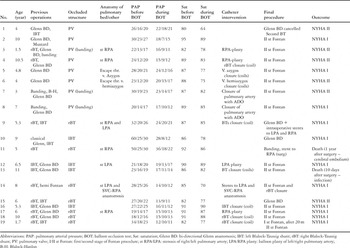
Table 1.

Total occlusion of the pulmonary trunk achieved by inflation of a balloon catheter (arrow) as shown by pulmonary angiography in the frontal projection.

Balloon occlusion of the Blalock-Taussig shunt demonstrated by angiography into the superior caval vein seen in the frontal plane.

Occlusion of a banded pulmonary trunk by a 6/8 Amplatzer duct occluder (arrow), shown in the frontal projection.
 You have
Access
- 1
- Cited by