


Introduction
Borderline personality disorder (BPD) affects approximately 1% of the population and is associated with high levels of service use, distress, functional impairment, deliberate self-harm, challenging behaviour and interpersonal difficulties (Coid et al. Reference Coid, Yang, Tyrer, Roberts and Ullrich2006). Psychological therapy is the primary treatment approach for BPD, and includes cognitive behavioural-based approaches such as Dialectical Behaviour Therapy and psychodynamic psychotherapies such as Mentalization-Based Therapy (NICE, 2009). There is increasing evidence that these different forms of psychotherapy can lead to improvement in a variety of borderline symptoms, but there is no clear superiority of one type of therapy over another, and none leads to remission for most patients (Leichsenring et al. Reference Leichsenring, Leibing, Kruse, New and Leweke2011).
One factor which may contribute to many of the problems associated with BPD, and which is not currently explicitly addressed by psychological therapies, is cognitive impairment. There is good evidence to show that people with BPD have a range of cognitive difficulties. A meta-analysis of ten studies compared the cognitive performance of people with BPD (n = 225) with healthy controls (n = 263) across cognitive domains of attention, cognitive flexibility, learning and memory, planning, speeded processing and visuospatial abilities (Ruocco, Reference Ruocco2005). BPD participants performed more poorly than controls across all neuropsychological domains, with mean effect sizes (Cohen's d) ranging from ‒0.29 (small to moderate) for cognitive flexibility to -1.43 (large) for planning. More recent studies have identified specific executive deficits, particularly in inhibitory dysfunction (Rentrop et al. Reference Rentrop, Backenstrauss, Jaentsch, Kaiser, Roth, Unger, Weisbrod and Renneberg2008). These cognitive deficits are suggestive of prefrontal and temporolimbic dysfunction, which is thought to underlie problems in behavioural and affective regulation and social cognition (Dell’Osso et al. Reference Dell’Osso, Berlin, Serati and Altamura2010). In support of this, Legris et al. (Reference Legris, Links, van Reekum, Tannock and Toplak2012) showed that poor performance on the Stroop test predicted lifetime suicide ideation or attempts even when borderline symptom severity and depression had been taken into account. Fertuck et al. (Reference Fertuck, Keilp, Song, Morris, Wilson, Brodsky and Stanley2012) also showed that better executive control and visual memory performance predicted increased time spent in treatment in a randomized controlled trial of psychological and pharmacological therapies in BPD. It has been proposed that cognitive impairment plays a key role in the development and maintenance of the disorder and is likely to reflect both environmental (e.g. trauma and/or neglect) and genetic aetiological factors (Perez & Widom, Reference Perez and Widom1994; Ruocco et al. Reference Ruocco, Laporte, Russell, Guttman and Paris2012). Therefore, cognitive problems may make legitimate treatment targets in BPD.
Cognitive Remediation Therapy (CRT) is a psychological treatment which aims to improve cognitive functioning. There is good evidence that it is effective in improving cognitive functioning, as well as functional outcome, mainly in people with a diagnosis of schizophrenia (Wykes et al. Reference Wykes, Huddy, Cellard, McGurk and Czobor2011), but more recently, studies have emerged to show its efficacy in major depression (Bowie et al. Reference Bowie, Gupta, Holshausen, Jokic, Best and Milev2013), anorexia nervosa (Tchanturia et al. Reference Tchanturia, Davies and Campbell2007) and attentional deficit hyperactivity disorder (Stevenson et al. Reference Stevenson, Whitmont, Bornholt, Livesey and Stevenson2002).
CRT has been delivered individually or in groups, using pencil-and-paper or computerized materials. Its focus is on the development of improved cognitive functioning (e.g. memory, attention, executive function), and in this respect it is somewhat akin to skills training approaches for BPD (Linehan, Reference Linehan1991; Huband et al. Reference Huband, McMurran, Evans and Duggan2007). CRT involves completing cognitive puzzles or more ecologically valid problem-solving exercises, which engage a variety of target cognitive skills, and which are scaffolded in their presentation, so that patients’ learning is largely errorless and experienced as highly successful. Cognitive tasks are administered on a highly repetitive basis and massed practice is generally considered a key component of the approach. Different conceptual accounts suggest that this may facilitate neuroplastic changes, or lead to the development of pragmatic schemas which can promote more well-regulated behaviour and which come to be automatized (Wykes & Spaulding, Reference Wykes and Spaulding2011). While some CRT programmes facilitate the bottom-up development of new basic cognitive skills which may cascade forward to more complex thinking processes, of particular relevance to BPD may be top-down approaches which emphasize the development of meta-cognition and self-regulation strategies (Wykes & Reeder, Reference Wykes and Reeder2005). In these approaches, the therapist helps the patient to increase their understanding of their own cognitive strengths and weaknesses, and to develop a variety of personally tailored strategies to enhance cognitive processing in the context of goals for everyday life. Consequently, CRT occurs within a low emotional-intensity context, while still offering the opportunity to reflect on one's own thinking and to develop a secure attachment with the therapist. An additional focus in CRT is on the transfer of new cognitive skills to everyday life, and to this end, CRT helps clients to formulate solutions in the context of daily life events. This process may lay important groundwork for future therapy by allowing familiarity in making links between daily life and therapy, and also the experience of past success in doing so. In combination, these elements of (a) skills training, (b) a focus on reflection on thinking skills, (c) generalization of cognitive skills to daily life, and (d) a therapeutic context with low emotional valence, may make CRT a useful precursor to existing therapies, particularly for those who may who may struggle to maintain an affective and interpersonal focus within a relationship (Fonagy et al. Reference Fonagy, Target, Gergely, Allen and Bateman2003) and for those whose cognitive problems (e.g. poor concentration and memory) may hinder them from making use of traditional psychotherapies.
Although we are aware of some emerging clinical applications of CRT to a BPD patient group, we can find no published study of such an intervention. Here we report for the first time, a study of the feasibility of delivering CRT to people with a BPD diagnosis, in two individual case studies.
Method
Selection of participants
The two cases, selected on the basis of their primary BPD diagnosis in the absence of a psychotic disorder, were included within a cohort pilot project to deliver CRT routinely on a low secure women's challenging behaviour facility in outer London, in response to low uptake of other therapies due to cognitive problems.
Study design and procedure
This study consists of two individual case studies investigating the feasibility and acceptability of CRT for BPD in which patients were assessed at baseline, immediately after receiving a course of CRT, and 3 months later, on a range of cognitive, symptom and functional measures. Both participants gave written informed consent and received a £10 cosmetics token for each completed assessment. The CRT was offered at least three times weekly on an individual basis for up to 40 sessions. The participants completed a brief semi-structured interview post-treatment, investigating their attitudes to the therapy. Both the assessments and treatment were carried out by a trained graduate psychologist (author J.L.), supervised by a clinical psychologist (author P.S.).
Treatment
The CRT was a pencil-and-paper version designed to target executive functions, working and long-term memory, and attention (Delahunty et al. Reference Delahunty, Reeder, Wykes, Morice and Newton2002). The therapist offers unconditional positive regard and uses a facilitative, collaborative approach in presenting a series of simple repetitive tasks which focus on the target cognitive skills. For example, a memory task might involve strategically encoding a shopping list and then recalling the list using the same strategies later. An executive task might involve planning a journey around a town using a map. These tasks are used to help the patient learn about their own cognitive strengths and difficulties and identify and use a set of personally relevant information processing strategies which capitalize on strengths and support areas of difficulty. Therapy begins with the collaborative identification of personal real-world goals, within which a cognitive target is embedded. For example, someone might wish to improve their concentration (cognitive target) in order to be able to read a complete chapter of a book (real-world goal). The relationship between the cognitive skills targeted in the CRT and everyday functioning is frequently discussed in therapy, and the patient is helped to transfer the new cognitive skills to everyday life by using homework tasks or by using personally relevant, everyday materials (e.g. newspapers, local maps) as stimuli for some of the CRT tasks in sessions.
Measures
Estimated premorbid IQ – Wechsler Test of Adult Reading (Wechsler, Reference Wechsler2001) (mean = 100,s.d. = 15).
Current IQ – Wechsler Assessment of Adult Intelligence – III (WAIS-III; Wechsler, 1997)(mean = 100, s.d. = 15).
Response inhibition – Hayling (Verbal) and Brixton (Visuo-spatial) tests (Burgess & Shallice, Reference Burgess and Shallice1997) – overall scaled scores (range 1–10).
Planning – Six Elements test, Behavioural Assessment for the Dysexecutive Syndrome(Wilson et al. Reference Wilson, Alderman, Burgess, Emslie and Evans1996) – total profile score (range 0–4).
Verbal fluency – Controlled Oral Word Association test (COWA; Benton & Hamsher, 1978) –total correct (minimum 0).
Verbal working memory – Digit Span, WAIS-III – age-scaled score (mean = 10, s.d. = 3).
Verbal long-term memory – Rivermead Behavioural Memory test (RBMT; Wilson et al. Reference Wilson, Cockburn and Baddeley1985)– story immediate and delayed – standardized profile score (range 0–2).
Speed of processing – Hayling test – Section 1 scaled score (range 1–7).
Social function – Global Assessment of Functioning (GAF; Endicott et al. Reference Endicott, Spitzer, Fleiss and Cohen1976) – total score(range 0–100; 100 signifies no symptoms and superior functioning).
Symptoms – Zanarini rating scale for Borderline Personality Disorder (ZAN-BPD; Zanarini, Reference Zanarini2003) – total score [range 0–36; BPD: mean (s.d.) = 14.3 (6.8); normal: mean (s.d.) = 5.2(3.5)].
Self-perception of cognitive function – Cognitive Failures Questionnaire (CFQ; Broadbentet al. Reference Broadbent, Cooper, Fitzgerald and Parkes1982) – total score (range 0–100, high score suggests high level of perceived cognitivefailures). Note that normative mean for 221 female student nurses = 52.48 (s.d. = 14.52).
Attitudes to CRT – a brief semi-structured interview designed for this study assessing patients’attitudes to CRT following the therapy.
Results
Participant 1: Maria
Brief history and presentation
Maria (not her real name) was a 38-year-old woman who had suffered neglect and abuse by family members before moving to the UK from South America to live with extended family in early adolescence. Her academic performance had been average but she had never worked. From late adolescence she became repeatedly involved in unstable, physically abusive relationships. During her current admission she expressed frequent suicidal ideation, but actual suicide attempts and self-harm were infrequent. She remained on the ward for several years, in part because she reported a persistent compulsion to harm children. She did not engage with psychological or occupational therapies, and her adherence with antipsychotic medication was limited. Her memory appeared poor (she would forget the names of patients and staff she knew well) and she appeared not to be able to manage her financial affairs, spending money recklessly and giving away her possessions.
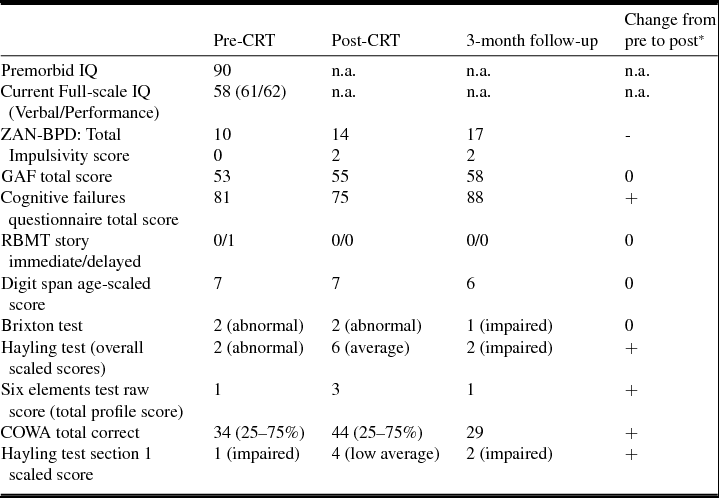
Maria's baseline scores on the standardized assessments are reported in Table 1. She showed a moderately high level of symptoms and moderate difficulties in general functioning. An estimate of her premorbid IQ placed her within the average range but her scores on the WAIS-III-UK suggested that her current IQ was extremely low, with no significant discrepancy between visual and verbal skills. Her behaviour during testing suggested that high levels of anxiety may have contributed to her poor performance on the WAIS-III. She showed relative strengths in her verbal working memory and verbal fluency which were both within the average range, consistent with her estimated premorbid IQ. However, she showed impairment or inefficiency in planning, response inhibition, verbal long-term memory and speed of processing. These difficulties were consistent with her self-report: her scores on the CFQ were almost two standard deviations above the normative mean, and anecdotally, she complained of forgetfulness, particularly with novel information, and was concerned about her ability to make plans and recall them, leaving her confused about day-to-day tasks and responsibilities.
Neuropsychological and symptom assessment scores for Maria

CRT, Cognitive Remediation Therapy; ZAN-BPD, Zanarini rating scale for borderline personality disorder; GAF, Global Assessment of Functioning; RBMT, Rivermead Behavioural Memory test; COWA, Controlled Oral Word Association test; n.a., not applicable.* 0, no change; –, deterioration; +, improvement in scores.
Response to therapy
Initially, Maria's attendance was good but this became more sporadic with periods of up to a fortnight of non-attendance. In total she attended 40 sessions over a 5-month period.
Her treatment goals were to learn strategies to improve (i) her memory for novel information and plans, and (ii) her ability to plan her daily activities. She had considerable insight into her cognitive difficulties, which frequently led to a sense of failure and low self-esteem, particularly when she felt overwhelmed by tasks. Successful strategies developed during CRT included simplifying task information by chunking and reducing the amount of material. She also used verbal rehearsal of self-instructions, which she did out loud at first, and then covertly to herself.
These strategies enabled Maria to gain a sense of control when approached with a novel task, and led to considerable reduction in anxiety and increased self-esteem as her performance consequently improved. Outside of the CRT sessions, Maria described the value of self-instruction when asked whether and how the CRT was helping, although she was not explicitly observed employing this technique. Her financial self-management and impulsive purchasing continued to be problematic, but her self- and staff-reported memory problems improved considerably.
Maria's scores on the standardized assessments over the three time points are reported in Table 1. There was a small increase in BPD symptoms over the course of the study and little change in general functioning. However, in terms of cognitive functioning, she showed marked improvement in her verbal response inhibition, planning, verbal fluency and speed of processing scores following therapy (most of which moved into the average ranges), but none of these changes was maintained 3 months later. There was also a slight reduction in the number of self-reported cognitive problems on the CFQ. There was no significant change in long-term or working memory, or in visuo-spatial response inhibition.
Responses to interview questions
(1) What did you feel helped?
Maria reported, ‘You helped me a lot. I enjoyed it’.
(2) What did not work?
She described frustration at not meeting her own expectations, saying that ‘Some things seemed to be easy but it wasn’t, so I get angry at myself even though you explained the right way to do it in the easiest way to understand, I still didn't understand. It got me upset a bit.’
(3) What do you feel you learned from CRT?
Maria said she felt the time she took to achieve things had reduced, but was unable to elaborate on this. She said the experience becoming ‘good and comfortable’ with tasks ‘helped my self-esteem’.
Participant 2: Carly
Presentation
Carly (not her real name) was a 21-year-old woman who had suffered disruption to her early care in the form of several changes of caregiver, abuse and chronic school bullying. She had received 11 years of formal education and achieved above average qualifications at age 16, but further education was disrupted by several acute psychiatric admissions triggered by self-harm. During her current admission, her self-harm was severe and frequent. She did not engage in psychological treatments, which she described as a ‘waste of time’. She expressed an interest in CRT after another patient described it in positive terms, and felt it might be helpful for self-reported difficulties in memory and sustained attention which she feared would affect her ability to study. Staff also noted concentration problems.
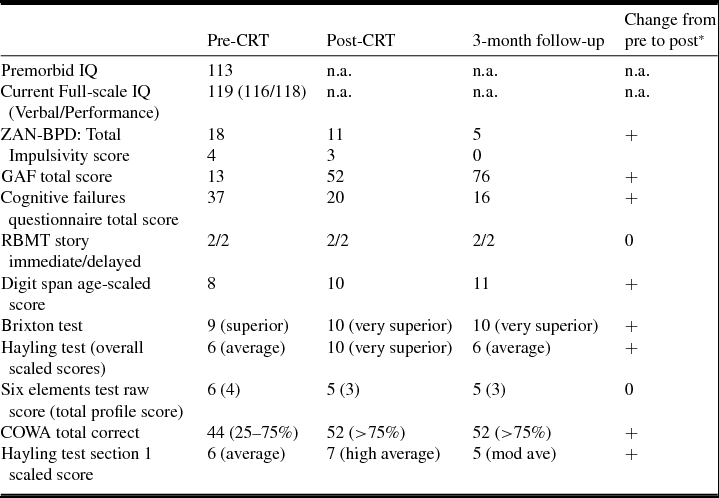
Carly's baseline scores on the standardized assessments are reported in Table 2. Estimates of her premorbid and current IQ placed her within the high average range with no significant discrepancy between visual and verbal skills. She showed moderate BPD symptoms on the ZAN-BPD with high levels of impulsive behaviour, and consistent with this was a very low score on the GAF, indicative of high levels of risk. Although her cognitive functioning generally fell within the average range, her performance on tasks of verbal working memory, verbal response inhibition and speed of processing were somewhat worse than what may be predicted on the basis of her IQ estimates.
Neuropsychological and symptom assessment scores for Carly
CRT, Cognitive Remediation Therapy; ZAN-BPD, Zanarini rating scale for borderline personality disorder; GAF, Global Assessment of Functioning; RBMT, Rivermead Behavioural Memory test; COWA, Controlled Oral Word Association test; n.a., not applicable.* 0, no change; –, deterioration; +, improvement in scores.
Response to therapy
Carly was usually punctual for planned sessions and these were offered three times per week. She attended all but three sessions offered, completing a total of 26 over a 3-month period.
Carly identified her treatment goals as improved concentration and memory. Consistent with her neuropsychological assessment, her cognitive performance was generally very good and Carly showed an ability to sustain her attention for up to an hour, competent memory skills and a creative use of strategies, such as chunking, rehearsal, organizing material and breaking information in smaller pieces. She enjoyed completing tasks, which often triggered positive childhood memories of doing puzzles of solving mathematical problems. As the tasks became more challenging, a tendency to begin working without forming plans and with some impulsivity, emerged. Consequent errors led to distress, which was frequently communicated by writing self-deprecating comments such as ‘I am bad’ repeatedly on a piece of paper. She reported that these perceived failures had triggered memories from childhood of being punished by a relative for making errors in her school homework. This led to the development of new strategies of taking time to read the task instructions fully, followed by the use of self-talk to verbalize the strategies she planned to use for the task. This resulted in more successful outcomes and fewer errors. Towards the end of CRT Carly commenced a full-time college course that she commuted to from the ward and which she has since passed with distinction.
Responses to interview questions
(1) What did you feel helped?
Carly commented on the good quality of the relationship with the therapist, and that she felt that CRT had improved her cognitive skills. ‘I haven't had that type of therapy before, I’m willing to give anything a go that will help with my borderline shit. My memory was extremely shit sometimes, all the memory tasks helped me in everyday life, I can multi-task easier. It helped at college, being able to do two things at once, I applied the strategy and wrote six pages of notes in the darkness and not losing where I was.’
(2) What did not work?
Asked what she considered less helpful, she remarked upon the distractions such as noise during her sessions and felt some tasks were ‘long winded, which makes you lose concentration’. She suggested ‘There should be two different levels’ and complained about inconsistencies within the therapy manual.
(3) What do you feel you learned from CRT?
‘Literally how to multi-task better, also to read instructions before I start and not to rush into things which I did before . . . It's weird but it also helped me to step back and think about things for a second . . . if you give someone a task, and ask them to wait a certain amount of time before starting it, see if they improve, because when you’re impulsive time seems to go slower.’
Discussion
For these two women with a BPD diagnosis who were residents in a low secure women's challenging behaviour facility in South London, and who had not previously engaged with psychological therapy, CRT proved to be a feasible and acceptable psychological treatment. They both identified cognitive difficulties as significant problems in their daily life which negatively affected their self-esteem, and cognitive skills were perceived to be worthwhile treatment targets. They attended on average at least twice a week for 3–5 months, and made noticeable improvements not only on the therapy tasks, but also in their neuropsychological test performance, particularly in response inhibition and verbal fluency, but also in verbal working memory, planning or speed of processing. Some of these improvements were maintained 3 months after the CRT had ended. Both patients reported not only enjoying the therapy, but noted additional benefits such as improved self-esteem (as their performance on the tasks improved), appreciation of the therapeutic relationship, and improved cognitive performance in everyday activities (particularly multi-tasking and self-reflection).
CRT has a number of qualities which may facilitate engagement, particularly for those who struggle to engage in more traditional psychotherapies, which remains a significant clinical challenge in BPD despite the emergence of evidence-based psychological therapies (McMurran et al. Reference McMurran, Huband and Overton2010). First, it often has high face validity for patients and addresses problems (i.e. with memory or concentration) which can negatively affect quality of life. Second, the therapy tasks are simple and presented using errorless learning and scaffolding teaching techniques, so that patients experience a consistently high degree of personal success. The therapist also provides judicious positive reinforcement and draws the patient's attention towards signs of improvement and success. This positive context may be particularly helpful for a patient group for which experiences of perceived failure and rejection can feel catastrophic. Third, one of the core aims of CRT is to develop meta-cognitive skills and knowledge (i.e. knowledge and self-regulation of thinking) which may be closely akin to mentalizing abilities or reflective functioning (Fonagy et al. Reference Fonagy, Target and Gergely2000). However, these are addressed without an explicit emotional or interpersonal focus. The therapist and patient are collaborators with a relationship akin to that of a teacher and student and a combined focus on the CRT tasks and everyday living skills. Therefore, it may provide a gentle introduction to reflection on thinking and an experience of an attachment relationship in a context with low emotional valence. This may be particularly helpful given that it in the context of emotional arousal and an attachment relationship that mentalizing is theorized to be more likely to break down for people with a BPD diagnosis (Bateman & Fonagy, Reference Bateman and Fonagy2006). CRT may therefore offer a type of ‘pre-treatment’ which may offer a subsequent window of opportunity for engagement in more intensive psychological work (Tchanturia et al. Reference Tchanturia, Davies and Campbell2007).
Although the cognitive improvements seen in this study cannot be attributed to the intervention, it is clear that in both cases, cognitive performance did not remain stable over the course of the study. The finding that performance on neuropsychological tests can be inconsistent between tests on one occasion is well-documented (Beblo et al. Reference Beblo, Saavendra, Mensebach, Lange, Markowitsch, Rau, Woermann and Driessen2006) but a literature search revealed no studies on the stability of cognitive functions over time in borderline personality disorder. One would expect that practice effects and variations in the level of effort or motivation are likely to impact differential performance at different time points, but even so, this study is consistent with the possibility that cognitive functions in BPD are amenable to change and that targeting those functions which may be relevant for more general functioning may be a worthwhile endeavour. The aim would obviously be for these cognitive changes to be generalized to everyday behaviour, and while there is evidence that cognitive performance is linked to clinical presentation and social functioning (Fertuck et al. Reference Fertuck, Lenzenweger and Clarkin2005) more work is needed to elucidate this link and to establish the nature of the cognitive impairment in BPD in terms of underlying psychopathology. We have argued that cognitive impairment may play an aetiological role in the development of the symptoms of BPD, but it also seems likely that some of the symptoms of BPD (e.g. dissociation) also have a negative impact on cognitive functioning (e.g. Brewin & Mersaditabari, Reference Brewin and Mersaditabari2013). These possible reciprocal links between cognitive functioning and some of the key psychological processes contributing to BPD may make interesting targets for future research.
Interesting observations from this study relating to the stability of cognitive function were, first, that for one of the patients, cognitive improvements were maintained at 3 months follow-up. A recent meta-analysis of CRT for schizophrenia (Wykes et al. Reference Wykes, Huddy, Cellard, McGurk and Czobor2011) showed that CRT was most beneficial in the context of adjunctive psychiatric rehabilitation, which suggests that CRT may require a context of increased opportunity for participants to be able to maintain and transfer new cognitive skills to daily life. In these two cases, cognitive improvements were maintained by Carly who continued to make behavioural changes and eventually to undertake an educational course. However, with Maria, whose cognitive improvements were not maintained, fewer behavioural changes were taking place. Thus these cases may reflect the differential opportunities for the two women to put their new cognitive skills into practice. The second notable observation was that in both cases, staff and the patients themselves reported improved memory in daily life, while there was no apparent change in performance on neuropsychological tests of memory. This apparent meta-cognitive shift may have been an artefact of improved confidence and a more thorough examination of this phenomenon would be interesting.
We should acknowledge that conclusions regarding the effectiveness of a psychological therapy cannot be drawn from these two case studies. However, this study does suggest that CRT may be feasible and acceptable for some people with BPD, and may provide a new therapeutic approach to complement existing evidence-based psychological therapies, and as such warrants further investigation. A first step may be to conduct a more methodologically rigorous case series of CRT using a more formal case study design (e.g. including a baseline assessment period prior to the start of treatment), with a larger and more varied group of participants and with an assessor who is independent from the therapist.
Acknowledgements
Clare Reeder receives salary support from the National Institute for Health Research (NIHR) Mental Health Biomedical Research Centre at South London and Maudsley NHS Foundation Trust and King's College London. The views expressed are those of the authors and not necessarily those of the NHS, the NIHR or the Department of Health.
Declaration of Interest
None.
(1) To investigate the feasibility and acceptability of cognitive remediation for people with a borderline personality disorder diagnosis.
(2) To demonstrate how cognitive remediation may be implemented with people with a borderline personality diagnosis.
(3) To demonstrate that cognitive skills may be important in the experience and recovery of people with a borderline personality disorder diagnosis, and consequently that cognitive functioning may make a legitimate treatment target.



Comments
No Comments have been published for this article.