Introduction
Approximately half of all U.S. households with at least one smoker restrict smoking inside the home (Mills, White, Pierce, & Messer, Reference Mills, White, Pierce and Messer2011). Self-reported reasons for such bans include concerns about health, bad smell, prohibition by a landlord, helping a smoker quit, moving or remodelling, safety, and pregnancy (Pizacani et al., Reference Pizacani, Martin, Stark, Koepsell, Thompson and Diehr2008). Smokers in households with smoking restrictions are more supportive of partial than full bans, but most (87.8%) indicate that they are supportive or very supportive of household smoking restrictions (Pizacani et al., Reference Pizacani, Martin, Stark, Koepsell, Thompson and Diehr2008).
In addition to prompting quitting among adult smokers (Pizacani et al., Reference Pizacani, Martin, Stark, Koepsell, Thompson and Diehr2004; Shopland, Anderson, & Burns, Reference Shopland, Anderson and Burns2006), household smoking bans influence children to grow up to have smoke-free homes as young adults (Albers, Biener, Siegel, Cheng, & Rigotti, Reference Albers, Biener, Siegel, Cheng and Rigotti2009). It is also associated with lower estimates of adult smoking prevalence (Albers, Biener, Siegel, Cheng, & Rigotti, Reference Albers, Biener, Siegel, Cheng and Rigotti2008; Thomson, Siegel, Winickoff, Biener, & Rigotti, Reference Thomson, Siegel, Winickoff, Biener and Rigotti2005) and a perception of reduced adult approval of smoking (Thomson et al., Reference Thomson, Siegel, Winickoff, Biener and Rigotti2005). Among adolescents who lived with non-smokers, the lack of a household smoking ban was associated with a greater chance of early experimentation with cigarettes (Albers et al., Reference Albers, Biener, Siegel, Cheng and Rigotti2008).
The purpose of the current study is to examine the relationship between household smoking bans and a commonly used measure of nicotine dependence. The Fagerström Test for Nicotine Dependence (FTND; Heatherton, Kozlowski, Frecker, & Fagerström, Reference Heatherton, Kozlowski, Frecker and Fagerström1991) and the Heaviness of Smoking Index (HSI; Heatherton, Kozlowski, Frecker, Rickert, & Robinson, Reference Heatherton, Kozlowski, Frecker and Robinson1989), a subset of two FTND items, are widely used measures of physical dependence on cigarettes. Both measures include an item measuring the time a smoker waits until smoking their first cigarette of the morning (time-to-first-cigarette; TTFC). The rationale for this question is that more dependent smokers will smoke sooner after waking than will someone who is less dependent, because they will wake up with greater withdrawal symptoms after going an entire night without a cigarette.
The time-to-first-cigarette item was found to be the most predictive item of the FTND (Baker et al., Reference Baker, Piper, McCarthy, Bolt, Smith and Kim2007; Fagerström, Reference Fagerström2003). In a one-week abstinence incentive study of non-treatment seeking daily smokers, the TTFC item significantly predicted time to lapse even when controlling for total FTND score, cigarettes smoked per day, and self-reported craving on the first day of abstinence (Sweitzer, Denlinger, & Donny, Reference Sweitzer, Denlinger and Donny2013). In a study comparing two versions of the Cigarette Dependence Scale (CDS; Etter, Le Houezec, & Perneger, Reference Etter, Le Houezec and Perneger2003) and the FTND, the time-to-first-cigarette item within the FTND was the only tobacco dependence measure that predicted smoking abstinence during tobacco dependence treatment for smokers with substance use disorders (Rohsenow, Martin, Tidey, Monti, & Colby, Reference Rohsenow, Martin, Tidey, Monti and Colby2013). Even after controlling for cigarettes per day, TTFC predicts cotinine levels in adolescent (Branstetter & Muscat, Reference Branstetter and Muscat2013) and adult smokers (Fu et al., Reference Fu, Fernández, Pascual, Martínez-Sánchez, Agudo and Moncada2011a; Fu et al., Reference Fu, Martínez-Sánchez, Agudo, Pascual, Borràs and Samet2011b; Muscat et al., Reference Muscat, Chen, Knipe, Stellman, Lazarus and Richie2009a; Muscat, Stellman, Caraballo, & Richie, Reference Muscat, Chen, Knipe, Stellman, Lazarus and Richie2009b; Park et al., Reference Park, Son, Lee, Lee, Kang and Lee2004; Toll, Schepis, O'Malley, McKee, & Krishnan-Sarin, Reference Toll, Schepis, O'Malley, McKee and Krishnan-Sarin2007).
Shorter time-to-first-cigarette has also been associated with health outcomes such as increased risk of head and neck cancer (Muscat, Ahn, Richie, & Stellman, Reference Muscat, Ahn, Richie and Stellman2011a), lung cancer (Muscat, Ahn, Richie, & Stellman Reference Muscat, Ahn, Richie and Stellman2011b), and supraglottis larynx (but not glottis larynx) cancer (Muscat, Liu, Livelsberger, Richie, & Stellman, Reference Muscat, Liu, Livelsberger, Richie and Stellman2012). Longer TTFC, however, has been associated with quitting smoking over the course of one year in a large sample of smokers in the UK (West, McEwen, Bolling, & Owen, Reference West, McEwen, Bolling and Owen2001).
We hypothesized that smokers living in residences with rules regulating indoor smoking would wait longer before their first cigarette of the day than would smokers living in residences without rules regulating indoor smoking. It is important to examine this relationship because if time-to-first-cigarette is influenced by variables other than nicotine dependence, there are clinical (e.g., nicotine replacement dosing), and research (e.g., potentially reduced predictive utility) implications.
Methods
The data presented here represents a secondary data analysis of the relationship between household smoking restrictions and time-to-first-cigarette in two independent samples of smokers. Sample 1 (N = 433) comes from a community sample of smokers seeking tobacco dependence treatment in a community based smoking cessation clinic. The only inclusion criterion for this sample was that participants were seeking treatment to quit smoking because data for this sample was not initially collected as part of a research study. Similarly, study participants in Sample 1 were not actively recruited because their data were not initially intended to be part of a research study. Sample 2 (N = 94) comes from a study of smokers with serious mental illness who were not interested in quitting smoking. Participants were adult smokers diagnosed with Schizophrenia, Schizoaffective Disorder, or Bipolar I Disorder based on the Structured Clinical Interview for DSM IV Disorders (SCID; First, Spitzer, Miriam, & Williams, Reference First, Spitzer, Gibbon and Williams2001). They were referred by clinicians at local outpatient mental health programs who were knowledgeable about our inclusion/exclusion criteria. All participants smoked at least 10 cigarettes per day, were capable of providing informed consent as measured by Folstein Mini Mental Status Exam of greater than 23, and were psychiatrically stable. Participants in both samples completed initial assessment batteries that included the Fagerström Test of Nicotine Dependence (FTND) and a question about smoking rules within their homes.
Fagerström Test for Nicotine Dependence (FTND) (Heatherton et al., Reference Heatherton, Kozlowski, Frecker and Fagerström1991). The FTND is a widely used measure of nicotine dependence. Its scores range from 0 to 10 with higher numbers suggesting greater nicotine dependence. It includes the item of interest for this study (i.e., time-to-first cigarette (TTFC)), with higher scores assigned to smokers who smoke sooner after waking than to smokers who smoke later after waking. While TTFC is usually reported as a categorical variable for scoring the FTND, we asked participants to report TTFC in minutes and used the continuous TTFC variable in our examination of the relationship between TTFC and home smoking rules for greater precision.
Home smoking rules. All participants in both samples were asked to describe any smoking restrictions in their homes. There were slight differences in the wording of the items in the two samples, but the question and response choices were comparable. Sample 1 was asked, “Which statement best describes smoking inside your home?” with response choices, “a. Smoking is not allowed anywhere inside the home, b. Smoking is allowed in some places or sometimes, and c. Smoking is allowed anywhere inside the home.” Sample 2 was asked, “What are the rules with regards to smoking indoors where you live?” with response choices, “1. No smoking indoors, 2. No smoking in certain rooms, or 3. No restrictions on smoking”
Results
Sample 1
Participants in Sample 1 (N = 433) were smoking for an average of 30.9 (SD = 11.56) years and were smoking 16.9 (SD = 9.8) cigarettes per day. They smoked their first cigarette of the day 17.1 (SD = 22.1) minutes after waking. The average age was 48.3 (SD = 10.9) and 54.8% were female. Participants identified as African American (52.8%), Caucasian (38.5%), and Hispanic/Latino (6.4%). Most (80.5%) had at least a high school education and only 37.9% were employed.
To evaluate the relationship between various intensities of home smoking rules, we computed Analysis of Variance (ANOVA) with planned comparisons using time-to-first-cigarette as the dependent variable and smoking rule (with three levels) as the independent variable. While 36.7% reported that there were no limitations to smoking in their home, 28.2% reported that they were allowed to smoke in some parts of their home, and 35.1% said that there was a total smoking ban inside their home.
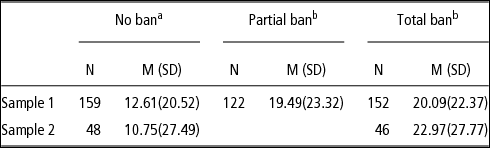
We detected a significant main effect, F (2,432) = 5.43, p = 0.0047 for home smoking rules. Pairwise multiple comparisons with Tukey corrections indicated that while there was no difference between those living in homes with total home smoking bans and partial home smoking bans, total home smoking bans and partial home smoking bans were associated with significantly longer time-to-first-cigarette as compared to those living without any smoking limitations in their homes (p < 0.05; see Table 1).
Relationship between home smoking bans and time-to-first-cigarette in smokers seeking tobacco dependence treatment (Sample 1) and in smokers with serious mental illness not interested in quitting (Sample 2)

Note: Different superscripts indicate significant differences within each sample (p < 0.05).
We then re-analysed this relationship and included number of cigarettes smoked per day in the model as a covariate. One participant had missing data with respect to cigarettes per day so this analysis was based on 432, rather than 433 participants. We again detected a significant main effect, F (2, 431) = 3.26, p = 0.0392 for home smoking rules. Pairwise multiple comparisons with Tukey corrections again indicated that that while there was no difference between those living in homes with total home smoking bans and partial home smoking bans, total home smoking bans and partial home smoking bans were associated with significantly longer time to first cigarette as compared to those living without any smoking limitations in their homes (p < 0.05).
Sample 2
Participants in Sample 2 (N = 96) were from a study of smokers with serious mental illness who were not interested in quitting smoking. Almost half (43.9%) were diagnosed with Bipolar Disorder, 31.6% were diagnosed with Schizophrenia, and 24.5% were diagnosed with Schizoaffective Disorder. Participants were smoking for an average of 26.3 (SD = 11.5) years. They smoked their first cigarette of the day 16.5 (SD = 27.7) minutes after waking, their average age was 43.1 (SD = 10.3) and 43.9% were female. Participants identified as African American (27.6%), Caucasian (61.2%), and Hispanic/Latino (5.1%). Most (78.4%) had at least a high school education and only 9.2% were employed.
Over half of participants (52.0%) reported that they were living independently, 20.4% reported that they were living in a situation in which they received assistance (e.g., a group home), and 27.6% reported living with parents or other caregivers. While 50% reported that there were no limitations to smoking in their home, 2.1% reported that they were allowed to smoke in some parts of their home, and 47.9% said that there was a total smoking ban inside their home. We dropped the two participants reporting a partial smoking ban from all analyses because of the small cell size and compared smokers reporting a total home smoking ban to smokers reporting no smoking ban.
A χ 2 analysis indicated a significant relationship between living arrangements and smoking rules in this sample of smokers with serious mental illness, χ 2(2) = 12.65, p = 0.0018. Among those living independently, only 33% had a total smoking ban inside their home while 80% of those living in group home or other assisted living settings, and 54% of those living with their parents or other caregivers reported a total smoking ban.
Time-to-first-cigarette data were positively skewed and so these data were log transformed. Smokers reporting a total home smoking ban smoked their first cigarette of the day significantly longer after waking as compared to those without a home smoking ban (22.96 minutes vs. 10.75 minutes) (back transformed), F(1,93) = 4.59, p = 0.0349 (see Table 1).
As with Sample 1, we re-analysed this relationship and included number of cigarettes smoked per day in the model as a covariate. Again, smokers reporting a total home smoking ban smoked their first cigarette of the day significantly longer after waking as compared to those without a home smoking ban, F (1,93) = 10.98, p = 0.0013.
Discussion
As hypothesized, smokers living in homes with rules governing smoking in the home (whether total or partial smoking bans) waited longer before their first cigarette of the day as compared to those living in homes without such rules. The hypothesis was supported in two independent samples, including one sample of smokers with serious mental illness who were not motivated to quit and one community sample of smokers who were motivated enough to quit to seek formal smoking cessation treatment. Despite the fact that our two samples were quite different, the relationships regarding smoking bans and time-to-first-cigarette from these samples were concordant. It is noteworthy that while 50% of those with serious mental illness reported no household smoking restrictions, only 36.7% of our community sample reported the same.
The applicability of the time-to-first-cigarette item for smokers with serious mental illness has been questioned before (Steinberg, Williams, Steinberg, Krejci, & Ziedonis, Reference Steinberg, Williams, Steinberg, Krejci and Ziedonis2005) and while the full FTND measure was found to have inadequate internal consistency reliability in one study (Steinberg et al., Reference Steinberg, Williams, Steinberg, Krejci and Ziedonis2005), these findings were not replicated in a second (Weinberger et al., 2006).
While we found a relationship between household smoking restrictions and time-to-first-cigarette in two diverse samples, these data may not generalize to other samples of smokers. An additional limitation to this study is the fact that we cannot determine directionality with these datasets. We cannot determine whether higher TTFC makes it easier for people to institute household smoking bans or if household smoking bans instigate higher TTFC. If we had data to determine whether the household smoking bans were voluntary or involuntary, this would provide a clue, though long-term longitudinal studies would be best to answer this question. Although the relationship between smoking restrictions and time-to-first-cigarette may be bidirectional, a longitudinal study of adults in Oregon conducted between 1997 and 1999 indicated that waiting more than 30 minutes before the first cigarette of the morning was associated with a greater chance of later household smoking ban adoption (Pizacani et al., Reference Pizacani, Martin, Stark, Koepsell, Thompson and Diehr2008).
These data indicate that greater attention to TTFC may be warranted. The TTFC item is intended to measure dependence based on the premise that greater dependence should be associated with shorter TTFC, because a highly dependent smoker will want to smoke soon after waking in the morning. If TTFC is related to a household smoking ban even when controlling for cigarettes smoked per day as demonstrated in these analyses however, this item may not be assessing dependence as intended in some cases. In addition, future research should examine whether TTFC is a better predictor of cessation in smokers without household smoking bans as compared to in those with household smoking bans. We could not examine this question because Sample 1 was a clinical sample without the stringent follow-up procedures of a research study, and we therefore do not have these data to explore.
The clinical implication of these findings include the fact that dosing instructions for some NRT (i.e., nicotine lozenge, nicotine gum) in the United States are based on time to first cigarette, with higher doses recommended for those with shorter time to first cigarette (Nicorette package insert, 2014a, 2014b; Shiffman, Sembower, Rohay, Gitchell, & Garvey, Reference Shiffman, Sembower, Rohay, Gitchell and Garvey2013).
If total or partial home smoking bans are artificially inflating these times, smokers adhering to these dosing instructions may be under-dosed and be at greater risk of relapse. Future studies could test this hypothesis empirically by examining the relationship between TTFC and treatment outcome while controlling for presence or absence of a household smoking ban.
Acknowledgements
None.
Financial Support
This study was supported by the National Institute on Drug Abuse grants R34DA030652, K23DA018203 (to Marc L. Steinberg).
Conflict of Interest
None.
Ethical Standards
None.