CASE REPORT
Mrs. X, was a 56-year-old Caucasian, married homemaker who lived with her husband and 16-year-old daughter. Her medical and surgical history was significant for hypothyroidism, diverticulosis, allergic rhinitis, Cesarian-section and face lift. Her past psychiatric history was significant for two previous psychiatric treatments. She first sought treatment for depression at age 34 after her mother's death from breast cancer. She was treated with both psychotherapy and paroxetine, which was discontinued because of side effects. Her second treatment was with a marriage counselor to consider marital conflicts. She had no history of substance abuse, psychiatric hospitalizations, or suicide attempts.
She was first diagnosed with breast cancer in July of 2010 after she found a lump on her left breast. She had an MRI that revealed lesions on both breasts. A left breast core biopsy demonstrated a poorly differentiated, ER + , PR + , HER2+ invasive ductal carcinoma. Her right breast findings were consistent with fibrocystic changes and she opted to undergo bilateral mastectomy. Post-surgically she had poor body image and low self-esteem. She received chemotherapy with cyclophosphamide and docetaxel from March 2011 to May 2011 followed by adjuvant therapy with anastrozole.
She began anastrozole on August 20, 2011. On November 7, 2011, she told her medical oncologist that her family was complaining about her mood swings. She was raising havoc in her family and because of her behavior everyone hated her. Anastrozole was discontinued and she was switched to letrozole and a day later she reported that she continued to feel extremely depressed and achy. She was instructed to stop the letrozole. On November 17, 2011, two days after discontinuation of Letrozole, she presented with her husband to the emergency care unit with suicidal ideation. She told the psychiatrist: “I have been feeling depressed, moody, angry and irritable for 2 months.” She endorsed recurrent thoughts of death and unspecific suicidal ideation stating: “my family will be better off without me.” She reported feeling depressed, anxious, enraged, guilty, helpless, and hopeless. She was self-isolating, had low energy level, was anhedonic and forgetful and had an inability to concentrate. She also reported recurrent intrusive thoughts of her spouse's infidelity that occurred three years prior to her cancer diagnosis.
Her mental status examination (in the emergency care unit): she was dressed casually, appeared younger than her stated age, and wore a blonde shoulder length wig. She was both tearful and guarded. Her mood was depressed and was congruent with her affect. She had no suicidal ideation or psychotic thought process or content. Her insight and judgment were fair. Her MMSE: 29/30, GAD: 21 (20–27) severe depression, PHQ-9: 19 (15–19) moderately severe. Her treatment recommendations were to follow up in the outpatient clinic for weekly psychotherapy and to consider an antidepressant. She agreed to psychotherapy and declined the proposed pharmacotherapy.
At her first followup visit, on November 30, 2012, she reported a dramatic improvement in her mood after stopping Anastrozole. Her MMSE 30/30, GAD -7: 7, PHQ - 9: 9.
On January 4, 2011, she returned for a followup visit and reported that she had been started on Exemestane on December 6, 2012 and had not experienced any changes in her mood. She reported feeling less depressed, less anxious, and less irritable. Although she felt stressed by construction work in her home, she had returned to her usual activities and had enjoyed visiting her son in Florida. She described feeling better about herself and was looking forward to completing breast reconstruction with tattooing of both breast areolas. She also reported significant improvement in her appetite and concentration. She was able to sleep at night with help of Zolpidem. She denied having any suicidal ideation.
The patient was last seen on March 21, 2012 at which time she reported hot flushes, some sadness and mild irritability, which was alleviated by taking lorazepam 0.5 mg. The patient was exercising an hour a day and was enjoying daily activities. She had no suicidal thinking and continued to take lorazepam 0.5 once a day, zolpidem 10 mg at bedtime, levothyroxine Sodium 0.88 mcg daily, and exemestane 25 mg.
DISCUSSION
Postmenopausal women with hormone responsive breast cancer constitute about 56% of all women with early stage breast cancer (Fink et al., Reference Fink, Sumner, Rosie, Grace and Quinn1996). Although, Tamoxifen, a selective estrogen receptor, was the standard of care for 35 years for women with breast cancer of all stages (Fink et al., Reference Fink, Sumner, Rosie, Grace and Quinn1996), currently, routine adjuvant standard of care for postmenopausal women with hormone receptor positive breast cancer is an AI (Fontaine et al., Reference Fontaine, Meulemasns and Huizing2008).
Several trials have demonstrated a benefit from adjuvant AIs in the post-operative treatment of postmenopausal women with hormone responsive (HR+) early stage breast cancer. The Arimidex, Tamoxifen, alone or in combination (ATAC) trial is a phase III multinational, randomized double-blind trial initially comprised of 9366 postmenopausal women with breast cancer, which compared anastrozole alone or in combination with tamoxifen following breast cancer surgery. The combination terminated early leaving further analysis limited to 6241 patients (Howell et al., Reference Howell, Cuzick and Baum2005). At a median followup of 68 months, treatment with anastrozole in HR+ patients revealed significant benefit in disease-free survival and time of recurrence. At 100 months followup, investigators observed a significant benefit in risk of distant metastasis in patients receiving anastrozole.
AIs lower the level of estrogen in the body. In postmenopausal women, the primary estrogen source is derived from conversion of androstenedione (produced by the adrenals) to estrone and estradiol in the peripheral tissues, including skin, adipose tissue, and breast. The enzyme responsible for the conversion is aromatase. AIs block the conversion of androstenedione to estrone and testosterone to estradiol giving a rise in the androgen and a fall in estrogens (Thomas et al., Reference Thomas, Williams and Marshall2008). Because premenopausal women have robust estrogen production in the ovaries, these agents are not effective in this population.
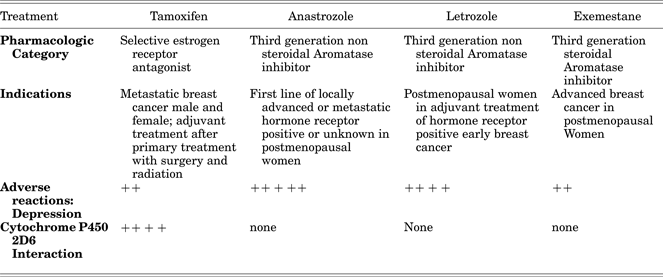
AIs are divided into two categories: steroidal/irreversible and nonsteroidal/ reversible inhibitors of estrogen synthesis. The nonsteroidal AIs are anastrozole and letrozole, and the steroidal compound is exemestane. Both classes reduce circulating estrogen to 1% to 10% of pretreatment levels. Low levels of estrogen in woman are linked with premenstrual syndrome and postmenopausal depression. See Table 1.
Comparison between Tamoxifen and aromatase inhibitors

AIs are generally more manageable than those seen with tamoxifen. There is only one case report of mood change resulting from anastrozole treatment. Goodwin (Reference Goodwin2006) described a woman with a history of post partum depression who experienced labile mood, tremulousness, and difficulty sleeping on anastrozole. On letrozole, the same patient developed “an acute irritable activated mood” followed by a prolonged period of depression after its discontinuation.
Side effects of AI include changes in mood, mental state, cognition, and behavior. Mood disturbances were reported among 597/3092 (19.3%) patients receiving anastrozole vs. 554/3092 (17.9%) patients tamoxifen in the ATAC trial (Howell et al., Reference Howell, Cuzick and Baum2005).
This is a case report of depression following the use of AI in woman with history of breast cancer. AIs are generally well tolerated, and mood disturbances are not among the most commonly reported adverse events.