

Introduction
Multiple nonprofit organizations and governments have made significant efforts to curb enterprise bribery (Groves, Lee, Li, Paik, & Vance, Reference Groves, Lee, Li, Paik and Vance2022; Yi, Chen, Meng, Li, & Shaheer, Reference Yi, Chen, Meng, Li and Shaheer2023; Zhong, Ren, & Wu, Reference Zhong, Ren and Wu2023a). However, enterprise bribery is still prevalent in business practices worldwide (Boakye, Siaw, & Sarpong, Reference Boakye, Siaw and Sarpong2022; Boikos, Pinar, & Stengos, Reference Boikos, Pinar and Stengos2023; Jung & Lee, Reference Jung and Lee2023; Yi, Chen, Meng, Li, & Shaheer, Reference Yi, Chen, Meng, Li and Shaheer2023). The cost of bribery is estimated at 2% of the global economy or $1.5–$2 trillion per year (Jiang & Min, Reference Jiang and Min2023; Zhou, Wang, Xu, & Xie, Reference Zhou, Wang, Xu and Xie2022). Enterprise bribery distorts resource allocation, reduces entrepreneurship, and increases the cost of doing business globally (Boikos et al., Reference Boikos, Pinar and Stengos2023; Kim, Praveen Parboteeah, & Cullen, Reference Kim, Praveen Parboteeah and Cullen2022; Li, Ren, Weng, & Yang, Reference Li, Ren, Weng and Yang2021). Thus, the following question arises: Why do companies become involved in bribery? A systematic answer to this question is important for shareholders, governments, and others to develop effective measures to curb enterprise bribery (Fu & Sun, Reference Fu and Sun2024).
According to the seminal view of Hambrick and Mason (Reference Hambrick and Mason1984), ‘executive characteristics can significantly influence firm decisions’ (Hambrick, Reference Hambrick2007; Recendes, Aime, Hill, & Petrenko, Reference Recendes, Aime, Hill and Petrenko2022). In view of this, upper echelons scholars argue that when the external environment is the same or similar, illegal enterprise behavior (e.g., bribery) is generally a reflection of executives’ cognitive patterns and values (Fan, Tao, Oehmichen, & van Ees, Reference Fan, Tao, Oehmichen and van Ees2024; Tuliao & Chen, Reference Tuliao and Chen2017). The incidence of bribery in business practices worldwide has profoundly demonstrated that executives play an integral role in enterprise involvement in bribery activities (Fan et al., Reference Fan, Tao, Oehmichen and van Ees2024; Sarpong, Sajdakova, & Adams, Reference Sarpong, Sajdakova and Adams2019). For example, in September 2022, Beijing Huayu Software issued an announcement disclosing the criminal detention of its core executives for allegedly bribing government officials.Footnote 1 In the past decade, there has been an increasing flow of individuals with overseas work or study experience from developed countries to emerging economies because of the significant economic development of emerging economies (e.g., China) and a series of preferential policies for returnees (Feng, Hu, Wang, & Yan, Reference Feng, Hu, Wang and Yan2023; Lin, Lu, Liu, & Zhang, Reference Lin, Lu, Liu and Zhang2016; Zhang, Xu, & Chen, Reference Zhang, Xu and Chen2021). For example, according to statistics from China’s Ministry of Education, 4,231,700 people chose to return to their home countries after completing their studies, accounting for 86.28% of those who completed their studies from 1978 to 2019.Footnote 2 After returning to their country of origin, some returnees may establish their own businesses, whereas others often choose to work for large enterprises and gradually grow into top management teams (TMTs) (i.e., returnee executives) (Ahmad, Farag, & Wang, Reference Ahmad, Farag and Wang2024; Ren, Zeng, & Zhong, Reference Ren, Zeng and Zhong2023). In particular, a large body of research shows that returnee executives significantly impact enterprises’ strategic choices and outcomes (Feng et al., Reference Feng, Hu, Wang and Yan2023; Zhang, Kong, & Wu, Reference Zhang, Kong and Wu2018; Zhong, Ren, & Song, Reference Zhong, Ren and Song2023b). However, little is known about how returnee executives influence companies’ preferences, especially those in emerging economies, for involvement in bribery.
To address these gaps, based on a methodology that does not rely on managers’ self-reports to measure firms’ bribery involvement (Zhong, Ren, & Wu, Reference Zhong, Ren and Wu2023a; Zhou, Wang, Xu, & Xie, Reference Zhou, Wang, Xu and Xie2022), we examine the impact of returnee executives on the bribery involvement of firms in emerging economies. We argue that the experience of working or studying in different cultures causes individuals to develop different perspectives on the same ethical issues (Zhang, Xu, & Chen, Reference Zhang, Xu and Chen2021), which results in returnees understanding ethical rules and principles more flexibly rather than absolutely. That is, returnee executives are more likely to develop moral relativism (Lu, Quoidbach, Gino, Chakroff, Maddux, & Galinsky, Reference Lu, Quoidbach, Gino, Chakroff, Maddux and Galinsky2017). In addition, bribery helps enterprises acquire scarce resources controlled by the government, thus improving their short-term financial performance and providing financial gains to returnee executives (Ren, Zhong, & Wan, Reference Ren, Zhong and Wan2022; Xu, Zhou, & Du, Reference Xu, Zhou and Du2019; Zhou, Wang, Xu, & Xie, Reference Zhou, Wang, Xu and Xie2022). Thus, driven by the benefits associated with bribery and distorted by moral relativism, returnee executives are likely to view bribery as a moral means of value, thus increasing enterprise bribery. As supporting evidence, prior research has shown that individuals with moral relativism are more likely to engage in unethical or illegal behavior (Chen, Chao, Xu, & Zhang, Reference Chen, Chao, Xu and Zhang2016; Lu et al., Reference Lu, Quoidbach, Gino, Chakroff, Maddux and Galinsky2017; Schurr & Ritov, Reference Schurr and Ritov2016).
Importantly, returnee executives in emerging economies (e.g., China) may have studied and worked in a developed host country such as North America, developed European countries, or Oceania (Han, Jennings, Liu, & Jennings, Reference Han, Jennings, Liu and Jennings2019; Ren et al., Reference Ren, Zeng and Zhong2023), which allows them to internalize the moral/ethical standards of the host country as their own dominant ethical standards (Han et al., Reference Han, Jennings, Liu and Jennings2019); thus, they are unlikely to develop moral relativism, which requires individuals to be flexible in applying moral norms of equal or similar status in response to particular behaviors (Lu et al., Reference Lu, Quoidbach, Gino, Chakroff, Maddux and Galinsky2017; Maddux, Lu, Affinito, & Galinsky, Reference Maddux, Lu, Affinito and Galinsky2021). Therefore, exploring when returnee executives are more likely to develop moral relativism and subsequently promote enterprise bribery has become an important theoretical topic. To address the ‘when’ question, on the basis of institutional theory (Chen, Liu, Tsui-Auch, Wang, Wang, & Yang, Reference Chen, Liu, Tsui-Auch, Wang, Wang and Yang2019; DiMaggio & Powell, Reference DiMaggio and Powell1983), we further introduce the moderating role of anticorruption initiatives and Confucian culture. The contingent effects of anticorruption and Confucianism are of interest because they play an important role in shaping society’s moral judgments about bribery. We argue that regions with anticorruption initiatives and prevalent Confucian culture generate strong moral judgments about bribery (Jiang & Wei, Reference Jiang and Wei2022; Philippou, Reference Philippou2024; Zhang, Zhang, & Cheng, Reference Zhang, Zhang and Cheng2023; Zhou, Jin, & Wang, Reference Zhou, Jin and Wang2017). In this case, returnee executives cannot have the flexibility to apply different moral codes to judge bribery, which results in their inability to develop moral relativism. In turn, the positive influence of returnee executives on enterprise bribery weakens. Both returnee executives and bribery are very common in China (Jiang & Min, Reference Jiang and Min2023; Ren et al., Reference Ren, Zeng and Zhong2023; Yi, Chen, Meng, Li, & Shaheer, Reference Yi, Chen, Meng, Li and Shaheer2023); thus, this provides a good empirical environment for testing our theoretical arguments. The findings obtained from 2241 nonstate-owned listed Chinese enterprises provide empirical evidence to support our theoretical arguments.
Through this study, we make three main contributions to the literature. First, in contrast to previous studies on the influence of the external environment or firm characteristics on enterprise bribery (Jeong & Siegel, Reference Jeong and Siegel2018; Jiang & Min, Reference Jiang and Min2023; Kim, Praveen Parboteeah, et al., Reference Kim, Praveen Parboteeah and Cullen2022; Xu et al., Reference Xu, Zhou and Du2019), we enrich the literature by focusing on the antecedents of enterprise bribery and providing insights for returnee executives. Second, by drawing attention to the dark side of returnee executives, we expand the growing literature on the economic consequences of returnee executives (Ahmad et al., Reference Ahmad, Farag and Wang2024; Ren et al., Reference Ren, Zeng and Zhong2023; Zhang et al., Reference Zhang, Xu and Chen2021). Moreover, we extend upper echelons theory, which uses demographic characteristics to map the intrinsic traits of executives (Hambrick, Reference Hambrick2007; Liu, Zhang, Gupta, Zheng, & Wu, Reference Liu, Zhang, Gupta, Zheng and Wu2022), as we provide more comprehensive theoretical knowledge to help us gain insights into how overseas experiences shape executive cognition and mindsets. Finally, we advance our understanding of when returnee executives influence firms’ strategic choices from an institutional perspective. In doing so, we also respond directly to Adams, Attah-Boakye, Yu, Johansson, and Njoya’s (Reference Adams, Attah-Boakye, Yu, Johansson and Njoya2023) call for research on integrating institutional theory and upper echelons theory (Ogbanufe, Kim, & Jones, Reference Ogbanufe, Kim and Jones2021).
Theoretical Background and Hypotheses Development
Executives and Enterprise Bribery
Enterprise bribery is the act of an enterprise offering, promising, or giving something to a business partner or government official in search of rent (Chen, Cullen, & Parboteeah, Reference Chen, Cullen and Praveen Parboteeah2015; Eddleston, Banalieva, & Verbeke, Reference Eddleston, Banalieva and Verbeke2020; Jung & Lee, Reference Jung and Lee2022). Enterprise bribery is considered a widespread and urgent problem worldwide, differing only in degree (Chadee, Roxas, & Kouznetsov, Reference Chadee, Roxas and Kouznetsov2021; Hauser & Hogenacker, Reference Hauser and Hogenacker2014; Krammer, Reference Krammer2019; Xu et al., Reference Xu, Zhou and Du2019). Enterprise bribery inhibits free markets and undermines business and economic development (Martin, Cullen, Johnson, & Parboteeah, Reference Martin, Cullen, Johnson and Praveen Parboteeah2007; Tan, Wu, & Zhong, Reference Tan, Wu and Zhong2024; Zhou et al., Reference Zhou, Wang, Xu and Xie2022). Given the prevalence and harmfulness of enterprise bribery, policymakers have devoted considerable effort to devising effective measures to curb such behavior (Zhong, Huang, & Ren, Reference Zhong, Huang and Ren2024). For example, conventions such as the United Nations Convention against Corruption and the OECD (2014) Anti-Bribery Convention address sanctions for bribery in the international business environment (Kim, Praveen Parboteeah, et al., Reference Kim, Praveen Parboteeah and Cullen2022).
In addition, scholars have invested a great deal of time and effort in identifying the antecedents of enterprise bribery to further discourage such behavior (Gago-Rodríguez, Márquez-Illescas, & Núñez-Nickel, Reference Gago-Rodríguez, Márquez-Illescas and Núñez-Nickel2020). Some scholars have emphasized the vital influence of industry and institutional environments on enterprise bribery (Gago-Rodríguez, Márquez-Illescas, & Núñez-Nickel, Reference Gago-Rodríguez, Márquez-Illescas and Núñez-Nickel2020; Martin et al., Reference Martin, Cullen, Johnson and Praveen Parboteeah2007). For example, anticorruption laws (Cuervo-Cazurra, Reference Cuervo-Cazurra2008), failure of formal institutions (Chadee et al., Reference Chadee, Roxas and Kouznetsov2021), bureaucratic barriers and uncertainties (Cieślik & Goczek, Reference Cieślik and Goczek2022; Krammer, Reference Krammer2019), competition from other multinational and local firms (Yi, Teng, & Meng, Reference Yi, Teng and Meng2018), and the level of bribery in the environment in which they are located (Lee, Oh, & Eden, Reference Lee, Oh and Eden2010) all influence enterprise involvement in bribery. In addition, some scholars have argued that firm characteristics play a key role in predicting enterprise bribery involvement (Birhanu, Gambardella, & Valentini, Reference Birhanu, Gambardella and Valentini2016; Xu et al., Reference Xu, Zhou and Du2019). For example, studies in this genre have revealed that short-term orientation (Birhanu et al., Reference Birhanu, Gambardella and Valentini2016), performance shortfalls (Xu et al., Reference Xu, Zhou and Du2019), the threat of falling high status (Jeong & Siegel, Reference Jeong and Siegel2018), delisting pressure (Ren et al., Reference Ren, Zhong and Wan2022), and firm ownership (Jiang & Min, Reference Jiang and Min2023; Yi et al., Reference Yi, Teng and Meng2018) all have a significant effect on enterprise bribery involvement.
Finally, several upper echelons scholars have noted the critical role of decision-maker characteristics (Collins, Uhlenbruck, & Rodriguez, Reference Collins, Uhlenbruck and Rodriguez2009; Kim, Praveen Parboteeah, et al., Reference Kim, Praveen Parboteeah and Cullen2022; Tuliao & Chen, Reference Tuliao and Chen2017). Collins et al. (Reference Collins, Uhlenbruck and Rodriguez2009) reported that firms with executives who have social ties to government officials are more likely to be involved in bribery. Tuliao and Chen (Reference Tuliao and Chen2017) showed that firms with male CEO–chairs are more likely to be involved in bribery. However, Kim, Lee, Tang, and Zhang (Reference Kim, Lee, Tang and Zhang2022) reported that firms controlled by female entrepreneurs are more likely to pay bribes in emerging markets. Sarpong et al. (Reference Sarpong, Sajdakova and Adams2019) noted that executive hubris increases the possibility of enterprise bribery involvement. This evidence demonstrates the impact of an executive’s personal background, experience, or psychological attributes on enterprise involvement in bribery. However, the role of executives’ overseas experience in the involvement of enterprises – especially those in emerging economies – in bribery has not received sufficient attention or investigation. Given that an increasing number of returnee executives are present in enterprises in emerging economies (e.g., China) and significantly impact their strategic choices and outcomes (Han, Jennings, Liu, & Jennings, Reference Han, Jennings, Liu and Jennings2019; Kunisch, Menz, & Cannella, Reference Kunisch, Menz and Cannella2019; Zhang et al., Reference Zhang, Xu and Chen2021), exploring the relationship between returnee executives and firm bribes is important and urgent.
Moral Absolutism
Is morality or a core part of morality objective and independent of people’s will, or is it relative and subjective? Or are there objective moral rules or value principles at all? Moral absolutism holds that people’s concepts of good and evil and moral norms are universal, a priori, and eternal, denying their historical, class, and national character. In contrast, moral relativism argues that we have no objective criteria for determining the merits of different moral frameworks (Ferguson & Flynn, Reference Ferguson and Flynn2016). The idea of relativism can be traced back to the Protagoras of ancient Greece in the 5th century BC. He believed that ‘man is the measure of all things’ and asserted that each person’s perceptions and resulting beliefs or opinions are equally true or correct. Truth, goodness, and beauty differ from person to person. The word ‘person’ here should be understood as a concept or thought within the human being. In this way, moral relativism can be defined as the idea that the truth or falsity of a moral judgment, or its justification, is not absolute or universal but is related to the traditions, beliefs, or practices of a group of people (Melé & Sánchez-Runde, Reference Melé and Sánchez-Runde2013; West, Reference West2009). Judging whether an action is ethical depends on what ethical rules the judge adopts (Lu et al., Reference Lu, Quoidbach, Gino, Chakroff, Maddux and Galinsky2017). For example, different societies may have different moral judgments with respect to tolerating bribery and environmental damage in a business setting (Melé & Sánchez-Runde, Reference Melé and Sánchez-Runde2013). Thus, individuals with moral relativism may have the flexibility to apply different moral rules to identify the same behavior as moral or immoral individuals do (Ruiz-Palomino & Bañón-Gomis, Reference Ruiz-Palomino and Bañón-Gomis2017; Sulsky, Marcus, & MacDonald, Reference Sulsky, Marcus and MacDonald2016).
The formation of personal moral relativism is subject to a range of personal characteristics and external environmental features (Lu et al., Reference Lu, Quoidbach, Gino, Chakroff, Maddux and Galinsky2017; Sulsky et al., Reference Sulsky, Marcus and MacDonald2016). However, in the era of economic globalization, particular value/moral pluralism has become a crucial factor in inducing individuals to develop moral relativism (Melé & Sánchez-Runde, Reference Melé and Sánchez-Runde2013). When individuals live in a relatively closed and stable society with dominant value standards and moral concepts and are relatively stable, it is unlikely that individuals will develop moral relativism in such an environment. With the advancement of economic globalization, individuals, especially those with overseas experience, have been able to gain in-depth exposure to and learn from the dominant value standards and ethics of different countries (Lu et al., Reference Lu, Quoidbach, Gino, Chakroff, Maddux and Galinsky2017; Maddux et al., Reference Maddux, Lu, Affinito and Galinsky2021; Melé & Sánchez-Runde, Reference Melé and Sánchez-Runde2013; Ruiz-Palomino & Bañón-Gomis, Reference Ruiz-Palomino and Bañón-Gomis2017). For example, in China, the use of scolding to educate children is generally accepted and recognized as a form of love and care for children. However, in the United States, the use of scolding in the educational process is considered a form of abuse, a very unethical and illegal behavior. Therefore, when an individual has lived or studied in both China and the United States, they may adopt different moral codes to judge the act of beating a child during the educational process, defining it as either moral or immoral, depending on the time and place. Sulsky et al. (Reference Sulsky, Marcus and MacDonald2016) are more precise in stating that individuals with moral relativism are sensitive to situational factors in judging the extent to which particular behaviors (e.g., theft) represent unethical behavior. Moral relativism has been progressively applied to explain individual/organizational moral decision-making (Chen et al., Reference Chen, Chao, Xu and Zhang2016; Lu et al., Reference Lu, Quoidbach, Gino, Chakroff, Maddux and Galinsky2017; Schurr & Ritov, Reference Schurr and Ritov2016; Sulsky et al., Reference Sulsky, Marcus and MacDonald2016). In this study, we draw on the idea of moral relativism to explain the intrinsic mechanisms by which returnee executives influence enterprise bribery.
Returnee Executives and Enterprise Bribery
Upper echelons theory suggests that executives’ experiences alter their cognitive and behavioral tendencies, which can create significant differences in firms’ strategic choices and strategic performance (Hambrick & Mason, Reference Hambrick and Mason1984). Thus, upper echelons theory provides theoretical explanations linking executive characteristics to firms’ strategic choices (Cao, Wang, Li, & Zheng, Reference Cao, Wang, Li and Zheng2022; Zhong et al., Reference Zhong, Ren and Song2023b). We draw on upper echelons theory (Hambrick & Mason, Reference Hambrick and Mason1984) to derive theoretical predictions of the relationship between returnee executives and enterprise bribery involvement. We hypothesize that returnee executives increase the extent to which firms in emerging economies are involved in bribery. Returnee executives develop management skills to handle complex and dynamic information (Ren et al., Reference Ren, Zeng and Zhong2023) and acquire more advanced management experience (Feng et al., Reference Feng, Hu, Wang and Yan2023; Kunisch et al., Reference Kunisch, Menz and Cannella2019). However, it is generally accepted that different countries have different cultures and that different moral concepts dominate these cultures (Gaganis, Hasan, Papadimitri, & Tasiou, Reference Gaganis, Hasan, Papadimitri and Tasiou2019; Hofstede, Reference Hofstede2003; Zhang, Xu, & Chen, Reference Zhang, Xu and Chen2021). As an unintended consequence, overseas experiences expose individuals to different and even contradictory moral concepts in multiple cultures (Lu et al., Reference Lu, Quoidbach, Gino, Chakroff, Maddux and Galinsky2017; Maddux et al., Reference Maddux, Lu, Affinito and Galinsky2021; Zhang et al., Reference Zhang, Kong and Wu2018), which can lead them to ‘think and act in a morally flexible and relativist manner’ (Lu et al., Reference Lu, Quoidbach, Gino, Chakroff, Maddux and Galinsky2017: 2). In other words, returnee executives are likely to develop a perception of moral relativism (Lu et al., Reference Lu, Quoidbach, Gino, Chakroff, Maddux and Galinsky2017; Maddux et al., Reference Maddux, Lu, Affinito and Galinsky2021). Indeed, based on experimental research, Lu et al. (Reference Lu, Quoidbach, Gino, Chakroff, Maddux and Galinsky2017) strongly showed that returnee executives have stronger moral relativism than nonreturnee executives do, especially when they have multiple foreign experiences.
Furthermore, individuals with moral relativism perceive morality as relative, typically have more lenient moral standards and are more tolerant of immoral or illegal behavior in themselves and others (Rai & Holyoak, Reference Rai and Holyoak2013; Schurr & Ritov, Reference Schurr and Ritov2016). Indeed, substantial evidence suggests that individuals with moral relativism are more likely to engage in immoral or illegal behavior (Lu et al., Reference Lu, Quoidbach, Gino, Chakroff, Maddux and Galinsky2017; Schurr & Ritov, Reference Schurr and Ritov2016). For example, one study revealed that the greater the level of moral relativism among decision makers in Chinese enterprises is, the less likely they are to make ethical decisions (Chen et al., Reference Chen, Chao, Xu and Zhang2016). Sulsky et al. (Reference Sulsky, Marcus and MacDonald2016) reported that participants with high moral relativism perceive theft as less immoral when theft is commonplace in the organization. Moreover, bribery is very common in emerging economies (e.g., China) (Jiang & Min, Reference Jiang and Min2023; Zhou et al., Reference Zhou, Jin and Wang2017). By paying bribes, firms can obtain more government-controlled scarce resources (e.g., bank loans and entry permits) (Ren et al., Reference Ren, Zhong and Wan2022) and more lucrative business opportunities (Krammer, Reference Krammer2019; Zhang, Reference Zhang2021); additionally, they can insulate themselves from the expropriation of government officials at a lower cost and ultimately achieve outstanding short-term performance (Xu et al., Reference Xu, Zhou and Du2019; Zhou et al., Reference Zhou, Wang, Xu and Xie2022). In turn, executives benefit from the firm’s outstanding financial performance. Therefore, driven by the benefits associated with bribery and distorted by moral relativism (Lu et al., Reference Lu, Quoidbach, Gino, Chakroff, Maddux and Galinsky2017; Maddux et al., Reference Maddux, Lu, Affinito and Galinsky2021), returnee executives are more likely to believe that bribery is not unethical, thereby increasing the extent to which firms in emerging economies (e.g., China) are involved in bribery.
Therefore, we propose the following hypothesis:
Hypothesis 1 (H1): Returnee executives positively affect enterprise bribery involvement.
The Moderating Effect of Anticorruption Initiatives and Confucian Culture
Building on Lu et al. (Reference Lu, Quoidbach, Gino, Chakroff, Maddux and Galinsky2017) and related studies (Chen et al., Reference Chen, Chao, Xu and Zhang2016; Lu et al., Reference Lu, Quoidbach, Gino, Chakroff, Maddux and Galinsky2017; Maddux et al., Reference Maddux, Lu, Affinito and Galinsky2021; Ruiz-Palomino & Martinez-Cañas, Reference Ruiz-Palomino and Martinez-Cañas2011), we argue that returnee executives from emerging economies develop moral relativism, which subsequently increases the likelihood that firms will be involved in bribery. However, scholars may argue that returnee executives from emerging economies (e.g., China) often gain overseas experience from host countries with lower levels of corruption, which may lead them to develop moral aversion to bribery. In addition, scholars may argue that although emerging economies have high levels of corruption, executives from these regions gain overseas experience from host countries with lower levels of corruption, and they may develop a neutral moral orientation toward bribery. These competing views are interesting, but there is no directly relevant empirical evidence to support them to date. In contrast, our view that overseas executives are more likely to develop moral relativism is supported by strong empirical evidence provided by Lu et al.’s (Reference Lu, Quoidbach, Gino, Chakroff, Maddux and Galinsky2017) experimental study (involving 8 substudies with more than 2,200 participants). Nonetheless, these competing views require us to relax the basic assumption that returnee executives from emerging economies develop moral relativism in all environments. By doing so, we can also indirectly corroborate the intrinsic mechanism role that moral relativism plays between returnee executives from emerging economies and enterprise bribery involvement.
Indeed, in developing the idea that returnee executives from emerging economies are more likely to develop moral relativism, we also implicitly assume that the different moral codes that returnee executives possess have the same or equivalent status in the society in which the returnee executives currently work. Only in this way will it be possible for returnee executives from emerging economies to flexibly apply different ethical codes to judge particular behaviors without being sanctioned or ostracized by society. As a complementary theory to upper echelons theory, institutional theory (DiMaggio & Powell, Reference DiMaggio and Powell1983) suggests that a region may produce one strong moral judgment against a certain behavior to exclude other alternative moral judgments. In this case, returnee executives are unable to apply different ethical codes flexibly to judge the same behavior, which results in their inability to develop moral relativism. Indeed, institutional theory and related evidence confirm that unless individuals or organizations follow dominant norms and practices, they will lose legitimacy and suffer social exclusion (Chen et al., Reference Chen, Liu, Tsui-Auch, Wang, Wang and Yang2019; DiMaggio & Powell, Reference DiMaggio and Powell1983), and their survival, development, and stability will be seriously threatened. Anti-corruption initiatives and Confucian culture represent formal and informal systems, respectively, which can lead to a dominant moral judgment against bribery in a region (Jiang & Wei, Reference Jiang and Wei2022; Philippou, Reference Philippou2024; Zhou et al., Reference Zhou, Jin and Wang2017) and thus may limit the formation of moral relativism among returnee executives from emerging economies. In view of this, we further introduce the moderating roles of anticorruption initiatives and Confucian culture to shed more light on the boundary conditions and underlying mechanisms of the role of returnee executives in enterprise bribery.
First, we argue that anticorruption initiatives weaken the positive influence of returnee executives on enterprise bribery. As formal institutions, anticorruption policies are widely used by individual countries to discourage bribery (Sari, Cahaya, & Joseph, Reference Sari, Cahaya and Joseph2021). However, in most countries with emerging economies (e.g., China), anticorruption policies are not strictly enforced, thus limiting their deterrent effect on enterprise bribery. Since 2013, the Chinese government has strengthened the practical implementation of anticorruption policies, resulting in the investigation of bribery by many government officials and state-owned enterprise executives. For example, one study found statistically that an average of only 30 cadres at the deputy department level or above were investigated and punished each year from 2003–2012, in contrast to the results found via the aforementioned data, which increased to 186 in 2013 and up to 380 in 2014 (Dang, Reference Dang2016). Anti-corruption initiatives rapidly reinforce moral judgments that bribery is immoral and make such moral judgments dominant in assessing bribery (Philippou, Reference Philippou2024; Zhou et al., Reference Zhou, Jin and Wang2017). As a result, in the presence of anticorruption initiatives, returnee executives cannot flexibly apply different ethical norms to the judgment of bribery, as this leads to serious social sanctioning and legal ostracism. In other words, in the presence of anticorruption initiatives, the immorality of bribery will dominate the moral judgments of returnee executives, reducing the likelihood of their developing moral relativism. In turn, this leads to anticorruption initiatives that weaken the positive influence of returnee executives on enterprise bribery.
Therefore, we propose the following hypothesis:
Hypothesis 2a (H2a): Anticorruption initiatives weaken the positive effect of returnee executives on enterprise bribery involvement.
Second, we argue that Confucian culture weakens the positive influence of returnee executives on enterprise bribery. Historically, Confucianism was founded by Confucius during the Spring and Autumn Period and was later inherited and developed by Mencius and others during the Warring States Period. Since Emperor Wu of the Han Dynasty, Confucianism has combined with feudal kingship to form a set of strict moral norms (Provis, Reference Provis2020). Over the past millennium, the popularity of Buddhism and Taoism has had some impact on the status of Confucian culture, but Confucianism still has a significant influence on the ideology and choice of behavior of people in the vast majority of China (Deng, Wu, Zeng, & Zhang, Reference Deng, Wu, Zeng and Zhang2024; Tong, Tian, & Cao, Reference Tong, Tian and Cao2024). Confucian culture asserts that a person must develop a sense of morality and the ability to distinguish between appropriate (good, right) and inappropriate (bad, wrong) behavior in different situations (Deng et al., Reference Deng, Wu, Zeng and Zhang2024). When embedded in an environment with a strong Confucian culture, Confucian moral judgments about bribery become the dominant moral value. If individuals living here do not have these moral judgments to internalize and follow, they are likely to be ostracized by society (Jin, Li, & Liang, Reference Jin, Li and Liang2023). Thus, in regions where Confucianism is prevalent, returnee executives are unlikely to be morally relativistic, as they are unlikely to have multiple equal status moral judgments to interpret bribery at the same time. In turn, this leads to a weakening of the positive influence of returnee executives on enterprise bribery through Confucian culture.
Therefore, we propose the following hypothesis:
Hypothesis 2b (H2b): Confucian culture weakens the positive effect of returnee executives on enterprise bribery involvement.
Methods
Sample and Data
To analyze how and when returnee executives affect enterprise bribery involvement, we tested our hypotheses via a sample of Chinese nonstate-owned listed companies from 2011 to 2020. We collected data on returnee executives and enterprise bribery from the China Stock Market and Accounting Research (CSMAR) database. The coverage of returnee executives and enterprise bribery in the CSMAR database is authoritative, and the database has been widely used in previous studies on Chinese enterprise executives and strategic management (Zhang et al., Reference Zhang, Xu and Chen2021; Zhong, Ren, & Song, Reference Zhong, Ren and Song2021a). Data on performance shortfalls, R&D investments, and other control variables were also obtained from the CSMAR. In addition, we screened the sample to improve the reliability of the empirical test results as follows. First, we removed financial listed enterprises whose accounting standards were significantly different from those of other industries (Xu et al., Reference Xu, Zhou and Du2019). Second, we removed the sample with missing variable data (Shi, Chen, & Li, Reference Shi, Chen and Li2023; Zhong et al., Reference Zhong, Ren and Wu2023a). Third, we also excluded special treatment (ST) and ST* samples (Jiang et al., Reference Jiang, Luo, Wang and Zheng Zhou2024; Zhou et al., Reference Zhou, Wang, Xu and Xie2022). After the screening process, we ultimately obtained 11,089 observations involving 2,241 listed enterprises.
Measurements
Dependent variable
Enterprise bribery. Since bribery is illegal, enterprises do not usually directly disclose bribery expenditures. However, as a series of studies have noted, we can obtain data on Chinese enterprises’ involvement in bribery on the basis of publicly disclosed entertainment and travel expenses (Jiang & Min, Reference Jiang and Min2023; Xu et al., Reference Xu, Zhou and Du2019; Zhong et al., Reference Zhong, Ren and Wu2023a; Zhou et al., Reference Zhou, Wang, Xu and Xie2022). The entertainment and travel expenses disclosed in the financial statements of Chinese listed enterprises generally consist of three components (Fan et al., Reference Fan, Tao, Oehmichen and van Ees2024; Kim, Lee, et al., Reference Kim, Lee, Tang and Zhang2022; Xu et al., Reference Xu, Zhou and Du2019): (i) normal expenditures for developing relationships with business partners, such as customers and suppliers; (ii) managerial excesses; and (iii) expenses for bribes. Following the approach of Xu et al. (Reference Xu, Zhou and Du2019) and Zhou et al. (Reference Zhou, Wang, Xu and Xie2022), we adopted the following steps to construct a proxy for enterprise bribery.
Specifically, we first used firms’ total sales, total assets, ratio of marketing expenses to total sales, capital intensity, and average compensation of the three highest-paid executives to predict regular entertainment and travel expenses and managerial excesses (Xu et al., Reference Xu, Zhou and Du2019). Of these, the first four elements were used to predict normal entertainment and travel expenditures for building relationships with business partners, whereas the last element was used to predict managerial excess. Second, we used the residuals from the above function to measure abnormal entertainment and travel expenses, which can be attributed to bribes (Jiang & Min, Reference Jiang and Min2023).
We took the log transformation of entertainment and travel expenses, total sales, total assets, and average compensation to reduce the influence of extreme values. To enhance comparability among enterprises, we used the ratio of abnormal entertainment and travel expenses to general and administrative expenses as a proxy for enterprise bribery (Ren et al., Reference Ren, Zhong and Wan2022; Xu et al., Reference Xu, Zhou and Du2019). As a measure of bribery expenditures that does not rely on managers’ self-reports, the above method has been applied extensively in prior studies examining bribery by Chinese firms (Jiang & Min, Reference Jiang and Min2023; Xu et al., Reference Xu, Zhou and Du2019; Zhong et al., Reference Zhong, Ren and Wu2023a; Zhou et al., Reference Zhou, Wang, Xu and Xie2022). The estimation model is as follows:
 \begin{align}
Log ( {Entertainment{\text{ }}and{\text{ }}travel{\text{ }}expenses} ) & = {\alpha _1} + {\beta _1}\ Log( {total{\text{ }}asset}) + {\beta _2}\ Log( {total{\text{ }}asset})\nonumber \\
& \quad\,\,\,{ + \,\,{\beta _3}\ Capital{\text{ }}intensity + {\beta _4}\ Marketing{\text{ }}intensity}\nonumber \\
& \quad\,\,\, { +\,\, {\beta _5}\ Log( {average{\text{ }}compensation} t) + \varepsilon {\text{ }}}
\end{align}
Independent variable
Returnee executives. Borrowing from relevant research, we defined the TMT as a group consisting of the CEO and managers who report directly to the CEO (Vandekerkhof, Steijvers, Hendriks, & Voordeckers, Reference Vandekerkhof, Steijvers, Hendriks and Voordeckers2015). Specifically, the TMT includes the CEO, chief operating officer, business unit head, and vice presidents (Zhang et al., Reference Zhang, Xu and Chen2021; Zhong et al., Reference Zhong, Ren and Song2021b). Returnee executives have studied or worked abroad (Cui, Li, Meyer, & Li, Reference Cui, Li, Meyer and Li2015). Accordingly, the variable returnee executives was measured as the percentage of executives with overseas work and study experience (Mohr & Batsakis, Reference Mohr and Batsakis2019; Zhang et al., Reference Zhang, Xu and Chen2021). In the robustness test, we used the absolute number of returnee executives as a proxy variable.
Moderator variables
Anti-corruption initiatives and Confucian culture. Since the scale and intensity of China’s anticorruption campaign at the beginning of 2013 were unprecedented (Kong, Tao, & Wang, Reference Kong, Tao and Wang2020), we set 2013 as the tipping point for anticorruption campaigns in China. The anticorruption initiatives were set to 0 before 2013 and 1 in 2013 and beyond (Fengyan, Hongjuan, Tan, & Qi, Reference Fengyan, Hongjuan, Tan and Qi2022). In addition, since Confucian academies are important for the propagation and education of Confucianism, we used the number of Confucian academies in each city to measure the Confucian culture of a region (Tong et al., Reference Tong, Tian and Cao2024; Yan, Xu, & Lai, Reference Yan, Xu and Lai2021).
Control Variables
We controlled for multiple variable levels to improve the reliability of the study findings. First, resource-rich firms may have fewer incentives to engage in bribery (Lopatta, Jaeschke, Tchikov, & Lodhia, Reference Lopatta, Jaeschke, Tchikov and Lodhia2017). We controlled for the variables firm size (the natural log of total assets) and slack resources, which capture a firm’s resources (Zhong et al., Reference Zhong, Ren and Song2021a; Zhou et al., Reference Zhou, Wang, Xu and Xie2022). Slack resources are measured as a current ratio, i.e., current assets/current liabilities (Duque-Grisales & Aguilera-Caracuel, Reference Duque-Grisales and Aguilera-Caracuel2021). Previous research has suggested that enterprise philanthropy may be an alternative to enterprise bribery (Zhong et al., Reference Zhong, Ren and Wu2023a). Therefore, we controlled for enterprise philanthropy, measured as the natural logarithm of the actual amount of enterprise giving (Zhang et al., Reference Zhang, Xu and Chen2021). In measuring enterprise philanthropy, we excluded expenditures on donations not for public benefit. We also controlled for variables associated with ownership, including state ownership and institutional ownership (Jiang & Min, Reference Jiang and Min2023). Previous research has suggested that state ownership may affect a firm’s bribery (Zhong et al., Reference Zhong, Ren and Wu2023a). We first controlled for state ownership, measured as the proportion of total share capital held by ‘state-owned’ shareholders in the table of the top 10 shareholders. Additionally, institutional investors have stronger incentives and the ability to monitor. Therefore, enterprises with more institutional ownership (measured as the percentage of the institutional shareholding ratio) may be associated with a lower likelihood of paying bribes.
Second, the TMT is the designer and executor of strategies. Hence, we controlled for a series of executive characteristics, including TMT tenure and size. Specifically, TMT tenure was measured as the average tenure of members of the TMT. TMT size is measured as the natural logarithm of the actual logarithm of the number of executives. In addition, previous research has suggested that CEO duality gives CEOs enormous power and greater autonomy in terms of resource allocation and strategic enterprise decisions, which may affect enterprise bribery. We controlled for CEO duality, a dummy variable that takes a value of 1 if the CEO also serves as the chairperson of the board and 0 otherwise.
Third, prior studies have highlighted the value of a firm’s board of directors for internal enterprise governance, which may affect enterprise bribery. We first controlled for independent directors and female directors, which are the ratios of the number of independent directors and female directors to the total number of board members, respectively.
Fourth, the level of economic development of a region may have a direct effect on the level of enterprise bribery. Therefore, we controlled for regional GDP; specifically, we used the natural logarithm of the GDP of each province in China to measure regional GDP. Finally, we controlled for year and industry effects (Xu et al., Reference Xu, Zhou and Du2019; Zhong et al., Reference Zhong, Ren and Song2021a).
Modeling
We performed a Hausman test, and the p value was 0.0000; therefore, we used a fixed effects model for the empirical testing (Zhong et al., Reference Zhong, Ren and Song2021a). As an important way to mitigate endogeneity, we adopt the following measures (Jiang, Xia, Devers, & Shen, Reference Jiang, Xia, Devers and Shen2021; Xu et al., Reference Xu, Zhou and Du2019; Zhang et al., Reference Zhang, Xu and Chen2021). First, the Driscoll–Kraay standard error was adopted for model estimation to overcome potential problems when panel data were used, such as heteroscedasticity, series-related problems, and cross-section-related problems (Deutsch, Keil, & Laamanen, Reference Deutsch, Keil and Laamanen2011; Driscoll & Kraay, Reference Driscoll and Kraay1998). Second, to reduce the possibility of reverse causality, we set enterprise bribery as the t + 1 period and the independent (returnee executives), moderator (corruption initiatives, Confucian culture), and control variables as the t period (Shi et al., Reference Shi, Chen and Li2023; Zhong et al., Reference Zhong, Ren and Wu2023a). Third, to circumvent the adverse effects of omitted variables, we selected variables at multiple levels as the control variables (Shi et al., Reference Shi, Chen and Li2023; Xu et al., Reference Xu, Zhou and Du2019). Finally, we performed robustness tests on the basis of the instrumental variable and propensity score matching (PSM) methods.
Results
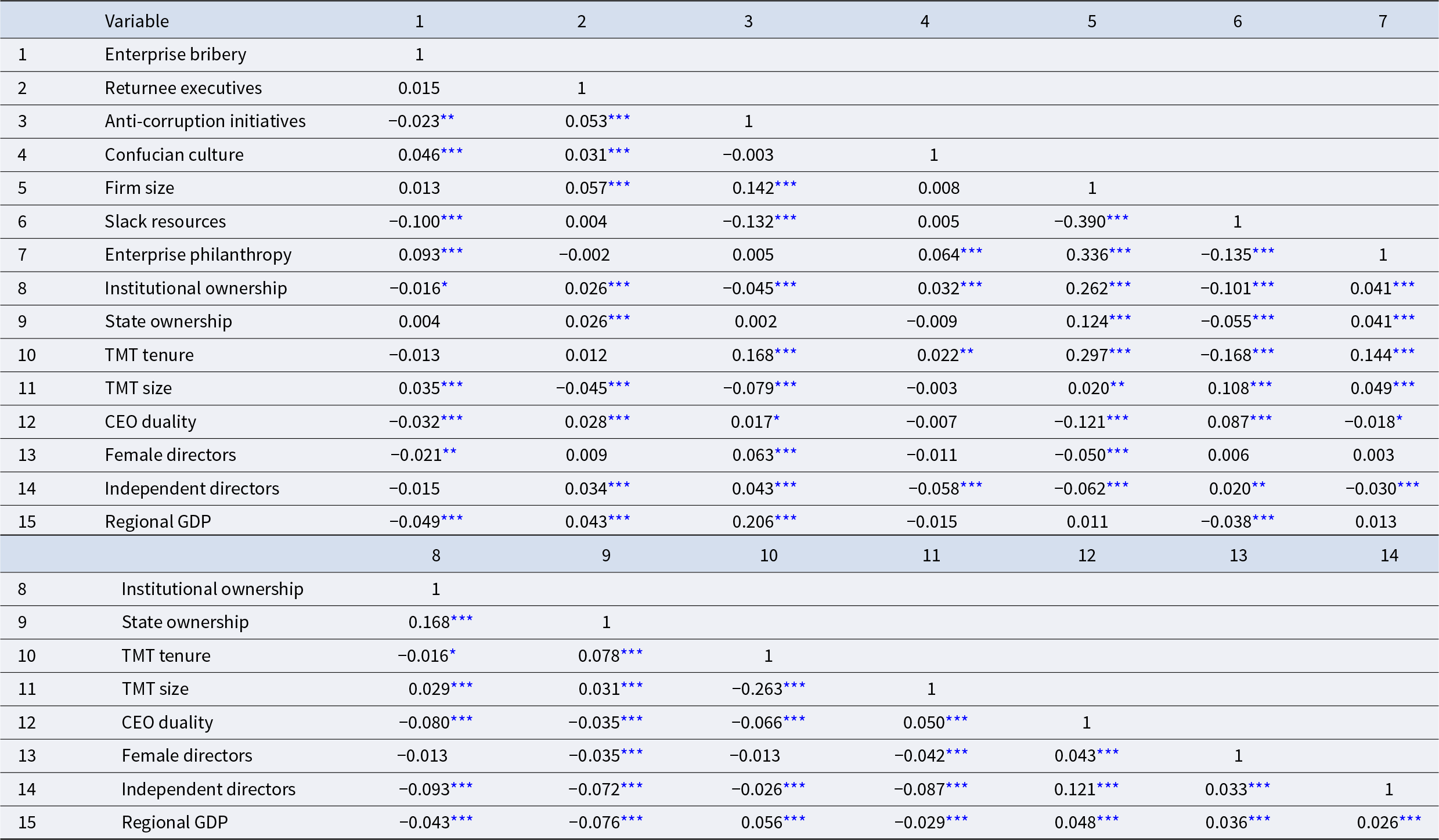
Table 1 provides the means, standard deviations, and maximum and minimum values of the variables. Table 2 provides the relative coefficients of the variables. The maximum correlation coefficient is 0.206 (regional GDP and anti-corruption initiatives). To check for potential multicollinearity in our analysis, we conducted a variance inflation factor (VIF) test for the full model. The average VIF of the full model was 1.12 (the maximum VIF was 1.52), suggesting that there was no significant multicollinearity (Jiang et al., Reference Jiang, Xia, Devers and Shen2021).
Descriptive statistics

Notes: Since the amount of enterprise bribery data is too small, we increase it by a factor of 1000 in practice. Same below.
Pearson correlation analysis

* Notes: **, and *** denote statistical significance at the 10%, 5%, and 1% levels, respectively.
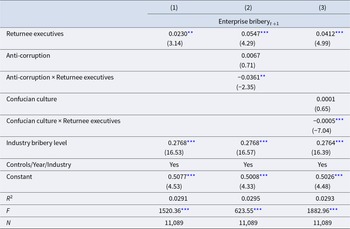
Table 3 reports the results of the regression analyses. Model 1 in Table 3 shows the regression results for returnee executives and enterprise bribery. As we can see from Model 1 in Table 3, the coefficient between returnee executives and enterprise bribery is positive and significant (β = 0.0221, p < 0.05), which indicates that enterprises with more returnee executives are more likely to be involved in bribery. Hence, H1 is supported.
Regression analysis of returnee executives and enterprise bribery (baseline model)

* Notes: **, and *** denote statistical significance at the 10%, 5%, and 1% levels, respectively.
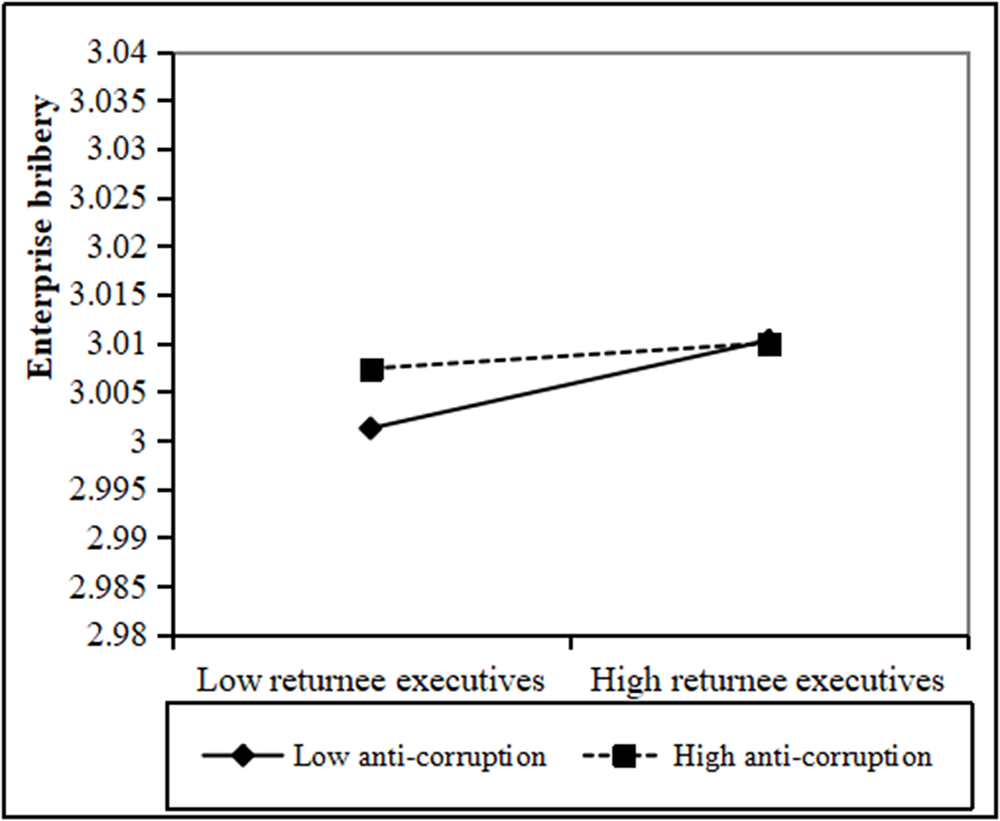
As we can see from Model 3 in Table 3, the coefficient of anti-corruption efforts × returnee executives is negative and significant (β = −0.0361, p < 0.05), indicating that anticorruption efforts weaken the effect of returnee executives on enterprise bribery. Hence, H2a is supported. Figure 1 clearly demonstrates H2a.
Schematic diagram of the moderating effect of anticorruption

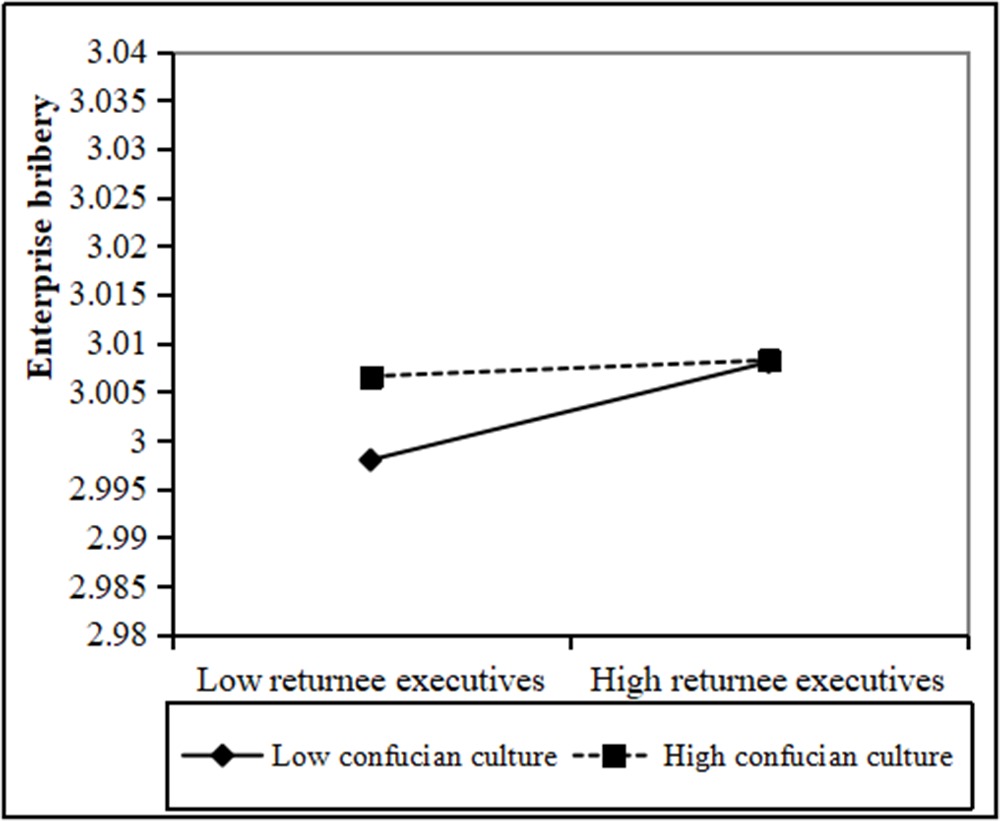
As shown in Model 3 in Table 3, the coefficient of Confucian culture ×returnee executives is negative and significant (β = −0.0005, p < 0.01), indicating that Confucian culture weakens the effect of returnee executives on enterprise bribery. Hence, H2b is supported. Figure 2 clearly demonstrates H2b.
Schematic diagram of the moderating effect of Confucian culture

Robustness Checks
Endogeneity problems may arise due to variable measurement bias and some omitted variables, leading to biased results. For example, the causes of enterprise bribery may also be influenced by factors such as the corporate culture and personal motivations of executives, which are difficult to measure. To avoid the impacts of endogeneity problems on the results of the benchmark regression, first, we adopted an instrumental variables approach. The selection of instrumental variables needs to satisfy the principles of relevance and exogeneity. The instrumental variable we choose is the nearest distance to the port. Specifically, first, we obtained the longitude and latitude of the capital city of each province via Google Maps. Second, we listed all coastal ports on the basis of the 2006 National Port Layout Plan of China’s Ministry of Transportation. Finally, we calculated the shortest distance between each provincial capital city and its corresponding nearest port. For ease of understanding, we reverse-coded the nearest distance to the port to obtain the final IV. The larger the IV is, the closer the region is to the coastal port.
We chose this instrumental variable for the following reasons. Ports such as Beijing–Tianjin–Hebei, the Yangtze River Delta, and the Guangdong–Hong Kong–Macao Greater Bay Area in China have a greater degree of openness and internationalization, which affects the high level of demand for internationally experienced talent in the economic development of the region. For returnees, proximity to ports also offers more suitable job opportunities, higher levels of urban development, and convenience, which are important considerations when choosing a region in which to work. In addition, there is no evidence that proximity to ports affects enterprise bribery. On this basis, we add all explanatory variables of the main regression equation to the model for control.
As Model 1 in Table 4 shows, the IV is positive and significant for returnee executives (β = 0.0001, p < 0.05). This suggests that companies are more likely to hire returnee executives closer to the port. Therefore, our instrumental variables satisfy the correlation principle. In addition, the ‘Kleibergen‒Paap rk LM statistic’ corresponds to a p value of 0, whereas the ‘Kleibergen‒Paap rk Wald F statistic’ is larger than the corresponding Stock–Yogo weak instrument. The ‘Kleibergen‒Paap rk Wald F statistic’ is greater than the corresponding Stock–Yogo 10% threshold for the weak instrumental variable test. This significantly rejects the original hypothesis of weak instrumental variables. Since the number of instrumental variables is equal to the number of endogenous explanatory variables at this point, it is exactly identified; therefore, there is no overidentification in this study. According to Model 2, the coefficient of returnee executives is significantly positive (β = 0.5612, p < 0.01), indicating that the positive effect of returnee executives on enterprise bribery remains robust after endogeneity is addressed with instrumental variables.
Regression analysis of returnee executives and enterprise bribery (the instrumental variable method and PSM)

* Notes: **, and *** denote statistical significance at the 10%, 5%, and 1% levels, respectively.
To address the endogeneity problem due to self-selection bias, we chose the PSM method for further testing. Our dependent variable is enterprise bribery, and the covariates include firm size, firm age, institutional ownership, state ownership, foreign ownership, TMT tenure, and TMT size. We used the nearest neighbor matching method and set the samples with returnee executives as the treatment group and the samples without returnee executives as the control group and adopted one-to-one put-back matching. There was no significant difference in any characteristic variable between the two groups of samples after matching, and the average treatment effect (ATT) was significantly positive (difference = 0.0099, T-state = 2.57). As Model 3 in Table 4 shows, the regression results based on the paired sample indicate that the coefficient of returnee executives is significantly positive (β = 0.0404, p < 0.05). Returnee executives remain robust to enterprise bribery after the endogeneity problem is solved because of the self-selection problem.
In addition, there is a self-selection problem due to the large difference between the sample groups with and without returnee executives. To mitigate the endogeneity problem caused by sample selection bias, we follow Heckman’s (1979) sample selection tradition and re-examine the ‘treatment effect model’ proposed by Maddala (1983). Specifically, in the first stage, we model the probability that a firm has a returnee executive and regress it via a probit model. We incorporate all the control variables from the baseline model, and following Ren et al. (Reference Ren, Zeng and Zhong2023), we introduce an exogenous instrumental variable, i.e., the mean value of returnee executives in the industry (Ren et al., Reference Ren, Zeng and Zhong2023). We argue that the industry’s mean value of returnee executives affects whether the focal firm chooses to hire returnee executives but does not directly affect enterprise bribery and thus can be used as an exogenous variable to address the self-selection problem. In the second stage, we include the inverse Mills ratio (IMR) estimated in the first stage as a control variable in the regression model, as shown in Table 5. According to the results in Table 5, the IMR is not significant, indicating that the sample selection bias problem is not serious. After the above test, all the results remain robust.
Regression analysis of returnee executives and enterprise bribery (Heckman two-stage model)

* Notes: **, and *** denote statistical significance at the 10%, 5%, and 1% levels, respectively.
After addressing the endogeneity issue, we perform the following robustness tests for H1. First, we replaced the enterprise bribery measures. Referring to Ren et al. (Reference Ren, Zhong and Wan2022), to increase comparability among enterprises, we use the ratio of abnormal entertainment and travel expenses to total assets as a proxy for enterprise bribery (Ren et al., Reference Ren, Zhong and Wan2022; Xu et al., Reference Xu, Zhou and Du2019), which is labeled enterprise bribery2. As the results of Model 1 in Table 6 show, the coefficient of returnee executives is significantly positive (β = 0.0010, p < 0.05).
Regression analysis of returnee executives and enterprise bribery (replacement of the measurement of the independent and dependent variables)

* Notes: **, and *** denote statistical significance at the 10%, 5%, and 1% levels, respectively.
Second, we replaced the measurement of returnee executives with the actual number of returnees (Liu, Lu, & Choi, Reference Liu, Lu and Choi2014) and marked this as returnee executives2. As Model 5 in Table 6 reports, the regression results show that the coefficient of returnee executives2 is significantly positive (β = 0.0027, p < 0.001).
Third, there are two alternative explanations for our study. The first alternative explanation is that since relationships play a crucial role in China’s business environment, returnee executives may lack local social connections because they live overseas for a long period of time (Lin et al., Reference Lin, Chen and Lin2018), which may increase their incentives to build a network of relationships by paying bribes. Emerging research suggests that alternative explanations can be ruled out by including control variables that are highly correlated with them (Chen, Fu, Tang, & Zhao, Reference Chen, Fu, Tang and Zhao2025). Therefore, we further include political connections as a control variable. Political connections is a dummy variable, i.e., assigned a value of 1 when the chairperson or the CEO is politically connected and 0 otherwise.
The second alternative explanation is that people with overseas study/work experience have high expectations of success. The pressure to meet these expectations may motivate some executives to engage in bribery as a means of achieving quick and visible results. Previous research has shown that when firm performance is above the aspirational goal (the minimum level of output that satisfies executives), executives’ expectations of success are subsequently raised (Giuliani, Nieri, & Vezzulli, Reference Giuliani, Nieri and Vezzulli2023), increasing the likelihood that they will delve into misconduct (including enterprise bribery) (Giuliani et al., Reference Giuliani, Nieri and Vezzulli2023; Mishina, Dykes, Block, & Pollock, Reference Mishina, Dykes, Block and Pollock2010). In light of this, we further include historical aspiration surplus and social aspiration surplus as control variables to rule out the second alternative explanation.
The historical aspiration surplus is measured as follows: when a firm’s current ROA is greater than its historical aspiration (measured by the previous year’s ROA), the historical aspiration surplus is equal to the firm’s current ROA minus the previous year’s ROA and 0 otherwise. The social aspiration surplus is measured as follows: when a firm’s ROA is greater than its social aspiration (as measured by the industry ROA average), the social aspiration surplus is equal to the firm’s ROA minus the industry ROA average; otherwise, it is 0. As seen from the model in Table 7, our empirical conclusions do not substantially change after alternative explanations are eliminated, thus indirectly supporting the role of moral relativism in the relationship between returnee executives and enterprise bribery.
Regression analysis of returnee executives and enterprise bribery (excluding alternative explanations)

* Notes: **, and *** denote statistical significance at the 10%, 5%, and 1% levels, respectively.
Finally, the anticorruption campaign that began in China in 2013 may have created varying opportunities for bribery across different industries. To mitigate the potential impact of these varying corruption opportunities on our empirical results, we use the industry bribery level as a proxy for corruption opportunities and include it as a control variable in our empirical model. As demonstrated in Table 8, the results remain consistent and are not significantly affected after controlling for firms’ opportunities to engage in bribery.
Regression analysis of returnee executives and enterprise bribery (adding industry bribery level as a control variable)

* Notes: **, and *** denote statistical significance at the 10%, 5%, and 1% levels, respectively.
Further Analyses
We attempt to indirectly test the mechanistic role of moral relativism in the relationship between returnee executives and enterprise bribery. It is a widely observed phenomenon that women mature earlier than men do, and in the process, women tend to develop stable moral standards and ethical concepts earlier. When women are exposed to overseas environments, they are unlikely to develop moral relativism because they already have stable moral standards and ethical norms. In addition, men are often socialized to emphasize the pursuit of power, competition, and autonomy, and the impact of this socialization is such that they may be more inclined to seek flexibility and adaptability when faced with moral judgments. In contrast, social expectations of women’s roles often include nurturing, caring for, and coordinating relationships, and these roles require women to form and maintain consistent moral standards and ethical values.
In sum, women are less likely than men to develop strong moral relativism as a result of overseas experience. Therefore, if moral activism acts as a mechanism in the relationship between returnee executives and enterprise bribery, then it is predictable that the positive relationship between returnee executives and enterprise bribery will weaken in firms with female returnee executives. For this reason, we retested the sample by dividing it into two groups on the basis of the presence or absence of female returnee executives. The empirical results in Table 9 support our theoretical reasoning above, thus indirectly supporting the mechanistic role of moral activism in the relationship between returnee executives and enterprise bribery.
Regression analysis of returnee executives and enterprise bribery (distinguishing between returnee executives who are female and those who are not)

* Notes: **, and *** denote statistical significance at the 10%, 5%, and 1% levels, respectively.
Discussion
Combating bribery is a top priority for policymakers worldwide. However, designing effective solutions is a complex task (Gago-Rodríguez et al., Reference Gago-Rodríguez, Márquez-Illescas and Núñez-Nickel2020). To improve the effectiveness of antibribery measures, scholars and policymakers have long focused on and explored the antecedents of enterprise involvement in active bribery (Jeong & Siegel, Reference Jeong and Siegel2018; Kim, Praveen Parboteeah, et al., Reference Kim, Praveen Parboteeah and Cullen2022; Martin et al., Reference Martin, Cullen, Johnson and Praveen Parboteeah2007). Despite the large number of bribery incidents indicating that executives play an important role in enterprise bribery, few studies have examined the influence of executives on enterprise bribery, especially in emerging economies (Collins et al., Reference Collins, Uhlenbruck and Rodriguez2009; Kim, Praveen Parboteeah, et al., Reference Kim, Praveen Parboteeah and Cullen2022).
In this study, we first introduce the research perspective on returnee executives and then theoretically analyze and empirically test the relationship between returnee executives and enterprise bribery involvement in emerging economies. We find that returnee executives generally increase the likelihood that private Chinese firms are involved in bribery. We attribute this to the fact that returnee executives have moral relativism, which makes them view bribery as a nonunethical competitive tool. The results of the empirical tests indirectly support the existence of these two intrinsic mechanisms. On the basis of institutional theory insights, we further find that anticorruption initiatives (formal institutions) and Confucian culture (formal institutions) weaken the influence of returnee executives on enterprise involvement in bribery. This study has important implications for upper echelons theory, institutional theory, and the enterprise bribery literature.
Theoretical Implications
First, by introducing a new, important but underexplored executive-level antecedent, in this study, we expand and enrich the growing literature on the antecedents of enterprise bribery from the perspective of executive characteristics. Admittedly, prior research has identified a large number of external and internal drivers that influence enterprise bribery but has focused on institutional, industry, and firm-level factors (Gago-Rodríguez et al., Reference Gago-Rodríguez, Márquez-Illescas and Núñez-Nickel2020; Jeong & Siegel, Reference Jeong and Siegel2018; Jiang & Min, Reference Jiang and Min2023; Martin et al., Reference Martin, Cullen, Johnson and Praveen Parboteeah2007; Xu et al., Reference Xu, Zhou and Du2019). However, this stream of research has difficulty explaining why different firms exhibit significant differences in bribery activity given the same institutional, industry, and firm characteristics. To address this conundrum, on the basis of insights from upper echelons theory (Hambrick & Mason, Reference Hambrick and Mason1984), several recent scholars have explored the impact of decision-maker social capital (Collins et al., Reference Collins, Uhlenbruck and Rodriguez2009), gender (Kim, Praveen Parboteeah, et al., Reference Kim, Praveen Parboteeah and Cullen2022; Tuliao & Chen, Reference Tuliao and Chen2017), and hubris (Sarpong et al., Reference Sarpong, Sajdakova and Adams2019) on enterprise bribery (Fan et al., Reference Fan, Tao, Oehmichen and van Ees2024). Given the increasing prevalence of returnee executives in enterprises in emerging economies (e.g., China) (Han et al., Reference Han, Jennings, Liu and Jennings2019; Zhang et al., Reference Zhang, Xu and Chen2021), we shed light on the role of returnee executives, building on the constructive perspectives already available to upper-echelon scholars. We systematically analyze how and when returnee executives influence the extent of enterprise involvement in bribery, which is an important and underexplored topic. Moreover, we contribute to a more comprehensive understanding of the drivers of enterprise involvement in bribery.
Second, by drawing attention to the dark side of returnee executives, we expand the growing literature on the economic consequences of returnee executives (Kunisch et al., Reference Kunisch, Menz and Cannella2019; Lu et al., Reference Lu, Quoidbach, Gino, Chakroff, Maddux and Galinsky2017; Zhang et al., Reference Zhang, Xu and Chen2021). Prior research has identified numerous benefits to returnee executives (Han et al., Reference Han, Jennings, Liu and Jennings2019; Kunisch et al., Reference Kunisch, Menz and Cannella2019; Luo, Chen, & Chen, Reference Luo, Chen and Chen2021). For example, returnee executives have been found to improve innovation performance (Cao et al., Reference Cao, Wang, Li and Zheng2022). However, we know little about the adversarial effect that returnee executives bring to firms and how firms should cope with them (Ren et al., Reference Ren, Zeng and Zhong2023; Zhang et al., Reference Zhang, Xu and Chen2021). In fact, the exploration of this issue is critical for developing balanced insights into the repercussions for returnee executives (Li, Zhang, Li, Zhou, & Zhang, Reference Li, Zhang, Li, Zhou and Zhang2012; Lu et al., Reference Lu, Quoidbach, Gino, Chakroff, Maddux and Galinsky2017; Ren et al., Reference Ren, Zeng and Zhong2023). We provide evidence that returnee executives substantially increase the likelihood of enterprise involvement in bribery under distortions of moral relativism. Thus, this study helps us develop more dialectical insights into the pros and cons of returnee executives. Moreover, we extend upper echelons theory, which uses demographic characteristics to map the intrinsic traits of executives (Hambrick, Reference Hambrick2007; Liu et al., Reference Liu, Zhang, Gupta, Zheng and Wu2022), as we provide more comprehensive theoretical knowledge to help us gain insights into how overseas experiences shape executive cognition and mindsets.
Finally, we provide the first knowledge of how returnee executives and the institutional environment work together to shape enterprise bribery, thus contributing to upper echelons theory and institutional theory. Scholars have focused on the moderating effects of managerial discretion (Ren et al., Reference Ren, Zeng and Zhong2023; Zhang et al., Reference Zhang, Xu and Chen2021), firm innovation capability (Feng et al., Reference Feng, Hu, Wang and Yan2023) and internal control on the relationship between returnee executives and firms' strategic choices. However, to date, we still know little about the role played by the institutional environment in the influence of returnee executives on firms' strategic choices. In fact, an increasing number of scholars have called for the integration of upper echelons theory and institutional theory to comprehensively understand strategic enterprise choices (Adams et al., Reference Adams, Attah-Boakye, Yu, Johansson and Njoya2023; Kanashiro & Rivera, Reference Kanashiro and Rivera2019). In light of this and by integrating the core principles of upper echelons theory and institutional theory, we analyze and demonstrate how the relationship between returnee executives and firms’ strategic choices is constrained by anticorruption actions and Confucian culture. This finding provides new insights into upper echelons theory and institutional theory, which indicate that the influence of returnee executives on firms’ strategic choices, especially those related to enterprise bribery, also depends on both formal and informal institutional environments.
Practical Implications
In this study, we shed important light on the role of enterprises in appointing executives and how policymakers can better curb enterprise bribery. In recent years, appointing people from overseas backgrounds to executive positions has become both fashionable and attractive. Prior research has highlighted the benefits that returnee executives bring to enterprises (e.g., more advanced knowledge and skills and richer social capital abroad) (Han et al., Reference Han, Jennings, Liu and Jennings2019; Kunisch et al., Reference Kunisch, Menz and Cannella2019; Luo et al., Reference Luo, Chen and Chen2021). However, through this study, we alert shareholders and boards to the dark side of returnee executives, as we suggest that returnee executives increase the likelihood that enterprises in emerging economies are involved in bribery activities. In this context, when enterprises appoint candidates with an overseas background as executives, shareholders, or directors on the board, they should be aware of the adverse effects of this decision on the business (e.g., judicial risk). Moreover, to better curb enterprise bribery, policymakers should focus on bribery in firms with many returnee executives. More precisely, shareholders and governments should take steps to avoid moral relativism toward returnee executives returning from overseas through bribery. For example, returnee executives may view films and videos related to anticorruption activities.
Second, our moderation analysis suggests that the relationship between returnee executives and enterprise bribery involvement is weakened by anticorruption initiatives and Confucian culture. Therefore, policymakers should focus on key institutional environments (e.g., anticorruption initiatives and Confucian culture) when analyzing the likelihood of bribery in firms with returnee executives. Specifically, they should be aware that firms are most likely to be involved in bribery when they have returnee executives and when they are located in environments where Confucian culture is weak or when there are no anticorruption initiatives. This means that better monitoring and reviewing such enterprises’ bribery activities can yield better results in controlling bribery activities.
Limitations and Future Research Opportunities
First, we attribute the relationship between returnee executives’ and enterprises’ involvement in bribery to moral relativism. However, we cannot directly empirically test the above intrinsic mechanism due to the limitations of a large-sample empirical study. Therefore, we encourage future research to directly confirm the mechanisms proposed in this study (e.g., moral relativism) and their boundary conditions via more rigorous methods, such as natural or laboratory experiments. In particular, owing to the availability of data, we were unable to incorporate the following factors into the theoretical framework to develop a fine-grained view of when returnee executives are more likely to develop moral relativism: (a) how similar or distinct the foreign culture is from the returnee executives’ native culture, (b) the duration of those executives’ stays abroad and geographic diversity, and (c) how long they have returned to their home country. We encourage future research to address the above topics via questionnaires or experimental methods.
Second, upper echelons theory holds that ‘attention to executive groups, rather than to individuals, often yields better explanations of organizational outcomes’ (Hambrick, Reference Hambrick2007: 334). In light of this, we develop new insights at the TMT level rather than at the CEO level, thereby generating stronger explanatory power with respect to how decision makers’ overseas experience affects enterprises’ involvement in bribery. However, in doing so, we treat the overseas experience of different TMT members as equivalent, regardless of their varying levels of power within the organization. Obviously, this is not realistic. Therefore, we encourage further consideration of executives with overseas experience in the theoretical framework of their position or power in the TMT, which is essential for more refined insights to occur.
Third, our findings may be applicable to emerging economies with inadequate laws and regulations, such as Brazil and Vietnam. However, caution is needed in transferring the findings of this study to countries with advanced economies, where market rules are more robust, thereby undermining the role of nonmarket activities such as enterprise bribery (Zhou et al., Reference Zhou, Wang, Xu and Xie2022). In addition, on the basis of institutional theory, we highlight the contingency effect of anticorruption initiatives and Confucian culture on the relationship between returnee executives and enterprise bribery. In fact, other formal and informal institutional factors may also influence the relationship between returnee executives and enterprise bribery. Future research could extend this line of research by exploring other potential moderators.
Finally, although our measures of enterprise bribery continue to be implemented by top scholars (Kim, Lee, et al., Reference Kim, Lee, Tang and Zhang2022; Xu et al., Reference Xu, Zhou and Du2019), they are inevitably noisy. For example, it is not possible to fully eliminate normal enterprise hospitality expenditures. This suggests that the measurement of enterprise bribery can be further improved. Future research may benefit from better measures of enterprise bribery.
Data availability statement
The data that support the findings of this study are available from the corresponding author upon reasonable request.
Acknowledgements
We appreciate the help and hard work of the Editor-in-Chief (Xiao-Ping Chen), Deputy Editor (Kai Chi Yam) and Senior Editor (Eric Zhao). Meanwhile, we are also grateful to the two anonymous reviewers for their insightful comments and suggestions. This work was supported by the National Natural Science Foundation Project of China (Grant No. 72202043), Guangdong Basic and Applied Basic Research Foundation (2024A1515010474), and the National Natural Science Foundation of Shaanxi Province Youth Project (2024JC-YBQN-0757).
Xi Zhong (HGzhongxi@163.com) is an associate professor at the College of Management, Shenzhen University. His research lies at the intersection of business ethics, performance feedback, and digital transformation. He has published over 120 academic articles in various scholarly journals, including Management and Organization Review, Journal of Business Ethics, Journal of Business Research, Technovation, Industrial Marketing Management, R&D Management, Asia Pacific Journal of Management, European Management Review, among others.
Ge Ren (Hrenge@yeah.net) is a doctoral student at the School of Business Administration, South China University of Technology. Her research lies at the intersection of ESG and corporate innovation strategies. She has published in several journals, including the Management and Organization Review, Corporate Social Responsibility and Environmental Management, Business Ethics, The Environment and Responsibility, Journal of Engineering and Technology Management, among others.
Xiaojie Wu (Xiaojie_wu@163.com) is a professor and PhD tutor at the School of Management, Guangdong University of Technology. His research lies at the intersection of innovation strategy and enterprise internalization. He has published in several journals, including the Journal of Management & Organization, Management and Organization Review, Journal of Business Research, Thunderbird International Business Review, among others.