Introduction
Lip and oral cavity cancer is the most common malignancies in Indian males constituting about 16·1% of all malignancies, according to GLOBOCAN 2018. Head and neck carcinoma is the most common malignancy among the Indian males as per Indian Council of Medical Research (ICMR) reports.1,Reference Singh, Prasad, Singh and Kumar2 External beam radiotherapy (EBRT) is one of the important components in the management of head and neck cancer (HNC). EBRT may be used alone or in combination of concurrent chemotherapy, depending upon the stage and risk factors of the disease.
The thyroid gland is the largest endocrine gland, in the anterior of the neck in front of the trachea. The thyroid gland secretes two major hormones triiodothyronine (T3) and thyroxine (T4), which are crucial in normal growth and development. Post irradiation hypothyroidism (HT) is a known complication and may be seen among 20–30% of the cases following EBRT where the neck is included in radiation portal.Reference Jemal, Siegel, Ward, Murray, Xu and Thun3 Neck lymphatic is routinely included in the target volume to treat an occult node positive or clinically node positive patients during radiotherapy (RT), which invariably includes a variable part of the thyroid gland. The effect of RT on the thyroid gland was first reported in 1929·Reference Groover, Christie, Merritt, Coe and McPeak4 The thyroid gland is a relatively radio-resistant organ. High dose of radiation may lead to severe degenerative changes with extensive vacuolisation and swelling of the cytoplasm, necrosis and desquamation of the follicular epithelium. In addition, fibrinoid necrosis of vessel walls, thrombosis and hemorrhage may be present. EBRT-related injuries to the thyroid gland include vascular injuries, autoimmune reaction and parenchymal cell damage. HT can occur within a relatively brief time after irradiation and is most likely due to loss of thyroid follicles. Surgical intervention to neck region increases the risk of HT but the risk of HT is not influenced by the addition of chemotherapy.Reference Posner, Ervin, Fabian, Weichselbaum, Miller and Norris5 In almost all cases, there is slow development and relatively non-specific nature of the symptoms (lethargy, cold intolerance, constipation, skin dryness, weight gain, slow mentation); a considerable number of post EBRT treated patients may have undiagnosed HT. HT can be diagnosed by a thyroid function test (TFT), which is more frequent but often missed because routine testing of thyroid is not done during follow-up. The consequences of HT include atherosclerotic changes, dyslipidemia and cardiovascular morbidity. Assessments, to test TFT is not yet a part of routine follow up of HNC patients. All these HT-related morbidities may be avoided, if detected earlier with proper follow-up using TFT and referring the needful patient to endocrinologist. In this study, we have tried to assess the incidence rate of HT in patients of HNC, treated with EBRT including the neck and to determine whether the addition of chemotherapy has any more effect on the development of HT.
Materials and Methods
A prospective, single institutional longitudinal observational study conducted at department of radiotherapy, Institute of Post Graduate Medical Education and Research (IPGME&R), Kolkata from January 2015 to August 2018. Institutional Ethics Committee of IPGME&R, Kolkata (Inst/IEC/2015/453 dated 3 September 2015), approved the study. In this study all biopsy-proven cases of HNC attending RT out-patient department, and planned to receive EBRT (≥45 Gy) including lower neck are included in the study. Inclusion criteria were as performance status 0–2 as per Eastern Cooperative Oncology Group (ECOG) performance status,6 HNC (carcinoma sinonasal cavity, carcinoma oropharynx, carcinoma oral cavity, carcinoma hypopharynx, carcinoma larynx) age more than 18 years, those who are eligible to receive EBRT or concurrent chemoradiation (CTRT). Exclusion criteria were a history of thyroidectomy, known case of HT, nasopharyngeal carcinoma, recurrent HNC and stage IV disease. The newly diagnosed patients are subjected to complete staging work up including clinical examination, chest X-ray, contrast enhanced computed tomography (CECT) scan face and neck, magnetic resonance imaging (MRI) when indicated, ultrasonography (USG) whole abdomen, complete blood count, liver function test, renal function, thyroid stimulating hormone (TSH), free thyroxine (FT4) and lipid profile at baseline. All the diagnosed patients were staged according to American Joint Committee on Cancer (AJCC) 7th edition.Reference Edge, Compton, Fritz and Green7 Blood tests for TSH and FT4 were repeated at the end of EBRT or CTRT. TSH and FT4 were repeated at each follow up. These follow-up appointments were scheduled at 6 weeks, 3 and 6 months after the completion of radiation. The TFTs were done at the department of biochemistry at IPGME&R, Kolkata and the accepted normal values were TSH: 0·3–5·0 mIU/mL, FT4:0·7–1·8 ng/dL.
Definition of outcome
HT was defined as failure of the thyroid gland to produce enough thyroid hormone, which may lead to certain clinical features including cold intolerance, fatigue, dry skin, arthralgia, weakness, weight gain, myalgias and memory impairment. Biochemically, HT is divided into clinical hypothyroidism (cHT) and subclinical hypothyroidism (sHT). cHT is characterised by increased TSH, decreased FT4 and may be in association of clinical feature of HT. sHT is characterised by increased TSH with normal FT4.
EBRT was delivered using a Telecobalt machine (Bhabhatron II, Panacea Medical Technologies, Bengaluru, India). Patients were treated with conventional fractionation with two gray (Gy) per fraction, five fractions a week. The dose of EBRT and concurrent chemotherapy were prescribed as per clinical indications and stage. All patients were undergone pre-radiation dental evaluation. All patients were treated in supine position with the appropriate immobilisation device. Conventional 2D RT planning was used. The dose was prescribed at the centre of inter field distance (IFD) in lateral opposed fields and at a depth of 3 cm in the case of low anterior neck field. Wherever applicable, the primary disease site and its draining echelon group of lymph nodes (LNs) were encompassed with parallel opposed fields with separate low anterior neck field with a proper field matching. The spinal cord was shielded for all patients after 44 Gy using conventional fractionation. If any residual neck disease was detected beyond the 44 Gy cut-off, tangential radiation portals were used to boost the dose. For lesions involving the skin or for tracheostomy stoma, boluses were used to increase the surface dose. Field junctions were avoided over cancerous growth. For matching the fields at junctions, half beam blocks or field gap calculations were made for orthogonal fields.
Results
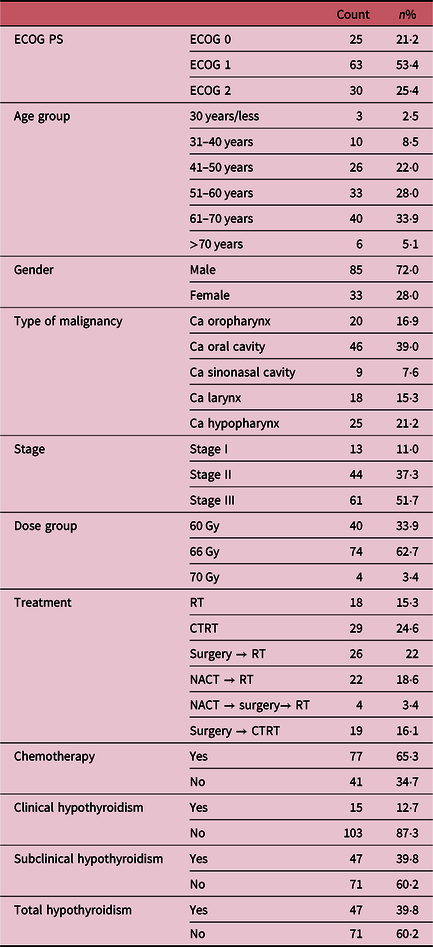
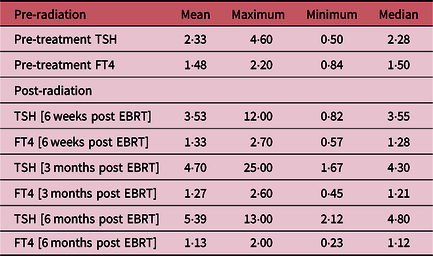
Out of 130 patients entered the study, two patients were found to be hypothyroid before the start of EBRT and excluded from the study. Eight patients had not completed their schedule of EBRT and not attended RT department for further treatment. Two patients did not follow their schedule of follow up as per study protocol. The data of 118 patients were available for the final analysis. The median age at presentation was 56 years. The most common age group was 61–70 years with 33·9%, followed by 51–60 years, 41–50 years, 31–40 years, >70 years and <30 years with 28, 22, 8·5, 5·1 and 2·5% respectively. The majority of the patients were male with 72 and 28% were females. The ECOG performance status (PS) of the patients was ECOG 0, 1 and 2 as 21·2, 53·4 and 25·4% respectively. The epidemiological characteristics are depicted in Table 1. The most common primary site of malignancy was oral cavity that constituted 39%, followed by carcinoma hypopharynx with 21·9% and carcinoma sinonasal cavity was less common with 7·6%. The patients were stage I, stage II and stage III as 11, 37·3 and 51·7% respectively. The most common modality of management was definitive CTRT (24·6%) followed by surgery and adjuvant RT (22%). Definitive RT only was considered in 15·3%, neoadjuvant chemotherapy (NACT) followed by the definitive RT in 18·6%, surgery followed by adjuvant CTRT in 16·1%, NACT followed by surgery and adjuvant RT in 3·4% of patients. The median dose of EBRT was 66 Gy. Systemic chemotherapy was considered in 65·3% of patients while 34·7% patients did not receive chemotherapy. Patients receiving 60, 66 and 70 Gy were 33·9, 62·7 and 3·4% respectively. At the end of follow-up of 6 months, 39·8% developed sHT and 12·7% cHT. The median value of pre-treatment TSH and FT4 was 2·28 mIU/mL and 1·5 ng/dL respectively. The median value of TSH and FT4 were 4·8 mIU/mL and 1·12 ng/dL respectively at the end of follow-up of 6 months (Table 2)
Epidemiological characteristics of patients.

Abbreviations: ECOG PS, Eastern cooperative oncology group performance status; Ca, carcinoma; Gy, gray; RT, radiation; CTRT, concurrent chemoradiation; NACT, neoadjuvant chemotherapy.
Pre- and post-radiation values of TSH and FT4.

Correlation studies and univariate analysis
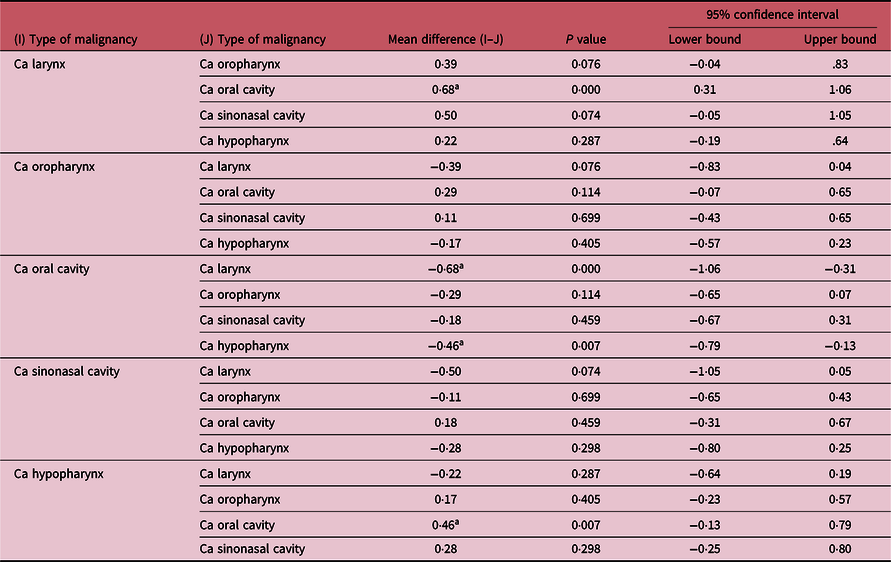
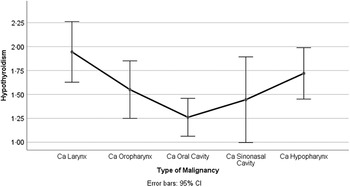
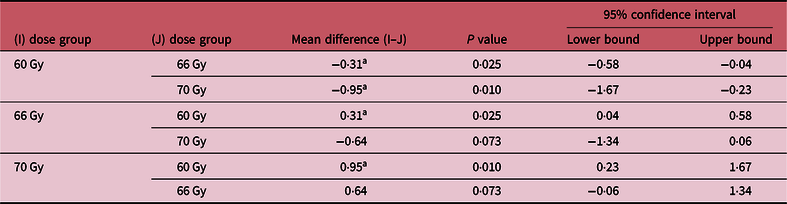
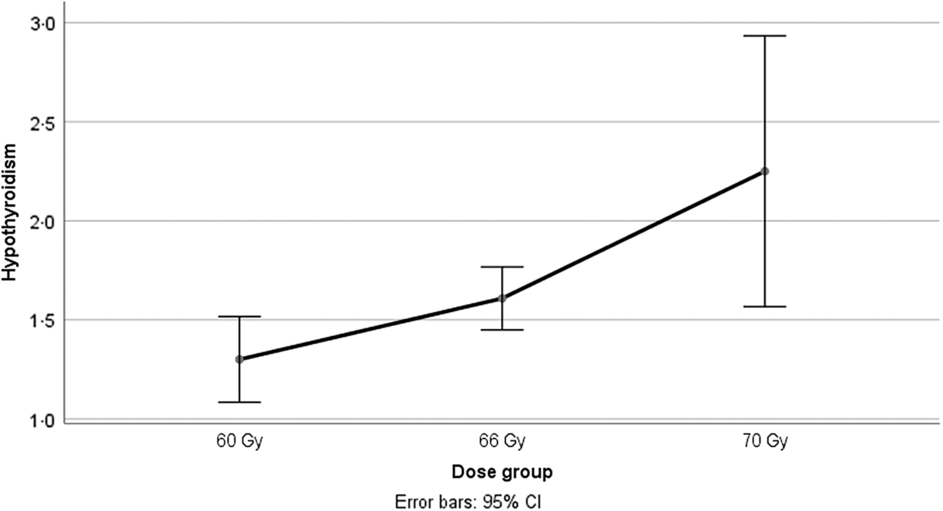
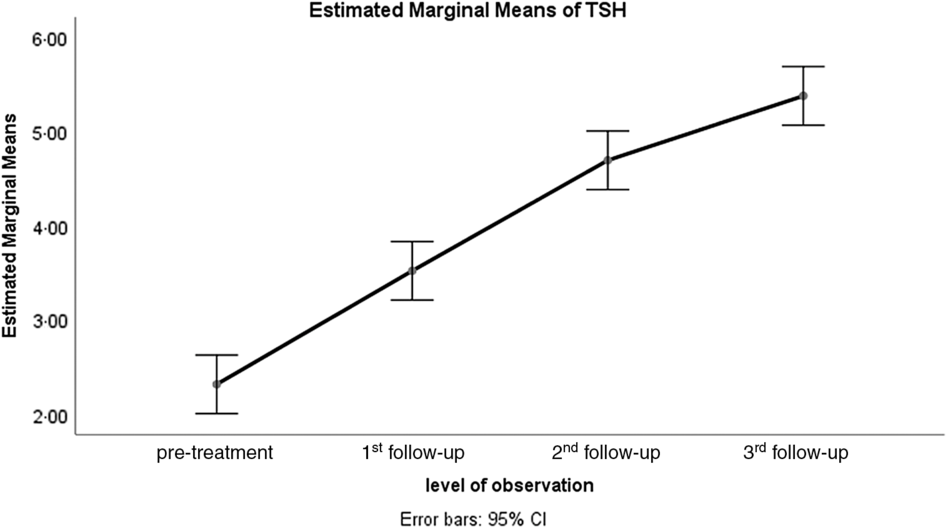
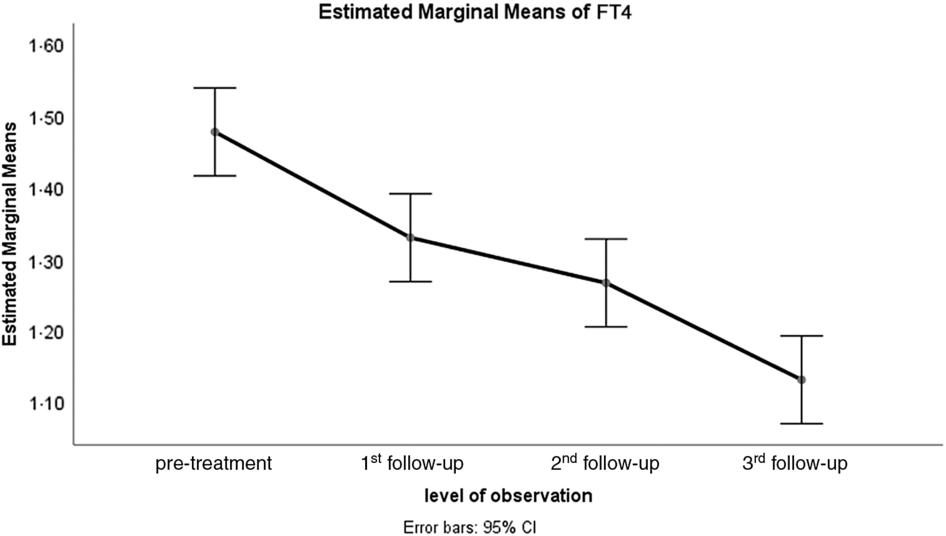
HT statistically significantly correlated with primary site of malignancy (p = 0·001), dose of EBRT (p = 0·005) using Chi-square test. The univariate analysis of variance of primary sites of malignancy and HT showed that the carcinoma larynx had statistically significantly more risk of development of HT in comparison to other primary sites of HNC (p = 0·004). The post Hoc tests with the least significant difference of primary sites of HNC and HT are depicted in Table 3, Figure 1. The univariate analysis of variance of dose of EBRT and HT showed that risk of HT increases with increasing dose of EBRT (p = 0·009). The post Hoc tests with the least significant difference of dose of EBRT and HT are given in Table 4, Figure 2. HT was not correlated statistically significantly with ECOG PS (p = 0·732), sex (p = 0·106), age (p = 0·548), stage (p = 0·547) and chemotherapy (p = 0·599). The significance of difference of TSH values as obtained before and after intervention as of three follow-ups at 6 weeks, 3 and 6 months interval was analysed by the method of analysis of variance (ANOVA) of 118 patients. There is a statistically significant (p < 0·001) increase in TSH values as compared to the pre-treatment TSH level (Table 5, Figure 3). There was statistically significant difference in FT4 values were obtained when compared before and after intervention as of three follow-ups at 6 weeks, 3 and 6 months interval is analyzed by ANOVA. There was a statistically significant reduction in FT4 values (p < 0·001) as compared to pre-treatment FT4 (Table 6, Figure 4).
Post Hoc tests of least difference between primary site of head and neck cancer and hypothyroidism (univariate analysis of variance).

a The mean difference is significant at the 0.05 level.
Risk hypothyroidism according to primary site of head and neck cancer.

Post Hoc tests of least difference between dose of EBRT and hypothyroidism (univariate analysis of variance).

a The mean difference is significant at the 0.05 level.
Risk hypothyroidism according to dose EBRT to head and neck cancer EBRT, external beam radiotherapy.

Post Hoc tests of least difference between pre- and post-treatment TSH values (univariate analysis of variance).

a The mean difference is significant at the 0.05 level.
Estimated means of TSH at each follow-up TSH, thyroid stimulating hormone.

Post Hoc tests of least difference between pre- and post-treatment FT4 values (univariate analysis of variance).

a The mean difference is significant at the 0.05 level.
Estimated means of FT4 at each follow-up FT4, free thyroxine.

Discussion
Head and neck carcinomas are one of the most common cancers especially in males. Approximately, 60–90% of the cases are associated with tobacco use in various forms.Reference Nadarajah and Michelle8 Most of the cases are diagnosed in a locally advanced stage. The impact of EBRT to the neck was first reported in 1929·Reference Jemal, Siegel, Ward, Murray, Xu and Thun3 A number of studies had reported the development of HT after multidisciplinary management of HNCs.Reference Felix, Dupre, Drape and Court9,Reference Markson and Flatman10
We analysed the incidence of HT following EBRT or CTRT to head and neck carcinoma. It was found that the age of the patients varied from 28 to 74 years with a median age of 56 years. The male patients constituted 72%, while females were 28%. The incidence of HT was not statistically significantly correlating with age (p = 0·548), gender of the patients (p = 0·106). Similar patient characteristics were reported by other published studies.Reference Tell, Sjödin, Lundell, Lewin and Lewensohn11,Reference Aich, Deb, Pal and Naha12
In this study, most common primary site was oral cavity (39%) followed by hypopharynx (21·2%) and oropharynx (16·9%). The primary site of HNC was varied from different studies. Kanti et al. reported larynx as the most common primary site (49%), Srikantia et al. reported in their study that carcinoma hypopharynx as most common primary site.Reference Aich, Deb, Pal and Naha12,Reference Srikantia, Rishi, Janaki, Bilimagga, Ponni, Rajeev, Kaushik and Dharmalingam13
In our study, the risk of HT was found to be more in those with carcinoma larynx followed by hypopharynx compared to other sites. The risk of HT was least in carcinoma of the oral cavity. This may be due to, that carcinoma larynx and hypopharynx treated with radiation portals entirely encompassing the neck, including thyroid region, thus receiving the entire high dose to the thyroid gland and ultimately leads to HT. Most of the patients were in stage III (51·7%) followed by Stage II and stage I. The incidence of HT was not statistically significantly correlating with the stage of the disease. All the patients in this study had received at least 45 Gy to the neck in a conventional fractionation and the median dose of EBRT was 60 Gy. Patients receiving 60, 66 and 70 Gy were 33·9, 62·7 and 3·4% respectively. This was in concordance with other literature, the minimum dose was 40 Gy to neck and maximum dose of 70 Gy when treated with radiation with radical intent.Reference Srikantia, Rishi, Janaki, Bilimagga, Ponni, Rajeev, Kaushik and Dharmalingam13–Reference Turner, Tiver and Boyages16 These different doses are dependent upon the intent to treat the patient either as adjuvant following surgery or radical irradiation to primary site along with draining lymphatics.
There was a statistically significant correlation between the dose of radiation and HT (p = 0·005). The patients, who received 66 Gy, had more risk of HT in comparison to 60 Gy. Similarly, patients who had received 70 Gy had more risk of HT in comparison to 66 Gy. DeGroot et al. and Hancock et al. in their study suggested that radiation dose of 30–80 Gy may be required to induce HT.Reference DeGroot17,Reference Hancock, McDougall and Constine18 Hancock et al. reviewed 1,787 patients of Hodgkin’s lymphoma treated with mantle field irradiation in a dose range of 35–45 Gy and estimated 43% risk of developing HT at 20 years.Reference Hancock, McDougall and Constine18 We found that there was a statistically significant increase in TSH level (p < 0·001) and decrease in the FT4 level (p < 0·001) during the follow-up. These findings were similar to other studies.Reference Cinar, Yigit and Alkan19,Reference Chougule and Kochar20
In the present study, the incidence of HT was not statistically significantly associated with the use of chemotherapy. This is in concordance with the other studies.Reference Aich, Deb, Pal and Naha12,Reference Srikantia, Rishi, Janaki, Bilimagga, Ponni, Rajeev, Kaushik and Dharmalingam13 During the follow-up period of 6 months following EBRT, 39·8% patients developed HT. The incidence of sHT and cHT were 39·8 and 12·7% respectively. This incidence rate is within the range of various studies about HT, which is from 3 to 64%.Reference Nishiyama, Tanaka, Tarui, Miyauchi and Okagawa22 It is important to recognise these sHT cases, as they are most likely to develop clinical HT cases in further follow-up. These subclinical hypothyroid cases are at 38 times risk of development of cHT.Reference Sinard, Tobin, Mazzaferri, Hodgson, Young and Kunz23 Cooper et al. in their study concluded that recognising and treating sHT early has advantages such as prevention of cHT related morbidity.Reference Cooper24 In a study by Tell et al. concluded that the lifelong testing of the TSH, as the incidence of cHT increases with time even after long-term follow-up.Reference Tell, Sjödin, Lundell, Lewin and Lewensohn25
In comparison to other studies, there are several limitations in this study, including the number of patients, 2D RT planning and the follow-up duration was only up to 6 months.
Conclusion
A significant number of HNC patients develop HT following EBRT to the neck. The thyroid gland must be considered as an important organ at risk while considering EBRT to head and neck region. Even though the thyroid gland lies in very close proximity and sometimes within the clinical target volume of the neck nodes, an attempt should be made to at least document the dose even if it cannot be spared. All HNC patients should undergo TFT at baseline and during each follow-up for detecting sHT. Post EBRT follow-up, proper medical referral and management to be ensured in the form of thyroxine supplementation. The symptomatic improvement with thyroxine supplementation leads to the improvement of quality of life in patients with HT. The questions remain unanswered include the interval of the TFT and when TFT should be started.
A large randomised study is needed to answer these questions.
Acknowledgements
We are thankful to Department of Biochemistry, ENT, General Surgery and Dentistry of IPGME&R, Kolkata.
Funding
Not applicable.
Conflict of Interests
Authors have no conflict of interests.
Ethical Statement
This study was performed in line with the principles of the Declaration of Helsinki. Institutional Ethics Committee of Institute of Post Graduate Medical Education and Research, Kolkata (Inst/IEC/2015/453 dated 3 September 2015) granted approval.