Developments in pesticide use in agriculture
Vietnam is a country with a long history of agricultural production. This sector has been and will remain a major motor for the national economy as well as for the livelihood and well-being of a major part of its population. Since Vietnam adopted a policy promoting a market economy in the mid-1980s, agricultural production has become more diversified whereby the area used for growing vegetables has increased remarkably, i.e., from 328,200 hectares (ha) in 1995 to 452,900 ha in 2000 and 525,900 ha in 20051. The Ministry of Agriculture and Rural Development has even planned to expand this area to 800,000 ha by 20102. This expansion of the area destined for vegetable growing in Vietnam, goes together with a remarkable increase of the total quantity of pesticides used for this activity, leading to several health and environmental problems. This section will explore this history to provide a background for the empirical study on the changes in pesticide use in Vietnam.
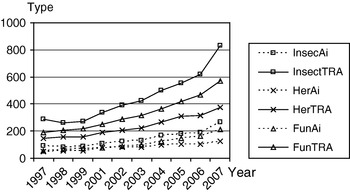
The initial promotion of the use of pesticides by the Vietnamese government was greatly facilitated by the centralized management and collectivized production, which dominated economic policies between 1959 and the early 1980sReference Xuan, Kerkvliet and Porter3. By 1988, following Vietnam's Doi Moi (or Renovation) policy toward a market orientation, the distribution of agricultural inputs was removed from the control of cooperativesReference Rigg4—the prevailing unit for agricultural production promoted by the Vietnamese government during the collectivization production period, i.e., from the end of the 1950s until the beginning of the 1980s—and given into the hands of private entrepreneurs who got engaged in the import, formulation and distribution of pesticides for agricultural crops. In less than 40 years, the initial pesticide use of just 100 tons per year in the 1950sReference Anh5 had multiplied 150 times by 1991Reference Oanh6. Particularly as a result of the privatization of agricultural production in Vietnam, pesticides were applied even more intensively, and their use therefore grew rapidly from 15,000 tons in 1991 to 35,000 tons in 2002Reference Oanh6. The expenditures for pesticide imports increased 13.5 times between 1991 and 2006Reference Oanh6, 7. These rapid changes not only concerned the quantities, but also the types of pesticides used. The numbers of both active ingredients and pesticide formulations/re-branded products distributed and used in Vietnam increased remarkably, especially during the past decade. On average, 38 new types of pesticides were registered annually in the years between 1997 and 2001, and 149 during the period from 2002 to 20078–17 (Fig. 1).
Types of pesticides (in Ai and formulation) distributed in Vietnam (1997–2007). Note: Ai, active ingredient; InsecAi, insecticide Ai; InsectTRA, insecticide trading names; HerAi, herbicide Ai; HerTRA, herbicide trading names; FunAi, fungicide Ai; FunTRA, fungicide trading names. Source: Ministry of Agriculture and Rural Development (1997–2007).

Currently, pesticide use per hectare is higher in the production of vegetables. In one of the major agricultural areas—the Red River Delta—the average amount of pesticides used is 5.52 kg ha−1 cropping season−1 for vegetables compared with 3.34 kg ha−1 for rice, 0.88 kg ha−1 for other food crops (e.g., maize and sweet potato), 3.34 kg ha−1 for short-season industrial crops (e.g., soybean and peanut) and 3.08 kg ha−1 for long-season industrial crops (e.g., tea and coffee). These figures are comparable with other ecological regions of VietnamReference Anh5.
The increased use of pesticides has positive effects such as higher cropping yields and, to a certain extent, improved quality of the products. However, pesticides also have negative health effects for the actors directly or indirectly involved in the food supply chain (such as farmers, traders and consumers) especially when pesticides are improperly applied. Poor farmer knowledge on the content, use and risks of these chemicals, ineffective governmental enforcement of pesticides' regulationsReference Anh5, Reference Tra18, and strong profit-driven interests among pesticide traders and users, have led to an increased use of cheap and rather hazardous pesticides in Vietnam in the 1990sReference Anh5, Reference Quyen, Nhan and San19. In this situation, the Vietnamese population has been threatened by the health risks associated with direct and indirect exposure to pesticides. For instance, in 2002 more than 7000 cases of food poisoning from pesticide residues (involving 7647 people) were reported, causing 277 deaths in 37 of the 61 provincesReference Xuyen20. These numbers of acute poisoning from direct and indirect exposure to pesticides do not include the numerous cases of ‘silent’ casualties by pesticidesReference Quang21, Reference Chau22.
Given these problems, agricultural authorities at ministerial, provincial and district levels have recently invested much to redirect vegetable farming practices to become less pesticide-based. Many training courses on technical knowledge, integrated pest management and the proper use of pesticides have been organized for farmers. In addition, field demonstrations and zone-planning for the so-called ‘safe vegetable production’ (the production follows a set of procedures regarding good soil and water condition, use of less toxic chemical inputs, clean seed/seedlings and adoption of integrated pest management strategy) have been implemented, especially in the peri-urban areas of Hanoi and in Hai Duong and Hung Yen provinces. However, it is not clear whether these interventions by the agricultural authorities have resulted in improvements in distribution and use of pesticides, as extensive and reliable information on pesticide trading and on farmers' practices in using pesticides is lacking.
Against this background, this empirical study focuses on two main objectives. First, as so little is known about the developments in pesticide distribution and use in Vietnam, our first objective was to assess the recent changes in this field, emphasizing the Red River Delta. Our second objective was to explain how these changes are taking place, focusing on the state actors and non-state actors involved in the distribution and application of pesticides. This research will provide a more thorough understanding of the decisions farmers make in selecting and using pesticides. After introducing the research methodology, a detailed analysis of the pesticide distribution practices is presented. This is followed by an analysis of the factors that influence pesticide selection and use by farmers. The final section formulates conclusions and recommendations for a more environmentally friendly use of pesticides.
Methodology
This article is based on two field studies in the Red River Delta in northern Vietnam, supplemented with a considerable number of interviews with stakeholders and informants.
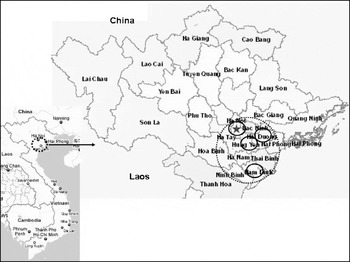
A first empirical study was done on the distribution and use of pesticides and carried out in two provinces in the Red River Delta: Hanoi and Hai Duong (Fig. 2). These provinces were selected because they produce large quantities of vegetables for markets in different provinces and regions throughout Vietnam. In Hanoi, the major vegetables were cauliflowers, choysum, kolhrabi, wax gourd, wrapped heart mustard, headed cabbage and carrot. These vegetables are mostly grown in winter and early spring. In summer, farmers grow rice and maize as major crops and some vegetables such as choysum, wax gourd, wrapped heart mustard and bitter melon. By contrast, in Hai Duong, the types of vegetables grown are less diverse. The major vegetables are headed cabbage, wrapped heart mustard, cucumber and kolhrabi. These are mainly grown in winter. In summer, farmers often grow water melon, rice and maize with a small area for headed cabbage, wrapped heart mustard and cucumber. Major insects and diseases on vegetables are: flea beetle, imported cabbage webworm, diamond back moth, cotton bollworm, white fly, aphid, black cutworm, Rhizoctonia, Xanthomonas and Alternaria. In addition, the organization of vegetable production varies between these provinces, from more intensive in Hanoi to less intensive in Hai Duong province. As such, these areas are representative of the existing variation in Red River Delta.
Locations of the study site in northern Vietnam (Hanoi, Hai Duong, Hung Yen and Nam Dinh province).

For the first empirical study, a farmers' survey was conducted from September to November 2006. In each province, two communities—one in which the state had targeted for ‘safe vegetable production’ and another without such policy which therefore can be called ‘normal vegetable production’—were selected. In each community between 30 and 33 farmers were systematically randomly selected, resulting in a total survey of 125 farmers. These 125 farmers were interviewed with the help of structured questionnaires to understand their agricultural practices and socio-economic conditions, i.e., land availability, labor availability, level of education, their present and past (5–7 years ago) vegetable farming activities. These background data were supplemented with questions on related issues such as the insect pests and diseases they encounter, their access to pesticides, to technical know-how and to the vegetable market, with a focus on the pesticide selection and use and on the actors and factors that influence their decision-making. Because farmers do not record or remember the exact names of the pesticides they have used, the research team borrowed all types of pesticides available in the large retailing shops in the area as samples for the interviewees. Each researcher brought a sample of about 40 types of pesticides and each farmer was requested to select the five pesticides they most regularly and recently applied. These five pesticides were then used to guide follow-up questions on toxic classification, pesticide cocktailing practices and pre-harvest interval.
Parallel with this survey, an additional number of 32 farmers in Dong Anh district, Hanoi, were monitored on a daily basis between August 2006 and March 2007 for all their farming activities. Similar monitoring data had been gathered before from these 32 farm households between August 2002 and March 2003 in the VEGSYS Project (Sustainable Technologies for Pest and Disease Management and Soil Fertility Management in Smallholder Vegetable Production in Sichuan, China and Red River Delta, Vietnam, http://www.vegsys.nl). This repetition allows a longitudinal comparison to track changes over time. The monitoring from August 2002 to March 2003 and from August 2006 to March 2007 will be termed monitoring periods 1 and 2, respectively (hereafter MP1 and MP2). A total of 199 primary production units with a sown area of 7.57 ha had been monitored in MP1 and 225 primary production units with a sown area of 8.16 ha in MP2 (a primary production unit is a full cycle of a certain crop grown on a specific plot).
Data originating from the farmers' survey are mostly reported based on the percentage of farmers' responses. In addition, by using SPSS software, several observed variables have been analyzed to determine factors that explain farmers' decision-making regarding pesticide selection and use. Discriminant analysis of the observed variables is also used to determine differences between the two groups of farmers (i.e., safe vegetable and normal vegetable production) and the two provinces. Quantitative data from farm monitoring are presented by average pesticide application (means) and statistically analyzed with Independent-Samples T Test to determine whether there is any change in pesticide application practices between MP1 and MP2.
Finally, this article also includes information gathered through semi-structured interviews with five staff members from agricultural departments, eight officials from plant protection departments, two researchers, six pesticide retailers and staff from pesticide companies. These interviews were supplemented with additional open interviews with 13 farmers in two other provinces—Hung Yen and Nam Dinh provinces (cf. Fig. 2)—to supplement those in Hanoi and Hai Duong provinces with a focus on recent changes in practices of pesticide distribution and application on vegetables as well as on the drivers for those changes.
Pesticide distribution: beyond short-term profits?
Since the introduction of the Doi Moi policy in the 1980s, the involvement of private actors in different sectors of the Vietnamese economy increased, including in the import, formulation and distribution of pesticides. Though government documents contain strict regulations for these activities, weak enforcement by the state has resulted in disorderly practices in marketing and handling pesticides. Recently however, as we will argue in this section, increased competition between pesticide companies and retailers, and a growing awareness among farmers of their potential negative effects, have resulted in some signs of improvement in pesticide practices (including the import, formulation and distribution) in Vietnam.
At present, the pesticide distribution system in the country is in the hands of a large number of small-scale private businesses. The number of companies involved in formulation and distribution of pesticides increased from 137 in 1999 to 193 in 200610, 16. Parallel with this trend, the number of pesticide retailers increased even faster. The number of retailers (excluding part-timers who often do not register their business) was estimated at around 19,000 in 2001Reference Van23, which grew significantly over the following years. For instance, the number of retailers inspected by Plant Protection Department officials in 2002 already totaled 27,578Reference Tra18, while a number of retailers still remained un-inspected. Since Vietnamese data are often not very reliable; these data would mean an increase of over 40% in 1 yearReference Mol24.
This rapid growth in the number of pesticide companies and retailers is an indication for the fact that the pesticide market in Vietnam is highly lucrative and ‘parasitic’. ‘Parasitic’ pesticide, in this sense, refers to cheap pesticides often with low effectiveness produced and/or packaged by small-scale Vietnamese pesticide companies. It is often applied in a cocktail with other pesticides, mostly of better quality, rather than used separately. Farmers were pushed to apply certain pesticides by retailers on whom they most rely on for guidance on the selection and application of pesticides. The market opportunities were particularly high when the official regulations that define pesticides as a special product for which formulation, trade and use is only allowed under specific conditions such as certificates for technical know-how, business, health, etc., were not (completely) followed25. Due to the general inadequacy in governmental enforcement of this policy, there were many companies violating the existing regulations. For instance, a comprehensive nation-wide inspection conducted by the Plant Protection Department in 2000Reference Huan and Anh26 found that out of the 10,233 pesticide retailers controlled, 5132 (50.2%) had no adequate storage facility for pesticides and that many stores failed to follow the safety guidelines. Pesticides were repeatedly stored near human foods and animal feed. Moreover, this Plant Protection Department inspection reported that 2388 retailers (23.4%) had no official permission to perform their business and as many as 8868 retailers (86.7%) had no certificate on technical pesticide knowledgeReference Huan and Anh26. In 2002, the inspection of 27,578 pesticide retailers detected 5183 (18.8%) breaking the regulations. The number of retailers violating the official regulations even increased to 19.9% in 2003, according to the inspectionReference Tra18. On another occasion during the same period, out of 36 pesticide companies inspected, 10 were violating the regulationsReference Tra18.
Simultaneously, there was substantial trade in illegal pesticides (mainly of highly toxic products). The nation-wide inspection in 2000 detected 2500 kg of banned pesticides and 4753 liters and 5645 kg of illegally imported pesticidesReference Huan and Anh26. In 2001, government officials confiscated 7959.5 kg of illegal pesticides when inspecting pesticide retailersReference Van23. However, as the inspection only applies visual and easy-to-check indicators regarding retailing and trading practices in pesticides, more ‘sophisticated’ violations are often not detected. So inspectors verify the presence of formal certificates on technical know-how for pesticide companies, of storage facilities for retailers, of information about the origin and expiry dates of the pesticides and of information labels on the packaged pesticides, but they cannot control the chemical composition of the inert ingredients that are used as carriers or bulk agents for the pesticides. Sometimes these inert ingredients are as toxic as, or even more toxic than, the active ingredients (Ai)27. Also, the compatibility between the real percentage of Ai(s), the real types of Ai(s) and the information on Ai(s) that is mentioned on the labels cannot be checked. For instance, our respondents from the pesticide companies, retailers and even many farmers suspect that some types of pesticides registered as from biological origin could in reality be from chemical sources, because they have a quick impact and high efficacy. Another strategy regularly applied by pesticide companies that evade regulations, which is greatly facilitated by the limited time available for inspection by the official teams, is to use different information labels for large packages (intended for official inspection) and for small packages (intended for farmers). Our field research discovered several examples of such label discrepancies in a pesticide shop in Gia Lam, Hanoi: the pre-harvest interval for the pesticide Reasgant 1.8EC (Abamectin) was 7 days according to the information on the large packages, but the label on the small packages mentioned only 3 days, which makes this product more attractive for farmers. Similarly, the pre-harvest interval for the pesticide Pounce 50EC (Permethrin) recommended on the large package was 12 days, while on the small package only 7 days was mentioned. Other pesticides such as PhiRonin 50SC (Fipronil) did not even have any pre-harvest interval information on the small packages at all, though on the large packages 14 days (for rice and beans) was indicated. We also found that several companies renewed the expiry date for already expired pesticides or even engaged in the production of counterfeit pesticides.
Given the competition between pesticide companies, introducing new products on the market is a key strategy to maintain (or expand) market share and profit. Foreign pesticide companies, such as Syngenta, Monsanto and Bayer, seem to adopt a bottom-up approach in introducing and promoting their products. When they put a new product on the market, they often start with an extensive and intensive promotion program and offer the product to farmers for free, before really engaging in trading it commercially. By contrast, domestic Vietnamese companies generally adopt a top-down, often parasitic, approach. The main reason for this difference is that unofficial open-door pesticide policy from the Vietnamese Ministry of Agriculture and Rural Development prevents companies from gaining a monopoly on a particular product for a certain period of time. Apart from this, the rapid emergence of resistance against pesticides among crops is shortening the period of effectiveness for many [formulated] pesticides with old Ais (mainly originating from China). For these reasons, once a local Vietnamese company decides to market a new product, it will do this as quickly as possible to take advantage of the temporary opportunities, for which an extensive retailer network is essential. Vietnamese companies do not have enough financial resources to invest in a prior extensive and intensive promotion program like foreign companies. Pesticide companies rely on retailers to sell their products as farmers are heavily dependent on them for the selection of pesticides and information about their use. Thus introducing ‘new’ products on the market is a combined strategy for companies and retailers to maintain (or improve) their market position. Although, such ‘new’ products often do not really have a new composition, their successful introduction offers large benefits for both the company and the retailer because farmers are not yet familiar with the product and have no idea about its real price. Developing and registering ‘new’ products is also a strategy in the competition between wholesalers and retailers operating on the same location. As the same product may be registered under different trading names, each wholesaler and his retailing network will have access to one or only a limited number of these trading names. By adopting the strategy of offering special commission fees for their retailers, many smaller Vietnamese pesticide companies have been able to successfully expand their business, illustrated by the growing number of pesticide products registered by Vietnamese companies in recent years11–16. The weak and ineffective government enforcement of regulations regarding pesticide formulation, distribution and use, allows many small-scale Vietnamese pesticide companies to put cheap and poorly effective products on the pesticide menu of farmers. Retailers and farmers are aware that if these cheap pesticides are used separately they will have only a limited effect in controlling pests and diseases and, consequently, they are combining them more and more into solutions known as ‘cocktails.’
In Vietnam, no formal collaboration exists between pesticide companies, although some negotiations have been ongoing between the large-scale pesticide companies to establish an association to fight counterfeit pesticides and unfair competition, but this has not yet generated a concrete result. For many years, competition from small-scale pesticide companies has been modest, as they did not really challenge the market shares and/or profitability of the large-scale companies. After having enjoyed lucrative profits on this easy market for a number of years, however, Vietnamese pesticide companies are currently challenged by more intense competition. They have to find a strategy to secure their longer-term interests and though they still continue selling parasitic pesticides for short-term profits, they have started to look as well for products with greater intrinsic value (i.e., new compounds) for which they face less competition. This comes together with attempts to increase their reputation among retailers and farmers. Respondents from pesticide companies indicated that they now have to take care not only of their short-term profits, the efficacy of a pesticide and its retailing price, but also of the potential resurgence of the pest resulting from repetitive use by farmers of certain of their products, as it could jeopardize their name and reputation.
Similarly, none of the interviewed pesticide retailers has cooperated with other retailers, not even through exchanges of pesticides or information. They are just competing with each other to protect their present business niche, but this has become more challenging in recent years. Since farmers are gaining increased knowledge on pesticides, a retailer who lacks technical know-how will be pushed out of the market if farmers find out he gave them wrong information about the selection and application of a pesticide. In combination with the increasing awareness among retailers of the potentially harmful effects of pesticides, this has meant an end of pesticide sales by many retailers. This has especially occurred in Hanoi, where farmers are increasingly becoming less dependent on retailers for technical know-how and financial services. For instance, the number of year-round pesticide retailers in Dong Anh district reduced from 128 to 28 between 1998 and 2006, while the number of year-round pesticide retailers in Hai Duong fell from 820 to 750 from 2005 to 2007. Retailers also stop their business because of reducing financial benefits as a consequence of increased competition. A pesticide retailer in Soc Son district, Hanoi revealed that in the 1990s, he could earn 20 to 25 million VND year−1 (or roughly US$1300 to 1600) from pesticide retailing, but in 2003 and 2004 he only earned 5–7 million VND year−1 (US$300 to 400), because three other retailers started a similar business in the village. He stopped his pesticide retailing activities in 2005. Retailers explain that in order to keep their clients satisfied they nowadays have to sell more expensive pesticides of high efficacy (meaning newer and safer compounds such as Abamectin, Acetamiprid and Indoxacarb).
Several other factors have contributed to the decline in use of illegal pesticides since the year 2000. Farm household income has increased due to off-farm employment and therefore farmers are willing to spend more for better-quality pesticides, especially for those relying on hired labor for pesticide application. Farmers want to control pests with the first application in order to reduce reapplication costs and labor requirements. This new trend discourages retailers from selling cheaper, less effective and less reliable pesticides (often of Chinese origin). Another reason for reduced use of illegal pesticides is enforcement by state authorities. Retailers repeatedly had to wait for several hours to get illegal pesticides from wholesalers, because these pesticides were kept in secret places and were only taken out if wholesalers felt they were not observed by the responsible state officials (for instance at the end of the day). Moreover, once caught with illegal pesticides, retailers may be forced to pay bribes to officials. One retailer in Hung Yen province said that after he was inspected with illegal pesticides, the money he had to bribe officials was a half of the total benefit that he could get from pesticide business in a year. Finally, farmers themselves have contributed to reduced use of illegal pesticides. For instance, our research found that in February 2005, about 7000 m2 of wrapped heart mustard rotted in a village of Dong Anh district. The farmers attributed the damage to the illegal pesticide and together they wrote a letter to the communal authorities and, in response, the retailer was fined. The retailer still continues his pesticide sales business but with a reduced number of clients and is no longer selling illegal products.
Pesticide use: toward less toxic active ingredients
In this section, we will report on the results of the survey among 125 farmers to gain better insights into their past and actual pesticide use and into the factors explaining changes in their practices. These data are supplemented with the findings from a farm-monitoring study conducted among 32 farmers from August 2006 to March 2007 in Dong Anh district, Hanoi (termed as MP2). The data from this farm monitoring study are compared with the results from a previous study done from August 2002 to March 2003 (termed as MP1).
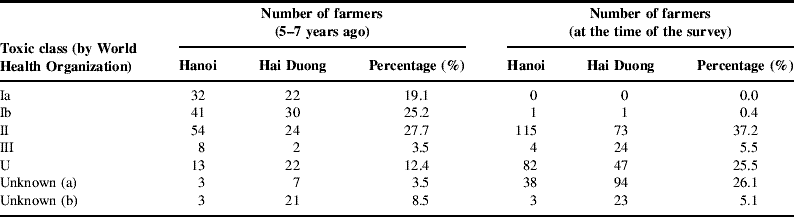
From the survey, a total of 282 responses were collected from 125 farmers about their use of pesticides 5–7 years ago. Of all pesticides used in that period 19% belonged to the highest toxicity as classified by World Health Organization (class Ia), 25% to class Ib, 28% fell under class II and 16% to class III and U28 (unlikely to present an acute hazard in normal use). The rest were either not listed by World Health Organization or contained unknown Ais. For current pesticide use, 505 responses were collected and of the pesticides used in this period, less than 1% was categorized under class Ib of toxicity. The rest belonged to the classes II, III, U and unknown. It deserves mentioning here that, according to other institutions, many unknown pesticides (i.e., Acetamiprid, Abamectin and Indoxacarb) contained low acute and chronic toxic material. Pesticides with unknown Ais accounted for 8.5% in farmers' use 5–7 years ago and 5.1% currently (Table 1).
Changes in the toxicity of pesticides used by Vietnamese farmers in two provinces during two time periods.
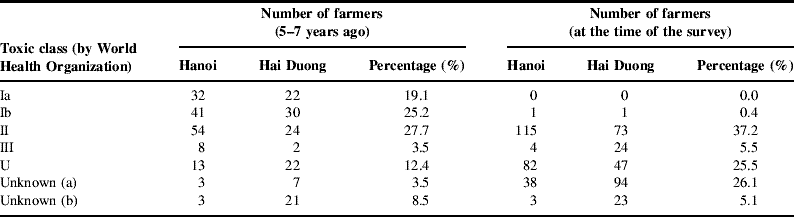
Unknown (a), pesticides with known Ai but not listed in IPCS28; Unknown (b), pesticides with unknown Ai.
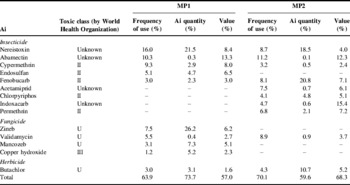
Insecticides are the most used pesticide and they account for 79 and 77% of the total pesticide selected by farmers 5–7 years ago and currently, respectively. The farm monitoring results showed that over time relatively more insecticides are being used, increasing from 48 to 65% of the total quantity of Ai in the pesticides used in MP1 and MP2, respectively. Herbicide use is also growing, though not at a similar rate; from 4 to 13%. In contrast, the use of fungicides is declining; down from 48 to 22% of the total Ai in pesticides used by farmers when comparing the two monitoring periods.
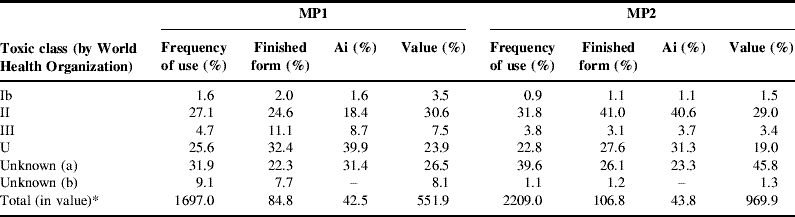
The results from farm monitoring furthermore confirm the impression that farmers rely more on pesticides from toxic class II and less on those from class U in MP2 as compared with MP1. This can be explained by the reduction in the use of fungicides, which formed the most-often applied pesticide in toxic class U. Better knowledge of farmers on insects and diseases partly explains the reduction of fungicides used in MP2. For instance, in the MP1, farmers often failed to correctly distinguish between the damage caused by mites and thrips and that resulting from fungi and therefore they relied on fungicides to treat pests. Besides, there is also a remarkable change in the types of pesticides used over time. Pesticides of unknown Ai, which accounted for 7.70% of the total pesticide volume of 84.8 kg (in finished form) in MP1, fell to 1.23% of the total volume of 106.8 kg in MP2 (Table 2). It is important to note that according to Table 1, farmers reported a significantly higher use of pesticides with toxic class Ia in the period 5–7 years ago than the findings for MP1 reported in Table 2. This could be explained by the different approaches adopted for data gathering, i.e., more qualitative indications in Table 1 compared with the quantitative findings used for Table 2.
Quantity and value of pesticides used by farmers in Hanoi during two time periods.
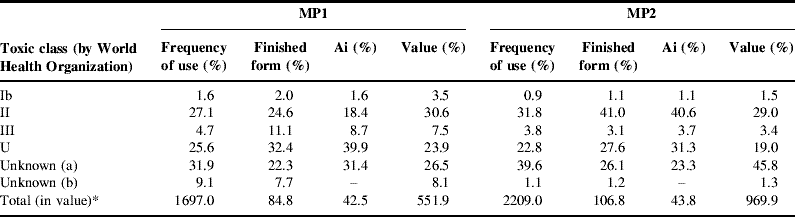
* Unit for frequency of use is number, finished form and Ai is kg and value is US$.
Unknown (a), pesticides with known Ai but not listed in IPCS28; Unknown (b), pesticides with unknown Ai.
A shift from more toxic to less toxic Ais between MP1 and MP2 was confirmed from pesticide expenditure data. For example, in MP1 the value (cost ha−1) of the ten most used pesticides accounted for roughly 74% of total Ai quantity, but only for 57% of the total value. By contrast, in MP2, these ten pesticides accounted only for 60% of the total Ai quantity used, but 68% of their total value. The increased use of pesticides such as Acetamiprid and Indoxacarb and the reduction of Endosulfan in MP2 indicate a shift toward the application of newer and safer compounds; this also signifies a trend toward the use of more expensive pesticides (Table 3).
The ten pesticides used most by farmers in Hanoi during two time periods.

This shift toward increasing use of more expensive and safer pesticides was also statistically confirmed. The Independent-Samples T Test analysis did not confirm a significant difference in the quantity of pesticides used per ha (both in finished form and in terms of Ai) between MP1 and MP2 for both farm household- and primary production unit-based analysis. The analysis, however, confirmed the significance of the difference between the pesticides used in MP1 and MP2 in terms of their value (df=60, P<0.01 and df=415, P<0.01 for household- and primary production unit-based T Test, respectively).
During the survey most farmers reported the use of more than five types of pesticides during one cropping season. Efficacy was the most important selection criterion for 92% of the farmers, whereas only 6.4% regarded toxicity to themselves and consumers as their most important consideration in pesticide selection. None of the farmers reported that they were concerned about the toxicity for themselves or consumers 5–7 years ago. Almost 97% of farmers asserted that the types of pesticides presently marketed and used are much more diverse than in the past. In addition, 72% of farmers stated that pesticides are safer today than they were in the past based on their own observations and personal experiences. For instance, farmers mentioned that at present they feel less tired after spraying pesticides and that they find less or no aquatic animals dead after spraying compared with the past. This impression is contradicted by 12% of the farmers, who think that pesticides are currently more toxic compared with 5–7 years ago.
A large majority (62%) of the farmers interviewed were not able to determine the World Health Organization-classified toxicity of the five pesticides they use most often. The rest could determine the toxicity of some or all of these five types. Farmers who knew the toxicity of some types have mainly learnt this by heart on the basis of information acquired from their neighbors or from the retailers. Those who could determine the toxicity of all five types of pesticides relied on the color of the barcode on the pesticide package/bottle and they got additional information from the pesticide labels. Pesticides that claimed to be biological were automatically considered safe by the farmers. Another tool farmers relied on in determining the toxicity of pesticides is the pre-harvest interval. The shorter the pre-harvest interval, the safer they considered the pesticide. Despite the fact that the majority of the farmers could not determine the toxicity of the pesticides they used, most of them were not really concerned about their toxicity as such. Up to 42% of the farmers said they take toxicity into account when they purchase and use pesticides.
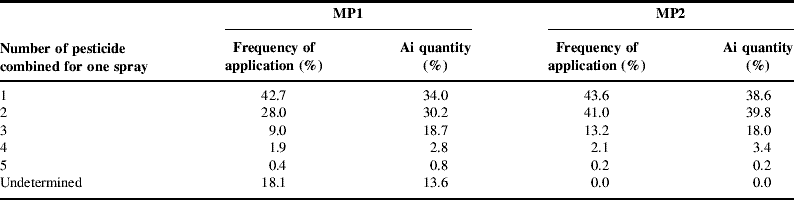
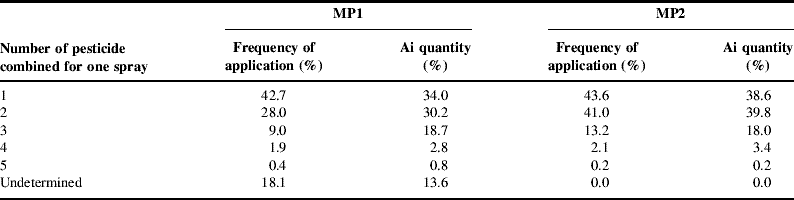
According to the farmers' survey, up to 75% of the farmers apply a higher dosage than recommended and only 25% of the farmers stick to the recommended dose. Around 27% of the farmers always combine two or more different types of pesticides in each spray. Roughly 2% of the farmers said that they never use pesticides in a cocktail. The rest reported that they could cocktail pesticides when they find serious attacks of pests and diseases. Similarly, during the farm monitoring study, the application of ‘pesticide cocktails’ dominated the spraying practices of farmers. In terms of their frequency, the combination of two pesticides for one spray increased remarkably, from 28% in MP1 to 41% in MP2. Sometimes the cocktail even consisted of more than two different types of pesticides (in finished form) (Table 4).
Pesticide spraying practices of farmers in Hanoi during two time periods.
Both the farmers' survey and the farm monitoring clearly showed that all (100%) farmers in the Red River Delta rely on pesticides as their main tool for controlling pests and diseases. However, next to pesticides, up to 42% of the farmers interviewed also apply other pest-controlling methods such as manual control, crop rotation and field clearing. In particular, 5% of the farmers reported that they apply crop rotation and soil treatment seasonally or periodically to reduce the development of pests and other diseases. According to farmers, clearing the fields after harvesting vegetables (or even without harvesting them if the market price is too low) is nowadays done more often than in the past, because they witnessed a significant effect on reducing the expansion of pests and diseases. Also new methods are emerging. For instance, a farmer in Hai Duong province discovered by accident a biological method to control Spodoptera litura—an insect that has strong negative effects on vegetable production:
‘Until two cropping seasons ago, after harvesting kohlrabi, I sprayed pesticides to kill the insects that remained in the soil, including Spodoptera litura. However, when I ploughed the soil in preparation of the next planting season, I found that the Spodoptera litura insects were highly concentrated in the few kohlrabi roots that were left in the field. So, I concluded that pesticides could not effectively control these insects since they live in the soil. During the next season when I found that the vegetable was damaged by the insects, I therefore collected kohlrabi leaves growing on other fields and put them on the soil beds to attract the insects. I started this job at about 4 or 5 pm and returned to my vegetable fields at 7 or 8 pm with a flash light and a tank. Kohlrabi leaves were carefully picked up and the insects were released into the tank by shaking the leaves. The leaves were then put back on the soil bed. Early next morning, I collected the insects from the kohlrabi leaves again. By doing so, I significantly controlled Spodoptera litura without using pesticides specifically for this insect. I did tell my neighbors and some of them have started to apply this controlling method as well.’
An example of less pesticide-based vegetable production is also found in Nam Dinh province. In some areas, farmers grow baby cucumber under contract with processing companies. At the early growing stage when the plant has only 2 to 3 leaves, it is often seriously attacked by leafminer. The conventional pesticide spraying method turns out to be less successful. For this, in recent years, instead of spraying pesticides, the farmers inject pesticide directly into pedicels of plant leaves. This pest control method not only helps farmers successfully control leafminer, but also save them up to 60% of pesticide quantity (in finished form), as revealed by farmers, as compared with the conventional method of spraying.
Factors influencing pesticide practices of farmers
As presented in the previous section, no statistical difference could be observed in quantity of pesticides used by farmers (per ha percropping season) when comparing 2002 and 2007. However, the study proved that there is a difference between the 2 years in terms of the value of the pesticides that farmers used (per ha per cropping season). This section will help to explain the different factors that play a role in farmers' daily decisions in selecting and handling pesticides.
The survey showed that farmers often judge the quality of the pesticides they apply on the basis of cash cost per tank of pesticide. For farmers in Hanoi, one tank worth 6000–7000 VND would be acceptable both in terms of their financial capacity and their perception of effective pest control under average circumstances. Farmers in Hai Duong, consider spending a little less, i.e., 5000–6000 VND for a tank, as acceptable. This perception of pesticide use based on financial expenditure can lead to the wrong application of pesticides, for instance, applying pesticide cocktails as mentioned above or using pesticides above/below the recommended dosage. For instance, in Dong Anh and Gia Lam district (Hanoi), we found examples of farmers who applied one package of Amate 150SC, which is technically suggested for treatment of about 120 m2 of vegetable area, for more than 200 m2! In order to save time and labor, some farmers increase the concentration of pesticide and reduce the volume of the tanks compared with the technical prescriptions for treating the crop.
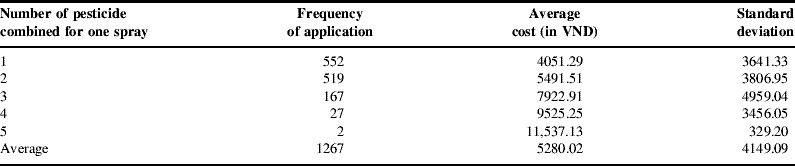
In our pesticide monitoring study, we found that, based on the information from the 1267 cases of pesticides applied during MP2, the average amount spent by farmers for one tank of pesticides is 5280 VND (Table 5). Although somewhat arbitrary, we can assume that pesticides sold for less than 2000 VND package−1 (to be applied in one tank) are inexpensive. On the basis of this assumption, we found that 28.4% of the total number of tanks contained inexpensive pesticides. Of the 111 different types of pesticides (in finished form) used by the farmers that were monitored, 25 were bought for less than 2000 VND package−1. The 25 cheap pesticides accounted for 26.4% of the total quantity of pesticide Ai, but only for 11.2% of the total pesticide cost. When farmers prioritize the reduction of risks from pests and diseases to save their crops, they tend to rely on pesticide cocktails. In general, the more pesticides are combined in the cocktail, the more expensive this is as well. Finally, farmers apply inexpensive pesticides for additional spray(s) if they consider the previous application not as effective as expected.
Average cost for one tank of pesticide in Hanoi in the second monitoring period (MP2).
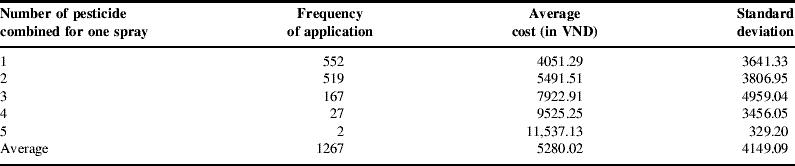
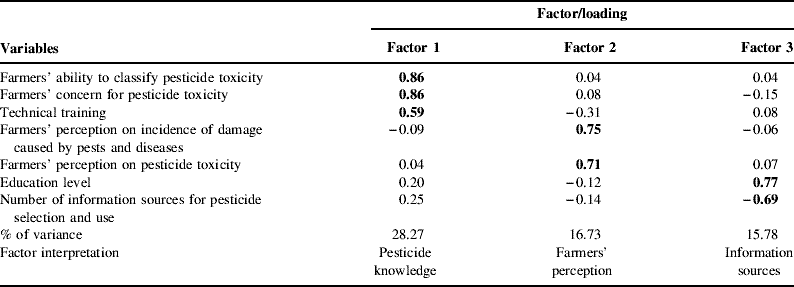
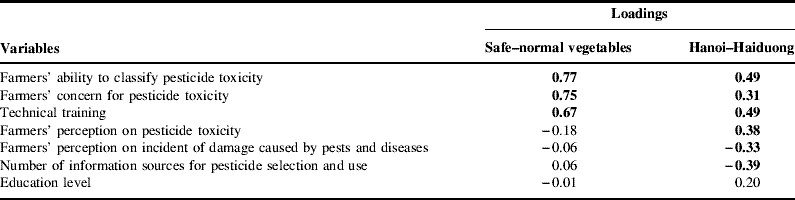
A Principal Components Analysis applied on seven variables coded from 1 to 4, resulted in three major groups of interrelated variables explaining the use of pesticides. Factor 1 (% of variance: 27.77) can be interpreted as ‘pesticide knowledge’ of farmers. This factor is accounted for mainly by the variables Farmers' ability to classify pesticide toxicity, Farmers' concern for pesticide toxicity and Technical training. Farmers with more technical training are more capable of classifying pesticide toxicity and seem more concerned about pesticide toxicity in their selection and use. Factor 2 (% of variance: 16.53) can be interpreted as ‘farmers' perception’. This factor is explained by two major variables: Farmers' perception on incidence of damage caused by pests and diseases and Farmers' perception on pesticide toxicity. Farmers who perceive that current problems of pests and diseases are more serious also perceive that current pesticides are more toxic than those in the past. It could be assumed that the higher the risks caused by pests and diseases are perceived, the more farmers intend to use toxic pesticides. Factor 3 (% of variance: 15.59) is interpreted as the ‘information sources’ based on which farmers make their selection and use of pesticides. There is a negative relation between the variables of Education level and Information sources for pesticide selection and use. This means that farmers of higher education level rely on fewer sources of information for their selection and use of pesticides. In this case, they preferably rely on their own knowledge, acquired from daily farming practices, rather than on external sources such as neighbors, retailers and/or extension staff (Table 6).
Factors affecting farmers' selection and use of pesticides in two provinces (principal components analysis: rotated component matrix).
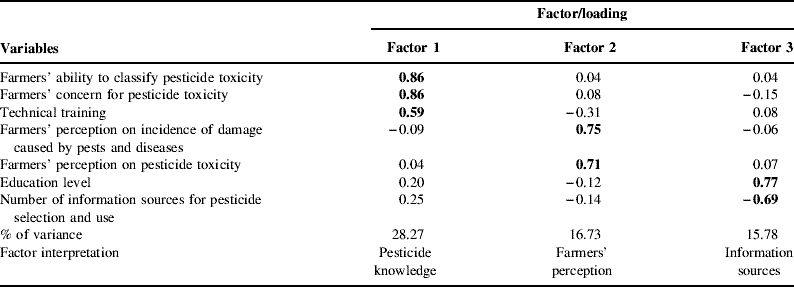
Variables indicated in bold values are considered for interpretation by the representative factor, n=125. Bartlett's test of sphericity is significant at P<0.01.
A discriminant analysis of the seven variables used for our factor analysis was carried out comparing ‘safe vegetable’ producers with their ‘normal vegetable’ colleagues and Hanoi with Hai Duong farmers. The discriminant analysis of safe vegetable versus normal vegetable growers gave high loadings for the variables Farmers' ability in the classification of pesticide toxicity, Farmers' concern for pesticide toxicity and Technical training. There is a statistically significant difference between these two groups of farmers (P<0.1). More technical training for farmers under a safe vegetable program explains this difference. There is also a statistically significant difference between farmers in Hanoi and those in Hai Duong (P<0.01). These two groups are not only significantly distinct in ‘pesticide knowledge’, but also in ‘perception’ on pesticide toxicity and the incidence of damage caused by pests and diseases, as well as the number of information sources to which farmers refer in their selection and use of pesticides (Table 7).
Differences in pesticide knowledge between farmer's groups in two provinces (discriminant analysis: structure matrix).
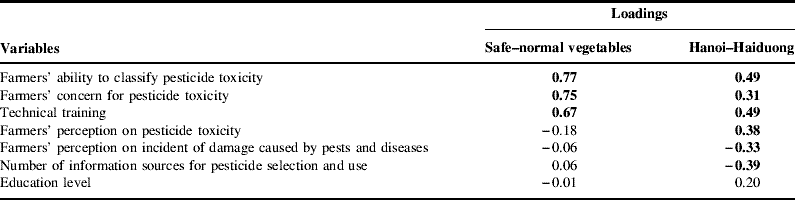
Variables indicated in bold are considered for interpretation by the representative factor, n=125, valid cases=76%. For safe–normal vegetables discriminant analysis, Wilks' Lambda=0.87; P=0.09 and for Hanoi–Haiduong, Wilks' Lambda=0.76, P<0.01.
Conclusions
The institutional setting in Vietnam for a change in pesticide distribution and toward use of fewer and fewer toxic active ingredients is slow, but somewhat promising. A highly profitable market, with ineffective state inspection and enforcement, and poorly informed farmers that were strongly dependent on retailers and pesticide producers together created a difficult situation for environmental improvements in pesticide management. Nevertheless, this study found clear evidence for the presence of an increasing number of vegetable farmers in Vietnam that changed practices of pesticide use, because of the health risks associated with pesticides and economic trade-offs, i.e., between labor and pesticide costs. Especially farmers in Hanoi showed increased preference for using pesticides with shorter pre-harvest intervals and higher costs, which are perceived as indications for safer pesticides. This trend goes together with a clear reduction in the use of pesticides with unknown Ais, which are often condemned as illegal and highly toxic in Vietnam. Although limited, this improvement in pesticide use can be considered a success, especially given the increasing intensification in vegetable production at the research sites (for instance in Dong Anh district, Hanoi, the cropping index increased from 1.41 in MP1 to 1.74 in MP2).
Farmers are remarkably concerned about the toxicity of the pesticides they use. Our study revealed that the selection and use of pesticides are, among others, influenced by the farmers' technical knowledge, their perception of the risks associated with pest and disease attacks and with pesticide toxicity and the information sources to which farmers have access. Red River Delta farmers seem to have developed from passive into reflexive users with respect to pesticide selection and application. Notably in Hanoi, farmers have become less dependent on pesticide retailers, both for their technical information and for financial support. Moreover, in certain cases, they are even ‘whistleblowers’ on the sale of illegal pesticides by these retailers. The combination of an increased awareness among farmers of the cost-effectiveness of pesticide use and of the negative effects of pesticides, with a somewhat more effective enforcement of state regulations, has contributed to the revealed shift toward the distribution and application of more expensive and safer pesticides, and to the decreased use of pesticides with unknown active ingredients.
But much still remains to be improved. Though parasitic and inexpensive pesticides account only for a small percentage of the total pesticide expenditure of farmers for all vegetable crops in MP2 (11.2%), they are responsible for a much higher percentage of the total quantity of active ingredients (26.4%), as shown in the results of our second farm monitoring study in Dong Anh district, Hanoi. These products do not contribute much to the control of pests and diseases, at least from retailers' and farmers' perspectives, but add heavily to the impact and burden on the environment and human health. Quick removal of these pesticides from the market via state intervention is thus technically and economically possible and could be strongly suggested. Otherwise, although farmers are increasingly getting rid of ‘parasitic’ pesticides while improving their knowledge and experience of these pesticides, it will take a long time until a substantial percentage of farmers decides to fully get rid of these pesticides.
The efforts by the Vietnamese authorities to promote ‘safe vegetable’ production practices, with relatively high costsReference Duc29, have achieved some results at the farm level. So far, this government program, with its extensive technical training provided to farmers, has led to differences in the ‘pesticide knowledge’ and ‘pesticide cocktailing practices’ of ‘safe vegetable’ farmers compared with ‘normal vegetable’ farmers. However, the differences in pesticide use practices between Hanoi and Hai Duong should be explained rather by the technical knowledge and financial capacity of farmers and the intensification of vegetable production than purely by governmental interventions, notably by differences in investments (e.g., in the so-called net houses, which protect plants (growing inside) from attacks of insects) and in the use of zoning areas for safe vegetable production. Future official programs on safe vegetable production should be based on a careful evaluation and analysis of the impacts of the program so far and, in particular, pay attention to other actors playing a role in successful improvements in practices of pesticide use.
Given the poor economic conditions of the small-scale and fragmented landholdings of Vietnamese farmers, and—to a lesser extent—the state of Vietnamese pesticide companies, a radical move away from pesticide use in the Vietnamese agricultural sector is not likely in the short term. Pesticides will, for the moment, remain of vital importance for Vietnam's agriculture in general and for vegetable production in the Red River Delta in particular. But a shift toward the reduction of pesticide use in vegetable production and the distribution of products with newer and safer compounds is possible and badly needed to protect human health and the environment. As shown above, this shift has already started. In particular, several innovations by farmers and—to a lesser extent—pesticide companies and retailers can be witnessed. These small shifts and innovations will certainly take time before gaining sufficient momentum and geographical spreading throughout the Red River Delta region. The further integration of Vietnam into the world economy, as well as an active governmental intervention strategy, will hopefully result in Vietnam joining the international trend toward ‘the gradual but relentless transition from chemical to more environmental friendly and biological pest control … ’ (italic added)Reference Mol30. The process of greening pesticide distribution and use in Vietnam may be slow so far, but is most likely to continue in the foreseeable future.