


Introduction
Approximately 60–70% of women in the UK experience hot flushes and night sweats (HF/NS) during the menopause transition; these are problematic for 20–25% due to physical discomfort, social embarrassment and disrupted sleep (Hunter and Liao, Reference Hunter and Liao1995). Although hormone therapy (HT) is an effective treatment, its use has declined (Menon et al., Reference Menon, Burnell, Sharma, Gentry-Maharaj, Fraser and Ryan2007) following the publication of prospective trials suggesting increased risks of breast cancer and stroke (Rossouw et al., Reference Rossouw, Prentice, Manson, Wu, Barad and Barnabei2007; Gabriel, Hsia, Johnson, Sanchez and Bonfill, Reference Gabriel, Hsia, Johnson, Sanchez and Bonfill2002). HF/NS often reoccur after HT is discontinued (Hunter et al., Reference Hunter, Gentry-Maharaj, Ryan, Burnell, Lanceley and Fraser2012) and therefore there is a need for safe, effective non-medical alternatives.
HF/NS are interesting bio-psycho-social phenomena (Hunter and Rendall, Reference Hunter and Rendall2007); there are discrepancies between subjective and physiological measures of HF/NS (Carpenter and Rand, Reference Carpenter and Rand2008; Thurston, Matthews, Hernandez and De La Torre, Reference Thurston, Matthews, Hernandez and De La Torre2009) and cross cultural differences in HF/NS experience (Melby, Lock and Kaufert, Reference Melby, Lock and Kaufert2005). A cognitive-behavioural model of HF/NS has been developed (Hunter and Mann, Reference Hunter and Mann2010) that includes stages of information input, detection and attribution, cognitive appraisal and behavioural reactions. There is evidence that women's HF/NS experiences are influenced by their beliefs about the menopause and their cognitive and behavioural reactions to HF/NS. There is some evidence to suggest that overly negative beliefs about menopause, relating to aging and other negative physical and emotional consequences, are associated with negative beliefs about HF/NS (Rendall, Simonds and Hunter, Reference Rendall, Simonds and Hunter2008). A factor analytic study of cognitive reactions to HF/NS has suggested three main sets of beliefs (Rendall, Simonds and Hunter, Reference Rendall, Simonds and Hunter2008): beliefs about self in a social context (social embarrassment, e.g. “when I have a hot flush everyone will look at me”), beliefs about control/coping with HF (control beliefs, e.g. “other women manage better than me”), and beliefs about coping with NS and sleep disruption (beliefs about NS and sleep, e.g. “If I have night sweats I'll feel terrible the next day”). Similarly, Hunter, Ayers and Smith (Reference Hunter, Ayers and Smith2011) identified three main dimensions of behavioural reactions: avoidance behaviours (e.g. transport, social activities), cooling behaviours (e.g. carrying fans, water), and positive behaviours (e.g. carrying on, accepting the HF, relaxing, using humour). These HF/NS beliefs and behaviours, apart from cooling behaviours that might function as safety behaviours, have been found to be significantly associated with more problematic HF/NS (Hunter et al., Reference Hunter, Ayers and Smith2011).
A 4-session cognitive behaviour therapy (CBT) treatment for HF/NS, including paced diaphramatic breathing (Freedman and Woodward, Reference Freedman and Woodward1992), showed promising results delivered in both one to one (Hunter and Liao, Reference Hunter and Liao1996) and in group formats (Hunter, Coventry, Hamed, Fentiman and Grunfeld, Reference Hunter, Coventry, Hamed, Fentiman and Grunfeld2009; Mann et al., Reference Mann, Smith, Balabanovic, Hellier, Hamed and Grunfeld2012). A randomized controlled trial has recently been carried out, comparing Group CBT and guided Self-Help CBT to no treatment, for women with problematic HF/NS (MENOS 2) (Ayers, Smith, Hellier, Mann and Hunter, Reference Ayers, Smith, Hellier, Mann and Hunter2012). Both forms of CBT led to clinically significant reductions in HF/NS Problem Rating; unadjusted effect sizes (Cohen d) were large for Group CBT (1.18; 95% CI, 1.36–2.88) and for Self-Help CBT (1.41; 95% CI, 1.29–2.86) compared to no treatment and improvements were maintained at 6-month follow-up. There were also significant reductions in the frequency of NS (but not daytime HF), and improvements in mood and quality of life that were greater for women attending Group CBT.
Although the MENOS 2 RCT demonstrates the efficacy of CBT in reducing the impact of HF/NS it provides little information about how women experienced the intervention and/or any changes they experienced during the process. An increasing number of RCTs of complex interventions include a qualitative component (Lewin, Glenton and Oxman, Reference Lewin, Glenton and Oxman2009). This paper presents the results of qualitative research conducted as part of the above RCT (Ayers et al., Reference Ayers, Smith, Hellier, Mann and Hunter2012). The main objectives were to carry out a qualitative evaluation of the intervention from the women's perspective by exploring (i) women's experience of treatment-related changes, i.e. what changed (outcome) and (ii) how they experienced the intervention, i.e. what did they change (process). The study was informed by the principles of Interpretative Phenomenological Analysis (IPA: Smith, Flowers and Larkin, Reference Smith, Flowers and Larkin2009); IPA embodies a phenomenological epistemology that focuses on exploring people's everyday experience. The research was conducted in parallel with the RCT but independently; during the analysis (January-March 2011) the trial outcomes were unknown, though these became available at the time of writing this paper (June 2011) and have been used to contextualize the results.
Method
Participants
All participants were recruited from the main trial which contained six cohorts of participants (for each treatment arm). For full details see Ayers, Mann and Hunter (Reference Hunter, Ayers and Smith2011) (trial protocol) and Ayers et al. (Reference Ayers, Smith, Hellier, Mann and Hunter2012) (trial outcome). Twenty interviews were conducted with participants recruited from the first three cohorts of the trial (10 Group and 10 Self-Help CBT). Participants were interviewed between November 2009 and August 2010 after the final 6-month follow-up assessment. The interviews were conducted at this point in order to avoid contaminating the main outcome data for the trial. While this may have limited recall, it allowed us to tap into the most salient memories of the experience and, perhaps more importantly, to access those changes that were maintained over time. Interviews were conducted with all consenting participants until the target sample of 20 interviews was realized (response rate 91% for Group CBT and 56% for Self-Help CBT). These 20 interviews were used for the main analysis. For validation purposes only, 10 further interviews were conducted with participants selected from the last three cohorts of the trial (5 Group and 5 Self-Help CBT), between August and December, 2010. Although validating the analysis is not standard practice in qualitative research, the validation exercise aimed to establish (to our own satisfaction) that the themes constructed were consistently represented in the data. We also felt that the validation exercise was justified because the main analysis was based on the first three cohorts of the trial (reflecting resources availability for transcribing and analysis). The validation interviews increased our confidence that the qualitative research captured the experiences of women throughout the trial.
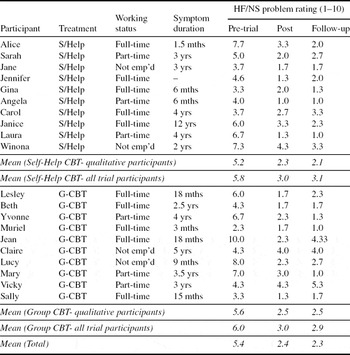
The participants’ ages ranged from 47–59 years (mean age = 54.3 years), and the majority (90%) were Caucasian (see Table 1). The table shows the HF/NS problem rating scores (scale 1–10) at baseline, post-treatment (6 weeks post-randomization) and at follow-up (26 weeks post-randomization). All names shown are pseudonyms. Ethical approval for this research was granted by the King's College London Research Ethics Committee (Psychiatry, Nursing and Midwifery Ethics Subcommittee, ref: PNM/08/09-42).
Participant profiles

Treatment protocol
Full details of the treatment protocol for both Group CBT and Self-Help CBT can be found in Ayers et al. (Reference Ayers, Mann and Hunter2011).
Group CBT
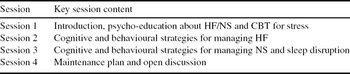
Participants attended a series of four 2-hour evening sessions (6–8pm) held on consecutive weeks. Each session included relaxation/paced breathing practice with a CD. Homework was assigned after each session including diary keeping and implementation of goals and strategies learned in the session. Session structure and content are summarized in Table 2.
CBT session structure and content

Guided Self-Help CBT mirrored the content of the Group CBT sessions. The booklet was divided into four sections reflecting the structure of the groups and participants were encouraged to set aside time to work on one section each week, over a period of 4 weeks. Participants were given the same CD and assigned the same homework tasks as group participants. They had a face-to-face introductory session with the clinical psychologist followed by a guiding telephone call 2 weeks into treatment.
Interview schedule
The interview schedule was developed based on the guidance of Smith and Osborn (Reference Smith, Osborn and Smith2008) and Smith et al. (Reference Smith, Flowers and Larkin2009). The key focus of the interview was to explore women's overall experience of the treatment and its impact (i.e. the changes they experienced as a result of taking part in the treatment and the women's perspectives on what facilitated the changes). We were primarily interested in capturing women's most salient memories of the experience. However, additional probing questions were included as appropriate, for example, to explore how women experienced different components of the treatment and how relevant contextual factors influenced their experiences. All the interviews were conducted by either the first or second author, both of whom were blind to the participants’ outcome scores at that time. The average length of the interview was approximately 30 minutes. All interviews were audio recorded with informed consent from participants. Interviews for the main analysis (see Participants sections) were transcribed verbatim and anonymized to protect confidentiality.
Data analysis
The first author analyzed the interviews supported by the second and third authors to validate the emerging thematic structure during the analysis. The analysis was conducted using IPA (Smith and Osborn, Reference Smith, Osborn and Smith2008; Smith et al., Reference Smith, Flowers and Larkin2009), applied with the support of a qualitative software (NVivo 9). The first stage involved reading and re-reading the transcripts, and making annotations to record any initial salient observations. After coding the first six transcripts (3 Group and 3 Self-Help), the first author reviewed the codes and organized them into a hierarchical structure of super-ordinate themes and underlying subordinate themes. These were then reviewed and finalized with the project team before the remaining 14 interviews were analyzed. An iterative approach was adopted to check that the developing themes were fully grounded in the data. Having completed the analysis of the 20 interviews we conducted a final validation exercise. An independent reviewer (psychology PhD student) compared the analytic output against the 10 additional interviews conducted with participants from the last three cohorts of the trial. A validation sheet was constructed which provided a detailed description of the themes and sub-themes identified through the main analysis. The researcher listened to each of the validation interviews in turn to establish whether each theme and sub-theme was represented in the interview. Quotations were extracted and documented for each theme and sub-theme. This process was repeated for each of the 10 validation interviews. In reporting the results of our analysis we have adhered to various well-established conventions for representing prevalence in qualitative thematic data (Braun and Clarke, Reference Braun and Clarke2006), using phrasing such as “the majority of participants” and “many participants” in a consistent way to express this, without quantification.
Results
The results are presented in two sections: (i) women's overall evaluation of the intervention (outcome); (ii) the thematic analysis capturing how women experienced the intervention and its effects (process). There was considerable similarity in how women experienced Group CBT and Self-Help CBT for HF/NS. Four super-ordinate themes were identified: (i) Making sense of symptom change; (ii) New ways of coping and regaining control; (iii) Acknowledging and challenging the menopause taboo (the socio-cultural context); and (iv) Social interactions and support versus independent learning. The final theme highlights the main differences between the Group and Self-Help CBT formats. The themes were similar across the main interviews and the additional validation interviews.
Women's overall evaluation of the intervention
All the women who received either Group CBT or Self-Help CBT reported that the overall experience was positive, the only variation being the degree of enthusiasm expressed. Two women (Jean and Mary) described the treatment as life-changing.
As regards the menopause it turned my feelings around completely. I was depressed. I was fed-up. I couldn't cope. The hot flushes were just driving me to absolute distraction. And now I feel back in control of my life. That's the difference it's made. (Jean/Group)
At the same time, two others (Carol and Vicky) stated that this was not the magic bullet they had been secretly hoping for, although they felt it had been beneficial. Three women mentioned that they felt nervous about the group context but for two of these, this anxiety dissipated quickly. Most women described several main benefits of treatment, including learning strategies to cope with HF/NS, increased knowledge and understanding, feeling more relaxed, and regaining a sense of control. The coping strategies that were most salient were paced breathing and finding ways to deal with stress and emotional reactions.
On a practical level the breathing exercises have really helped, especially at night . . . I know it will pass but the breathing exercises have really helped. (Lesley/Group)
Women also described feeling more accepting of their HF/NS. This was often attributed to new knowledge and understanding, acquired either directly or experientially, or to the recognition that what they were experiencing was normal.
Well it was learning things like realizing that actually my hot flushes tended to last for only 5 minutes, and then using that so like when I got a flush I could tell myself oh this is only going to last for 5 minutes. (Winona/Self-Help)
As a result of the strategies learned, women regained a sense of being back in control.
I would say that it's been excellent for me. I initially thought that I could do absolutely nothing to help myself with menopausal symptoms . . . going through the book and realizing that I could control things has been excellent for me . . . . .I hardly have any hot flushes now. (Angela/Self-Help)
Some women noted that the benefits of the treatment had been far-reaching, prompting them to make positive changes in their lives.
Although it's helped with my menopausal symptoms I just find that it has touched on so many areas of my life . . .I just feel like I've learned so much from it. It's not just with the menopause. (Gina/Self-Help)
How women experienced the intervention and treatment related changes
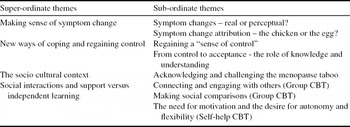
The four super-ordinate themes and the underlying sub-ordinate themes are shown in Table 3. These were broad themes that grouped sub-themes and were broadly based on the content of the sub-themes; while prompt questions were used in relation to the components of the CBT, the four themes reflected the content of the women's descriptions based on their experience of the treatment.
Summary of super-ordinate and sub-ordinate themes

Theme 1: making sense of symptom change
Although many women reported having fewer HF/NS, the majority described reduced symptom severity or impact.
For some reason, maybe because I've come to accept them, they seem to be less frequent and less severe, you know, they seem to be quite mild. (Alice/Self-Help)
Improvements were even acknowledged by several women who had expressed initial scepticism.
I have to say that when I first saw it (the ad) I thought Naaa. Because what I thought is how is it going to help? It can't control the hormones so you know it's not a magic wand that's going to make it go away. . . But I thought I'll give it a go. And I'm really surprised. (Sally/Group)
However, women did struggle to pinpoint how the CBT intervention changed their experience of HF/NS, as outlined in the sub-themes below.
Sub-theme: symptom change, real or perceptual? Although the majority of women “felt better overall”, they had difficulty pinpointing how and when improvements occurred.
I'm not sure whether they've got worse or better, or whether I just don't think about them as often. Sometimes I think oh, maybe I've had hot flushes and I don't even realize I've had one. (Gina/Self-Help)
This uncertainty seemed to be associated with declining awareness of symptom episodes.
It's so much gone into the back of my mind that it's difficult to know. (Angela/Self-Help)
Many women were curious about the relationship between their symptoms and their attention, wondering whether their symptoms had appeared to improve simply because they were less focused on them. Most explicitly recognized that the more they were busy and engaged, the less they noticed flushes.
To be honest, I think they're probably better but I'm not so aware of them. I just think I haven't got time for that. (Claire/Group)
However, some described adopting purposeful strategies to redirect their attention away from the flush (e.g. concentrating hard on whatever they were doing, focusing on breathing).
I concentrate really hard on what's being said on the radio, or on the television, or look at a book. (Jean/Group)
Sub-theme: symptom change attributions, the chicken or the egg? Uncertainty was also expressed in the explanations that women made for changes in their HF/NS.
I don't know. It's just the whole deal I think. (Jennifer/Self-Help)
Common external attributions for changes included the passage of time or the natural progression of the menopause and changes in the weather.
As far as I can identify, my symptoms have always been closely linked with the weather. . .so it's a bit difficult to judge really. (Winona/Self-Help)
Most commonly, women attributed improvements to a combination of factors, including changes that had occurred (or that they had made) as a result of the treatment. Most attributed improvements to new skills acquired, especially paced breathing, but also becoming more aware of their thoughts and using purposeful distraction, to an overall change in attitude to their symptoms, or to feeling better generally.
The deep breathing really helped because I always remember to just breathe and let it flow over me. I just forget about it. I let that deal with it. (Alice/Self-Help)
As with attention, the observed link between stress and symptoms sometimes led to questioning or confusion regarding the direction of causality (do they have fewer symptoms because they are feeling less stressed or vice versa?)
Theme 2: new ways of coping and regaining control
All the women felt that the treatment improved their confidence in their ability to cope with their HF/NS symptoms.
The hot sweats vary during the day, they come and go, but they haven't changed. It's just coping with them that has become easier. (Carol/Self-Help)
Many women indicated that the emotional reactions to their symptoms had changed, often making comparisons between past and present emotional experiences.
I used to get quite annoyed and irritable with them and frustrated (sighs) just lost it really . . .you know, I had no patience. (Mary/Group)
Coping was also equated with being able to carrying on with one's activities despite the symptoms.
If I was having a difficult conversation. . . .and I could feel one go and that would distract me away from the conversation so I couldn't follow it through properly . . . But now I can ignore it totally and carry on with the conversation. (Jean/Group)
Some women reported that their improved coping strategies had generalized and that they were dealing better with their lives.
I think it contributed towards me gradually dealing with being made redundant because it was a very positive step to be taking. (Winona/Self-Help)
and were more confident about handling symptoms in the future.
I think, God will this go on forever, but if it does, if I'm still having hot flushes in 10 years time I know that I will be able to cope with that. (Claire/Group)
Sub-theme: regaining a “sense of control”. More than half the women (12/20) described experiencing a restored “sense of control”. In contrast, prior to treatment many had felt that they had little or no control over their symptoms, a factor that contributed significantly to their distress.
So like I say I'm in control now whereas before I thought that the hot flushes were in control. (Sally/Group)
Having control meant different things to different women. Although a few felt that they could sometimes prevent flushes occurring, more commonly women felt that they could influence symptom severity.
Although you can't do anything about the frequency of them, you can actually do something about the severity of them. You can either get yourself into a tizzy over it or you can let it go over you. (Laura/Self-Help)
Others felt that they could simply manage their reactions to their symptoms or, at the very least, acknowledged a choice to ignore them.
It is worth noting that some women (8/20) expressed a strong need to be in control. Some expressed strong beliefs that they should be able to control their HF/NS and/or that menopausal symptoms should not take over their lives.
I'm not going to let this eat me. I'm going to eat it . . . . . because you've got to fight. That's life! (Yvonne/Group)
Others described themselves as determined, strong-willed and driven, or described lives that required a lot of control.
Of all the strategies that restored a sense of control, paced breathing was reported to be the most helpful because it could potentially be applied in any situation. Women also described evidence of using a variety of cognitive and behavioural strategies, including use of helpful thoughts (described as “changing the channel in my head” by Beth/Group), and changing their focus of attention (ignoring the flush and carrying on or changing behaviours that focused their attention on their flush). For example, one woman noted how her thoughts had changed when she has HF in social situations.
I used to think “well perhaps they're thinking whatever's the matter with that woman”. . . .particularly men. But I just don't worry about it as much anymore. And if they happen I think well, it's only going to last a few seconds. I'm not going to collapse. (Lesley/Group)
Many women also described applying the above strategies in other situations besides HF/NS. As a result, they gained more control over their emotions generally, resulting in improvements in wellbeing and relationships.
Sub-theme: from acceptance to control – the role of knowledge and understanding. Many women (13/20) felt that their ability to cope with HF/NS had improved due to their more accepting stance towards the symptoms (allowing the HF/NS to run its course or “letting it go”).
It's to do with just letting things happen really and in a way not trying to control so much what's happening so therefore by not actually trying to control it so much I'm actually coping with it better. (Lucy/Group)
Often this attitude of acceptance was used in conjunction with more active coping strategies. Many of these women attributed their increased acceptance to improved knowledge and understanding of their menopausal symptoms (e.g. information about the thermoregulatory mechanisms of HF/NS).
It all just started to make sense a bit about the temperature. I mean it was a light bulb moment. You start to look at things differently. (Sally/Group)
This knowledge helped women to recognize that the experience is normal.
If I can rationalize why it's occurring then it's not so frightening and it's not quite so threatening. (Lucy/Group)
For some women, the move towards acceptance was broader - accepting the whole menopause transition.
I suppose the fact that every woman's got to go through this . . . I will come out the other end and it's not quite as big a deal as I first thought it was. (Lesley/Group)
Many women also described greater self acceptance, evidenced by their efforts to challenge their attitudes and rules about the way they live their life. They described how they were trying to make fewer demands on themselves and attaching greater importance to self-care. Many of these changes were still being maintained at the 6-month follow-up.
Although acceptance was a theme shared by group and self-help participants, the self-help participants seemed to mention this more than the group participants (mentioned more often and in more domains of life). It is possible that the self-help booklet communicated this more strongly and powerfully than the group CBT. Also, acceptance was often linked to knowledge and understanding, and maybe the latter is more easily digested from a booklet as women can take in the information at their own pace and re-read sections over time. In line with this, self-help participants discussed the knowledge they had acquired more often than Group CBT participants.
Theme 3: socio-cultural context: acknowledging and challenging the menopause taboo
Many women described their experience of problematic menopausal symptoms as quite isolating, stating that menopause remains a taboo subject. As an unacceptable topic of conversation, discussions on this topic were experienced as rather limited.
It seems like in the ordinary world outside if you didn't have this kind of session, no one talks about the menopause so it's like no one else is going through it apart from you. (Yvonne/Group)
Overall, there was a sense that women just need to get through it on their own. Consequently they felt less supported by their peers during the menopause relative to other life transitions.
I mean I've obviously got quite a lot of friends who are in a similar situation but none of us ever really go into huge details about it. (Claire/Group)
Also it was noted that many women do not go through the transition in parallel with their peers.
I don't have a lot of friends of similar age to me living here in London, I have sometimes missed just being able to compare notes. (Winona/Self-Help)
Given this context, it was interesting that some women (7/20) spontaneously described a variety of new behaviours (following treatment) to counter and challenge this taboo. These included being more open with others about the menopause, recommending the treatment to their friends, and even sharing their learning directly.
I say “you all need to do it. Sign up. It's really good”. . . . I go don't catastrophize. You're thinking the worst and it might not happen. (Sally/Group)
Women typically found that this attracted an interested audience and elicited positive reactions from others.
While both Group and Self-Help CBT participants acknowledged the ongoing menopause taboo, Group CBT participants were rather more likely to challenge this taboo by going out and talking openly about their experiences after treatment. Several self-help participants did this too but not to the same extent. Having the experience of talking in a group might have helped these women to be more confident about doing this in daily life.
Theme 4: social interactions and support versus independent learning
This theme relates to women's experiences of the different treatment formats (Group versus Self-Help) and their perceptions of the alternatives available. It draws attention to the individual differences and contextual factors that influence this. For example, it links strongly with Theme 3 in that women's reflections seem to strongly reflect the sociocultural context of HF/NS.
Sub-theme: connecting and engaging with others (Group CBT). For those who experienced the Group CBT, the value of meeting as a group and being with the other women was often the most salient memory of their experience. As well as enjoying the social/experiential aspect, women felt that they gained knowledge, understanding and changed perspectives from both listening and talking to the other women.
It was a huge benefit. If only, coming into the sessions, meeting the others and just doing that. (Muriel/Group).
Many women described reacting positively to the being allocated to the group treatment and meeting others with similar experiences: they were “not the only one”.
It helped me to see that there are so many other people that are in the same situation. (Yvonne/Group)
The group provided a safe forum and permission to discuss their concerns openly.
You are within a safe environment, with other women of a similar age and similar experience so you completely identify and you share those experiences. (Lucy/Group)
Of the 15 women who expressed a preference for a particular treatment format (at the follow-up interview) 12 stated that they would prefer Group CBT. This strong preference highlights the importance of sharing concerns and group support.
I think that being in a group is more supportive than doing it on your own. (Jane/Self-Help)
In line with this, several Self-Help CBT participants felt that they had missed out on the supportive aspect of the group treatment.
I found it a bit lonely. I would quite like to have listened to what other people had to say. . .it would have been nice to compare notes with somebody. (Laura/Self-Help)
This limitation of Self-Help CBT was also recognized by a number of group participants who felt that Self-Help CBT would be less beneficial because it offers less opportunity to connect with others.
I really felt it was it was really beneficial. I'm not sure that if I'd done it at home I would have found it so beneficial. (Claire/Group)
Sub-theme: making social comparisons (Group CBT). The majority of women who participated in Group CBT (8/10) compared their experiences with other group members and felt this was helpful in terms of normalizing their experiences and gaining a better perspective on their own situation.
It was really helpful just to talk to other women. . .and actually to realize that some people had stressful lives even worse than mine. Mine wasn't that bad in comparison. (Jean/Group)
The comments made by women suggested that much of the benefit appeared to be derived from making downward social comparisons.
It was really good to have eight people in the room who were all probably suffering more than me. (Claire/Group)
For several women, observing how other women were benefiting from the treatment also helped to improve motivation.
You could see the change in her. . .so that was quite good. (Sally/Group)
However, two women who perceived their situation to be significantly better than that of other group members, experienced negative reactions to this, including guilt (feeling they didn't deserve to be there) and anxiety (how their symptoms could progress).
So many people there had really bad hot flushes and I thought I shouldn't be here because there are people really a lot worse than me. (Sally/Group)
Sub-theme: need for motivation and desire for autonomy and flexibility (Self-Help CBT). The key theme relating to Self-Help CBT was the need for motivation and the capacity for self-directed learning. Several women who were highly motivated found it easiest to deal with.
I'm such a disciplined person . . . It suited me exactly and I knew it would. I thought this is going to help me and I need to do this on my own. . . Every evening I sat down and I did my exercises. (Angela/Self-Help)
In contrast, several others who were less motivated or disciplined or who were more time-constrained (e.g. working full-time) struggled to work through the entire booklet.
Well the times that I did it I had to stay up late in the night. Sometimes I fell asleep . . . . .I didn't quite finish doing that for that reason you know, finding the time. (Alice/Self-Help)
Perhaps related to motivational issues, self-help participants tended to recall less about the experience than group participants. Notably, however, three women expressed a fairly strong preference for the self-help treatment format. Two of these (one group and one self-help participant) felt that they could process information more effectively on their own.
It's distracting for me (talking about groups) because I know I can grasp it very, very quickly, what I'm meant to be doing. I don't need somebody else saying, have you done this, have you done the next thing. (Angela/Self-Help)
Other benefits of self-help were also highlighted. For example, several self-help participants mentioned the flexibility of this treatment format that allowed them greater autonomy.
In the end I quite liked doing it in my own time and my own space and whatever. (Jennifer/Self-Help)
In a similar vein, Laura appreciated the fact that she could keep her booklet for future reference.
I keep it by my bedside. . . .every now and then I'll just look back and see where I've come from and where I'm at now. (Laura/Self-Help)
Discussion
The main objectives of this study were to explore how women experienced a CBT-based intervention for HF/NS delivered both in a Group and Self-Help CBT format. This study complements the main MENOS2 RCT evaluating the effectiveness of CBT for HF/NS. Mirroring the trial outcomes, women evaluated both Group and Self-Help CBT as beneficial, improving their ability to cope, sense of control, and the impact of HF/NS. The women interviewed were representative of women who took part in the trial in that their problem rating scores reduced to a level consistent with the scores of the women in the main trial.
The analysis captured women's perspectives on the impact of the intervention (outcome) and their experience of the intervention (process) and generated four main themes. The level of analysis is arguably more phenomenological than interpretative, reflecting our desire to remain as closely tied as possible to women's accounts of their experiences.
Analysis of main themes
Making sense of symptom change
Women's struggle to make sense of changes in their experiences of HF/NS mirrors the complexity of the multiple interacting factors that might influence HF/NS (Hunter and Mann, Reference Hunter and Mann2010). Importantly, women's narratives illustrate a shifting perspective from a biomedical view of HF/NS to a more bio-psycho-social understanding. Given the historical emphasis on medical treatments for HF/NS, it is not surprising that many women began treatment with the view that HF/NS were biological events outside their control. However, through treatment most developed awareness, albeit somewhat tentative and uncertain, that how they experienced their HF/NS symptoms may be influenced by psychological factors, such as the focus of their attention, their attitude, and their cognitive and behavioural reactions to them.
New ways of coping and regaining a sense of control
This theme relates to the primary benefit highlighted by women, i.e. their improved ability to manage their HF/NS. The theme focuses the notion of perceived control, but incorporates varying perceptions about what exactly is being controlled (the physiological symptoms, emotional and cognitive reactions to the symptoms, and how one relates to (or transcends) these reactions). The sub-theme “regaining a sense of control” suggests that women's beliefs about the controllability of the symptoms were modified by the treatment, a change that was often attributed to paced breathing (perceived as distracting and calming), as well as other cognitive and behavioural strategies. Previous research has found that control beliefs (lack of control) are associated with HF/NS related distress (Hunter and Liao, Reference Hunter and Liao1995; Rendall et al., Reference Rendall, Simonds and Hunter2008); it is conceivable that this change may be a key mediator of HF/NS problem rating. However, many women also associated a developing attitude of acceptance with improved coping and emotional wellbeing, an observation that is consistent with the growing evidence on the transformative power of acceptance (Hayes, Follette and Lineham, Reference Hayes, Follette and Lineham2004). It is particularly interesting that both increased acceptance and perceived control were associated with improved coping. Although seemingly paradoxical at one level, there is evidence that acceptance, as an intentional strategy, is experienced as empowering (Hayes, Reference Hayes2004; Teasdale, Reference Teasdale1999). In women's accounts, accepting HF/NS seems to render them less bothersome, thus increasing perceived control.
Acknowledging and challenging the menopause taboo
The fact that many women described the menopause as a taboo subject reflects the entrenched negative stereotypes of the menopause that still prevail in western cultures. It also provides a useful contextualization of women's reactions to the different treatment formats, explaining the strong preference for Group CBT. It is noteworthy that the treatment (especially Group CBT) encouraged behaviours that served to challenge this taboo, for example viewing menopause as a normal process and women's increased willingness to discuss and recommend the treatment to their friends.
Social interactions and support versus independent learning
This theme explored differences in the way women experienced the different treatment formats. “Connecting and engaging” and “Making social comparisons” illustrate some non-specific group processes that women found helpful. The former met the support needs of women who felt isolated with their HF/NS and the latter helped women to gain new perspectives on their own situation. The fact that the majority of Group CBT participants made downward comparisons is consistent with previous research showing that people who feel threatened tend to compare themselves to those who are less fortunate to enhance their self-esteem (Wood, Taylor and Lichtman, Reference Wood, Taylor and Lichtman1985). Along similar lines, it has been suggested that downward counterfactual thinking (manifest as “at least. . . .” type thoughts) may facilitate emotional regulation via a ‘contrast effect’ (Schwartz and Bless, Reference Schwartz, Bless, Martin and Tesser1992) thus serving an adaptive coping function (Roese and Olson, Reference Roese, Olson, Roese and Olson1995). Nevertheless, it is important to note that Self-Help CBT participants reported HF/NS problem rating improvements comparable with Group CBT participants without these experiential elements, suggesting that these may not be crucial in mediating problem rating outcomes. However, they may explain other secondary outcomes of the main RCT, such as the improvements in sleep, depressed mood and health related quality of life observed particularly among the Group CBT participants (Ayers et al., Reference Ayers, Smith, Hellier, Mann and Hunter2012). The final sub-theme “Need for motivation, autonomy and flexibility” outlines some important considerations in relation to the Self-Help CBT format. Women's feedback suggested that differences in disposition (motivation, conscientiousness and discipline), skills (self-efficacy for independent learning) and situations (work and other life commitments) might influence their ability to engage consistently in the Self-Help CBT.
These qualitative results are consistent with the hypothesis that the CBT intervention might work by influencing symptom perception and cognitive appraisal and possibly mood, rather than having an impact on physiological mechanisms of HF/NS (see Ayers et al., Reference Ayers, Smith, Hellier, Mann and Hunter2012). Further quantitative analyses of moderators and mediators of HF/NS are planned to clarify this issue, which will include beliefs, behaviour, and mood. Women's reflections on their experiences were also consistent with the CBT model of HF/NS (Hunter and Mann, Reference Hunter and Mann2010) in that the changes that they described support some of the hypothesized mechanisms targeted by the intervention. For example, we hypothesized that paced breathing might shift attentional focus away from negative appraisal of HF/NS, that psychoeducation might reduce negative appraisal of menopause and HF/NS, that cognitive therapy might increase acceptance and self-efficacy in coping with HF/NS and sleep (Hunter and Mann, Reference Hunter and Mann2010). The results of this study also provide some evidence that women were using cognitive strategies (to reduce catastrophizing and negative appraisals in various situations) and behavioural strategies, such as distraction, focusing attention away from HF/NS, and carrying on and ignoring flushes, rather than avoiding situations.
In terms of limitations, the women may have tended to emphasize the positive aspects of the experience in order to please the interviewer; especially given that many women had expressed gratitude for the opportunity to be in the trial. We did try to counteract this bias by explicitly stating that we were interested in their honest opinions, including both the positive and negative aspects of the experience. However, the fact that this bias can only be partially overcome is acknowledged. The timing of the interviews (after the follow-up assessment) may have adversely affected women's recall of the intervention, especially Self-Help CBT. However, the majority of women were able to describe their experiences quite fluently, and only one woman (a Self-Help participant) struggled to recall anything in detail. The main analysis was based on interviews conducted with participants recruited during the first half of the trial. To counter this potential bias, the themes were independently validated using a sample of 10 interviews from the second half of the trial. It is also important to note the differential response rate among Group and Self-Help CBT participants. If the Self-Help CBT participants who agreed to participate in this research over-represented those who responded more positively to the intervention, this might inflate the positive benefits of Self-Help CBT. However, the problem rating reductions observed among the sample of women interviewed were consistent with those observed in the main RCT. Finally, the results in this study are based on the reflections of 20 women who experienced these treatments in the context of an RCT and, as such, cannot be assumed to generalize to regular clinical and healthcare settings.
In conclusion, the results of this study are consistent with the quantitative results of the main MENOS2 RCT. However, they provide information about factors that might mediate these outcomes, as well as those that might have produced improvements in mood and health related quality of life, which were more evident for Group CBT participants. Key factors mentioned by women were a restored sense of control (experienced on a number of different levels and often facilitated by paced breathing) and acceptance. Many women also demonstrated an ability to attend differently to their HF/NS, having hot flushes but not noticing them. Perhaps reflecting the skills learning involved, the beneficial effects of the treatment in some cases extended beyond management of menopausal symptoms. Group CBT had greater popular appeal relative to Self-Help CBT; women valued the experiential aspects of the group including meeting others in a similar situation, experiencing support and normalization. However, the results of both the main RCT and this research suggest that Self-Help CBT is also an effective treatment option for HF/NS.
Acknowledgements
This work was supported by the NIHR Biomedical Research Centre for Mental Health, South London and Maudsley NHS Foundation Trust and the Institute of Psychiatry, King's College London.



Comments
No Comments have been published for this article.