INTRODUCTION
Coloration pattern in fish is a species-specific morphological trait that affects important ecological aspects such as con-specific communication and predator avoidance. However, colour abnormalities have been described (Mills & Patterson, Reference Mills and Patterson2009), including the total absence of pigmentation in skin and retina (true albinism) and the limited loss of it (partial albinism) (Venizelos & Benetti, Reference Venizelos and Benetti1999; Sandoval-Castillo et al., Reference Sandoval-Castillo, Mariano-Melendez and Villavicencio-Garayzar2006; Veena et al., Reference Veena, Thomas, Raje and Durgekar2011).
Total and partial albinism have been reported in several species, including Chrondrichthyes (sharks, rays and ratfishes), such as the common torpedo Torpedo torpedo (Ben Brahim et al., Reference Ben Brahim, Seck and Capapé1998), the seal shark Dalatias licha (Bottaro et al., Reference Bottaro, Ferrando, Gallus, Girosi and Vacchi2008), the spotted ratfish Hydrolagus colliei (Reum et al., Reference Reum, Paulsen, Pietsch and Parker-Setter2008) or some rajid species Raja spp. (Ball et al., Reference Ball, Jones, Lynghammar, Noble and Griffiths2013); in Osteichthyes (bony fishes), such as the catfish Silurus glanis (Dingerkus et al., Reference Dingerkus, Séret and Guilbert1991) and the moray eel Muraena clepsydra (Béarez, Reference Béarez2002), among others. Moreover, albinism affects species of economic importance in aquaculture, particularly in Pleuronectiformes or flatfishes, such as Paralichthyidae (Estévez et al., Reference Estévez, Kaneko, Seikai, Dores, Tagawa and Tanaka2001), Pleuronectidae (Aritaki & Tagawa, Reference Aritaki and Tagawa2011) and Soleidae (Boglino et al., Reference Boglino, Wishkerman, Darias, de la Iglesia, Andree, Gisbert and Estévez2014).
In the present work, we report the first record of albinism in salema, Sarpa salpa (Linnaeus, 1785), in the Western Mediterranean.
MATERIALS AND METHODS
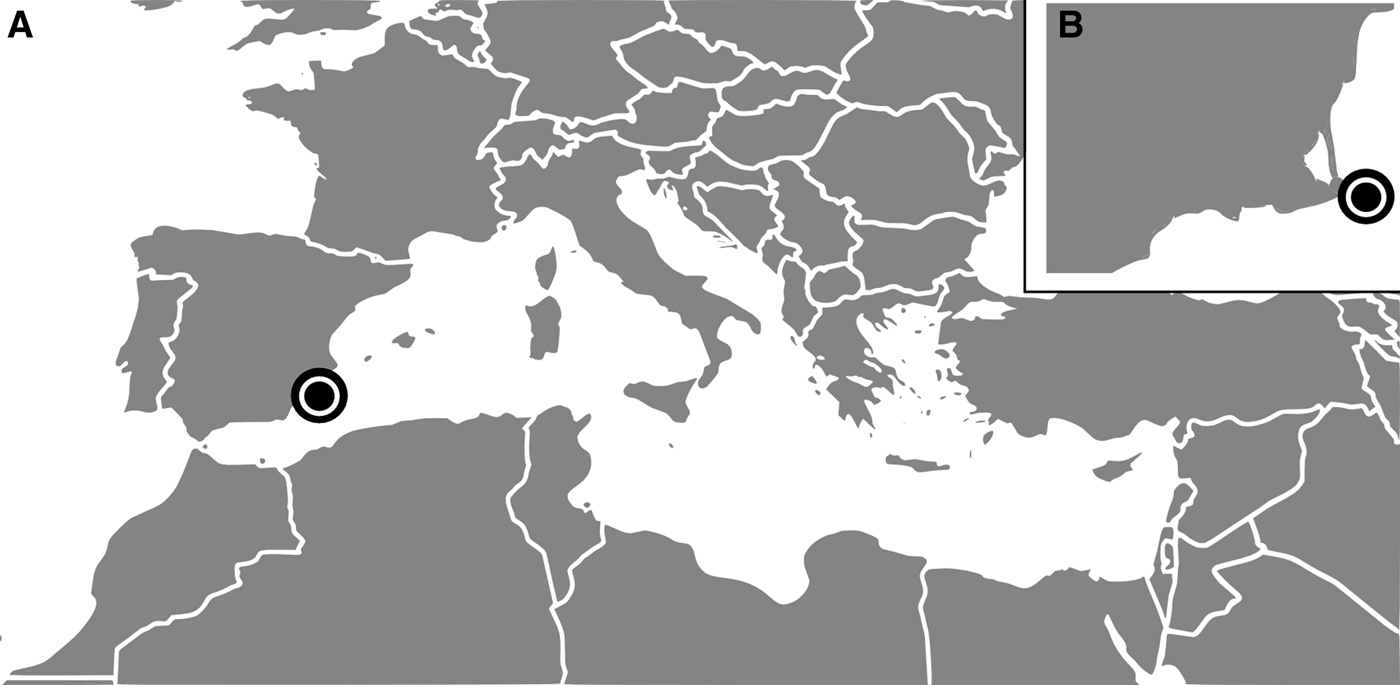
The specimen was observed during a single snorkelling and free-diving survey in a shallow, sandy and rocky cove from Cabo de Palos (Murcia, Spain, 37°38′05.8″N 0°41′31.8″W) on 5 September 2014 at 9 a.m. A video of the albino salema within its school was recorded at a depth of 2 m using a compact camera with an underwater appliance (INTOVA, Model #IC-500). The raw capture rate was 24 frames per second of 640 × 480 pixels. A single frame was extracted as a JPEG static image.
Cabo de Palos is a cape located in south-east Spain and has a well-conserved Marine Protected Area (MPA) named Cabo de Palos-Islas Hormigas. However, the specimen was detected close to the MPA, but outside it, on a low-depth shore northward of the coastal zone of the cape.
RESULTS
The albino salema was recorded in a shallow area from Cabo de Palos, south-east Spain (Figure 1). Rocky boulders covered by algae (Jania spp. and Padina pavonica) were interspersed with patches of Posidonia oceanica and detritic bottoms. Briefly, fish diversity included benthonic species from Gobiidae, Blenniidae, Scorpaenidae and Tripterygiidae families; nectobenthonic from Sparidae, Labridae, Serranidae; and pelagic from Atherinidae, Belonidae and Carangidae, among others.
Location where the albino salema was recorded, Cabo de Palos (Spain). Mediterranean map (A) and regional close-up (B).

An adult individual of salema showing an overall lack of pigmentation was detected in a school of about 50 porgies and other species, including Atherina spp., Diplodus sargus, Diplodus vulgaris and Trachinotus ovatus (Figure 2 and online Supplementary Material 1).
The albino salema. Two individuals with the typical coloration of the species (A, upper left) swim behind the albino salema (B). The image was extracted from an 11-s-long video, available as online supplementary material 1.

The typical coloration in salema is grey-bluish, having 10–11 longitudinal golden lines; however, the specimen was almost white and presented a black spot surrounding its left eye. Its right eye did not show any loss of coloration. Regarding other aberrant pigmentation, it did not show the salema's characteristic yellow ring in its eyes and, although the golden longitudinal stripes were observed, they were only slightly conspicuous.
Although the specimen was not captured and, therefore, not measured, it was similar in both size and shape to the rest of the school formation members.
DISCUSSION
Albinism is a pigmentation disorder caused by a deficiency in melanin production, thus resulting in complete or partial absence of pigmentation. Changes in tyrosinase and P genes located in autosomes are the most prevalent causes (Summer, Reference Summer2009). Depending on whether the entire body or part of it is affected, the individuals are classified into true or partial albinos (Reum et al., Reference Reum, Paulsen, Pietsch and Parker-Setter2008). True albinos are characterized by the total absence of pigmentation in skin and retina (Sandoval-Castillo et al., Reference Sandoval-Castillo, Mariano-Melendez and Villavicencio-Garayzar2006). In contrast, specimens showing partial albinism, also known as pseudo-albinos, show either a normal coloration pattern disrupted by white areas (Venizelos & Benetti, Reference Venizelos and Benetti1999) or a generalized decrease in pigment levels in skin or eyes (hypomelanosis) (Berdeen & Otis, Reference Berdeen and Otis2011). Leucism, another colour defect, is characterized by a decrease or absence of skin pigmentation while maintaining eyes untouched, as appears in birds (Forrest & Naveen, Reference Forrest and Naveen2000); however, some authors consider leucism as a synonym of partial albinism (Veena et al., Reference Veena, Thomas, Raje and Durgekar2011).
True albinism has been reported in cartilaginous fishes, such as Hydrolagus colliei (Reum et al., Reference Reum, Paulsen, Pietsch and Parker-Setter2008), Mustelus schimitti (Teixeira & de Araújo, Reference Teixeira and de Araújo2002), Galeocerdo cuvier (Sandoval-Castillo et al., Reference Sandoval-Castillo, Mariano-Melendez and Villavicencio-Garayzar2006), Rhinobatos halavi (Souissi et al., Reference Souissi, Golani, Méjri, Salem and Capapé2007), Torpedo torpedo (Ben Brahim et al., Reference Ben Brahim, Seck and Capapé1998) or Carcharodon carcharias (Smale & Heemstra, Reference Smale and Heemstra1997), Dasyatis americana (Wakida-Kusunoki, Reference Wakida-Kusunoki2015), Triakis semifasciata (Follett, Reference Follett1976), Chiloscyllium plagiosum (Clark, Reference Clark2002) and Carcharhinus obscurus (Bejarano-Álvarez & Galván-Magaña, Reference Bejarano-Álvarez and Galván-Magaña2013), among others. This phenomenon also occurs in bony fishes, as in Batrachoides surinamensis (Piorski & Nunes, Reference Piorski and Nunes2010), Schizolecis laticaudus (de Brito & Caramaschi, Reference de Brito and Caramaschi2005) and Silurus glanis (Dingerkus et al., Reference Dingerkus, Séret and Guilbert1991).
Partial-albinism reports on cartilaginous fishes include Dalatias licha (Bottaro et al., Reference Bottaro, Ferrando, Gallus, Girosi and Vacchi2008), Narcine entemedor (Sandoval-Castillo et al., Reference Sandoval-Castillo, Mariano-Melendez and Villavicencio-Garayzar2006), Scoliodon laticaudus (Veena et al., Reference Veena, Thomas, Raje and Durgekar2011), Raja clavata (Ball et al., Reference Ball, Jones, Lynghammar, Noble and Griffiths2013), Stegostoma fasciatum (Nakaya, Reference Nakaya1973), Zanobatus schoenleinii (Diatta et al., Reference Diatta, Reynaud and Capapé2013), Nebrius concolor (Taniuchi & Yanagisawa, Reference Taniuchi and Yanagisawa1987) and Carcharhinus limbatus (Sancho-Vazquez et al., Reference Sancho-Vazquez, Del Moral-Flores and Mendoza-Vargas2015), among others. For bony fishes, a shortlist of partial albinos comprise Acanthistius patachonicus (Mansur, Reference Mansur2011), Genidens spp. (Leal et al., Reference Leal, Schulz, Albornoz, Machado and Ott2013), Muraena clepsydra (Béarez, Reference Béarez2002), Bagre marinus (Wakida-Kusunoki & Amador-del-Ángel, Reference Wakida-Kusunoki and Amador-del-Ángel2013) and two species of porgies (Sparidae) – Diplodus sargus and Dentex dentex (Casu et al., Reference Casu, Lai, Curini-Galleti, Ruiu and Pais2009). Until now, no record of an albino salema has been reported.
The salema distribution includes the Eastern Atlantic and the Mediterranean (Bauchot & Hureau, Reference Bauchot, Hureau, Whitehead, Bauchot, Hureau, Nilsen and Tortonese1986); the specimen was observed close to the MPA Cabo de Palos-Islas Hormigas, in which the species is frequent (García-Charton et al., Reference García-Charton, Pérez-Ruzafa, Sánchez-Jerez, Bayle-Sempere, Reñones and Moreno2004). Given that the case showed a decreased pigmentation level but had the eyes unaffected, we propose its ascription to partial albinism.
It has been described that aberrant colour can be accompanied by morphological alterations, such as vertebral deformities (Díaz De Astarloa, Reference Díaz De Astarloa1995). We did not notice any change in morphology, size nor mobility. Skin pigmentation plays a key role in predation avoidance and mate attraction (Mills & Patterson, Reference Mills and Patterson2009). For instance, it has been proposed that lack of coloration might increase susceptibility to predators. However, the albino salema was adult in size, was part of a school and had no noticeable changes in its fitness levels. This result is in concordance with previous reports of normal-sized adult albinos, as in Narcine entemedor (Sandoval-Castillo et al., Reference Sandoval-Castillo, Mariano-Melendez and Villavicencio-Garayzar2006), Batrachoides surinamensis (Piorski & Nunes, Reference Piorski and Nunes2010) and Bagre marinus (Wakida-Kusunoki & Amador-del-Ángel, Reference Wakida-Kusunoki and Amador-del-Ángel2013).
Supplementary materials and methods
The supplementary material for this article can be found at http://www.journals.cambridge.org/MBD
ACKNOWLEDGEMENTS
This research received no specific grant from any funding agency, commercial or not-for-profit sectors. We acknowledge Josep Biayna for his helpful comments on the manuscript.